Your workforce is your
biggest execution risk.
Most leaders can't see it.
Understand your workforce. Know your execution risks. Know where to invest.
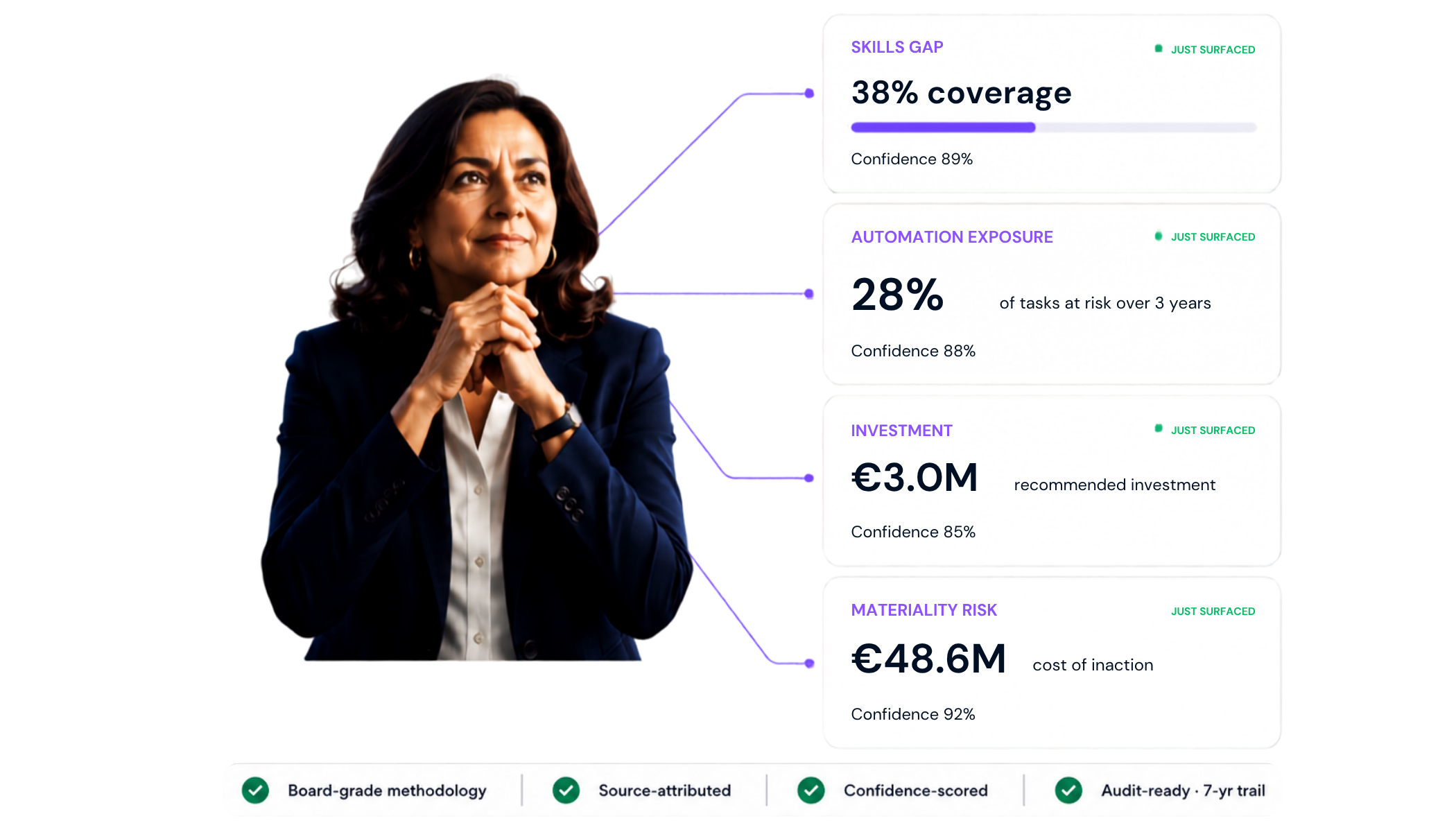
The gaps that derail strategies are rarely the ones anyone saw coming.
Organisations invest heavily in people. But capability gaps, role misalignment, and skills exposure to automation are invisible until they become execution risk. By the time they surface, the strategy has already slipped.
Workforce decisions, who to hire, redeploy, restructure, or automate, carry material financial consequences. Yet they are routinely made with fragmented HR data, static annual plans, and no clear view of financial exposure.
No clear view of whether the workforce can execute the strategy
Most organisations cannot answer in real time which capabilities they have, where the gaps are, or whether those gaps will derail current strategic priorities.
Execution risk surfaces in the P&L, not in the workforce plan
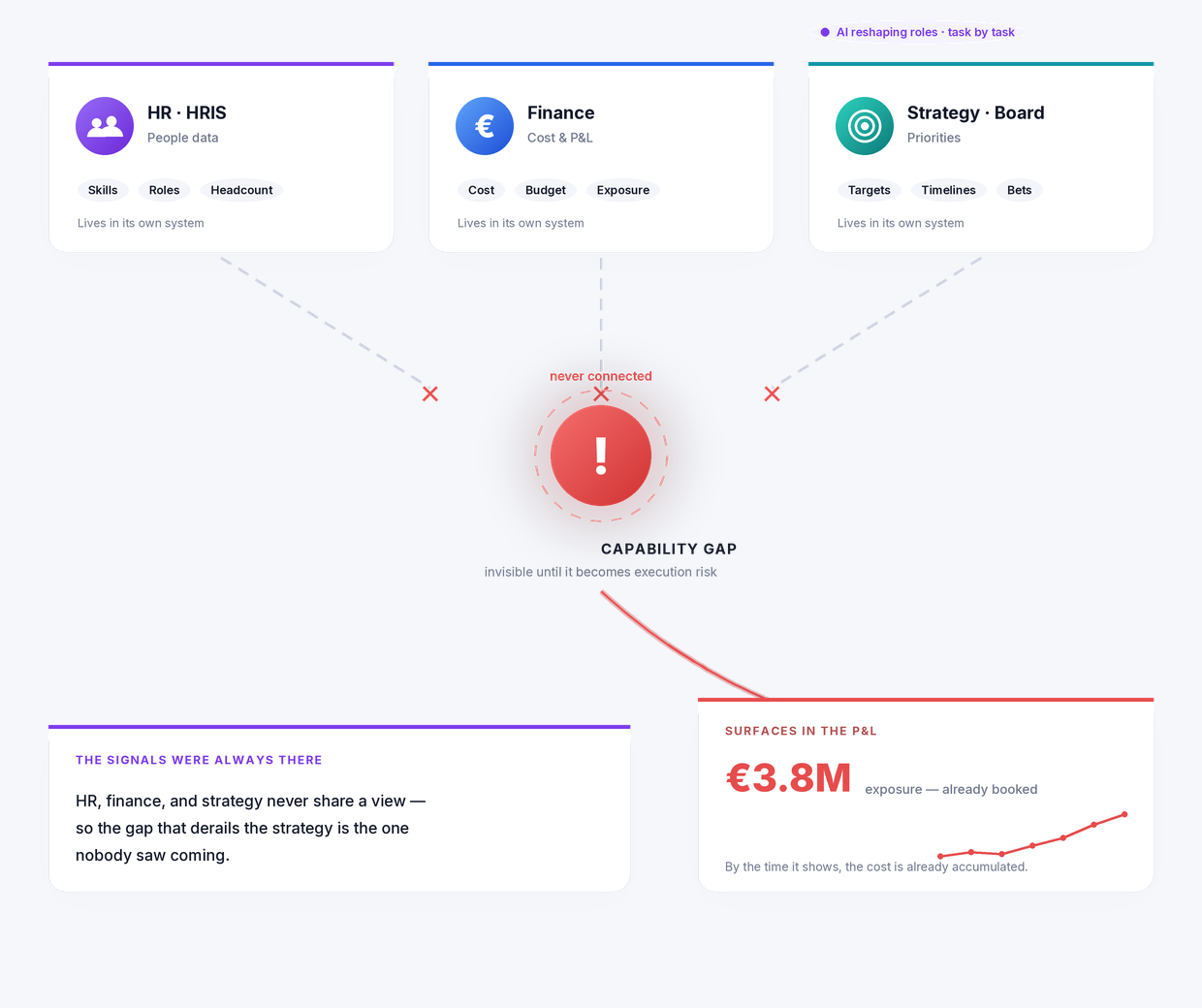
By the time a capability gap shows up in delivery data, the financial exposure has already accumulated. The signals were always there — they just were not connected to the decision layer.
HR, finance, and strategy data are never in the same room
People data sits in the HRIS. Financial risk sits in finance. Strategy sits in the boardroom. Nobody integrates all three for the decisions that require all three.
AI is reshaping roles faster than anyone is tracking
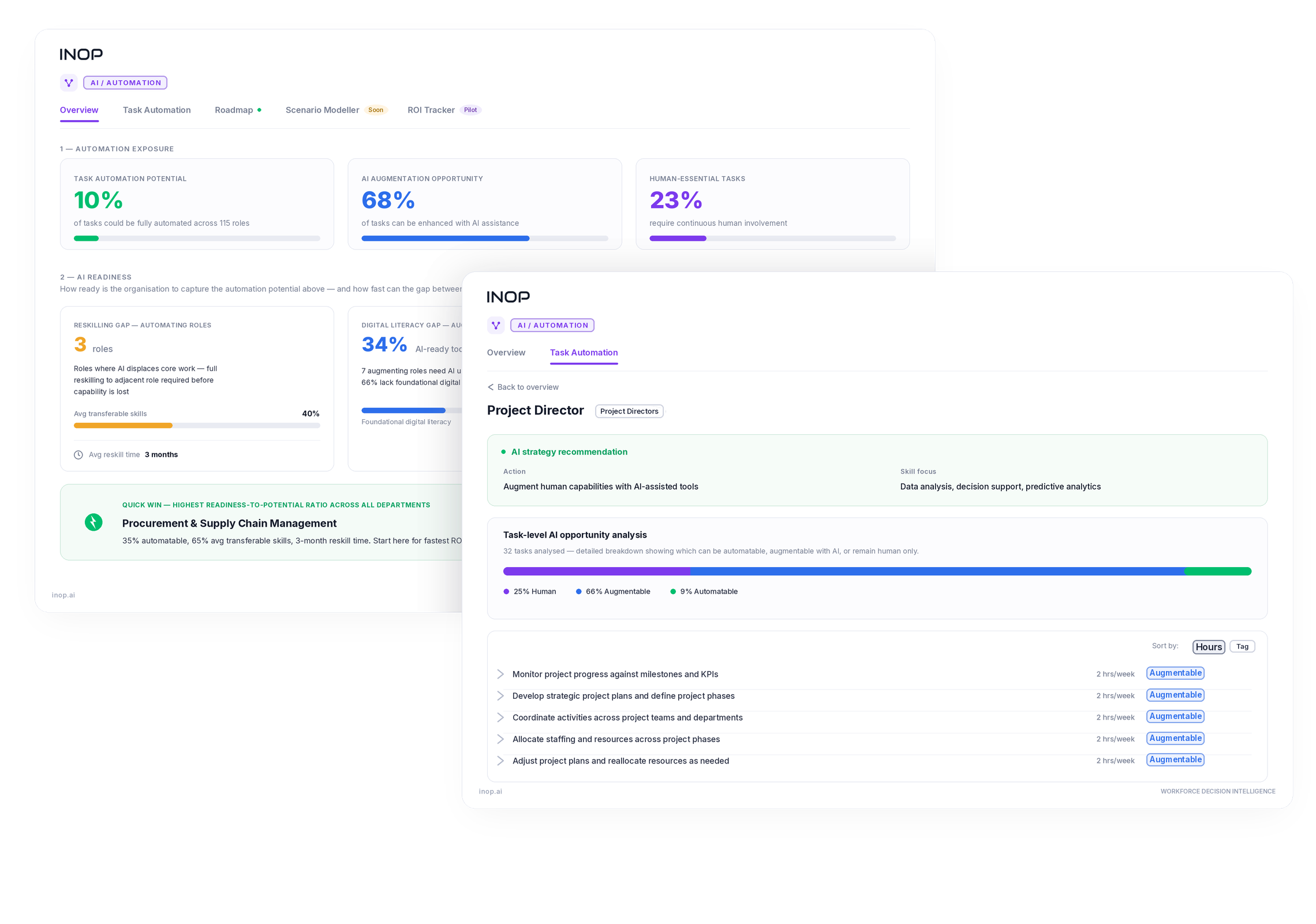
Most organisations are watching for job displacement. They are missing the much larger story: automation is quietly reshaping what roles cost, what they produce, and what skills they require — task by task, quarter by quarter.
Most companies are asking the wrong question about AI.
They are asking how many jobs AI will replace. The better question is: which tasks are being automated, at what pace, and what does that mean for your cost base, your risk exposure, and your workforce strategy?
INOP doesn't just tell you what's wrong. It tells you what to do.
For every capability gap INOP identifies, it models four response pathways with financial trade-offs across 30-day, 180-day, 1-year, and 3-year horizons. Workforce investment decisions made with the same rigour as capital allocation.
Build
Develop capability internally through learning, upskilling, or structured programmes
Buy
Hire externally when speed or scarcity makes building too slow or costly
Redeploy
Move existing talent to where it creates more value across the organisation
Automate
Replace or augment tasks with AI and automation, with a clear view of the financial case
INOP is an AI-powered workforce decision intelligence platform. It connects strategy, finance, people, market, and AI data into one decision layer, giving leaders a continuously updated view of where their organisation can execute, which capabilities and skills they have, where it will fall short, and what every gap costs.
Scored across six risk domains, from capability, leadership and mobility to automation exposure and strategic execution risk.
Most platforms give you the data. INOP gives you the data and the decision, telling you what it means for your strategy, with the financial consequence of every path attached to every recommendation.
Can we execute the strategy with the workforce we have?
A real-time view of execution readiness, linking capabilities, roles, and critical skills directly to strategic priorities, delivery timelines, and financial outcomes.
Where are the gaps, and what will they cost if we do nothing?
Capability gaps quantified in financial terms, value leakage, delay probability, and the full cost of inaction modelled across 30-day to 3-year horizons.
Should we build, buy, redeploy, or automate — and at what cost?
Every gap comes with four modelled response pathways. Each option is priced using real-time compensation benchmarks and scored for market feasibility and time-to-impact.
The leaders accountable for outcomes, not activities.
Built for mid-size to large enterprises where workforce decisions carry material strategic and financial consequences.
CHRO
Move beyond building skills frameworks and assessments. Quantify execution risk and the financial impact of capability decisions.
Strategic Workforce Planning →CEO & CFO
See where capability gaps will slow revenue, inflate workforce cost, or derail strategic initiatives, before they show up in quarterly results. Model workforce investment like any other capital decision.
Explore the platform →Board
Govern workforce execution risk with the same rigour applied to financial and operational risk. Answer the disclosure questions investors and regulators are increasingly requiring.
Workforce Disclosure research →PE Operating Partner
Pressure-test the value creation plan before close. Maintain visibility across the portfolio through every stage of the hold, execution risk, leadership gaps, cost structure, and automation potential.
INOP for PE firms →The evidence base behind the platform.
INOP's research programme establishes the evidence base for workforce intelligence as a governance and financial discipline, not an HR function. Two flagship reports, used by boards, institutional investors, and policy makers.
Browse all researchThe Workforce Disclosure Gap
Research based on 800+ shareholder proposals across the Russell 3000. Why workforce disclosure fails, what investors need, and the governance framework to close the gap.
The Automation Accountability Gap
Co-authored with Edna Elbazar. The disconnect between technical automation potential, real-world implementation, and boards' ability to govern and disclose workforce impact to investors.
Built with and for people who know this problem well.
INOP works with organisations navigating complex workforce decisions, and is backed by advisors who have sat in the room where those decisions get made.
"INOP gives HR leaders the financial language they need to have the conversations that matter at board level. This is long overdue."
"The intelligence INOP surfaced in our first engagement identified execution risks we had no visibility of from any existing report or planning process."
"For the first time we had a view of not just where capability gaps existed, but what closing them was worth. That changes the conversation entirely."
Ready to see your workforce clearly?
Most organisations know who they have. Very few know what they can actually do, where the critical gaps are, and what those gaps will cost them.