For Private Equity

Workforce execution risk made visible.

INOP helps Private Equity firms identify, quantify, and mitigate workforce risks that directly impact value creation, before and after the deal.

Book a demo
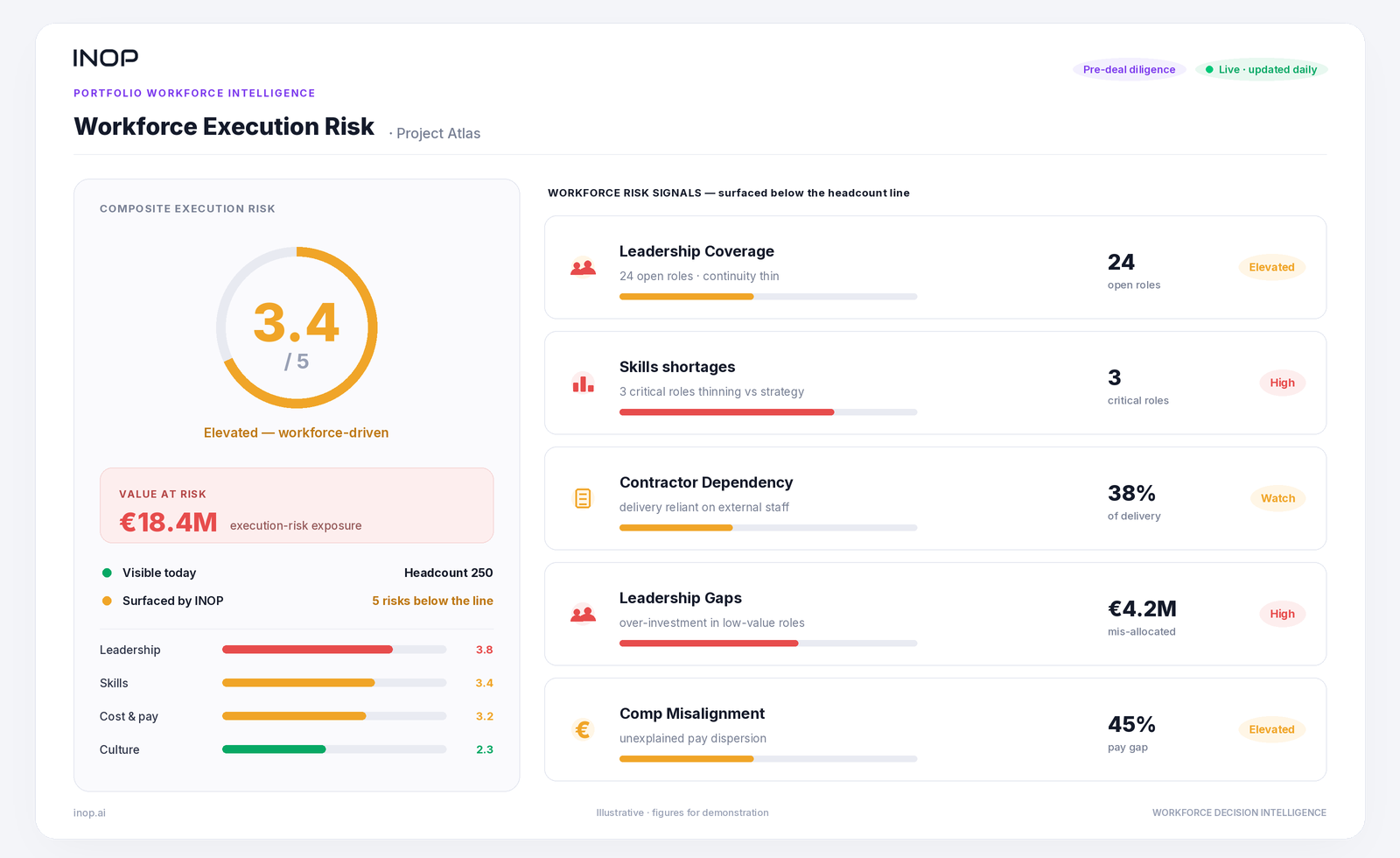
Trusted by leadership teams and investors navigating complex workforce decisions
Skyborn Renewables Hypoport SE BUX ImFusion Allchiefs Broadridge

We give deal teams and operating partners a clear, decision-grade view of whether portfolio companies have the capabilities, leadership, cost structure, and workforce readiness required to execute the investment thesis.

PE lifecycle

Where INOP fits in the PE lifecycle.

Pre-Deal

Workforce Risk & Readiness Signals

INOP supports faster, deeper insight during diligence by highlighting:

Critical role and leadership exposure
Capability gaps against the value creation plan
Workforce cost structure and compensation
AI and automation potential
Internal vs external talent feasibility
This enables deal teams to pressure-test assumptions and avoid execution surprises post-close.
Post-Close

Value Creation & Execution

INOP becomes a continuous execution intelligence layer, supporting:

Workforce readiness assessment
Restructuring and redeployment decisions
Build / Buy / Redeploy / Automate trade-offs
Leadership succession and capability development
Cost optimisation through automation and mobility
INOP ensures workforce decisions stay aligned to the value creation plan as conditions change.
The risk

Why workforce blind spots destroy value.

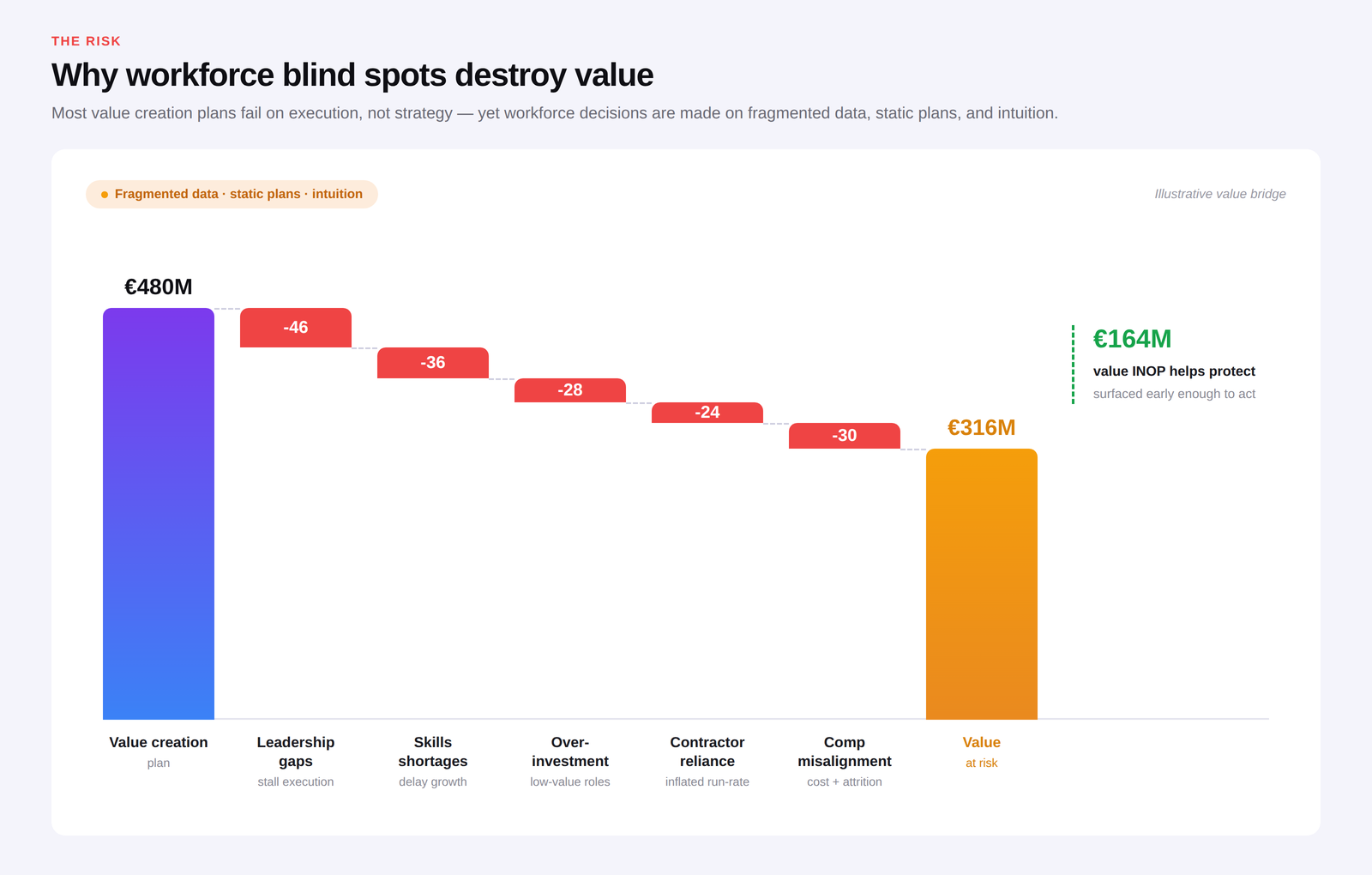
Most value creation plans fail due to execution risk, not strategy. Yet workforce decisions, hiring, restructuring, cost take-out, leadership changes, automation, are often made with fragmented data, static plans, or intuition.

This creates hidden risks:

Leadership gaps that stall execution

Skills shortages that delay growth or transformation

Over-investment in low-value roles

Excessive contractor reliance

Compensation misalignment that inflates cost or undermines retention

INOP exists to make these risks visible, early enough to act.
What INOP delivers

What INOP delivers for PE firms.

Workforce Cost Discipline

  • Compensation intelligence to benchmark roles and skills
  • Visibility into over- or under-investment in talent
  • Support for building the right team at the right cost

Governance & Accountability

  • Board-ready views of workforce execution readiness
  • Clear act now vs do nothing implications
  • Ongoing assurance that workforce plans remain aligned to strategy

Capability Driven Value Creation

  • Identify which skills and roles truly drive growth
  • Focus investment on capabilities that matter most
  • Reduce dependency on external hiring and contractors

Faster, More Confident Decisions

  • One view across skills, roles, leadership, cost, and structure
  • Scenario modelling to understand trade-offs and timing

Execution Risk Visibility

  • Early identification of workforce risks that threaten value creation
  • Clear signals on where execution will slow, stall, or fail
🔗

Full BBRA Framework

  • Build, Buy, Redeploy, or Automate decisions priced per gap
  • Sequenced across 180-day, 1-year, and 3-year horizons
  • Financial trade-offs quantified at every step
Decision infrastructure

Built for execution under pressure.

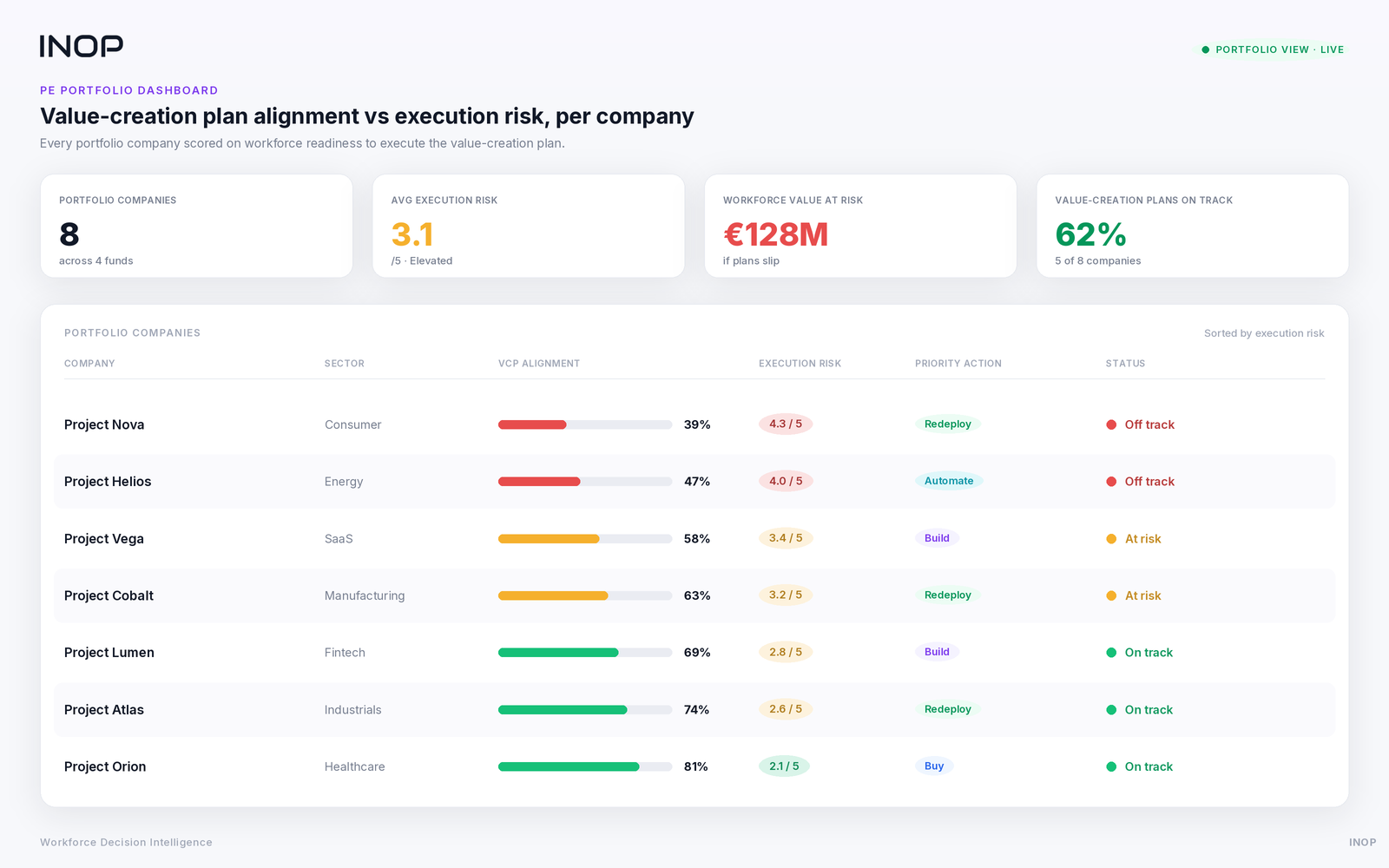
INOP is not an HR system or reporting tool. It is decision infrastructure for Private Equity, designed to help deal teams, operating partners, and boards see whether portfolio companies can actually execute the value creation plan.

Fewer execution surprises

Workforce risk visible before it lands in the board pack.

Faster realisation of the value creation plan

Capability gaps addressed before they slow the plan.

Better alignment between talent, cost, and strategy

Every workforce decision tied to the financial outcome.

More resilient portfolio companies

Workforce execution risk reduced where it matters most.

By making workforce execution risk visible across skills, leadership, cost, and structure, INOP reduces uncertainty where it matters most: at the point of action.

Get started

See what INOP reveals about your portfolio.

Workforce execution risk is the gap most PE firms discover too late. INOP gives you the view before the deal closes.

FAQ

Common questions

INOP adds value at both ends. Pre-deal, it gives deal teams a rapid, evidence-based view of workforce execution risk against the investment thesis — capability gaps, leadership exposure, cost structure, and automation potential. Post-close, it becomes the continuous intelligence layer that keeps workforce decisions aligned to the value creation plan as conditions change. Most clients find the pre-deal diligence use case generates the fastest return, as it prevents costly post-close surprises.
Initial analysis is delivered within 48 hours of complete data submission. The data collection phase typically takes 2–3 weeks, guided by INOP. For time-sensitive diligence situations we can scope a focused rapid assessment on critical roles and leadership exposure only, which compresses the timeline significantly.
INOP works with whatever data is available. Ideal inputs include organisation structure, role profiles, headcount by function and seniority, people data, financial plans, and strategic initiative maps. INOP augments client data with external market intelligence, skills signals, and AI/automation exposure data — so the analysis is never limited to what the company already knows about itself.
For pre-deal diligence using only publicly available or deal-provided data, INOP can operate within the deal team without portfolio company involvement. Where employee-level data is used, data processing transparency requirements apply and the portfolio company should be aware. INOP provides a platform overview and data processing documentation for any disclosure requirements.
Traditional HR due diligence reviews policies, headcount, and org charts. INOP goes further: it quantifies execution risk in financial terms, scores capability gaps against the value creation plan, models Build/Buy/Redeploy/Automate trade-offs, and identifies the workforce risks most likely to delay or derail the investment thesis. It is decision infrastructure, not a compliance checklist.