INOP Skills Intel

External Skills Intelligence & Demand Signals for Your Skills Taxonomy

Your skills framework maps what you have. Skills Intel tracks where external demand is moving, with AI impact modelling built in.
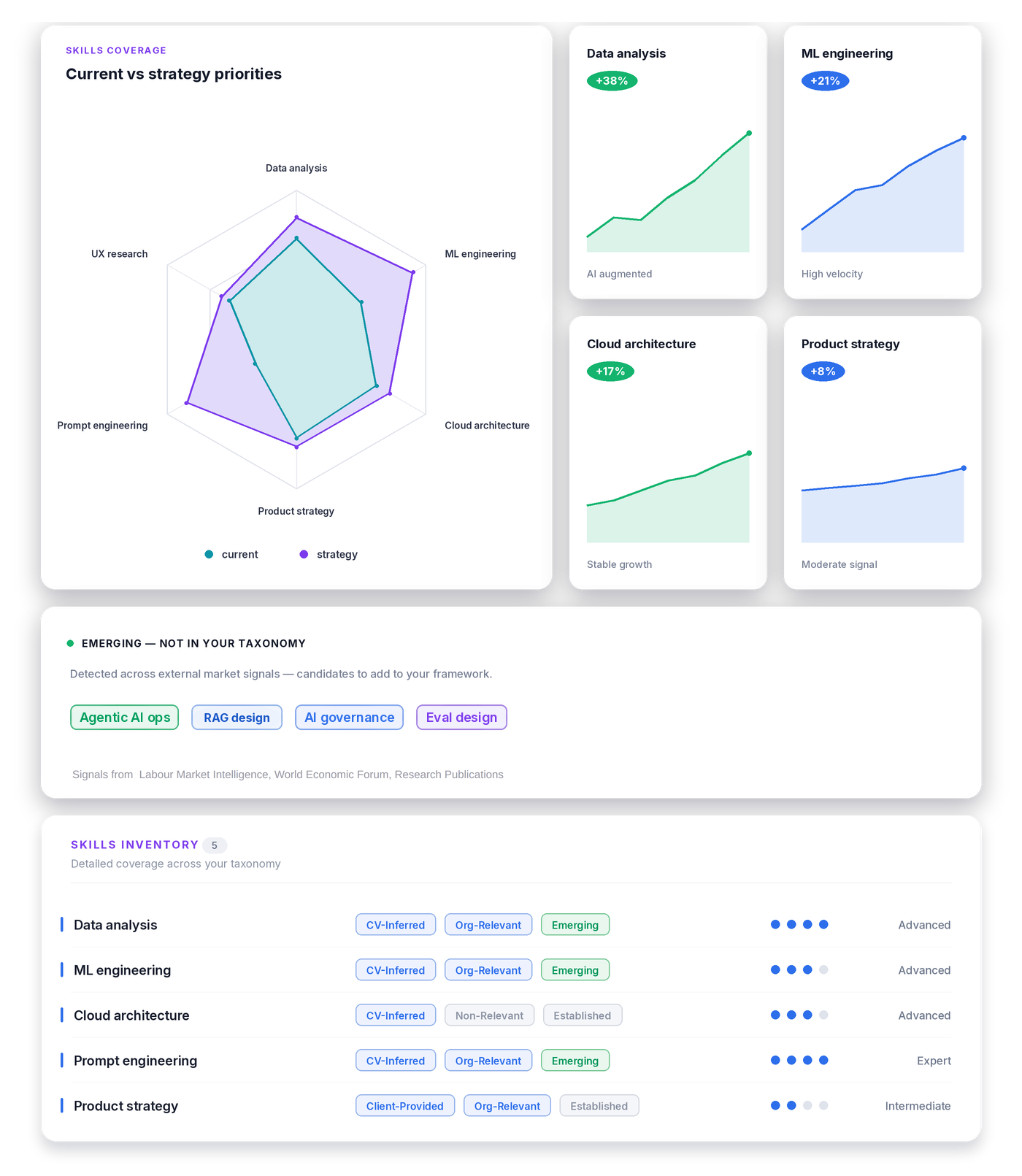
Mapped to your taxonomy API or secure feed Role, industry & sector context Monthly, daily, quarterly or annual updates
Trusted by leadership teams and investors navigating complex workforce decisions
Skyborn Renewables Hypoport SE BUX ImFusion Allchiefs Broadridge
The problem

Why an internal-only skills framework creates competitive risk.

Internal skills frameworks reflect what your organisation values today. But they lack visibility into how external skills demand is evolving. Without an external skills intelligence lens, you can't see:

Skills prioritised internally while market demand declines

Emerging capabilities entering competitor organisations before yours

Whether upskilling investments align with where your sector is moving

Which skills face AI automation or displacement

When skills taxonomies operate without external validation, capability gaps and competitive disadvantages develop unseen.

Demand signals

External skills demand signals mapped to your framework.

For each skill in your skills taxonomy or library, Skills Intel provides a clear market state based on tracked demand signals.

Emerging

New or accelerating demand

Skills showing rapid growth in your market. Act now to build or acquire.

In Demand

Sustained growth

Consistent and growing relevance. Investment here is well-grounded.

Stable

Consistent demand

Minimal directional change. Maintain but don't over-invest.

Declining

Weakening relevance

Decreasing demand. Review investment and transition pathways.

Each signal includes context
Proficiency levels (beginner to expert)
Role families and seniority levels
Industry and sector-specific views
AI/Automation impact (full replacement, partial automation)

Delivered in a consistent structure each cycle, making skills trends trackable over time.

Example

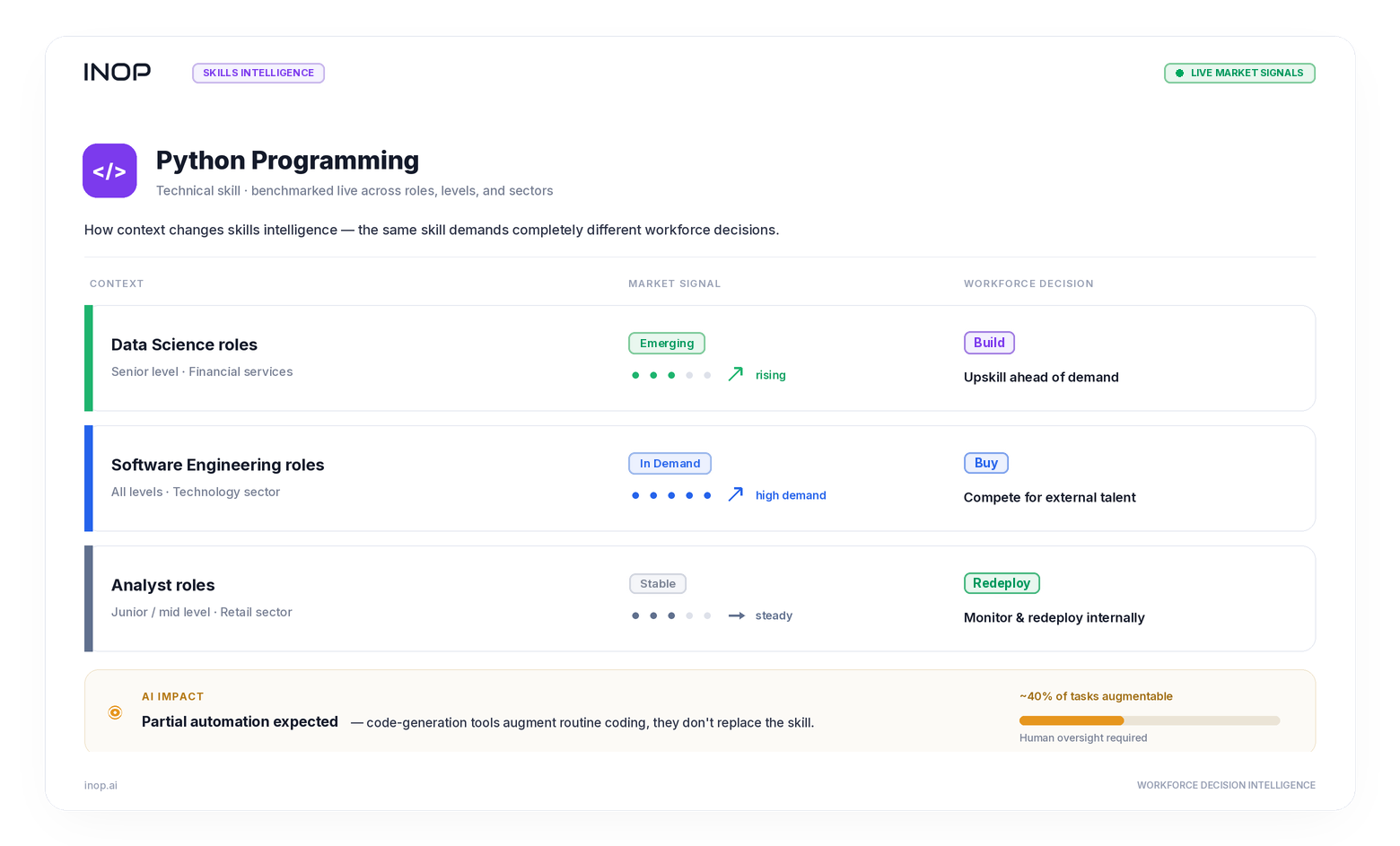
How context changes skills intelligence.

The same skill in different contexts demands completely different workforce decisions.

Skill: Python Programming

Emerging

Data science roles, senior level, financial services

In Demand

Software engineering roles, all levels, technology sector

Stable

Analyst roles, junior/mid level, retail sector

AI Impact: Partial automation expected (code generation tools)

Same skill. Different contexts. Different workforce decisions.
How Skills Intel is different

Beyond LinkedIn Talent Insights, Lightcast, and generic labour market data.

Generic tools provide industry-wide trends. Skills Intel provides intelligence specific to your organisation's skills taxonomy and market context.

LinkedIn Talent Insights, Lightcast & generic skills data

Industry-wide skills trends
One-size-fits-all demand signals
Historical skills reporting
Generic labour market insights

INOP Skills Intel

Mapped to your specific skills taxonomy or library
Contextualised by proficiency, role, sector, and location
Forward-looking AI/automation impact modelling on skills
Demand signals aligned to your actual labour markets

Actionable intelligence aligned to your framework — not broad trends you still need to interpret.

Three steps

Skills taxonomy validation in three steps.

01

Provide your skills taxonomy or library

Share your skills list, optional definitions, market scope, and preferred update cadence.

02

Align skills methodology

We map your skills to external demand signals at the proficiency, role, and sector level, and model AI/automation impact on each skill. Confirm signal definitions and thresholds together.

03

Receive recurring skills intelligence

Delivered via API feed or secure download, ready to integrate into HR analytics, workforce planning systems, skills management platforms, or advisory workflows.

Built for

Skills intelligence for enterprises, HR tech platforms, and consulting firms.

Enterprises with internal skills management systems

API feed integrates directly into HCM platforms, HR tech stacks, or proprietary workforce planning solutions to validate internal skills taxonomies against external market reality.

HR technology and skills platform providers

Embed Skills Intel as an external validation layer for client skills frameworks, differentiating your skills management platform with market intelligence and AI impact modelling.

Consulting and advisory firms

Support skills transformation projects with external intelligence that validates client skills frameworks, informs investment priorities, and models workforce change scenarios.

Where it's applied

Where organisations apply skills demand intelligence.

Skills taxonomy governance

Validate that internal skills taxonomies reflect external market evolution, not just internal perspectives.

Upskilling & reskilling investment

Direct learning budgets toward skills with sustained or growing external demand.

AI & automation workforce planning

Identify which skills face automation risk and plan redeployment or reskilling pathways.

Internal mobility & career frameworks

Ensure career pathways align with skills that maintain or grow in external relevance.

Strategic workforce planning

Test capability assumptions against external skills signals before committing resources.

Organisation & role design

Validate whether role definitions and proficiency requirements align with current skills market standards.

Flexible delivery

Flexible skills data delivery.

Delivered in a consistent structure each cycle, making skills trends trackable over time.

Skills Intelligence API Feed

Real-time or scheduled delivery via RESTful API. Standard documentation and sample payloads provided.

Secure Skills Data Download

CSV, Excel, or JSON files via secure portal. Suitable for consulting engagements or teams without API infrastructure.

Custom Skills Integration

Tailored implementation for complex environments or multi-system architectures.

Get started

Add external market visibility to your skills taxonomy.

Validate your internal skills framework against external demand signals. Understand where skills demand is moving and what AI is changing.

FAQ

Common questions

Skills Intel is INOP's external skills intelligence service. It tracks where external skills demand is moving across industries, geographies, and role types — mapped directly to your organisation's skills taxonomy or library, with AI/automation impact modelled for each skill. It is delivered as a recurring feed via API or secure download, not as a one-time report.
Generic labour market intelligence tools provide industry-wide trends. Skills Intel provides intelligence specific to your organisation's skills taxonomy and market context, contextualised by proficiency level, role family, sector, and location. The difference is actionable intelligence aligned to your framework rather than broad trends you still need to interpret.
Yes. Skills Intel is designed to work with your existing skills taxonomy or library. You provide the skills list, optional definitions, and market scope. INOP maps your skills to external demand signals and models AI/automation impact. You can also use INOP's own taxonomy, or blend both approaches.
Skills intelligence is delivered via RESTful API feed for real-time or scheduled integration, or via secure download in CSV, Excel, or JSON format. Update cadence is configurable: monthly, quarterly, or daily depending on your use case and source type.
Skills Intel feeds directly into INOP's Strategic Workforce Planning platform — validating internal capability assessments against external market reality, enriching role classification with market demand signals, and informing BBRA decisions with forward-looking skills intelligence. It can also be used as a standalone service without the full INOP platform.