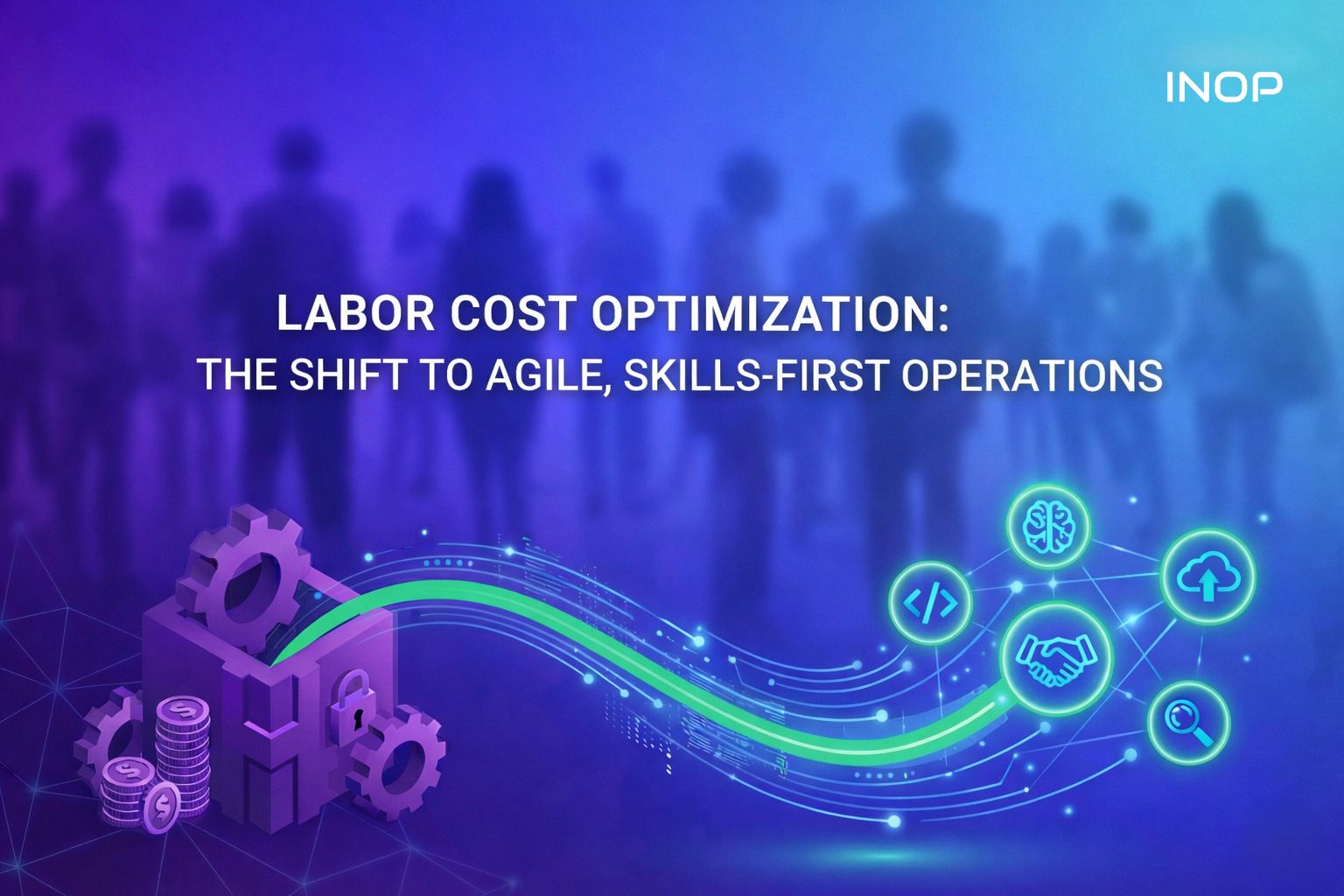
When budgets tighten and revenue targets slip, what’s the first lever most companies reach for? Labor cost optimization, often disguised as “headcount reduction” or “organizational restructuring.” In a volatile economy, this reaction feels instinctive, even inevitable. But here’s the uncomfortable truth: layoffs are a blunt instrument that cuts muscle along with fat, leaving organizations weaker, not leaner.
The real flaw isn’t in the intent to optimize labor costs, it’s in the method. Traditional cost-cutting approaches treat employees as interchangeable line items on a spreadsheet, ignoring the skills, adaptability, and untapped capacity hiding in plain sight across your organization. The result? Companies slash headcount in one department while simultaneously paying premium rates to hire contractors in another, all because they lack visibility into what their people can actually do.
Labor cost optimization in today’s environment isn’t about cutting costs at all costs, it’s about optimizing utilization. It’s about shifting from a static, role-based operating model to an agile, skills-first approach that unlocks hidden capacity within your existing workforce. By doing so, you reduce the need for expensive external hires, minimize the trauma of layoffs, and build a more resilient organization capable of adapting to whatever the market throws your way.
This article explores how forward-thinking companies are rewriting the playbook on workforce efficiency. We’ll examine the hidden costs of static operations, break down three core strategies for true labor cost optimization, and show you how a data-driven, skills-first approach can save millions while actually improving employee engagement and productivity.
The Hidden Costs of Static Operations
Before we discuss solutions, let’s examine the problem most finance teams never quantify: the enormous waste embedded in traditional, siloed workforce structures.
The Silo Tax
Picture this: Your marketing department is actively recruiting for a project manager with experience in digital transformation. The role has been open for six weeks, and you’re burning through recruiter fees. Meanwhile, three floors down, your operations team just laid off a project manager with nearly identical skills due to a department-wide budget freeze.
This isn’t a hypothetical scenario, it happens every day in organizations of all sizes. When workforce planning happens in departmental silos, leadership operates with a fragmented view of talent supply and demand. The “silo tax” is what you pay when your left hand doesn’t know what your right hand is doing: duplicated recruiting costs, severance packages, lost institutional knowledge, and the productivity drain of having critical roles unfilled while qualified people sit on the bench elsewhere.
A 2023 study by Deloitte found that large enterprises waste an average of $2.4 million annually on this exact problem, hiring externally for skills that already exist within the organization but are hidden behind rigid departmental boundaries and outdated job descriptions.
The Contractor Premium
Let’s talk about the 30-50% premium you’re paying for external consultants and contractors. This isn’t just about hourly rates, it’s the total cost of engagement. When you hire a contractor, you’re paying for:
- Higher base compensation (often 30-40% above equivalent full-time salaries)
- Onboarding and knowledge transfer time
- Vendor management overhead
- The risk of quality inconsistency and cultural misalignment
Now consider this: According to research from Harvard Business Review, approximately 40% of external contractor work could be performed by existing employees if organizations had proper visibility into their workforce’s full skill sets. That hypothetical “Jane in Accounting” who happens to have advanced data analysis skills from her previous career? She’s perfectly capable of handling that market research project you just contracted out for $75,000. The problem isn’t a lack of talent, it’s a lack of visibility.
The Underutilization Crisis
Perhaps the most invisible cost is simple underutilization. When employees are locked into rigid job descriptions and evaluated solely on their primary role responsibilities, their additional skills and capacity go to waste. Research from MIT Sloan School of Management suggests that knowledge workers in traditional role-based organizations operate at approximately 75-80% capacity on average, with roughly 20% “slack” that could be redirected to high-value projects.
Think about what that means at scale: In a company with 1,000 employees averaging $80,000 in annual compensation, 20% underutilization represents $16 million worth of human capital sitting idle. That’s not a rounding error, it’s a strategic liability.
Strategy One: Fluid Resource Allocation and the Internal Gig Economy
The first pillar of skills-first labor cost optimization is treating your internal workforce like a dynamic talent marketplace rather than a static organizational chart.
The Marketplace Mindset
In a traditional model, when a department needs specialized expertise for a three-month project, the default response is straightforward: requisition a new full-time employee or engage a contractor. Both options are expensive and often unnecessary.
The fluid resource allocation model flips this equation. Instead of hiring a new FTE for that short-term project, you “borrow” capacity from existing employees across the organization, perhaps 25% of four people’s time for the project duration. These employees bring the required skills, they’re already embedded in your culture, and they return to their primary roles when the project concludes.
The Cost Mathematics
Let’s run the numbers on a typical scenario:
Traditional Approach:
- Hire one FTE at $90,000 annual salary for a 6-month project
- Recruiting costs: $27,000 (30% of salary is industry standard)
- Onboarding and ramp time: 2-3 weeks at reduced productivity
- Risk of role mismatch requiring replacement
- Total cost: $117,000+ (and you’re stuck with a position you may not need long-term)
Fluid Allocation Approach:
- Identify 3 internal employees with relevant skills at 33% capacity allocation each
- Internal mobility incentive: $2,000 bonus per participant ($6,000 total)
- One week of cross-training and project orientation
- Total incremental cost: $6,000 (the base salaries are already sunk costs)
The savings are dramatic: $111,000 on a single project. But the benefits extend beyond immediate cost reduction. Employees gain exposure to new challenges and build skills, internal knowledge sharing strengthens organizational resilience, and you avoid the risk and trauma of hiring for short-term needs and then laying off when the project ends.
Implementation Requirements
Creating an effective internal gig economy requires infrastructure that traditional HR systems weren’t designed to support. You need real-time visibility into employee skills, availability, and interests. You need streamlined processes for managers to “release” talent for internal opportunities without creating territorial friction. And you need cultural buy-in that celebrates mobility and collaboration rather than punishing it.
This requires the flexible structure and skills visibility that progressive organizations are building through comprehensive skills inventories and dynamic workforce planning systems.
Strategy Two: Precision Reskilling vs. The Buy Approach
The second strategic pillar addresses one of the most expensive and avoidable costs in workforce management: the reflexive habit of buying talent externally instead of building it internally.
The True Cost of External Hiring
The Society for Human Resource Management estimates that the total cost to replace a mid-level employee averages 150-200% of annual salary when you account for:
- Direct recruiting costs (agency fees, job board postings, applicant tracking systems)
- Interview time and productivity loss across multiple rounds
- Onboarding and training
- Ramp time to full productivity (often 6-8 months for knowledge workers)
- Cultural integration and team disruption
For a role with an $80,000 salary, you’re looking at $120,000 to $160,000 in total replacement costs. For a senior position at $150,000? That figure can exceed $300,000.
The Reskilling Alternative
Now contrast that with the cost of reskilling an existing employee who’s an “80% match” for an open role:
- Targeted training program: $3,000-$8,000 depending on skill complexity
- Mentorship and shadowing: absorbed in existing compensation
- Ramp time: significantly shorter due to existing organizational knowledge
- Total cost: $5,000-$10,000 on average
The financial case is overwhelming. But the operational benefits are equally compelling: faster time-to-productivity, higher retention (employees who receive development opportunities are 34% more likely to stay), and the creation of learning pathways that make your entire organization more adaptable.
The 80% Match Principle
The key to effective reskilling isn’t trying to transform every employee into everything. It’s identifying the right candidates for the right transitions using your skills taxonomy as a guide.
If you have an open role requiring skills A, B, C, D, and E, you don’t need to find someone who possesses all five. You need to identify internal candidates who already have skills A, B, C, and D, and then invest strategically in closing the gap on skill E. This is what we call the “80% match principle,” and it’s the foundation of precision reskilling.
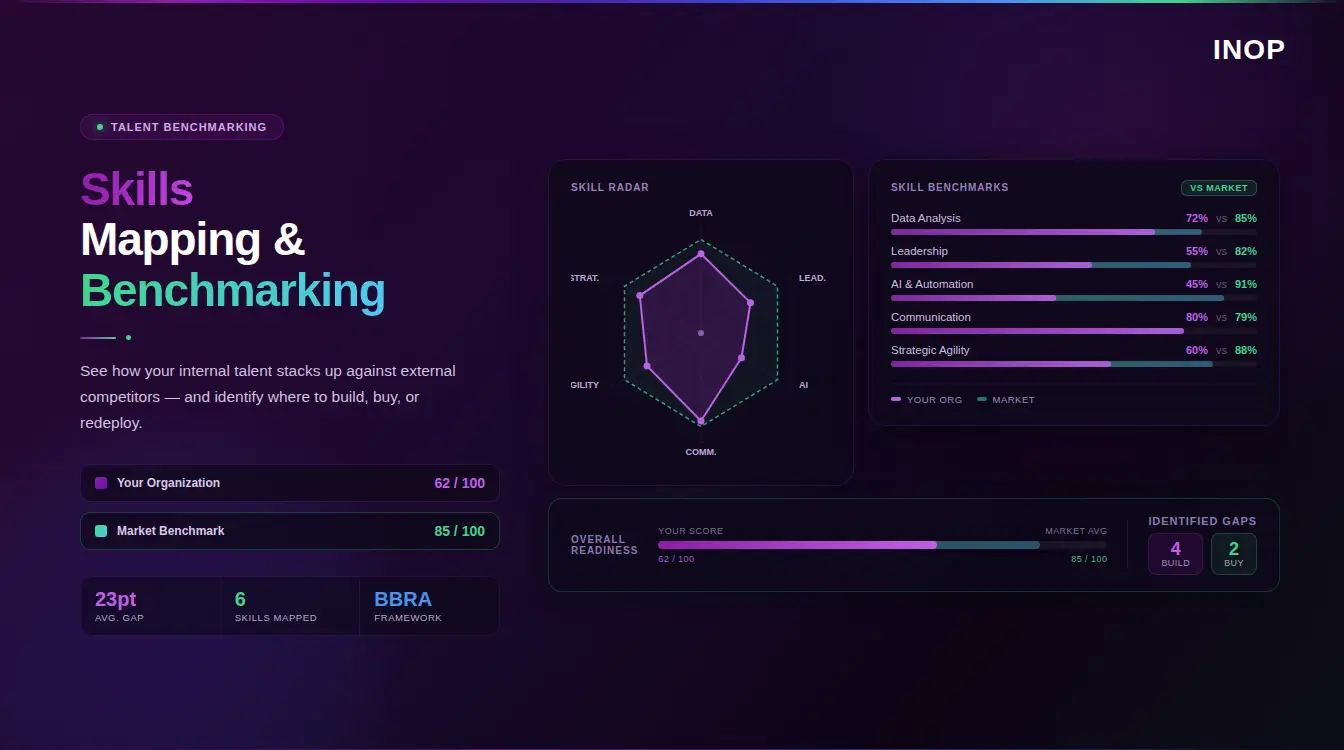
Modern skills intelligence platforms can automate this matching process, scanning your workforce to identify employees whose existing skill profiles align closely with open positions or anticipated future needs. The system flags candidates, estimates the skill gap, and even recommends specific training interventions to close it.
For a detailed breakdown of the financial modeling and ROI calculations that support reskilling decisions, organizations should develop comprehensive frameworks that compare the total lifecycle costs of build vs. buy decisions across different skill categories and organizational levels.
Strategy Three: Optimizing the Contingent Workforce
The third strategic lever involves fundamentally rethinking how and when you deploy contingent workers, contractors, consultants, and temporary staff.
The Overgeneralization Problem
Most organizations use contingent workers inefficiently. They hire contractors to fill “roles” when they should be hiring them for specific “tasks” or “skills.” The difference is significant.
When you hire a contractor to fill a generalist project manager role, you’re paying premium rates for the full scope of that person’s time, including routine administrative work, status meetings, documentation, and coordination activities that don’t actually require specialized expertise. Meanwhile, your full-time employees are underutilized, with capacity that could easily absorb these lower-value activities.
The Task Decomposition Approach
The optimization strategy is elegant: decompose the work. Separate the high-value specialized tasks that justify premium contractor rates from the routine activities that can be handled by existing staff.
Example Scenario:
You need to implement a new enterprise software system, a project traditionally filled by a full-time contractor at $150/hour for 6 months (roughly $180,000).
Task Decomposition:
- System architecture and integration design: 200 hours of specialized expertise (pay the contractor premium)
- Project management and coordination: 400 hours of generalist work (assign to internal project manager with capacity)
- User training and documentation: 300 hours (assign to internal staff who understand organizational culture)
- Ongoing troubleshooting and optimization: 100 hours of specialized expertise (contractor)
Cost Comparison:
- Traditional approach: $180,000 (1,200 hours × $150)
- Decomposed approach: $45,000 (300 contractor hours × $150) + internal capacity reallocation
- Savings: $135,000
This approach requires more sophisticated workforce planning, but the financial and operational benefits are substantial. You stop paying premium rates for commodity work, you develop internal capabilities rather than remaining dependent on external expertise, and you maintain better project continuity and institutional knowledge.
The Strategic vs. Tactical Distinction
A useful framework is distinguishing between strategic and tactical contractor usage:
Strategic contractor use (justified premium rates):
- Specialized technical expertise you’ll need infrequently
- Emerging skills where the market is still developing
- Short-term surge capacity for unprecedented demand spikes
- Knowledge transfer and capability building
Tactical contractor use (often wasteful):
- Long-term backfill for unfilled positions
- Generalist work that existing staff could handle
- Skills that represent core organizational competencies
- Roles that require deep institutional knowledge
By being more disciplined about this distinction, organizations can typically reduce contingent workforce spending by 20-40% without sacrificing project outcomes.
The Technology Stack: Data-Driven Decision Making
None of these strategies work without data. You cannot optimize what you cannot measure, and measuring workforce capacity and skills at scale requires purpose-built technology infrastructure.
The Three Data Pillars
Skills Inventory: Real-Time Supply Visibility
At the foundation is a comprehensive, dynamic skills inventory, a living database that captures not just job titles and departments, but the actual capabilities of every employee. This includes technical skills, soft skills, certifications, project experience, language capabilities, industry knowledge, and learning interests.
Unlike static HR records updated annually during performance reviews, modern skills inventories are continuously refreshed through multiple data sources: self-assessments, manager validations, project completion records, learning management systems, and increasingly, AI-powered inference from work artifacts like code commits, documents authored, and collaboration patterns.
The result is a searchable, quantified view of your talent supply at any moment.
Demand Planning: Real-Time Needs Forecasting
The second pillar is demand planning, a forward-looking view of the skills and capacity you’ll need to deliver on business objectives. This integrates data from multiple sources:
- Strategic initiatives and project pipelines
- Revenue forecasts and growth plans
- Anticipated retirements and turnover
- Technology roadmaps and digital transformation initiatives
- Market trends and competitive analysis
Advanced organizations are moving beyond annual workforce planning cycles to continuous demand forecasting that updates monthly or even weekly as business conditions evolve.
AI-Driven Matching: Optimizing the Supply-Demand Equation
The third pillar connects supply and demand through intelligent matching algorithms. When a new project is initiated or a role opens, the system automatically:
- Identifies internal candidates with relevant skill profiles
- Ranks matches by skill alignment and availability
- Flags skill gaps that could be closed through targeted training
- Recommends optimal team compositions that balance expertise and development opportunities
- Calculates the capacity impact and alerts to potential conflicts
This isn’t science fiction, it’s the current state of the art in workforce intelligence platforms. Organizations using these systems report 30-50% reductions in time-to-fill for open roles, 25-35% decreases in external hiring costs, and dramatic improvements in employee engagement as people gain access to opportunities aligned with their skills and interests.
Building the Foundation
Creating this data infrastructure is the prerequisite for everything else we’ve discussed. Without real-time visibility into skills supply and demand, fluid resource allocation remains manual and inefficient, reskilling decisions are based on gut instinct rather than data, and contingent workforce optimization is impossible.
This data foundation is built on the framework of creating a dynamic skills taxonomy, a structured, comprehensive language for describing work and capabilities that enables all downstream workforce intelligence.
Case Study: The Tale of Two Approaches
Let’s bring these concepts to life with a scenario that many organizations are facing right now.
The Scenario
TechCorp, a 2,000-employee software company, faces a mandate from the board: reduce operating costs by 10% ($20 million from a $200 million annual budget) over the next fiscal year in response to market uncertainty and declining margins. Labor costs represent 70% of the budget ($140 million), making workforce decisions central to achieving the target.
The Traditional Approach
Path A: Headcount Reduction
Leadership takes the straightforward route: a 10% across-the-board reduction in force (RIF), eliminating 200 positions.
Immediate outcomes:
- Annual savings: $20 million (achieved on paper)
- Severance costs: $4 million
- Institutional knowledge loss: immeasurable
- Remaining employee morale: collapsed
- Productivity impact: 15-20% decline in the first quarter post-RIF due to survivor stress, knowledge gaps, and increased workload
Six-month aftermath:
- Customer service quality deteriorates due to understaffing
- Key projects delayed or canceled due to skill gaps
- Remaining employees burn out, leading to voluntary turnover of another 8% (80 people), predominantly high performers with options
- Company forced to hire contractors at premium rates to fill critical gaps: $6 million in contingent workforce spend
- Net first-year savings: $10 million (50% of target after accounting for severance, productivity loss, and backfill costs)
Long-term damage:
- Employer brand damaged, making future recruiting more difficult and expensive
- Innovation pipeline disrupted
- Organizational trauma that takes years to heal
The Agile Approach
Path B: Skills-First Optimization
Leadership takes a different route, implementing the strategies outlined in this article.
Immediate actions:
- Freeze all external hiring for 90 days
- Conduct comprehensive skills audit of the entire workforce
- Implement workforce intelligence platform: $500,000 investment
- Launch internal mobility program and train managers on fluid resource allocation
First quarter:
- Identify 320 employees (16% of workforce) with 20%+ underutilized capacity
- Redeploy this capacity from maintenance activities to revenue-generating projects
- Cancel $8 million in planned contractor engagements, replacing with internal resources
- Launch precision reskilling program for 50 employees to close skill gaps in high-priority areas: $400,000 investment
Six-month outcomes:
- External hiring reduced by 85%: $12 million in savings
- Contractor spending reduced by 60%: $8 million in savings
- Productivity gains from better resource allocation: equivalent to 40 additional FTEs
- Zero layoffs
- Employee engagement scores increase by 12 points due to new development opportunities
- Net first-year savings: $19.6 million (98% of target)
Long-term gains:
- More agile, resilient organization capable of quickly responding to market changes
- Workforce that sees the company investing in people rather than disposing of them
- Skills infrastructure that supports continuous optimization
- Employer brand strengthened, reducing future recruiting costs
The Comparison
Side by side, the choice seems obvious. Yet most organizations still default to Path A because it appears simpler and delivers immediate cost reduction on paper. The reality is that the “simple” path is actually far more expensive and destructive when you account for total costs over time.
Path B requires more sophisticated planning and execution. It demands investment in technology and processes. It asks leaders to think beyond the blunt instrument of headcount and engage with the complexity of skills, capacity, and organizational capability. But for organizations willing to make this shift, the financial and human returns are overwhelming.
Implementing the Shift: Where to Start
For organizations ready to move from theoretical understanding to practical implementation, the journey typically follows this sequence:
Phase One: Visibility (Months 1-3)
The first priority is gaining clear visibility into your current state. You cannot optimize without understanding what you have.
Key activities:
- Conduct skills inventory across the organization (start with a pilot department if company-wide feels overwhelming)
- Map current workforce allocation to projects and activities
- Identify all external workforce spending (contractors, consultants, temporary staff)
- Establish baseline metrics for capacity utilization, time-to-fill, and external hiring costs
Phase Two: Quick Wins (Months 3-6)
Once you have visibility, identify opportunities for immediate impact that build momentum and demonstrate value.
Target areas:
- Cancel or internalize upcoming contractor engagements where you have internal skill matches
- Redeploy underutilized employees to short-term projects instead of hiring
- Launch pilot internal mobility program in one division
- Implement reskilling for 3-5 employees as proof of concept
Phase Three: Scaling (Months 6-12)
With proof points established, expand successful initiatives across the organization and build the infrastructure for sustained optimization.
Focus areas:
- Roll out workforce intelligence platform company-wide
- Establish formal internal talent marketplace
- Develop reskilling pathways for high-demand skills
- Train managers and leaders on skills-first decision making
- Integrate skills data into workforce planning and budgeting processes
Phase Four: Continuous Improvement (Ongoing)
Skills-first operations isn’t a project with an endpoint, it’s an ongoing operating model that continuously evolves.
Sustained practices:
- Quarterly skills demand forecasting linked to business strategy
- Monthly workforce utilization reviews
- Continuous learning opportunities aligned to strategic skill needs
- Regular optimization of internal vs. external workforce mix
- Measurement and refinement of all optimization initiatives
Overcoming Common Obstacles
The shift to skills-first operations faces predictable resistance. Being prepared for these obstacles improves your odds of success.
Obstacle One: Managerial Territorialism
Managers often resist “lending out” their team members, even when those people have excess capacity. They view their headcount as a resource to protect.
Solution: Change the incentive structure. Evaluate managers not on the size of their teams but on their ability to develop talent and contribute to organizational objectives. Create shared service models where departments receive credit for providing talent to strategic initiatives.
Obstacle Two: Employee Resistance to Visibility
Some employees are uncomfortable with the idea of making their full skill sets visible, either due to privacy concerns or fear that they’ll be assigned work outside their comfort zone.
Solution: Frame skills transparency as empowerment, not surveillance. Show employees how visibility creates access to opportunities, development, and career mobility. Make skill sharing voluntary initially and demonstrate value before making it mandatory.
Obstacle Three: Technology Overwhelm
The marketplace for workforce intelligence tools is crowded and confusing. Organizations often get stuck in lengthy vendor evaluation cycles.
Solution: Start simple. You don’t need a perfect system on day one. Begin with spreadsheets and surveys if necessary. Prove the concept with manual processes before investing in sophisticated platforms. Technology should enable your strategy, not define it.
Obstacle Four: Lack of Executive Commitment
Skills-first transformation requires sustained executive sponsorship. When leadership focus wavers, initiatives lose momentum.
Solution: Connect workforce optimization directly to business outcomes that executives care about: cost reduction, revenue growth, time-to-market, competitive advantage. Use pilot results to build the business case for continued investment.
Measuring Success: The Right Metrics
What you measure determines what you optimize. Skills-first labor cost optimization requires new metrics beyond traditional HR dashboards.
Financial Metrics:
- Total cost per capability (including salary, benefits, training, and overhead)
- Internal fill rate (percentage of open roles filled from within)
- Reskilling ROI (cost of reskilling vs. cost of external hiring)
- Contractor spend ratio (contractor costs as percentage of total labor costs)
- Cost per hire (should decrease as internal mobility increases)
Operational Metrics:
- Average capacity utilization rate
- Time-to-fill for critical roles
- Skill gap closure rate
- Internal mobility rate (percentage of employees who change roles internally per year)
- Project staffing cycle time (time from project approval to fully staffed)
Strategic Metrics:
- Workforce agility index (speed of redeploying talent to new priorities)
- Skills currency (percentage of workforce with up-to-date skills in strategic areas)
- Talent density (revenue or value creation per employee)
- Future-readiness score (alignment between current skills and future needs)
These metrics collectively define what genuine workforce optimization looks like in practice: not the elimination of labor cost through headcount reduction, but the continuous alignment of people, processes, and technology to maximize the value produced per dollar of total workforce investment. The distinction between measuring inputs and measuring outcomes is what separates a skills-first operating model from a cost-cutting programme with better language.
Organizations serious about optimization track these metrics monthly, discuss them in executive leadership meetings, and use them to guide continuous improvement.
The Broader Implications: Building Antifragile Organizations
Labor cost optimization through skills-first operations delivers immediate financial benefits. But the longer-term strategic value may be even more significant.
In a world of constant disruption, technological change, market volatility, geopolitical uncertainty, the organizations that thrive won’t be the most efficient in static conditions. They’ll be the most adaptable when conditions change.
A skills-first operating model creates what Nassim Taleb calls “antifragility”, the ability not just to withstand shocks but to actually benefit from them. When market conditions shift, when new technologies emerge, when strategic priorities pivot, organizations with clear visibility into workforce capabilities and proven mechanisms for rapid redeployment can respond in weeks rather than quarters.
This agility becomes a compounding advantage. You learn faster, you adapt faster, you capitalize on opportunities faster. Meanwhile, competitors stuck in rigid role-based structures are still waiting for hiring approvals.
The cost optimization is real and substantial. But the strategic resilience may ultimately be worth even more.
Conclusion
Labor cost optimization has long been synonymous with the painful arithmetic of reduction: cutting headcount, slashing budgets, and doing more with less. But this equation has always been incomplete. It focuses exclusively on the denominator, the input costs, while ignoring the numerator: the actual value and utilization of your workforce.
The shift to agile, skills-first operations rewrites this equation entirely. By building visibility into workforce capabilities, implementing fluid resource allocation, investing strategically in reskilling, and optimizing the external workforce, organizations can achieve substantial cost reduction without the collateral damage of traditional approaches. More importantly, they build organizational resilience and agility that compounds over time.
The financial case is compelling: typical implementations deliver 15-30% reductions in labor costs through decreased external hiring, lower contractor spend, and improved capacity utilization, all while maintaining or even increasing employee engagement and organizational capability. But the strategic case is even more powerful: in an era of constant disruption, the ability to rapidly redeploy talent to emerging opportunities and threats is a competitive advantage worth far more than short-term cost savings.
This isn’t a theoretical framework waiting to be proven. Leading organizations across industries, from technology companies to healthcare systems to financial services firms, are already operating this way, and they’re pulling ahead of competitors still locked into rigid, role-based structures.
The question for your organization isn’t whether to make this shift, but when and how quickly. Every month you continue operating with static workforce models is another month of wasted capacity, unnecessary external spending, and missed opportunities to build capabilities that will define success in the years ahead.
Stop wasting money on invisible talent gaps. The capacity you need to achieve your strategic objectives likely already exists within your organization, you just can’t see it yet. Consider conducting a comprehensive workforce utilization audit to quantify how much capability you’re leaving on the table. The insights might surprise you, and they’ll almost certainly change how you think about labor costs forever.
The future belongs to organizations that view their workforce not as a fixed cost to be minimized, but as a dynamic capability to be optimized. The tools, frameworks, and proven approaches exist today. The only remaining question is whether you’ll lead this transformation or be disrupted by competitors who already have.