HR Has Been Looking in the Rearview Mirror Long Enough
Here’s a scenario that should sound painfully familiar: your CHRO walks into a quarterly business review and presents a slide showing that voluntary turnover increased by 18% last year, concentrated in the sales department, mostly among employees with two to four years of tenure. The room nods. Someone asks what you’re going to do about it. And everyone quietly acknowledges that those employees, and the institutional knowledge they carried, are already gone.
That is the fundamental problem with how most HR departments operate today. They are experts at explaining what already happened. Predictive People Analytics exists to change that equation entirely.
In 2026, the C-suite no longer wants a post-mortem. They want a forecast. Finance doesn’t report last quarter’s cash flow and call it a strategy, they model future scenarios and recommend action. HR must operate the same way. This article will walk you through the full journey: understanding where your organization sits on the HR analytics maturity model, defining what predictive people analytics actually is (and what it isn’t), exploring its highest-value use cases, and providing a practical 90-day roadmap to get started. Whether you’re a CHRO, an HR Analytics Director, or an HR Tech leader evaluating your next investment, this is the strategic guide you need.
The HR Analytics Maturity Model
Before you can move forward, you need to understand where you are. The HR analytics maturity model is a four-stage framework that describes how organizations progress from basic data tracking to sophisticated forecasting. Think of it as a diagnostic tool, not a judgment, but a starting point.
Descriptive Analytics: What Happened?
This is where the vast majority of HR teams live today. Descriptive analytics means generating reports on things that have already occurred: headcount by department, turnover rate for the quarter, absenteeism trends over the past year. The tools are familiar, Excel spreadsheets, static dashboards in your HRIS, and the occasional PowerPoint deck assembled the night before a board meeting.
There is nothing inherently wrong with descriptive analytics. You need a baseline. But relying on it exclusively is like navigating a ship using only a map of where you’ve already been.
The most common form this stage takes is a static HR Analytics Dashboard built on periodic data exports: headcount by department, turnover for the quarter, cost-per-hire by function. These dashboards are a necessary foundation, but they answer only the questions executives already know to ask, not the ones that reveal risk before it materializes.
Diagnostic Analytics: Why Did It Happen?
The second stage adds a layer of causality. Instead of just reporting that turnover was 18%, diagnostic analytics asks why it happened. This might involve cross-referencing exit survey data with manager performance scores, correlating engagement survey results with team productivity metrics, or analyzing whether compensation competitiveness varied across the departments with the highest attrition.
Organizations at this stage are doing something genuinely valuable, they’re building the analytical muscle and the data infrastructure that predictive work will eventually require. Diagnostic analytics is not a stepping stone to skip. It’s essential groundwork.
Predictive Analytics: What Will Happen?
This is where HR data science truly begins to differentiate high-performing HR functions. Predictive analytics uses historical employee data, statistical modeling, and machine learning algorithms to forecast future workforce outcomes. Instead of telling you that turnover was high, it tells you which employees are likely to leave in the next 90 days, before they’ve updated their LinkedIn profile.
This is the core of the predictive people analytics conversation, and we will unpack it in depth throughout this article.
Prescriptive Analytics: What Should We Do?
The fourth and most advanced stage doesn’t just predict an outcome, it recommends a specific intervention. A prescriptive system might flag a high-flight-risk employee and automatically suggest a targeted retention package, a development conversation, or a lateral move into a role with better growth potential. This is the frontier, and while only a small percentage of organizations have fully reached it, the technology infrastructure to get there is more accessible than ever.
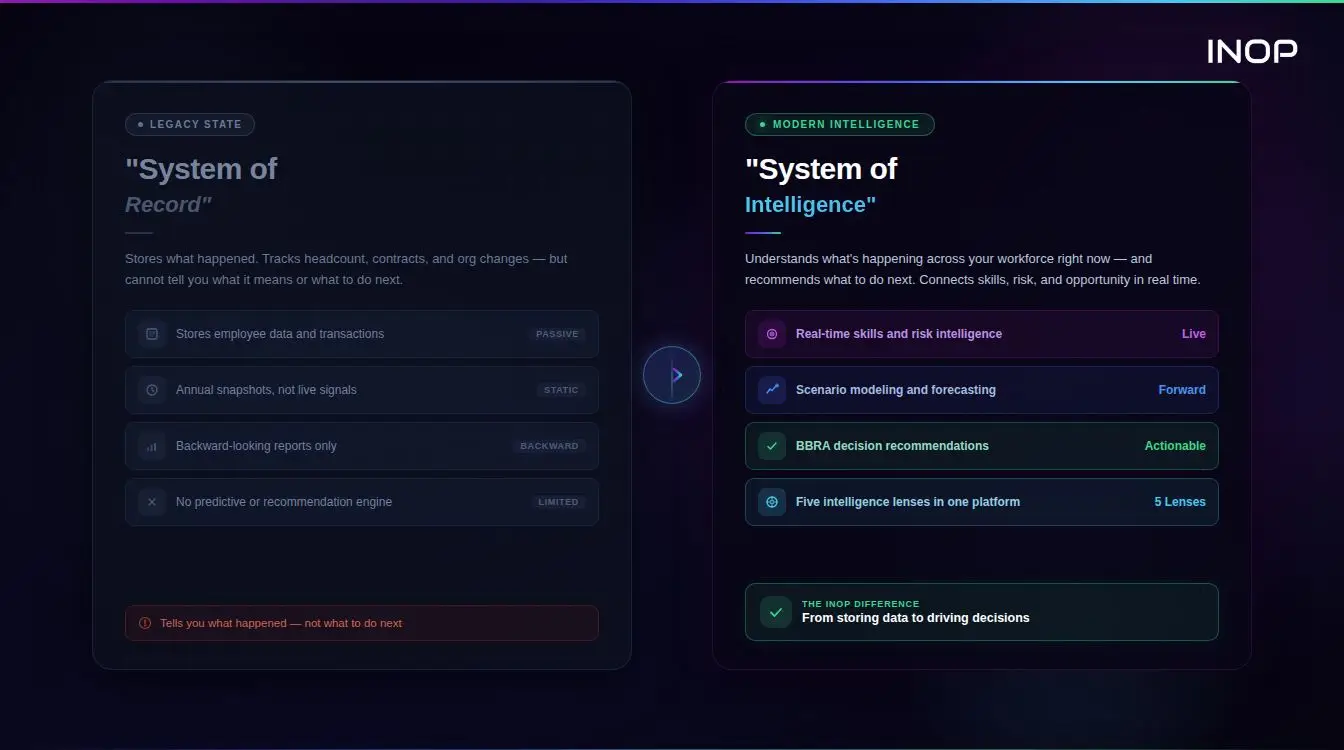
For CHROs evaluating how prescriptive capabilities layer onto predictive foundations, the comparison between these two tiers is worth exploring in depth. Predictive HR analytics forms the foundation of the prescriptive tier — but the architectural difference between generating a forecast and generating a decision recommendation involves distinct data requirements, competency framework maturity, and BBRA-aligned decision logic that most organizations underestimate when sequencing their analytics investment.
What Is Predictive People Analytics?
Predictive people analytics is the use of historical employee data, statistical algorithms, and machine learning techniques to identify future workforce trends, forecast talent risks, and optimize HR decision-making.
It is worth pausing on what this definition does not say. It does not say “predicting the future with certainty.” It does not say “replacing human judgment.” And it absolutely does not mean feeding an algorithm a few spreadsheets and waiting for magic to happen.
What it does mean is this: pattern recognition at scale. When thousands of data points, performance reviews, engagement scores, compensation history, tenure, manager relationships, training completion rates, absenteeism, internal mobility, and more, are analyzed together, patterns emerge that no individual HR professional could detect manually. An employee who receives a below-average performance rating, stops participating in optional training programs, and takes an unusual number of single-day absences may be exhibiting a well-documented pre-departure pattern. Predictive people analytics surfaces that signal weeks or months before the resignation letter arrives.
The “magic,” in other words, is sophisticated mathematics applied to behavioral data, not fortune-telling, but probability engineering. A well-built attrition model doesn’t say “this person will leave.” It says “this person has a 74% probability of leaving within 90 days based on historical patterns from employees who exhibited similar behaviors.” That distinction matters enormously for how managers and HR professionals should act on the output.
Core Use Cases for Predictive People Analytics
Understanding the theory is one thing. Seeing where predictive workforce analytics delivers measurable ROI is what moves organizations to invest. Here are the three highest-impact use cases driving adoption right now.
Forecasting Flight Risk
Employee attrition is one of the most expensive and disruptive forces a company can face. Replacing a mid-level employee typically costs between 50% and 200% of their annual salary when you factor in recruiting, onboarding, training, and lost productivity. For a sales organization, the damage can extend to customer relationships and pipeline continuity.
Predictive flight risk models work by identifying behavioral and structural signals that historically precede voluntary departures. These signals are often subtle: a drop in meeting participation, a shift in how an employee fills out their quarterly self-assessment, a compensation package that has fallen more than 10% below market rate. Individually, none of these indicators is conclusive. Combined and compared against thousands of past attrition cases, they form a statistically robust early warning system.
Organizations that have deployed flight risk models report being able to intervene with at-risk employees 60 to 90 days before the typical resignation timeline, enough time for a meaningful manager conversation, a retention offer, or a development plan that re-engages the individual.
Predicting Quality of Hire
Hiring decisions are notoriously difficult to evaluate in real time. Interviews are subjective, structured or not. Resumes tell you where someone has been, not necessarily how they’ll perform in your specific context. And hiring managers are busy, they rely heavily on gut instinct and pattern recognition that is often shaped by implicit biases.
Predictive quality-of-hire models use pre-employment assessment data, candidate trajectory analysis, skills match scores, and historical outcomes from similar hires to generate a probability score for long-term success in a given role. Instead of comparing “this candidate reminds me of a great hire we made three years ago,” you are comparing structured data against a validated model.
The financial stakes are significant. A misaligned hire at the manager level can cost upward of $240,000 when you include salary, benefits, severance, and the downstream productivity impact on the team, and according to the latest cost of bad hire statistics 2026, that figure is rising across most industries. Better predictive screening doesn’t eliminate hiring risk, but it substantially improves the odds, and over hundreds of hiring decisions, even a modest improvement in quality-of-hire rates compounds into a material competitive advantage.
Anticipating Skills Gaps
Product roadmaps evolve. Markets shift. Technologies become obsolete. One of the most strategic questions an HR function can answer is: given where this company is going in the next 18 months, do we have the talent to get there?
Skills gap modeling connects workforce data with business planning data. If your product strategy requires a major expansion into machine learning-enabled features, and your current engineering talent inventory shows that only 12% of your engineers have relevant ML skills, that is a quantified risk, not an abstract worry. It becomes the basis for a targeted upskilling investment, a targeted hiring campaign, or a partnering strategy with external vendors.
This use case requires a solid skills taxonomy, a structured, consistent way of defining and tracking capabilities across your workforce, before the predictive modeling can produce reliable results. The quality of your input data directly determines the quality of your output insights.
Building the Foundation: Data Readiness
Here is the uncomfortable truth that many HR technology vendors prefer not to lead with: predictive models are only as good as the data you feed them.
If your job titles are inconsistent across business units (is it “Senior Software Engineer,” “Sr. SWE,” or “Software Engineer III”?), if your performance ratings mean different things in different parts of the organization, and if your HRIS, ATS, LMS, and performance management platform have never exchanged a single record, your predictive analytics initiative will fail before it starts.
Data readiness has three foundational components.
Data cleansing is the unsexy but non-negotiable first step. It means standardizing your ontologies: consistent job families, consistent skills definitions, consistent rating scales. This work typically takes longer than anyone expects and reveals more inconsistencies than anyone wants to admit. Budget time for it.
Data integration means connecting your disparate HR technology systems so that information flows into a unified data environment, often called a data lake or a people data warehouse. An employee’s learning history should be connectable to their performance trajectory. Their compensation relative to market should be connectable to their engagement scores. Without integration, you are running predictive models on partial information, which produces partial, and sometimes dangerously misleading, results.
The warning bears stating plainly: AI trained on bad data doesn’t just produce bad predictions. It produces bad predictions with high confidence scores, which can be worse than no prediction at all. Garbage in, garbage out, and in HR, the “garbage” manifests as biased hiring decisions, misdirected retention investments, and misallocated development budgets.
Overcoming the Cultural and Ethical Barriers
Even the most technically sophisticated predictive analytics program will fail if it isn’t trusted and used by the people it’s designed to serve. Cultural and ethical barriers are real, and they deserve serious strategic attention.
The Black Box Problem
A manager receives an alert that one of their top performers has a “high flight risk score.” Their natural first question is: why? If the answer is “the algorithm says so,” that manager will either ignore the recommendation entirely or act on it without understanding the underlying factors, neither of which is the outcome you want.
Explainable AI (systems that can articulate the primary drivers behind a given prediction) is not just a technical nicety. It is a prerequisite for organizational adoption. HR leaders should evaluate every predictive analytics vendor or internally built model on the dimension of interpretability, not just accuracy.
Ethics and Algorithmic Bias
This is perhaps the most important consideration in the entire discipline of HR data science. Predictive models learn from historical data. If your historical data reflects a workforce where senior leadership positions were disproportionately filled by men from elite universities (because of past hiring biases) then a model trained on “what predicts success” in your organization will learn to replicate those biases at scale and at speed.
Algorithmic fairness audits, regular model reviews, and diverse teams involved in model design are not optional practices. They are ethical obligations. A predictive system that systematically disadvantages candidates from underrepresented groups is not only a legal liability, it actively undermines the inclusion goals most organizations publicly espouse.
Keeping the Human in the Loop
Predictive analytics should inform and augment human decision-making, never replace it. The final call on any retention intervention, hiring decision, or development investment should rest with a qualified human professional who understands the context, the individual, and the nuances that no model can fully capture. Treating AI recommendations as inputs to judgment, not substitutes for it, is both the ethical and the strategically smart approach.
Getting Started: A 90-Day Roadmap
The most common reason predictive people analytics initiatives stall is that they try to solve everything at once. A high-ambition, low-focus approach produces months of planning conversations and no actual results. The alternative is disciplined scoping: identify one high-impact problem, build a focused solution, demonstrate value, and expand from there.
Month One: Define the Problem
Choose a single, well-defined business problem with measurable stakes. A strong candidate: first-year voluntary turnover in the sales department, which has averaged 28% over the past three years, well above your industry benchmark of 18%. This is specific enough to model, important enough to warrant investment, and clear enough to evaluate when results come in.
Secure a business sponsor (ideally the VP of Sales or the Chief Revenue Officer) who has a direct stake in the outcome. Predictive analytics projects with strong business ownership succeed at a dramatically higher rate than those driven exclusively by HR.
Month Two: Audit the Data
With your problem defined, inventory the data that surrounds it. What do you know about the employees who left in their first year, their onboarding experience, their ramp-to-quota trajectory, their manager’s historical retention rate, their compensation relative to peers, their engagement survey responses? What data exists, what is clean, and what gaps need to be filled?
This step will almost certainly surface data quality issues. Treat them as project inputs, not project blockers. Document them, prioritize the ones that matter most for your model, and develop a plan to address them.
Month Three: Run a Pilot Model
With a reasonably clean and integrated dataset, build or commission a pilot predictive model. Run it retrospectively first: apply the model to historical data from two years ago and see whether it would have accurately flagged the employees who ultimately left. This backtesting approach gives you a performance baseline without any real-world stakes.
If the model performs meaningfully better than chance (and a well-constructed model typically should) present the findings to your business sponsor with a proposal to deploy it prospectively. Measure the outcome over the following two quarters. Refine the model as new data comes in.
Conclusion: The Bridge Between HR and Business Strategy
Predictive People Analytics is not a technology trend. It is a fundamental repositioning of what HR is capable of contributing to organizational success. When HR can walk into a business review and say “based on current signals, we project a 22% increase in first-year sales attrition over the next two quarters, concentrated in three specific regions, and we recommend the following three interventions”, that is HR operating as a strategic business partner, not an administrative function.
The journey from reactive reporting to proactive strategy requires investment in data infrastructure, analytical capability, and cultural change management. None of those investments are trivial. But the organizations that make them are building a genuine competitive advantage in talent, one that compounds over time as their models improve, their data matures, and their HR teams develop deeper analytical fluency.
The rearview mirror has its uses. But the windshield is where strategy lives.
Ready to start your predictive analytics journey? Share your biggest HR data challenge in the comments below, we read every one and respond with specific guidance. If this article was useful, share it with a fellow HR leader who’s still stuck in reactive reporting mode. And explore our related deep-dives on flight risk modeling, quality-of-hire analysis, and building a dynamic skills taxonomy to continue building your proactive HR strategy.
Frequently Asked Questions
What is the difference between predictive people analytics and traditional HR reporting? Traditional HR reporting describes what has already happened, last quarter’s turnover rate, this year’s training completion percentages. Predictive people analytics uses historical data and machine learning to forecast what is likely to happen in the future, enabling HR to intervene before problems materialize rather than after they’ve already caused damage.
How much data do you need to start using predictive people analytics? There is no universal minimum, but as a practical guideline, most attrition prediction models require at least 18 to 24 months of historical employee data and a reasonable sample size of prior turnover events to learn from. Organizations with fewer than 300 to 500 employees may find that commercial benchmarking data or industry models need to supplement their internal datasets.
What HR technology systems need to be connected for predictive analytics to work? At a minimum, you typically need your HRIS (for demographic and tenure data), your performance management system (for ratings and goal data), and your ATS (for pre-hire data if you’re modeling quality of hire). LMS integration adds significant value for skills and development modeling. The more integrated your technology stack, the richer your predictive models can be.
How do you ensure predictive HR models don’t reinforce existing biases? Algorithmic bias mitigation requires a multi-layered approach: auditing your training data for historical over- or under-representation, selecting model features that are demonstrably job-relevant rather than proxies for protected characteristics, running regular fairness audits across demographic groups, and maintaining human oversight on all consequential decisions the model informs. This is an ongoing practice, not a one-time checklist.
What’s the typical ROI of a predictive people analytics investment? ROI varies significantly by use case and organization size, but the financial case is well-documented. Organizations using predictive attrition models report reducing unwanted turnover by 15% to 25% on average. At an average replacement cost of 1.5x annual salary, even modest improvements in retention for a mid-sized workforce can generate millions of dollars in annual savings. Quality-of-hire improvements compound further through productivity gains over a hire’s tenure.
Do you need a data science team to implement predictive people analytics? Not necessarily, though analytical capability is important. Several enterprise HR platforms (including purpose-built solutions like a talent intelligence platform) now offer pre-built predictive models that HR professionals can configure without writing code.. However, for more customized and accurate models, access to data scientists or HR analytics specialists with quantitative skills significantly improves outcomes. Many organizations start with vendor-provided models and develop internal capability over time.
What is the biggest reason predictive people analytics initiatives fail? The most common failure modes are poor data quality, lack of executive sponsorship outside of HR, and scope that is too broad to deliver measurable results within a reasonable timeframe. Starting with a single, well-defined business problem (rather than attempting to build a comprehensive workforce intelligence platform from day one) is the single most reliable predictor of a successful first initiative.
Book a Demo
Make confident workforce decisions that support strategy and value creation.