







AI-Powered Strategic Workforce Planning for a Skills-Based World
Plan, model, and adapt your workforce based on capabilities, risk, and business strategy, not just headcount.

Why Workforce Strategies Often Miss the Mark
Most organisations are trying to plan their workforce for the future, but they’re doing it with outdated assumptions, fragmented data, and limited visibility.
The most common challenges leaders face
As markets shift and AI and automation reshape work, traditional workforce plans struggle to keep up.
Leaders are left unable to answer basic but critical questions:
Are we ready to execute our strategy? Where are the real risks? Are we investing in the right capabilities?
INOP Helps You Answer the 5 Questions That Matter Most
Most workforce strategies fall short not because of execution, but because the right questions go unanswered.
INOP helps leaders answer the five that truly matter:
What capabilities do we actually have and where?
Where are the gaps today, and under future business scenarios?
What workforce risks could delay or derail execution?
Where should we invest, redeploy, automate, or scale back?
What will these decisions cost across timeframes and scenarios?
Most tools model roles and headcount.
INOP connects capabilities to business value, financial impact, and execution outcomes.
Why INOP Is Different
Critical capabilities, not just skills in isolation
Role-level analysis tied directly to execution and delivery
A unified intelligence layer connecting workforce data with financialand strategic outcomes
Workforce risk as a business and governance issue, not an HR reporting exercise
continuous strategic decision discipline.
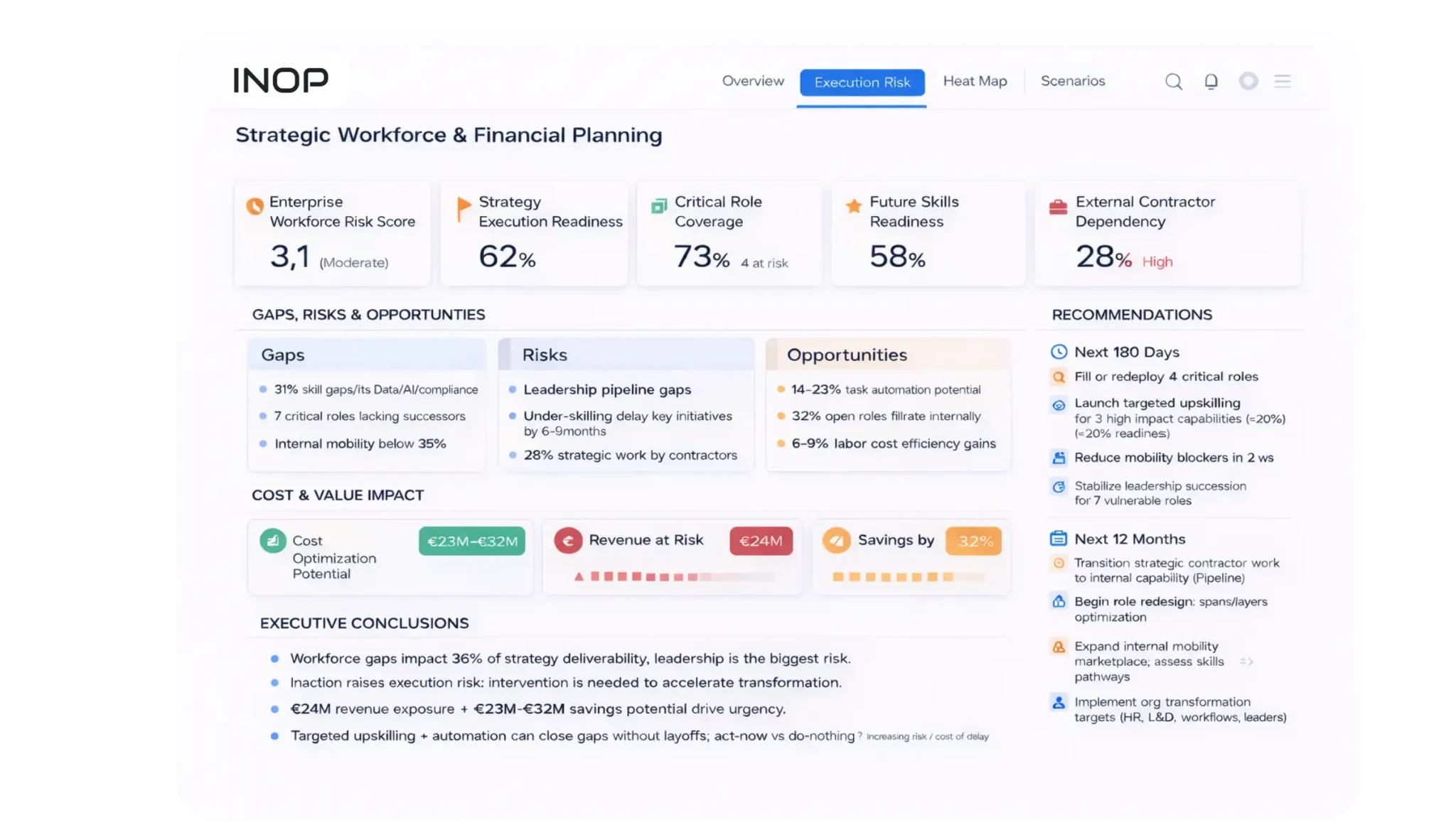
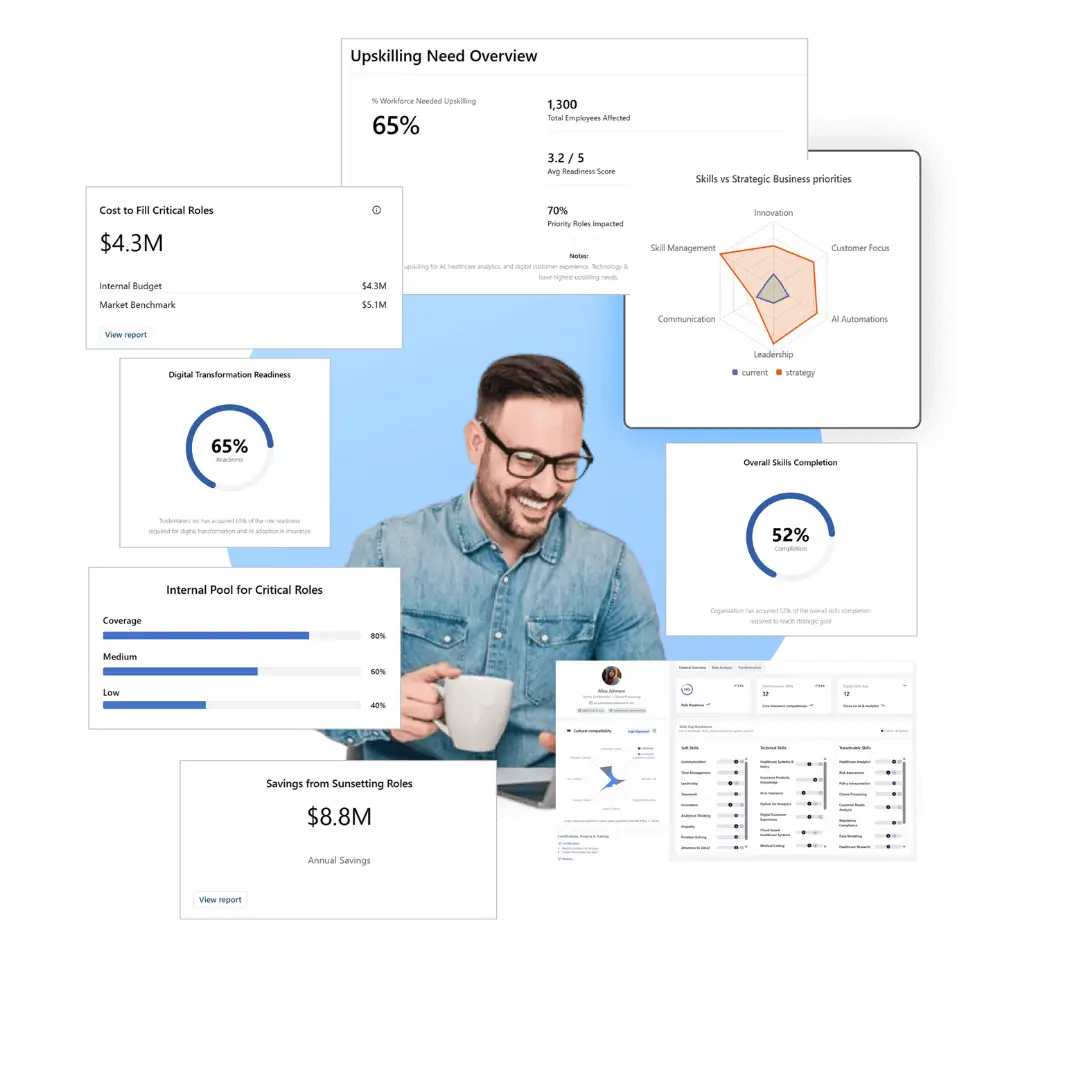
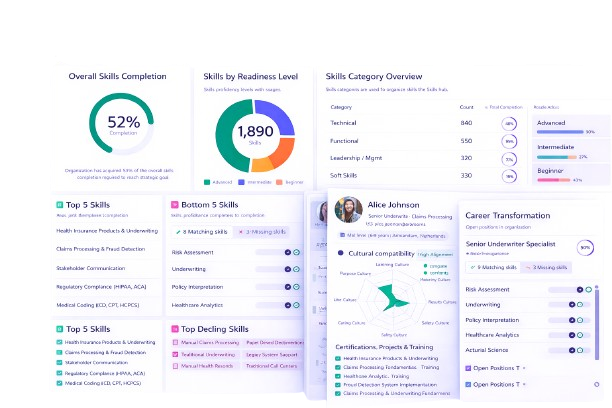
INOP gives leaders a real-time, transparent view of their workforce—linking skills to strategy, gaps to action, and people to opportunity.
Connecting skills, roles, and strategy in real time.
How INOP Thinks About Strategic Workforce Planning
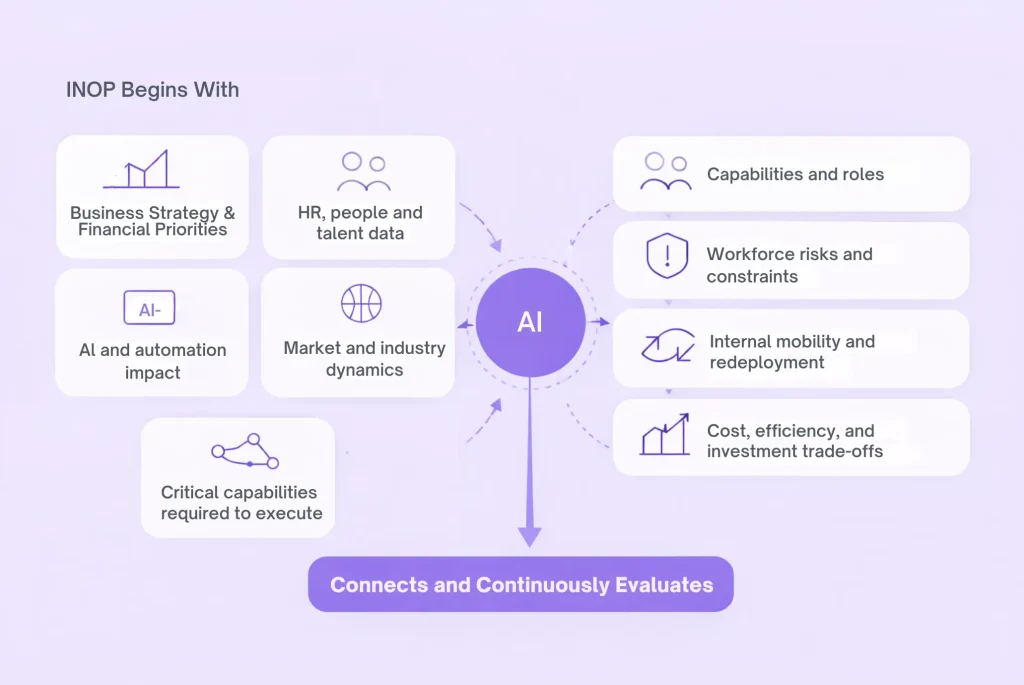
Where most tools focus on planning outputs, INOP starts with the decisions leaders need to make. Our approach is decision-first, grounded in what actually drives execution and value.
This ensures workforce planning is always grounded in reality, aligned to how the business actually operates, and focused on execution, risk management, and value creation.
Powered by Proprietary Skills Intelligence
INOP doesn’t just detect skills. It understands their strategic impact.
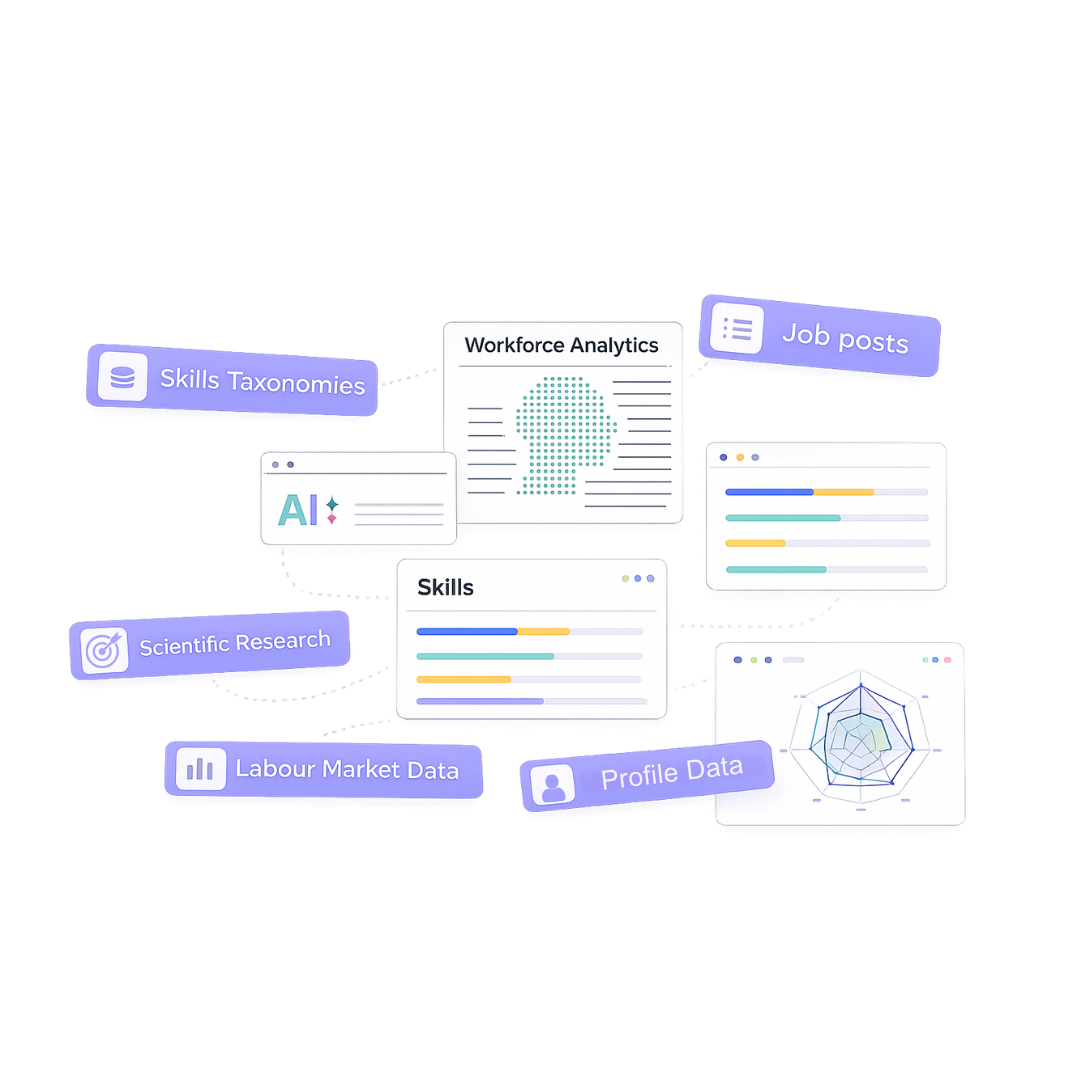
INOP’s AI-powered strategic workforce planning leverages millions of global labor signals and leading frameworks that underpin the shift toward skills-based organizations. All taxonomies are continuously updated, localized, and context-aware for maximum precision and relevance in a skills-first world.
Core Capabilities of INOP’s Strategic Workforce Planning Platform
Built for agility. Aligned to strategy. Powered by Skills Gap Analytics
Leverage INOP’s real-time capabilities, including rich taxonomies, workforce risk scoring, industry dynamics, and AI impact modelling, to identify critical capability gaps, forecast talent and workforce investment needs, and support long-term, strategic workforce planning.

Live Role & Skill Intelligence
A real-time view of what capabilities exist today, what’s emerging, and what’s missing.
Business-Aligned Planning
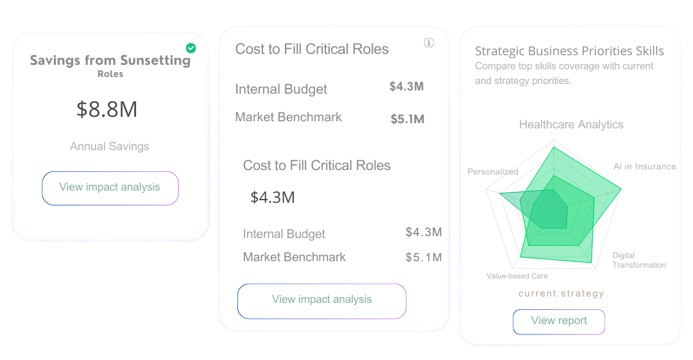
Plan workforce needs in lockstep with strategic, financial, and operational priorities.
Workforce Risk Engine
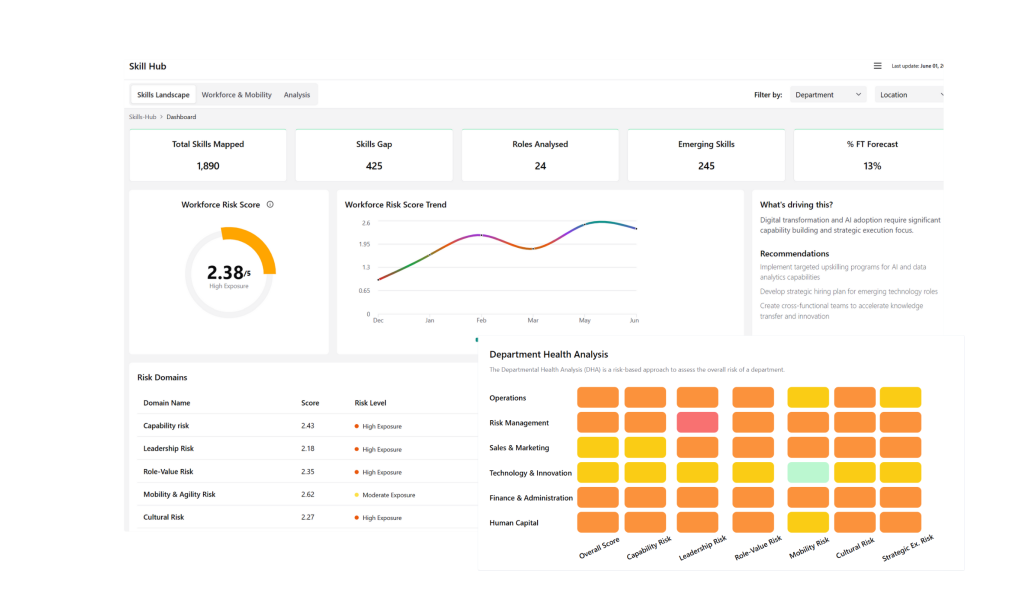
Identify where talent shortages, leadership gaps, capability concentration or skill decay create execution risk.
Scenario-Based Planning
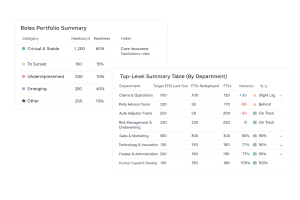
Model future demand, automation impact, restructuring options, and cost across multiple business scenarios.
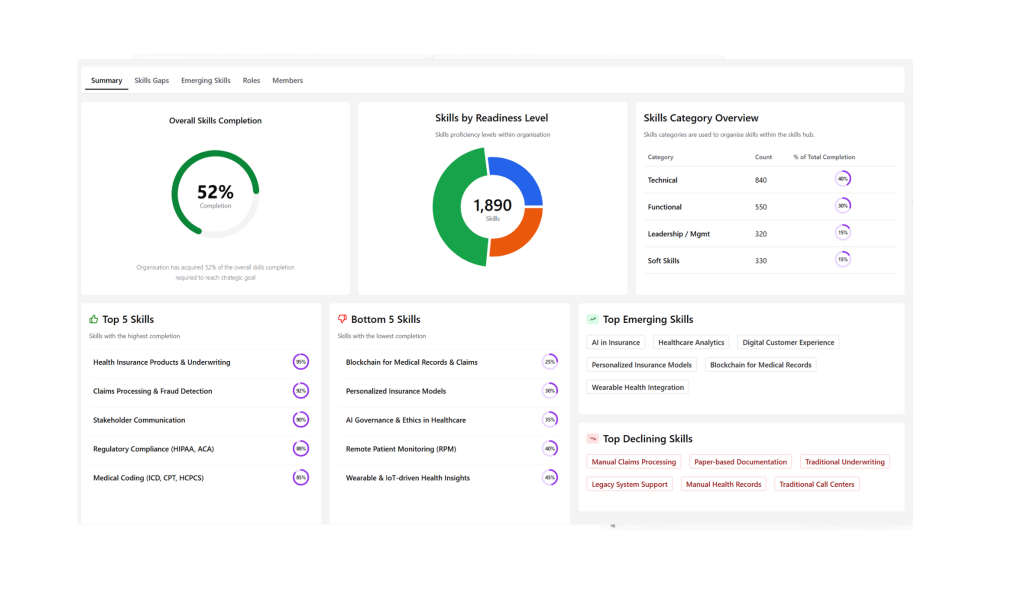
Cross-Functional Intelligence
Align HR, Finance, Strategy, and Operations in one connected, decision-ready view.
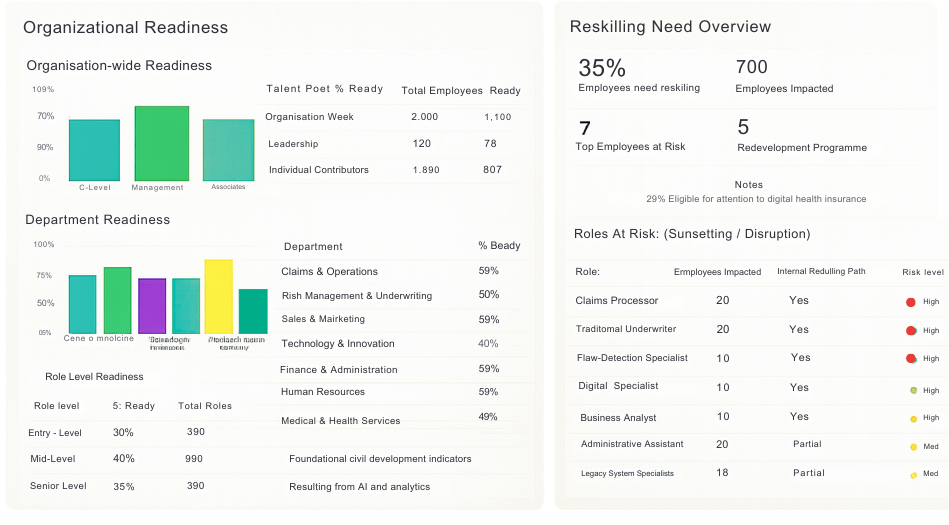
Upskilling & Reskilling Strategies
Design focused programs aligned to future capability needs and priority roles.
From Insight to Action: The Decisions INOP Enables
Prioritise investment
Decide where to build, buy, automate, or sunset capabilities
Scale with confidence
Understand execution risk before hiring, restructuring, or exiting roles
Enable internal mobility
Redeploy talent to where it creates the most value
Optimise cost and efficiency
Identify overcapacity, duplication, and automation opportunities
Target upskilling & reskilling
Invest where development delivers the highest strategic and financial
return
INOP helps leaders understand where execution risk is emerging, how workforce decisions affect performance, cost, and growth, and what happens if they act, or do nothing.
Enterprise-Ready, Secure, and Integrated
INOP integrates seamlessly with your existing HRIS, ATS, LMS, and financial systems.
SOC 2 Type II & ISO 27001 certified
GDPR-compliant, fully encrypted at rest and in transit
Real-time dashboards across roles, skills, and business units
Continuously updated with external market and industry signals
Your data stays private, protected, and yours.
Fast. Dynamic. Predictive workforce decision intelligence.
Allocate talent and capital where it creates the most value.
FAQ
INOP is a strategic workforce decision intelligence platform built for senior leaders — CHROs, CFOs, CEOs, boards, and PE operating partners. It synthesises data across five integrated intelligence lenses: Strategy, Finance, People, Market, and AI & Automation, connecting workforce data to strategy and financial outcomes in a single decision layer. It gives leaders a real-time view of their workforce capabilities and skills, what gaps exist, and what risks could derail execution. Leaders can model scenarios, understand financial impact, and make informed decisions about where to invest, redeploy, automate, scale back, or build new capability, with value leakage, margin risk, and execution costs quantified at every step. It is not an HRIS, a reporting tool, or a dashboard. It is a decision engine, delivered as a SaaS platform, with no lengthy IT implementation.
INOP is built for mid-size and large enterprises, typically 250 to 10,000+ employees, where workforce decisions carry material strategic and financial consequences. It is designed for CHROs who need to demonstrate strategic impact, CEOs and CFOs who need execution risk quantified in financial terms, and PE operating partners who need investor-grade workforce intelligence across a portfolio.
People analytics tools report on what has already happened: headcount, attrition, engagement scores, benchmarks. INOP is built for forward-looking decisions. It scores execution risk, models scenario impact across Build, Buy, Redeploy, and Automate pathways, quantifies capability gaps in financial terms, and produces board-ready intelligence. Historical dashboards tell you what happened. INOP tells you what it means for strategy and what to do about it.
Workday and SAP are designed to record workforce transactions: hire to retire, payroll, benefits, org management. They are built for operational accuracy. INOP is built for operational excellence and strategic decisions. It ingests data from your HRIS and augments it with external market intelligence, financial modelling, and AI and automation exposure scoring, producing insights your HRIS was never designed to generate. INOP works alongside your HRIS, not instead of it.
Skills platforms build ontologies and infer skills from job data, which is valuable but single-domain. INOP synthesises intelligence across five integrated lenses simultaneously: Strategy, Finance, People, Market, and AI & Automation. A skills gap in isolation is an HR observation. The same gap connected to financial exposure, automation trajectory, market talent supply, and strategy execution risk becomes a board-level decision. That synthesis is what INOP produces and what no single-domain skills platform can replicate.
INOP synthesises data across five integrated domains. Strategy covers execution readiness, leadership capacity, and succession risk. Finance covers workforce cost modelling, ROI on talent investment, and scenario-based financial impact. People covers real-time skills mapping, role intelligence, mobility capacity, and reskilling pathways. Market covers sector dynamics, competitor hiring activity, compensation benchmarking, regulatory environment, M&A signals, and technology disruption, drawing on published research from WEF, McKinsey, BCG, OECD, and Gartner, configured per client sector and geography. AI & Automation covers role-level automation exposure, task displacement, and FTE and cost impact modelling. No single lens is sufficient on its own. Their intersection is where strategic insight is produced.
INOP’s Decision Intelligence Layer is organised around six interconnected risk domains. Capability Risk scores whether the organisation has the skills and competencies required to execute current and future strategy, mapped at role, team, function, and business unit level. Leadership Risk scores the quality and depth of leadership capability, succession readiness, AI literacy, and transformation sponsorship strength. Mobility scores internal redeployment capacity, skills adjacency, reskilling pathway availability, and workforce agility. Role-Value Risk identifies whether roles are delivering expected value and maps critical, emerging, declining, and sunset roles. Culture Risk scores cultural alignment with strategic direction, change readiness, and transformation capacity. Strategic Execution Risk is the composite domain, integrating signals from all five domains above to produce the organisation’s overall execution risk score: the probability and estimated cost of workforce-driven strategic failure. These domains are not independent scorecards. They share data across a unified layer and their intersection is what produces board-ready intelligence.
Accordion Content
BBRA is INOP’s core decision framework for workforce investment. For any capability gap identified, INOP models four response pathways. Build means developing the capability internally through upskilling, with time-to-competency and cost modelled. Buy means hiring externally, with market availability, compensation benchmarks, and lead time factored in. Redeploy means identifying internal talent with adjacent skills that can transition into the gap, with reskilling feasibility scored. Automate means assessing whether the role or task is better addressed through automation, with FTE displacement and cost impact quantified. Each pathway is evaluated with financial trade-offs across 30-day, 180-day, 1-year, and 3-year horizons so leaders can make investment decisions with the same rigour applied to capital allocation.
INOP’s AI & Automation domain applies task-level analysis across 40,000+ roles using seven published research frameworks including WEF Future of Jobs, Stanford HAI, O*NET/AIOE, McKinsey, ILO, and Eloundou et al., to produce automation susceptibility scores for every role in the organisation. Each role is assessed across six dimensions. The output classifies each role as not impacted, partially impacted, or fully impacted across four time horizons: near-term at 180 days, medium at 12 months, structural at 2 years, and transformational at 3 or more years. FTE displacement estimates, cost impact modelling, and transition pathway recommendations are generated for each scenario. This is not a generic automation forecast. It is modelled against your actual workforce composition and connected directly to the BBRA decision framework.
Leadership Risk is one of INOP’s six scored risk domains. INOP scores the quality and depth of leadership capability across the organisation, including succession readiness at critical levels, AI literacy among senior leaders, transformation sponsorship strength, and bench depth. These scores feed directly into the Strategic Execution Risk composite because execution failure is rarely a skills problem alone. It is frequently a leadership problem: insufficient bench depth, low AI literacy at the top, or a leadership cohort misaligned with the transformation the strategy requires. INOP makes that risk visible, quantified, and connected to action before it materialises.
Role-Value Risk is INOP’s framework for assessing whether roles across the organisation are delivering the value they are costed to deliver. INOP classifies roles into four categories: critical, emerging, declining, and sunset, and identifies concentration risk where too much capability or cost is concentrated in roles that are declining in strategic relevance. This connects directly to automation exposure modelling, workforce restructuring scenarios, and capital reallocation decisions. It is the analytical foundation for answering one of the most difficult questions in workforce planning: not just what capabilities you have, but what they are actually worth to the strategy.
INOP translates every risk domain score into financial exposure: value leakage, margin risk, and growth constraints, with confidence intervals suitable for board reporting. Capability gaps are connected to revenue at risk. Leadership bench gaps are connected to execution delay costs. Automation exposure is connected to FTE and cost impact. The result is that workforce risk sits alongside other financial risk indicators in executive and investor reporting, not as a qualitative HR narrative, but as a quantified, auditable number.
Most workforce planning tools produce point-in-time snapshots reviewed once a year. INOP runs as a live strategy model, continuously updated as internal workforce data, business conditions, and external market signals change. This shifts workforce planning from an annual HR exercise to a continuous intelligence capability aligned to the same cadence leadership uses to manage the business. Leaders can query the platform, run scenario analyses, and access insights and progress at any point in the planning cycle.
Yes. INOP’s Skills Intelligence feed delivers external market signals mapped to your organisation’s own skills taxonomy, including demand trends, AI and automation impact scores, and forward-looking signals across proficiency levels, role types, and geographies. Unlike generic labour market data from providers such as Lightcast or LinkedIn Talent Insights, INOP’s skills intelligence is contextualised to your specific taxonomy, sector, and markets, and delivered via API feed or secure download for direct integration into your HCM platforms, HR tech stack, or proprietary workforce planning solutions. Update cadence is monthly or quarterly. This capability is also used by HR technology providers and consulting firms to enrich their own client solutions with external skills market intelligence.
Yes, and it is purpose-built for this use case. PE operating partners can use INOP to conduct structured workforce risk scoring pre- and post-acquisition, quantify human capital value leakage, and compare execution readiness across portfolio companies on a consistent framework. Human capital due diligence is typically qualitative and inconsistent across deals. INOP makes it structured, scored, and investor-grade, giving operating teams the same visibility into workforce risk that they already have into financial and operational risk.
Yes. INOP is referenced and used by strategy and workforce consulting firms, including global advisory practices, as part of their client engagements where structured workforce decision intelligence is required. We have been included in proposals and client programmes by major consulting firms where the need is to connect workforce data to strategic and financial decision-making with rigour that spreadsheet-based approaches cannot provide. INOP works alongside consulting teams as the analytical and intelligence layer underpinning their recommendations. If you are working with an advisory partner on a workforce transformation, restructuring, or due diligence engagement, we are happy to discuss how INOP can support that programme. Get in touch at friends@inop.ai.
INOP is delivered as a SaaS platform and integrates with existing HRIS, ERP, and financial systems via API, meaning there is no lengthy IT implementation, no infrastructure to manage, and no replacement of your existing systems. Clients retain full control of their data at all times. INOP does not access employee data unless explicitly agreed in writing. Data is stored by default in Frankfurt, Germany, fully compliant with GDPR and EU data residency requirements. Multi-region and private cloud deployments are available where required. Most organisations are operational and producing decision-grade outputs within weeks of onboarding.
INOP is fully GDPR and CCPA compliant. The client is the data controller; INOP acts as data processor. INOP does not process special category data, meaning no performance ratings, ethnicity, gender, health data, or similar sensitive attributes are required. The platform can operate in fully anonymised or aggregated mode where individual-level data is not needed. On the EU AI Act, INOP’s AI models produce explainable outputs with confidence scoring, human oversight is built into every decision pathway, and full technical documentation is maintained. AI provides decision support only. Final decisions are always human-led. Compliance documentation is available on request.
INOP’s proprietary taxonomy covers 22,000+ skills mapped across roles, functions, sectors, and geographies, structured specifically for strategic decision-making, not job posting or CV matching. Skills are organised by criticality, adjacency, automation susceptibility, and time-to-acquire. This depth is what enables INOP to model reskilling pathways, internal mobility options, role-value transitions, and workforce evolution, not just report on the skills you have today.