
Sources for Cost of Bad Hire Statistics: DOL, SHRM and CareerBuilder Citations
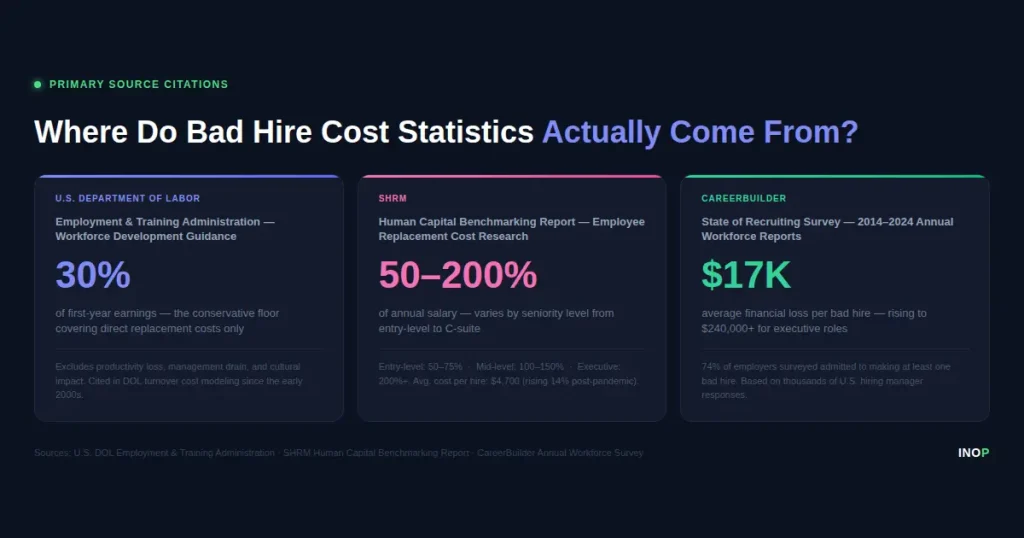
The most-cited bad hire cost figures in HR literature come from three primary sources. Here are the original citations and direct references for each:U.S. Department of Labor: The 30% Rule
The U.S. Department of Labor’s figure that a bad hire costs at least 30% of that employee’s first-year earnings originates from the Department’s historical workforce guidance on employee turnover costs. The statistic has been cited extensively since the early 2000s in DOL workforce development publications and training materials. The DOL’s Employment and Training Administration references this figure in the context of turnover cost modeling for workforce development programs. Note that this 30% represents the conservative floor of direct replacement costs only, it does not include productivity loss, management drain, or cultural impact, which is why HR practitioners frequently cite higher multiples.SHRM: 50% to 200% of Annual Salary
The Society for Human Resource Management’s range of 50% to 200% of annual salary comes from SHRM’s research on employee replacement costs, detailed in their Human Capital Benchmarking Reports and referenced across multiple SHRM publications on talent acquisition and retention. The range reflects the variation by seniority level: entry-level roles trend toward 50–75%, mid-level managerial and technical roles toward 100–150%, and C-suite or executive positions toward 200% or above. SHRM’s $4,700 average cost per hire figure comes from their 2016 Human Capital Benchmarking Report, with subsequent data confirming the figure has risen approximately 14% from pre-pandemic levels by 2024.CareerBuilder: The $17,000 Average
The $17,000 average financial loss per bad hire and the 74% of employers who reported making a bad hire come from CareerBuilder’s annual survey research on workforce and hiring trends, conducted across thousands of US hiring managers. These figures have been cited in CareerBuilder’s annual “The State of Recruiting” and related workforce reports from 2014 through 2024. The $240,000 figure for executive-level bad hires represents the upper range across executive-level respondents when factoring in all associated costs.Most bad hire costs start with a capability gap no one could see coming. Book a demo to see how INOP’s skills intelligence surfaces the mismatch between what a role needs and what a candidate or existing employee can actually deliver, before it becomes a six-figure mistake.
What Qualifies as a “Bad Hire”?
Before diving into numbers, it’s worth being precise. A bad hire isn’t just someone who gets fired. A bad hire is any new employee who fails to meet the expectations set at the time of hiring, whether due to skill misalignment, cultural incompatibility, poor attitude, dishonesty, or simply the wrong fit for the role. Bad hires typically fall into a few recognizable patterns:- The skill misrepresenter: Someone who overstated their qualifications and struggles to perform at the required level.
- The culture mismatch: A technically capable person who disrupts team cohesion, communication, or morale.
- The disengaged employee: Someone who shows up but delivers minimal effort, often dragging others down with them.
- The early departer: An employee who leaves within three to six months, taking all the onboarding investment with them.
When the Compensation Model Itself Creates the Bad Hire
Most bad hire analysis focuses on the selection decision: the wrong candidate chosen from the right process, or the right candidate evaluated through the wrong criteria. Less often examined is whether the compensation structure that attracted the candidate in the first place was aligned with what the organization actually needed from them.
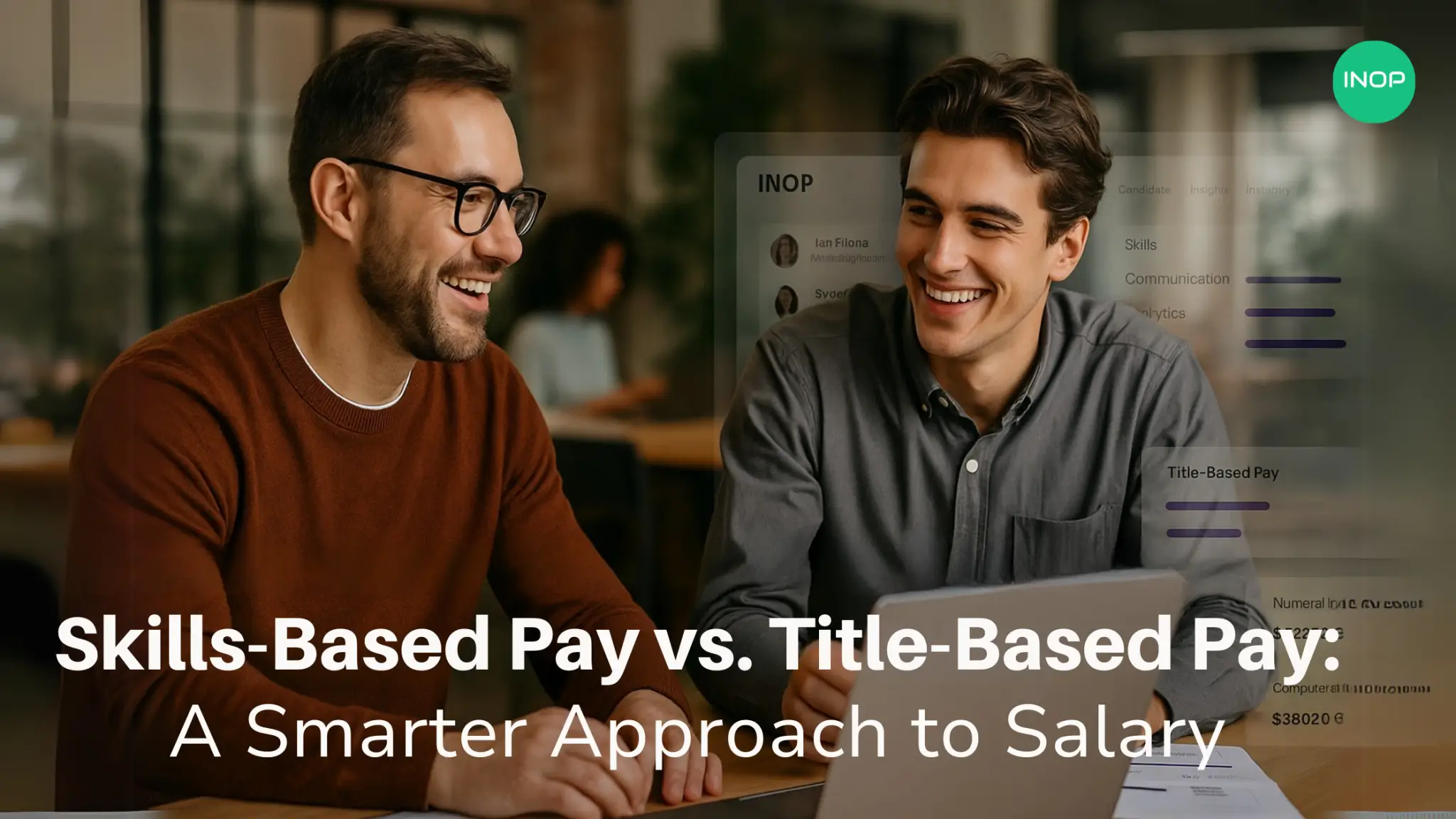
A title-based pay structure that rewards seniority and position rather than demonstrated capability can attract candidates who are optimized for negotiating salary rather than building skills, and it gives hiring managers no structured way to verify that the compensation being offered reflects what the role actually requires. The result is a hire that looks correct on paper and performs below expectation, one of the most expensive and hardest-to-diagnose bad hire patterns.
Understanding the full range of skill based pay advantages and disadvantages matters here because the compensation model shapes who applies, what they expect, and whether they stay. Organizations that pay for verified competencies rather than job titles attract candidates who are motivated by skill development, set clearer expectations about what capability the role requires, and give HR a structured framework for assessing whether compensation is aligned with actual demonstrated ability. That alignment does not eliminate bad hires, but it does remove one of the structural conditions that produce them most predictably: the gap between what the organization is paying for and what it is actually getting.
The Bad Hire Risk You Create by Overlooking Internal Candidates
Many bad hires are not failures of selection. They are failures of scope. Organizations that default to external recruitment without first assessing internal capability systematically increase their exposure to bad hire risk, because they are drawing from a pool of unknowns when a verified, culturally embedded alternative may already exist on the payroll.
The concept of hidden talent describes exactly this: employees whose capabilities exceed what their current role, title, or manager visibility would suggest. In organizations without a structured process for surfacing these people, they remain invisible to hiring decisions. The business then spends an average of $4,000 and 42 days recruiting externally for a role that an existing employee could fill with lower onboarding cost, faster time to productivity, and far less cultural risk.
The financial case is straightforward. A bad external hire at the mid-level carries a replacement cost of between one and three times annual salary when recruitment fees, onboarding, lost productivity, and early attrition are factored in together. An internal move that goes well carries almost none of those costs. The asymmetry means that every time a strong internal candidate goes unidentified and an external hire goes wrong instead, the business absorbs a cost that a better talent visibility process would have avoided entirely.
What Percentage of Salary Does a Bad Hire Cost?
When calculating HR budgets, leaders frequently ask: What percentage of salary does a bad hire cost? As a baseline, the U.S. Department of Labor states that a bad hire costs 30% of their first-year salary. However, this is a conservative estimate that mostly covers direct replacement costs. When you factor in lost productivity, onboarding time, and management drain, the SHRM (Society for Human Resource Management) framework is more accurate. According to SHRM, a bad hire costs:- 50% to 75% of annual salary for entry-level or hourly employees.
- 100% to 150% of annual salary for mid-level technical or managerial roles.
- 200% to 213% of annual salary for C-suite and executive leadership positions.
The Source of the 30% Rule: U.S. Department of Labor
Many HR professionals search for the exact source of the widely cited “30% rule.” According to the U.S. Department of Labor, the cost of a bad hire is at least 30% of the employee’s first-year earnings. This metric originates from the DOL’s historical guidelines on the financial impact of employee turnover, which focuses heavily on the direct, hard costs of recruiting, interviewing, and basic onboarding. However, modern HR experts often note that this 30% is just the floor, it accounts primarily for immediate replacement expenses and frequently excludes the massive, hidden costs of lost productivity, management drain, and team burnout.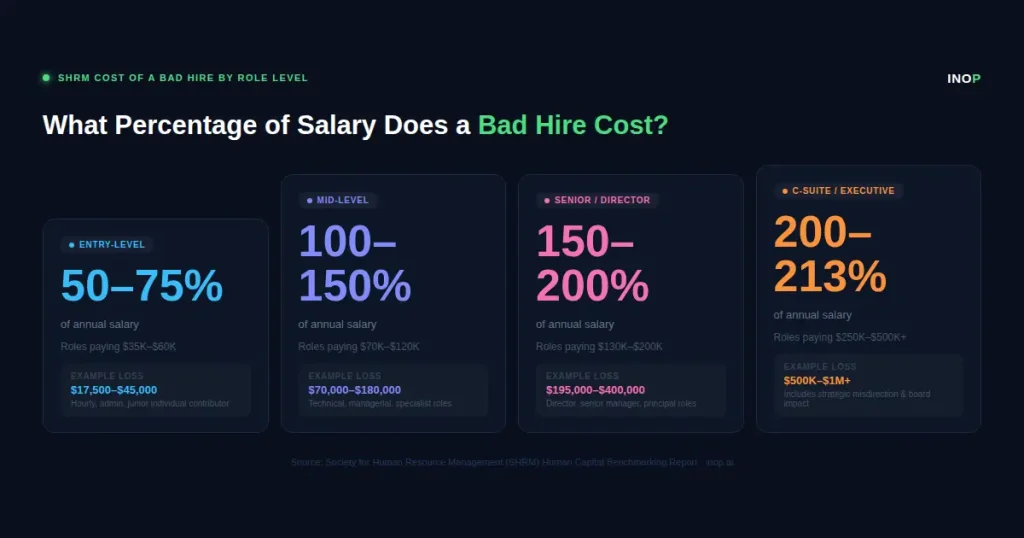
The Numbers: How Much Does a Bad Hire Actually Cost?
Let’s ground this in data, because the figures are sobering. According to the U.S. Department of Labor, the cost of a bad hire can reach up to 30% of the employee’s first-year salary. For a mid-level role paying $80,000 per year, that’s $24,000 minimum. For senior positions, the figure climbs dramatically. The Society for Human Resource Management (SHRM) estimates that replacing an employee costs between 50% to 200% of their annual salary, depending on seniority and specialization. A LinkedIn survey found that 85% of hiring professionals reported that a bad hire negatively affected the entire team, not just the company’s balance sheet. In a 2024 CareerBuilder study, nearly 75% of employers admitted to having made a bad hire, and the average reported loss per bad hire was $17,000. For executive-level positions, that average jumps to $240,000 or more when you factor in all related costs. These aren’t just statistics. They represent real budget losses that your competitors are avoiding while you’re absorbing them.SHRM Cost Per Hire: Non-Executive Roles and the 3x-4x Multiplier
A common question among talent acquisition teams is how these financial penalties differ by role level. According to SHRM, the baseline average cost per hire for non-executive roles is approximately $4,700. However, bringing on the wrong person triggers a costly domino effect. For non-executive employees, a bad hire can easily cost an organization 3 to 4 times their base salary when you factor in disruption, wasted onboarding, and lost opportunity. Meanwhile, replacing executive-level positions can reach up to 200% to 213% of their annual salary, turning a simple mistake into a quarter-million-dollar loss.The CareerBuilder $17,000 Benchmark
While percentages provide a solid framework, many employers look for hard dollar averages. A highly referenced benchmark from CareerBuilder found that the average cost of a single bad hire is nearly $17,000. For small to mid-sized businesses, absorbing a $17,000 loss on a single mis-hire can wipe out entire quarterly training or software budgets. Furthermore, this benchmark often acts as a conservative baseline; when factoring in leadership roles or highly specialized technical positions, that number easily scales upwards. These losses are happening inside your organisation right now. Most companies don’t discover a mis-hire’s true cost until after the damage is done, when a team is already stretched, morale is sliding, and a replacement cycle has begun. INOP models hiring risk before you make the decision: flagging capability mismatches, surfacing hidden gaps, and quantifying the cost of inaction in terms your board and CFO can act on.Every mis-hire is a decision made without the full picture. Book a demo to see how INOP’s strategic workforce planning platform models the true cost of a capability gap and the return on closing it, before the budget is spent.

Looking Back: Cost of Bad Hires Statistics 2024
To understand how rapidly recruitment risks are escalating, it helps to look at the baseline cost of bad hire statistics 2024 provided. The year 2024 served as a major turning point, highlighting how tighter labor markets, the rise of remote work, and inflation drove up the price of hiring mistakes:- The 3x Salary Multiplier: A 2024 LinkedIn study revealed that replacing a bad hire could cost an organization up to three times the employee’s annual salary when factoring in recruitment, onboarding, lost productivity, and the subsequent damage to team morale.
- Rising Average Cost Per Hire: In 2024, baseline hiring expenses surged. Data from the Society for Human Resource Management (SHRM) noted that the average cost simply to bring on a standard employee had risen to $4,700 (a 14% increase from pre-pandemic levels). Executive-level cost per hire averaged a staggering $28,329, meaning a bad hire at the senior level compounded into a massive financial loss.
- The 74% Regret Rate: A widely cited CareerBuilder study from that year showed that 74% of employers admitted to hiring the wrong person for a role. On average, companies reported losing between $14,900 and $17,000 on every poor hiring decision in direct costs alone.
- The 17% “Supervision Tax”: The operational drag in 2024 was immense. Research highlighted that managers spent an average of 17% of their workweek supervising, documenting, and correcting the mistakes of poorly performing hires. In hybrid and remote environments, this leadership capacity drain was often even higher.
Breaking Down the True Cost of a Bad Hire
The real cost of a bad hires is layered. Think of it less like a single line item and more like a series of financial ripples spreading outward from the moment the wrong person joins your team.Recruiting and Onboarding Costs
This is the most visible part. It includes job board advertising fees, recruiter commissions (often 15–25% of first-year salary for agency hires), background checks, pre-employment assessments, and the time your HR team and hiring managers spend reviewing résumés and conducting interviews. Once someone is hired, onboarding costs kick in, orientation programs, training materials, IT setup, and the time spent by experienced team members to bring the new hire up to speed. Research from the Brandon Hall Group shows that strong onboarding programs improve new hire retention by 82%, which tells us that poor onboarding compounds the risk of a bad hire becoming an expensive one. If that employee leaves within six months (voluntarily or not) you repeat this entire cycle from scratch.Lost Productivity and Opportunity Cost
While a bad hire is underperforming, the work still needs to get done. That means colleagues absorb the slack, managers spend extra time coaching and correcting, and deadlines slip. A Gallup study found that disengaged employees cost businesses $3,400 for every $10,000 in salary through lost productivity alone. Beyond individual output, consider what your team could have accomplished with a great hire in that seat. Missed projects, delayed launches, stalled client relationships, these opportunity costs rarely appear on a balance sheet, but they are very real.Training Investment
The average U.S. company spends approximately $1,300 per employee per year on training, according to the Association for Talent Development. For specialized or technical roles, this figure can be several times higher. When a bad hire leaves, every dollar invested in their development walks out the door with them.Management Time Drain
This cost is invisible on most spreadsheets but deeply felt by managers. When an underperforming employee is on the team, management time shifts from strategy and leadership to documentation, performance improvement plans, HR consultations, and conflict resolution. A 2023 Harvard Business Review report found that managers spend an average of 17% more time managing a poor performer than a solid one, time that is never recovered. The 17% management tax is invisible on your P&L, but it’s real. When your best managers are spending nearly a fifth of their week correcting, documenting, and managing a poor fit, you’re not just losing that time, you’re losing what they would have built instead. INOP gives talent and operations leaders a live picture of workforce capability so hiring decisions are made on verified data, not gut feel.Team Morale and Cultural Damage
This is arguably the most lasting damage a bad hire can inflict. When a new person disrupts the team (through negativity, inconsistent performance, or behavior that breaks trust) the ripple effect can cause top performers to disengage, seek other opportunities, or explicitly resign. Losing even one high performer because of a bad hire can compound your losses dramatically. If that departing employee earns $100,000 per year and costs 150% of their salary to replace, you’re now looking at an additional $150,000 in replacement costs, all traceable back to one bad hiring decision. Beyond the financial numbers, the intangible toll on mental health and workplace culture is severe. A poor-fitting employee forces your high performers to absorb the slack, leading to heightened stress, burnout, and resentment. When management fails to address an underperformer swiftly, dysfunction becomes normalized. Your best employees start to notice who gets coached, who gets protected, and who gets away with sub-par work. Eventually, your top talent stops raising their hands, and the team’s energy shifts from innovation to mere survival. This cultural decay can ultimately trigger the departure of your most valuable people, exponentially compounding your turnover costs.Legal and Compliance Costs
In cases where a bad hire involves misconduct, discrimination, or negligent hiring (meaning the employer failed to adequately screen the candidate) the financial exposure escalates significantly. Legal fees, settlements, HR investigation time, and potential regulatory penalties can push the total cost of a single bad hire into the hundreds of thousands for mid-size businesses.External Costs: Client Trust and Brand Reputation
The damage of a bad hire rarely stays contained within the HR department. When a poor fit interacts with your clients, vendors, or partners, your company’s reputation is immediately put at risk. A bad hire in a customer-facing role can lead to breached contracts, lost client accounts, and negative public reviews. Rebuilding broken client trust takes far longer than replacing a bad employee, and the lost lifetime value (LTV) of an alienated customer often dwarfs the employee’s base salary.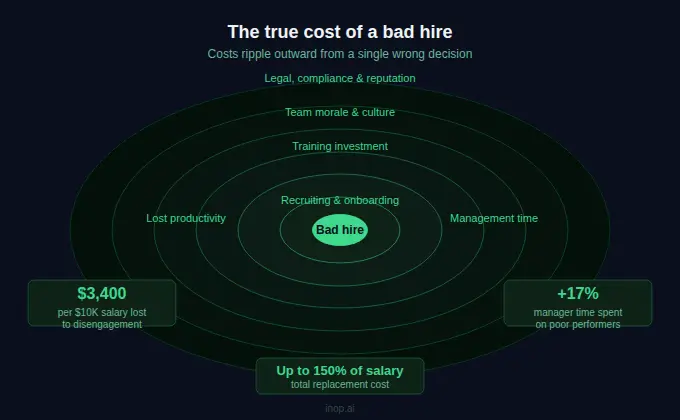
Average Cost Per Hire vs. The True Cost of a Bad Hire
When looking at 2025 and 2026 recruitment statistics, it is crucial to separate the Average Cost Per Hire from the Cost of a Bad Hire. The Average Cost Per Hire (CPH) is the baseline financial investment required to fill an open seat. Recent statistics place the average U.S. Cost Per Hire between $4,000 and $7,000, depending on the industry. This includes recruiter fees, job board ads, and background checks. However, the Cost of a Bad Hire is a compounding expense. If you spend $5,000 (Average Cost Per Hire) to bring someone in, and they fail within six months, you do not just lose that $5,000. You lose their salary paid to date, the training resources consumed, the productivity lost, and you must spend another $5,000 to replace them. This is why a bad hire quickly escalates into the tens of thousands of dollars.The Hidden Costs That Almost Never Get Measured
Beyond the categories above, there are softer costs that rarely make it into post-mortems but are very much real. Client and customer impact: A bad hire in a client-facing role can damage relationships that took years to build. One poor interaction, mishandled project, or broken promise can cost you a contract worth far more than the employee’s salary. Brand and reputation damage: In the age of Glassdoor, LinkedIn, and social media, disgruntled or underperforming employees often go public. A negative review from a fired employee or a viral story about internal dysfunction can affect both your employer brand and your customer trust. Institutional knowledge gaps: When a bad hire replaces someone excellent and then leaves quickly themselves, the organization loses continuity. Documentation suffers, processes break, and the team must rebuild from an even weaker foundation than before.The Cost of a Bad Pay Decision: When Compensation Errors Compound Hiring Risk
The financial damage of a bad hire does not only originate at the hiring decision itself, it can also be triggered by a bad pay decision made after a good hire is in seat. Underpaying a high performer relative to market creates voluntary attrition that produces the same replacement cost as a bad hire: 50–200% of annual salary in turnover expense, plus lost institutional knowledge and team disruption. Overpaying a mis-hire compounds the bad hire cost in both directions: the salary paid during tenure inflates the direct compensation line in your cost calculation, and internal equity damage, when peers discover the pay differential, can trigger disengagement and departure among your correctly-placed employees. Research from Mercer and Willis Towers Watson consistently shows that organizations with reactive compensation practices (adjusting pay only when employees threaten to leave) spend 2–3x more on total compensation management over five years than those with proactive, data-driven pay structures. In this sense, the cost of a bad pay decision is not a one-time event, it is a compounding annual cost that begins the moment a compensation structure falls out of alignment with market reality.Why Bad Hires Happen: The Root Causes
Understanding the cost of a bad hire is only useful if you also understand why they happen. The most common causes in 2026 include: Rushed hiring processes. Pressure to fill a role quickly (often due to understaffing) leads to shortcuts: fewer interview rounds, minimal reference checks, or skipping assessments altogether. The urgency of filling a seat outweighs the discipline of finding the right fit. At a broader level, these root causes are symptoms of a larger gap in workforce risk management, the strategic discipline of identifying and mitigating people-related threats before they become costly problems. Poorly defined job requirements. When hiring managers can’t clearly articulate what success looks like in a role, it becomes nearly impossible to evaluate candidates accurately. Vague job descriptions attract misaligned applicants and confuse the hiring process. Overreliance on first impressions. Interviews are notoriously poor predictors of performance when not structured carefully. Charm, confidence, and likability are easy to mistake for competence. Neglecting cultural fit. Technical skills are measurable. Cultural alignment is harder to assess but equally important. Ignoring values, communication style, and work preferences in the hiring process is a consistent driver of bad hire outcomes. Inadequate reference checking. Many organizations treat reference calls as a formality. In reality, a well-conducted reference check is one of the most valuable tools in the hiring arsenal, and skipping it is a risk that frequently comes back to bite. Rushed decisions, vague role definitions, and unverified skills are preventable, if you have the right intelligence. The root causes of bad hires aren’t random. They’re structural. INOP maps your workforce against real-time market data, identifies where skill gaps create hiring urgency, and lets you model build-vs-buy decisions before you ever post a job description. Organisations working with INOP reduce mis-hire exposure by removing the guesswork from talent decisions entirely.How to Detect a Bad Hire Early: The 30-60-90 Day Framework
The most expensive bad hires are not the ones who are clearly wrong on day one. They are the ones who last long enough to consume full onboarding investment, generate team disruption, and require a complete replacement cycle before anyone makes a definitive call. The difference between a $20,000 bad hire and a $100,000 bad hire is often simply how long the organization waited before acting.
The 30-Day Signal: Misalignment Indicators Worth Taking Seriously
By day 30, a bad hire almost always produces visible signals that are frequently misattributed to “the adjustment period.” The warning signs at this stage are behavioral and relational rather than performance-based, which is why most managers discount them.
Watch for: an inability to self-direct within defined role parameters (constant questions about what to do next in areas where the role description was clear); a pattern of explaining rather than doing (responding to every coaching moment with context about why the task was hard rather than adjusting the approach); relationships with peers that are notably cooler than typical onboarding period dynamics; and feedback inconsistencies where the new hire’s self-assessment of their own performance diverges significantly from what their work output actually shows.
At 30 days, the intervention cost is still low. A structured 30-day check-in that surfaces these signals explicitly, with documented feedback and a 30-day improvement commitment, costs a few hours of manager time. The same conversation at day 120, with severance, legal review, and replacement cycle factored in, costs $40,000 to $100,000.
The 60-Day Signal: When Pattern Matters More Than Incident
By day 60, the question is no longer whether the signals are real. It is whether they represent a fixable performance issue or a fundamental mismatch. The distinction is important because the financial outcome of the two paths diverges sharply at this stage.
A fixable performance issue has a clear, narrow gap between what was expected and what is being delivered, a coachable root cause (skill gap in a defined area, process unfamiliarity, communication style adjustment needed), and a documented improvement trajectory from week three to week eight showing directional progress.
A fundamental mismatch shows the opposite: broad-based underperformance across multiple dimensions, a pattern of attributing gaps to external factors rather than self-correcting, and no measurable improvement trajectory despite manager investment. The research finding that managers spend 17% of their time on bad hire management is almost entirely generated in the day 30 to 90 window by organizations that mistake a fundamental mismatch for a fixable performance issue.
If the 60-day assessment indicates fundamental mismatch, the cost of continuing is not zero. Every additional month of employment for a confirmed mismatched hire adds approximately $8,000 to $25,000 in loaded cost (salary and benefits plus management time plus team productivity impact), with none of that investment recoverable.
The 90-Day Decision Point: The Financial Case for Acting
By day 90, an unresolved bad hire situation has typically consumed between $30,000 and $60,000 in loaded costs depending on seniority. At this point, the question organizations face is whether to continue investing in recovery or to make a separation decision and begin the replacement cycle.
The financial argument for acting at 90 days rather than 120 or 150 is straightforward. For a role with a $80,000 annual salary, each additional month of continued employment with a confirmed mismatched hire adds approximately $10,000 to $15,000 in loaded costs including management time and team productivity impact. A separation at 90 days versus 150 days saves $60,000 to $90,000 in continued costs before severance, while starting the replacement cycle 60 days sooner.
The psychological barrier to acting is the sunk cost fallacy: the sense that the investment already made in the hire should be recovered before writing it off. In cost accounting terms this is wrong, past investment is not recoverable regardless of the decision. The only financially relevant question at day 90 is the future cost of each available path. An organization that acts at 90 days rather than 180 days on a confirmed mismatched hire consistently produces a total bad hire cost that is 30 to 50% lower than one that waits for certainty that was already available at the earlier decision point.
The Cost of a Bad Hire Formula: How to Calculate Your True Costs
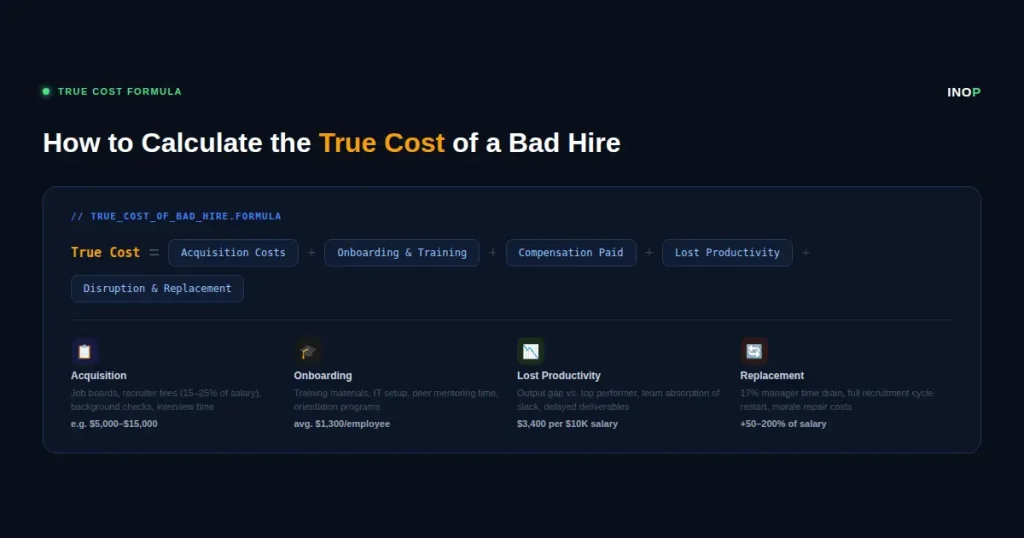
To truly understand the financial impact on your specific organization, you need a reliable, actionable framework. You can use the following formula to calculate your total cost of a bad hire internally: True Cost of a Bad Hire = (Acquisition Costs + Onboarding Costs) + (Compensation Paid) + (Lost Productivity & Opportunity Costs) + (Disruption & Replacement Costs) Acquisition Costs: Job board fees, external recruiter commissions (typically 20-25% of the first-year salary), background checks, and the hourly value of HR and Management time spent reviewing resumes and interviewing.- Onboarding & Training: Cost of training platforms, IT setup, and the time experienced peers spend mentoring rather than producing.
- Compensation Paid: The salary, benefits, and sign-on bonuses paid to the employee before their departure.
- Lost Productivity: The revenue or output lost during their tenure, often calculated as the difference between their output and a top performer’s expected output.
- Disruption & Replacement Costs: The financial value of the time managers spent correcting mistakes, managing conflict, and the entire cost of starting the recruitment cycle over from scratch.
Running the Formula: Two Worked Scenarios
Abstract formulas are easier to act on when someone has already run them once. Here are two worked examples across different seniority levels.
Scenario 1: A Mid-Level Marketing Manager ($85,000 salary)
The hire lasts five months before it becomes clear the role is not working. Here is what the organization actually spent:
Acquisition costs: Agency fee at 20% of salary ($17,000) plus internal interview time (hiring manager and two panelists, 6 hours each at an average of $55 per hour) = $17,990.
Onboarding and training: IT setup and software licenses ($800), orientation program ($400), peer mentoring time (estimated 30 hours from a senior team member at $45 per hour) = $2,550.
Compensation paid: Five months of salary and benefits ($35,400 plus approximately $8,500 in benefits) = $43,900.
Lost productivity: Gallup’s $3,400 per $10,000 salary benchmark applied to five months of underperformance = $11,900.
Management time drain: Hiring manager at $75,000 salary spending 17% of their time on performance management for five months = $5,313.
Replacement cycle restart: Full acquisition cost cycle repeated = $17,990.
Total: $99,643
For an $85,000 role, this bad hire cost 117% of annual salary. Not the theoretical 50 to 75% SHRM quotes for entry-level, because the actual costs compound in ways the percentage formula understates.
Scenario 2: A Senior Data Engineer ($145,000 salary)
The hire lasts seven months. The team absorbs the productivity gap during a critical product launch window.
Acquisition costs: Agency fee at 25% ($36,250), technical interview panel time (four senior engineers at $90 per hour, two rounds each at 4 hours = 32 hours) = $2,880, plus recruiter and coordination time = total $42,000.
Onboarding and training: $1,200 in tooling and access setup, senior engineer mentoring (40 hours at $72 per hour) = $4,080, plus documentation and environment configuration time = $6,000.
Compensation paid: Seven months salary and benefits ($84,600 salary plus $20,000 benefits pro-rated) = $104,600.
Lost productivity: Seven months of underperformance against a senior engineering output benchmark, estimated at 40% of expected contribution = $56,350.
Management time drain: Engineering manager at $130,000 annual salary, 17% of time for seven months = $12,808.
Project delay cost: The team’s failure to meet a feature delivery milestone during this period resulted in a delayed release, conservatively valued at $40,000 in lost revenue and client contract penalties.
Replacement cycle restart = $42,000.
Total: $265,838
For a $145,000 role, this bad hire cost 183% of annual salary, and that estimate excludes the reputational damage to client relationships from the delayed delivery.
The lesson from both scenarios is the same: the percentage-of-salary shorthand significantly understates real costs because it does not capture compounding effects, project delays, or the cost of the replacement cycle running immediately after the first cycle’s expenses.
The Cost of a Bad Hire by Industry and Role Level
Not all bad hires are created equal. The cost scales significantly depending on industry and seniority, which is precisely why smart headcount planning is so critical before you ever post a job opening. In technology, where skill shortages are acute, a bad software engineer hire can cost $150,000 to $300,000 when you include the productivity loss of a 6-month underperformer, the senior engineers who had to compensate, and the full replacement cycle. In healthcare, a bad hire in a clinical or administrative capacity can carry patient safety and compliance risks on top of financial ones, raising costs into territory that includes regulatory fines and liability exposure.The Unique Cost of a Bad Sales Hire
While all bad hires are expensive, a bad sales hire carries a unique financial penalty. If a sales representative is in the market for six months and fails to close deals, the cost is not just their base salary, commission draw, and training time. You must calculate the burned leads, the pipeline mismanagement, and the lost quota capacity. For instance, if a rep has a $1,000,000 annual quota and takes six months to ramp up before ultimately failing, you have lost $500,000 in potential revenue that a competent rep would have secured. Add to that the potential permanent loss of alienated prospects to competitors, and a bad sales hire is arguably one of the most dangerous risks to top-line growth.Cost of a Bad Hire in Financial Services
In financial services, banking, insurance, asset management, a bad hire carries regulatory compliance risk on top of performance cost. A licensed professional who misrepresents credentials or mishandles client accounts can trigger regulatory investigations, client loss, and fines that dwarf their base salary. For mid-level relationship managers or advisors with a book of business, a bad hire can permanently damage client relationships representing millions in AUM, making this one of the highest-risk industries for mis-hire exposure.Cost of a Bad Hire in Manufacturing and Operations
In manufacturing, the cost of a bad hire in a supervisory or quality control role extends beyond the individual’s salary to production line efficiency. A supervisor who introduces process shortcuts or fails to enforce quality standards can cause defect rates to rise across entire production runs, damage that compounds daily and may not be detected until a downstream quality audit. Industry benchmarks suggest that operations bad hires in supervisory roles cost 75–125% of annual salary when production efficiency losses are included.Cost of a Bad Hire at the Executive Level: The Full Breakdown
Executive bad hires deserve their own detailed treatment because the cost structure is fundamentally different. Beyond the 200–213% of salary replacement cost, executive mis-hires carry: strategic misdirection costs (flawed initiatives that take 12–24 months to reverse), key talent attrition triggered by leadership dissatisfaction, board and investor confidence erosion, and in some cases legal exposure from decisions made during tenure. A CFO mis-hire at a $100M revenue company can, in an extreme case, produce financial reporting errors or capital allocation mistakes that materially affect company valuation, a cost that cannot be expressed as a multiple of their $300,000 salary. At the executive level, the equation becomes most severe. A poorly matched C-suite hire can reshape company culture in damaging ways, make strategic decisions that take years to undo, and trigger departures of key talent who no longer trust leadership. The financial formulas for bad hire cost are the same regardless of company size, but the proportional impact scales dramatically as organizations get smaller. For a Fortune 500 company, a $50,000 bad hire at the mid-level costs $50,000–$100,000 in total exposure. This is a meaningful cost but one that can be absorbed within a large HR and operational budget without existential consequences. For a 50-person company, the same hire represents a far larger percentage of total payroll, often requiring the CEO or founding team to directly absorb management time that was otherwise allocated to growth. The ripple effect through a small team, morale disruption, peer overload, cultural damage, is proportionally more severe when there are fewer people to distribute it across. For a 5-person startup, a single bad hire can alter the company’s trajectory. One disruptive team member in a founding team of five changes team dynamics by 20%. One skills-misrepresenting engineer in a technical founding team can delay product launches by months. At this scale, the true cost is not just financial, it is existential in the sense that it can determine whether a funding round succeeds or a product ships on time. This is why hiring rigor, counterintuitively, matters most to the organizations with the fewest resources to apply it.How to Reduce the Risk of a Bad Hire
The goal isn’t perfection, no process eliminates hiring risk entirely. But structured, intentional hiring practices can dramatically reduce the frequency and severity of bad hires. Use structured interviews. Standardized questions evaluated against defined criteria remove much of the subjectivity that leads to poor decisions. Behavioral interview questions (“Tell me about a time when…”) are especially effective at revealing how candidates actually perform, rather than how they describe themselves. Invest in assessments. Skills-based testing, cognitive ability assessments, and personality frameworks (used appropriately) provide data points beyond the interview. Many platforms offer role-specific simulations that show you how a candidate will actually work. Slow down to speed up. Counterintuitively, taking an extra one to two weeks to fill a role correctly almost always saves months of management headaches and thousands in turnover costs. Prioritize cultural alignment. Include team members in the interview process who can assess whether a candidate will genuinely thrive in your environment, not just perform the technical duties. Check references seriously. Don’t just ask “Is this person rehireable?” Dig into specifics: How did they handle conflict? What type of management did they thrive under? What would they need to improve? Improve onboarding. Even the right hire can become a bad hire if they’re dropped into a sink-or-swim environment. A structured 30-60-90 day onboarding plan significantly improves retention and ramp-up time. Explore more: workforce planning case studyThe ROI of Getting Hiring Right: What Prevention Actually Pays
Every dollar invested in hiring process improvement should be evaluated against the cost of the mistake it prevents. The math is consistently in favor of investment, but most organizations never run it explicitly. Here is the framework.
The Prevention ROI Formula
Prevention ROI = [(Cost of Bad Hire Avoided minus Cost of Improved Process) divided by Cost of Improved Process] multiplied by 100
Applied to a realistic mid-market scenario: if your organization’s average bad hire cost at the mid-level is $90,000 (consistent with the worked scenario above), and you invest $8,000 annually in structured assessment tools, skills verification, and interview training, avoiding a single bad hire produces an ROI of 1,025%.
That figure holds even when you apply conservative assumptions. If your process improvement only reduces bad hire frequency by 50% rather than eliminating it entirely, and your average bad hire costs $60,000 rather than $90,000, a $10,000 annual process investment still generates a 200% ROI from one prevented mis-hire alone.
What the Investment in Better Hiring Actually Buys
The ROI calculation is most useful when it is tied to specific process changes with known costs. Here is what the prevention investment typically covers and what each element returns:
Structured interview training for hiring managers, typically a one-time investment of $500 to $2,000 per manager, reduces subjective bias that is the root cause of culture mismatch bad hires, which represent the most expensive category because they stay longest before departure.
Skills verification and assessment tools, running $3,000 to $15,000 annually depending on volume, prevent the skill misrepresentation category of bad hire, which accounts for approximately 29% of bad hire cases according to CareerBuilder’s manager survey data.
A 30-60-90 day onboarding structure, which costs primarily in manager time investment upfront, dramatically reduces early departure bad hires by surfacing misalignment in the first 30 days when intervention cost is still low rather than at month five when replacement cost is fully loaded.
Reference check protocol redesign, essentially zero cost, prevents a meaningful share of bad hires because studies consistently show that 80% of bad hire outcomes could have been predicted from a properly conducted reference conversation that most organizations are not conducting rigorously.
How INOP Shifts the Calculation
The bad hire cost formula changes structurally when workforce decisions are made from verified skills intelligence rather than from interview impression and credential matching. When INOP’s skills intelligence platform surfaces the capability gap between what a candidate claims and what the role actually requires, the most expensive category of bad hire, the skill misrepresenter who lasts long enough to cause full financial damage, is identified before the offer is made rather than six months after onboarding. The ROI of that intelligence is not a $5,000 platform fee avoided by one prevented bad hire. It is the compounding return of every mis-hire prevented across every role over every planning cycle.
For organizations that want to see how INOP quantifies hiring risk before a decision is made rather than after it compounds, the strategic workforce planning platform models the cost of capability gaps and the financial case for closing them through development versus external hire versus doing nothing. Book a 20-minute demo to run this against your own open roles.
Moving Beyond Resumes: How AI Prevents Costly Bad Hires in 2026
Traditional hiring relies heavily on resumes and gut-feeling interviews, which are exactly what lead to the staggering costs of bad hires. To truly mitigate these financial risks, modern HR teams are moving toward skills-first, AI-driven talent matching. By utilizing advanced platforms to analyze deep skills, cultural alignment, and verifiable experience before an offer is ever extended, companies can drastically reduce their mis-hire rate. Investing in predictive talent intelligence not only protects your bottom line from the 30% penalty of a bad hire, but it also ensures you are building a resilient, high-performing team from day one.Final Thoughts: Hire Slow, Hire Right
The cost of a bad hire in 2026 is not just a line item on a spreadsheet, it’s a compound event that touches your finances, your team, your clients, and your culture. The numbers are significant: tens of thousands for junior roles, hundreds of thousands for senior ones, and potentially far more when you factor in the secondary effects. The good news is that bad hires are largely preventable. Structured processes, honest evaluation, and a genuine commitment to cultural fit will reduce your risk substantially. Every hour invested in getting hiring right pays for itself many times over. If this article has helped you see hiring through a new lens, share it with a colleague who’s building or scaling a team, the insights here could save them from a very expensive mistake. And if you’re looking to tighten up your own hiring process, explore our related resources on structured interviewing, onboarding best practices, and building a resilient talent strategy. Because in the end, the best hire you can make is the one that works out, and the best money you can spend is on not having to hire the same role twice.Frequently Asked Questions
What Qualifies as a “Bad Hire”?
A bad hire isn’t just someone who gets fired. It is any new employee who fails to meet the expectations set at the time of hiring, whether due to skill misalignment, cultural incompatibility, poor attitude, dishonesty, or simply the wrong fit for the role. These typically fall into a few patterns: the skill misrepresenter, the culture mismatch, the disengaged employee, and the early departer.
What Percentage of Salary Does a Bad Hire Cost?
As a conservative baseline, the U.S. Department of Labor states that a bad hire costs at least 30% of their first-year salary. However, when factoring in lost productivity, onboarding time, and management drain, the Society for Human Resource Management (SHRM) estimates costs range from 50% to 75% for entry-level employees, 100% to 150% for mid-level technical or managerial roles, and 200% to 213% for C-suite and executive leadership positions.
How Much Does a Bad Hire Actually Cost?
According to CareerBuilder benchmark data, the average financial loss per bad hire is nearly $17,000 for entry-level to mid-level roles. For highly specialized or executive-level positions, that average jumps dramatically to $240,000 or more when factoring in all associated costs.
What is the source of the 30% Rule?
The widely cited “30% rule” originates from the U.S. Department of Labor’s historical guidelines on the financial impact of employee turnover. It focuses heavily on the direct, hard costs of recruiting, interviewing, and basic onboarding. HR practitioners often note that this 30% represents a conservative floor that excludes massive hidden costs like lost productivity and team burnout.
How can compensation models create bad hires?
A title-based pay structure that rewards seniority and position rather than demonstrated capability can attract candidates who are optimized for negotiating salary rather than building skills. This creates a gap between what the organization is paying for and what it actually gets. Organizations that instead pay for verified competencies can better align compensation with demonstrated ability and attract candidates motivated by skill development.
Does overlooking internal candidates increase the risk of a bad hire?
Yes. Organizations that default to external recruitment without systematically assessing internal capabilities increase their risk by drawing from a pool of unknowns. Finding an external hire costs an average of $4,000 and takes 42 days, whereas tapping into “hidden talent” already on the payroll usually results in lower onboarding costs, faster time to productivity, and significantly less cultural risk.