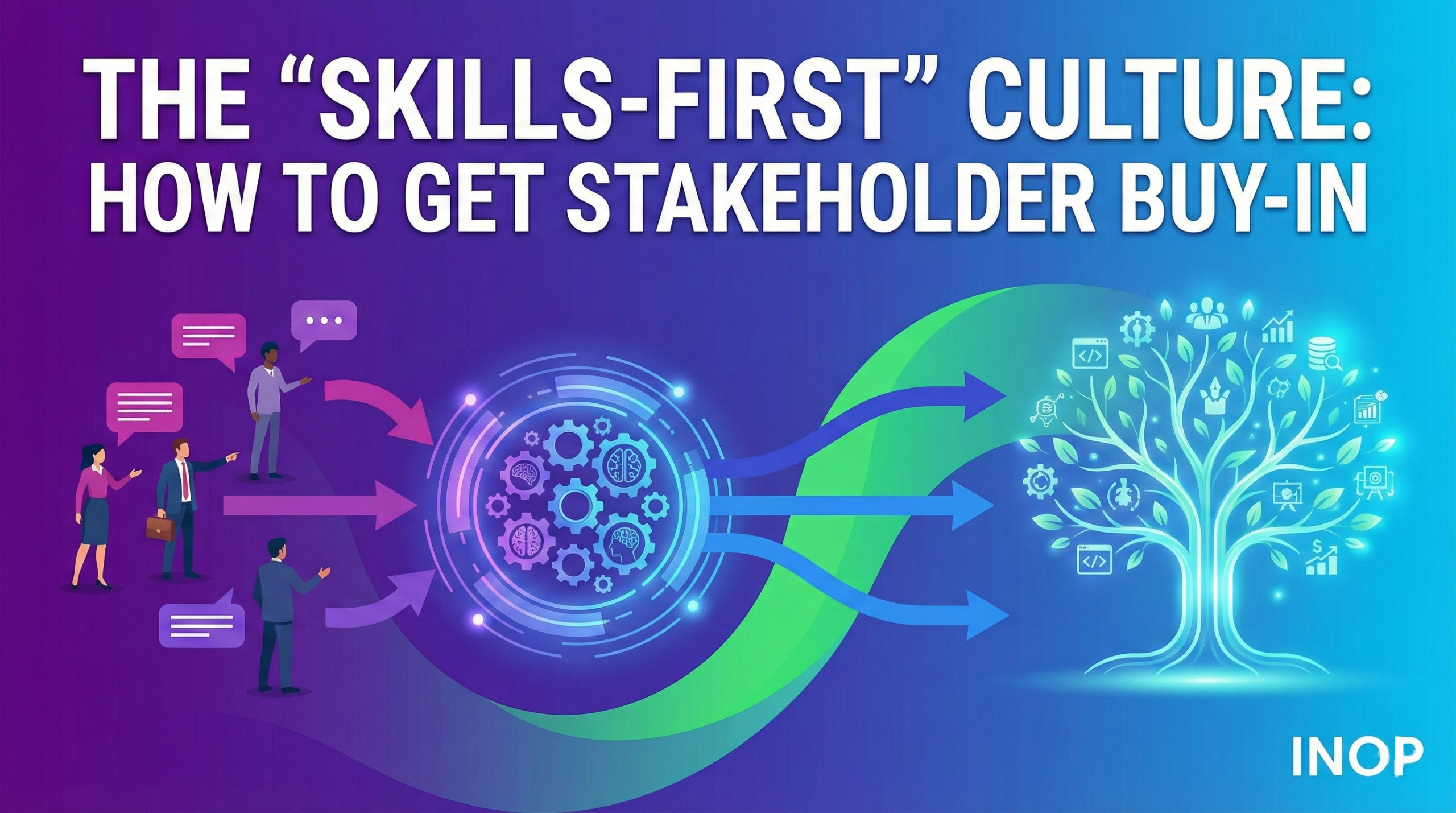
Here’s a sobering reality check: 70% of digital transformations fail, not because of faulty technology or poor planning, but because of resistance from the very people who are meant to benefit from them, employees. Now, imagine trying to shift your entire organization from rigid job descriptions to a fluid, dynamic skills-first model. It’s not a simple software upgrade or a new HR policy. It’s a fundamental transformation that touches every corner of your workforce, from the C-suite to frontline employees. The difference between reskilling vs upskilling becomes critical in this context, as leaders must strategically decide where to invest resources to build capabilities that don’t yet exist versus enhancing the ones already present.
This article isn’t about the theoretical benefits of skills-based organizations, you’ve likely already read those. Instead, we’re diving into the practical, messy reality of how to actually get your stakeholders on board. We’ll apply proven change management principles to navigate the cultural shift from traditional job frameworks to a skills-first approach, addressing the unique concerns of executives, middle managers, and employees along the way.
The Vision: Defining the Destination
Before you can convince anyone to join you on this journey, you need to be crystal clear about where you’re headed. A skills-first organization isn’t simply a company with cleaner HR data or a fancier learning management system. It’s an entity built for agility in an unpredictable market.
In a traditional organization, talent is locked into predefined roles. When priorities shift, whether due to emerging technologies, market disruptions, or strategic pivots, companies scramble to hire externally or reorganize entire departments. A skills-based organization, by contrast, can rapidly redeploy internal talent based on verified capabilities rather than job titles. It’s the difference between owning a toolbox with labeled compartments versus dumping all your tools in a pile and hoping you find the right one when you need it.
The end state you’re moving toward includes:
- Dynamic talent marketplaces where employees can apply for projects based on skills, not just formal qualifications
- Transparent career pathways that show employees exactly which skills they need to develop for advancement
- Data-driven workforce planning that identifies skills gaps before they become business bottlenecks
- Agile team composition that can be assembled and reassembled as business needs evolve
This transformation requires structural changes to your HR systems, technology infrastructure, and data architecture. Understanding the full scope of what needs to change, from skills taxonomies to talent management platforms, provides the foundation for the cultural work ahead.
According to a 2023 Deloitte study, organizations with mature skills-based practices are 98% more likely to retain high performers and 107% more likely to place talent effectively. These aren’t marginal improvements; they’re competitive advantages that compound over time. To understand the full scope of the structural changes required before you start the cultural work, review our [The Complete Guide to Building a Skills-Based Organization].
Winning the C-Suite: The ROI Argument
Executive teams don’t resist change because they’re stubborn. They resist it because they’ve seen too many HR initiatives consume resources without delivering measurable business outcomes. To them, your skills-first proposal initially looks like another expensive project with vague benefits and a timeline measured in years.
The barrier you’re facing isn’t philosophical, it’s financial. Executives view most HR projects as cost centers, not revenue drivers. Your job is to reframe the conversation entirely.
Speaking the Language of Risk and Return
Static job descriptions represent a business risk, that most executives haven’t quantified. When your talent strategy is built around fixed roles, you’re essentially betting that the skills your company needs today will be the same skills it needs tomorrow. In industries experiencing rapid technological change, this is a losing bet.
Consider this real-world scenario: A financial services company maintained traditional IT job descriptions even as their business shifted toward cloud architecture and data science. When they finally needed to build new capabilities, they discovered that 40% of their IT workforce had outdated skills that didn’t align with strategic priorities. The cost? $12 million in external hiring and six months of delayed product launches, all because they couldn’t see or mobilize the skills already within their walls.
Now flip the script. Present skills as a strategic asset class. Just as executives track financial capital and physical assets, they should track human capital with the same rigor. A skills-first approach enables:
- Reduced time-to-fill for critical positions (30-50% faster by tapping internal talent)
- Lower cost-per-hire by prioritizing internal mobility over external recruitment
- Decreased turnover among high performers who see clear development pathways
- Increased strategic agility to respond to market changes without wholesale reorganization
When presenting to the C-suite, come armed with specific financial projections. If your organization spends $5 million annually on external recruiting, show how even a 20% reduction through internal mobility translates to $1 million in savings. If you’re investing heavily in learning and development without connecting it to business outcomes, demonstrate how a skills-first approach optimizes your L&D spend by targeting the specific capabilities that drive strategic goals. The financial modeling around reskilling vs upskilling decisions becomes particularly important here, executives need to see how you’re allocating resources between building entirely new capabilities versus deepening existing ones.
Executives want to know how this impacts the bottom line. Show them how a skills-first approach optimizes your L&D spend. We broke down the financial modeling in our article on [Reskilling vs. Upskilling: Where to Invest Your Budget].
Winning the Middle Managers: Thawing the Frozen Middle
If executives are the gatekeepers of resources, middle managers are the gatekeepers of implementation. You can secure executive sponsorship and employee enthusiasm, but if your middle management layer resists, your transformation will stall in the most frustrating way possible, slow, quiet sabotage disguised as operational priorities.
Understanding the Manager’s Dilemma
Middle managers aren’t being difficult when they resist skills-based practices. They’re being rational actors responding to the incentive structures you’ve built. In most organizations, managers are evaluated on their team’s performance and their ability to deliver results. When you introduce skills transparency and internal mobility, managers perceive, often correctly, that you’re asking them to:
- Invest time in developing employees who might then be “poached” by other departments
- Take on additional administrative work (skills tagging, assessments, development plans) without reducing their other responsibilities
- Potentially lose their best performers to lateral moves that benefit the organization but hurt their team
This is called talent hoarding, and it’s not a character flaw, it’s a predictable response to misaligned incentives.
for better understanding we suggest to read the guide to decide whether to use job-based or person-based structures.
The WIIFM Approach: What’s In It For Me?
To win over middle managers, you need to make the skills-first approach clearly beneficial to their day-to-day reality, not just the organization’s long-term vision.
Faster, Better Hiring: Instead of posting a job requisition and waiting 60 days for HR to source external candidates, a manager with access to skills data can identify internal candidates within 48 hours. One manufacturing company reduced their average time-to-fill from 52 days to 18 days by implementing internal talent marketplaces, allowing managers to fill critical gaps without the usual recruitment bottlenecks.
Improved Performance Management: Many managers privately admit they don’t have full visibility into what their team members can actually do. They rely on assumptions, past projects, and informal conversations. A skills-based system gives them an evidence-based view of their team’s capabilities, making it easier to assign the right person to the right project and identify development needs before they become performance issues.
Enhanced Team Planning: When managers can see not just who reports to them but what skills they collectively possess, they can make smarter decisions about taking on new initiatives, identify risks, and build more resilient teams.
The key is to make these benefits tangible during pilot phases. Select champion managers who are already frustrated with traditional hiring and development processes. Show them quick wins. Document the time they save. Then let them become advocates to their peers.
Winning the Employees: Building Psychological Safety
While executives worry about ROI and managers worry about resources, employees worry about something more fundamental: their livelihoods. When you announce a new system that will “capture everyone’s skills,” you’re triggering very real fears, especially in an age of AI-driven automation and regular workforce restructuring.
Addressing the Surveillance Concern
Employees often perceive new HR systems as monitoring tools. The unspoken question in their minds: “Is the company building a database to figure out who’s redundant?” This fear isn’t irrational. Many organizations have used workforce analytics to inform layoff decisions, and employees have long memories.
Your change management strategy must address this head-on with transparency and consistency. The narrative you need to establish is simple: This isn’t about surveillance; it’s about visibility.
Consider how one global technology company framed their skills initiative during town halls: “You can’t be promoted for skills nobody knows you have. You can’t be considered for exciting projects if your capabilities are invisible to the organization. This system puts your hidden talents on the map and in front of decision-makers who are looking for exactly what you can do.”
Creating Opt-In Moments and Agency
While you ultimately need comprehensive skills data across the organization, the rollout shouldn’t feel mandatory and punitive. Create opt-in moments where employees see immediate, personal value:
- Allow employees to create skills profiles that surface opportunities they’re interested in
- Show them how the system matches them to projects, mentors, or development programs
- Give them control over what skills they want to develop next, rather than having growth plans imposed on them
One professional services firm piloted their skills platform with employees who had expressed frustration about being pigeonholed in their current roles. These individuals became enthusiastic adopters because they saw the system as a tool for career expansion, not corporate surveillance. Their authentic testimonials during the broader rollout were more effective than any corporate communication.
The Data Privacy Commitment
Be explicit about how skills data will and won’t be used. Put it in writing. Commit that skills profiles won’t be the primary factor in layoff decisions (performance, business needs, and tenure will remain primary considerations). Guarantee that employees own their development journey and can update their profiles as they grow.
When employees trust that the system exists to expand their opportunities rather than limit them, adoption becomes natural rather than forced.
The Rollout Strategy: A Phased Approach
Even with stakeholder buy-in, implementation strategy determines success or failure. The most common mistake organizations make is attempting a “big bang” launch, rolling out the complete skills framework to the entire company simultaneously. This approach almost always fails because it overwhelms systems, people, and processes.
Instead, adopt the ADKAR change management model: Awareness, Desire, Knowledge, Ability, and Reinforcement.
Phase One: Awareness
Before you ask anyone to change behavior, they need to understand why change is necessary. This phase focuses on creating a compelling narrative about the business imperative.
Use multiple communication channels: town halls where leaders explain the strategic rationale, newsletters that share success stories from other organizations, and team meetings where managers can address specific concerns. The message should be consistent: The world of work is changing rapidly, and our current systems can’t keep pace with the skills we need to compete.
Avoid HR jargon. Instead of talking about “skills ontologies” and “taxonomy frameworks,” talk about helping people, grow their careers and helping the business adapt to changing markets.
Phase Two: Desire
Awareness, alone doesn’t create change. People need to want to participate. This is where pilot programs with champion teams become critical.
Identify departments or teams, that are already frustrated with traditional talent management. Maybe it’s a fast-growing product team that can’t hire quickly enough, or an innovation group that constantly needs diverse skills for experimental projects. Give them early access to the skills platform, provide white-glove support, and obsessively track their success metrics.
When these champions report back that they filled positions 40% faster, or that team members found development opportunities they didn’t know existed, you’ve created organizational desire. Success stories from peers are infinitely more persuasive than executive mandates.
Phase Three: Knowledge and Ability
Now you’re ready to scale. This phase requires comprehensive training on how to actually use the new skills taxonomy, assessment tools, and opportunity marketplaces.
Don’t make the mistake of assuming this is intuitive. Create role-specific training:
- For employees: How to build your skills profile, find opportunities, and plan development
- For managers: How to search for skills, assess team capabilities, and support employee growth
- For HR partners: How to use skills data for workforce planning and talent decisions
Make the training practical, not theoretical. Use real scenarios from your organization. Show actual screens and workflows. Provide job aids and quick reference guides.
Phase Four: Reinforcement
This is where most transformations lose momentum. After the initial launch excitement fades, old habits creep back unless you actively reinforce new behaviors.
Reinforcement requires embedding skills-first practices into your existing talent processes:
- Update performance review templates to include skills development as a core evaluation criterion
- Modify promotion criteria to emphasize skills growth, not just time in role
- Celebrate “skills mobility” stories in company communications, when Jane from Customer Support moves to Product Management because her skills profile revealed her UX research capabilities, make it visible
- Incorporate skills-based succession planning into leadership discussions
One pharmaceutical company created a quarterly “Skills Spotlight” where they featured employees who had successfully transitioned to new roles through their skills platform. These stories reinforced that the system was real, working, and creating tangible career opportunities.
Common Pitfalls in HR Transformation
Even with strong stakeholder buy-in and a phased rollout, certain traps can derail your skills-first transformation. Being aware of them helps you avoid or mitigate their impact.
The “Big Bang” Failure
We’ve touched on this, but it bears repeating because it’s so common. Organizations get excited about their new skills platform and want to show immediate, company-wide impact. They mandate that all 10,000 employees complete skills profiles within 30 days. The result? Overwhelmed employees, incomplete data, frustrated managers, and a system that’s seen as burdensome rather than beneficial.
Start small, Prove value, Then scale deliberately.
Taxonomy Fatigue
Skills taxonomies can contain hundreds or thousands of skills. Asking employees to manually review and tag themselves against all relevant skills is cognitively exhausting and produces low-quality data.
Instead, use AI and inference engines to suggest skills based on job history, completed projects, certifications, and learning activities. Present employees with a pre-populated profile that they can confirm, edit, or expand. This reduces friction dramatically, people are much more willing to spend 10 minutes refining a suggested profile than 60 minutes building one from scratch.
Lack of Executive Sponsorship
If your CEO, CFO, and CHRO aren’t actively talking about skills in company meetings, strategy sessions, and leadership communications, your transformation will lack the institutional weight it needs to succeed.
Executive sponsorship isn’t a one-time kickoff speech. It’s sustained, visible commitment. When executives ask about skills gaps in business reviews, reference skills data in strategic planning, and share their own development journeys, it signals that this isn’t an HR initiative, it’s a business imperative.
Ignoring the Technology Foundation
Culture and change management are essential, but they can’t overcome fundamentally broken technology. If your skills platform is clunky, slow, or disconnected from the tools people already use, adoption will suffer no matter how good your communication strategy is.
Invest in user experience. Integrate skills data into the systems where work actually happens, performance management platforms, learning systems, project management tools. Make it as easy as possible for people to engage with skills data without adding extra steps to their workflow.
Misaligned Incentives
If managers are still evaluated solely on retention and team performance, they’ll continue to hoard talent. If employees see colleagues who develop new skills getting stuck in their current roles while external hires get the exciting opportunities, they’ll stop investing in growth.
Your incentive structures, must align with your stated values. Reward managers who develop talent that successfully moves to other parts of the organization. Celebrate employees who reskill into emerging areas. Make internal mobility a marker of career success, not career stagnation.
Measuring Success: Beyond Vanity Metrics
As your skills-first culture takes root, resist the temptation to measure success through vanity metrics like “number of skills in the database” or “percentage of employees with completed profiles.” These numbers tell you about data volume, not business impact.
Instead, track metrics that demonstrate organizational capability:
- Internal mobility rate: What percentage of open positions are filled by internal candidates?
- Time-to-productivity for redeployed talent: How quickly do employees who move into new roles based on skills reach full performance?
- Skills gap closure rate: How fast are you closing identified capability gaps through reskilling and upskilling?
- Employee engagement with development: Are people actively using the platform to find learning opportunities and growth paths?
The distinction between reskilling vs upskilling, becomes measurable here. Reskilling investments should show employees moving into entirely different capability areas, often correlating with strategic pivots or emerging business priorities. Upskilling investments should show deepening expertise in current domains, typically resulting in improved performance metrics within existing roles.
For example, a retail company might reskill store managers into data analyst roles to support their e-commerce expansion, while simultaneously upskilling their existing data team in advanced machine learning techniques. Both are valuable, but they serve different strategic purposes and should be measured differently.
Conclusion: Change Management Is the Bridge to Reality
A skills-first organization isn’t built through technology platforms, taxonomies, or policies alone. It’s built through the patient, deliberate work of change management, winning hearts and minds at every level of your organization.
Executives need to see risk mitigation and ROI. Middle managers need to experience tangible benefits in their daily work. Employees need to feel psychological safety and see genuine opportunities. Each stakeholder group has legitimate concerns that deserve thoughtful responses, not dismissive reassurances.
The organizations that succeed in this transformation are those that recognize it’s fundamentally a human challenge, not a technical one. They invest as much in communication, training, and reinforcement as they do in systems and data. They start small, prove value, and scale based on evidence rather than enthusiasm.
The journey from job-centric to skills-centric won’t happen overnight, and it won’t always be smooth. But in a world where the half-life of skills is shrinking and business models are constantly evolving, building organizational agility through a skills-first culture isn’t optional, it’s existential.
What’s your experience with driving culture change in HR? Share your biggest challenge or success story in the comments below. And if you found this guide helpful, share it with other leaders who are navigating the same transformation.
Frequently Asked Questions
How long does it typically take to fully implement a skills-first culture?
There’s no universal timeline, but most organizations see meaningful adoption within 12-18 months, and mature practices within 2-3 years. The key is not to rush. Quick, forced implementation almost always backfires. Focus on getting pilot programs right, learning from them, and then scaling deliberately. Organizations that try to accomplish everything in 6 months typically end up starting over.
What if employees refuse to participate in creating skills profiles?
This usually indicates a trust problem, rather than a compliance problem. If participation is low, pause and investigate why. Are employees afraid of how the data will be used? Do they see any personal benefit? Is the process too time-consuming? Address the root, cause rather than mandating participation. Sometimes, simply showing employees how the system helped their colleagues find new opportunities, is enough to shift from resistance to enthusiasm.
Should we build our skills taxonomy from scratch or buy a pre-built one?
Most organizations benefit from starting with an industry-standard taxonomy (like ESCO, O*NET, or vendor-provided frameworks) and then customizing it for their specific needs. Building from scratch is expensive, time-consuming, and usually results in something that resembles existing taxonomies anyway. The value isn’t in having a completely unique taxonomy, it’s in having one that’s consistently applied across your organization.
How do we prevent skills data from becoming outdated?
Make skills updates part of regular workflows rather than annual exercises. Integrate prompts into your learning management system (“You just completed this course, would you like to add these skills to your profile?”), performance reviews, and project completion processes. Also, use AI to identify potential skill changes based on activities and surface suggestions to employees for confirmation.
What’s the difference between investing in reskilling vs upskilling, and how do we decide?
Upskilling deepens existing expertise, taking a good Python developer and training them in advanced frameworks. Reskilling creates new capabilities, training that same developer to become a product manager. Your decision should be driven by strategic workforce planning. If you’re entering new markets or adopting new business models, you likely need reskilling. If you’re optimizing existing operations or facing increasing complexity in current domains, upskilling is usually more appropriate. Most organizations need both, but the ratio depends on how dramatically your business is transforming.
How do we handle managers who still resist after we’ve addressed their concerns?
Some resistance will persist despite your best efforts. At a certain point, you need executive sponsorship to make it clear that this is a business priority, not an optional experiment. Work with resistant managers individually to understand specific blockers, but also make it clear through performance expectations and leadership messaging that supporting skills-based practices is part of what it means to be a manager in your organization.