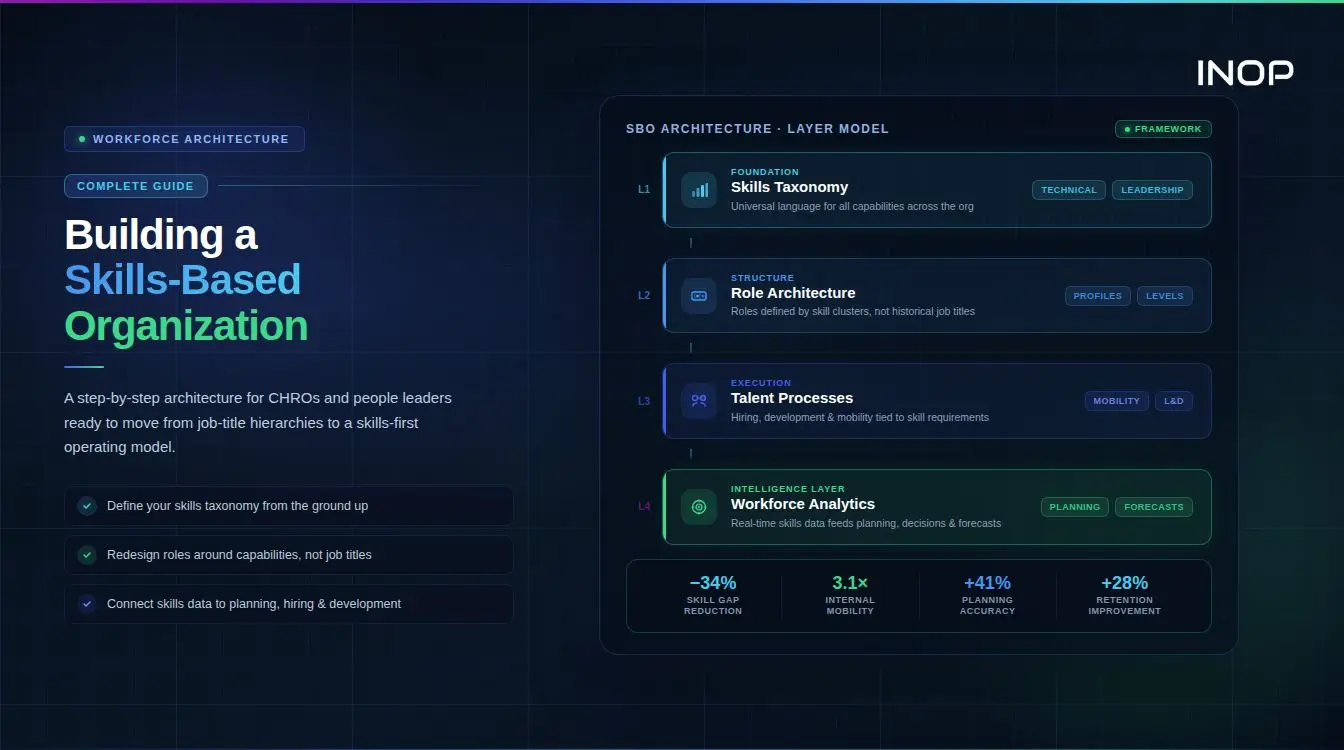
A skills based organization plans work, development, pay, and mobility around what people can actually do, rather than around the job title on their offer letter. It’s a structural shift, not a rebrand: instead of a rigid ladder of fixed roles, work gets defined by the skills it requires, and people get matched to it based on verified capability rather than tenure or title proximity.
This guide covers what a skills based organization actually is, the framework behind building one, the concrete benefits organizations report after making the shift, real examples of companies further along the journey, and the tools HR and workforce leaders use to operationalize it.
What Is a Skills Based Organization
A skills based organization is an operating model where decisions about hiring, development, deployment, and pay are anchored to a defined set of skills rather than to a job description. Most organizations still run almost entirely on job architecture: a role is defined once, a job description is written, and every decision about that seat, who fills it, what they’re paid, where they can move next, gets evaluated against that static definition. A skills based organization inverts that. The unit of analysis becomes the skill, not the job, and a job becomes simply a current bundling of skills that can be reassembled as the work changes.
How a Skills Based Organization Differs from a Job-Based Organization
In a job-based organization, a person’s career path, pay band, and eligibility for a role are all tied to their job title. A skills based organization instead maintains a live skills profile for each employee, verified through assessment, project evidence, or manager and peer validation, and uses that profile to drive the same decisions. The practical difference shows up clearly in internal mobility: in a job-based model, moving into a new role usually means applying and competing against external candidates for a posted opening. In a skills-based model, the organization can proactively surface people whose verified skills already match an emerging need, before a role is ever formally posted.
Beyond Skills: The Task-Level Frontier
Most skills-based organization frameworks operate at the skill level: they map which capabilities employees hold and match those against role requirements expressed as skill clusters. This is a substantial improvement over job-title-based decision-making. But it still misses a more granular and more AI-relevant unit of analysis: the task.
A skill is a capability. A task is what that capability is applied to do. The distinction matters in 2026 because AI automation does not affect skills uniformly across a role. It affects specific tasks within a role, often leaving the underlying skill intact while removing the task that previously provided the primary business value for possessing it. A financial analyst’s SQL skill is not automated by AI. The task of pulling standard monthly reports that SQL was used for is. The analyst still has the skill; the organization no longer needs to staff that task the same way.
Organizations operating at the task level can ask a different and more strategically precise question: which tasks within each role are changing, which capabilities are required for the tasks that will remain or grow, and which tasks can be decomposed from full-time roles into gig assignments, automation handoffs, or AI-augmented workflows?
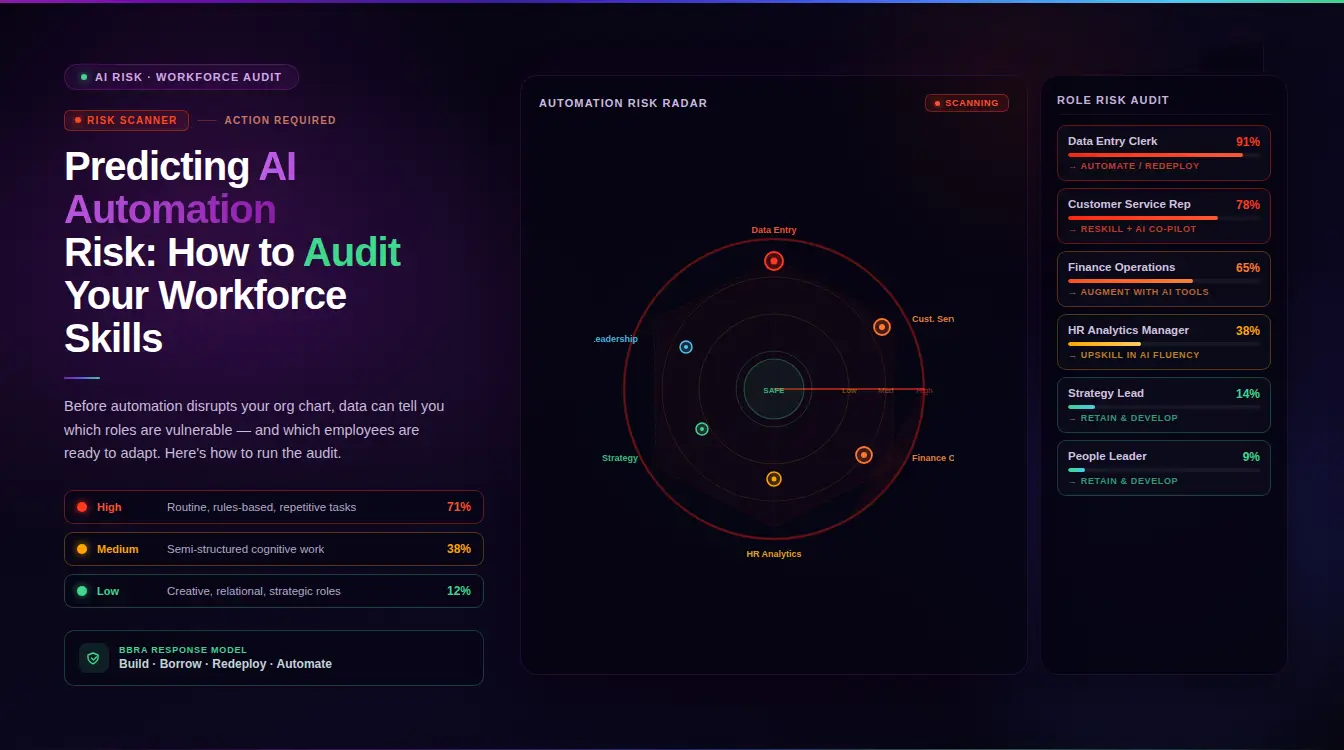
The concept underlying this layer is automation risk scored at the task level: not whether a job title is exposed, but which specific tasks within a role carry exposure to AI or software substitution, and at what pace. This task-level view is what INOP’s AI and Automation intelligence layer provides: role analysis at the task composition level, mapped against automation susceptibility across six dimensions and four time horizons, rather than a blanket assessment of whether a job title is “at risk.” For organizations that have already built a skills-based foundation and want to take the next analytical step, the task layer is where skills intelligence becomes workforce strategy rather than workforce administration.
For organizations that have identified tasks ready for an automation handoff at this level of analysis, the next challenge is execution. AI workforce automation covers why the gap between a task scoring high for automation and an agent running that task reliably in production is wider than most organizations anticipate, and what governance decisions determine which side of that gap a deployment lands on.
Benefits of a Skills Based Organization
The case for making this shift is no longer theoretical. Organizations that adopt a skills-based approach are 107% more likely to place talent effectively and 98% more likely to retain high performers, according to Deloitte’s research on the status of skills based organizations.
The benefits tend to concentrate in four areas. Faster internal deployment: when skills data exists independently of job titles, matching a person to a new project or role takes days instead of the weeks a formal job posting and search process usually requires. Wider access to opportunity: skills-based decisions evaluate what someone can demonstrably do rather than the pedigree markers, degree, prior title, tenure, that job-based systems tend to overweight, which expands the realistic pool of internal candidates for any given need. More accurate workforce planning: a skills-based data layer gives planning teams a granular view of actual capability, rather than the blunt proxy of headcount by job title, which is what strategic workforce planning depends on to be accurate rather than aspirational. Better retention: employees who can see a credible path to their next role based on skills they’re actively developing, rather than a job title they may never be offered, are demonstrably more likely to stay.
Skills Based Organization Framework
Most organizations that have successfully made this shift describe a similar underlying framework, even when the specific tools and sequencing differ.
Skills Taxonomy and Common Language
Everything downstream depends on a shared, structured taxonomy of skills, technical, human, and role-specific, that means the same thing across every business unit. Without this, “data analysis” can mean five different proficiency levels depending on which department is describing it, and no downstream decision built on that data will be reliable.
Assessment and Verification Mechanism
A skills taxonomy is only useful if the organization has a credible way of knowing who actually has which skills at what proficiency level. This typically combines structured self-assessment, manager or peer validation, and, where it matters most, formal skills assessment for critical or high-risk role families.
Internal Talent Marketplace
Once skills data exists and is trusted, organizations need a mechanism that actually surfaces it: an internal marketplace where open projects, gigs, and roles are matched against employee skills profiles, so internal capability gets considered before an external search begins.
Skills-Based Rewards and Compensation
Pay structures built entirely around job titles and grade levels don’t reward someone for developing a scarce, high-value skill unless that skill happens to come with a title change. Mature skills based organizations build compensation mechanisms that can recognize and reward skill acquisition directly, which requires pay data granular enough to price skills, not just roles.
The Credibility Threshold: When the Compensation Gap Breaks the Model
There is a specific moment in a skills-based organization implementation when employee trust collapses if the compensation layer is missing. It does not happen on day one, when the taxonomy is new and the promise is still intact. It happens approximately 12 to 18 months in, when an employee has demonstrated a new skill, had it validated, and then watched a pay review cycle pass without it affecting their compensation.
The employee’s internal reasoning at that point is precise: “The organization asked me to develop this skill. I developed it. They verified it. They are still paying me based on my job title from two years ago. The skills-based model is a development initiative, not a compensation commitment.” Once that conclusion is reached, participation in the skills programme drops, assessment completion rates fall, and the quality of the skills data begins to degrade as the employees who care most about accuracy disengage from the system.
The compensation credibility threshold is reached around the second performance cycle after the skills framework launches. Organizations that do not have at least a partial compensation connection in place by that point typically see participation rate decline of 20 to 35% in the 18 to 24 months following launch.
The connection does not need to be a complete skills-based pay band rebuild, which can take 18 to 24 months to design and implement properly. It can begin with two more limited but visible mechanisms. First, a skill acquisition premium: a defined, documented pay adjustment for employees who demonstrate skills in a short list of high-priority, high-scarcity capabilities that the organization has explicitly identified as strategically critical. This is narrow, affordable, and visible. Second, a skills consideration in merit review: a documented process by which skills development evidence is one of three to five inputs into merit increase decisions, rather than a purely performance-rating-based process. This does not require new pay bands. It requires a documented process change in how managers make merit recommendations.
The goal at this stage is not a perfect skills-based compensation system. It is maintaining the credibility that the organization’s skills investment actually means something to an employee’s career and earnings. The threshold is relatively low: employees need to see that skills development can influence their pay. They do not need to see a complete restructuring of how everyone is compensated.
Governance and Ownership
Someone in the organization needs clear ownership of the skills taxonomy itself, keeping it current as the business and the labor market change, and clear accountability for how skills data gets used in decisions, so the framework doesn’t quietly decay into an unmaintained spreadsheet within a year of launch.
Skills Half-Life by Domain: How Quickly Your Taxonomy Will Decay
One of the most underappreciated inputs to skills taxonomy governance is the half-life of the skills being tracked: how long a given skill retains its market value and organizational relevance before it needs to be reassessed or redefined.
Skills half-life varies enormously by domain, and designing a governance cadence without accounting for this variation produces a taxonomy that is overmaintained in stable areas and catastrophically outdated in fast-moving ones. Based on available labor market research and industry practice:
AI and machine learning skills: 12 to 18 months. The specific frameworks, tools, and model architectures that constitute proficiency in this domain are evolving fast enough that a skill assessed against the 2023 definition of “machine learning intermediate” may not reflect what the 2026 market means by the same label. Any taxonomy that includes AI-adjacent skills needs a quarterly validation check, not an annual one.
Cybersecurity skills: 18 to 24 months. Threat landscape evolution and tooling changes mean that specific technical certifications and platform proficiencies decay relatively quickly, though the underlying analytical and systems-thinking capabilities transfer across generations of tools.
Cloud infrastructure skills: 24 to 36 months. Core cloud architecture principles are more stable than the specific platform features built on top of them, but platform-specific certifications (AWS, Azure, GCP) need regular reassessment as vendors update their service architectures.
Software engineering (general): 36 to 48 months for foundational languages and practices. Language-specific frameworks and toolchain preferences change faster, but the underlying programming capability persists longer.
Data analysis and business intelligence: 36 to 48 months. The tools change (Excel to Tableau to AI-assisted analytics) but the analytical reasoning and data interpretation skills transfer across tool generations.
Professional and management skills: 5 to 8 years for the core capability, though behavioral expectations evolve with organizational culture and market norms. Leadership effectiveness criteria from 2018 may not fully capture what effective leadership looks like in a hybrid, AI-augmented work environment.
Domain expertise (finance, law, engineering, medicine): 5 to 10 years for the conceptual foundation, with continuous update requirements for regulatory, technical, and methodological developments within each field.
These half-life estimates should directly inform your taxonomy governance cadence: skills with shorter half-lives need quarterly validation; those with longer half-lives can be reviewed annually. A single governance cadence applied across all domains will produce an organization that is spending governance effort in the wrong places.
Skill-Based Organization Examples
Unilever is frequently cited as an early and visible adopter, having restructured its approach to internal roles around collections of skills rather than fixed job titles, a shift its HR leadership has described publicly as core to how the company now thinks about internal deployment.
Haier, the appliance and electronics manufacturer, offers a more radical example: rather than a conventional job hierarchy, it operates through small, self-organizing internal units built around skills and outcomes rather than fixed roles, with workers moving between units through an internal talent marketplace as business needs shift.
More typically, the shift looks less dramatic and more incremental: a global professional services firm building a skills taxonomy for a single high-demand practice area first, piloting an internal marketplace within that practice, and only expanding the model enterprise-wide once the pilot demonstrates faster internal fill rates and cleaner workforce planning data. Most successful transformations look far more like this gradual, practice-by-practice rollout than a company-wide reorganization announced on day one.
See how a skills taxonomy turns into a working internal marketplace. Book a demo to walk through INOP’s approach.
Tools That Help HR Leaders Build a Skills Based Organization
| Tool | Best For | Core Function |
|---|---|---|
| Workday Skills Cloud | Enterprises already on Workday | Skills taxonomy and persistent skills graph tied to HCM |
| Gloat | Internal talent marketplace at scale | AI-matched internal mobility and project staffing |
| Degreed | Connecting skills gaps to learning | Skills assessment paired with learning content delivery |
| SkyHive | Labor market benchmarking of internal skills | External skills taxonomy and demand signal mapping |
| Eightfold AI | Enterprise talent intelligence | AI-driven skills inference from work history and activity |
Skills Intelligence and Data Platforms
Workday Skills Cloud and SkyHive both specialize in maintaining a structured, current skills taxonomy, the foundational layer every other part of the framework depends on. SkyHive in particular focuses on mapping internal skills against external labor market demand signals, which matters for organizations that want their internal taxonomy validated against how the broader market defines and values the same skills.
Internal Talent Marketplace Platforms
Gloat and Eightfold AI both specialize in the matchmaking layer: surfacing internal employees for open projects, gigs, and roles based on skills data rather than requiring an employee to know an opening exists and apply for it manually. Eightfold layers in AI-driven skills inference, building skills profiles from work history and project activity rather than relying solely on self-reported or assessed data.
Skills-Based Compensation Platforms
Few platforms handle the compensation side of a skills based organization well, since it requires connecting internal skills data to real market pay data granular enough to price a skill rather than a job grade. This is the layer most skills-based transformations underinvest in, and it’s where the framework tends to stall: an organization can build a taxonomy and a marketplace, but without the ability to actually reward the skills it says it values, the model loses credibility with employees fairly quickly.
Building a Skills Based Organization Without Starting From Hiring
The foundation for any skills assessment programme is a well-constructed competency mapping framework, a structured definition of the specific skills, knowledge, and behaviors required at each proficiency level for each role. Without it, assessment lacks a shared standard, and proficiency scores across managers and teams become incomparable.
Most guides to this topic default to hiring as the entry point: rewrite job descriptions around skills, screen candidates on skills instead of resumes. That’s a reasonable eventual piece of a mature skills based organization, but it’s the wrong place to start, and starting there is a common reason transformations stall. External hiring only ever addresses roles you don’t already have someone for. The faster, cheaper, and more retention-positive place to start is the workforce you already have.
Start With a Skills Taxonomy, Not a Reorg
Build and validate the taxonomy for one business unit or practice area before attempting anything enterprise-wide. A taxonomy built too broadly, too fast, tends to be shallow everywhere and useful nowhere.
Redesign Internal Mobility Before Redesigning Recruiting
Once skills data exists for a business unit, put it to work internally first: surface existing employees for open internal projects and roles before those roles ever reach an external job posting. This is where the fastest, most visible wins tend to show up, and it builds the internal trust needed before extending the model further.
Connect Skills Data to Compensation and Planning
Once the taxonomy and internal marketplace are working, connect that same skills data to compensation decisions and to workforce planning, so skills data becomes the basis for pay and headcount decisions, not just an interesting internal mobility feature sitting off to the side.
Ready to see skills data connected to planning and pay decisions? Book a demo to see how INOP sequences the shift.
Skills Based Organization for PE Portfolio Companies
For private equity operating partners, a skills-based approach to workforce data offers something a job-title-based HR system cannot: a consistent way to evaluate actual workforce capability across multiple portfolio companies, regardless of how inconsistently each one has historically defined and titled its roles. Job titles vary wildly across companies acquired in different deals, at different times, in different industries; skills, evaluated against a common taxonomy, do not.
That consistency matters most in two moments. During diligence and integration planning, a skills-based capability map lets an operating partner assess real redundancy and real gaps across an acquired workforce, rather than relying on job titles that may not accurately reflect what people actually do. And ahead of an exit, a documented, skills-based workforce capability profile is a more defensible basis for the workforce component of a value creation story than a headcount table organized by inconsistent legacy job titles.
Common Pitfalls When Building a Skills Based Organization
Trying to build the taxonomy enterprise-wide on day one. This is the single most common reason transformations stall. A narrower, deeper pilot in one business unit produces faster proof of value than a shallow enterprise-wide rollout.
Treating it as a talent acquisition project. Framing the shift primarily around hiring and recruiting undersells the bigger, faster win sitting in the existing workforce, and tends to produce a project that only HR and recruiting care about, rather than one the whole business sees value in.
Skipping the compensation layer. A skills-based model that never connects to pay eventually loses employee trust, since employees are being asked to invest in developing and demonstrating skills that the organization isn’t actually rewarding.
No clear governance owner. A skills taxonomy with no one accountable for keeping it current decays quickly, and a decayed taxonomy undermines every decision built on top of it.
Measuring adoption instead of outcomes. Tracking how many employees have a skills profile is a vanity metric if it isn’t paired with tracking whether that data is actually changing internal fill rates, development spend, or planning accuracy.
Avoiding this requires treating the skills-based initiative as an organizational design decision, not just a talent development project. Structure, roles, processes, rewards, and systems all have to be adjusted together. Changing the skills taxonomy without adjusting the reward structure, or redesigning roles without adjusting reporting lines, reproduces the old model with new labels.
Why Most Skills-Based Organization Initiatives Stall at the Taxonomy Stage
The honest number is uncomfortable. Despite significant investment and genuine organizational intent, the majority of skills-based organization initiatives do not move past the first two stages of the maturity curve. Organizations build a taxonomy. They conduct a skills inventory. Then the data sits in a system that nobody is making decisions from, and 18 months later a new CHRO or a new set of priorities quietly deprioritizes the programme.
Understanding where this happens, and why, is more useful than another list of what a mature skills-based organization looks like.
The Stage 2 Stall: When Skills Data Exists but Decisions Don’t Change
The most common failure point is the transition from “we have skills data” to “skills data changes decisions.” Organizations invest in building a taxonomy and populating it with assessment data. They can now tell you what percentage of their workforce has Python at intermediate level. What they cannot tell you is how that information changed a single promotion decision, compensation review, or headcount request in the last quarter.
The Stage 2 stall happens for a specific structural reason: skills data was built as an HR project rather than as a decision infrastructure. The taxonomy lives in a talent management system that managers never open except during performance review season. The assessment results are stored as employee records rather than surfaced at the moment a deployment or promotion decision is being made. The data was designed for reporting, not for decisions.
The organizations that move past this stage share one characteristic: they connected skills data to a decision that already carried organizational weight before they tried to use it for anything new. They started by using it for promotion decisions in one function, or for project staffing in one business unit, where the decision-maker was already bought in and the skills data made their job visibly easier. That single connection between skills data and a decision that mattered is what moves an organization from Stage 2 to Stage 3. Without it, the taxonomy accumulates and decays.
The Governance Decay Pattern
The second most common failure pattern is governance decay: a taxonomy that was accurate when it was built becomes progressively less useful as the business and the labor market evolve around it, while the internal update process fails to keep pace.
The required skills for jobs have already changed by 25% since 2015, a rate expected to double by 2027. A taxonomy built in 2023 that has not been substantively updated for 18 months may already be misaligned with the capabilities the business actually needs today. When managers start noticing that the skills taxonomy does not reflect the work their teams are actually doing, they stop trusting it. When they stop trusting it, they stop using it. When they stop using it, the case for the programme collapses.
The organizations that avoid this pattern treat taxonomy governance as a continuous operational discipline rather than a project phase that ends. They assign specific ownership, define a quarterly review cadence, and build update triggers connected to business events: a new technology adoption, a strategic pivot, a market signal that a skill cluster is rapidly evolving. The taxonomy update is not a separate initiative. It is part of how the organization stays calibrated to its own evolving strategy.
The Manager Incentive Problem
The third failure pattern is the one most organizations are least comfortable naming: manager incentive misalignment. A skills-based organization asks managers to develop people beyond their current role and actively support internal mobility. That is exactly the opposite of what a manager whose performance metrics are built around team delivery output is incentivized to do. A high performer who could fill a gap in another function is a talent asset for the organization and a loss for the manager’s team.
In transformation projects, people are found sitting on ideas and skills their company did not know about or listen to. The organization invests in a skills-based model but without the integration required, the new approach is only paid lip service. Internal mobility data consistently shows this pattern: skills platforms surface internal candidates at a significantly lower rate than they theoretically should, not because the matching is poor, but because managers who control approvals are quietly blocking transfers their metrics do not reward.
The governance fix is not a policy announcement. It is a performance metric redesign. Until manager performance metrics explicitly reward talent development and internal mobility, the skills-based model will compete against a compensation structure that is pushing in the opposite direction.
The Skills-Based Organization Decision Audit: Are You Actually Using Skills Data?
The gap between claiming to be a skills-based organization and actually being one is measurable. The following 10-question audit tests whether skills data is genuinely driving decisions in your organization or whether the skills programme is running in parallel to the decision processes that actually determine people’s careers.
Answer each question honestly, based on what happened in the last six months, not what the policy says should happen.
1. In the last three promotions your organization made above individual contributor level, was the candidate’s verified skills profile formally reviewed as part of the decision?
Yes = 1 point. Informally considered = 0.5. No = 0 points.
2. In the last five internal role moves or project staffing decisions, were candidates surfaced through a skills-based matching process, or did the decision come through manager networks and informal recommendations?
All through skills matching = 2 points. Mixed = 1 point. All through networks = 0 points.
3. In the last annual merit review cycle, was skills development evidence a documented input to merit increase recommendations, or was the process purely performance-rating-based?
Documented skills input = 2 points. Informal consideration = 1 point. Not a factor = 0 points.
4. When the last significant capability gap was identified (a business unit needed a skill it did not have), was the first evaluation against the internal skills database, or was the first call to a recruiter or agency?
Skills database first = 1 point. Went straight to external = 0 points.
5. Does your skills taxonomy have a named owner with documented responsibility for keeping it current, and has that person made changes to the taxonomy in the last 90 days?
Named owner and recent updates = 2 points. Named owner, no recent updates = 1 point. No clear owner = 0 points.
6. In the last quarterly business review or strategic planning session, was skills data referenced as a planning input by anyone above the HR function?
Referenced by CEO, CFO, or business leader = 2 points. Referenced by CHRO or HR = 1 point. Not referenced = 0 points.
7. Can your HR team currently produce, within 24 hours, a list of every employee who holds a specific skill at intermediate level or above, across the whole organization?
Yes, reliably = 2 points. Yes but with caveats about data quality = 1 point. No = 0 points.
8. Have any employees in your organization received a pay increase or premium specifically attributable to demonstrating a new skill, in the last 12 months?
Yes, documented = 2 points. Informally, through review = 1 point. No = 0 points.
9. Does your organization track the internal fill rate for roles and projects separately for candidates surfaced through skills matching versus those found through manager networks or job postings?
Yes, tracked = 1 point. No = 0 points.
10. Has any manager in your organization ever been positively recognized or rewarded for developing a team member who subsequently moved to another function?
Yes, explicitly = 2 points. Informally = 1 point. No = 0 points.
H3: Scoring Your Skills-Based Organization Maturity
15 to 17 points: You are operating a genuinely skills-led organization. Skills data is influencing real decisions across multiple talent processes. The governance question to address is whether the taxonomy is current enough to support the decisions being made from it.
10 to 14 points: You are in active transition. Skills data is influencing some decisions in some parts of the organization, but the programme has not yet penetrated the compensation layer and manager behavior is inconsistent. The next priority is picking one or two high-visibility decision processes and making the skills data requirement explicit and non-negotiable.
5 to 9 points: You have built skills infrastructure that is not yet driving decisions. This is the most common position for organizations 12 to 24 months into a skills-based initiative. The taxonomy exists. The data exists. The decisions are still being made the old way. The risk is that without connecting the data to decisions that carry real weight, the programme will lose organizational attention within the next planning cycle.
Below 5 points: The skills-based initiative is aspirational rather than operational. The most valuable next step is not improving the taxonomy or investing in new technology. It is identifying one specific decision process in one specific business unit where a named leader will commit to using skills data, and building the minimal data quality required to support that single decision reliably. One real decision made from skills data is worth more than a perfect taxonomy that changes nothing.
How INOP Supports a Skills Based Organization
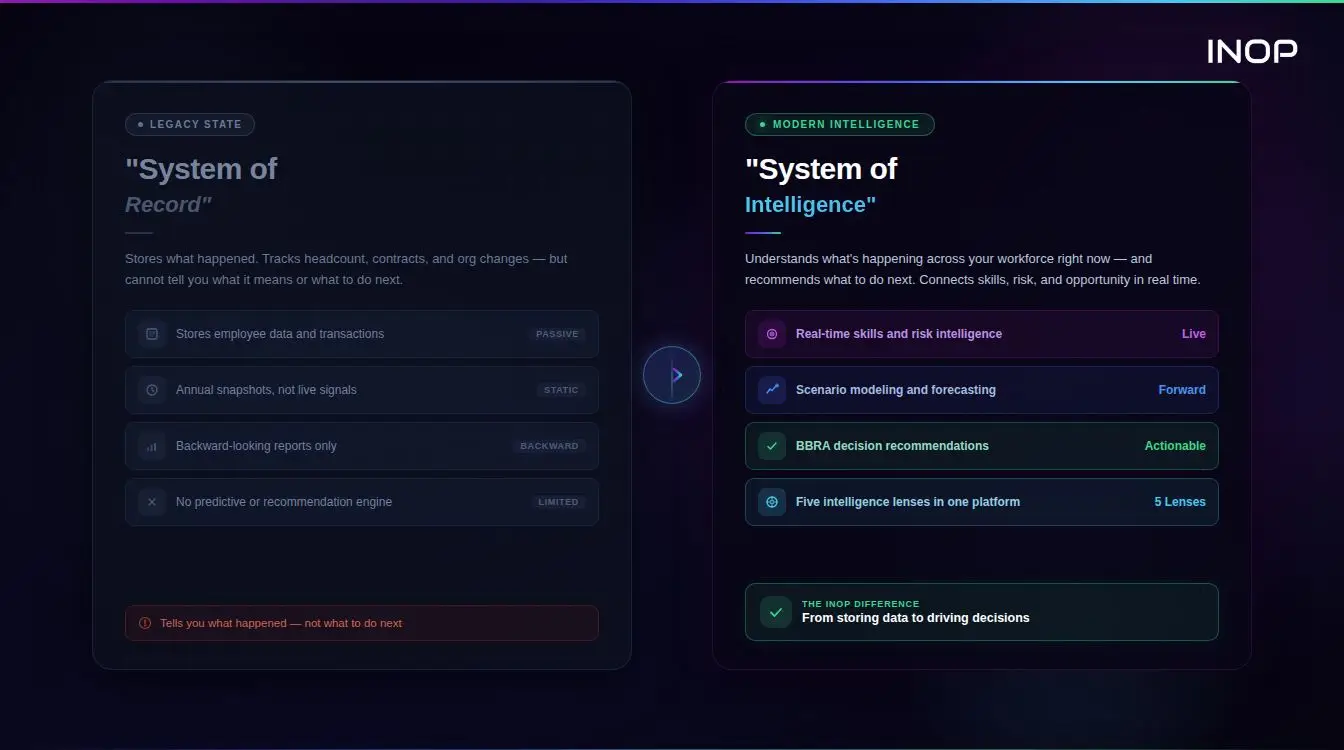
INOP is built for organizations further along this shift, ones that have moved past treating skills as a talent acquisition initiative and want skills data driving planning, deployment, and pay decisions across the workforce. That work runs across INOP’s five integrated intelligence lenses: Strategy, Finance, People, Market, and AI and Automation.
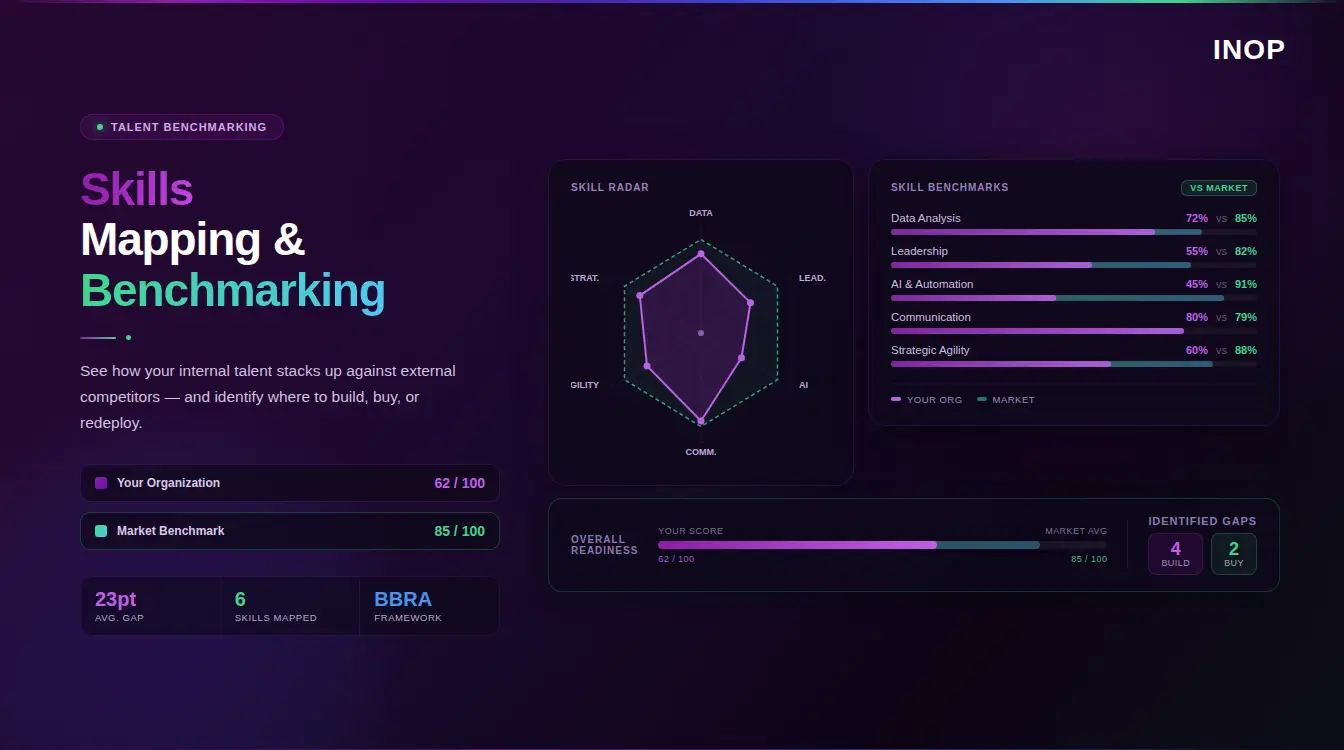
INOP’s Skills Intelligence maps your internal skills taxonomy against external labor market demand signals, so you know not just what skills your workforce has today, but whether those skills are becoming more or less valuable in the market, and where a taxonomy has gone stale relative to how the work has actually evolved.
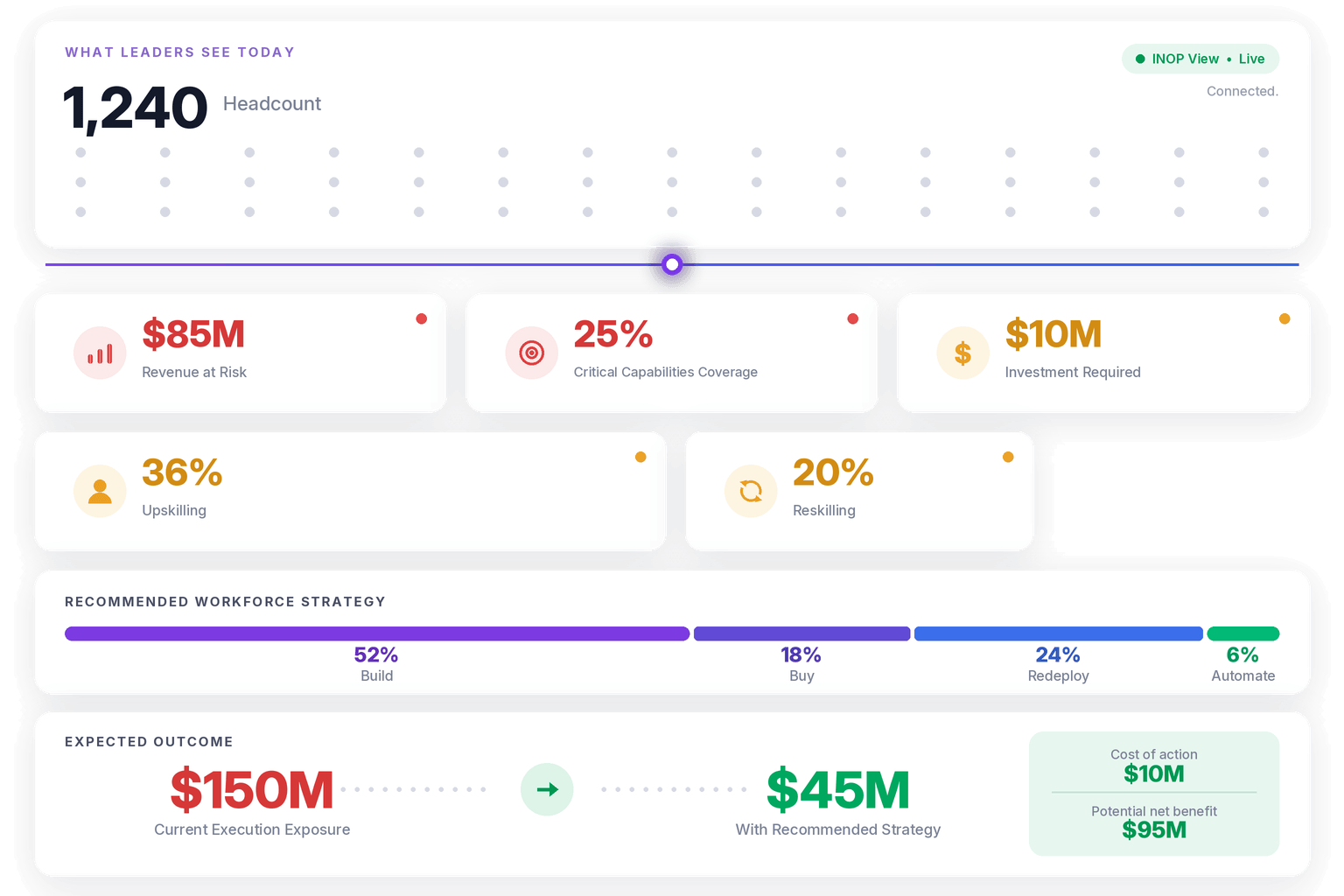
That skills data feeds directly into INOP’s Strategic Workforce Planning platform, where every identified gap is evaluated through Build, Buy, Redeploy, Automate (BBRA), INOP’s proprietary decision architecture, modeling the financial trade-off of each response across thirty-day, one-hundred-eighty-day, one-year, and three-year horizons, so redeployment and reskilling get evaluated with the same financial rigor as a hiring decision, not treated as a lesser option by default.
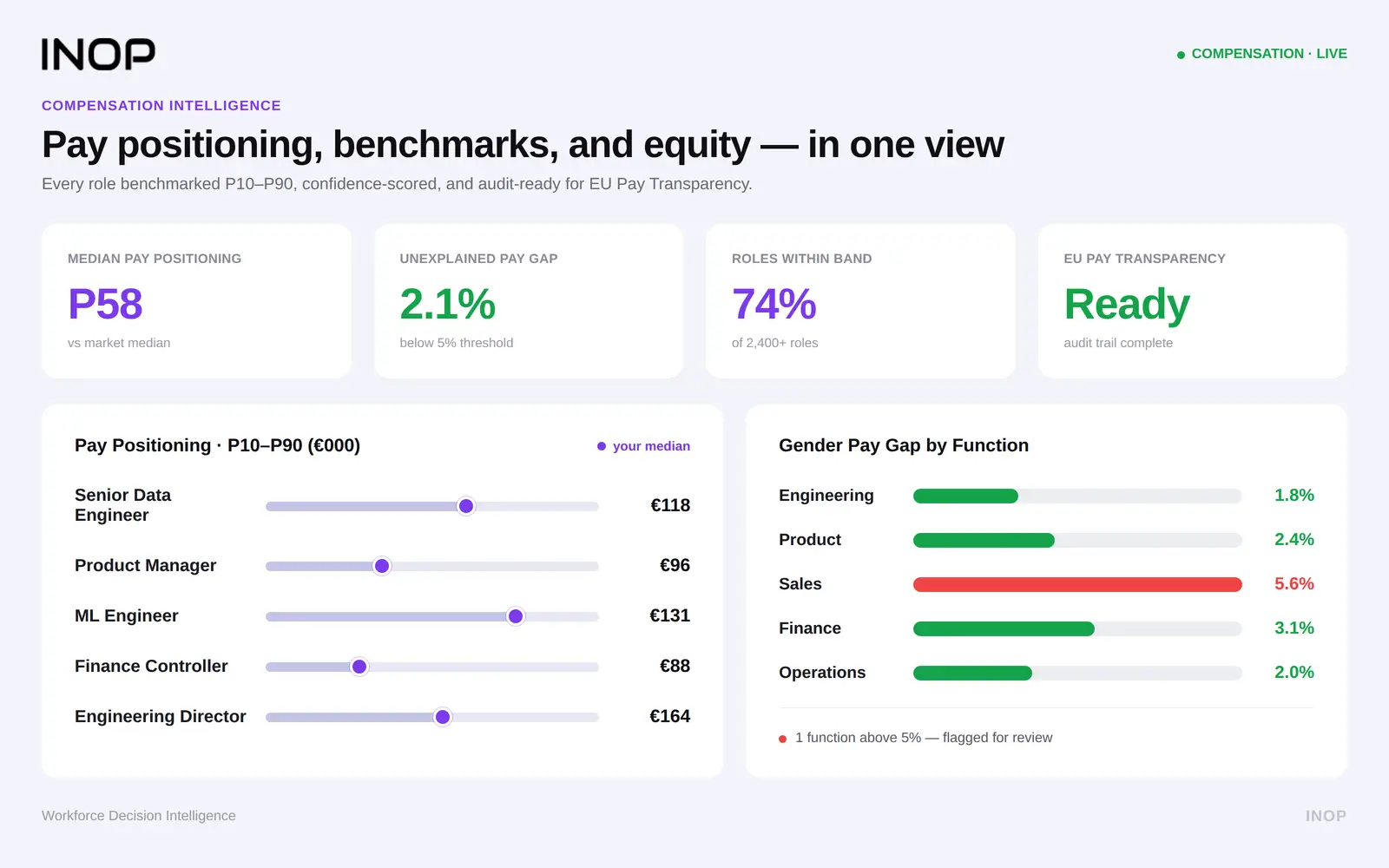
And because a skills based organization eventually has to reward the skills it says it values, that same data connects to INOP’s Compensation Analytics platform, so pay decisions can reflect verified, current skills rather than a job grade that may no longer describe the work.
Conclusion
A skills based organization isn’t a hiring initiative or an HR technology purchase, it’s a structural change in what data drives decisions about work, development, deployment, and pay. The organizations getting real value from it started narrow, proved the model internally before expanding it, and connected skills data to compensation and planning rather than letting it live as an isolated mobility feature. The framework is well established at this point. The differentiator is sequencing and follow-through, not novelty.
Frequently Asked Questions
What is the difference between a skills based organization and skills-based hiring?
Skills-based hiring is one narrow application, evaluating external candidates on demonstrated skills rather than resumes and credentials. A skills based organization is the much broader operating model, using skills data to drive internal mobility, development, compensation, and workforce planning, not just external hiring decisions.
How long does it take to build a skills based organization?
Most successful transformations run as a multi-year effort, but a focused pilot within a single business unit, taxonomy, assessment, and an initial internal marketplace, can be built and show early results within one to two quarters. Enterprise-wide maturity, particularly the compensation layer, typically takes considerably longer.
What is the first step in building a skills based organization?
Build and validate a skills taxonomy for one business unit or practice area first, rather than attempting an enterprise-wide rollout immediately. A narrow, well-validated taxonomy produces faster proof of value than a broad, shallow one.
Do we need new software to become a skills based organization?
Some technology is generally required, particularly for the skills taxonomy, assessment, and internal marketplace layers, but the harder work is organizational: governance, manager buy-in, and connecting skills data to decisions that already carry weight, like compensation and promotion. Technology alone does not produce a skills based organization.
How does a skills-based approach support private equity operating partners?
A common skills taxonomy gives operating partners a consistent way to evaluate workforce capability across portfolio companies that may use wildly inconsistent job titles, supporting more accurate diligence and integration planning, and providing a more defensible basis for the workforce component of a pre-exit value creation story.
Can a skills based organization coexist with traditional job titles?
Yes, and most organizations run both in parallel during the transition. Job titles remain useful externally and for basic organizational structure; skills data increasingly drives the actual decisions, development, mobility, pay, behind those titles. Very few organizations eliminate job titles entirely.
Book a Demo
Make confident workforce decisions that support strategy and value creation.