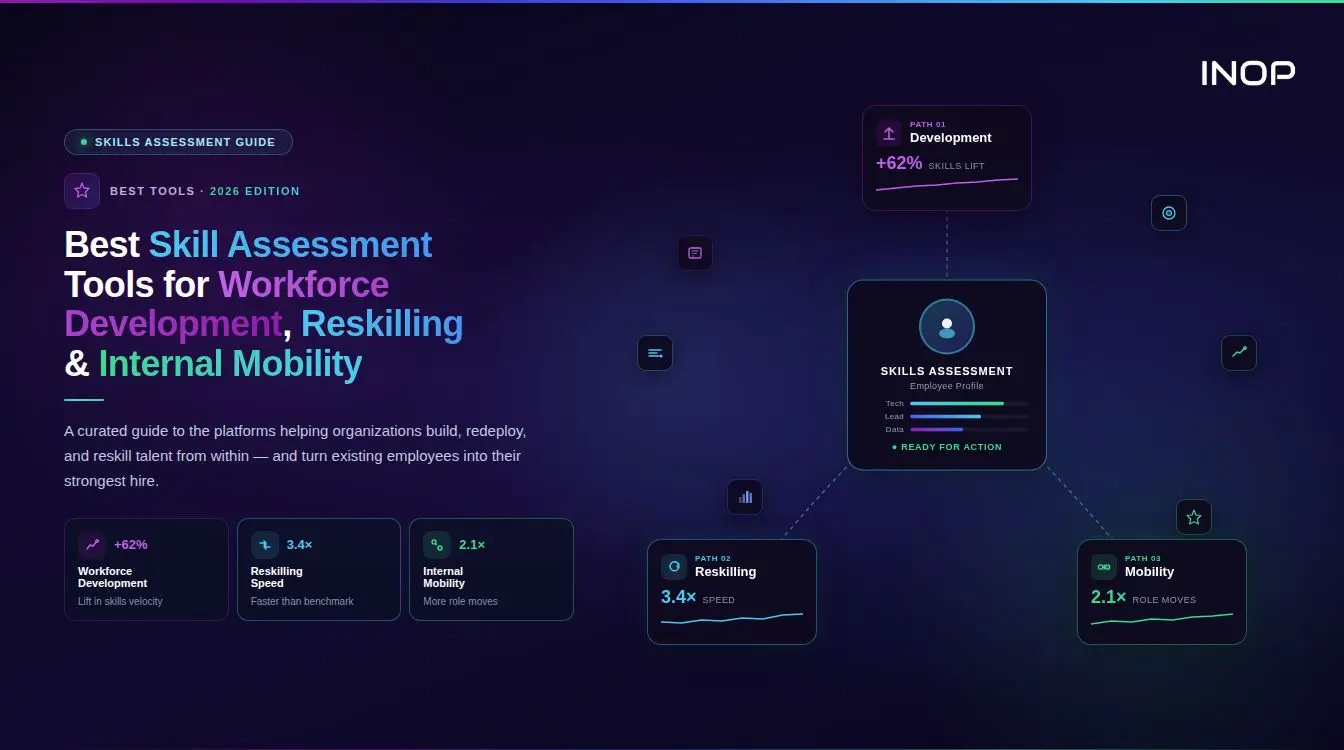
A skills assessment tool used to mean one thing: a test candidates took before you decided whether to hire them. That definition is now too narrow to be useful. In 2026, the most valuable use of a skills assessment tool is not screening people at the door, it is understanding what your existing workforce can already do, where capability gaps are forming, and which employees are ready to move into new roles before you ever open a requisition.
This guide compares the leading skills assessment platforms on the market today, whether you are evaluating candidates for a specific role, building a reskilling program, running a workforce-wide capability audit, or supporting succession planning. It covers what each tool actually measures, which platforms are built for hiring versus workforce development, how to connect assessment data to the systems that act on it, and how to choose the right fit for your organization’s constraints.
What a Skills Assessment Tool Actually Measures
Not every assessment measures the same thing, and that distinction matters more than most buyers realize. A coding challenge measures technical proficiency at a point in time. A behavioral game measures decision-making patterns. A job simulation measures how someone performs a task under realistic conditions. Understanding which of these your organization actually needs, rather than defaulting to whichever platform has the most name recognition, is the first decision that determines whether an assessment program succeeds.
Where a Skills Assessment Tool Fits in Workforce Intelligence
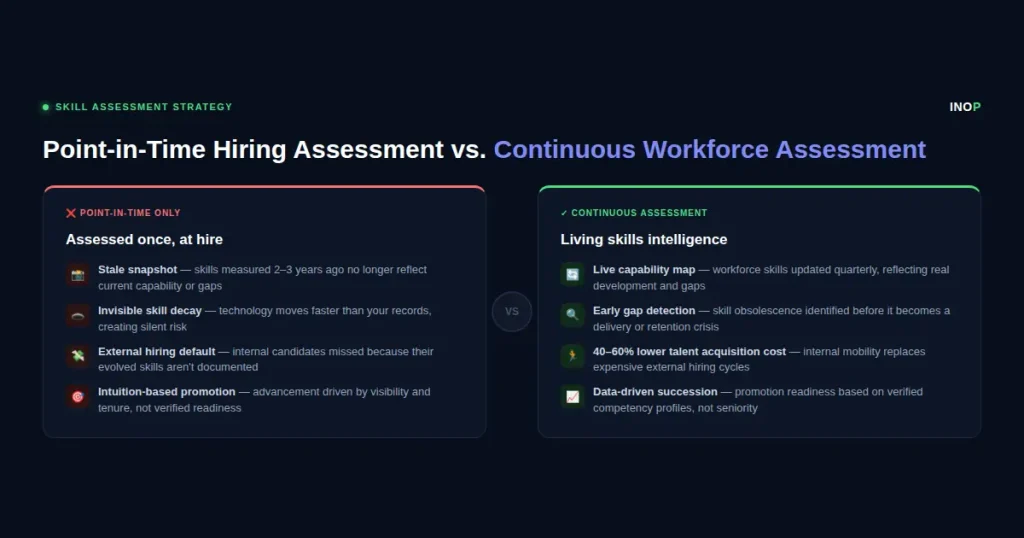
Organizations that assess skills only at the point of hire are measuring capability at the moment it matters least. The employee you hired three years ago has developed new skills, lost others, and accumulated project experience that no job title or HR record accurately reflects. Meanwhile, the business has changed, new technologies, new competitors, new strategic priorities, and the skills required to execute the roadmap today are materially different from the ones you screened for at hire.
Continuous skill assessment addresses this by maintaining a live, verified picture of workforce capability rather than a hiring-era snapshot. Internal recruiting also costs meaningfully less than external hiring once agency fees, premium job board spend, and onboarding overhead are counted, which is one reason internal mobility has become a board-level priority rather than an HR nice-to-have (ITD World).
Types of Assessment Methodologies on the Market
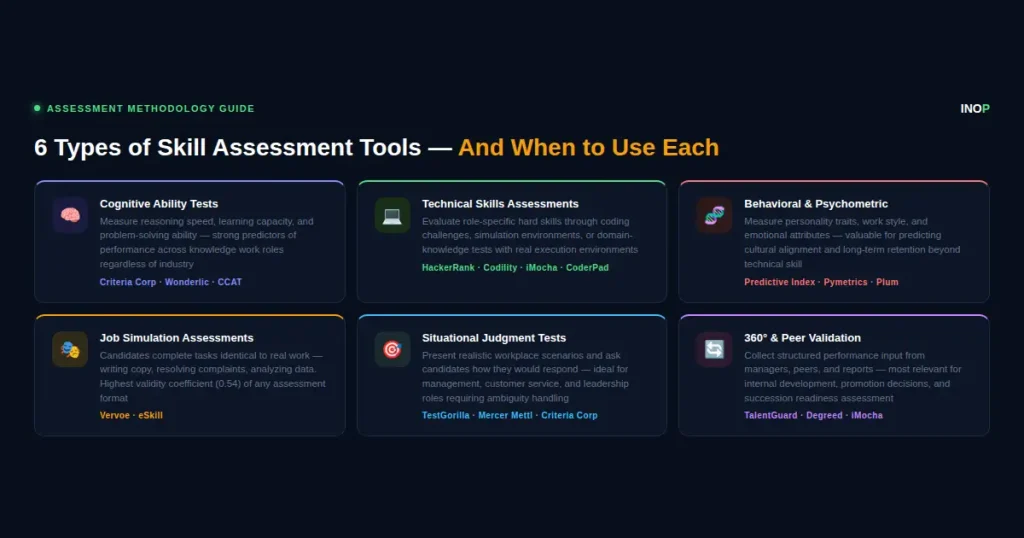
Before comparing individual platforms, it helps to understand the assessment methodologies behind them. Most effective programs combine several.
Cognitive ability tests measure reasoning, problem-solving speed, and learning capacity. Criteria Corp and Wonderlic specialize here, using validated instruments to predict performance across knowledge work roles regardless of job title.
Technical skills assessments evaluate role-specific hard skills through coding challenges, simulation environments, or domain-knowledge tests. HackerRank, Codility, iMocha, and CoderPad lead this category.
Behavioral and psychometric assessments measure personality traits, work style, and emotional attributes. Tools like the Predictive Index, Pymetrics’ neuroscience-based games, and Plum’s talent framework fall here, and are particularly useful for predicting cultural fit and retention.
Job simulation assessments ask candidates or employees to complete tasks identical to actual work, writing copy, resolving a customer complaint, analyzing a dataset. Vervoe leads this category.
Situational judgment tests present realistic workplace scenarios and ask how the person would respond. They’re widely used for management, customer service, and leadership roles where decision-making under ambiguity matters most.
Peer and manager validation tools collect structured performance input from managers, peers, and direct reports. These are more relevant for internal development and promotion decisions than pre-hire screening, and platforms like TalentGuard integrate this directly into skills assessment workflows.
Key Features to Look for in a Skills Assessment Platform
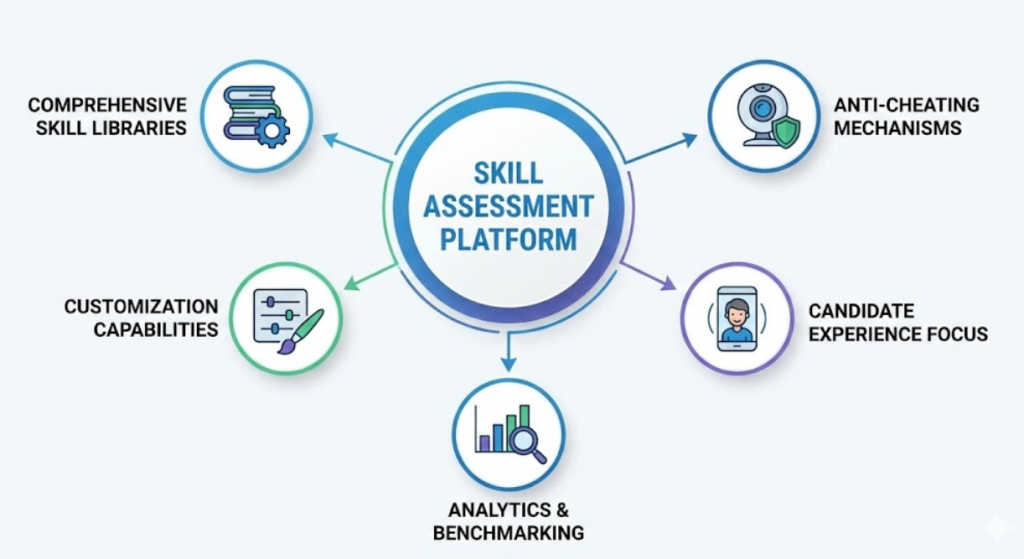
Not all assessment tools are built to the same standard. The platforms worth investing in share several characteristics that separate them from generic questionnaires.
Skill Library Depth and Customization
Top-tier platforms offer extensive libraries covering technical skills, soft skills, cognitive ability, and role-specific competencies, so you don’t need multiple platforms for different job families. Equally important is customization: can you add company-specific scenarios, or weight certain skills more heavily based on your priorities, without sacrificing psychometric validity?
Assessment Integrity, Employee Experience, and Analytics
Assessment integrity matters. Stronger platforms incorporate proctoring, plagiarism detection, question randomization, and browser lockdown features so results reflect the person’s own work, ideally without making the experience feel invasive. Candidate and employee experience matters just as much; clunky, overlong assessments drive people away before they finish. And the analytics layer is what turns a single score into a decision: look for comparative benchmarking against your existing workforce or industry norms, and reporting that identifies training needs, not just pass or fail outcomes.
Skills Gap Analysis Tools: From Individual Scores to Workforce Intelligence
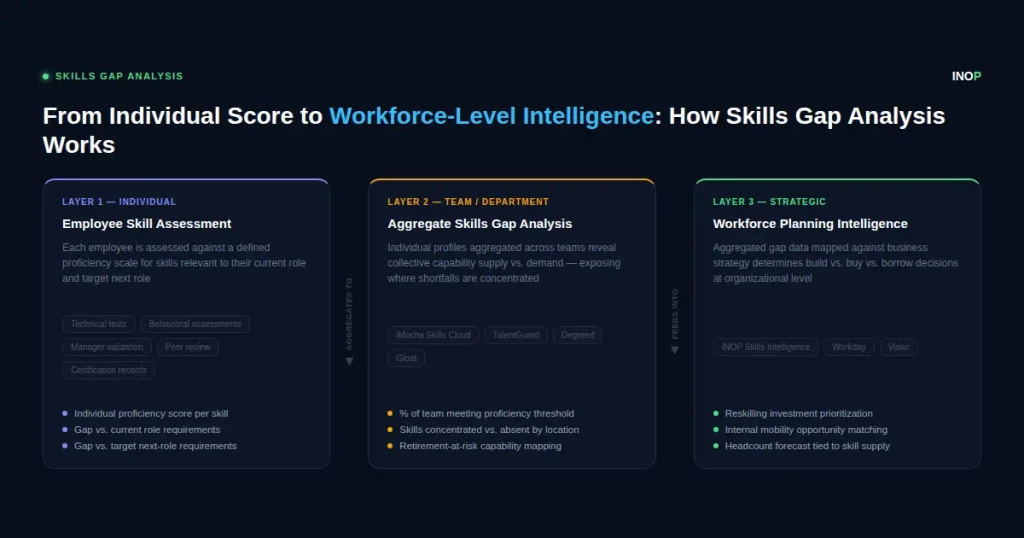
An individual assessment tells you what one person can do. A skills gap analysis tool aggregates that data across the workforce and compares it to what the business needs, producing the organizational-level intelligence that actually drives planning decisions: what percentage of the workforce meets the required proficiency for a given role family, where skill supply is concentrated or absent across departments and locations, and which emerging skill requirements have no internal supply at any proficiency level.
This distinction matters because most assessment platforms, HackerRank, TestGorilla, and Codility among them, are built around individual evaluation. The workforce planning use case requires aggregated, comparative, trend-based views that these platforms don’t natively provide.
Platforms Built for Workforce-Wide Gap Analysis
iMocha Skills Intelligence Cloud connects individual assessments to a workforce-wide skills taxonomy, producing gap dashboards by role, department, and skill domain, with HRIS and LMS integrations that route identified gaps into learning recommendations.
TalentGuard WorkforceGPT builds skills frameworks and role taxonomies used to assess current workforce readiness against future role requirements, supporting succession planning and reskilling design with structured data rather than manager estimates.
Degreed sits at the intersection of assessment and learning delivery, assessing proficiency, comparing it to role benchmarks, and immediately connecting the gap to relevant learning resources.
Gloat uses AI-powered skills inference from work activity alongside formal assessment to maintain current workforce skills profiles, then surfaces internal talent for open roles based on verified capability rather than job title proximity.
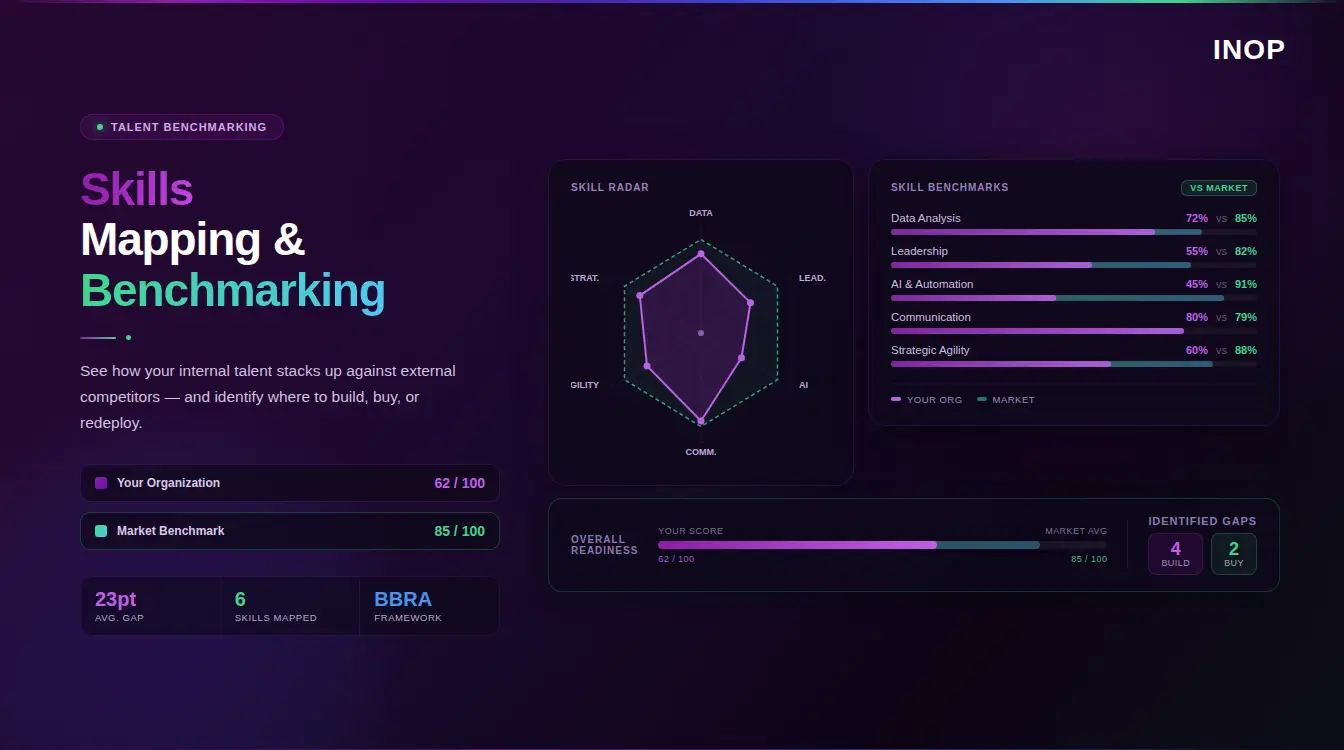
Assessment outputs from any of these platforms can be ingested into INOP’s Skills Intelligence layer as structured skills data, contributing to a workforce-wide capability map that external labor market signals can then validate against.
See how assessment data becomes workforce intelligence. Book a demo to walk through how INOP turns skills data into planning decisions.
Skills Assessment Tools Compared
| Tool | Best For | Pricing Model | Standout Feature |
|---|---|---|---|
| INOP | Turning assessment and skills data into workforce decisions | Custom | Skills intelligence plus Build, Buy, Redeploy and Automate decisions across five lenses: Strategy, Finance, People, Market, and AI and Automation |
| HackerRank | Deep technical assessments for engineering teams | Subscription | Large coding challenge library across dozens of languages |
| Codility | Problem-solving and debugging assessments | Subscription | Code playback |
| TestGorilla | Cross-functional skills testing, soft and hard | Subscription | Broad library covering cognitive, personality, and role-specific tests |
| Vervoe | Realistic job simulations | Custom | AI-scored job tasks in place of traditional tests |
| Criteria Corp | Cognitive aptitude testing | Custom | Validated assessments including the Criteria Cognitive Aptitude Test |
| iMocha | Niche technical skills and AI-driven skills mapping | Custom | Large skills library covering niche technical skills |
| Plum | Behavioral and potential profiling for development and succession | Custom | Psychometric profile mapped against top performers |
INOP: Turning Skills Assessment Data Into Workforce Decisions
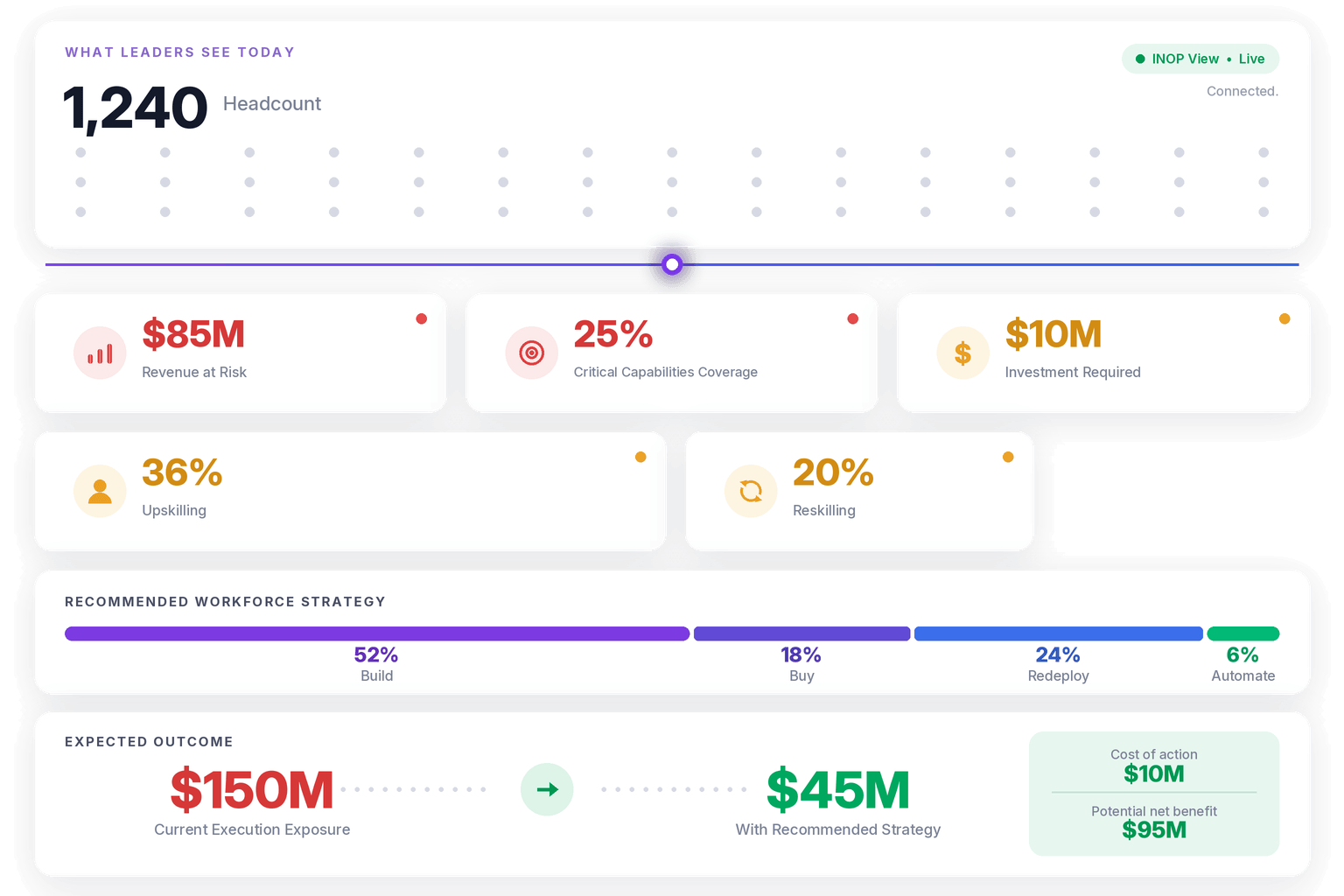
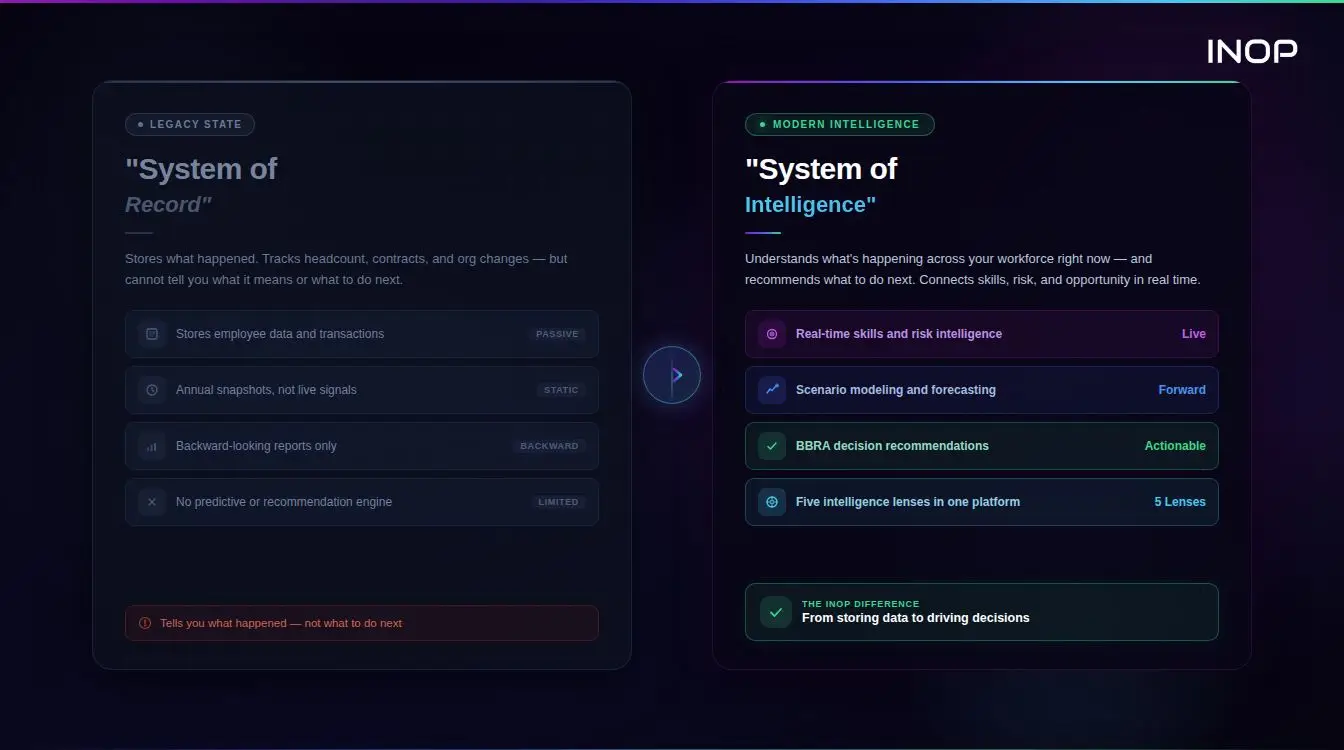
INOP is the skills intelligence layer that sits above assessment tools. Results from the platforms below can be ingested, mapped to your skills taxonomy and combined with external demand signals. INOP then models Build, Buy, Redeploy and Automate options across 30-day, 180-day, 1-year and 3-year horizons, weighing each across five lenses: Strategy, Finance, People, Market, and AI and Automation. Assessment data becomes a workforce decision, not a report.
Comprehensive and Technical Testing Platforms
HackerRank remains a standard for technical assessments, particularly for software development roles, with a large library of coding challenges spanning multiple languages and real-world project simulations. Codility focuses on engineering talent with automated code reviews and pair programming simulations, emphasizing code quality and readability rather than functionality alone. TestGorilla takes a broader approach, spanning cognitive ability, personality, technical skills, and language proficiency, making it a fit for companies hiring across multiple departments with one platform.
Simulation and Behavioral Platforms
Vervoe stands out for job simulations rather than traditional tests: candidates complete realistic tasks identical to the role itself, writing marketing copy, analyzing a dataset, resolving a simulated customer complaint. Criteria Corp specializes in cognitive aptitude testing with instruments designed to predict learning ability and problem-solving speed across knowledge work roles. Pymetrics uses neuroscience-based games to assess cognitive and emotional attributes like attention and risk tolerance, rather than asking candidates to self-report. Plum maps candidates or employees against a defined set of talents benchmarked to your top performers, useful where cultural alignment matters as much as technical skill.
Platforms Built for High-Volume and Enterprise Programs
Toggl Hire is built around short, focused assessments deployable across large candidate pools, giving recruiters a single dashboard for completion rates, score distributions, and rankings without manual aggregation. TestGorilla also scales well here, letting HR teams build standardized assessment bundles that deploy across every open role in a job family at once. For enterprise programs spanning many business units, governance becomes the deciding factor: role-based access controls so regional hiring managers can customize within central guardrails, plus audit logs for compliance. iMocha’s enterprise tier and HireVue’s organizational hierarchy features are both built with this in mind.
Several additional platforms serve specific use cases worth evaluating. The Predictive Index is built around behavioral science, mapping candidates against role archetypes derived from top performers, and is particularly strong for sales and leadership roles. Mercer Mettl combines cognitive, technical, and psychometric assessment for both hiring and workforce development contexts. TestDome and eSkill serve small and mid-sized teams with role-based libraries at accessible price points. CoderPad supports live, collaborative technical interviews for engineering and data science hiring. Glider AI focuses on hands-on skill validation rather than multiple-choice formats.
Skill Benchmarking and Competency-Based Assessment
The difference between a mediocre assessment tool and a genuinely useful one often comes down to benchmarking depth. Any platform can report a score. The platforms worth investing in tell you what that score means relative to your top performers, the broader talent market, or the specific competency profile of the role.
Skill benchmarking works by establishing a reference dataset, either internal or drawn from industry-wide performance norms, and measuring how each result compares to it. Competency-based assessment goes a step further: rather than testing an isolated skill in isolation, it defines the cluster of knowledge, behavior, and judgment required to perform effectively in a role over time, so a person is evaluated on the patterns that predict how they will learn and adapt, not just what they know today.
For HR leaders moving toward skills-based workforce planning, the reporting layer matters as much as the assessment itself. Look for platforms that produce structured output your HRIS can ingest, not just PDF reports, so a hiring-stage assessment can also become a long-term workforce data asset rather than a one-time filter.
How to Roll Out a Skills Assessment Program Across Your Workforce
Define Assessment Purpose Before You Buy
Workforce development assessments, measuring current employees against role requirements or future skill targets, need different configurations than succession readiness assessments, which compare internal candidates to a defined leadership profile. Getting this right up front prevents organizations from deploying hiring-calibrated tools in workforce development contexts, where scoring norms and proficiency frameworks are often misaligned.
Build a Recurring Cadence, Not a One-Off Exercise
Skills decay and develop on timescales shorter than most organizations realize. A skill assessed as advanced two years ago may be intermediate today if the technology has moved on. A quarterly or biannual assessment cycle, lighter than an initial baseline but consistent, keeps workforce skills data current enough to plan from. Tie assessment cycles to your strategic planning calendar so the data is fresh when planning conversations happen.
Benchmark Against Role Requirements, Not Percentiles
Percentile rankings show how someone compares to other test-takers. What workforce planning actually needs is comparison against the specific proficiency level required for a person’s current role and their target next role. Build benchmarks around defined role profiles, this role requires advanced Python, intermediate stakeholder management, rather than generic market percentiles. That produces actionable gap data: not “this employee is in the 62nd percentile” but “this employee is one proficiency level below the requirement for the senior analyst role.”
Connect Results to Development and Mobility Pathways
An assessment that produces a score with no downstream action delivers little organizational value. The strongest implementations connect results directly to learning recommendations, development plans, and internal mobility pathways, so a gap in data visualization automatically triggers a curated learning path and a reassessment timeline, not just a number in a report nobody acts on.
Connecting Assessment Data to Your HRIS and Workforce Systems
Selecting a skills assessment tool in isolation misses a critical decision: how it connects to the rest of your hiring and people operations infrastructure. Assessment data that lives only inside the assessment platform’s dashboard delivers a fraction of its value. The leverage comes when results flow automatically into your Applicant Tracking System and, for converted hires, into your HRIS.
The integrations worth prioritizing when evaluating a platform: automatic assessment invitations triggered when a candidate reaches a defined pipeline stage, composite scores and pass or fail flags syncing directly into the ATS candidate profile, skills data transferring into the HRIS at hire so the record persists post-hire instead of being archived, and gap data routing into connected LMS platforms for reskilling use cases rather than producing only a static PDF.
Among the platforms compared here, iMocha and HireVue offer the most complete enterprise integration ecosystems, with connectors for Workday, SAP SuccessFactors, Greenhouse, Lever, and iCIMS. TestGorilla and Toggl Hire offer webhook-based integrations suited to mid-market stacks. HackerRank and Codility integrate deeply into engineering-specific workflows, including GitHub and JIRA.
Already have assessment data sitting in your ATS or HRIS? Book a demo to see how INOP turns it into a workforce-wide capability map.
Skills Assessment for PE Portfolio Companies
For private equity operating partners, skills assessment tools serve a distinct purpose from day-to-day HR use: they provide a rapid workforce capability audit that informs post-acquisition integration planning and pre-exit value creation strategy. A hundred-day plan built on assumptions about workforce capability, rather than verified assessment data, is a plan built on guesswork at exactly the moment precision matters most.
The value compounds at scale. Individual assessment scores are useful for a single hiring decision, but aggregated across a portfolio company’s workforce, they start to reveal capability concentration, redundancy, and gaps that inform build, buy, redeploy, or automate decisions well before an integration deadline. Operating partners running this analysis across multiple portfolio companies benefit from a consistent taxonomy that lets capability data be compared across entities, not just within one.
Skills-Based Assessment as an Equity and Fairness Mechanism
Beyond efficiency gains, skills-based evaluation reshapes who gets access to opportunity inside an organization. Traditional hiring and promotion practices often overweight credentials that correlate with privilege, elite universities, unpaid internships, or professional networks built through family connections, rather than demonstrated capability.
Skills assessment levels that playing field by evaluating capability directly. A self-taught programmer receives the same coding challenge as a computer science graduate; both are judged on ability, not pedigree. A skills-based approach to evaluating candidates increases the eligible talent pool by roughly 2.3 times compared to credential-based screening, according to Handshake’s analysis of employer data, with an even larger expansion in underrepresented candidate segments.
Proper implementation matters. Poorly designed assessments can introduce new bias. Ensure any platform you adopt has been validated for adverse impact, audit results regularly for demographic disparities, and combine assessments with structured evaluation methods that measure dimensions a test alone cannot. Employment testing is also subject to EEOC guidelines and the Uniform Guidelines on Employee Selection Procedures, and legal counsel should be involved before implementation in regulated industries.
Measuring ROI from a Skills Assessment Tool Program
Internal fill rate. The most direct financial indicator is the share of open roles filled by internal candidates identified through skills data rather than external search. Organizations that use continuous assessment to maintain current workforce profiles report meaningfully higher internal fill rates, and every internal fill avoids a comparable share of the external recruitment cost for that role.
Skills development velocity. Track the average time from gap identified to gap closed at the required proficiency level for employees on development plans. This measures whether assessments are generating real capability change, not just scores.
Reskilling program accuracy. What share of employees who complete a targeted reskilling program, assigned based on an assessment-identified gap, actually reach the target proficiency level within the planned timeframe? This validates whether the assessment tool is correctly identifying gaps and whether learning resources are correctly matched to closing them.
Workforce planning confidence. Survey HR and business leaders periodically on their confidence in workforce skills data for planning decisions. Organizations with mature continuous assessment programs report meaningfully higher planning confidence, and higher finance team trust in workforce cost projections that depend on skills availability assumptions.
Skills coverage rate. What share of the workforce has a complete, validated skills profile updated within the last year? This is the data quality metric underpinning everything else. An organization where a large share of employees have outdated or missing skills profiles cannot make reliable workforce planning decisions, regardless of how good its assessment tools are.
Continuous Assessment for Reskilling, Mobility, and Succession Planning
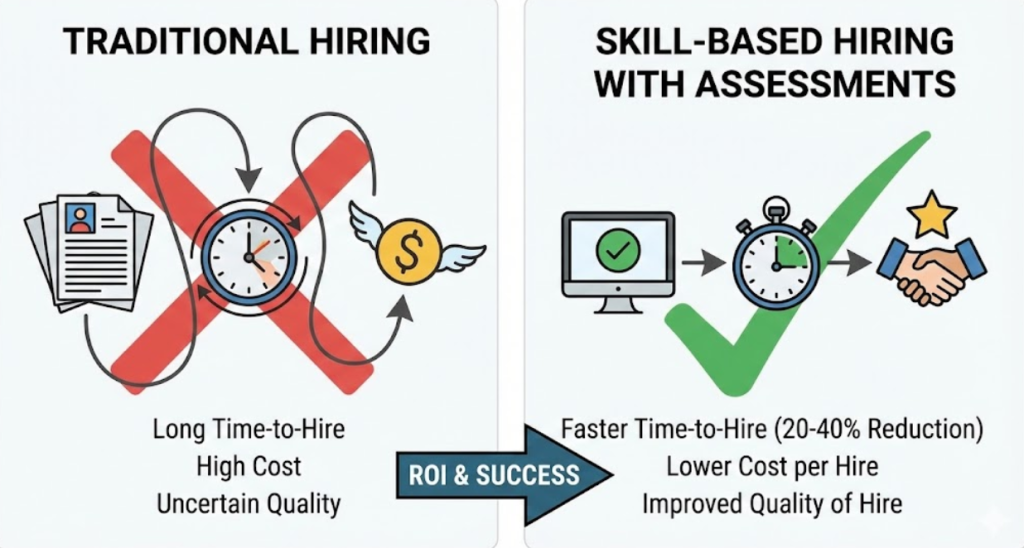
Most organizations treat skills assessment as a pre-hire activity: a candidate applies, completes a test, gets hired or rejected, and the data is archived. That approach captures only a fraction of the value these platforms can generate.
Continuous skill assessment across the existing workforce serves three practical functions. First, it maintains an accurate skills inventory; job titles are a poor proxy for actual capability, and periodic reassessment, whether through formal tests, project-based evidence, or peer validation, keeps that picture current. Second, it directly informs reskilling investment: if assessment data shows a proficiency gap concentrated in a specific team or skill domain, that becomes a training budget decision rather than only a hiring decision. Third, it enables data-driven internal promotion decisions rather than ones based on tenure or visibility alone.
For reskilling specifically, several platforms have built dedicated workflows. iMocha integrates assessment results with LMS recommendations, so a gap identified in a skills assessment triggers a curated learning path rather than just a score report. Degreed and Pluralsight sit at the intersection of assessment and learning delivery. Workday Skills Cloud, for enterprise environments already on Workday, creates a persistent skills graph that updates as employees complete learning activities or are reassessed.
Using Assessment Data for Succession Planning
Succession planning without skills data defaults to seniority and visibility, the two factors most correlated with bias in leadership development. Skill assessment changes the succession question from who leadership believes could do the job to who has already demonstrated the capabilities the role requires. When a competency profile is defined, strategic planning, cross-functional influence, financial literacy, change leadership, and current employees are assessed against it, the pool of qualified candidates frequently includes people the traditional succession process would have overlooked.
The practical implementation requires three steps most organizations skip: defining a competency profile for each succession target role rather than just a job description, assessing current employees against that profile using the same instrument used for external hiring, and tracking development progress against profile gaps on a regular cadence so readiness is a current measurement rather than a historical assumption. TalentGuard supports competency framework design and readiness tracking, iMocha supports proficiency assessment against defined role competencies, and Plum supports predicting performance potential based on behavioral patterns correlated with leadership success.
How to Choose the Right Skills Assessment Tool for Your Organization
The right platform depends less on which tool has the longest feature list and more on the specific constraints of your context.
If you are a startup or SMB hiring across multiple non-technical roles, TestGorilla’s broad library covers the widest range of use cases without requiring a dedicated HR tech team. Toggl Hire works well for high-volume screening of frontline and junior roles, and TestDome is the lowest-cost entry point for lean teams.
If you are hiring primarily for technical and engineering roles, the decision narrows to HackerRank, Codility, iMocha, and CoderPad. HackerRank offers the deepest volume of coding challenges and strongest brand recognition among developer candidates. Codility emphasizes code quality and pair programming. CoderPad suits teams that want live collaborative technical interviews. iMocha covers a broader range of IT skills beyond pure coding.
If you are running skills-first programs across multiple business units, governance features become the deciding factor: role-based access controls, audit logs, and documented integrations with Workday or SAP SuccessFactors. iMocha and HireVue are both built for this context.
If predicting culture fit and retention is the primary concern, behavioral and psychometric tools, The Predictive Index, Plum, or Pymetrics, deliver insights technical skill tests cannot, particularly for leadership and customer-facing roles.
If you are hiring at high volume for shift-based or frontline roles, prioritize platforms with mobile-first interfaces, multilingual assessment content, and job task simulations built around procedural or physical work rather than white-collar knowledge tasks.
One practical framework: identify your top three constraints, budget, volume, and integration requirements, and eliminate platforms that fail any single one before evaluating features. The best assessment tool is the one your team will actually use consistently, not the one with the most impressive demo.
Common Pitfalls to Avoid
Over-reliance on test scores. Treating assessments as the sole decision criterion is risky. Tests measure specific competencies at a single point in time; they don’t capture potential or unique perspectives that might benefit a team. Use scores as part of a broader evaluation framework.
Excessively long assessments. Completion rates drop sharply once an assessment runs long, particularly among already-employed candidates who are often your best targets. Consider a two-stage process for comprehensive evaluation rather than one lengthy test.
Neglecting mobile optimization. A meaningful share of candidates search and apply from mobile devices. Assessments that aren’t mobile-friendly exclude a real portion of the talent market, often disproportionately affecting younger and diverse candidates.
Ignoring legal compliance. Employment testing is subject to EEOC guidelines and the Uniform Guidelines on Employee Selection Procedures. Ensure your platform provides validation studies demonstrating job-relatedness and minimal adverse impact, and consult legal counsel before implementing assessments in regulated industries.
Failing to provide feedback. Candidates and employees invest time in your assessment process. Sharing meaningful feedback, even for those you don’t advance, meaningfully improves the experience and your standing as an employer.
Future Trends in Skills Assessment Technology
Adaptive testing adjusts question difficulty in real time based on responses, providing more accurate measurement in less time. Virtual reality simulations are starting to enable immersive job previews and assessments for roles where physical or spatial judgment matters. Continuous skill validation is replacing one-time hiring tests with ongoing assessment throughout employment, supporting internal mobility and proactive training needs. Natural language processing increasingly evaluates written communication and documentation quality, automating soft skill assessment that once required human judgment. Bias detection algorithms are being built directly into assessment platforms to flag potentially biased questions before they reach candidates.
How INOP Extends Skills Assessment Data Into Workforce Strategy
Skills assessment tools generate some of the most valuable data an organization produces about workforce capability, but only if that data connects to the planning and development systems that act on it. In most organizations, assessment results get buried in the ATS. A new hire might score exceptionally on Python and leadership potential during a HackerRank assessment, but three years later, when the organization needs to staff a critical AI project, that data has been forgotten.
INOP closes that loop by taking the isolated results from assessment platforms and turning them into workforce-wide intelligence, synthesized across five integrated lenses: Strategy, Finance, People, Market, and AI and Automation.
Continuous skills intelligence. Instead of treating an assessment as a one-off hiring hurdle, INOP ingests that data to build a living map of workforce capability, tracking not just what skills employees were hired for, but how those capabilities evolve.
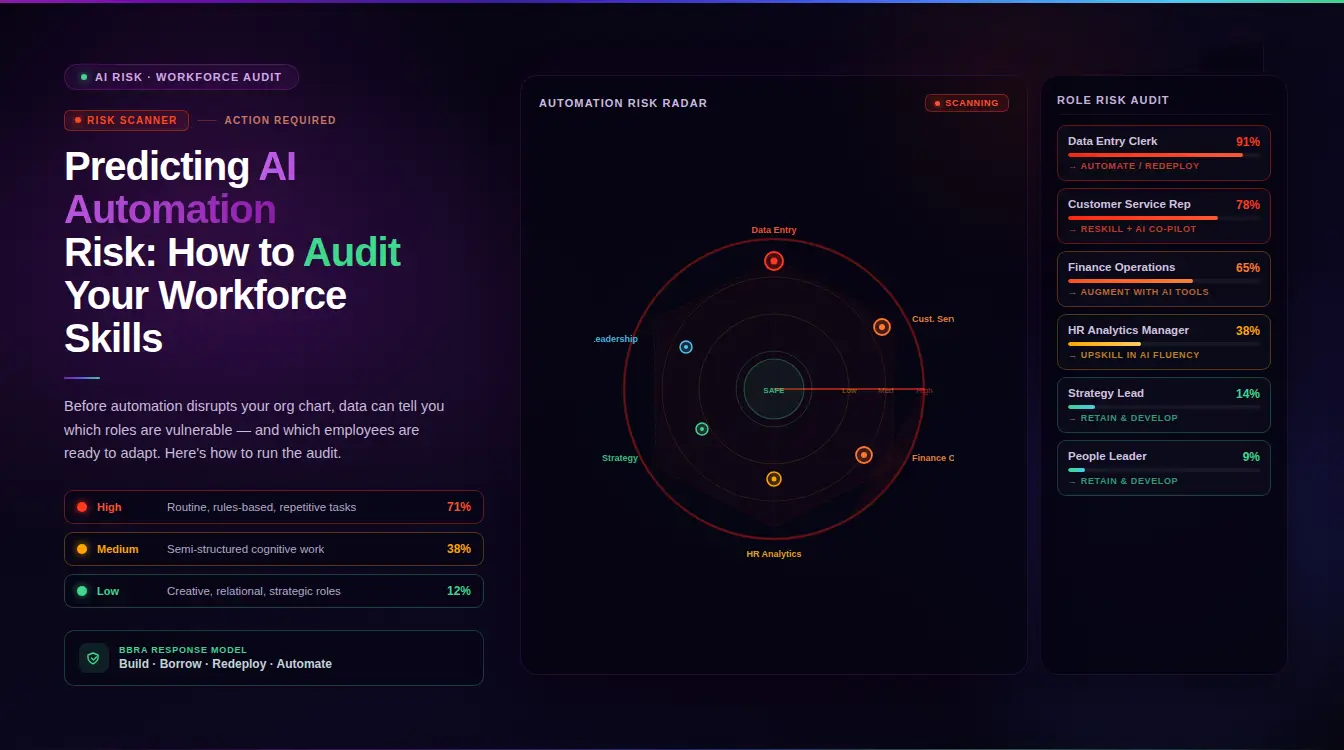
Strategic workforce planning. Once assessment data is mapped against future business goals, INOP highlights exactly where capability vulnerabilities lie, using its Build, Buy, Redeploy, Automate (BBRA) framework, INOP’s proprietary decision architecture, to model financial trade-offs across each response pathway. This is where INOP’s Strategic Workforce Planning platform moves organizations from reactive hiring to a defensible, decision-first process for closing gaps.
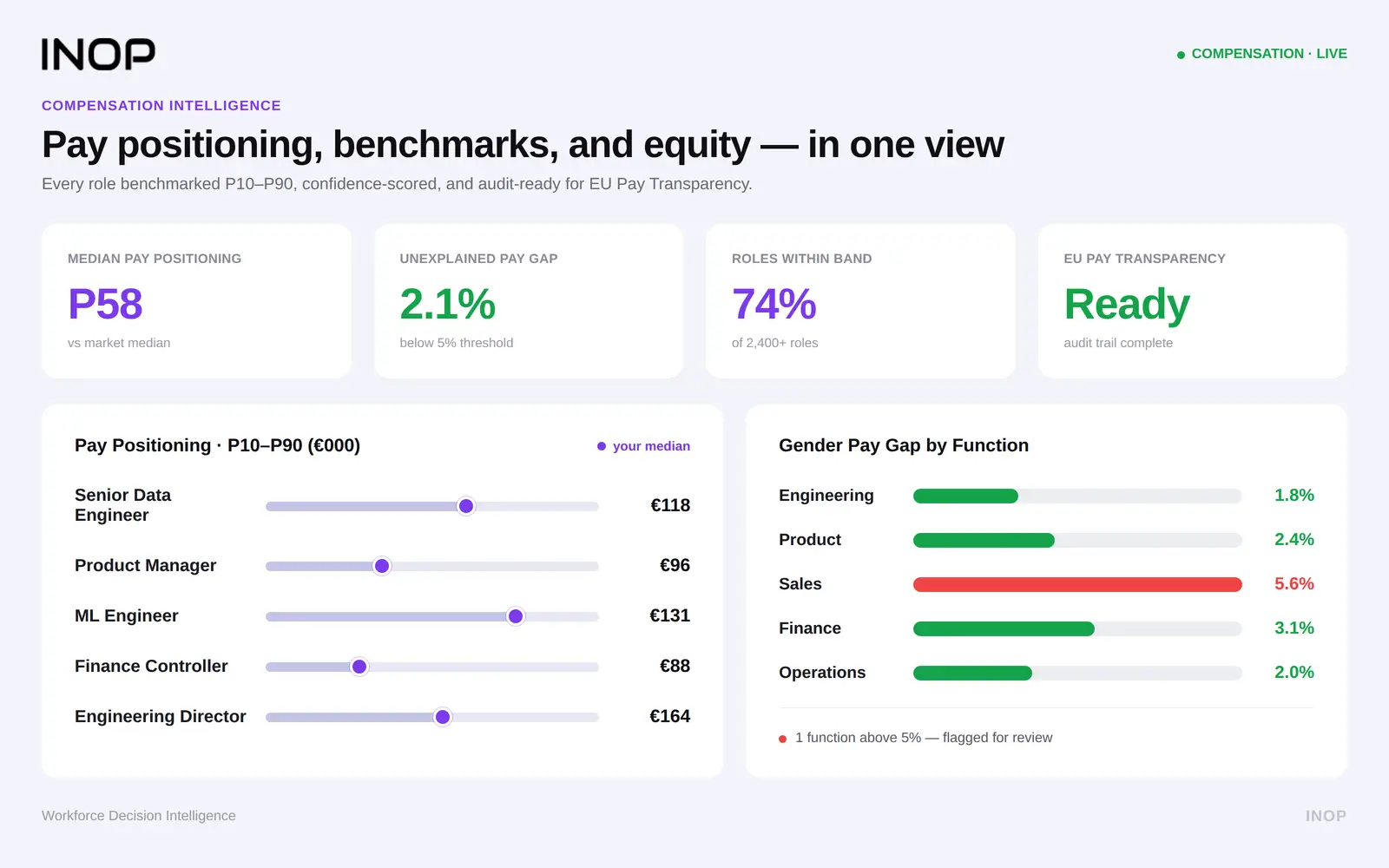
Data-driven compensation. If a workforce is being assessed for specific, high-value skills, pay structure should reflect that. INOP’s Compensation Analytics platform connects verified skills data to market benchmarks, supporting a transition from rigid title-based pay bands to a defensible skills-based pay structure.
Internal talent mobility. Before an organization spends on external sourcing and new assessments, INOP’s engine scans the existing workforce for employees who already possess the needed skills, reducing external hiring costs and improving retention by offering visible internal mobility pathways.
Assessment tools tell you who is capable today. INOP tells you how to deploy, pay, and develop that capability going forward.
Conclusion
Skills assessment tools have moved well beyond a pre-hire formality. From comprehensive platforms like HackerRank and TestGorilla to specialized tools like Vervoe and Pymetrics, and workforce-focused platforms like iMocha and TalentGuard, today’s market offers strong options for hiring, reskilling, and internal mobility use cases alike.
The key to success lies less in the tool itself and more in how it’s implemented. Define clear success criteria, combine assessment data with other evaluation methods, prioritize the experience for candidates and employees, and build a plan for what happens to that data after the assessment ends. Done well, skills assessment doesn’t just improve a single hiring decision, it becomes the foundation for a workforce strategy that can adapt as capability needs change.