Imagine knowing exactly how much your top performer should earn next quarter—not based on last year’s budget, but on real-time market shifts, skill demand, and inflation trends happening right now. That’s the power of predictive compensation analytics, a transformative approach that’s reshaping how organizations plan, budget, and compete for talent. Instead of relying on outdated salary surveys or gut feelings, forward-thinking companies are using data-driven forecasting to stay ahead of compensation trends before they become problems.
In today’s volatile labor market, where skills become obsolete faster than ever and remote work has globalized the talent pool, traditional compensation planning feels like driving with a rearview mirror. This article explores how predictive compensation works, why it matters more than ever, and how your organization can leverage real-time data to forecast pay with precision and confidence.
What Is Predictive Compensation Analytics?
Predictive compensation analytics is the practice of using historical data, current market information, and advanced algorithms to forecast future salary trends and compensation needs. Rather than simply reacting to market changes or conducting annual salary reviews based on last year’s numbers, this approach enables organizations to anticipate shifts in pay expectations, skill premiums, and competitive pressures.
At its core, this methodology combines several data sources: internal employee performance metrics, external market benchmarks, economic indicators like inflation and unemployment rates, and industry-specific trends. Machine learning models then analyze these inputs to identify patterns and generate forecasts that help HR leaders make proactive decisions.
The difference between traditional compensation planning and predictive analytics is substantial. Traditional methods typically rely on annual salary surveys that may be six to twelve months old by the time they’re published. By contrast, predictive models can incorporate data updated weekly or even daily, giving organizations a significant competitive advantage when it comes to attracting and retaining talent.
Scope: Compensation Planning Analytics vs. Workers’ Compensation Analytics
It’s worth distinguishing predictive compensation analytics in the HR context from predictive analytics in workers’ compensation insurance, two distinct fields that share terminology. This article addresses the former: using data and forecasting models to predict employee salary trends, optimize pay structures, and make proactive compensation decisions in talent management. Workers’ compensation analytics, by contrast, applies predictive modeling to injury claims management, risk assessment, and insurance cost forecasting, a separate domain with different data sources, tools, and stakeholders.
The Role of Predictive Analytics in Compensation Planning
Predictive analytics plays four distinct roles in modern compensation planning, each addressing a different limitation of traditional annual-review cycles.
1. Forecasting market salary movements before they arrive
Rather than waiting for annual benchmarking surveys, which can be 6–12 months old by publication, predictive models analyze real-time job posting data, economic indicators, and competitive intelligence to project where market rates are heading. Compensation leaders can see a likely 8% increase in cloud engineer salaries coming three quarters out, rather than discovering it after talent has already walked.
2. Identifying flight risk before employees begin interviewing
By combining compensation data with performance trajectories, tenure, engagement signals, and external market rates, predictive models assign flight risk scores to individual employees. Organizations implementing these models report identifying at-risk employees 60–90 days before departure, creating an intervention window that doesn’t exist in reactive compensation systems. Research from workforce analytics platforms indicates that turnover prediction models drive a 31% improvement in retention outcomes by enabling proactive responses.
3. Optimizing budget allocation across roles and departments
Traditional merit planning applies blanket percentage increases across the organization. Predictive analytics enables granular differentiation: a data engineering team may require 8% increases to stay competitive based on market trajectories, while a different function may be adequately addressed with 3%. This granularity prevents both overspending where it’s unnecessary and underspending where it costs the most — attrition in critical roles.
4. Modeling compensation equity trajectories
Predictive models don’t just show current pay gaps, they forecast how existing compensation practices will compound into larger equity issues over time. If merit increase processes consistently advantage certain groups by even 0.5% annually, a predictive model reveals how that gap widens over five years. This forward-looking equity modeling is becoming essential as pay transparency laws require organizations to defend not just current pay decisions, but the systems that produce them.
Why Real-Time Data Matters in Compensation Planning?
The compensation landscape has fundamentally changed. A software engineer’s market value in January might look dramatically different by June due to technological disruptions, mass layoffs in competing firms, or sudden demand spikes in emerging technologies. Static compensation data simply can’t keep pace.
Real-time data addresses this challenge by providing continuous visibility into market movements. When a competitor announces layoffs, when a new skill suddenly becomes critical, or when inflation accelerates beyond expectations, real-time systems capture these signals immediately. This allows compensation leaders to adjust their strategies before losing key talent to better-paying opportunities.
Consider this example: In 2022, when inflation in the United States reached 9.1%—the highest in four decades—companies relying on 2021 salary data found themselves significantly behind market rates. Organizations using real-time compensation intelligence were able to identify the trend early, model its impact, and implement mid-year adjustments that prevented attrition. Those who waited for their annual review cycle lost valuable employees who couldn’t afford to wait six months for raises that matched their cost of living.
Real-time data also helps identify micro-trends that broader surveys might miss. Perhaps demand for Python developers in your specific metro area is spiking while remaining stable nationally. Or maybe a particular certification has suddenly become highly valued in your industry. These nuances only become visible when you’re monitoring data continuously rather than annually.
Key Components of Predictive Compensation Systems
Building an effective predictive compensation system requires several interconnected components working together seamlessly.
Data Integration and Quality
The foundation of any predictive system is clean, comprehensive data. This includes internal data such as employee performance ratings, tenure, skills inventories, promotion histories, and current compensation levels. External data sources include market salary surveys, job posting analytics, cost-of-living indices, competitor intelligence, and broader economic indicators.
Data quality matters enormously. A model trained on incomplete or biased data will produce unreliable forecasts. Organizations must establish processes for data validation, standardization, and regular updates to ensure their predictions remain accurate.
Analytical Models and Algorithms
Modern predictive compensation systems employ various analytical techniques. Linear regression models might forecast baseline salary progression, while more sophisticated machine learning algorithms can identify complex patterns and interactions between variables.
Some systems use time series analysis to understand seasonal compensation trends, neural networks to predict retention risk based on pay equity, or clustering algorithms to identify similar employee groups for targeted compensation strategies. The specific techniques matter less than ensuring the models are appropriate for your data and objectives.
Market Intelligence Feeds
Real-time market intelligence separates predictive systems from traditional approaches. These feeds might include job board scraping that tracks salary ranges in real-time postings, competitor monitoring through public filings and news, industry-specific benchmarking networks, and economic data from government sources.
The most effective systems don’t just collect this data—they contextualize it. A 15% increase in advertised salaries for data scientists means something very different if it’s happening across all industries versus only in financial services.
Scenario Planning Capabilities
Predictive systems should enable “what-if” analysis. What happens to your compensation budget if inflation continues at current rates versus moderating? How would a 10% increase in base pay for your engineering team impact retention compared to a 5% increase plus enhanced equity? These scenario planning tools help leaders make informed decisions rather than guesses.
How Organizations Use Predictive Analytics for Pay Forecasting?
The practical applications of predictive compensation analytics extend across the entire employee lifecycle and organizational planning.
Workforce Planning and Budgeting
Finance and HR teams use predictive models to forecast compensation expenses with greater accuracy. Instead of applying a blanket 3% merit increase assumption, they can model different scenarios: higher increases for critical roles, geographic variations, performance-based differentiation, and market-driven adjustments for specific skill sets.
A technology company might discover that their data engineering team will require 8% increases to remain competitive based on current market trajectories, while their marketing team might be adequately compensated with 3% increases. This granular insight enables more efficient budget allocation and prevents both overspending and underspending on talent.
Retention Risk Modeling
By combining compensation data with performance metrics, tenure, and market trends, organizations can identify which employees face the highest flight risk due to compensation gaps. A high performer earning 15% below market rate represents a significant retention risk—predictive models can flag this before the employee even starts interviewing elsewhere.
Some advanced systems incorporate external signals like LinkedIn activity or industry hiring trends to refine these predictions. If competitors in your region are aggressively hiring for specific roles, employees in those positions face higher poaching risk even if they’re currently satisfied.
Competitive Positioning
Predictive analytics help organizations understand not just where they stand today, but where they’ll stand in six or twelve months if current trends continue. This forward-looking perspective is crucial for strategic positioning decisions.
For example, a healthcare organization might learn that nurse practitioner salaries in their region are projected to increase 12% over the next year due to a combination of increased demand and limited training pipeline. Armed with this insight, they can proactively adjust their compensation structure rather than reactively responding to turnover.
New Hire Offer Optimization
When making offers to candidates, predictive models can recommend optimal compensation packages based on the candidate’s skills, experience, market conditions, and internal equity considerations. This reduces the risk of both under-offering (and losing candidates) and over-offering (and creating internal compression issues).
One financial services firm reported that implementing predictive offer analytics reduced their offer rejection rate by 22% while also decreasing average offer amounts by 3%—evidence that they’d been both losing candidates with low offers and overpaying others where it wasn’t necessary.
Compensation Forecasting for People Analytics Teams
People analytics teams occupy a specific position in predictive compensation work: they sit at the intersection of data infrastructure, HR strategy, and financial planning. The workflow is meaningfully different from what a compensation manager or CHRO experiences.
Data Pipeline and Model Ownership
People analytics teams are typically responsible for building or configuring the underlying models — integrating HRIS data, connecting external market feeds, running regression or machine learning models, and producing forecast outputs that other stakeholders consume. This requires ownership of data quality upstream: inconsistent job codes, missing skills data, or stale performance ratings all degrade forecast accuracy before the model even runs.
A practical data readiness checklist for people analytics teams before building compensation forecasts:
- Employee-level compensation records with full history (not just current values)
- Standardized job architecture with consistent levels and families across business units
- Performance ratings linked to employee IDs at the individual level, not just department averages
- Verified market benchmarking data at the role and level combination, not just job family
- Inflation and economic indicator feeds integrated at appropriate geographic granularity
Translating Forecast Outputs for Finance and Business Leadership
The technical output of a predictive model — probability distributions, confidence intervals, scenario ranges — requires translation for executive decision-making. People analytics teams that present raw model output without a clear narrative find their forecasts ignored or misapplied.
Effective translation means: leading with the business question the forecast answers (“we expect our engineering compensation to be 11% below market by Q3 if current trends hold”), stating the confidence level plainly (“this is based on the past 18 months of market data, accuracy within 4% for near-term projections”), and leading decision-makers to the specific decision point (“the model suggests front-loading increases now is less costly than reactive salary corrections after attrition begins”).
Monitoring Compensation Trends Across Departments
One of the highest-value applications for people analytics teams is surfacing cross-departmental compensation trend disparities before they become equity or retention problems. The analytics that help monitor workforce compensation trends include:
- Compa-ratio tracking by department — the ratio of actual pay to market midpoint, monitored over rolling 12-month periods to catch drift before it becomes a structural gap
- Pay percentile distribution analysis — understanding whether a department’s pay is concentrated at the bottom of the range (compression risk) or scattered across the full band (potential inequity)
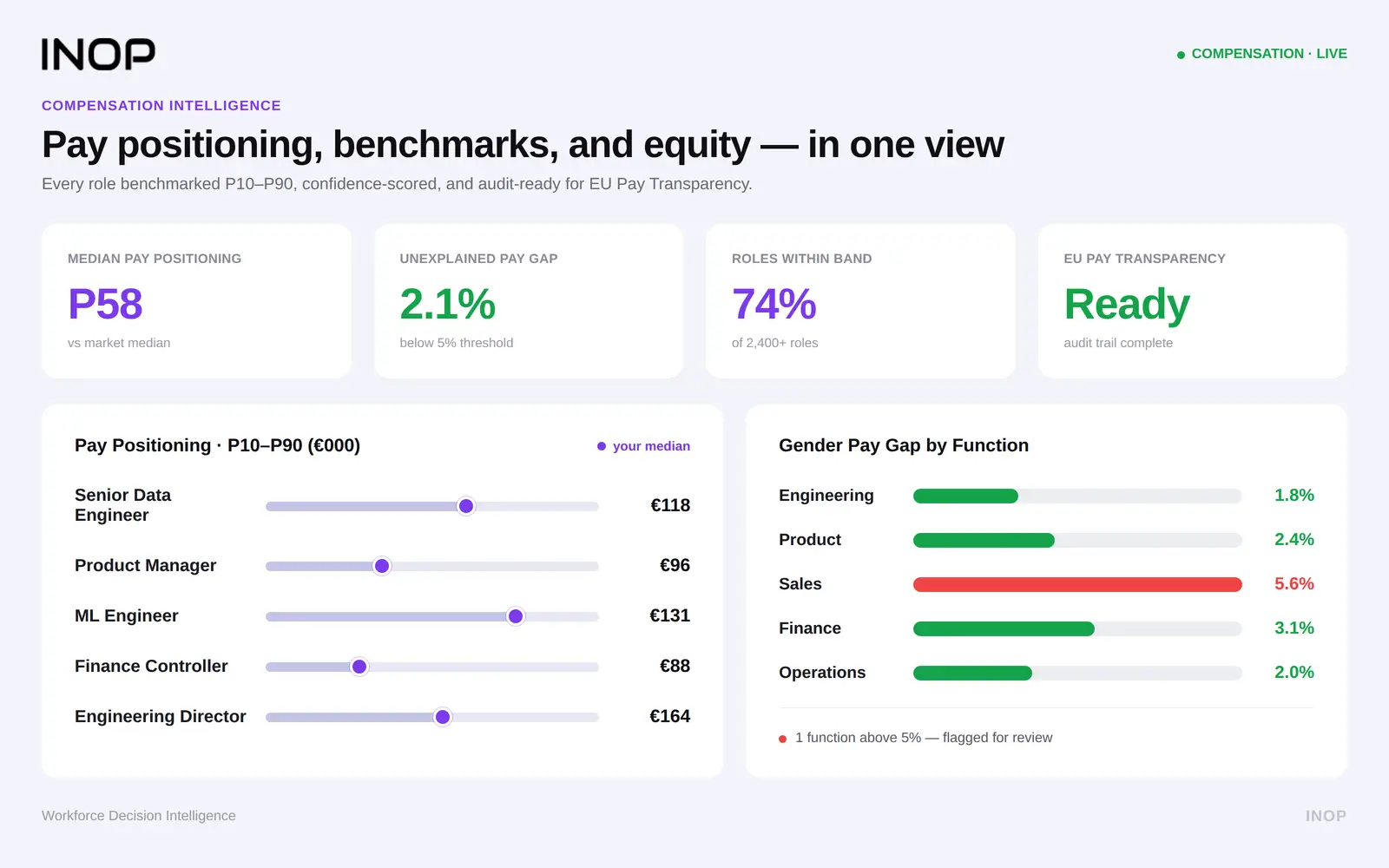
- Merit increase distribution analysis — whether increase rates are consistent across demographic groups within departments, and whether performance ratings and increase rates correlate as expected
- Market movement velocity tracking — how quickly market rates are moving for specific skill clusters within each department, flagging functions where the external market is outpacing internal pay progression
Suggested: Improved pay forecasting directly supports talent retention strategies
Challenges and Considerations in Implementation
Despite its benefits, implementing predictive compensation analytics isn’t without challenges.
Data Privacy and Ethics
Compensation data is highly sensitive. Organizations must ensure their predictive systems comply with privacy regulations like GDPR or CCPA, maintain appropriate access controls, and use data ethically. There’s also the risk of algorithmic bias—if historical data reflects past discrimination, models might perpetuate those biases unless specifically designed to prevent it.
Transparency becomes crucial. Employees should understand, at least generally, how compensation decisions are made. Black-box algorithms that nobody can explain create distrust and potential legal liability.
Change Management
Moving from traditional compensation planning to predictive analytics requires cultural change. Compensation managers must develop new skills, executives need to trust data-driven recommendations over intuition, and employees may need education about how the new approach benefits them.
Resistance often comes from managers accustomed to having discretion over pay decisions. Predictive systems don’t eliminate judgment—they inform it—but this distinction isn’t always clear initially.
Technology Investment
Building or buying a sophisticated predictive compensation system requires investment. Smaller organizations might struggle to justify the cost, though increasingly affordable SaaS solutions are making these capabilities more accessible.
The calculation should consider not just technology costs but also the cost of poor compensation decisions: mis-hires, regrettable turnover, overspending on talent, and competitive disadvantage all carry substantial price tags that effective analytics can reduce.
Data Availability and Quality
Organizations with poor data hygiene, fragmented HR systems, or limited access to market intelligence will struggle to implement effective predictive models. Sometimes the prerequisite work of cleaning up data and establishing proper systems takes longer than building the analytical models themselves.
Best Practices for Getting Started
If your organization is ready to explore predictive compensation analytics, consider these practical steps.
Start with a specific use case rather than trying to transform everything at once. Perhaps focus on retention risk in a critical department or market positioning for high-demand roles. This allows you to demonstrate value before expanding.
Ensure executive sponsorship from both HR and finance leadership. Predictive compensation sits at the intersection of people strategy and financial planning, so both functions must be aligned and supportive.
Invest in data infrastructure before sophisticated analytics. Clean, integrated data delivers more value than complex models built on questionable inputs. Audit your current compensation data, employee data, and market intelligence sources to identify and address gaps.
Partner with vendors strategically. Unless you’re a very large organization with substantial data science resources, you’ll likely need external expertise. Look for partners who understand both compensation strategy and predictive analytics, not just one or the other. Keep up with the latest compensation analytics news to stay informed about emerging tools and best practices.
Start simple and iterate. A basic predictive model that’s actually used is more valuable than a sophisticated system that sits unused because it’s too complex. Build foundational capabilities first, then enhance them over time as users gain confidence and competency.
Communicate the “why” to stakeholders. Managers and employees need to understand that predictive compensation benefits everyone: it ensures fair pay, helps the organization remain competitive, and enables more transparent, objective decisions.
How Organizations Adopt Real-Time Data Tools for Dynamic Compensation Planning
The transition from static annual surveys to real-time compensation intelligence typically follows a three-phase adoption pattern.
Phase 1: Data foundation (months 1–3). Before any real-time tool delivers value, the underlying data must be clean and connected. Most organizations spend the first phase auditing their employee data, standardizing job architectures, and establishing API connections between their HRIS and external market feeds. This phase is often underestimated, organizations with fragmented HR systems or inconsistent job coding may need 6 months of data preparation before any meaningful forecast is possible.
Phase 2: Pilot use case (months 3–6). The most successful adoption patterns start with one specific, high-stakes use case, typically retention risk for a critical technical function, or market positioning for a role with active hiring pressure. A focused pilot builds internal credibility: when stakeholders see that the model correctly predicted a market shift or identified a flight risk before the employee gave notice, trust in real-time data tools accelerates across the organization.
Phase 3: Scale and integrate (months 6–18). Once the pilot proves value, organizations expand coverage to additional role families, integrate the real-time data into budget planning cycles, and connect forecast outputs to compensation review workflows so managers act on insights during the process rather than reviewing them after decisions are made.
The most common failure pattern is inverting this sequence, purchasing a sophisticated platform before establishing data quality, running it against incomplete or inconsistent inputs, and concluding that “predictive compensation doesn’t work” when the actual problem was upstream data governance.
Salary Forecasting Software and Predictive Compensation Planning Tools
The market for predictive compensation and salary forecasting software has matured into distinct tiers. Here’s how to evaluate the landscape based on your organization’s size, budget, and use case priorities.
Enterprise Platforms with Full Predictive Modeling
These tools combine compensation management with built-in predictive and scenario modeling capabilities. They’re designed for large organizations managing complex, multi-country pay structures.
- beqom — Offers a Pay Predictor module that runs compensation prediction scenarios in real time, generating data-driven merit, promotion, and new hire recommendations with explainable rationale. Integrates with HRIS for full data continuity.
- Workday Compensation — Includes market data integration, merit planning, and scenario modeling. Strong for organizations already in the Workday ecosystem that want to avoid external point solutions.
- SAP SuccessFactors — Provides compensation planning with built-in analytics, benchmarking integration, and budget forecasting. Best suited for global enterprises with complex approval workflows.
- Decusoft Compose — Features explainable predictive compensation that shows managers the specific factors driving each AI recommendation — addressing the “black box” concern that erodes manager trust in algorithmic pay suggestions.
Mid-Market Compensation Analytics and Forecasting Tools
- CandorIQ — Built for HR and Finance alignment, combining headcount planning with compensation forecasting in one platform. Supports scenario modeling for merit cycles, hiring plans, and equity refresh. Strong on real-time budget utilization visibility.
- Beqom (mid-market tier) — Also available for smaller organizations with modular pricing.
- Pequity — Purpose-built for Total Rewards teams, with flexible merit cycle configuration and market benchmarking integration.
- Aeqium — Focused on compensation cycle management with analytics and equity reporting, popular with scaling tech companies.
Market Intelligence and Benchmarking Feeds
These are the external data sources that power real-time salary forecasting, whether inside a platform or connected via API:
- Lightcast (formerly Emsi Burning Glass) — The most comprehensive real-time labor market intelligence platform, tracking salary trends across millions of job postings. Used by compensation teams to benchmark specific skills and roles against live market demand.
- Radford (Aon) — Industry-standard technology and life sciences compensation survey data, used for benchmarking high-demand technical roles.
- Mercer WIN (Workforce Intelligence Network) — Real-time compensation benchmarking database used by HR leaders for dynamic market positioning.
How to Choose the Right Tool
When evaluating predictive compensation software, prioritize these criteria in order:
First, data connectivity — a tool is only as accurate as the data feeding it. Confirm it integrates with your HRIS, pulls live market benchmarks, and ingests performance data without manual CSV uploads.
Second, explainability — black-box algorithms that produce recommendations nobody can explain create manager resistance and legal liability. Look for tools that show which factors drove each recommendation.
Third, scenario modeling depth — can you model a 5% vs. 8% merit increase by department? Can you run an inflation scenario? Can you model what happens to your pay equity metrics if certain groups receive different increase rates? The more granular the what-if capability, the more useful the tool is for strategic planning.
Fourth, user experience for non-data-scientists — the best predictive compensation tool is one that compensation managers actually use. An overly technical interface that requires data science support for every run defeats the purpose
How to Choose a Compensation Forecasting Solution
Selecting the right predictive compensation tool requires matching the solution to your organization’s data maturity, use case priorities, and stakeholder structure. A framework for evaluation:
Step 1: Identify your primary use case. Are you primarily solving for workforce budget forecasting, individual flight risk detection, new hire offer optimization, or pay equity modeling? Different tools prioritize different capabilities. A tool built for sales commission forecasting (Xactly) will underperform for strategic workforce compensation modeling compared to a tool purpose-built for HR analytics (beqom, CandorIQ).
Step 2: Assess your data readiness. The most sophisticated forecasting engine produces unreliable outputs when fed incomplete or inconsistent data. Before evaluating platforms, audit whether your compensation history, performance ratings, and job architecture are clean and consistent enough to support modeling. If not, a lighter-weight tool is more appropriate while data quality is addressed.
Step 3: Require a live demonstration on your own data. Vendor demos on synthetic datasets rarely reveal how a platform handles the messy realities of your actual employee data — missing fields, inconsistent job codes, or geographic complexity. Request a proof of concept using a sample of your real data before committing.
Step 4: Evaluate explainability, not just accuracy. A system that produces accurate recommendations that managers don’t trust is less valuable than one that’s 85% as accurate but shows its reasoning clearly. Ask vendors specifically how their models explain individual recommendations and what controls managers have to override or adjust model outputs.
Step 5: Confirm integration depth with your HRIS. A compensation forecasting tool that requires manual data exports to function will be abandoned within 12 months. Confirm pre-built connectors exist for your specific HRIS version, not just “integrates with Workday” in general.
The Future of Compensation Forecasting
Looking ahead, predictive compensation analytics will likely become table stakes rather than competitive advantage. As artificial intelligence and machine learning capabilities become more accessible, even smaller organizations will be able to leverage sophisticated forecasting tools.
We’re already seeing early signs of how these systems will evolve. Real-time sentiment analysis from sources like Glassdoor or social media could provide early warning signals about compensation satisfaction issues. Integration with skills assessment platforms might enable predictions about how quickly an employee’s market value will appreciate based on their learning trajectory. More sophisticated economic modeling could help organizations anticipate industry-specific disruptions before they impact talent markets.
The organizations that embrace these capabilities now will develop institutional knowledge and refined processes that create lasting advantages. Those that wait will find themselves perpetually catching up, reacting to talent market shifts rather than anticipating them.
Conclusion
Predictive compensation analytics represents a fundamental shift from reactive to proactive talent management. By leveraging real-time data and sophisticated forecasting models, organizations can anticipate market changes, optimize their compensation investments, and maintain competitive advantage in the war for talent. While implementation requires thoughtful planning, appropriate technology, and cultural change, the benefits—improved retention, more efficient budgeting, and enhanced ability to attract top talent—make it an increasingly essential capability.
The question isn’t whether predictive compensation will become standard practice, but how quickly your organization will adopt it. Those who move now gain first-mover advantages: refined processes, accumulated institutional knowledge, and the ability to outmaneuver competitors who remain anchored to traditional approaches. Understanding future salary trends before they fully materialize gives you the power to shape your talent strategy rather than simply responding to it.
Ready to transform your compensation strategy? Start by assessing your current data capabilities, identifying specific use cases where prediction would deliver immediate value, and exploring technology partners who can accelerate your journey. The future of compensation planning is here—and it’s powered by predictive analytics. Share your thoughts on how your organization is approaching compensation forecasting in the comments below, or explore our other resources on building data-driven HR strategies.
Frequently Asked Questions
What is the difference between predictive compensation analytics and traditional salary benchmarking?
Traditional salary benchmarking compares your current compensation against market data, typically from surveys conducted annually or semi-annually. It tells you where you stand today based on historical information. Predictive compensation analytics uses current and historical data to forecast where the market is heading, enabling proactive rather than reactive decision-making. It’s the difference between looking at a snapshot versus watching a video—one shows you a moment in time, the other reveals trends and trajectories.
How accurate are predictive compensation models?
Accuracy varies based on data quality, model sophistication, and market stability. Well-designed systems typically achieve forecasting accuracy within 3-5% for near-term predictions (three to six months) and 5-10% for longer-term forecasts (twelve months or more). However, unexpected events—economic shocks, industry disruptions, or regulatory changes—can impact any forecast. The key is using predictions as informed guidance rather than absolute certainties, and continuously refining models as new data becomes available.
Do we need a data science team to implement predictive compensation analytics?
Not necessarily. While having internal data science expertise is helpful, many organizations successfully implement predictive compensation through vendor partnerships or SaaS platforms that provide the analytical capabilities as a service. The more critical requirement is having compensation professionals who understand how to interpret and apply predictive insights strategically. Think of it like using GPS—you don’t need to understand satellite technology to navigate effectively.
How often should compensation forecasts be updated?
This depends on your industry, organizational size, and market volatility. Technology companies in competitive markets might update forecasts monthly or even more frequently for critical roles. Organizations in more stable industries might update quarterly. The key is balancing the value of fresh insights against the effort required to refresh models and communicate changes. Most organizations find that quarterly updates with monthly monitoring of key indicators provides the right balance.
Can predictive compensation analytics help with pay equity?
Absolutely. Predictive models can identify pay disparities across demographic groups and forecast how current compensation decisions will impact equity over time. For example, if your promotion and merit increase practices disproportionately benefit certain groups, predictive models can reveal how these patterns will compound over several years, allowing you to make corrections before gaps become significant. However, organizations must ensure their models don’t perpetuate historical biases by carefully examining the data and algorithms they use.
What data sources are most important for accurate compensation forecasting?
The most valuable data typically includes internal employee compensation and performance data, external market salary surveys and benchmarks, job posting analytics showing real-time market rates, economic indicators like inflation and unemployment, and industry-specific metrics such as funding levels or revenue growth. No single source is sufficient—accuracy comes from integrating multiple perspectives. Organizations with access to comprehensive compensation intelligence from diverse sources generate the most reliable forecasts.
How do we handle situations where predictive models conflict with manager judgment?
Predictive models should inform decisions, not replace human judgment entirely. When conflicts arise, treat them as opportunities for dialogue. Perhaps the model has identified a trend the manager hasn’t recognized, or perhaps the manager has context about an individual situation that the model can’t capture. The best practice is establishing clear governance around when models should be weighted heavily (for population-level decisions) versus when manager discretion should prevail (for individual circumstances). Over time, tracking these decisions helps refine both the models and the decision-making framework.
Book a Demo
Make confident workforce decisions that support strategy and value creation.