There is a version of HR transformation that most organizations have already completed. They moved payroll off spreadsheets. They put employee records into a cloud HRIS. They built onboarding workflows and compliance checklists inside a platform that can be accessed from a browser. The administrative burden dropped. The audit trail improved. The data became consistent. That was the first wave, and it was genuinely valuable.
But HR transformation in 2026 means something different. The organizations that completed the first wave and stopped there now have a well-organized record of the past. What they do not have is the intelligence to shape the future. The shift from system of record to system of intelligence is the defining challenge of this decade for senior HR leaders, and the CHROs navigating it successfully are not the ones with the most sophisticated HRIS. They are the ones who have built the decision layer that sits above it.
This architectural shift is one of the four dimensions of workforce transformation: technology and tools. It sits alongside people and skills, roles and structure, and culture and adoption. Changing the technology infrastructure without addressing the other three dimensions, particularly the culture dimension that determines whether leaders actually trust and act on the intelligence the system produces, is the most common way a system of intelligence investment stalls before it changes decisions.
This article explains what that shift actually involves, why it has become urgent, what it requires technically and organizationally, and how HR leaders can build the intelligence architecture that connects workforce data to the strategic and financial decisions boards actually make.
Key Takeaways
Most HRIS platforms are optimized for data integrity and auditability, not forward-looking decision support. That architectural gap is now a strategic liability.
A system of intelligence synthesizes internal workforce data with external market signals, financial modelling, and AI exposure scoring to produce decisions, not reports.
The six risk domains of a workforce intelligence platform replace retrospective dashboards with live scores of execution risk tied directly to business strategy.
The BBRA framework (Build, Buy, Redeploy, Automate) connects every capability gap to a structured intervention with financial trade-offs modelled across four time horizons.
Most organizations are at stage two or three of a four-stage maturity path. Understanding where you are is the prerequisite for planning the next move.
What a System of Record Was Built to Do
Systems of record were designed with a specific and legitimate purpose: to create a reliable, consistent, auditable store of workforce information. Who is employed, in what role, at what compensation, in which location, under what employment terms. The HRIS as it was originally conceived was a transaction processing system, and it excelled at that job.
The problem is that the job it was designed for is not the job the business needs HR to do now. 92% of CHROs anticipate that AI will be further integrated into the workforce in 2026, and 87% forecast greater adoption of AI within HR processes, according to SHRM’s 2026 State of AI in HR report. 82% of C-suite leaders now see the future HR function as one that manages humans and digital agents together, and 98% of executives are planning organizational design changes within the next two years, according to Mercer’s 2025 research. These are not incremental adjustments to an existing HR model. They are structural changes to the nature of work itself, and a system designed to record what happened last quarter cannot keep pace with them.
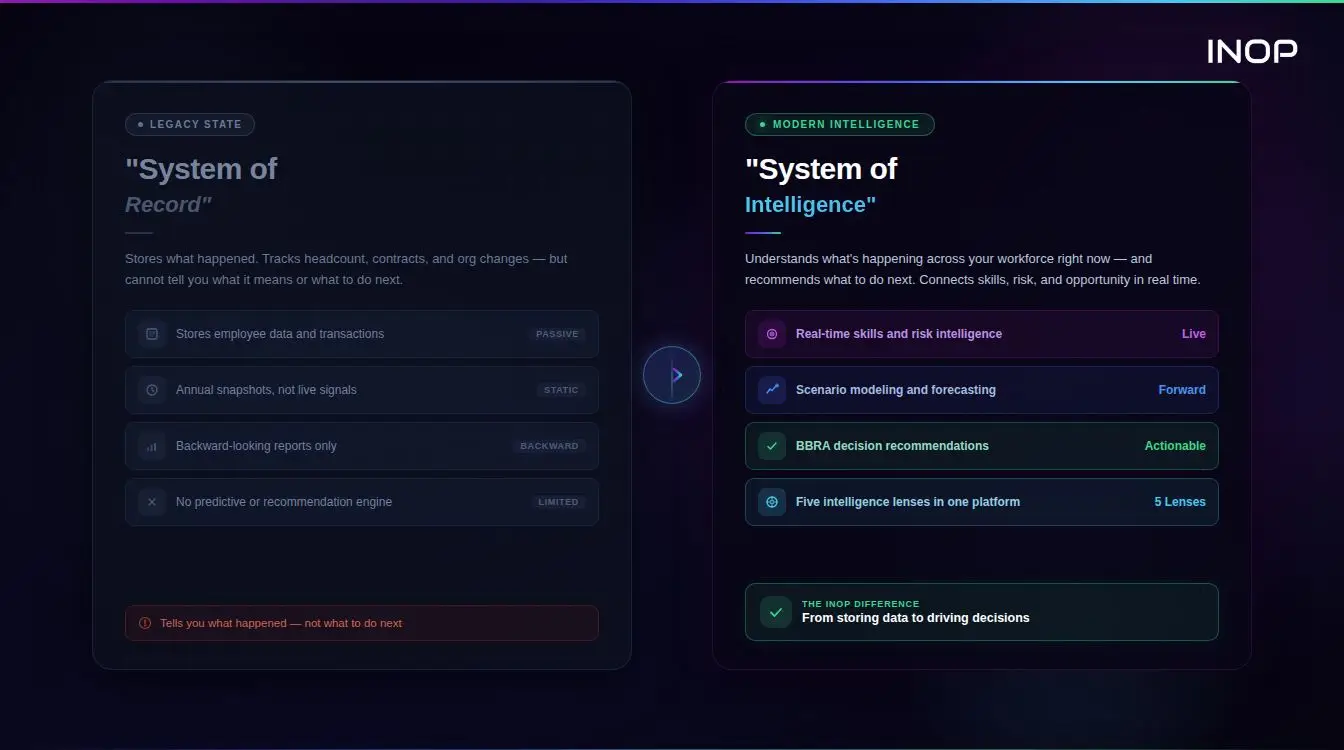
The limitation is not the HRIS. It is the expectation that the HRIS can be both the system of record and the system of intelligence. These are architecturally different functions. A system of record is optimized for data integrity, consistency, and auditability. A system of intelligence is optimized for synthesis, forward-looking analysis, and decision support. Asking one system to do both typically means it does neither particularly well.
The evidence for this gap is consistent across organizations of every size. 55% of HR leaders reported in 2025 that their existing technology solutions fall short of meeting both current and future business needs, primarily due to a lack of integration and fragmented data, according to a Gartner survey. HR teams spend 18 to 22% of their time managing system issues, integrations, and data movement rather than strategic initiatives. Only 39% of organizations say their various HR solutions are usefully integrated with one another, despite the majority running between two and four separate HR platforms.
The picture that emerges is of an HR function that has invested heavily in data collection and relatively little in the intelligence layer that makes that data useful for decisions. That imbalance is what HR transformation now needs to correct.
Why the Shift Has Become Urgent Now
The argument for moving beyond the system of record has existed for years. What has changed in the last 24 months is the cost of not moving. Several converging forces have raised the stakes to a level where the gap between record-keeping and intelligence is no longer a strategic inconvenience. It is a governance and competitive liability.
The Speed of Skills Change
Skills are now changing faster than annual planning cycles can track. According to research by Lightcast, over the past three years the average job has seen 32% of its skills change. Microsoft and LinkedIn project that skills will change by 50% globally by 2030, with generative AI expected to accelerate that figure to 68%. A workforce planning process that updates capability data annually and runs strategy on that basis is making decisions on a picture that is already significantly out of date by the time it is used.
A system of record captures the skills an employee had when their profile was last updated. A system of intelligence tracks which of those skills are growing in external demand, which are declining, which face automation within your planning horizon, and what that means for the organization’s ability to execute its strategy over the next 12 to 36 months. Those are different data products, and only the second one is useful for workforce planning in the current environment.
The Fragmentation Problem
Most HR functions are not running on one system. Organizations reported an average of 9.1 HR systems in 2024, up from 6.2 in 2020, reflecting continuous tool additions rather than platform replacement. Each system captures a slice of the workforce picture: the HRIS holds headcount and employment data, the LMS holds learning records, the performance platform holds review data, the ATS holds hiring history, and the compensation tool holds pay data. None of these systems speaks to the others in real time.
The consequence is that no one in the organization has a unified, current view of workforce capability. HR synthesizes manually, in spreadsheets, using data pulled from multiple systems last synchronized at different times. Finance makes workforce cost assumptions based on headcount data that does not include the capability context that determines whether the headcount is actually able to execute what the budget assumes. Leadership makes strategic commitments without a clear view of whether the workforce is capable of delivering them.
56% of organizations rely on manual data entry or file uploads to move employee data between HR systems, and companies with fragmented HR stacks spend 34% more on HR technology administration compared to those with integrated stacks. The administrative cost of fragmentation is measurable. The strategic cost, in decisions made on incomplete or stale data, is almost certainly larger.
The Expectation Gap at the Executive Level
The third force making the shift urgent is the changing expectation of what the CHRO brings to the executive table. The CHRO of 2026 is not expected to report on headcount and attrition. They are expected to answer questions with direct financial and strategic implications: Are we capable of executing the strategy we have committed to? Where are the workforce risks that could derail our plans? What will our workforce cost look like under different growth scenarios? Where should we invest in capability and where should we redirect toward automation?
Only 47% of CHROs believe their culture currently drives employee performance, according to a 2025 Gartner survey of 222 CHROs. 74% of companies say they are not keeping up with their own demand for new skills, according to Josh Bersin’s 2026 Imperatives research. These are not operational failures. They are symptoms of a function that is measuring the wrong things with the wrong tools and arriving at the executive table with data that cannot answer the questions being asked of it.
Why a System of Intelligence Is Not Just a Better Dashboard
Before describing what a system of intelligence does, it is worth being precise about what it is not. The most common mental model CHROs arrive with when considering this transition is a more sophisticated people analytics platform: better visualizations, more data sources, faster reporting cycles. That model understates the architectural shift involved and is one reason so many analytics investments fail to deliver the strategic impact they promised.
People analytics platforms analyze historical internal HR data to identify patterns in attrition, performance, and engagement. They answer the question of what happened, sometimes with enough sophistication to suggest why. A system of intelligence does something structurally different. It synthesizes data from multiple internal and external sources, connects it to strategic and financial context, and produces forward-looking insight that supports decisions rather than reports on history. The output is not a richer version of what already existed. It is a different kind of output entirely.
The lens that connects role health findings to structural decisions is organizational design: not redrawing the org chart, but evaluating whether the six components of a working design, strategy, structure, roles, processes, systems, and rewards, are actually aligned. A system of intelligence surfaces where they are not. Organizational design is what determines the response.
The practical difference becomes clearest through an example. Consider a declining skill identified in the internal skills data. A people analytics platform surfaces that decline as a trend. A system of intelligence connects it across multiple dimensions simultaneously: through the Finance lens, it becomes a modelled cost exposure, quantifying what the declining capability is costing in productivity, project delay, and turnover risk. Through the AI and Automation lens, it becomes a question of whether the gap still needs to be filled by a human in 18 months, or whether automation is already closing it. Through the Market lens, it tells you what that skill currently costs to source externally and whether supply is tightening or loosening in the markets where you hire. Through the Strategy lens, it tells you whether the gap threatens a specific strategic commitment and at what probability. The same data point. Four actionable dimensions. A decision, not a report.
This is the intelligence architecture that INOP is built to deliver. Rather than replacing the HRIS or other systems of record, INOP ingests data from existing HR, finance, and operational systems and augments it with external market intelligence, financial modelling, and AI and automation exposure scoring, synthesizing output across five integrated lenses: Strategy, Finance, People, Market, and AI and Automation. No single-domain analytics tool produces that synthesis, and no system of record was ever designed to.
The Automate pathway in that model is increasingly the one organizations reach for first and regret soonest. AI workforce automation at production scale requires a governance architecture most organizations have not built before they commit to the deployment, which is why more than 40 percent of current AI agent projects are expected to be canceled before reaching production, despite the economic case being real.
The Maturity Path: Locating Where You Are Before Planning the Next Step
HR transformation does not happen in a single step, and the right next move depends entirely on where an organization currently sits on the maturity path. Most CHROs attempting to plan a transformation without this map end up investing in capabilities they are not yet ready to use, or optimizing a stage they have already outgrown.
Stage one: Administrative record-keeping. The HRIS captures employment transactions. Data lives in spreadsheets. Reporting is manual and backward-looking. Strategic decisions are made without workforce data as a structured input. The priority at this stage is data consolidation and basic system implementation.
Stage two: Operational reporting. The HRIS generates standard reports on headcount, attrition, time-to-fill, and compensation. Dashboards exist. The data is more consistent. The reports describe what happened but they do not inform decisions about what to do next. Only one in ten organizations rate their HR technology stack at the expert stage of maturity, according to HR.com’s 2025 State of HR Technology research, suggesting that the majority are navigating stages one and two.
Stage three: People analytics. The organization begins connecting HR data to business outcomes, using analytics to understand patterns in attrition, performance, and engagement. The analysis is more sophisticated, but it remains primarily historical. The question being answered is still what happened rather than what the organization should do. This is where most mid-size and large organizations with mature HR functions currently sit, and where the ceiling of the system of record becomes most acutely felt.
Stage four: Workforce decision intelligence. External market data, financial modelling, and forward-looking scenario analysis are integrated with internal HR data in a unified decision layer. The question being answered shifts to what the options are and what each one costs. Risk is quantified rather than described. Investment decisions are modelled across time horizons. The CHRO operates as a strategic business partner with financial credibility at the executive table. This is the stage that INOP’s strategic workforce planning platform is built to enable, and the stage at which HR transformation produces its most significant business impact.
Locating your organization accurately on this path is not a judgment. It is a diagnostic. The organizations that accelerate most effectively through the maturity path are those that are clear-eyed about where they currently are and disciplined about what the next stage actually requires, rather than attempting to skip stages in a way that leads to technology investments sitting on top of data foundations that cannot support them.
One of the clearest expressions of the difference is workforce management forecasting. A system of record can report that three critical roles are currently unfilled. A system of intelligence can model how many roles will be unfilled in six months, which capabilities will be lost through predicted attrition, what the financial cost of that gap is, and which Build, Buy, Redeploy, or Automate response produces the best return across each planning horizon.
The Six Risk Domains That Replace the Dashboard Model
One of the most concrete expressions of the shift from record to intelligence is the replacement of the retrospective dashboard with a forward-looking risk architecture. Dashboards report on metrics. Risk domains score the probability and estimated cost of specific types of workforce-driven strategic failure. That distinction is not semantic. It changes what the output is used for and who uses it.
INOP’s Decision Intelligence Layer is organized around six interconnected risk domains, each capturing a dimension of workforce risk that a system of record cannot see.
Capability Risk scores whether the organization has the skills and competencies required to execute current and future strategy, mapped at the role, team, function, and business unit level. This is not a skills gap report. It is a live score of execution readiness tied directly to what the business strategy demands.
Leadership Risk scores the quality and depth of leadership capability, succession readiness, AI literacy, and transformation sponsorship strength. For organizations undertaking significant change, this domain captures the human risk that most transformation programs fail to quantify until it has already derailed delivery.
Mobility Risk scores internal redeployment capacity, skills adjacency, reskilling pathway availability, and workforce agility. This is the data layer that makes the Redeploy lever of INOP’s BBRA framework actionable, surfacing the internal talent options that would otherwise be invisible to planners working from headcount data alone.
Role-Value Risk identifies whether roles are delivering expected value and maps critical, emerging, declining, and sunset roles. As automation reshapes task content and strategy evolves, the role portfolio needs continuous reassessment. This domain provides that signal on a live basis rather than during an annual org design review.
Culture Risk scores cultural alignment with strategic direction, change readiness, and transformation capacity. For HR transformation itself, this domain is particularly important: the technology layer of a system of intelligence is only as valuable as the organizational culture’s ability to use it, and Culture Risk is the domain that makes that readiness visible before a transformation investment is made.
Strategic Execution Risk is the composite domain, integrating signals from all five domains above to produce the organization’s overall execution risk score: the probability and estimated cost of workforce-driven strategic failure. This is the output that belongs in a board pack. It answers the question that every board is implicitly asking when it approves a strategic plan: is the workforce capable of delivering this, and what happens if it is not?
Where the BBRA Framework Connects Intelligence to Action
The most common failure mode of HR analytics investments is that they produce insight without action. The intelligence exists. The interpretation exists. The recommendation does not, or if it does, it lacks the financial structure that would make it defensible in a capital allocation conversation.
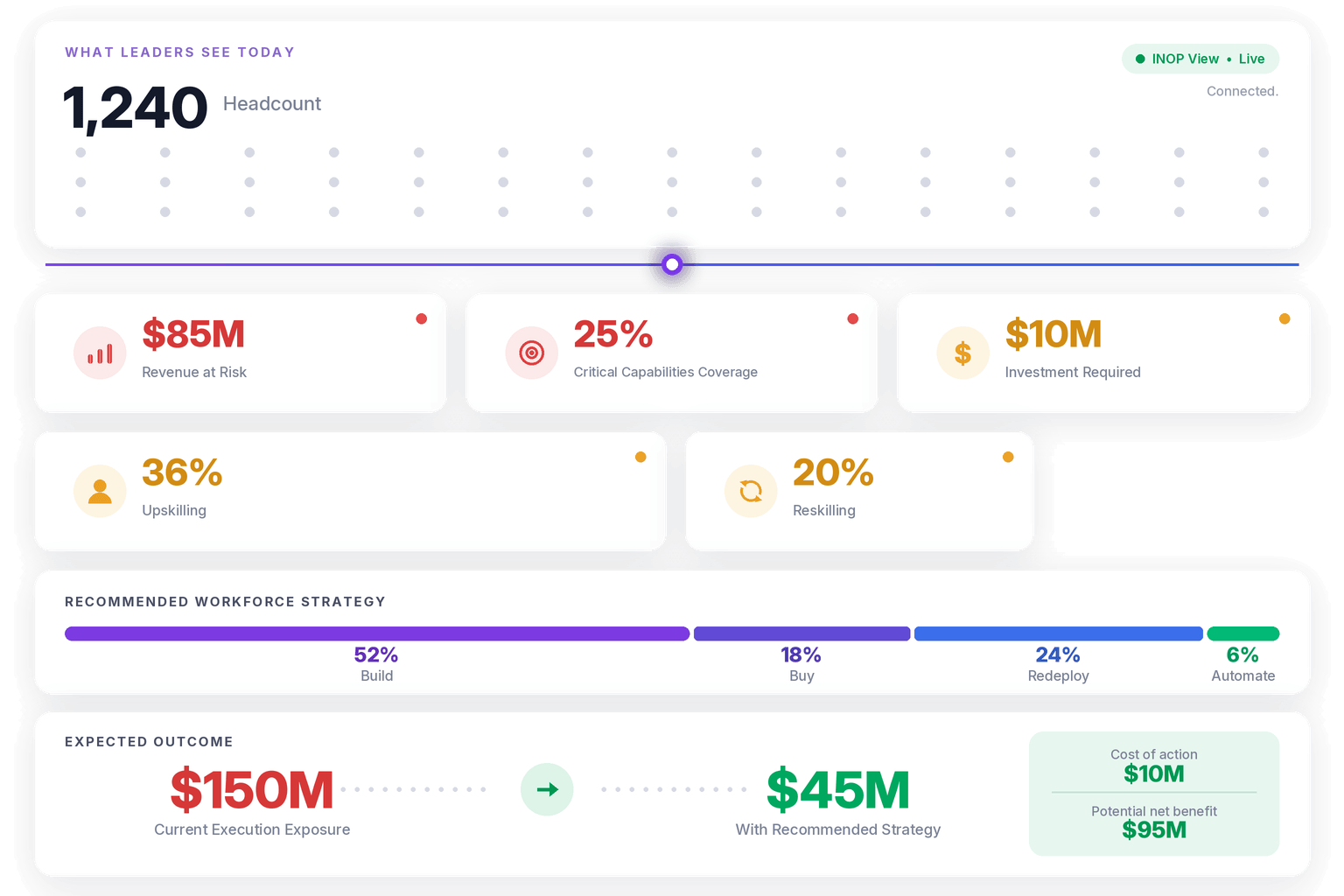
INOP’s BBRA framework, INOP’s proprietary decision architecture for workforce action, solves this by connecting every capability gap identified through the intelligence layer to a structured comparison of four intervention pathways: Build, Buy, Redeploy, and Automate. For each pathway, INOP models financial trade-offs across 30-day, 180-day, 1-year, and 3-year horizons, so leaders can make workforce investment decisions with the same rigor they apply to any other significant business investment.
Build models internal development cost and time-to-competency for closing the gap through upskilling. It is typically the lowest unit cost per skill acquired but the longest time horizon, and it is most defensible when the employee brings domain knowledge that an external hire cannot replicate.
Buy factors in market availability, real-time compensation benchmarks drawn from INOP’s compensation analytics platform across 3.5 million global job postings and 16 countries, and realistic hiring lead time. Buy decisions need to be calibrated against actual market conditions rather than benchmark averages from the prior year.
Redeploy scores skills adjacency and reskilling feasibility for internal candidates, surfacing the internal talent options that the Mobility Risk domain has already mapped. This is the most consistently underused lever in workforce strategy and the one with the highest potential for cost efficiency when the skills inventory is detailed enough to support it.
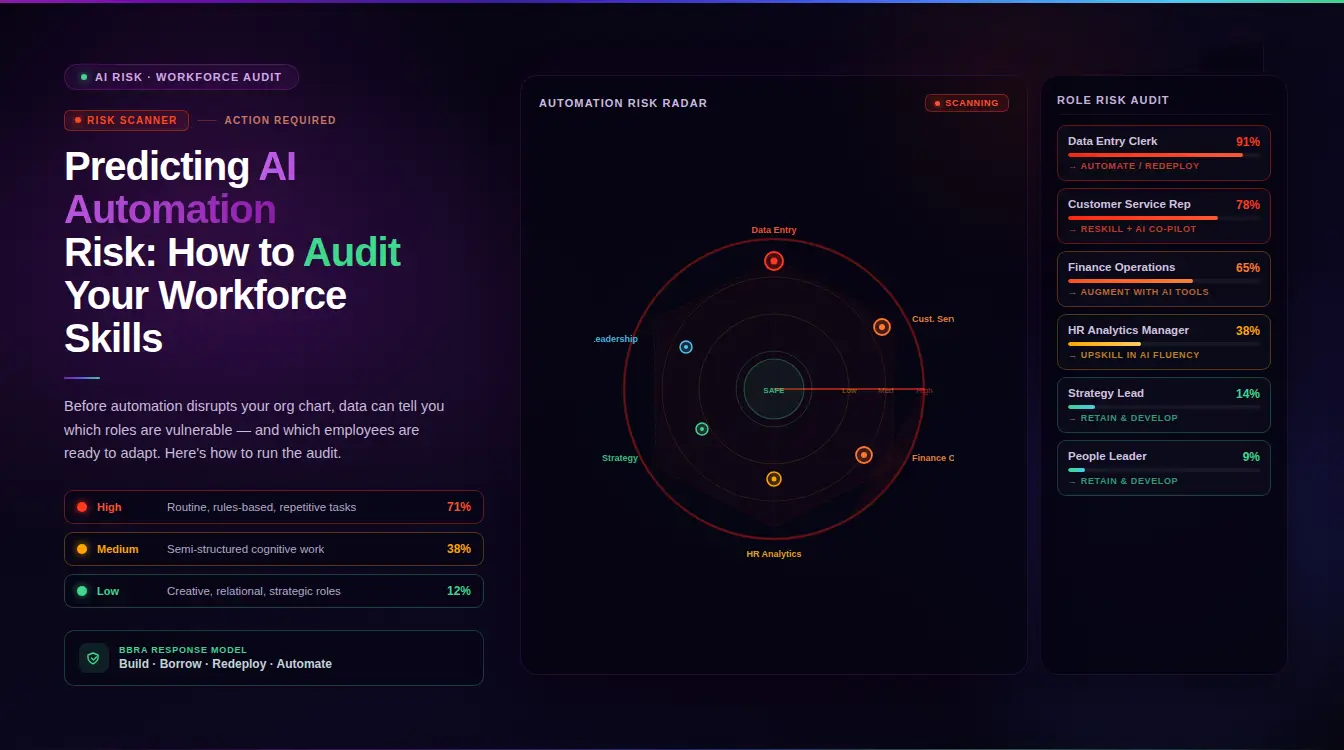
Automate quantifies FTE displacement and cost impact across time horizons, using INOP’s AI and Automation lens which applies task-level analysis across 40,000+ roles using seven published research frameworks. This lever evaluates whether a capability requirement is better addressed by accelerating automation than by investing in human capability development.
This is what separates a system of intelligence from a system of insight. Insight tells you where the gap is and what it costs. Intelligence tells you what to do about it, what each option will cost, what each will return, and across what timeline. That output is what earns the CHRO a genuine seat in financial planning rather than a reporting slot in the strategy deck.
The outputs a system of intelligence produces are only as valuable as the organization’s capacity to receive and act on them. An AI enabled workforce is the human infrastructure on the receiving end: leaders who understand what an AI-generated recommendation is based on, managers who can challenge it when the context is wrong, and a governance layer that creates accountability for what happens when an automated recommendation gets followed without sufficient scrutiny.
Ready to see what a system of intelligence looks like built for your organization?
Book a demo with INOP and explore how the Decision Intelligence Layer connects your existing workforce data to the strategic and financial outcomes your board can act on.
The Role of External Intelligence in the Architecture
A system of intelligence built entirely on internal data has a structural ceiling. Internal data tells you what your workforce looks like today. It cannot tell you whether what you have is aligned with where the market is moving, what the capabilities you need will cost to acquire externally, or which of your current skills are heading toward obsolescence as AI reshapes external demand.
This is where external intelligence becomes a non-negotiable component of the transformation architecture, not an optional enrichment layer. INOP integrates external market intelligence across two specific dimensions.
Skills Demand Intelligence
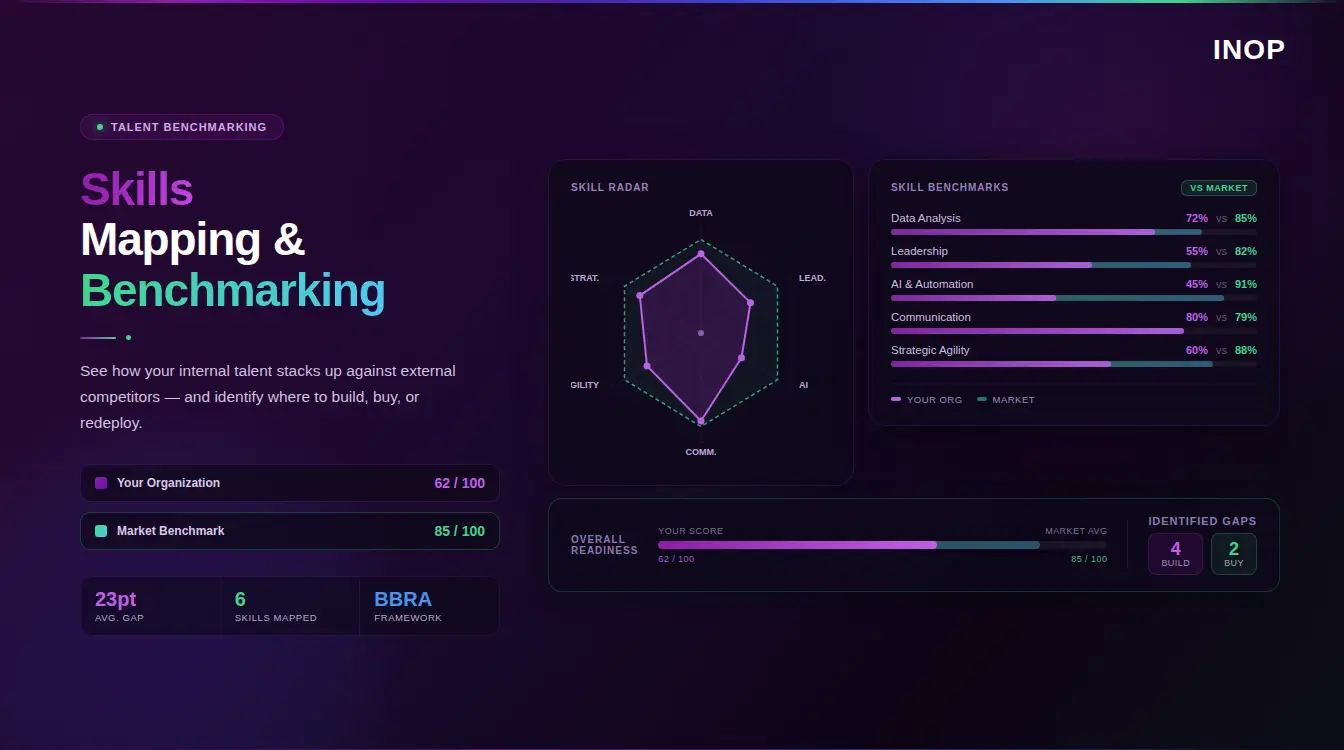
INOP’s Skills Intelligence service maps external skills demand signals directly to an organization’s internal taxonomy, at the proficiency, role, sector, and geography level, with AI and automation impact modelling built in for each skill. The output for each skill in your framework is a market state, Emerging, In Demand, Stable, or Declining, contextualized by the specific labor markets your organization competes in rather than by industry-wide averages.
This external validation layer does something that internal-only HR analytics cannot: it tells you whether the capabilities your workforce strategy is prioritizing are aligned with where external demand is moving. Most skills analytics tools stop at identifying the internal gap. The question that matters for a system of intelligence is what that gap is costing the business, and whether the external market can supply what the strategy needs, at what cost, and on what timeline.
Compensation Market Intelligence
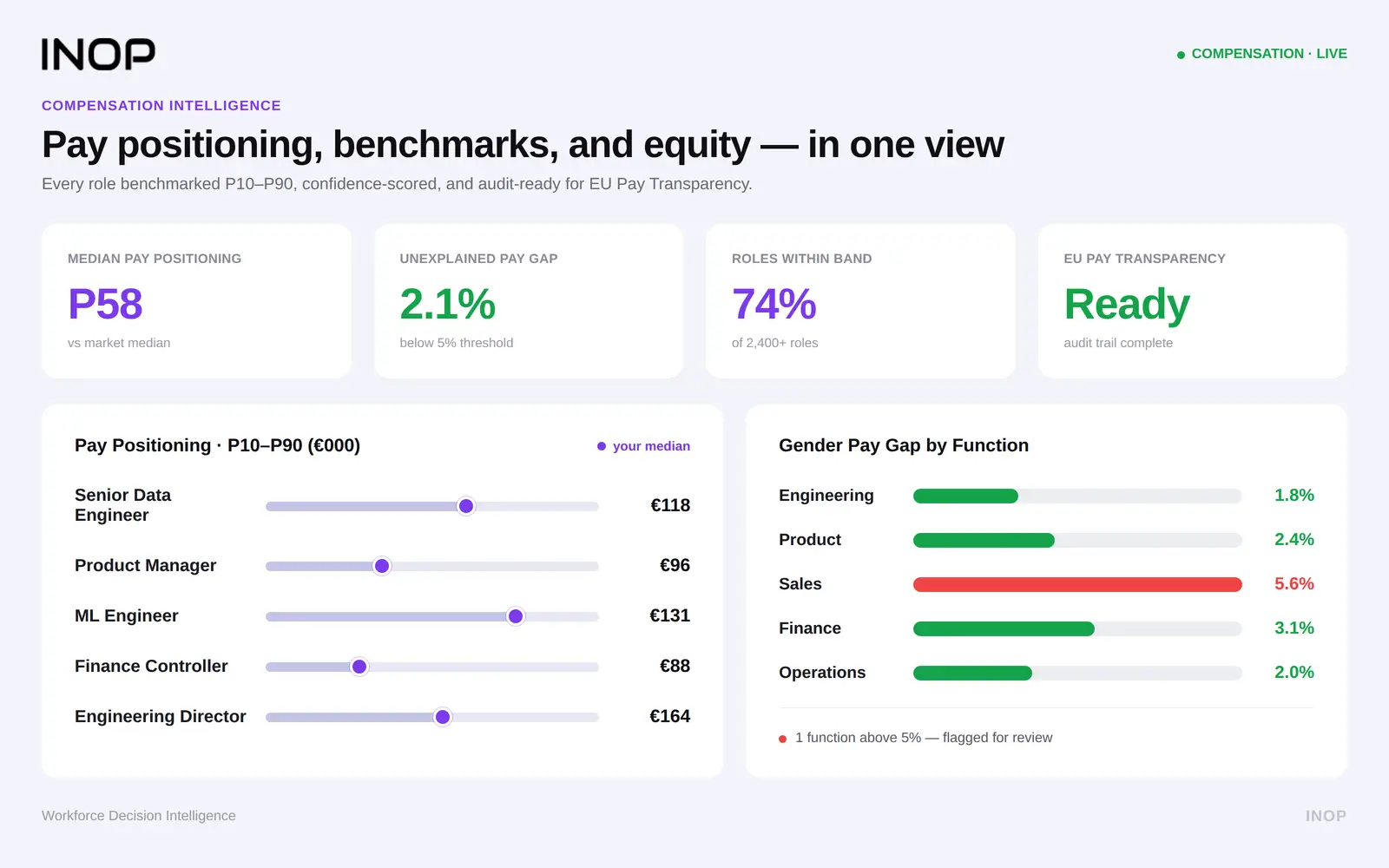
INOP’s compensation analytics platform draws on 3.5 million global job postings across 16 countries and a skills taxonomy of 22,700 unique skills to provide real-time salary benchmarking and skills-based pay frameworks. For a system of intelligence, this data serves two distinct purposes: it calibrates the financial model that underlies every BBRA intervention decision, and it connects workforce planning to pay equity and regulatory compliance. With the EU Pay Transparency Directive requiring organizations with 100 or more employees to ensure objective, skills-based pay structures, the compensation intelligence layer is increasingly part of the governance architecture of the organization, not just an HR planning tool.
The Organizational Side of HR Transformation
The technology architecture of a system of intelligence is a necessary condition for HR transformation. It is not a sufficient one. The organizational dimensions of the shift are equally important and consistently underestimated.
The HR and Finance Partnership
A system of intelligence produces its highest value when HR and Finance are operating from the same data layer. When workforce cost modelling, scenario planning, and capability investment decisions are made in a shared analytical environment, the outputs are more accurate, more defensible, and more likely to drive action. The current state in most organizations is the opposite: HR synthesizes manually while Finance operates on workforce cost assumptions disconnected from the capability data that would make those assumptions precise. The system of intelligence closes that gap by providing a unified view that both functions can work from simultaneously.
The Governance Dimension
With three in four knowledge workers already using AI tools at work, 78% of them without any official guidance or oversight, HR now has a governance mandate that sits above the traditional people management function. The system of intelligence needs to include AI governance as a structural component. INOP’s AI and Automation lens, which applies task-level analysis across 40,000+ roles using seven published research frameworks, provides the organizational visibility into AI adoption and automation exposure that this governance responsibility requires. Without that visibility, AI governance is a policy document rather than an operational capability.
What HR Transformation Looks Like for PE Portfolio Companies
For private equity operating partners, the shift from system of record to system of intelligence is not a digital transformation aspiration. It is a value creation tool with direct financial implications that most portfolio company HR functions are not currently equipped to provide.
Portfolio companies in transformation typically carry HR functions that were built for the operational scale and complexity of their pre-acquisition state. They have systems of record that capture what the workforce looks like. They rarely have the intelligence layer that answers whether that workforce is capable of executing the value creation plan, where the gaps are, what they cost, and what the intervention options are with financial trade-offs attached.
INOP’s dedicated PE workforce intelligence offering provides exactly this layer, in a format designed for the investment committee rather than the HR function. The six risk domain architecture gives operating partners a structured view of workforce-driven strategic risk across capability, leadership, mobility, role-value, culture, and strategic execution dimensions. The BBRA framework with four-horizon financial modelling translates that risk into intervention options with cost and return figures that belong in a value creation plan alongside capital allocation decisions.
For operating partners managing multiple portfolio companies, the consistency of INOP’s analytical framework across the portfolio creates a basis for comparative risk assessment and resource allocation that is not possible when each portfolio company is using different HR systems and different reporting frameworks. The intelligence layer provides the standardization that makes portfolio-level workforce decisions as rigorous as portfolio-level financial decisions.
See how INOP’s five-lens Decision Intelligence Layer transforms workforce data into board-ready strategic and financial insight.
Book your demo today and explore what HR transformation built on a system of intelligence looks like for your organization.
Conclusion
HR transformation has been a priority for the better part of a decade. What has changed is the definition. The first wave, moving from paper to digital, from local to cloud, from manual to automated, is largely complete for most mid-size and large organizations. The second wave is more demanding because it requires not just a technology upgrade but an architectural shift in what HR is expected to produce.
A system of record tells leadership what the workforce looked like last quarter. A system of intelligence tells leadership whether the workforce is capable of executing the strategy it has committed to, where the risks are, what they cost, and what the options are for addressing them with financial trade-offs attached. That shift is what HR transformation in 2026 actually means, and it is what earns the CHRO a permanent seat at the strategy table rather than a reporting slot.
The technology to make this shift is available now. INOP’s Decision Intelligence Layer, connecting internal workforce data with external market intelligence across five integrated lenses, six risk domains, and BBRA-driven intervention modelling across four financial horizons, is built specifically to close the gap between the system of record that most organizations have and the system of intelligence the current business environment demands.
If you are navigating this transition inside your own organization and want to explore what the intelligence layer would look like built for your specific context, the most direct path is a conversation with our team. And if you have a perspective on where the system of record to system of intelligence shift is stalling in your organization, leave a comment below. The most useful thinking on this topic comes from practitioners working through it, not from frameworks describing it.
Frequently Asked Questions
What is the difference between a system of record and a system of intelligence in HR?
A system of record is designed to capture, store, and retrieve workforce information reliably: employment data, compensation, headcount, compliance records. It is optimized for data integrity and auditability. A system of intelligence synthesizes that data with external market signals, financial modelling, and strategic context to produce forward-looking insight that supports decisions. The system of record answers what happened. The system of intelligence answers what it means, what is likely to happen next, and what the organization should do about it.
How is a system of intelligence different from a people analytics platform?
People analytics platforms analyze historical internal HR data to identify patterns in attrition, performance, and engagement. They answer the question of what happened, sometimes with enough sophistication to suggest why. A system of intelligence is built for forward-looking decisions. INOP synthesizes data across five integrated lenses simultaneously: Strategy, Finance, People, Market, and AI and Automation. A capability gap in isolation is an HR observation. The same gap connected to financial exposure, automation trajectory, market talent supply, and strategy execution risk becomes a board-level decision. That synthesis is what a system of intelligence produces and what no single-domain analytics platform can replicate.
Why is HR transformation urgent in 2026 specifically?
Several forces converged around 2024 and 2025 to make the transition from system of record to system of intelligence genuinely urgent. Skills are changing faster than annual planning cycles can track, with 32% of the average job’s skills changing in three years and projections of 50 to 68% change by 2030. AI is reshaping the task composition of roles across functions. Fragmented HR technology stacks, averaging 9.1 systems per organization in 2024, are producing data that cannot support the quality of decisions the business now requires. And board-level expectations for workforce intelligence have risen to match what is already expected of financial reporting.
What are INOP’s six risk domains?
INOP’s Decision Intelligence Layer is organized around six interconnected risk domains that together produce a composite Strategic Execution Risk score. Capability Risk scores whether the organization has the skills to execute its strategy. Leadership Risk scores succession readiness, AI literacy, and transformation sponsorship. Mobility Risk scores internal redeployment capacity and skills adjacency. Role-Value Risk identifies critical, emerging, declining, and sunset roles. Culture Risk scores change readiness and cultural alignment with strategic direction. Strategic Execution Risk integrates signals from all five domains to produce the composite probability and estimated cost of workforce-driven strategic failure, the output designed for board-level governance rather than HR reporting.
What is INOP’s BBRA framework?
BBRA stands for Build, Buy, Redeploy, and Automate. It is INOP’s proprietary decision architecture for translating capability gap analysis into workforce action. For any gap identified through the intelligence layer, INOP models all four intervention pathways with financial trade-offs across 30-day, 180-day, 1-year, and 3-year horizons. Build models internal development cost and time-to-competency. Buy factors in market availability and real-time compensation benchmarks. Redeploy scores skills adjacency and reskilling feasibility for internal candidates. Automate quantifies FTE displacement and cost impact across time horizons. This gives leaders investment-grade rigour on workforce decisions, making HR a genuine participant in capital allocation rather than a cost center reporting on headcount.
How do PE operating partners use INOP’s system of intelligence?
Operating partners use INOP to assess workforce-driven execution risk in portfolio companies with the same analytical rigour they apply to financial performance. During diligence, the six risk domain architecture surfaces capability gaps, concentration risk, and cultural alignment issues that are not visible in financial statements. During the value creation period, the BBRA framework with four-horizon financial modelling translates workforce gaps into intervention options with cost and return figures that belong in a value creation plan. INOP’s dedicated PE workforce intelligence offering delivers this analysis in a format designed for the investment committee, not the HR function.
What maturity stage does an organization need to reach before investing in a system of intelligence?
A system of intelligence sits at stage four of the HR technology maturity path. It requires that basic data infrastructure, consistent internal data, and some level of people analytics capability already exist, because the intelligence layer synthesizes and elevates that data rather than creating it from scratch. Organizations at stage one or early stage two should prioritize data consolidation and HRIS implementation before investing in an intelligence layer. Organizations at stage three, with people analytics capability in place, are typically ready to make the architectural shift. INOP is designed to work alongside existing systems of record rather than replace them, which means the transition does not require a full technology replacement before intelligence becomes accessible.
Make confident workforce decisions that support strategy and value creation.