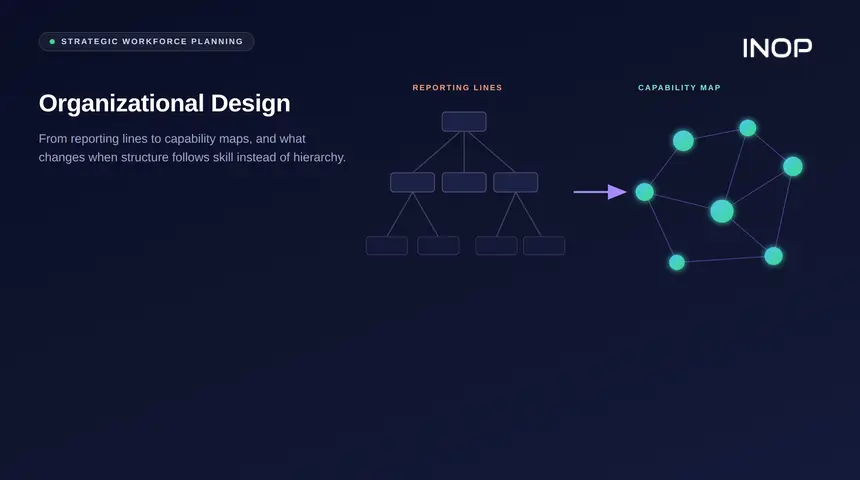
Organizational design is the deliberate structuring of roles, reporting lines, decision rights, and workflows so an organization can actually execute its strategy, rather than a chart that gets drawn once and defended long after the business it described has changed. For decades, this meant defining who reports to whom. That is no longer the whole question. Organizations increasingly have to design around what work needs doing and which combination of people and AI can do it, not just around headcount and hierarchy.
This guide covers what organizational design actually requires, the six components every design has to address, why span of control remains one of the most underused levers available, and the shift already underway from headcount-based org charts to capability-based work charts.
What Organizational Design Actually Covers
Organizational design is not just the org chart. A complete design addresses strategy, structure, roles, processes, systems, and rewards together, since a change to any one of these six components without adjusting the others rarely holds. Strategy clarifies what the organization is trying to achieve and the capabilities it needs to get there. Structure defines reporting lines, spans of control, and how work is grouped, by function, product, or geography. Roles specify responsibilities, decision rights, and skill requirements. Processes establish how work actually flows across teams. Systems ensure the right data, tools, and budget reach the people who need them. Rewards align incentives with the behavior the design is meant to produce. Treating any one of these as the whole design, structure especially, is the most common reason a redesign looks complete on a slide and fails in practice.
The Six Components Every Organizational Design Has to Address
Most organizational design efforts default to redrawing the structure component and calling it finished. A durable design has to at least check the other five before declaring the work done, since strategy without matching roles produces confusion about who owns what, and structure without matching rewards produces a design nobody is actually incentivized to operate within as intended.
The interaction effects between these six components are what usually get missed. A structural change that flattens management layers, for instance, only works if roles are simultaneously redefined to reflect broader decision rights at the individual contributor level, if processes are adjusted so approvals do not still route through a layer that technically no longer exists on the chart, and if rewards recognize the added scope those individual contributors are now expected to carry. Skip any one of those adjustments and the flattened structure looks efficient on paper while quietly reproducing the same bottlenecks it was meant to remove, just without the job titles that used to make those bottlenecks visible.
Span of Control: The Most Consequential Design Lever Most Leaders Underuse
Span of control, the number of people reporting to a single manager, sounds like a minor administrative detail and functions as one of the highest-leverage decisions in any organizational design. Narrow spans of five to seven reports support detailed supervision and coaching. Wide spans of eight to fifteen or more support flatter, more autonomous structures with fewer layers and lower management cost. Getting this wrong compounds quietly: promoting a strong technical performer into a wide span with no management support is a well-documented trap, and even organizations investing heavily in leadership development, more than 75 percent according to Gartner’s tracking, still struggle to see meaningful improvement in managerial effectiveness when the underlying span itself was never designed around actual workload and role complexity.
See how INOP models organizational design decisions against real workforce data. Book a demo to walk through a live view for your organization.
Why Organizational Design Is Shifting From Org Charts to Work Charts
Traditional org charts create artificial scarcity by organizing around headcount rather than capability delivery, and that default is now being challenged directly at the highest levels of major companies. Shopify’s internal AI mandate put the shift in blunt terms: before asking for more headcount, teams must demonstrate why they cannot get what they want done using AI. This is not a call to replace people with machines. It is a demand that organizational design start from the work that needs doing and the capability required to do it, human, AI, or some combination, rather than starting from an assumed headcount number and backfilling justification for it afterward. A work chart maps tasks, outcomes, and capabilities. An org chart maps reporting relationships. Increasingly, organizations need both, and the first is becoming the harder, more consequential one to get right.
INOP’s Five Intelligence Lenses Applied to Organizational Design
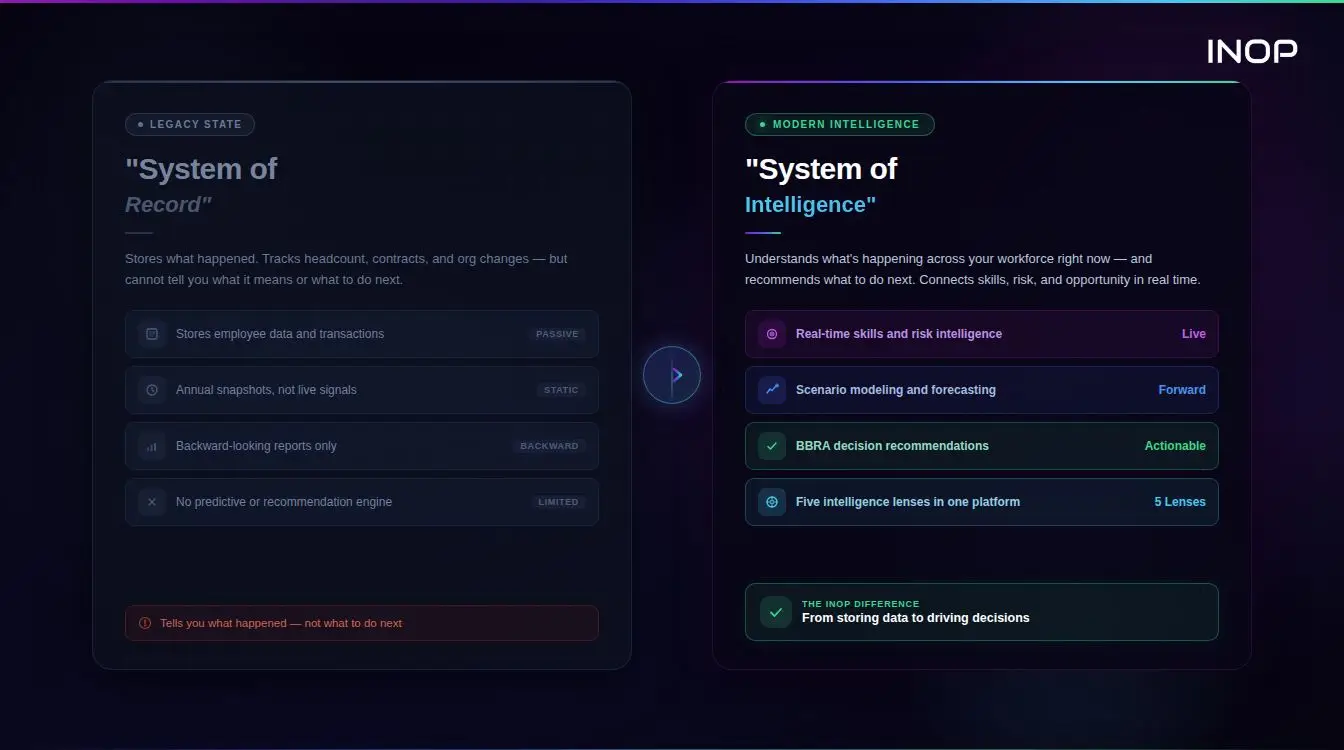
A structural change that looks efficient on an org chart can still create real risk elsewhere in the organization. INOP evaluates every organizational design decision through five intelligence lenses to catch that risk before it becomes a costly restructuring mistake.
| Lens | What It Evaluates in an Organizational Design Decision |
|---|---|
| Strategy | Whether a proposed structural change actually supports a defined business priority, not just a cleaner-looking chart |
| Finance | The real cost of the redesign, including management overhead from span-of-control changes, against the alternatives |
| People | Whether current employees can actually staff the new structure, and where succession or concentration risk sits within it |
| Market | Whether the proposed roles and skills are realistically available externally if the design assumes new hiring |
| AI and Automation | Whether a headcount request is actually justified, or whether the underlying work is a genuine automation candidate first |
BBRA: The Decision Behind Every Headcount Request
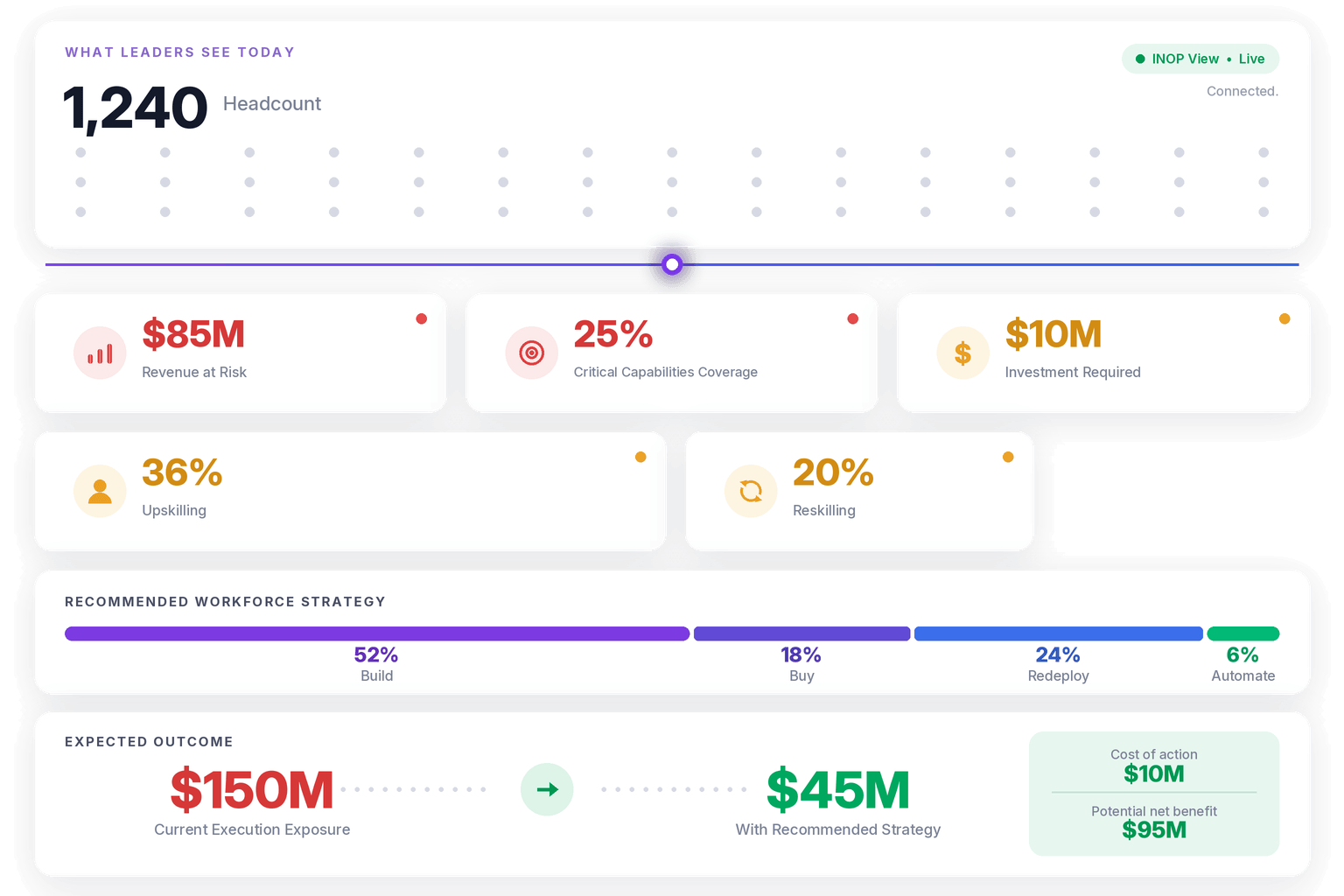
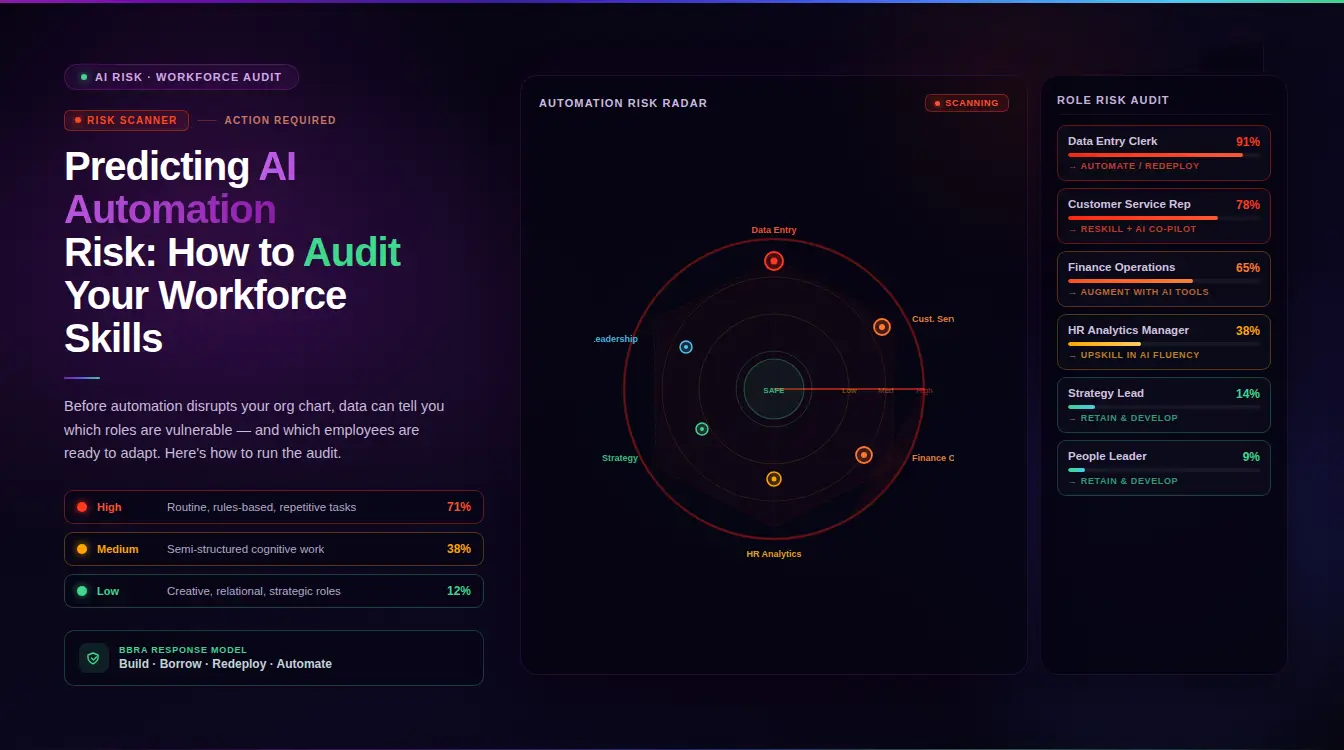
The shift toward work charts described above needs an actual mechanism, not just a mandate, and this is where INOP’s proprietary BBRA framework fits directly into organizational design. Build, Buy, Redeploy, and Automate models four intervention pathways against financial tradeoffs across four time horizons: thirty days, one hundred eighty days, one year, and three years, giving a design team a structured way to answer exactly the question Shopify’s mandate poses.
Applied to a headcount request inside an organizational design decision, this means the request gets compared rather than approved by default: would building capability in an existing team close the gap, would redeploying someone from a lower-priority function work faster, does the scale of the gap genuinely justify external hiring, or is the underlying work better addressed through automation entirely. McKinsey’s own organizational design tools have documented outcomes as concrete as an 18 million dollar savings and stock value boost for a media company that closed a workforce capability gap of more than 1,500 people through structured design rather than reflexive hiring, exactly the kind of outcome that depends on running the BBRA comparison rather than defaulting to the traditional org-chart response.
Organizational Design for Private Equity Operating Partners
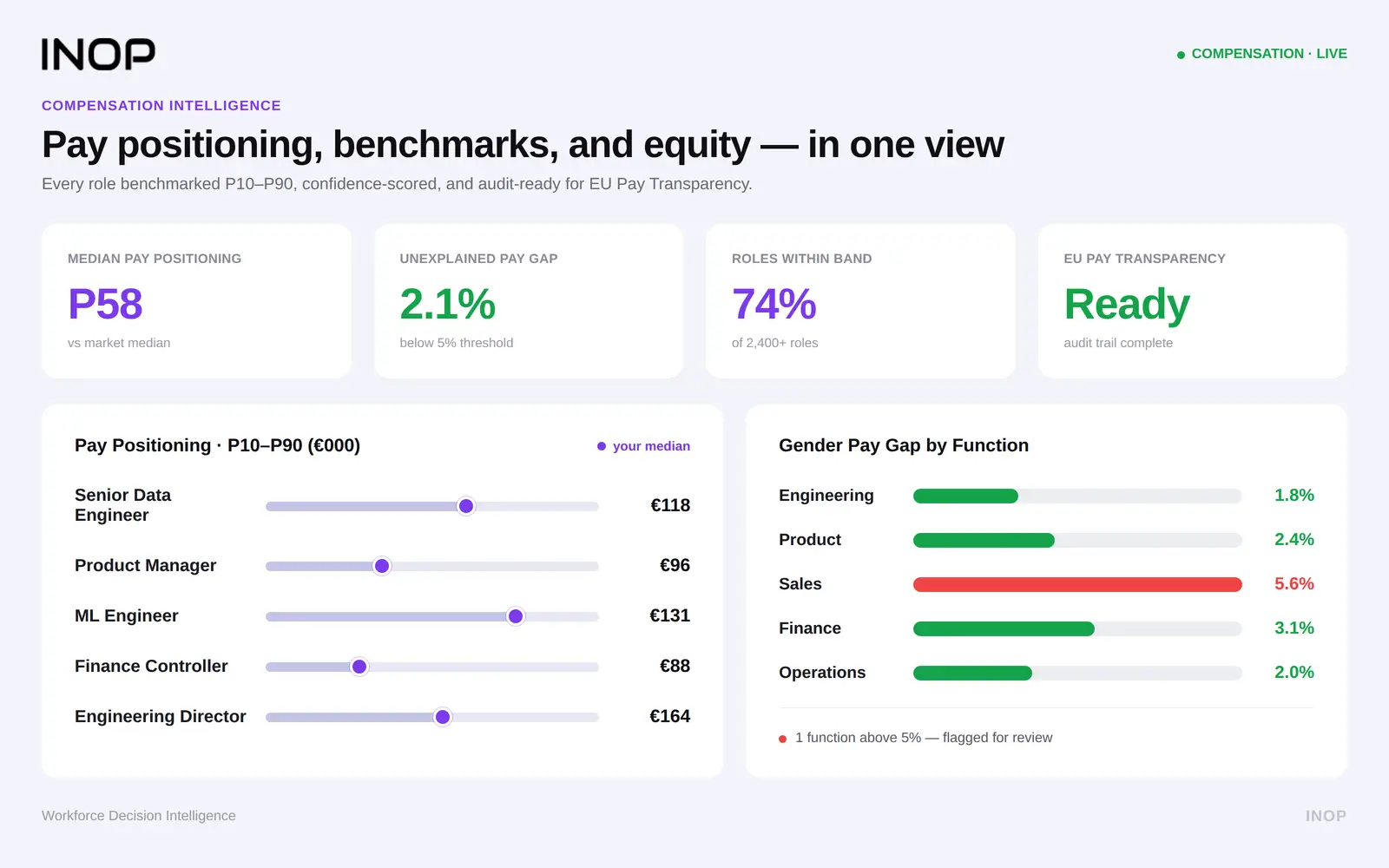
Inside a portfolio company, an organizational design presented during diligence, a clean chart with clear reporting lines, can look complete while hiding real exposure in span of control, succession depth, or capability gaps the chart itself does not show. A hundred-day plan built on an org chart alone, without checking whether the structure can actually execute the value creation plan, is planning against an incomplete picture. Standardizing this evaluation across a portfolio through INOP’s strategic workforce planning platform gives operating partners a consistent way to check whether a portfolio company’s organizational design reflects real capability and workload, not just a tidy reporting structure. Where a design surfaces roles carrying scarce, high-demand capability, INOP’s compensation analytics platform connects that finding directly into pay benchmarking, since a redesigned role frequently carries a different market rate than the position it replaced.
Common Mistakes in Organizational Design
Treating the org chart as the entire design. Structure is one of six components. A redesign that changes reporting lines without adjusting roles, processes, systems, and rewards to match rarely produces the outcome it was meant to deliver.
Setting span of control by convention rather than workload. Applying the same manager-to-report ratio across every team regardless of role complexity ignores one of the most consequential and most correctable levers in the entire design.
Approving headcount requests without comparing alternatives. A request for more people should be compared against building capability internally, redeploying existing talent, or automating the underlying task, not approved as the default response to every workload increase.
Designing around today’s roles instead of the work itself. A structure built entirely around existing job titles inherits whatever inefficiency or redundancy those titles already carry, rather than starting from what work actually needs to get done.
Redesigning structure without verifying the workforce can staff it. A new design that assumes capability the organization does not currently have, with no modeled plan to acquire it, is designing for a workforce that does not exist yet. INOP’s skills intelligence platform closes this gap by mapping verified skills data against external labor market signals, so a redesign gets checked against real capability rather than assumption, a discipline covered in more depth in INOP’s guide on workplace transformation strategy and its own missing financial decision layer.
Reorganizing without a defined review cadence afterward. A structure declared finished and left untouched drifts out of alignment with the business it was built to serve well before the next scheduled reorganization. Treating organizational design as continuous, revisited on a defined cadence rather than only when a crisis forces the question, is what keeps a structure from quietly going stale.
Frequently Asked Questions
What are the main components of organizational design?
Strategy, structure, roles, processes, systems, and rewards. A complete design addresses all six together, since changing structure alone without adjusting the other five rarely produces a lasting result.
What is the ideal span of control?
There is no universal number. Narrow spans of five to seven reports suit roles requiring close supervision, while wide spans of eight to fifteen or more suit autonomous, flatter teams. The right span depends on role complexity, manager experience, and available technology, not a fixed company-wide standard.
How is organizational design changing because of AI?
Organizations are increasingly designing around work and capability rather than headcount and reporting lines alone. Some, like Shopify, now require teams to demonstrate why AI cannot address a need before approving additional headcount, shifting the starting question from who reports to whom toward what work actually needs doing.
What is the difference between an org chart and a work chart?
An org chart maps reporting relationships. A work chart maps tasks, outcomes, and the capabilities required to deliver them, human, AI, or a combination of both. Organizations increasingly need both, with the work chart becoming the harder and more consequential one to get right.
How should private equity operating partners evaluate a portfolio company’s organizational design?
By checking whether the structure reflects real workload, span of control, and capability, not just clean reporting lines. A chart that looks organized during diligence can still hide succession gaps or capability shortfalls that only surface once execution begins.
Ready to see your organizational design modeled against real capability instead of a static chart? Book a demo and INOP will walk through the five-lens model and BBRA, live.