AI automation bias is the tendency to over-trust an AI system’s output simply because it came from an automated system, even when the underlying data is thin, outdated, or wrong. In workforce planning, this shows up as headcount recommendations, compensation benchmarks, or reskilling priorities that get accepted because a model produced them, not because anyone verified them. As more of the workforce decision stack gets automated, this bias becomes a governance risk in its own right, separate from whether the underlying AI system is accurate.
This guide explains what ai automation bias is, why it is spreading beyond hiring into core workforce planning, and how to structure decisions so human judgment stays in the loop rather than getting quietly displaced by it.
What AI Automation Bias Actually Means
Automation bias is a well documented behavioral pattern that predates modern AI: people tend to overly rely on automated outputs while discounting contradictory information in front of them, a definition confirmed in the International AI Safety Report’s review of the research. It has been observed for decades in aviation and monitoring systems, where operators failed to catch errors that a non-AI automated system missed simply because they trusted the system more than their own judgment.
What changes with generative and predictive AI is scale and confidence. AI automation bias in a workforce context means a compensation recommendation, a risk score, or a skills classification gets treated as settled because a model generated it, when in reality the model’s output deserves the same scrutiny a junior analyst’s first draft would get.
Why AI Automation Bias Is Easy to Miss
The same research notes that people are less likely to correct an AI system’s errors specifically when correcting them requires extra effort, or when they already hold a favorable view of the tool producing the output. That combination, convenience plus trust, is exactly the environment most workforce platforms are designed to create, which is what makes the bias so easy to miss inside an HR or people analytics function that is already stretched thin.
When AI Automation Bias Caused Real Harm: Documented Cases
Understanding automation bias in theory is easier when accompanied by documented examples of what happens when it is not caught. Three cases have become foundational references in the governance literature because they illustrate distinct failure modes, each of which maps directly to a workforce decision category your organization is likely already using AI to support.
Amazon’s Recruiting Tool: When Training Data Encodes Historical Bias
Amazon developed an AI recruiting tool trained on ten years of its own historical hiring data. The tool learned from patterns in that data and began systematically downgrading candidates from women’s colleges and penalizing CVs that contained the word “women’s.” Amazon’s engineers discovered the bias in 2018 and discontinued the tool, but the case established something that remains the most important principle in AI hiring governance: a model trained on biased historical decisions will produce biased future recommendations even when the organization intends for it to be objective. The automation bias dimension was that reviewers were acting on the tool’s recommendations rather than scrutinizing its reasoning, which is exactly what allows historical patterns to propagate forward without challenge.
The Workday Class Action: Employer Liability for Vendor Algorithms
In February 2024, a class action lawsuit was filed against Workday alleging that its AI screening system engaged in systematic discrimination based on race, age, and disability. In May 2025, the case advanced to a significant legal milestone, establishing that employers are liable for the discriminatory outcomes of vendor-supplied AI tools even when they did not design those tools themselves. This finding directly addresses the most common misconception in AI workforce governance: that purchasing a tool from a vendor transfers the liability to the vendor. It does not. The employer who deploys the tool, accepts its recommendations, and acts on them is the party regulators and plaintiffs hold accountable.
For a complete analysis of how human capital risk exposure is quantified and governed, INOP’s guide on human capital risk covers the full risk management framework.
HireVue and Facial Analysis: When the Proxy Variable Is the Problem
HireVue’s early video interview AI assessed candidates partly through facial expression and vocal pattern analysis. The premise was that these signals correlated with job performance. The problem was that facial expression and vocal pattern analysis is heavily influenced by factors that correlate with protected characteristics: cultural norms around eye contact, accent and speech patterns, and lighting conditions in home interview environments. The Illinois Artificial Intelligence Video Interview Act, enacted in 2020, became the first US legislation specifically targeting this practice, requiring employer disclosure and consent when AI analyzes video interviews. HireVue subsequently discontinued its facial analysis features, but the case illustrated a recurring pattern: AI systems that use legitimate-sounding proxy variables can produce discriminatory outcomes when those proxies correlate with protected class membership in ways the developers did not model.
Where AI Automation Bias Shows Up in Workforce Planning
Automation bias used to be discussed almost entirely in the context of hiring and screening tools. It has since spread into every part of the workforce decision stack.
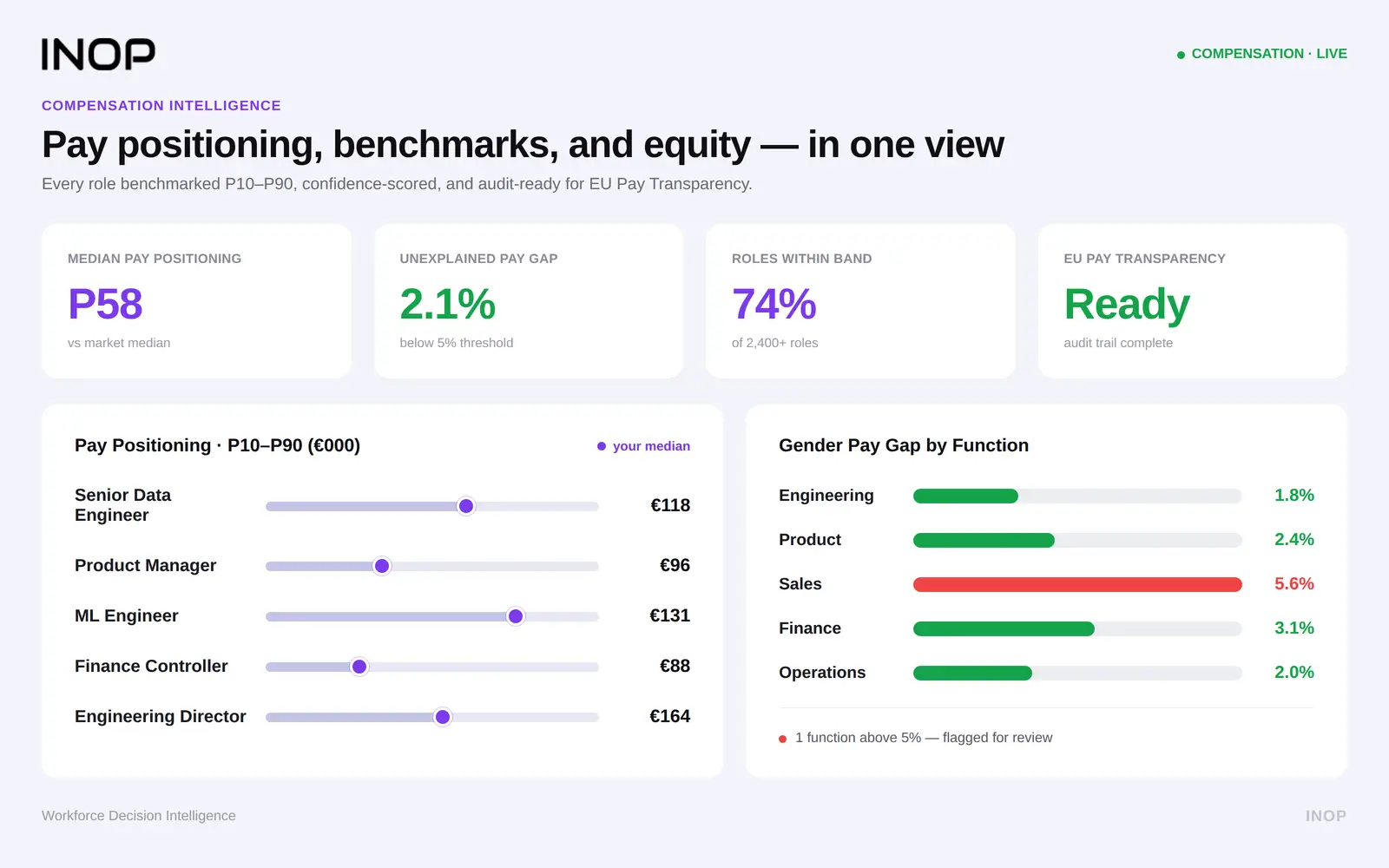
Compensation benchmarking. A pay recommendation generated from a model can look authoritative simply because it is precise to the dollar, even when the underlying dataset is thin for a given role or region. Precision is not the same as accuracy, and automation bias makes it easy to confuse the two, which is exactly why a benchmark needs to trace back to a transparent, verifiable dataset like the one behind INOP’s compensation analytics platform, not a single opaque score.
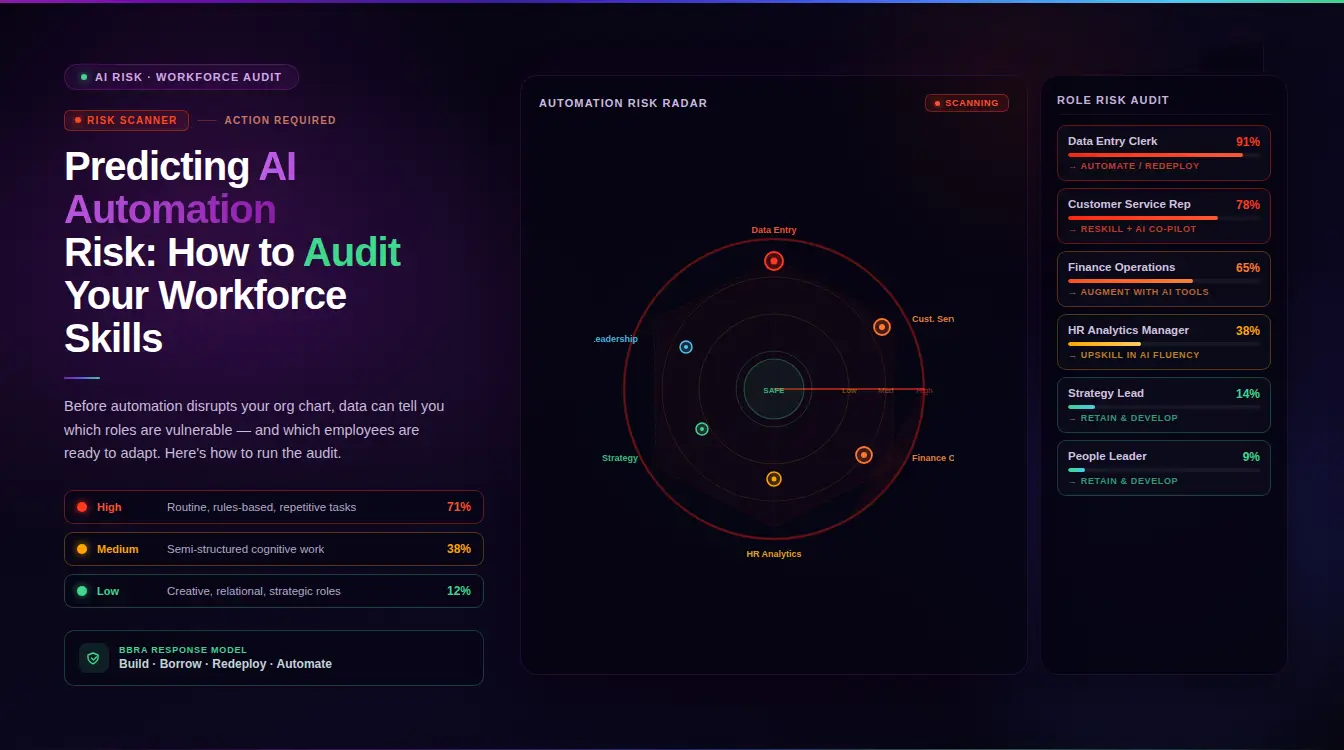
Skills and risk classification. When a system flags a role as high risk for automation or a skill as declining, that label can quietly become fact inside planning conversations before anyone checks it against current external labor market data.
Headcount and restructuring recommendations. A model that recommends eliminating a role or flattening a layer carries real organizational weight. Legal counsel is increasingly clear that this weight creates liability the organization did not previously carry, since regulators and courts are treating an automated recommendation as a decision the employer made, not a neutral tool, a point raised directly in recent employment law commentary.
Performance and promotion scoring. Ranking and scoring tools that influence promotion or assignment decisions carry a particular version of this risk, because even when a human technically remains in the loop, the presence of a score reduces how carefully that human questions it, a pattern described in recent workplace AI governance analysis.
See how INOP keeps verified data and human review at the center of every workforce recommendation. Book a demo to walk through the Decision Intelligence Layer live.
Why AI Automation Bias Is a Growing Governance Problem
Regulatory attention is catching up to this exact risk. Several jurisdictions now require independent bias audits of automated employment decision tools before deployment and on an ongoing basis, with rules extending beyond hiring into scheduling, promotion, and compensation, according to recent employment law guidance. None of this is legal advice, and organizations should work with counsel on jurisdiction-specific compliance. What it does confirm is that regulators increasingly view an unverified automated recommendation as an organizational decision, not a neutral input, which means automation bias is no longer only a data quality issue. It is an accountability issue.
The Scale Problem: Why AI Bias Is Categorically Different from Human Bias
A biased human hiring manager makes biased decisions one candidate at a time. A biased AI system makes the same biased decision across every candidate who passes through it simultaneously, at a scale and speed that no human reviewer can catch in real time. This scale amplification is what makes algorithmic HR software uniquely risky: a single biased algorithm can impact thousands of candidates or employees, exponentially increasing the liability risk compared to biased individual human decisions.
The practical implication for governance is that the standard for AI decision review cannot be the same as the standard for human decision review. A human manager making 200 promotion decisions over a year can be coached, observed, and corrected through normal management processes. An AI system making 200,000 compensation recommendations simultaneously requires a different governance architecture entirely, one that catches systematic patterns before they accumulate rather than after they are discoverable through an audit.
This is also why the regulatory response to AI bias in employment has been faster and more specific than the regulatory response to human bias. Legislators and regulators understand that an AI system that produces discriminatory outcomes does not require discriminatory intent to cause harm at the scale of thousands of affected individuals. That scale effect is what justifies the proactive bias audit requirements now operative in New York City and emerging across multiple US states and EU jurisdictions.
How Fast AI Is Entering HR Decisions in 2026
The automation bias governance problem has become urgent because AI adoption in HR has accelerated faster than governance frameworks have kept pace. SHRM’s State of AI in HR 2026 Report found that in organizations that have implemented AI, HR professionals are using it frequently: 26% use AI tools weekly, 20% daily, and 9% several times a day. Senior HR leaders adopted AI tools earlier than those in less senior positions, which means the individuals making consequential workforce decisions are also the individuals most deeply integrated into AI-assisted workflows.
That pattern is exactly the environment in which automation bias causes the most damage. When a CHRO or VP of People Analytics reviews an AI-generated headcount recommendation, the combination of seniority, time pressure, and familiarity with the tool creates the precise conditions research identifies as highest risk for deferring to automated output rather than scrutinizing it: the reviewer holds a favorable view of the tool, correcting it requires effort, and the organizational culture around the tool signals trust rather than skepticism.
The frequency and seniority of AI adoption in HR is not itself a problem. It is the context in which automation bias governance either exists and prevents harm, or does not exist and allows it.
AI Automation Bias and the 2026 Legal Landscape: What HR Leaders Are Now Required to Do
The governance case for addressing AI automation bias was compelling before 2026 as a matter of decision quality and ethical practice. In 2026 it is also a compliance requirement in a growing number of jurisdictions, with specific, enforceable obligations that go beyond general anti-discrimination law.
New York City Local Law 144: The Current Benchmark
New York City Local Law 144 remains the most specific and most enforced AI employment regulation currently in effect in the United States. Organizations using automated employment decision tools, defined as computational processes derived from machine learning that substantially assist or replace discretionary employment decisions, to screen candidates or employees residing in New York City must obtain an independent bias audit before deployment and at least annually thereafter, publish a summary of audit results, and provide advance notice to candidates and employees when such tools are being used.
The practical scope of this law is broader than most organizations realize. “Substantially assist or replace discretionary employment decisions” includes not only candidate screening but also tools that score, rank, or filter employees for promotion, assignment, or compensation decisions. Organizations that have implemented performance scoring, compensation recommendation, or skills classification tools and have not conducted a bias audit for NYC-based employees are currently operating outside these requirements.
Colorado, California, and the State Law Patchwork
California’s Civil Rights Council has extended anti-discrimination laws to AI tools, requiring employers to maintain records of automated decision data for four years and prohibiting the use of AI that screens out applicants based on protected characteristics. Colorado’s AI Act, delayed to June 2026, requires rigorous impact assessments for high-risk AI systems. Illinois requires disclosure and consent when AI analyzes video interviews.
The practical challenge this creates is a compliance matrix that varies by the location of every candidate and employee the tool touches. An organization using an AI performance scoring tool for employees across 15 states faces 15 potentially different compliance requirements, some of which are still evolving. The minimum defensible approach is treating the most stringent applicable requirement — currently NYC Local Law 144 — as the baseline for all deployments.
Federal Level: EEOC and Existing Law
At the federal level, the EEOC has made unambiguously clear that employers remain fully responsible under Title VII when AI-driven tools produce discriminatory outcomes, regardless of whether the tool was internally developed or purchased from a vendor. The adverse impact analysis that applies to human selection procedures applies equally to automated ones: if an AI tool produces selection rates for a protected group that fall below 80% of the highest-performing group, that disparity triggers scrutiny regardless of whether any discriminatory intent existed.
The December 2025 executive order on AI established a federal framework that emphasizes voluntary standards for lower-risk applications while preserving existing anti-discrimination law. Employers should not interpret the executive order as reducing their obligations under Title VII, the ADEA, or the ADA when those laws apply to AI-assisted employment decisions.
What These Requirements Mean in Practice
Three immediate actions are required for most organizations using AI in workforce decisions. First, inventory every AI tool currently influencing employment decisions, including vendor-provided tools embedded in HRIS platforms or ATS systems that may not be obviously labeled as AI. Second, obtain or request bias audit documentation from every vendor whose tool affects decisions involving employees or candidates in regulated jurisdictions. Third, establish a human review protocol for every consequential decision category where AI produces a recommendation, with documentation of the human review process that can be produced in an audit or legal challenge.
How INOP’s Five Intelligence Lenses Guard Against Automation Bias
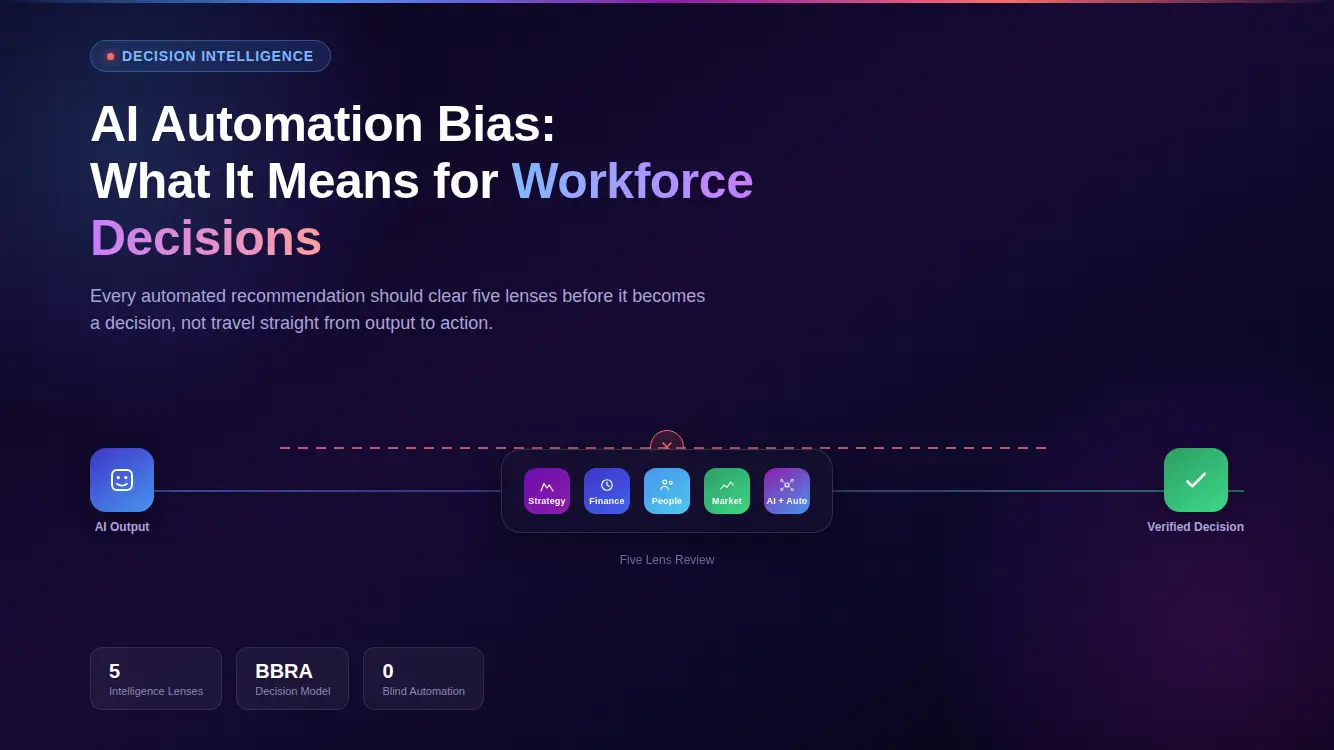
The structural fix for ai automation bias is not less automation. It is forcing every automated recommendation through more than one lens before it becomes a decision. INOP evaluates every workforce recommendation, including its own, through five intelligence lenses rather than a single output score.
- Strategy: Does this recommendation align with a stated business priority, or is it optimizing for a metric that looked convenient to automate?
- Finance: What is the actual cost and payback of acting on this recommendation, modeled explicitly rather than assumed from the confidence of the output?
- People: Who is affected, and does the underlying data reflect current reality for that specific group or role, not an average pulled from stale records?
- Market: Does external labor market data support this recommendation, or does it rely only on internal history that may already be outdated?
- AI and Automation: Is the recommendation itself a candidate for automation, and if so, what verification step is required before it gets acted on without review?
Requiring a recommendation to clear all five lenses is what prevents a single automated output from becoming a decision on its own weight.
Using BBRA to Keep Human Judgment in the Loop
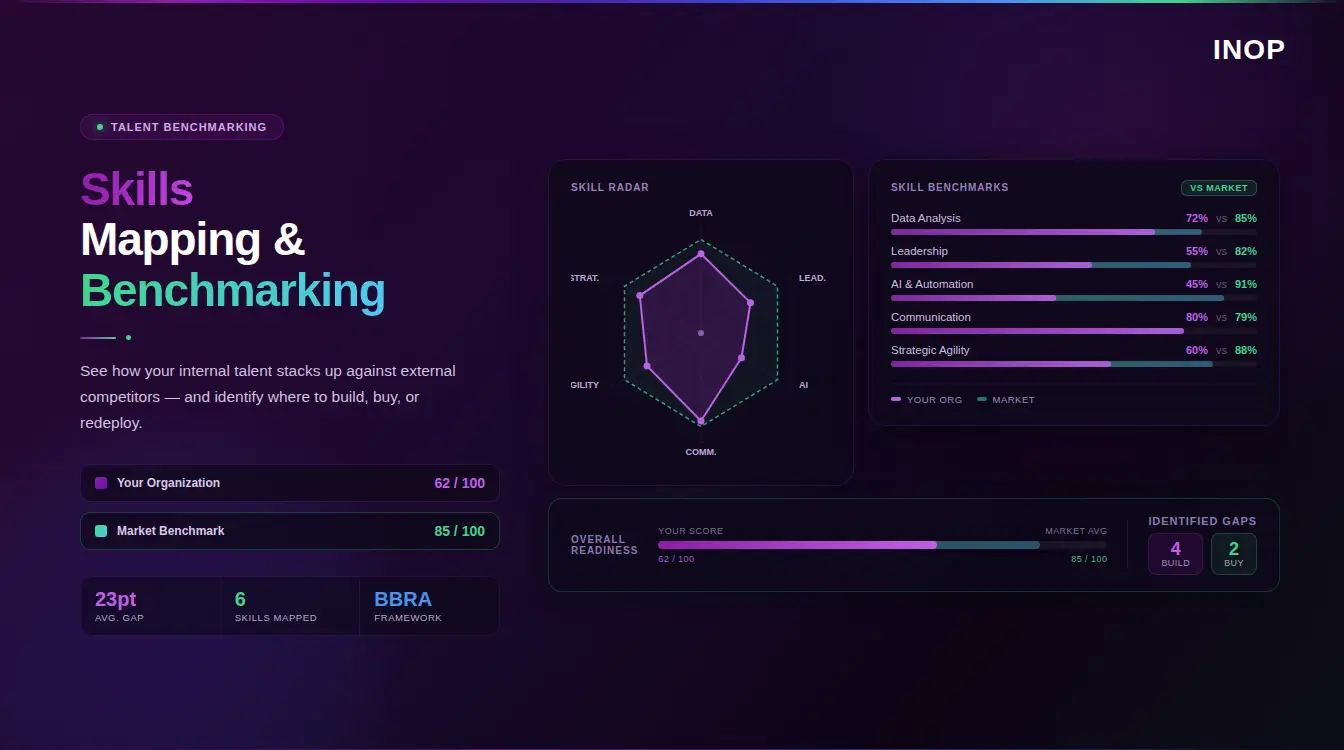
INOP’s proprietary BBRA framework, Build, Buy, Redeploy, and Automate, exists specifically to slow down automated recommendations at the point where they matter most: the moment a gap or risk gets acted on. Rather than accepting a single automated suggestion, BBRA requires modeling four distinct pathways against financial tradeoffs across four time horizons, thirty days, one hundred eighty days, one year, and three years. That structure forces a human decision maker to compare alternatives explicitly rather than accepting whichever pathway a model surfaced first, which is the exact moment automation bias tends to take hold.
Applied to a role flagged as automation-ready, for example, BBRA does not let that flag become the decision. It requires comparing what building internal capability would cost against redeploying someone with adjacent skills, buying the capability externally, and automating the task itself, side by side, before anyone signs off.
Want to see BBRA applied to a real recommendation your team is weighing? Book a demo and INOP will walk through the pathway comparison live.
How to Build Governance Against AI Automation Bias
A handful of practical controls meaningfully reduce automation bias without slowing workforce decisions to a crawl.
Require a Second Data Source Before Acting
No single automated recommendation should move forward on internal data alone. Cross-checking a skills classification against external labor market signals, for instance through INOP’s skills intelligence platform, gives reviewers an independent reference point rather than asking them to second-guess a model with nothing to compare it against.
Make the Reasoning Visible, Not Just the Score
A recommendation without a visible reason is what makes automation bias easy. When the system shows why it produced a number, not just the number itself, reviewers have something concrete to challenge instead of a black box to either accept or reject wholesale.
Route High Stakes Decisions Through Multiple Lenses by Default
Restructuring, compensation changes, and role elimination should never clear on a single automated score. Building the five-lens review into the workflow itself, rather than relying on a reviewer to remember to apply it, is what keeps the check from eroding under deadline pressure.
Audit the Outcomes, Not Just the Inputs
Bias audits typically focus on whether a tool’s training data is representative. Equally important is auditing what actually happened after a recommendation was accepted: was the pathway that got chosen the one BBRA modeled as optimal, or the one that was simply presented first.
Vendor Due Diligence: Questions to Ask Before Deploying Any AI Workforce Tool
Automation bias governance starts before a tool is deployed. The following questions should be part of every vendor evaluation for AI tools that will influence workforce decisions.
Can the vendor produce an independent bias audit conducted by a third party rather than an internal team, covering the specific use case and population the organization will deploy the tool for? A general audit covering candidate screening does not cover performance scoring or compensation recommendation. The audit should match the deployment.
What data was the model trained on, and how recent is it? A model trained on historical hiring data from 2018 to 2022 has been trained on a labor market and workforce composition that differs materially from 2026. If the underlying data is stale, the model’s outputs embed assumptions from a past environment.
What is the tool’s reported adverse impact ratio across race, gender, age, and disability status for the specific use case being evaluated? If the vendor cannot produce this breakdown, the organization cannot satisfy the bias audit requirements in regulated jurisdictions and should not deploy the tool.
Does the tool allow human override of its recommendations, and is that override documented automatically? A tool that makes override difficult or that does not log when a human reviewer departs from the AI recommendation creates an accountability gap. The organization needs to demonstrate that human judgment is genuinely in the loop, not nominally present.
What happens to the data the tool processes, and what are the data retention and deletion obligations? In jurisdictions requiring four-year record retention of automated decision data, the vendor’s data practices must align with the organization’s compliance obligations, not just the vendor’s own preferences.
Transparency to Employees: What They Are Entitled to Know
Governance against AI automation bias does not only run toward regulators and leadership. It runs toward employees as well, who are increasingly entitled to know when AI is influencing decisions about their compensation, promotion, or role.
NYC Local Law 144 requires advance notice to employees when automated employment decision tools are used in promotion and other decisions affecting current employees, not only in external recruiting. Several EU member states implementing the AI Act require disclosure to workers when AI systems substantially influence working conditions. Illinois and California have specific disclosure requirements for certain AI-assisted employment decisions.
Beyond legal requirements, transparency about AI use in workforce decisions is a practical trust and retention consideration. Employees who discover retrospectively that an AI system influenced a promotion decision they did not know was partly automated — particularly if they would have challenged the output — experience a specific form of trust erosion that is difficult to recover. Proactive disclosure, framed as “this tool supports our decision-making and all outputs are reviewed by named decision-makers,” maintains trust more effectively than disclosure that follows a complaint or legal challenge.
Build employee notification into the workflow for every AI-assisted decision category. This does not require disclosing the model’s technical specifications. It requires informing the affected employee that automated analysis was one input to the decision, that a human reviewer made the final call, and that the employee can request a review if they have concerns about the outcome.
AI Automation Bias and Private Equity Operating Partners
Automation bias carries a distinct risk inside portfolio operations, where a single AI-driven workforce recommendation, if unquestioned, can shape a hundred-day plan across an entire portfolio company. An operating partner relying on a portfolio company’s existing AI tooling without an independent verification layer inherits whatever bias is already baked into that tooling, often without visibility into how the underlying recommendations were generated. Standardizing workforce decisions across a portfolio through INOP’s strategic workforce planning platform gives operating partners a consistent, verified layer to check portfolio company recommendations against, rather than taking each company’s automated outputs at face value.
Frequently Asked Questions
What is the difference between AI automation bias and algorithmic discrimination?
Algorithmic discrimination refers to a model producing systematically unfair outcomes for a protected group. AI automation bias is a separate, human-side pattern where people over-trust an automated output regardless of whether that output is biased in the discrimination sense. A model can be statistically fair and still be applied through a biased, insufficiently scrutinized decision process.
Does adding a human reviewer eliminate AI automation bias?
Not by itself. Research on automation bias specifically shows that a human in the loop still tends to defer to an automated recommendation, especially when correcting it takes extra effort. Meaningful oversight requires visible reasoning and a structured comparison process, not just a person’s signature on the output.
How often should AI-driven workforce recommendations be reviewed for automation bias?
High-stakes categories, compensation, restructuring, and role elimination, warrant review on every decision rather than a periodic audit. Lower-stakes, high-volume recommendations can be sampled on a regular cadence, but the review process itself should be built into the workflow rather than treated as an occasional check.
How should private equity operating partners evaluate AI automation bias across a portfolio?
By checking whether each portfolio company’s AI-driven workforce decisions were verified against independent data and multiple decision lenses, not only whether the underlying tool passed a vendor bias audit. A vendor’s fairness audit covers the model. It does not cover whether the humans using it are simply deferring to its output.
What is the first step to reducing AI automation bias in workforce decisions?
Require a second, independent data source before any AI-generated workforce recommendation is acted on. This single control addresses the core mechanism behind automation bias, which is acting on a recommendation because nothing readily available contradicts it.
Make confident workforce decisions that support strategy and value creation.