What if your organization could perfectly align its talent with business goals, every role filled with the right skills, at the right time, without overstaffing or skill shortages? That’s exactly what a skills-based workforce planning tool can help you achieve.
In today’s rapidly changing work environment, traditional headcount planning no longer works. Businesses need to look beyond “how many people” they have and focus on “what skills” they have. This article explores what skills-based workforce planning tools are, why they matter, and how HR leaders can use them to future-proof their talent strategy.
We’ll cover key features, benefits, implementation tips, and the metrics that truly matter, so you can make informed decisions that drive productivity, reduce costs, and build a resilient workforce.
What Is a Skills-Based Workforce Planning Tool?
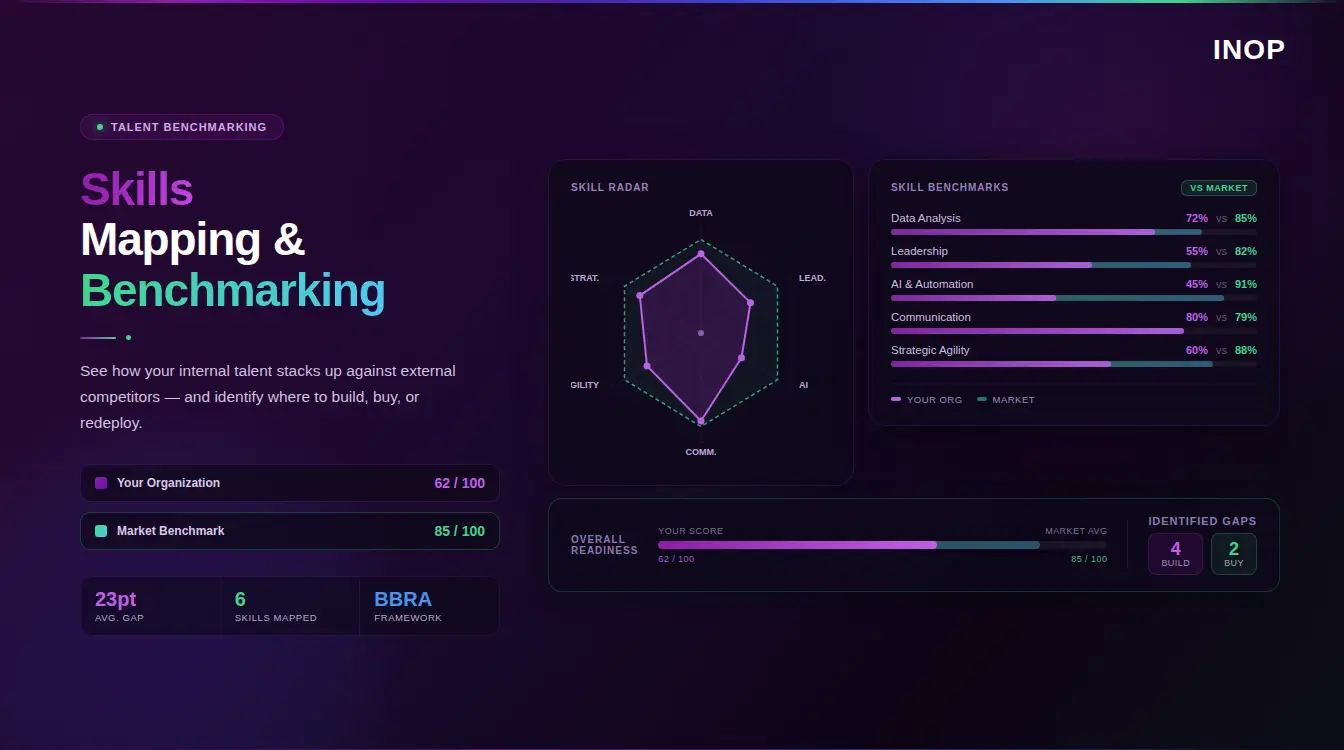
A skills-based workforce planning tool is a specialized software solution designed to map employee skills against organizational needs. Unlike traditional workforce planning software that focuses mainly on job titles or headcount, this approach digs deeper into the skillsets of your employees.
These tools collect, analyze, and visualize data on your team’s skills, enabling HR and business leaders to:
- Identify gaps between current skills and future requirements
- Make smarter hiring and training decisions
- Reduce costs from overstaffing or under-utilization
- Improve workforce agility during rapid market changes
Key Components of a Skills-Based Workforce Planning Tool
- Skill Inventory Management: A centralized database that tracks employees’ skills, certifications, and proficiencies.
- Demand Forecasting: Predicts future skill needs based on business growth, upcoming projects, or industry trends.
- Gap Analysis: Compares current workforce skills with future demand to highlight critical shortages.
- Scenario Modeling: Allows HR leaders to simulate different staffing models or “what-if” situations.
- Integration Capabilities: Syncs with HRIS, LMS, and applicant tracking systems for a complete view.
Why Traditional Workforce Planning Fails and What Skills-Based Planning Replaces
Traditional workforce planning operates at the role level. It counts how many people you have in each job title, forecasts how many you will need based on growth assumptions, and produces a headcount request that Finance approves or declines. This model worked adequately when roles were stable, skills within a role were homogeneous, and the primary workforce challenge was filling seats rather than building capability.
None of those conditions apply in 2026. According to the World Economic Forum’s 2026 Future of Jobs Report, 44% of core skills in the average role will change between 2025 and 2028. Planning at the role-name level masks that shift entirely, because two employees with the same job title may have materially different skill profiles, one capable of executing the new strategy and one not. Headcount planning cannot distinguish them. Skills-based planning can.
The cost difference between the two approaches is quantifiable. Reactive hiring runs 19% more expensive per hire and produces 23% lower first-year retention than planned hiring based on skills intelligence. These figures reflect a structural advantage: when organizations know what skills they need before the gap becomes critical, they can source talent proactively, develop internal candidates, and match new hires to verified role requirements rather than estimated ones.
Before reaching for the job board, a skills-based planning approach examines three levers in sequence. The first is whether targeted upskilling of existing employees can close the gap at lower cost and higher retention probability than external hiring. The second is whether internal redeployment can move someone with adjacent skills into the gap, preserving institutional knowledge and eliminating a recruitment cycle. The third is external hiring, which becomes the right answer only when the capability genuinely does not exist internally and cannot be developed within the required timeframe. Organizations that default immediately to the third lever are systematically paying external market premiums for capabilities they already have.
The Skills in Practice 2026 Report found that mature organizations also surface employee interest data alongside proficiency data, with maximum interest scores running approximately 25% higher than current skill scores. That gap between what people can do today and what they want to develop toward is a planning signal that most organizations ignore entirely. An employee who has foundational data science skills and strong interest in developing them further is a reskilling investment opportunity. An employee with the same foundational skills and no development interest in that direction is not. Skills-based workforce planning makes this distinction visible. Headcount planning does not.
Including Automation in the Skills-Based Plan: The Column Most Plans Leave Blank
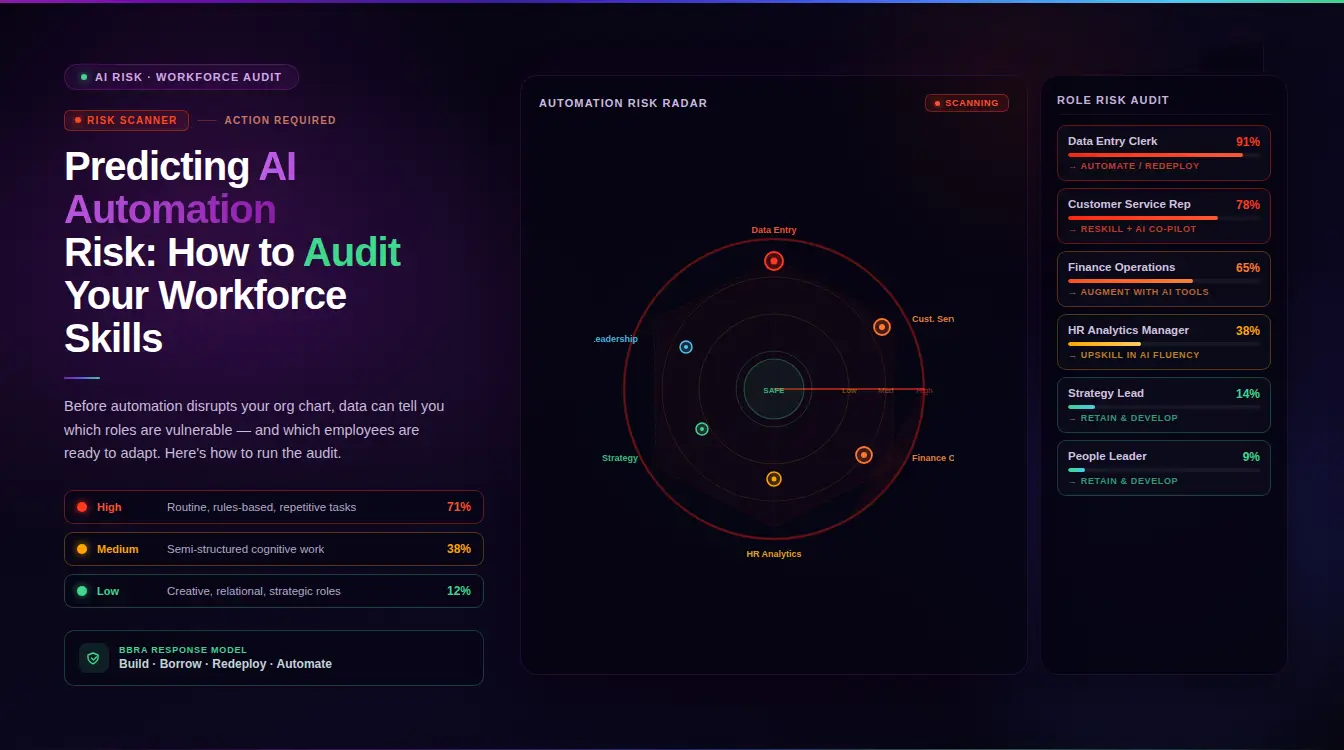
McKinsey’s 2025 research finds that approximately 28% of routine knowledge tasks are now automatable with current AI and software tools. For workforce planning purposes, this means a meaningful share of the headcount that previous planning cycles would have requested can now be delivered more efficiently through automation rather than additional staff.
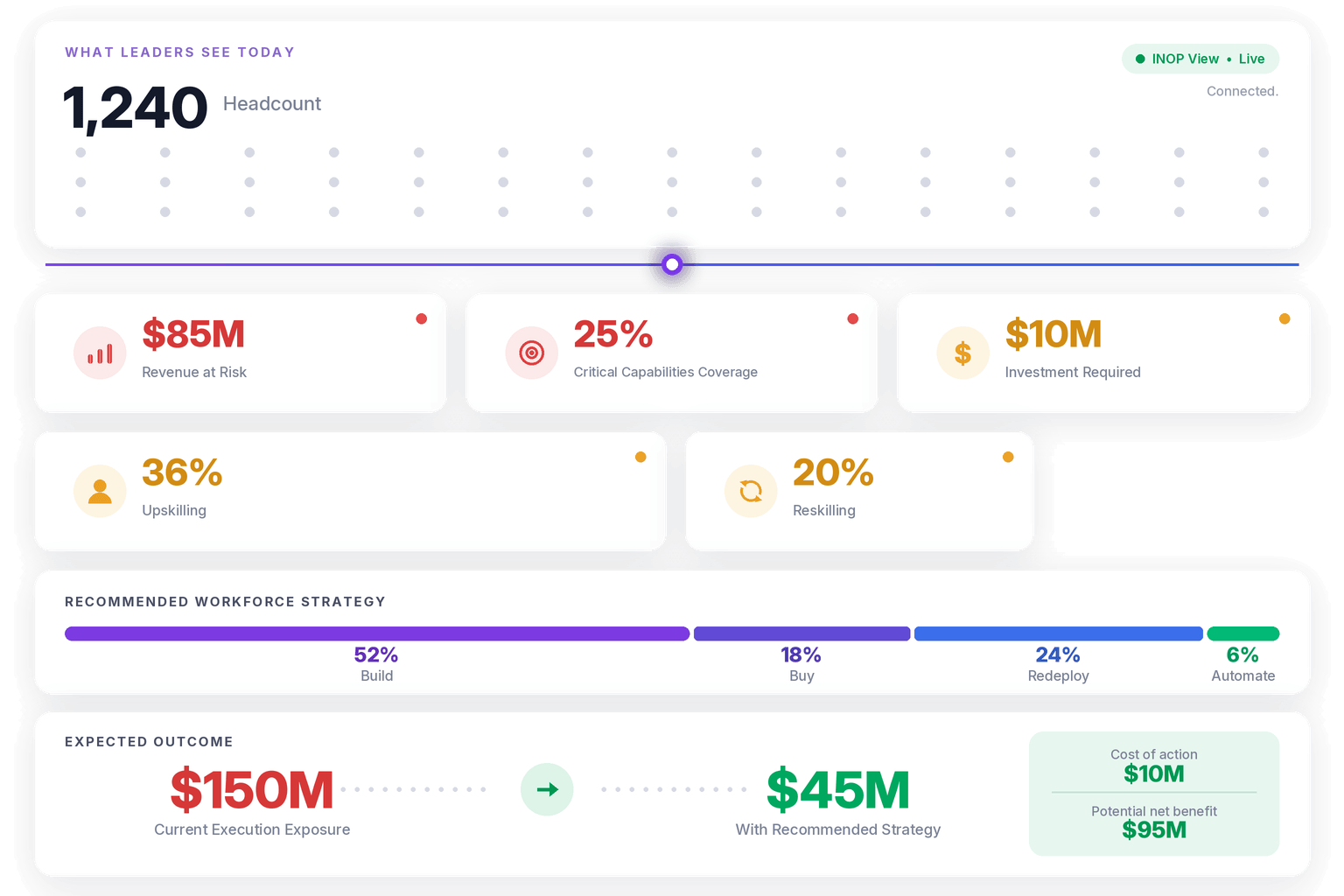
A skills-based workforce planning approach handles this directly by modeling four pathways for every identified capability gap: Build the capability internally through development, Buy it externally through hiring, Redeploy someone with adjacent skills who can be developed faster than an external hire can reach productivity, or Automate the task and redirect the human capacity toward work that requires distinctly human judgment. Most workforce plans default to Build or Buy without evaluating Redeploy or Automate, which means they consistently overestimate headcount requirements and underestimate the potential of the existing workforce.
The value of including the automation pathway explicitly is not just cost saving. It is capability prioritization: when organizations identify which tasks within a role are automating, they can focus human skills development on the capabilities that AI tools augment rather than replace, building a workforce that works with automation rather than being displaced by it.
Benefits of a Skills-Based Workforce Planning Tool
Adopting the right solution can transform how your HR team operates and how your organization achieves growth.
Improved Talent Allocation
For organizations also evaluating how compensation structures interact with skills strategy, the distinction between skills-based and job based pay has direct implications for how talent allocation decisions are rewarded and sustained.”
Reduced Hiring Costs
Instead of hiring externally for every new project, companies can identify employees who are upskilling-ready and promote internal mobility, cutting recruiting costs by as much as 30% (real-world case studies of skills-based workforce planning).
Enhanced Decision-Making with Real-Time Data
A strong workforce planning software solution provides dashboards and analytics that empower HR leaders with real-time insights. You can instantly see skill gaps, forecast demand, and make evidence-based staffing decisions.
Greater Workforce Agility
When unexpected changes hit, whether due to economic shifts or sudden market demand, you can quickly reassign resources, retrain staff, and respond without slowing down operations.
Connecting Skills-Based Planning to Financial Decision-Making
The most significant failure in most workforce planning processes is not data quality or tool capability. It is the disconnect between HR’s workforce plan and Finance’s headcount budget. HR builds a skills gap analysis in Q3. Finance builds the headcount budget in Q4. They use different assumptions, different headcount definitions, and different timelines. The result is two plans that produce conflict rather than alignment when they meet at the investment decision.
Skills-based workforce planning tools that integrate with financial planning systems solve this by making workforce capability data a shared input to cost modeling rather than a separate HR report that Finance receives and discounts. When a CHRO can show the CFO that a specific capability gap represents a quantified execution risk with a modeled cost of closure through each available route, the workforce planning conversation becomes a financial analysis rather than an HR request.
The specific integration that matters is skills-adjusted cost modeling: understanding not just how many people you need but what those people’s capabilities need to be and what that combination costs to assemble. A plan that forecasts 20 additional data engineers without modeling whether those engineers need advanced machine learning expertise or foundational SQL proficiency is financially incomplete, because the compensation cost and the sourcing difficulty are materially different at those two proficiency levels.
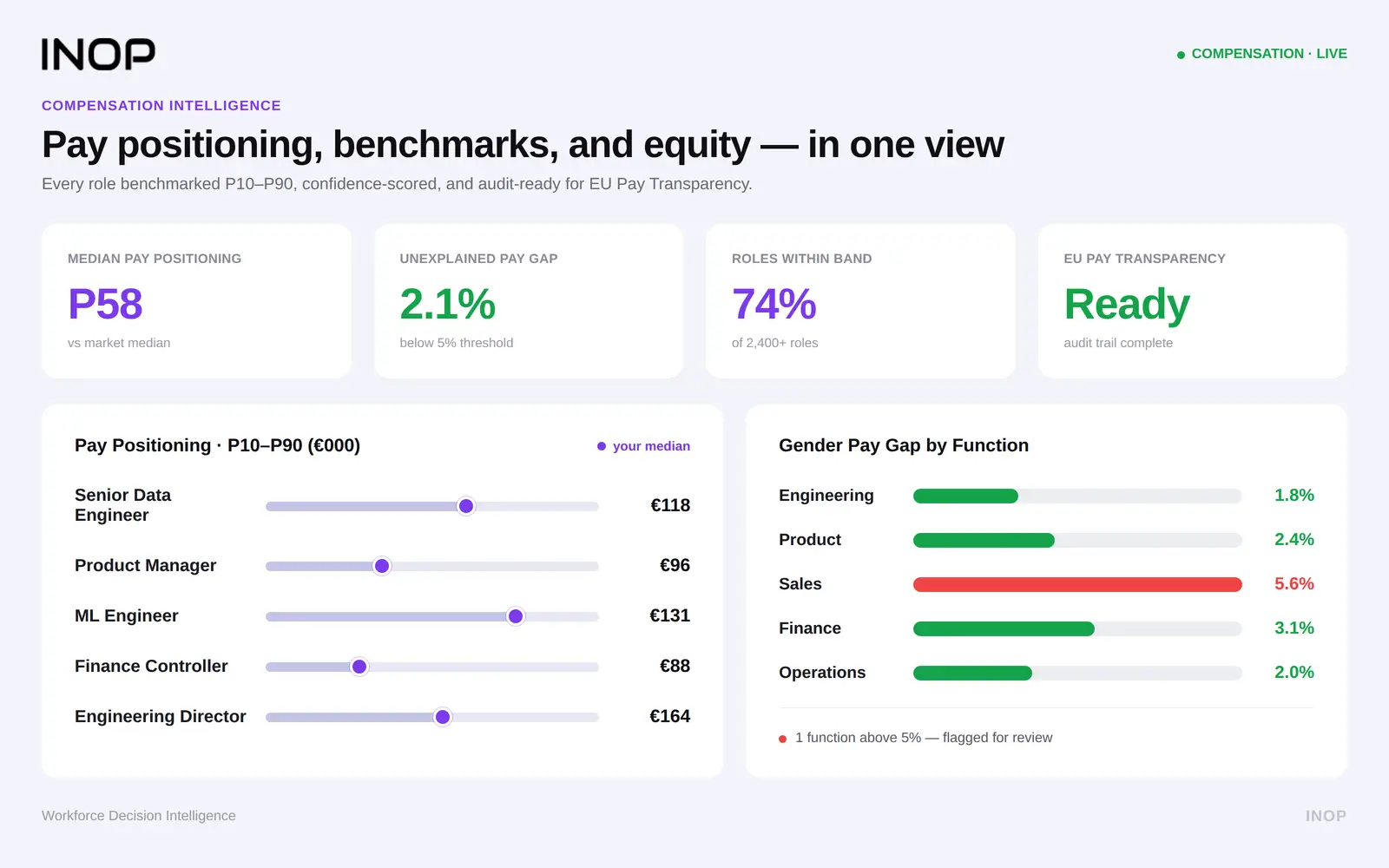
Organizations that achieve this Finance-HR integration report that workforce decisions move faster, receive less pushback at budget review, and produce better outcomes because they were made with a complete picture rather than partial data. The INOP compensation analytics platform provides exactly this connection, linking skills intelligence to real-time market benchmarks and financial scenario modeling in a format that Finance can audit and HR can action
Mergers, Acquisitions, and Restructuring: The High-Stakes Use Case
Skills-based workforce planning tools prove their value most dramatically during organizational transformation events: mergers, acquisitions, restructurings, and digital transformation programmes where getting the workforce equation wrong has immediate and significant financial consequences.
In a post-merger integration, the foundational workforce question is which capabilities exist in which entity, where they overlap, and where the combined organization has gaps that the transaction was not designed to fill. Traditional headcount analysis answers the first question at the role level. Skills-based analysis answers it at the capability level, which is where the integration decisions that determine synergy realization actually live.
An acquisition that doubles the sales headcount but creates a single large function with redundant capability in customer relationship management and a critical gap in technical pre-sales expertise has a predictable outcome: the synergies projected in the deal model will not materialize on schedule because the combined organization cannot execute the sales motion the model assumed. Skills-based workforce planning surfaces this before the close rather than after it.
For restructuring decisions, the same principle applies. Eliminating a function based on headcount rather than capability analysis risks removing unique institutional knowledge or technical depth that cannot be easily replaced, while retaining redundant capacity in areas where the organization was already over-resourced. Skills data at the individual level is what makes restructuring decisions precise rather than blunt.
How to Choose the Right Skills-Based Workforce Planning Tool
Not all tools are created equal. Look for these must-have features when evaluating options:
- AI-Driven Skill Matching: Automates gap analysis and suggests training or hiring priorities.
- Scenario Planning: Lets you prepare for different growth, budget, and workforce models.
- User-Friendly Interface: HR teams should be able to adopt the tool without extensive training.
- Customizable Dashboards: Enable stakeholders to view insights most relevant to them.
- Compliance and Security: Essential for data privacy, especially if operating across regions.
Best Skills-Based Workforce Planning Tools: A Comparison for HR Leaders
The market for skills-based workforce planning tools has matured into distinct tiers based on use case, organizational size, and depth of skills intelligence. Here is how the leading platforms compare.
Enterprise Skills Intelligence and Planning Platforms
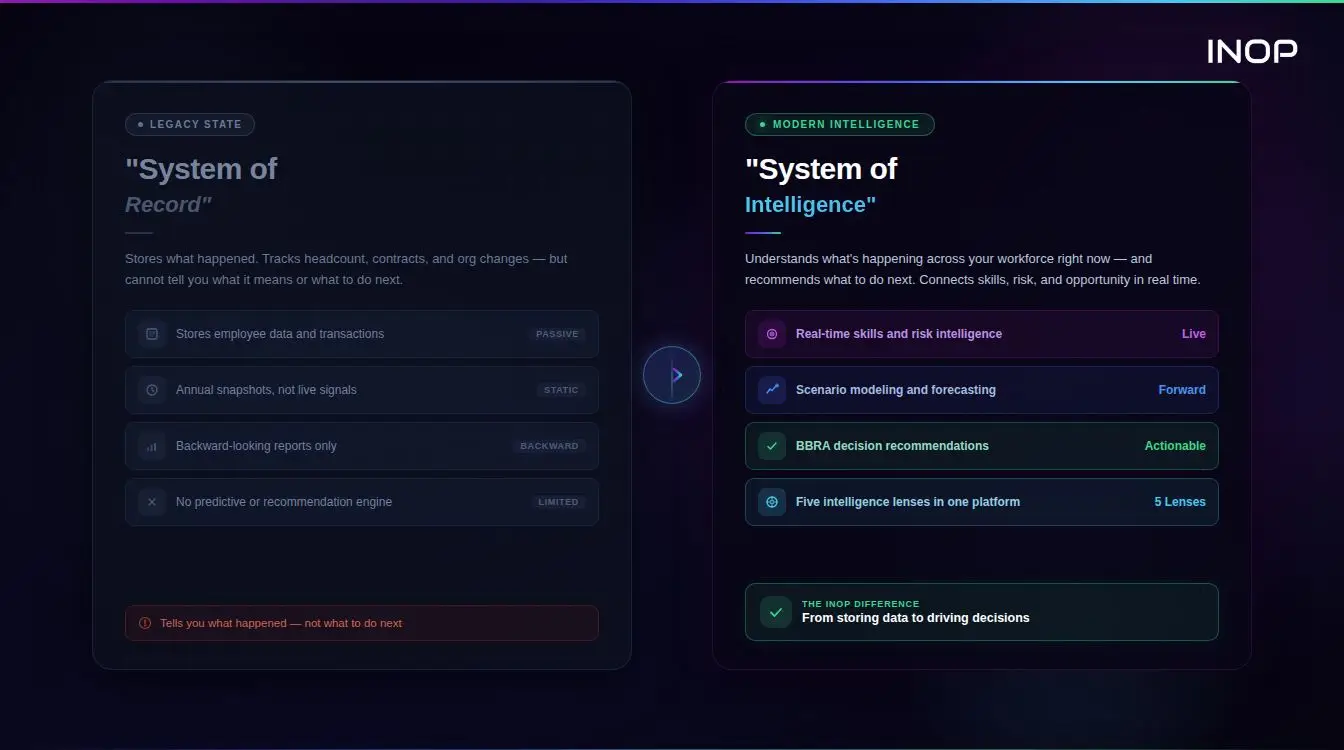
INOP is built specifically for skills-based strategic workforce planning in mid-to-large enterprise and PE portfolio company environments. Its Five Intelligence Lenses — Strategy, Finance, People, Market, and AI/Automation — give HR, Finance, and executive leadership a unified view of workforce capability against business objectives. INOP connects skills gap data directly to financial scenario modeling, making it one of the few platforms where a CHRO and CFO can work from the same workforce dataset. Purpose-built for organizations that need audit-ready workforce intelligence rather than a general-purpose HR tool. Book a demo to see INOP’s skills intelligence platform in action.
Workday provides headcount planning tightly integrated with financial forecasting, with skills tagging built into employee profiles. Strong for organizations already in the Workday ecosystem that want workforce planning connected to compensation and performance without managing a separate platform. Less suited for organizations that need deep external skills market benchmarking or AI automation risk modeling.
Visier is a people analytics platform with strong workforce forecasting and attrition prediction capabilities. It sits above the HRIS layer, connecting data from multiple HR systems to produce planning insights. Particularly strong for turnover risk modeling and skills-based segmentation. Better suited for organizations with a dedicated People Analytics team than for HR generalists.
SAP SuccessFactors provides workforce planning within the broader SAP ecosystem, with scenario modeling, demand forecasting, and skills taxonomy integration. Best suited for global enterprises with complex approval workflows already standardized on SAP. Integration outside the SAP environment adds cost and implementation complexity.
Mid-Market and Specialist Platforms
365Talents builds AI-powered skills graphs that map relationships between skills and connect them to internal mobility, learning recommendations, and succession planning. Strong on multilingual capability and skills taxonomy management. Particularly well suited for organizations with large, distributed workforces across multiple geographies.
Gloat combines a skills intelligence layer with an internal talent marketplace, enabling employees to be matched to projects, roles, and gigs based on verified skills rather than job title proximity. Best for organizations where internal mobility is a primary strategic objective and where the workforce has sufficient size to generate meaningful internal matching data.
Eightfold AI uses deep learning to build talent intelligence graphs from résumés, skills assessments, and project histories. Strong on inferring skills from unstructured data and connecting external talent market intelligence to internal workforce planning. Well suited for organizations that want to benchmark internal skill supply against external market demand continuously.
Cornerstone OnDemand provides an integrated learning and talent platform with skills gap analysis tied directly to learning content. Strong for organizations that want development planning and workforce planning in a single platform rather than managing separate tools. Less sophisticated on the financial modeling side than dedicated planning platforms.
Implementing Skills-Based Workforce Planning Successfully
Step 1: Build a Skills Taxonomy
Define a clear list of skills relevant to your organization and classify them by proficiency levels.
Step 2: Collect and Validate Data
Gather data from resumes, performance reviews, and self-assessments. Validate it regularly to avoid outdated information.
Step 3: Engage Leadership
Secure buy-in from executives and department heads by showing how this initiative ties directly to revenue and efficiency.
Step 4: Roll Out Training and Reskilling Programs
Use gap analysis results to build targeted learning programs, ensuring employees are future-ready.
Measuring Success
HR leaders must track key metrics to evaluate the ROI of a skills-based workforce planning initiative. Some common KPIs include:
- Time-to-Fill for Critical Roles: Should decrease as internal mobility improves
- Training ROI: Measure performance improvement after training investments
- Employee Engagement Scores: Higher alignment often results in better retention
- Workforce Productivity Metrics: Track project delivery times and overall output
Building the Business Case for Skills-Based Workforce Planning Tools
Gaining organizational approval for a skills-based workforce planning tool requires translating its benefits into financial terms that a CFO or CEO can evaluate against the cost. The following framework provides the structure most organizations need to make that case compellingly.
The business case begins with the cost of the current state, not the cost of the proposed solution. The questions that generate the most persuasive data are: how much did the organization spend on external hires last year for roles where an internal candidate with adjacent skills existed but was invisible? How many days did critical roles sit vacant, and what was the productivity cost per vacancy day? What percentage of hires in the last two years have left within 12 months, and what is the replacement cost per departure?
For most mid-to-large enterprises, these three calculations produce a current-state cost that significantly exceeds the annual cost of a skills-based planning platform. An organization making 200 professional hires annually where 30% could have been internal matches is spending approximately $3 million per year in avoidable external recruitment costs, before accounting for the lost productivity during vacancy periods and the lower retention rates of externally-hired employees compared to internally-promoted ones.
The second component of the business case is the risk cost: what capability gaps currently exist that could prevent the organization from executing its strategic plan, and what would it cost if one of those gaps materialized as a project failure, a missed market opportunity, or a regulatory non-compliance event? Skills-based planning tools make these gaps visible and quantifiable. The cost of identifying and closing a gap proactively is almost always lower than the cost of managing the consequences of discovering it too late.
Executives approve investments that solve problems they already own. The workforce planning business case that connects to a financial problem Finance is actively worried about, headcount cost overruns, unexpected attrition in critical functions, a digital transformation that is behind plan, has a significantly higher approval rate than one that asks Finance to evaluate HR’s definition of the problem.
Challenges and How to Overcome Them
- Data Quality Issues: Inaccurate or outdated skill data can derail planning efforts. Regular audits are key.
- Change Management Resistance: Employees may fear being “profiled” by skills. Communicate the benefits clearly.
- Technology Integration: Ensure your chosen tool works well with existing HR systems to avoid data silos.
Conclusion
Skills-based workforce planning is no longer optional, it’s the backbone of future-ready HR strategy. By investing in a skills-based workforce planning tool, HR leaders can eliminate guesswork, reduce costs, and align talent with business priorities like never before.
Ready to start? Explore tools that fit your organization’s size and complexity, run a pilot program, and use your first insights to drive long-term success.
Your turn: How are you currently tracking and closing skill gaps in your workforce? Share your thoughts in the comments, or check out our resources to start your transformation today.
FAQs
What is the difference between skills-based workforce planning and traditional headcount planning?
Traditional headcount planning counts employees by role and forecasts how many seats will be needed based on growth assumptions. Skills-based workforce planning goes a layer deeper, mapping what capabilities exist within each role, where those capabilities fall short of what the business needs, and which pathway — developing existing employees, redeploying internal talent, or hiring externally, closes each gap at the lowest cost and risk. The distinction matters because two employees in the same role may have completely different capability profiles, and a headcount model treats them identically while a skills-based model distinguishes them.
How do skills-based workforce planning tools connect to financial planning?
The most valuable implementations connect skills gap data directly to financial scenario modeling. Rather than producing a skills report that HR reviews separately from the budget process, skills-based tools that integrate with financial planning systems allow HR and Finance to work from the same data: which capability gaps are critical to strategic execution, what each closure pathway costs over a defined time horizon, and what the financial risk of leaving a gap unaddressed looks like in comparable terms. This integration is what converts workforce planning from an HR exercise into a CFO-level capital allocation input.
What should I look for in a skills-based workforce planning tool if my organization is mid-market rather than enterprise?
Mid-market organizations should prioritize tools that provide immediate value without requiring a 12-month implementation. Look for platforms with pre-built skills taxonomies that can be customized rather than built from scratch, HRIS integration that does not require custom development, and analytics dashboards that HR generalists can operate without data science support. Platforms like 365Talents and iMocha serve this segment well. Enterprise platforms like Gloat and Eightfold AI offer more sophistication but require more implementation investment and organizational change management than most mid-market HR functions can sustain.
How long does implementation actually take and what determines the timeline?
Implementation timelines range from three months for a focused pilot in one function with clean data to 18 months for an enterprise-wide rollout with complex HRIS integration and a skills taxonomy built from scratch. The primary determinant of timeline is data quality: organizations with clean, current employee data and an existing skills taxonomy implement significantly faster than those that need to build the data foundation first. Most vendors recommend a phased approach where the first 90 days deliver a working pilot in one business unit, followed by expansion once the data governance and adoption model is proven.
Can a skills-based workforce planning tool help with succession planning?
Yes, and this is one of its highest-value applications. When succession planning is done without skills data, it defaults to seniority and manager nomination as the selection criteria for successor candidates. When skills data is available, succession can be done based on capability proximity: which current employees have skill profiles closest to the requirements of the target leadership role, and what is the development investment required to close the remaining gap? This approach produces a more accurate, more diverse succession bench and significantly lower post-promotion failure rates than nomination-based succession processes.
What is the ROI of skills-based workforce planning and how long does it take to see it?
Most organizations see early ROI indicators within six to twelve months: improved internal fill rates for open roles, reduced time-to-fill for critical positions, and lower external agency spend as internal candidates become more visible. The larger financial returns, from reduced mis-hire rates, improved retention in high-value roles, and better alignment between L&D investment and actual skills gaps, typically accumulate over 18 to 36 months. Organizations that track the right metrics from the start, specifically internal fill rate, cost per hire, first-year retention, and skills coverage on critical roles, can demonstrate quantified ROI within two quarterly planning cycles.