Strategic workforce planning frameworks are structured methods for aligning workforce capability with business strategy, comparing what an organization has against what it will need, and translating that gap into a plan. Several well established frameworks exist, and most organizations default to whichever one a consultant introduced them to years ago without ever asking whether it still fits how fast the business now needs to move. Understanding what the major frameworks actually offer, and where each one breaks down under current conditions, is the first step to building a planning approach that survives contact with a real business cycle.
This guide covers the strategic workforce planning frameworks most organizations encounter, where each one tends to fall short, and how INOP’s own approach evolved the most durable idea among them, the build, buy, borrow, bind model, for an environment where automation is now a real fifth option.
What a Strategic Workforce Planning Framework Actually Does
A strategic workforce planning framework gives an organization a repeatable structure for answering the same core question over and over: given where the business is headed, what workforce capability do we need, what do we currently have, and what closes the gap. Frameworks differ in how many steps they use and what they emphasize, but nearly all of them share the same underlying shape: assess current state, forecast future need, identify the gap, and develop a response. Gap analysis specifically is the step that turns a framework from a documentation exercise into something actionable, comparing current workforce composition against future requirements to surface shortages, surpluses, and structural misalignment, according to recent research on strategic workforce planning.
Why Strategic Workforce Planning Frameworks Differ So Much in Rigor
The frameworks below range from lightweight, five-step structures to detailed, eight-step competency models, and the difference in rigor is not accidental. A more detailed framework trades speed for precision, while a lighter one trades precision for the ability to move faster. Neither is universally correct, which is exactly why choosing between strategic workforce planning frameworks should depend on organizational maturity and pace of change rather than on which model has the most steps.
The 4 Established Frameworks Worth Knowing
A handful of named frameworks account for most of what organizations actually use, whether they realize they are using a named model or not.
The Five-Phase Model: Assess, Forecast, Identify, Strategize, Measure
The most commonly taught structure moves through five phases: analyzing current workforce capability, forecasting future needs against business goals, identifying the resulting skill and headcount gaps, developing targeted strategies to close them, and measuring outcomes through defined performance metrics. This structure is intentionally generic, which makes it a reasonable starting point and also explains why so many organizations that adopt it never move past the assessment phase into anything resembling ongoing measurement.
The HCI Eight-Step Competency Model
Developed by the Human Capital Institute, this model centers workforce planning on competencies rather than headcount, mapping the specific capabilities an organization needs and building development plans around closing the distance between current and required competency levels. Its strength is precision at the individual capability level. Its weakness is scale: an eight-step, competency-first process is thorough and slow, which makes it a poor fit for organizations that need to replan faster than an annual or biannual cycle allows.
The OPM Five-Step Model
The United States Office of Personnel Management’s model offers a simpler five-step structure that many organizations use as an entry point into strategic workforce planning specifically because it requires less specialized expertise to implement than the HCI model. It is a reasonable starting framework for an organization with no existing planning discipline, though its simplicity means it offers little guidance on the harder question of what to actually do once a gap is identified.
Build, Buy, Borrow, Bind
Popularized in workforce strategy circles and built around four responses to a capability gap, developing skills internally, hiring externally, using contractors for project-based work, and retaining top performers through growth and compensation, this model is closer to a decision framework than a planning process, according to the same research on strategic workforce planning models. It has aged better than most because it focuses on the decision itself rather than the steps leading up to it, which is exactly the quality that made it the right foundation to build on rather than replace outright.
See how INOP evolved these frameworks into a continuous, AI-native planning system. Book a demo to walk through a live view for your organization.
Where These Frameworks Fall Short Today
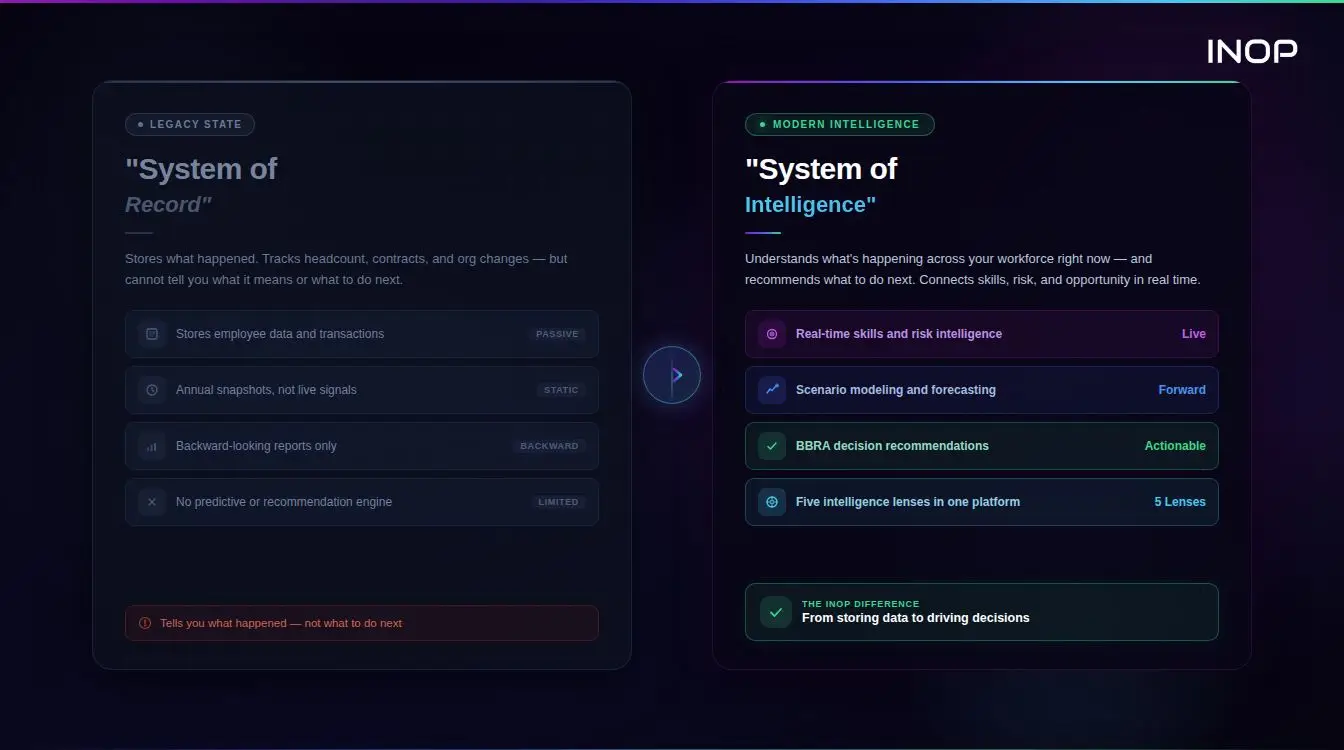
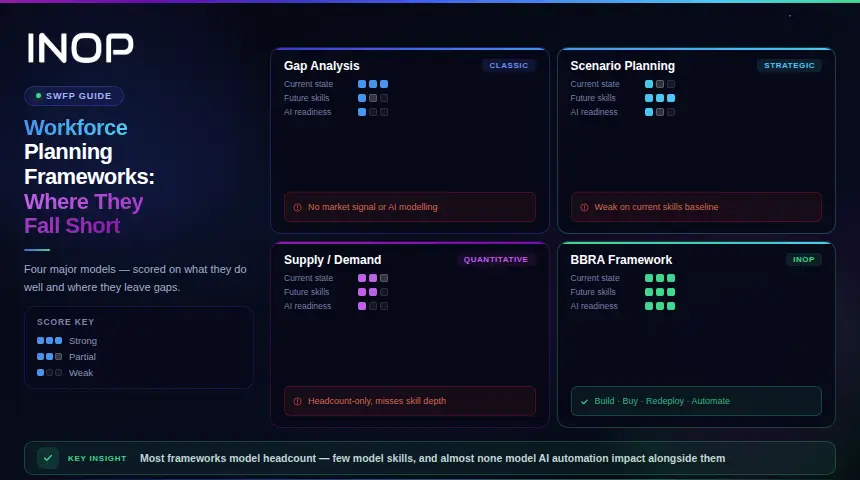
Every framework above was built around an assumption that no longer holds: that workforce planning happens on a fixed cycle, annual or biannual, with enough lead time to run a multi-step process before the business need arrives. Seven in ten business leaders now say their primary competitive strategy over the next three years is to be fast and nimble, according to Deloitte’s 2026 Global Human Capital Trends research cited in the same strategic workforce planning research. A framework designed around a slow, sequential process is structurally mismatched with that pace, regardless of how rigorous its individual steps are. The other consistent gap across all four models is that none of them treat automation as a genuine fourth or fifth response to a capability gap, since they predate the current wave of AI-driven task automation becoming a realistic alternative to hiring, developing, or contracting for a skill.
INOP’s Five Intelligence Lenses: A Framework Built for Continuous Planning
Rather than running through sequential phases on a fixed calendar, INOP evaluates every workforce decision continuously through five intelligence lenses, replacing the cycle-based structure of older frameworks with something that operates at the pace strategy actually requires now.
| Lens | What It Replaces From Traditional Frameworks |
|---|---|
| Strategy | The business-alignment step every framework includes but few keep current between planning cycles |
| Finance | The cost modeling most frameworks treat as a separate, disconnected exercise from the workforce plan itself |
| People | The competency and skills assessment step, refreshed continuously rather than once per cycle |
| Market | External labor market context that older frameworks reference qualitatively rather than track as live data |
| AI and Automation | The missing lens entirely absent from every framework predating widespread task automation |
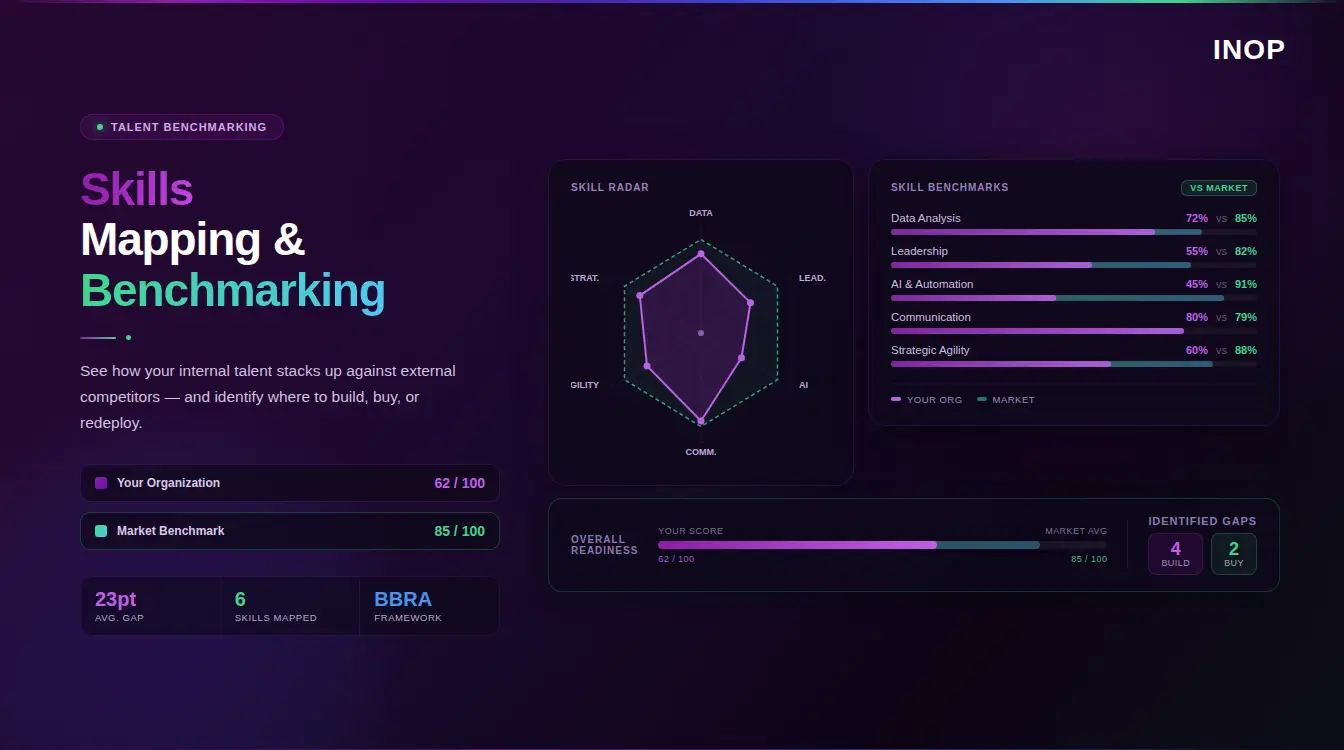
BBRA: The Build, Buy, Borrow, Bind Model, Rebuilt for the Automation Era
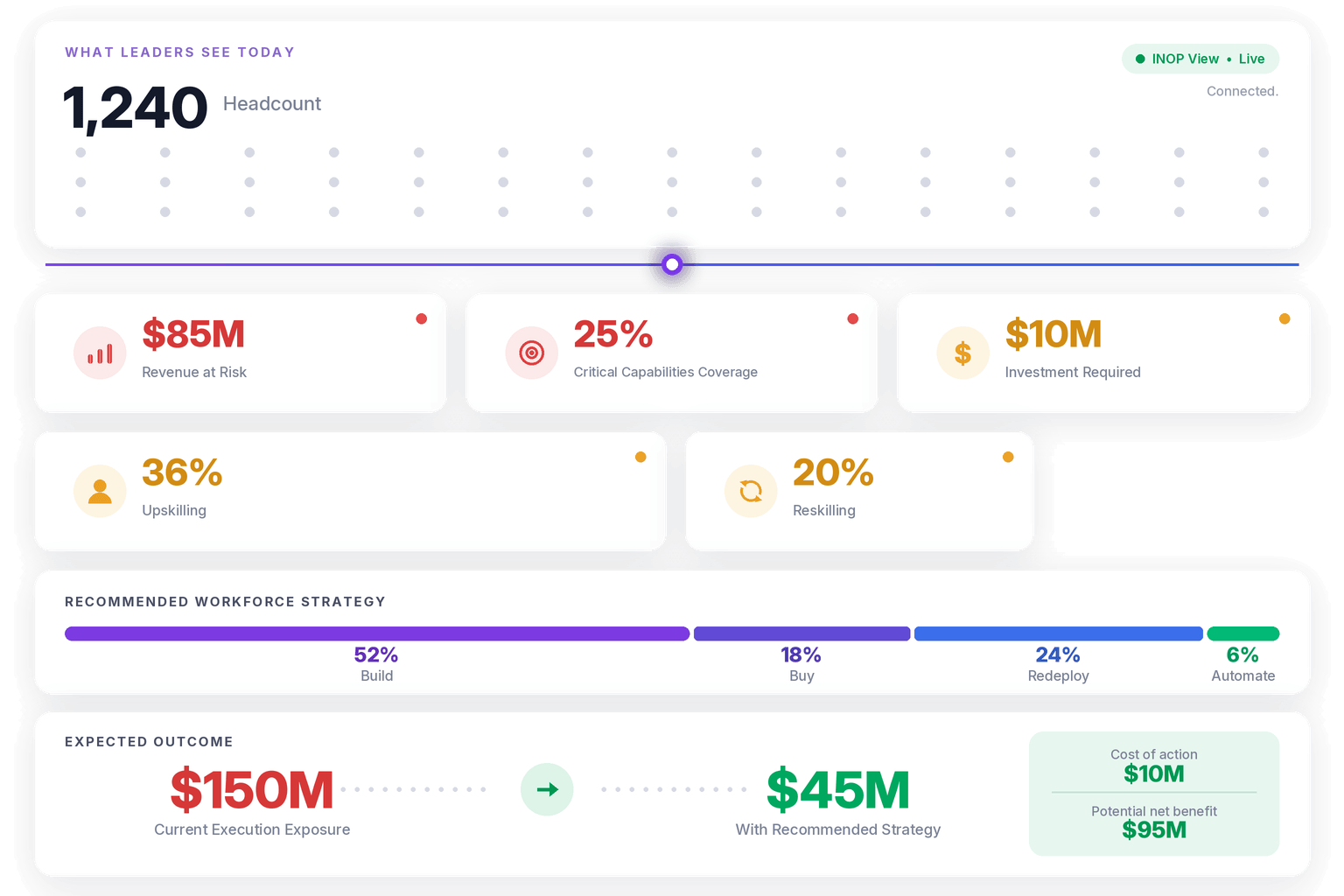
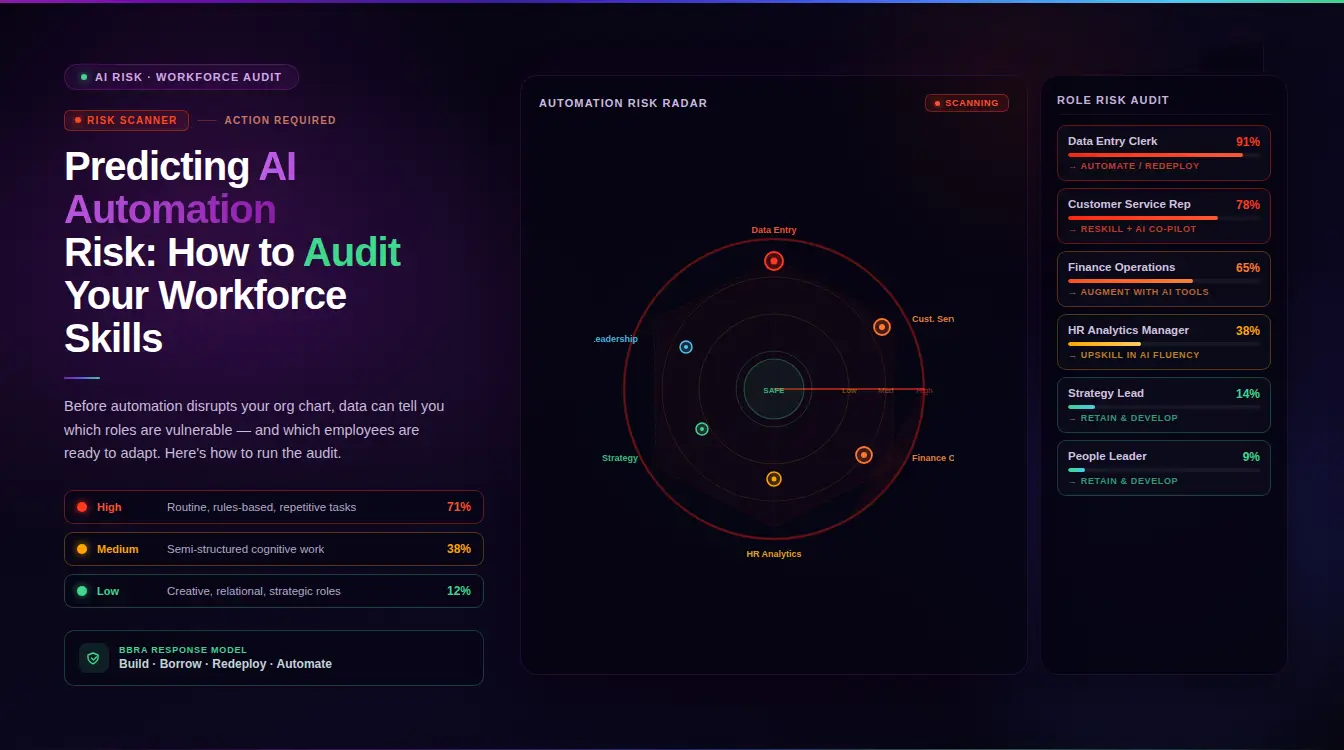
INOP’s proprietary BBRA framework, Build, Buy, Redeploy, and Automate, is a direct descendant of the build, buy, borrow, bind model, updated for a workforce environment where automation is now a genuine option and internal redeployment matters more than short-term contracting for most strategic gaps. Build and Buy carry over largely unchanged, developing capability internally or hiring it externally. Redeploy replaces Borrow, reflecting that moving an existing employee with adjacent skills into a gap is now a faster, better-tracked option than it was when contracting was the default flexible response. Automate replaces Bind, reflecting that in many cases the smarter response to a capability gap is not retaining a person against attrition risk but automating the underlying task so the gap stops recurring.
BBRA models all four pathways against financial tradeoffs across four time horizons, thirty days, one hundred eighty days, one year, and three years, giving a workforce planning function the same decision logic the original build, buy, borrow, bind model offered, updated for what a capability gap actually requires closing in 2026.
Strategic Workforce Planning Frameworks for Private Equity Operating Partners
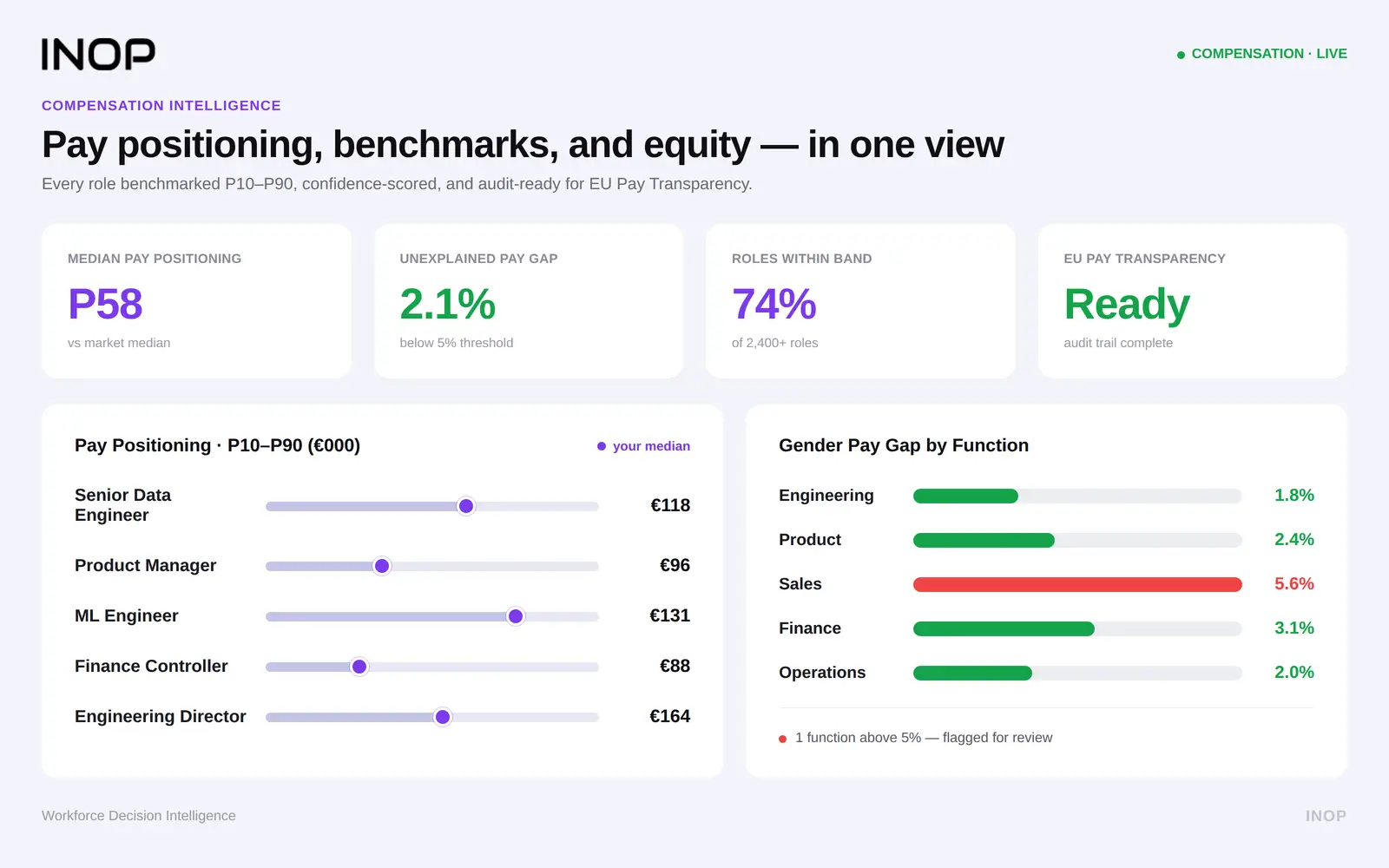
Inside a portfolio company, the specific named framework a company claims to use matters less than whether that framework has actually been kept current since it was adopted. A company running an HCI-based competency model from three years ago, with no update since, is operating on a workforce picture that predates most of its current strategic priorities. Standardizing framework evaluation across a portfolio through INOP’s strategic workforce planning platform gives operating partners a consistent way to check whether a portfolio company’s planning approach is genuinely continuous or simply a static document revisited once a year under a more sophisticated name. Where a framework surfaces roles carrying scarce, high-demand capability, INOP’s compensation analytics platform connects that finding directly into pay benchmarking, since a gap identified through any of these frameworks often carries a compensation dimension the framework itself will not price out.
Common Mistakes When Choosing a Strategic Workforce Planning Framework
Adopting a framework and never revisiting whether it fits the current pace of the business. A framework chosen for a slower-moving organization years ago often survives well past the point where it still matches how fast the business actually needs to plan.
Treating the framework as the plan itself. A framework is a structure for producing a plan, not a substitute for one. Organizations that stop at documenting the framework, rather than running it to an actual decision, are doing planning theater rather than planning.
Ignoring automation as a genuine response option. Every established framework predates automation becoming a realistic alternative to hiring or developing a skill. A framework still treating build, buy, and borrow as the only three responses to a gap is missing a pathway that is often faster and cheaper than any of the original three.
Running the framework on a fixed annual cycle. A five-step or eight-step process is only as useful as how often it gets rerun. INOP’s skills intelligence platform supports continuous reassessment by mapping external demand signals against your existing skills taxonomy in real time, rather than leaving the framework’s inputs to go stale between annual cycles.
Choosing a framework based on complexity rather than fit. An eight-step competency model is not automatically better than a simpler five-step process. The right framework depends on organizational size, planning maturity, and how fast the business needs to replan, not on which model sounds the most sophisticated. A hybrid approach, blending elements of demand-based, scenario-based, and skills-based planning, is often the more realistic fit for mid-to-large organizations with complex structures and multiple competing planning priorities across departments, according to recent research on strategic workforce planning guidance, rather than forcing every gap through a single named model regardless of the situation.
Frequently Asked Questions
What is the most widely used strategic workforce planning framework?
The generic five-phase model, assess, forecast, identify gaps, develop strategy, measure outcomes, is the most commonly taught and adopted structure, largely because it requires the least specialized expertise to implement compared to models like the HCI eight-step framework.
How is the HCI model different from the OPM model?
The HCI model centers on competency mapping across eight detailed steps, offering precision at the cost of speed. The OPM model uses a simpler five-step structure that is faster to implement but offers less guidance on what to actually do once a gap is identified.
Does build, buy, borrow, bind still apply today?
The underlying logic still holds, but the specific responses have shifted. Redeployment now typically outperforms short-term borrowing for many gaps, and automation has become a genuine fifth option the original model never accounted for, which is why frameworks like BBRA updated the model rather than discarding it.
How often should a strategic workforce planning framework be rerun?
Continuously is the ideal, rather than on a fixed annual or biannual cycle. Given how fast skill requirements and business priorities now shift, a framework rerun only once a year is often already outdated by the time its findings reach a planning conversation.
How should private equity operating partners evaluate a portfolio company’s strategic workforce planning framework?
By checking how recently the framework was actually rerun, not just which named model the company claims to follow. A sophisticated framework applied once and left untouched for years provides less reliable insight than a simpler framework updated continuously.
Ready to see a strategic workforce planning framework that runs continuously instead of once a year? Book a demo and INOP will walk through the five-lens model and BBRA, live.