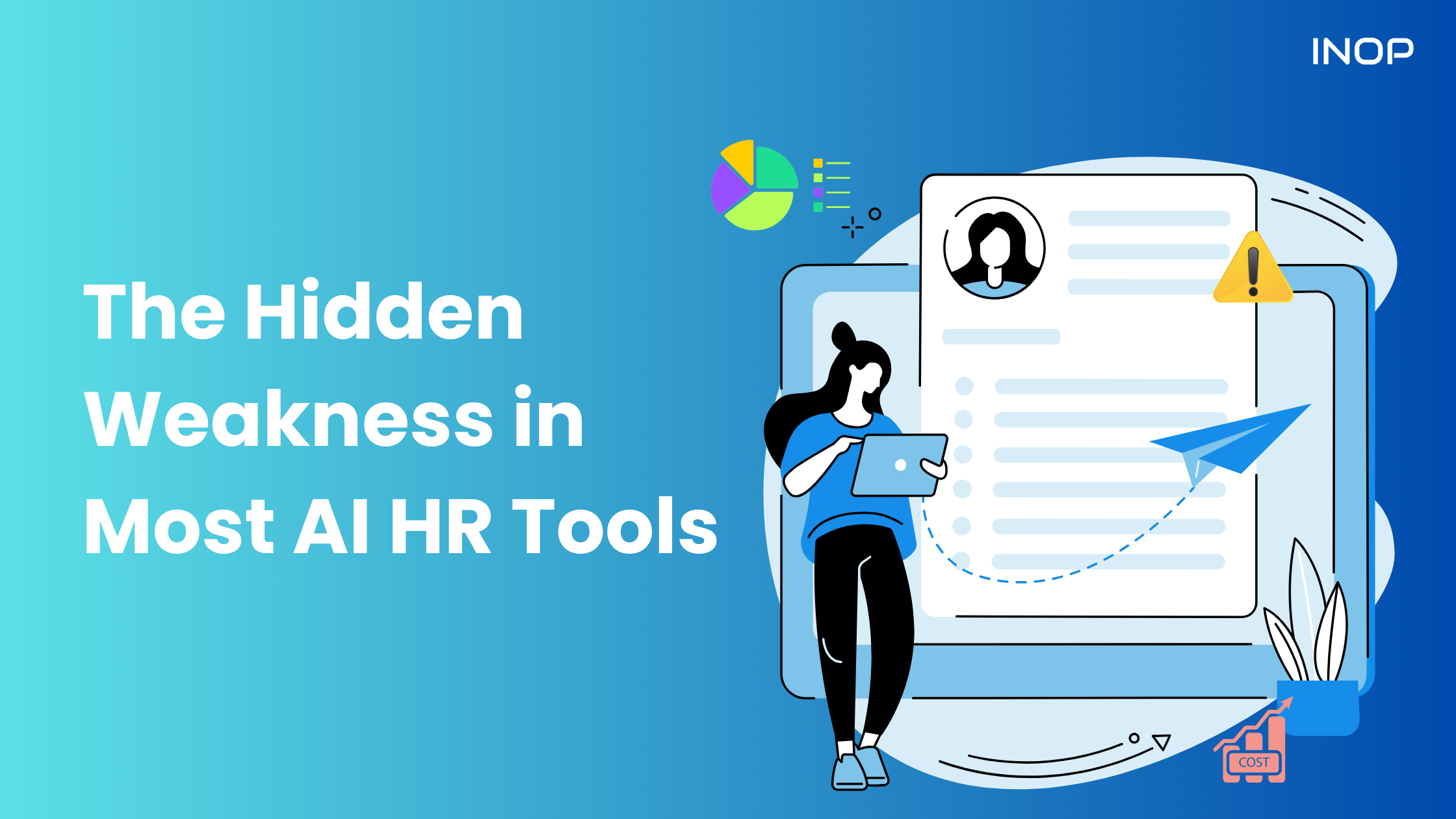
The HR tech market is flooded with AI-powered platforms promising to transform hiring, compensation, and workforce planning. Many have automated tasks that used to take hours. But a flaw cuts through most of them, and it has nothing to do with the sophistication of the algorithms. The problem is what sits beneath them: static datasets, generic taxonomies, and disconnected architectures that fragment intelligence rather than connecting it.
The symptoms show up in leadership meetings, not in product demos. Mis-hires remain expensive and common. Workforce planning still reacts to problems rather than anticipating them. Pay equity reports and actual hiring patterns stay disconnected. These are not technology failures in the narrow sense. They are data and architecture failures wearing the label of AI innovation.
Want to see what workforce intelligence looks like when it’s built from the ground up, not bolted on? Book a 20-minute demo with INOP.
What Generic Taxonomies Miss
Most HR platforms today rely on public or off-the-shelf frameworks like O*NET or ESCO. Both were designed for occupational classification, not for real-time predictive workforce decision-making. AI decision-making models that lack explainability are 60% more likely to face legal challenges from candidates or employees questioning the fairness of decisions, and models built on stale frameworks make that challenge more likely because their recommendations do not reflect how roles actually function today.
Skills across every sector are being reshaped faster than fixed taxonomies can track. A framework that captured the data analyst role accurately in 2021 misses the current reality: data analysts now routinely operate at the intersection of Python, business intelligence, and stakeholder communication in ways that role classifications from five years ago do not reflect. The same is true in green tech, AI engineering, digital marketing, and dozens of other domains where role boundaries are actively converging.
What static frameworks miss falls into four categories. Emerging skills in AI development, climate tech, and digital transformation, which do not appear in classification systems built before they existed. Role convergence across functions, where a modern growth marketing manager holds skills that formerly sat in separate data, design, and strategy roles. Culture and values alignment, which matters more to retention than most skills frameworks acknowledge. And growth trajectory, the gap between what someone can do now and what they are capable of developing toward, which a fit-for-now taxonomy cannot surface.
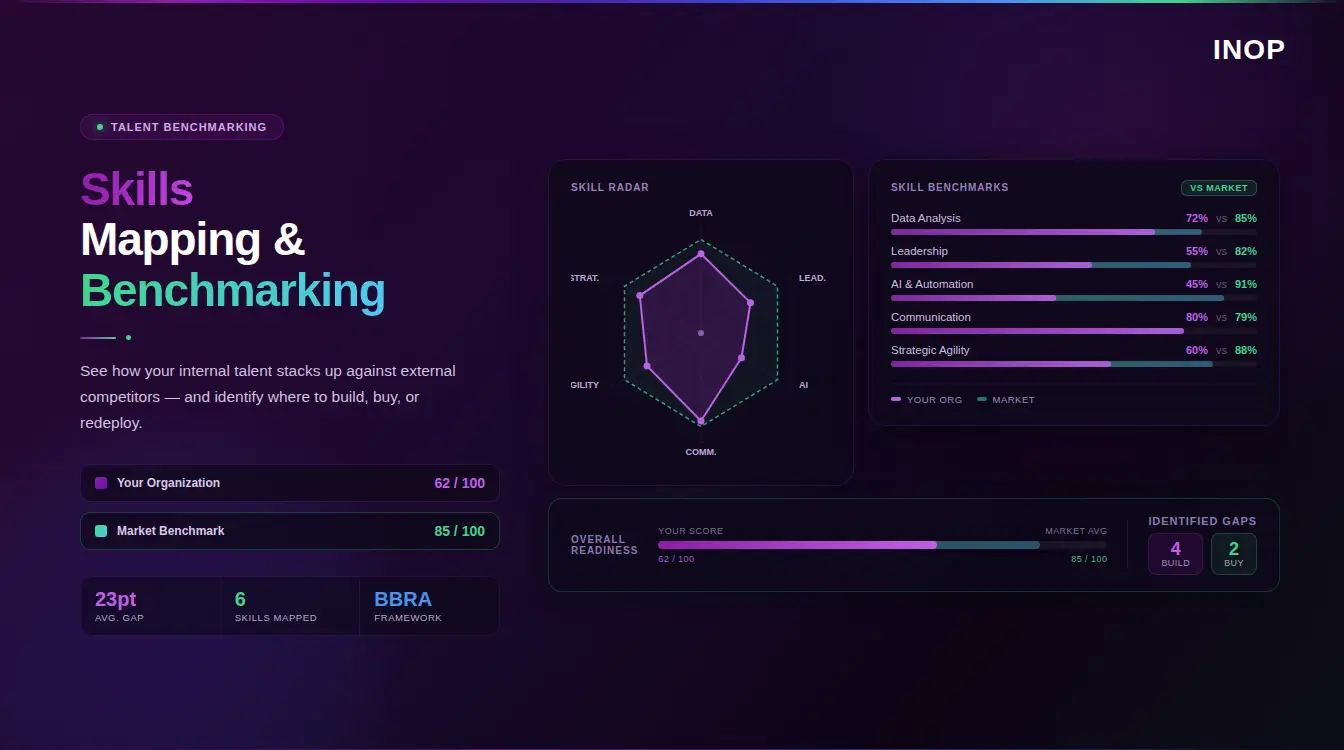
Using these frameworks to fuel AI recommendations produces one-dimensional outputs: keyword matches, templated job descriptions, and skills alignment that strips context and penalizes candidates who do not happen to use the exact vocabulary the taxonomy expects. For a full treatment of how static skills frameworks create planning gaps, INOP’s guide on skills mapping covers what a dynamic, benchmarked approach looks like in practice.
Why Explainability Is Now a Compliance Requirement, Not a Feature
The second major weakness in most AI HR tools is a lack of explainability. When a recruiter sees a fit score, they typically cannot see what the score is based on, which variables drove it, or whether those variables correlate with protected characteristics. 30% of HR professionals admit that the AI tools they use lack adequate explainability, making it difficult to justify decisions to candidates or employees. 60% of employees feel uncomfortable when AI is used to evaluate their performance without clear understanding of how the system works.
In 2025, this stopped being primarily an ethical concern and became a legal one. AI systems used in hiring are classified as high-risk under the EU AI Act, requiring transparent scoring, documented bias audits, and candidate disclosure before deployment, making explainability a compliance requirement, not just a best practice. In the US, New York City Local Law 144 requires independent bias audits and candidate notice for automated employment decision tools. Illinois requires disclosure when AI analyzes video interviews.
29% of companies paused or restructured AI recruitment tools due to bias findings in 2025. That figure represents organizations that discovered the problem after deployment, at significantly higher cost than catching it during design. A 2023 IBM study found that 78% of CHROs want more transparency in how HR technology arrives at decisions, but only 32% feel they currently get it. The gap between what CHROs want and what vendors deliver is not closing fast enough given the regulatory timeline.
Explainability is not a cosmetic layer added after the model is built. It is a design constraint that determines whether the model can be trusted, audited, or defended. For a deeper look at the governance framework that should accompany any AI-assisted workforce decision, INOP’s guide on AI automation bias and workforce decisions covers the full regulatory and ethical landscape.
The Automation Bias Problem: When Humans Follow the Machine
A less-discussed weakness sits not in the AI tools themselves but in how humans interact with them. When humans defer excessively to AI outputs, they may under-scrutinize wrong recommendations. Organizational psychologists call this automation bias: the tendency to accept AI recommendations without applying the critical review that would catch errors in a human-generated recommendation.
The stakes of this in HR are significant. A 2025 University of Washington study found that recruiters using AI tools with bias built into the models mirrored those biased choices up to 90% of the time. When recruiters made decisions without AI or with unbiased AI, they chose candidates without the demographic skew. The AI did not replace the recruiter’s judgment. It colonized it.
This finding changes the case for explainability. Explainability is not just about satisfying regulators or giving candidates an answer when they ask why they were rejected. It is the mechanism that keeps a human decision-maker genuinely in the loop rather than nominally so. A recruiter who can see exactly which variables drove a recommendation, and can interrogate whether those variables are appropriate, is a different kind of decision-maker than one who sees a score and acts on it. The first is using AI as a tool. The second has become a conduit for whatever bias the training data contains.
Building human review into AI-assisted HR decisions is not a sign that the AI is failing. It is the architecture that makes the AI defensible. The EU AI Act requires it. NYC Local Law 144 requires it. And the 2025 UW research demonstrates why it matters even when regulations do not yet compel it.
Why Intelligence Must Be Full-Stack, Not Bolted On
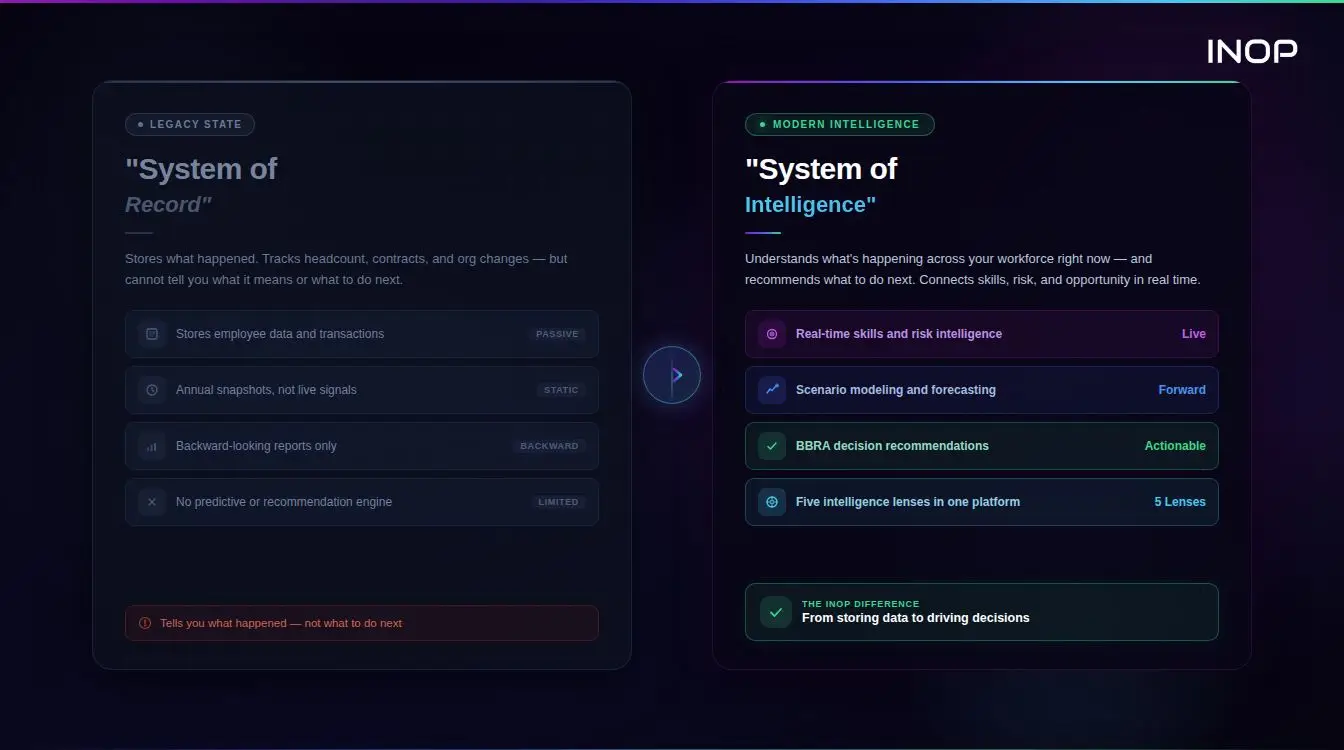
The architectural problem that compounds everything above is that most HR platforms add AI as a module rather than building it as a foundation. A traditional platform automates resume screening in the ATS, benchmarks compensation in a separate tool, and manages internal mobility in a third system. Each module may function adequately in isolation. None of them talk to each other.
The cost of this fragmentation is invisible in product demos and visible in board meetings. You hire someone based on an AI screening score that assessed fit for a static job description. Six months later, the compensation benchmarking tool flags them as significantly below market. The internal mobility platform, which has no sight of either decision, cannot surface them as a candidate for an adjacent open role. Three separate AI tools, three separate datasets, and the employee still leaves for a competitor who made a better offer.
True workforce intelligence needs to connect the full employee lifecycle from the same data layer. Hiring decisions should inform compensation benchmarking. Compensation data should feed retention risk modeling. Internal skills data should surface internal candidates before external searches open. None of this is technically impossible. It is architecturally absent from most current HR platforms because intelligence was added after the fact, module by module, rather than built as the foundation.
For HR leaders evaluating where their current tool stack creates these invisible disconnects, INOP’s guide on predictive versus prescriptive HR analytics covers what a connected intelligence architecture produces compared to disconnected analytics modules.
The Compliance Dimension: CSRD, ESG, and What Connected Intelligence Makes Possible
Compliance requirements are accelerating the urgency of this architecture problem. The EU Corporate Sustainability Reporting Directive requires organizations to disclose workforce data covering working conditions, diversity, skills investment, and human capital risk in formats that third-party auditors can verify. The SEC’s human capital disclosure rules require US public companies to describe their workforce management approach in investor-facing filings with enough specificity to be evaluated across periods.
Neither of these requirements can be satisfied by disconnected AI tools producing separate outputs. CSRD workforce data needs to come from a single, auditable source that connects skills data to headcount data to compensation data to diversity data. When those data sets live in separate platforms updated on separate schedules by separate teams, the compliance report is a reconciliation exercise rather than an accurate disclosure. The risk is not only regulatory. Investors and institutional shareholders are increasingly using human capital disclosure quality as a signal of management effectiveness. A company that cannot produce a coherent, data-grounded picture of its workforce governance is signaling something about the quality of its decision-making infrastructure.
Connected workforce intelligence is the infrastructure that makes compliance reporting an output of ongoing management rather than a separate project. INOP’s guide on human capital risk covers how governance frameworks connect workforce data to investor-facing disclosure obligations in a format that survives audit.
Fixing the Foundations: What the Founder Observed
“After spending more than two decades working closely with CHROs and leadership teams — while building and exiting in this space and serving on multiple boards — one thing has become clear: the issue is not necessarily AI itself. It is what powers it, and how connected it is.
Too often, the industry solves one part of the puzzle — automating interviews, parsing resumes, benchmarking pay — but fails to connect the dots across the workforce lifecycle. Compliance frameworks like CSRD and ESG demand not just data, but transparency and accountability. Without connected intelligence, organizations are forced to manage strategy through spreadsheets and assumptions.
INOP’s Approach: Building Intelligence From the Ground Up
At INOP, the SIZ (Screening Intelligence Zone) engine was built to screen not just faster, but smarter, fairer, and more strategically, grounded in real-world context and connected across the workforce lifecycle.
SIZ operates on four design principles that directly address the weaknesses above.
Proprietary taxonomies rooted in live data. Rather than relying on O*NET or ESCO classifications, SIZ draws from proprietary taxonomies built from global labor frameworks and continuously enriched with live data from millions of job postings, verified employee profiles, job descriptions, and company data. The taxonomy reflects how roles actually function in 2026, including emerging skills, role convergence, and capability adjacencies that static frameworks miss.
Contextual, dynamic data beyond the resume. SIZ incorporates behavioral signals, values alignment indicators, team culture data, and growth trajectory alongside traditional skills matching. Fit-for-now and fit-for-future are treated as different assessments, not the same one.
Multi-layered AI with transparent outputs. The engine combines natural language processing, classification models, generative AI, large language models, and predictive modeling, all fine-tuned for workforce decision-making. Every recommendation includes a transparent breakdown of which variables drove it and why, satisfying both the human reviewer’s need to interrogate and the regulator’s requirement for documented explainability.
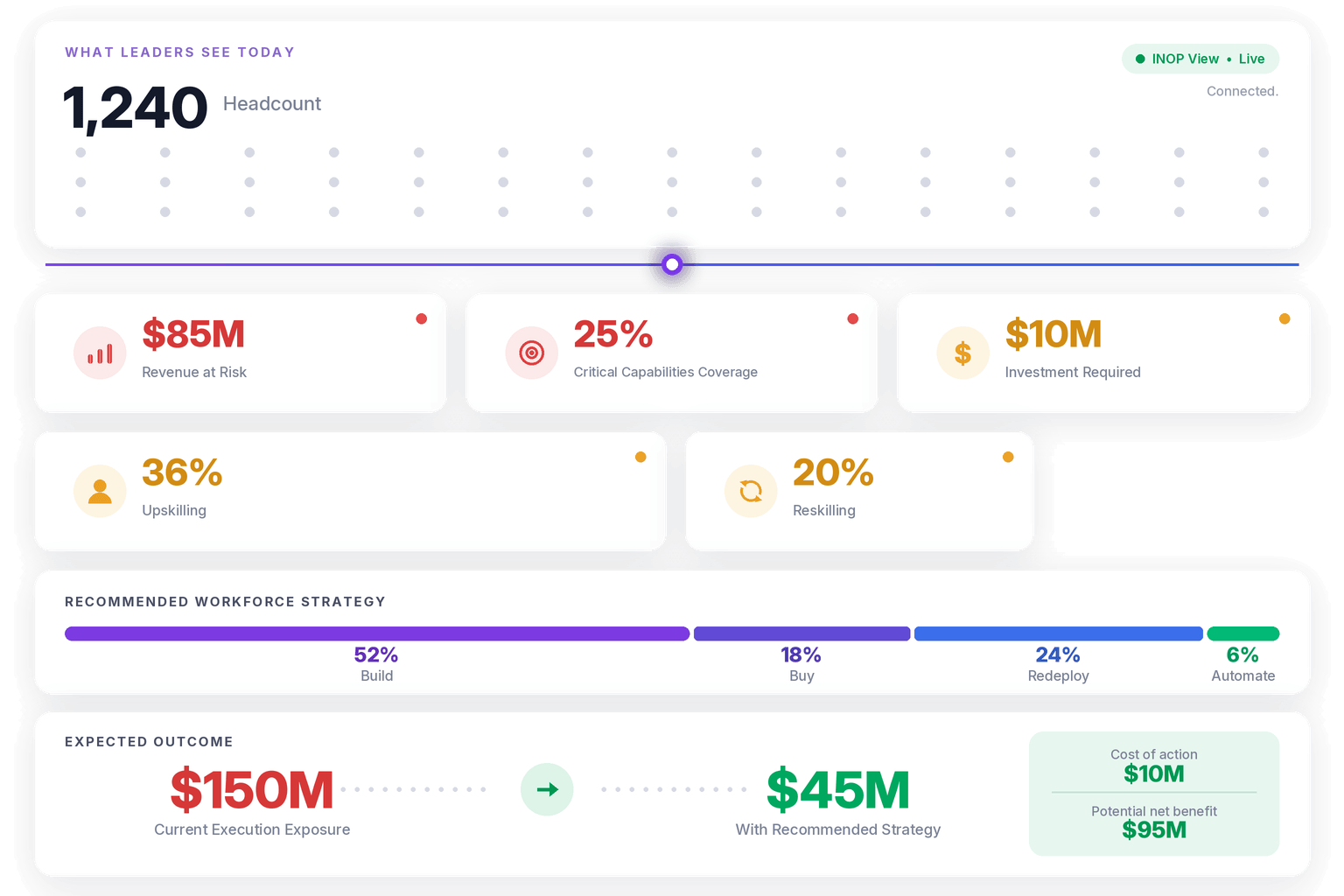
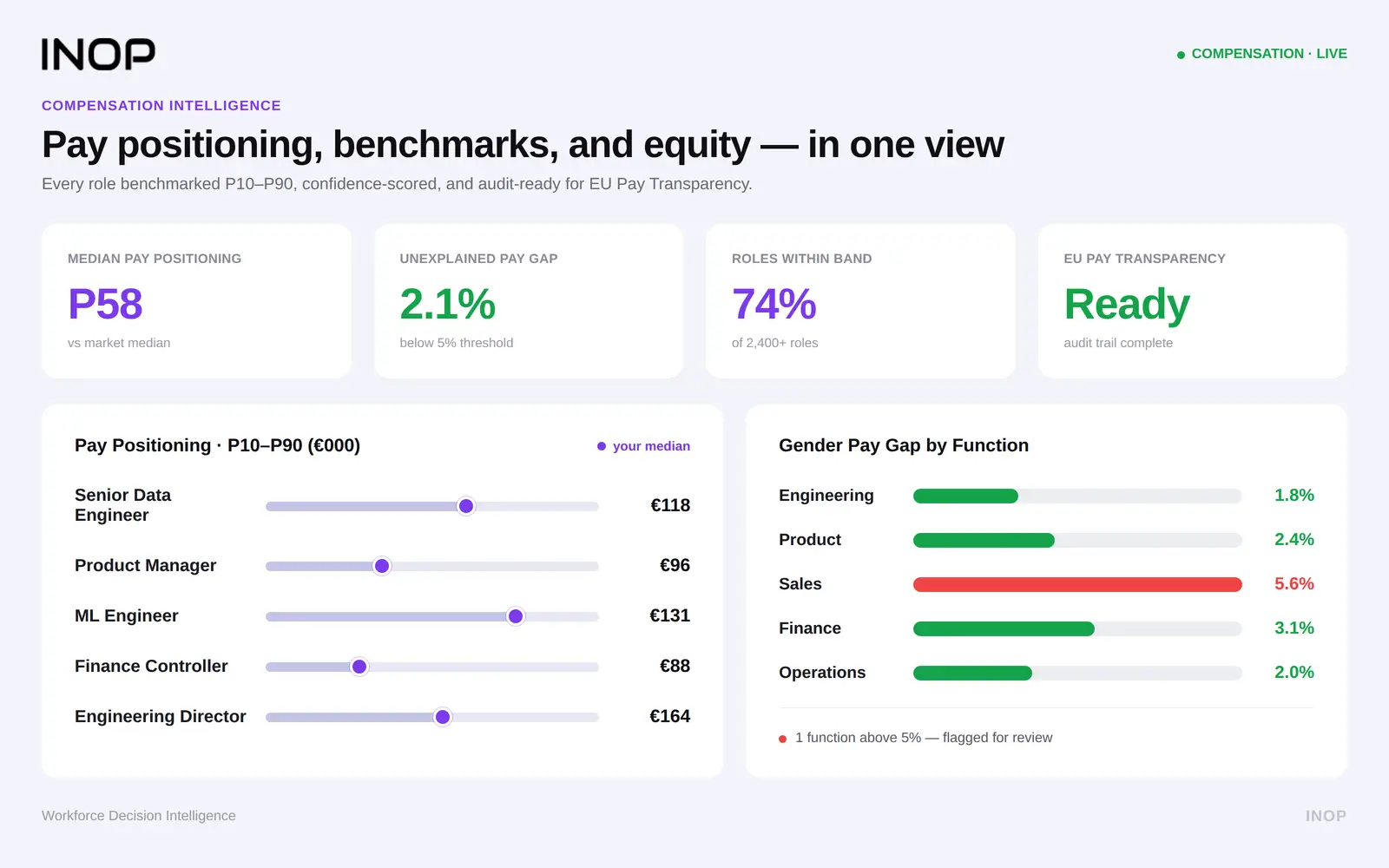
Connected across the workforce lifecycle. SIZ is not a screening module bolted onto a separate compensation tool bolted onto a separate mobility platform. INOP’s strategic workforce planning platform connects hiring, compensation, internal mobility, and workforce planning from a single intelligence layer. A skills profile built during hiring informs the compensation benchmark. The compensation benchmark informs retention risk modeling. The internal skills inventory informs the next open role before the external posting goes live.
Ready to see workforce intelligence that connects hiring, pay, and planning from a single data layer? Book a demo and walk through a live demonstration of SIZ and INOP’s connected intelligence architecture.