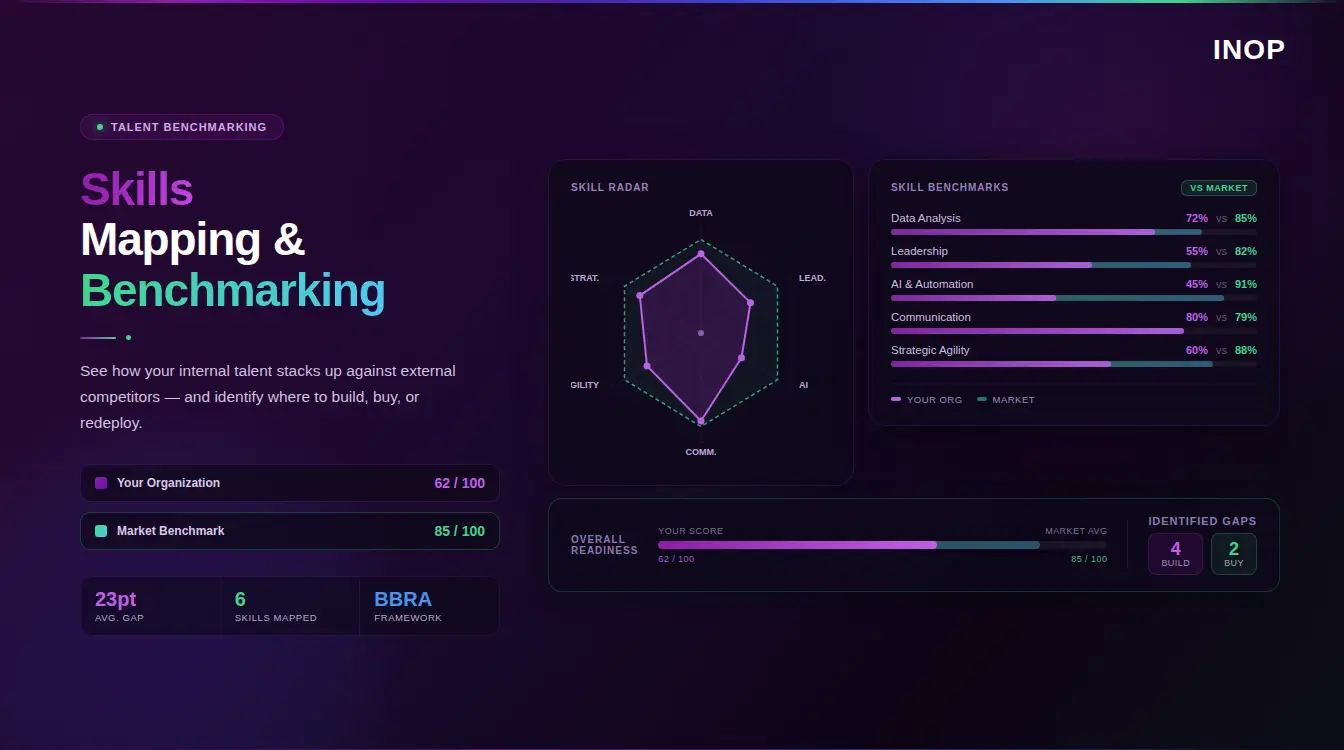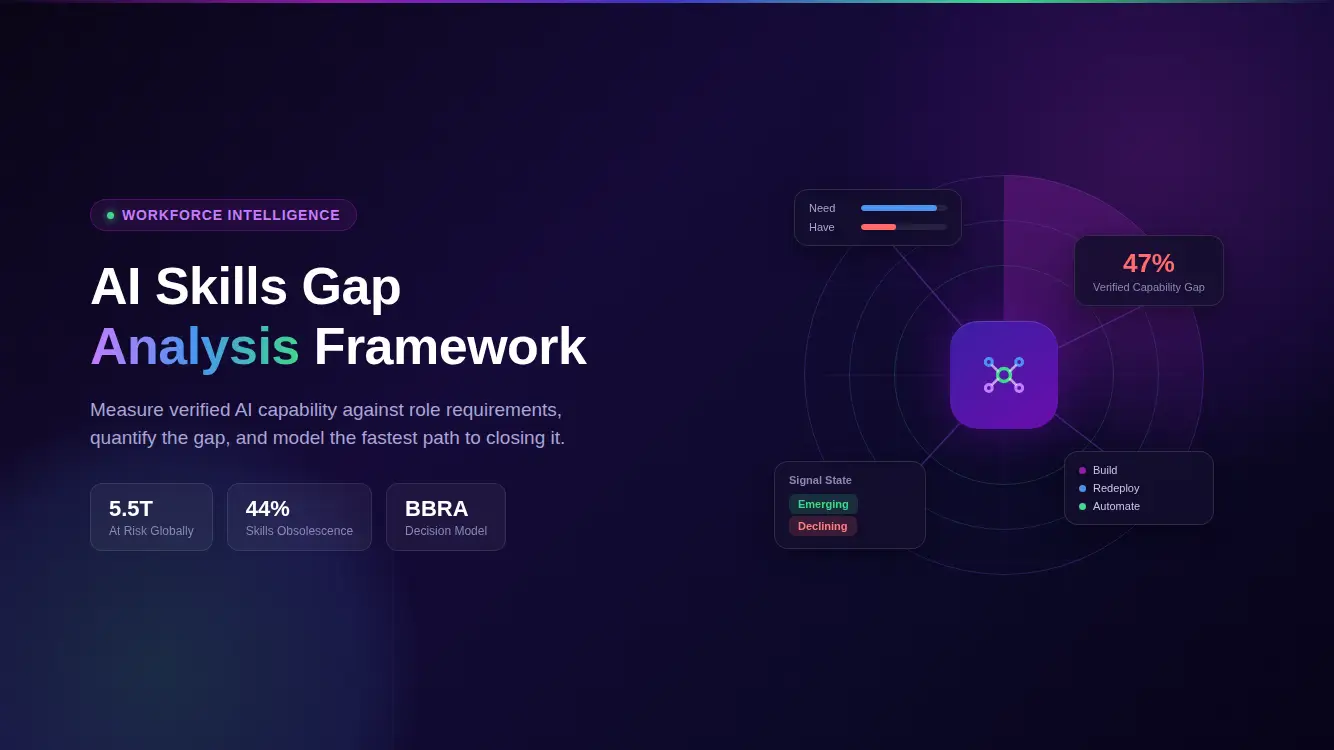
An ai skills gap analysis is the process of measuring the difference between the AI capability your organization needs and the AI capability your workforce actually has, role by role, function by function. For CHROs and people analytics leaders, this has become one of the most urgent exercises on the workforce planning calendar. Enterprises that treat AI skill measurement as a one-time survey are already behind the organizations running it as a continuous, verified process.
This guide walks through what an ai skills gap analysis actually measures, why most organizations get the process wrong, and how to build one using verified data instead of self-reported checklists.
What an AI Skills Gap Analysis Actually Measures
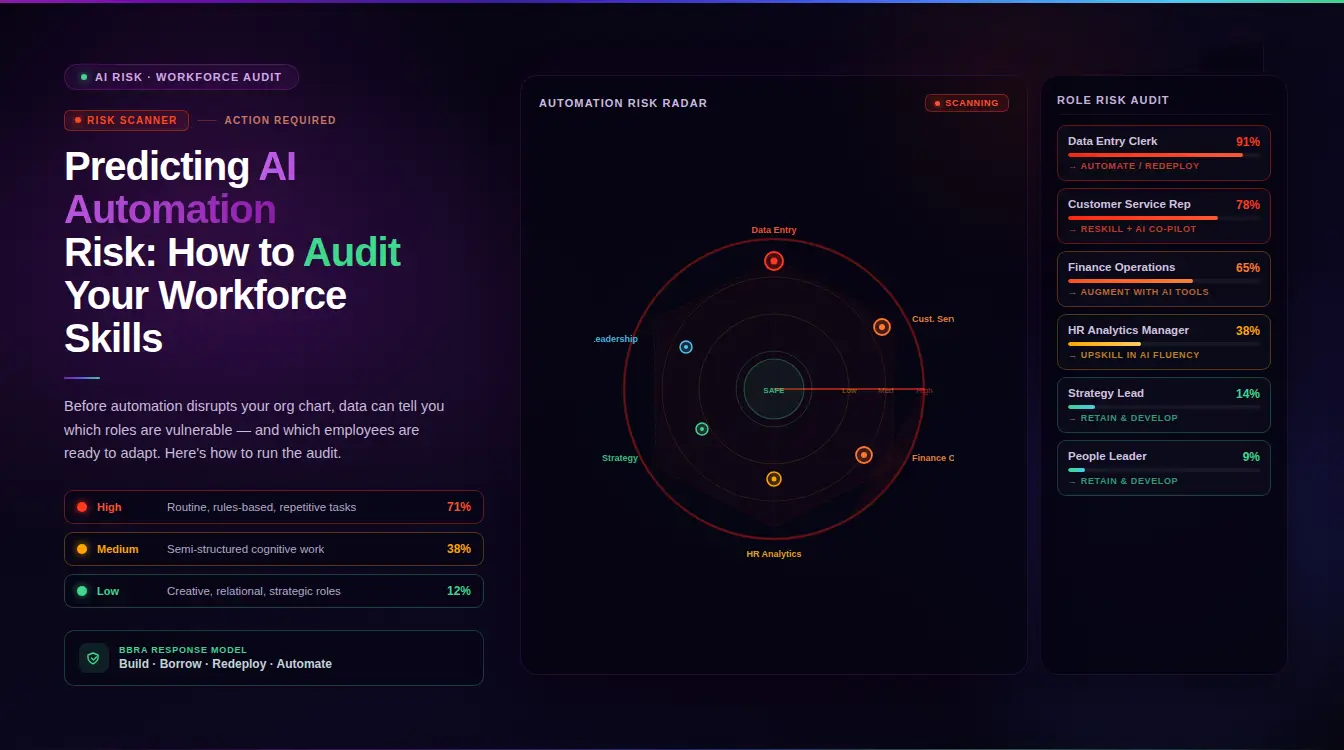
An ai skills gap analysis compares two things: the AI capabilities a role requires today and in the near future, and the demonstrated AI capabilities of the people currently in that role. The gap between the two is not a training wish list. It is a quantified risk that shows up in delayed projects, stalled automation initiatives, and AI investments that never reach production.
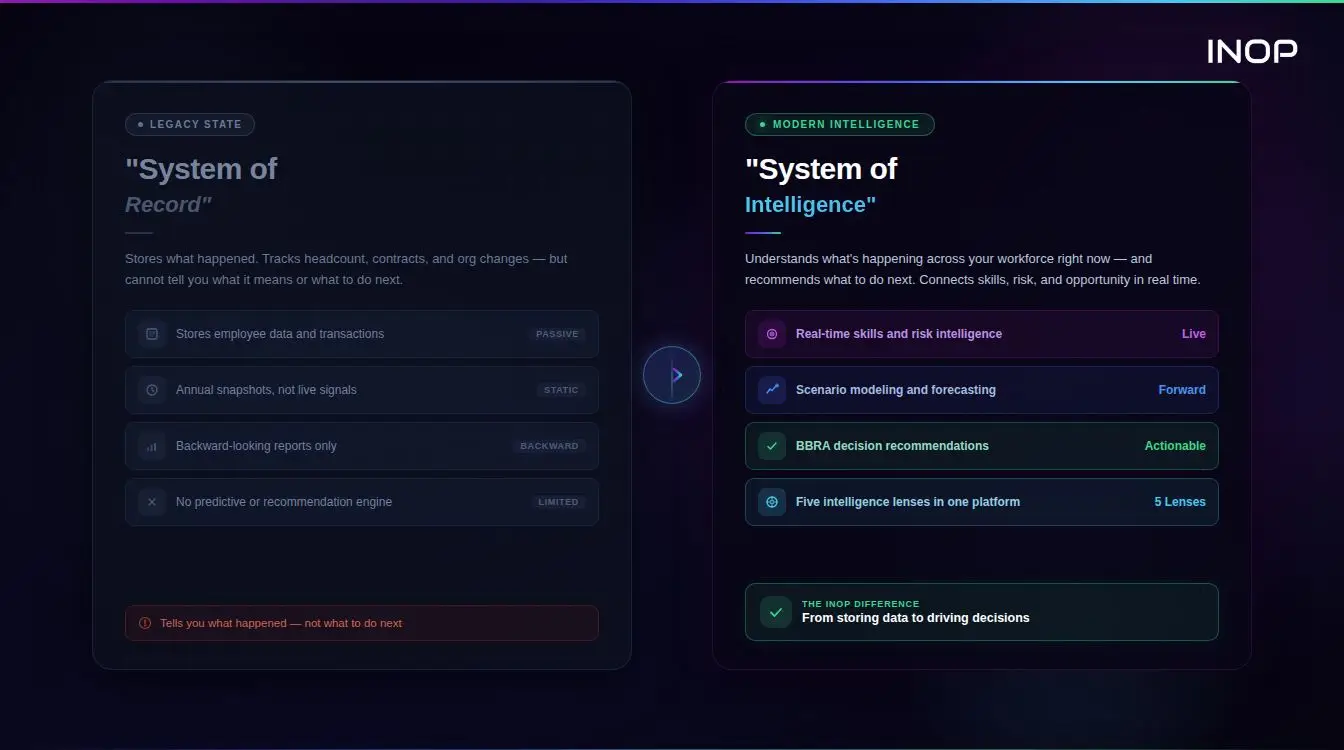
Most organizations still run this analysis through self-reported surveys or manager opinion, which produces a picture that looks tidy and is often wrong. A credible analysis instead relies on role-based benchmarks, verified assessment data, and workforce signals pulled from actual work output rather than a form employees fill out once a year.
Why Self-Reported Skills Data Fails
Self-assessment inflates confidence in exactly the areas where employees are least equipped to judge their own gaps, because people tend to overestimate familiarity with a tool and underestimate the difference between using AI casually and using it reliably inside a regulated, high-stakes workflow. This is one of the root causes behind a pattern researchers keep finding: organizations report having AI training in place, yet still describe a persistent AI skills gap when asked directly, because the underlying data used to design that training was never verified in the first place, as research on workforce skill visibility has documented.
Why the AI Skills Gap Keeps Widening
Three forces are compounding at once, and each one raises the cost of running an outdated or superficial gap analysis.
Skill decay has compressed from years to months. The World Economic Forum’s most recent Future of Jobs data puts the current skills obsolescence rate at a level high enough that a large share of a worker’s core capabilities today will be outdated within the next few years, with a majority of global employers now naming the skills gap as their primary barrier to transformation, according to the Future of Jobs Report analysis. A gap analysis run annually cannot keep pace with a decay curve moving that quickly.
Demand for AI capability has pulled far ahead of supply. Global estimates now put open AI-related roles at several multiples of the qualified candidates available to fill them, a ratio detailed in recent workforce shortage analysis. Hiring your way out of the gap is no longer a reliable strategy on its own, which pushes internal capability building back to the center of workforce planning.
The financial exposure is now board-level, not a learning and development line item. Analysts project that sustained AI skills shortages could put trillions of dollars of global economic output at risk, a figure explored in recent AI workforce readiness research. Roles with verified AI exposure also command a meaningful wage premium over comparable roles without it, a gap documented in recent labor market coverage, which means the cost of an unaddressed gap compounds through both lost output and rising replacement cost.
See how INOP quantifies AI exposure and readiness across your workforce. Book a demo to walk through a live risk model for your organization.
How to Run an AI Skills Gap Analysis Step by Step
A rigorous ai skills gap analysis follows four stages. Skipping any one of them is what produces the mismatch between reported AI readiness and actual AI readiness that shows up in nearly every recent workforce survey.
Map AI Capability Requirements by Role
Start by defining what AI-relevant capability actually means for each role family, not as a single company-wide standard but as a graduated benchmark. A finance analyst’s required AI proficiency looks different from a product manager’s, and both look different from a frontline operations role. Without role-specific benchmarks, every subsequent measurement is comparing people against the wrong bar.
Assess Current Proficiency with Verified Signals
Replace self-assessment and manager opinion with verified signals wherever possible. This includes actual work output, completed assessments tied to real tasks rather than generic quizzes, and external labor market data that shows which skills are gaining or losing relevance outside your walls. INOP’s skills intelligence platform is built for this stage specifically. Rather than trying to catalog every skill inside your organization from scratch, it maps external demand signals against your existing skills taxonomy so you can see, role by role, which capabilities are classified as emerging, in demand, stable, or declining in the outside labor market, then line that up against what your workforce currently holds.
Quantify the Gap and Model the Response
When the Build pathway is the right call, structuring that investment correctly matters as much as making it. AI driven upskilling covers how to target training at verified gaps rather than assigning generic courses, and how to verify that the gap actually closed rather than just tracking module completion.
Monitor the Gap Continuously, Not Annually
Given how fast AI-relevant skills are decaying, a gap analysis that runs once a year is measuring a workforce that no longer exists by the time the report ships. Continuous monitoring, refreshed against live external labor market signals, is what separates organizations that stay ahead of the curve from organizations that rediscover the same gap every twelve months.
Applying INOP’s Five Intelligence Lenses to AI Skill Gaps
A gap in AI capability rarely stays contained to a training question. It touches strategy, budget, people, market position, and the automation roadmap all at once, which is why INOP evaluates every workforce risk, including AI skill gaps, through five intelligence lenses rather than a single skills score.
- Strategy: Does the AI capability gap block a specific business initiative, and how urgent is that initiative relative to others competing for budget?
- Finance: What does closing the gap cost through each intervention pathway, and what is the cost of leaving it open?
- People: Who currently holds adjacent skills that make redeployment realistic, and where does attrition risk concentrate if the gap is left unaddressed?
- Market: How does the external labor market for this capability compare to what you can build or retain internally?
- AI and Automation: Could the underlying task the gap was blocking be automated instead of staffed, changing the nature of the gap entirely?
Running an AI skill gap through all five lenses at once is what turns a static assessment into an actionable workforce decision.
The BBRA Framework for Closing AI Skill Gaps
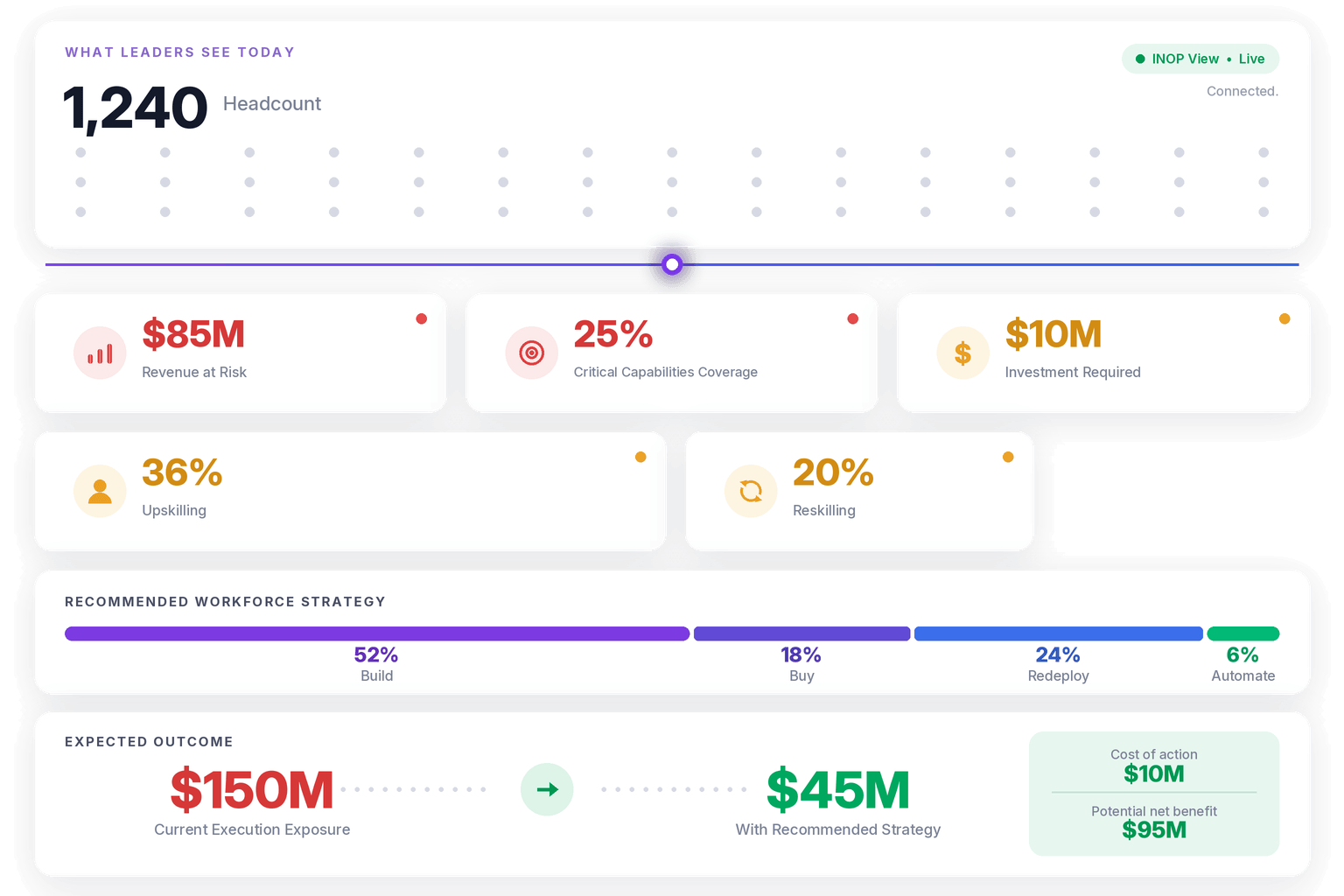
Once a gap is confirmed, INOP’s proprietary BBRA framework models four intervention pathways, Build, Buy, Redeploy, and Automate, against financial tradeoffs across four time horizons: thirty days, one hundred eighty days, one year, and three years. Applied specifically to AI skill gaps, this looks like:
Build models the cost and timeline of internal upskilling against the pace of skill decay, since a training investment that takes eighteen months to complete may already be obsolete for fast-moving AI capabilities. Buy weighs external hiring cost and time to fill against the current AI talent shortage. Redeploy identifies employees with adjacent capability who could close the gap faster than either building from scratch or hiring externally. Automate asks whether the underlying task should be handled by AI systems rather than by closing a human skill gap at all.
Modeling all four pathways against the same financial and time horizons gives workforce leaders a comparison they can bring directly into budget conversations, rather than a training recommendation made in isolation.
Want to see BBRA modeled against your own workforce data? Book a demo and INOP will walk through a live pathway comparison for a role family of your choice.
AI Skills Gap Analysis for Private Equity Operating Partners
For operating partners, an AI skills gap inside a portfolio company is a valuation question before it is an HR question. A company running its core operations on AI-exposed workflows without a verified view of who can actually execute those workflows carries integration risk that rarely surfaces in a standard diligence process, because diligence typically measures headcount and org structure, not verified capability against forward-looking AI exposure.
Applied across a portfolio, this analysis supports several decisions operating partners are already making under time pressure: which portfolio companies carry the highest AI capability risk relative to their transformation plans, where a build versus buy versus redeploy decision changes the economics of a hundred-day plan, and how to benchmark AI readiness consistently across companies that otherwise report workforce data in incompatible formats. Standardizing the analysis with INOP’s strategic workforce planning platform gives operating partners a comparable view across the entire portfolio rather than a one-off assessment inside a single asset.
Common Mistakes in AI Skills Gap Analysis
A handful of recurring errors explain why so many organizations run a gap analysis and still describe the same problem a year later.
Treating the analysis as a one-time project. Given how quickly AI-relevant skills decay, a static report is stale within a quarter, sometimes faster for the roles closest to frontier tooling.
Relying on job titles instead of task-level capability. Two employees with the same title can carry very different actual AI proficiency. Measuring at the title level hides the gap rather than revealing it.
Stopping at measurement without a decision framework. A dashboard that shows a gap without modeling what to do about it, financially and by time horizon, rarely survives contact with a budget cycle.
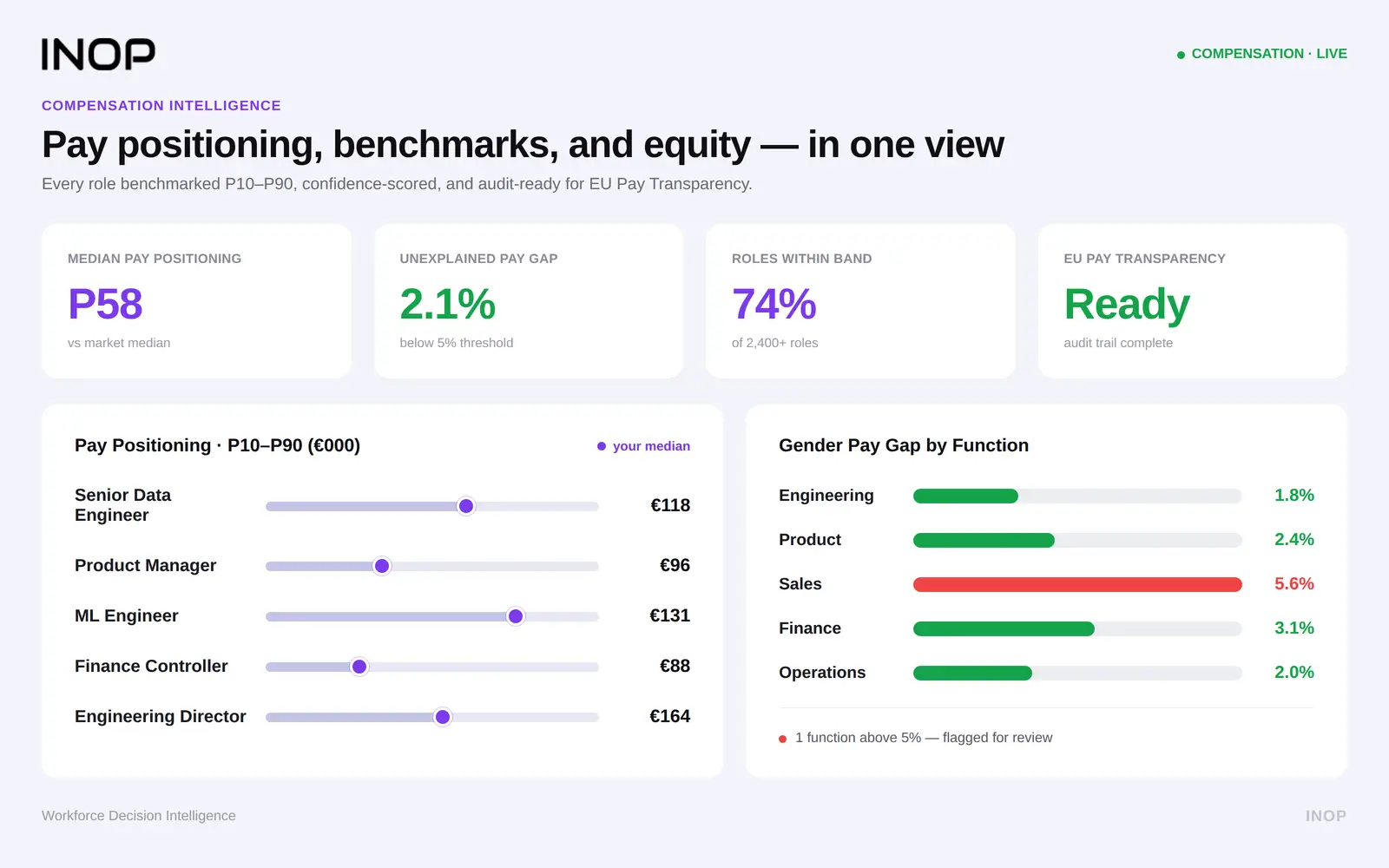
Ignoring compensation exposure. Roles with verified AI capability increasingly carry a market wage premium. An organization that measures the skill gap without also benchmarking the compensation implications risks losing the people who close that gap to a competitor paying market rate for it, which is where INOP’s compensation analytics platform connects directly back into the same workforce dataset.
Frequently Asked Questions
What is the difference between a skills gap analysis and an AI skills gap analysis?
A general skills gap analysis can cover any capability area. An ai skills gap analysis specifically isolates AI-related capability, which decays and shifts far faster than most traditional skill categories, so it typically requires more frequent measurement and a data source tied to current market signals rather than a static internal skills catalog.
How often should an organization run an AI skills gap analysis?
Given the pace of AI skill obsolescence documented across recent labor market research, quarterly refreshes are a reasonable minimum for AI-exposed roles, with continuous monitoring preferred where the underlying data supports it.
Can AI skills gaps be closed through hiring alone?
Rarely at scale. Demand for verified AI capability currently outpaces the available qualified candidate pool by a wide margin, which is part of why internal pathways like redeployment and targeted upskilling have become central to closing the gap rather than a secondary option to hiring.
How should private equity operating partners think about AI skills gaps across a portfolio?
As a diligence and valuation input, not only an HR metric. A verified, standardized view of AI capability risk across portfolio companies lets operating partners compare transformation readiness consistently and prioritize where a build, buy, redeploy, or automate decision changes the economics of a hundred-day plan.
What data should an AI skills gap analysis rely on instead of surveys?
Verified assessment data tied to real work output, external labor market demand signals mapped against your internal skills taxonomy, and role-based benchmarks rather than self-reported confidence, which research consistently shows overstates actual readiness.
Make confident workforce decisions that support strategy and value creation.