Talent intelligence data is reshaping how organizations make their most consequential decisions. What if you discovered your organization has been making multimillion-dollar talent choices the same way a restaurant owner guesses how many tables to set for dinner? For decades, HR leaders have relied on intuition, historical precedent, and lagging metrics to hire, retain, and develop their workforce. In 2026, that approach no longer holds up.
Just as marketing transformed from billboard guesswork to precise, real-time digital analytics, HR is undergoing its own quantitative revolution. The organizations winning the talent war today are not the ones with the biggest recruiting budgets or the flashiest employer brand. They are the ones that have turned workforce decisions into a data science.
This ultimate guide covers everything you need to know about talent intelligence: what it is, how to build a talent intelligence database from scratch, how it differs from traditional people analytics, how to use AI for talent intelligence, how large organizations are applying it today, and how to measure financial return. Whether you are a CHRO preparing to pitch the board, a VP of Talent Acquisition redesigning your hiring process, or a first-time buyer evaluating platforms, this guide is built for you.
What Data Does Talent Intelligence Actually Use?
Most conversations about talent intelligence skip past the most fundamental question: what is the data itself? Before you can understand how talent intelligence works strategically, you need to understand the raw material it runs on. Talent intelligence data is not a single feed or a single system. It is a composite of six distinct data categories, each contributing a different dimension of workforce insight.
Internal Structured Data
This is the foundation layer. Internal structured data includes every record your HR systems already hold: employee records from your HRIS covering tenure, job history, compensation, department, and location; performance scores and rating histories from your performance management system; promotion and lateral move records; absenteeism and leave patterns; and headcount and reporting structure data from your org chart.
This data is organized, machine-readable, and relatively clean, which makes it the easiest layer to activate. The limitation is that it only tells you about your own organization, and only about facts that were explicitly recorded. It tells you that someone was promoted to Senior Engineer in Q2 2024. It does not tell you what skills they demonstrated to earn that promotion.
Internal Unstructured Data
Unstructured internal data is where most organizations leave significant intelligence on the table. This category includes performance review narratives (the written text, not just the numerical score), project assignment histories, skills assessments, learning and development records from your LMS, job application data for internal candidates, and, where legally permissible and ethically governed, collaboration patterns derived from communication and project management tools.
Natural language processing applied to performance review text, for example, can surface skill signals that no structured field ever captures. A manager writing “demonstrated exceptional ability to translate technical requirements into business language for executive audiences” is signaling a skill that would never appear in an ATS dropdown. AI can read that signal and map it to your skills taxonomy automatically.
Applying natural language processing to unstructured data, such as performance review narratives, helps HR teams automatically surface signs of hidden talents that managers might overlook in standard evaluations.
External Labor Market Data
External labor market data is what transforms talent intelligence from a HR reporting tool into a genuine strategic instrument. This category includes real-time job posting data aggregated from thousands of sources (giving you visibility into what roles competitors are hiring for, at what volume, and in which locations), published and survey-based compensation data covering salary bands by role, seniority, geography, and industry, labor supply data showing how many qualified candidates exist in a given market for a specific skill cluster, and economic indicators like unemployment rates and labor force participation that affect hiring conditions.
Without this layer, your workforce decisions are made in a vacuum. With it, you know whether the scarcity you are experiencing hiring data engineers is specific to your employer brand or a market-wide supply problem that no amount of recruiting spend will solve.
Skills Supply and Demand Data
This is a specialized subset of external data that deserves its own category because of its strategic importance. Skills supply and demand data tracks which specific capabilities are emerging (high demand, limited supply), stable (demand and supply in equilibrium), or declining (automation or market shift reducing relevance) across industries and geographies.
Organizations using this data can answer questions like: is the shortage of prompt engineering talent a temporary market condition or a structural gap that requires a build-versus-buy decision? Is machine learning operations (MLOps) a skill worth training internally given how quickly external supply is growing? This layer is what separates reactive talent decisions from genuinely anticipatory workforce strategy.
Competitive Talent Signal Data
Competitive talent intelligence data covers the signals your competitors are broadcasting through their own hiring activity. When a competitor posts 40 data science roles in a market where they previously had 10, that is a signal about their strategic direction that your product and people strategy teams should both know about. When a key executive departs a competitor and joins a new venture, that is a signal about talent availability and competitive disruption.
This category also includes employer brand signals: review data from platforms like Glassdoor and LinkedIn, candidate experience sentiment, and offer acceptance rate data that, in aggregate, tells you how your talent value proposition compares to the market’s alternatives.
Learning and Credentialing Data
The final category captures the continuous skill development signals that employees generate outside your formal HR systems. This includes external certifications and licenses, completion of online courses on platforms like Coursera or LinkedIn Learning, conference participation, publications, open-source contributions, and academic credentials beyond the initial hiring record.
These signals matter because skills development today happens largely outside company-sponsored training programs. An engineer who has completed a graduate-level deep learning certification on their own time has a meaningfully different capability profile than their job title alone suggests. Talent intelligence platforms that ingest these external credentialing signals produce far more accurate skills profiles than those relying on HRIS records alone.
What Is Talent Intelligence? Definition and Meaning
Talent intelligence refers to the practice of collecting and activating talent intelligence data, combining internal HR records, external labor market feeds, and AI-driven skills signals to make strategic, predictive decisions about hiring, retaining, and deploying a workforce. The talent intelligence meaning extends well beyond a simple data dashboard: it is the systematic transformation of fragmented people data into forward-looking strategic insight.
The simplest talent intelligence definition is this: it is the intelligence layer that sits between your raw workforce data and your business strategy. Without it, HR operates reactively. With it, HR operates as a genuine strategic function, forecasting capability gaps, neutralizing flight risk, and aligning human capital investment with financial goals.
Talent intelligence data includes internal records from your HRIS, ATS, LMS, and performance systems, as well as external feeds covering real-time labor market supply and demand, competitor hiring activity, compensation benchmarks, and emerging skills trends. The combination of these two data streams, run through machine learning models, is what produces true intelligence rather than simple reporting.
Talent Intelligence vs. People Analytics
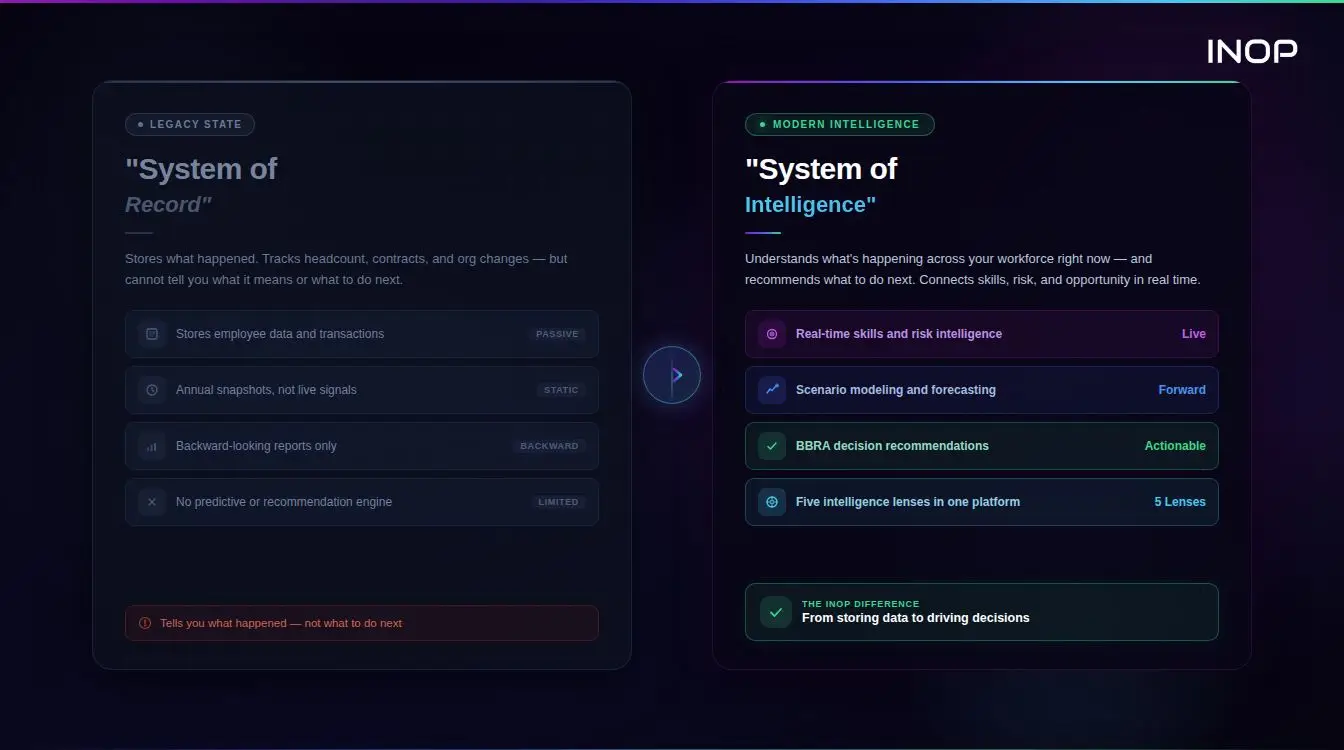
People analytics, as most organizations practice it today, answers questions about the past. How many employees did we lose last quarter? What was our average time-to-fill? How did engagement scores change year-over-year?
Talent intelligence answers questions about the future. Which skills will we be short of in 18 months? Which top performers are showing signs of disengagement before they resign? What is the true external market rate for a Senior Data Engineer in Berlin right now, not six months ago?
| Dimension | Traditional People Analytics | Talent Intelligence |
|---|---|---|
| Time Orientation | Backward-looking (what happened) | Forward-looking (what will happen) |
| Data Sources | Internal HRIS and ATS only | Internal + external labor market feeds |
| Output | Dashboards and historical reports | Predictive models and recommendations |
| Primary User | HR Business Partners | CHROs, Workforce Planning Directors |
| Decision Speed | Monthly or quarterly reviews | Real-time and continuous |
| Skill Focus | Job titles and performance ratings | Dynamic skills taxonomy and capability mapping |
This is not a subtle distinction. The shift from analytics to intelligence is the difference between reading a map after you have already driven off the road and having a GPS that reroutes you in real time.
The Three Pillars of a Talent Intelligence Strategy
Think of talent intelligence as a three-legged stool. Remove any one leg and the entire structure collapses. Organizations that invest in only one or two of these pillars consistently report frustration with their results, not because the technology failed them, but because they built on an incomplete foundation.
Pillar 1: Internal Skills Intelligence
The first pillar is knowing exactly what your current workforce is capable of. This sounds obvious, but most large organizations have shockingly poor visibility into the skills that exist inside their own four walls. According to McKinsey, only 5% of companies say they have a comprehensive picture of the skills their employees possess.
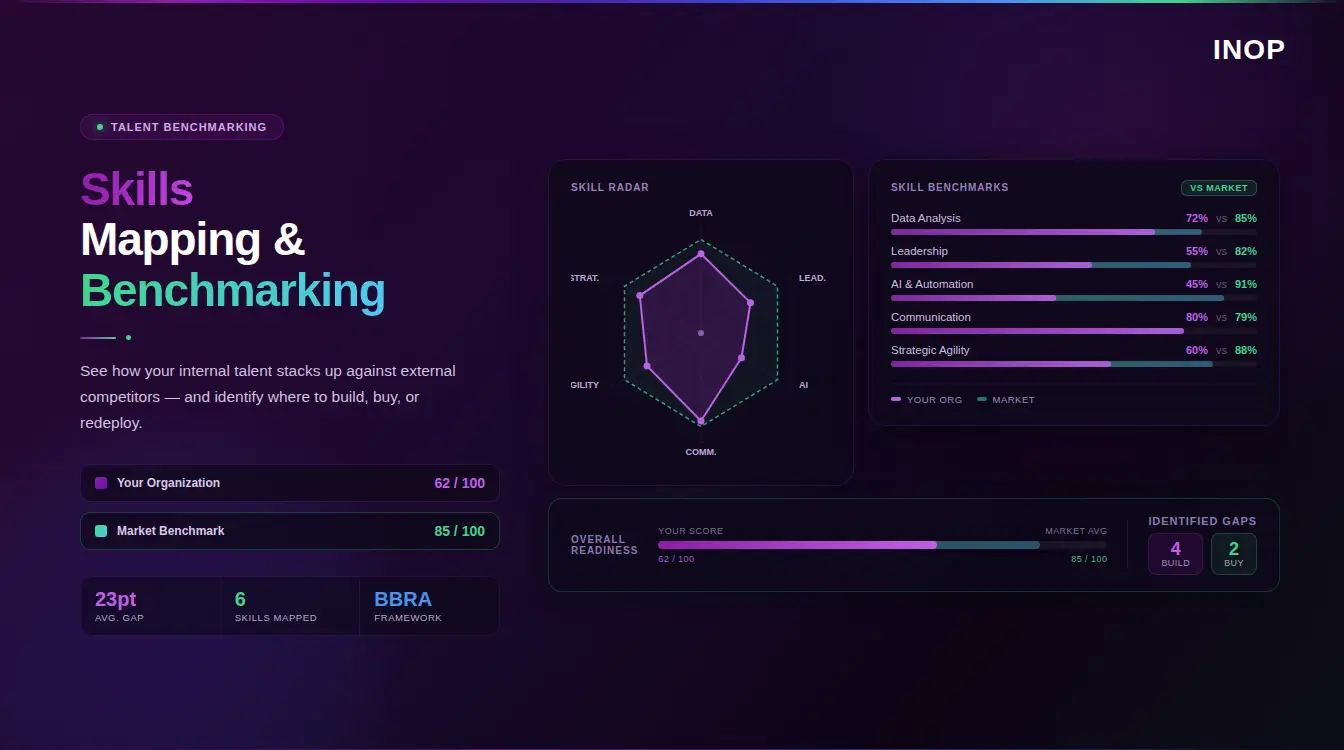
Building robust internal skills intelligence requires creating a dynamic skills taxonomy, a living database that maps every role, every employee, and every team to a structured set of capabilities. When this foundation exists, you can answer critical questions before making expensive external hires. This is closely tied to understanding the hidden talent within your organization, the skills and potential your employees possess that never appear on a job title or org chart.
Validating that taxonomy against real employee capabilities requires structured measurement. A skills assessment tool provides the objective data layer that turns a skills taxonomy from a theoretical framework into a live, verified picture of what your workforce can actually do.
Pillar 2: External Market Intelligence
The second pillar is the one most traditional HR functions completely ignore: what is happening outside your organization. External labor market intelligence involves tracking competitor hiring trends, monitoring the global supply and demand for specific skills, and benchmarking your compensation ranges against real-time market data.
Without external labor market data, your workforce plan is built on assumptions. With it, it is built on evidence. True skills intelligence maps these market demand signals directly to your specific internal skills taxonomy, showing you exactly which capabilities are emerging, stable, or declining in your exact sector.
Pillar 3: Predictive AI Modeling
The third pillar is where the real strategic power emerges. Predictive AI modeling takes the inputs from your internal skills database and your external market intelligence, and runs them through machine learning algorithms to forecast future scenarios.
This is the pillar that allows you to answer questions like: given our three-year product roadmap and the current external talent supply, what is our probability of successfully hiring the engineers we need at our current compensation bands? The model gives you the data you need to make a faster, better-informed decision.
How to Build a Talent Intelligence Database
A talent intelligence database is the foundational infrastructure that makes everything else possible. Without it, even the most sophisticated AI platform is working on sand. Building this database correctly is the single most consequential investment an HR technology leader can make.
Here is a step-by-step process for building a talent intelligence database that is both architecturally sound and practically deployable:
Step 1: Inventory your data sources. Map every system that holds people data: ATS, HRIS, LMS, performance management, compensation, and any third-party market feeds. Most organizations discover they have 6 to 12 systems holding people data with no shared identifier between them.
Step 2: Define your skills taxonomy. Build or adopt a structured skills ontology. Tag every role and every employee record against it. Prioritize the 50 to 100 skills most critical to your strategic roadmap first, then expand from there.
Step 3: Design the database architecture. Decide on a centralized talent data warehouse or a federated model with a unified API layer. Define entity relationships between employees, roles, skills, projects, and compensation bands before writing a single line of integration code.
Step 4: Ingest and clean historical data. Standardize job titles across your HRIS, normalize historical records, and eliminate duplicates. This step is the most time-consuming and the most commonly skipped. Skipping it guarantees poor prediction quality downstream.
Step 5: Connect external market data. Integrate labor market feeds for real-time salary benchmarking, competitor hiring signals, and skills supply-demand data for your target geographies. Without this layer, your talent intelligence database can only tell you about yourself.
Step 6: Establish governance protocols. Define data ownership, access permissions, update cadences, and a data steward responsible for ongoing hygiene. Set clear SLAs for how quickly new hires and skill updates propagate across the system.
Talent Intelligence Database Architecture
The architecture of your talent intelligence database determines how well the system scales, how quickly it updates, and how cleanly it integrates with downstream tools. There are two dominant patterns organizations choose between.
The centralized data warehouse model routes all people data into a single unified warehouse, typically built on Snowflake, BigQuery, or Redshift. This model gives you the cleanest analytics surface and the most consistent data governance, but requires meaningful engineering investment upfront.
The federated API model allows each source system to retain its own data while a middleware layer abstracts across them in real time. This is faster to deploy and requires less data migration, but introduces dependency on each source system’s API reliability.
The talent intelligence platform data model at the core of either architecture should contain five primary entity types: Employee (with a dynamic skills profile, performance history, tenure, and compensation), Role (with required skill clusters and market rate bands), Project (with required capabilities and past staffing patterns), Market Signal (external labor market data mapped to internal skill taxonomy), and Prediction (model outputs for flight risk, skills gap, hiring probability, and internal mobility fit).
Regardless of which architecture you choose, every talent intelligence database requires a canonical skills ontology as its semantic layer. Without a shared language for skills, data from different systems cannot be meaningfully joined.
Talent Intelligence Database Best Practices
Organizations that successfully build and maintain talent intelligence databases consistently follow these practices:
Standardize before you automate. Clean your job architecture and role taxonomy before connecting any intelligence layer. If your HRIS has 47 variations of Software Engineer, your skills gap analysis will be incoherent.
Treat your skills taxonomy as a living product. Assign a skills taxonomy owner, establish a quarterly review cadence, and budget for updates as new roles and technologies emerge. Skills that did not exist 18 months ago, for example prompt engineering or AI governance, are already critical in many organizations.
Build for real-time, not batch. Talent intelligence that runs on monthly data exports will always be a step behind. Design your integrations to push updates as events occur: new hire, promotion, course completion, departure.
Separate storage from serving. Your historical talent data warehouse and your live recommendation engine should not share the same infrastructure. Separate them to avoid performance degradation when running large predictive models.
Validate predictions against outcomes. Every quarter, compare the model’s flight risk scores from six months ago against actual resignations. This feedback loop is how your talent intelligence database improves over time.
Document your lineage. Every data field in your intelligence layer should have a clear lineage record: where it came from, how it was transformed, and when it was last updated. This is non-negotiable for building leadership trust in AI-generated recommendations.
Talent Intelligence Data Quality: Why Most Platforms Fail
The most common reason talent intelligence implementations underdeliver is not the AI model. It is not the platform vendor. It is the data going into the system. Garbage in, garbage out is not a cliche in this context, it is a root cause analysis of most failed deployments.
Understanding the four dimensions of talent intelligence data quality is the difference between a platform that earns C-suite confidence and one that gets quietly deprioritized after six months.
Completeness
A talent intelligence system is only as complete as the workforce it can see. In most large organizations, significant portions of the workforce are systematically underrepresented in the data: contingent workers and contractors who were never entered into the HRIS, employees in acquired companies whose records live in legacy systems that were never migrated, and high performers whose skills have evolved substantially since their original onboarding record was created.
Incomplete data does not just produce incomplete insights. It produces biased ones. If your flight risk model was trained on data that systematically excludes one category of employee, its predictions will be wrong in systematic, non-random ways.
The completeness benchmark for a production-ready talent intelligence database: 95% of active employees should have a skills profile with at least five verified skills attributes, and 90% of roles should have validated skills requirements tied to a shared taxonomy.
Freshness
Talent intelligence data has a shorter shelf life than most HR leaders realize. A skills profile that has not been updated in 18 months is likely wrong for a meaningful percentage of your workforce. Compensation data that comes from an annual survey published eight months ago is already outdated in high-demand markets. Job architecture that has not been reviewed since before a major product pivot may be mapping your workforce to strategic priorities that no longer exist.
Freshness standards for each data category: employee skills profiles should be updated at minimum quarterly; compensation benchmarks should refresh monthly for critical roles; external labor market feeds should update continuously or at most weekly.
Accuracy
Accurate talent intelligence data is not just numerically correct. It is semantically correct. When a performance review from 2022 gives an employee a 4.2 out of 5, that rating is only accurate if it was calibrated consistently across managers and departments. When an ATS records a candidate as “rejected,” that record is only accurate if someone captured why, not just that the outcome was a no-hire.
The most damaging accuracy problem in talent intelligence is job title inconsistency. When your HRIS contains 34 variations of “Product Manager” across divisions, every analytical model built on that data will produce outputs that are technically precise and substantively misleading. Job architecture standardization is an accuracy problem before it is a technology problem.
Interpretability
The fourth dimension is the one most often overlooked. Even data that is complete, fresh, and accurate can fail if the humans using the intelligence cannot understand what it means or trust how it was derived.
When a predictive flight risk model assigns an employee a score of 0.73, does the manager looking at that output understand what drove the score? Do they know what confidence interval surrounds it? Do they know whether the model has been validated against actual outcomes in their specific business unit?
Interpretability is a data quality problem because unexplained outputs are effectively unusable outputs. The organizations that get the most value from talent intelligence data invest as much in translating model outputs into plain language as they do in the models themselves.
Talent Intelligence Decision Making
Talent intelligence decision making represents a fundamental shift in how HR leaders allocate their most important resource: their attention. Instead of reacting to data after decisions have already been made poorly, intelligence-driven HR leaders use structured decision frameworks that bring data into the conversation before commitments are made.
There are four categories of talent intelligence decisions that most organizations need to formalize.
Hiring Decisions
Traditional hiring decisions are made by triangulating a resume, an interview scorecard, and a gut feeling. Talent intelligence-driven hiring decisions add two more inputs: an objective skills match score against a validated role profile, and an external market signal that confirms or challenges assumptions about candidate supply.
When these data points conflict with intuition, the right response is not to override the data but to investigate the gap. Why does the AI score a candidate highly when the hiring manager is skeptical? Often, the answer reveals a bias in the hiring manager’s mental model that, once surfaced, leads to better decisions.
Workforce Planning Decisions
The most consequential area for talent intelligence decision making is strategic workforce planning. When a company is deciding whether to build, buy, borrow, or automate a capability, the right answer depends heavily on talent intelligence data: what does the internal skills inventory look like, what is the external supply of that skill, what does it cost to hire versus train, and what is the timeline implication of each option?
Organizations with mature talent intelligence practices have integrated these data inputs into their annual planning cycles alongside financial forecasts, making talent supply a first-class variable in strategic decision-making rather than an afterthought.
Retention Decisions
Predictive flight risk scores give managers a window they have never had before: the ability to intervene before an employee decides to leave. But the decision to intervene, and how, still requires human judgment. Talent intelligence decision making in retention contexts means understanding which interventions are most effective for which employee profiles, and having the managerial courage to have difficult conversations before they become necessary.
Internal Mobility Decisions
Skills-based internal mobility matching produces candidate lists that hiring managers and employees often find surprising. An employee flagged as a strong internal candidate for a role they never applied for creates a decision point: does the organization proactively surface that opportunity, or wait for the employee to discover it? The data is clear: proactive surfacing produces significantly higher conversion rates and measurably better outcomes for both the employee and the organization.
Talent Intelligence Analytics: Turning Data into Strategy
Talent intelligence analytics refers to the specific analytical models and measurement frameworks that translate raw workforce data into decision-ready strategic insight. It is distinct from general HR reporting in that it is predictive, prescriptive, and connected to business outcomes rather than purely descriptive.
The maturity model for talent intelligence analytics moves through four stages:
Stage 1 — Descriptive analytics: What happened? Headcount reports, turnover rates, time-to-fill by department. Most HR functions operate here today.
Stage 2 — Diagnostic analytics: Why did it happen? Analyzing which factors correlate with high attrition in specific teams, or why certain hiring pipelines consistently produce lower-performing hires.
Stage 3 — Predictive analytics: What will happen? Flight risk scores, skills gap forecasts, workforce supply modeling for future headcount plans.
Stage 4 — Prescriptive analytics: What should we do? AI-generated recommendations for specific retention interventions, compensation adjustments, or internal mobility placements.
Most organizations using talent intelligence platforms today are operating at Stage 2 or 3. Stage 4, where the system generates specific, actionable recommendations that managers can execute immediately, is where the greatest value exists and where the most sophisticated platforms are now competing.
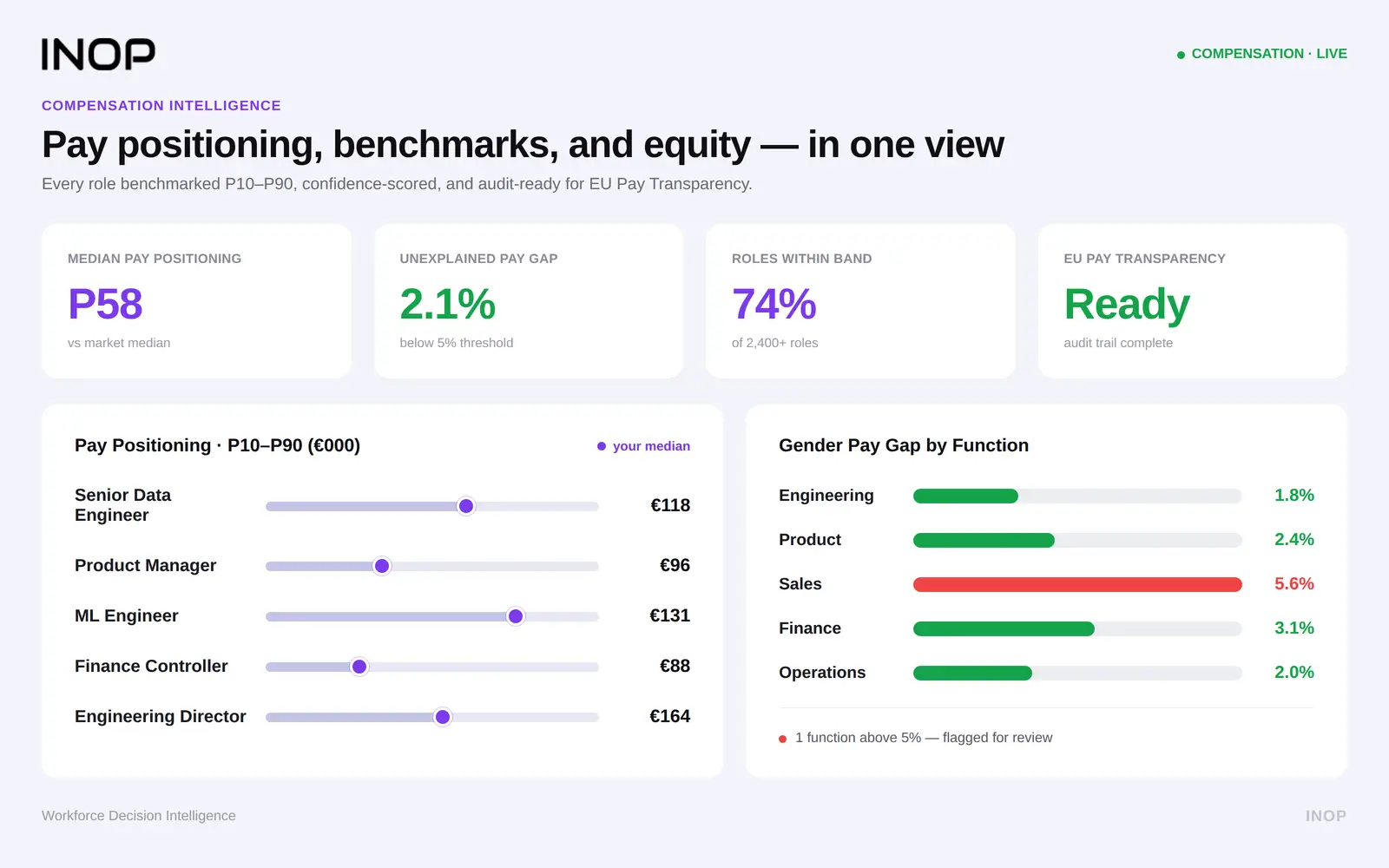
Key talent intelligence analytics modules that CHROs and VPs of Talent Acquisition should expect from any enterprise-grade platform include: skills gap analysis by department and business unit, predictive retention scoring with driver attribution, compensation equity and market positioning analysis, internal mobility opportunity matching, hiring funnel conversion optimization, and workforce scenario modeling for strategic planning.
How to Use AI for Talent Intelligence
Artificial intelligence is the engine that makes talent intelligence possible at scale. But knowing how to use AI for talent intelligence effectively requires understanding which problems AI solves well and which still require human judgment.
Where AI Adds the Most Value
Skills inference and taxonomy mapping. AI can infer skills from unstructured data sources including job postings, resumes, performance reviews, project descriptions, and course completions, mapping them to a standardized taxonomy far faster and more consistently than any human team. This is the foundational use case and the one with the clearest, most immediate ROI.
Pattern recognition across large datasets. AI can identify correlations that no human analyst would detect manually. The combination of factors that predicts flight risk typically includes 15 to 20 interacting variables. Statistical models handle this complexity far better than human intuition.
Real-time external signal processing. AI can continuously monitor thousands of external data sources including job postings, compensation surveys, and academic publications, translating those signals into intelligence about skill supply, compensation trends, and competitor talent strategies.
Where Human Judgment Remains Essential
AI does not replace the decision. It improves the inputs to the decision. When a predictive model flags an employee as a flight risk, a manager still needs to decide how to have that conversation and what to offer. When a skills gap analysis reveals that a critical capability is unavailable in the external market at current compensation bands, a CHRO still needs to decide whether to raise bands, invest in training, or revise the product roadmap.
The most effective organizations using AI for talent intelligence have learned to treat AI recommendations as a highly informed colleague, one worth listening to carefully, but not one that overrides human accountability for outcomes.
Transforming the HR Lifecycle with Talent Intelligence
How to Use Talent Intelligence for Hiring
Traditional recruiting is still heavily resume-dependent. AI-powered talent acquisition moves beyond the resume by analyzing candidates against a rich skills profile, including adjacent capabilities, learning velocity, and demonstrated outcomes. Modern talent intelligence platforms identify high-potential matches that keyword-filtered ATS systems routinely miss.
To use talent intelligence for hiring effectively, organizations need to first build a validated skills profile for each role rather than relying on a keyword list. Second, integrate the intelligence platform with their ATS so that scoring happens automatically as candidates enter the pipeline. Third, train hiring managers to use skill match scores as one input among several rather than a binary filter. Fourth, track 12-month performance outcomes for AI-matched hires versus traditionally sourced hires to validate and refine the model over time.
Organizations using skills-based hiring report a 40% increase in the quality of shortlists and a 25 to 30% reduction in time-to-fill for technical roles.
Precision Internal Mobility
Every time a company fills an open role externally, it pays a price that extends far beyond the recruiter’s fee. Research from the Society for Human Resource Management estimates that replacing an employee costs between 50% and 200% of their annual salary, depending on role complexity.
Talent intelligence enables precision internal mobility, systematically matching employees to open roles, projects, or stretch assignments based on their current skills profile and development trajectory. When an employee whose skills map shows 80% overlap with a product manager role is automatically surfaced as an internal candidate, the cost of that hire drops dramatically and that employee’s engagement improves because they see a visible growth path inside the organization.
Proactive Retention: Helping Managers Have Conversations with Flight-Risk Employees
The most expensive signal in HR is the two-week notice. By the time an employee hands it in, the decision to leave was made weeks or months earlier. Talent intelligence solutions change this dynamic by generating behavioral flight risk scores that give managers the data they need to intervene proactively.
The pattern data that feeds these models includes project participation changes, collaboration network shifts, internal application activity, performance trajectory, time since last promotion, and compensation positioning relative to market. When these factors combine into a statistically significant pattern, the system surfaces a flag that enables the manager to have a direct, meaningful conversation before the employee begins interviewing elsewhere.
The most effective talent intelligence solutions for helping managers have retention conversations with flight-risk employees proactively include three components: a risk score with clear driver attribution so the manager understands why the employee is flagged, a guided conversation framework that gives managers specific talking points without making the conversation feel scripted, and a follow-up tracking mechanism that records what was discussed and monitors whether risk indicators change over the following 90 days.
Platforms leveraging this type of predictive modeling have helped organizations reduce voluntary attrition by 15 to 20% by triggering early conversations with at-risk high performers before those employees begin interviewing elsewhere.
Strategic Workforce Planning
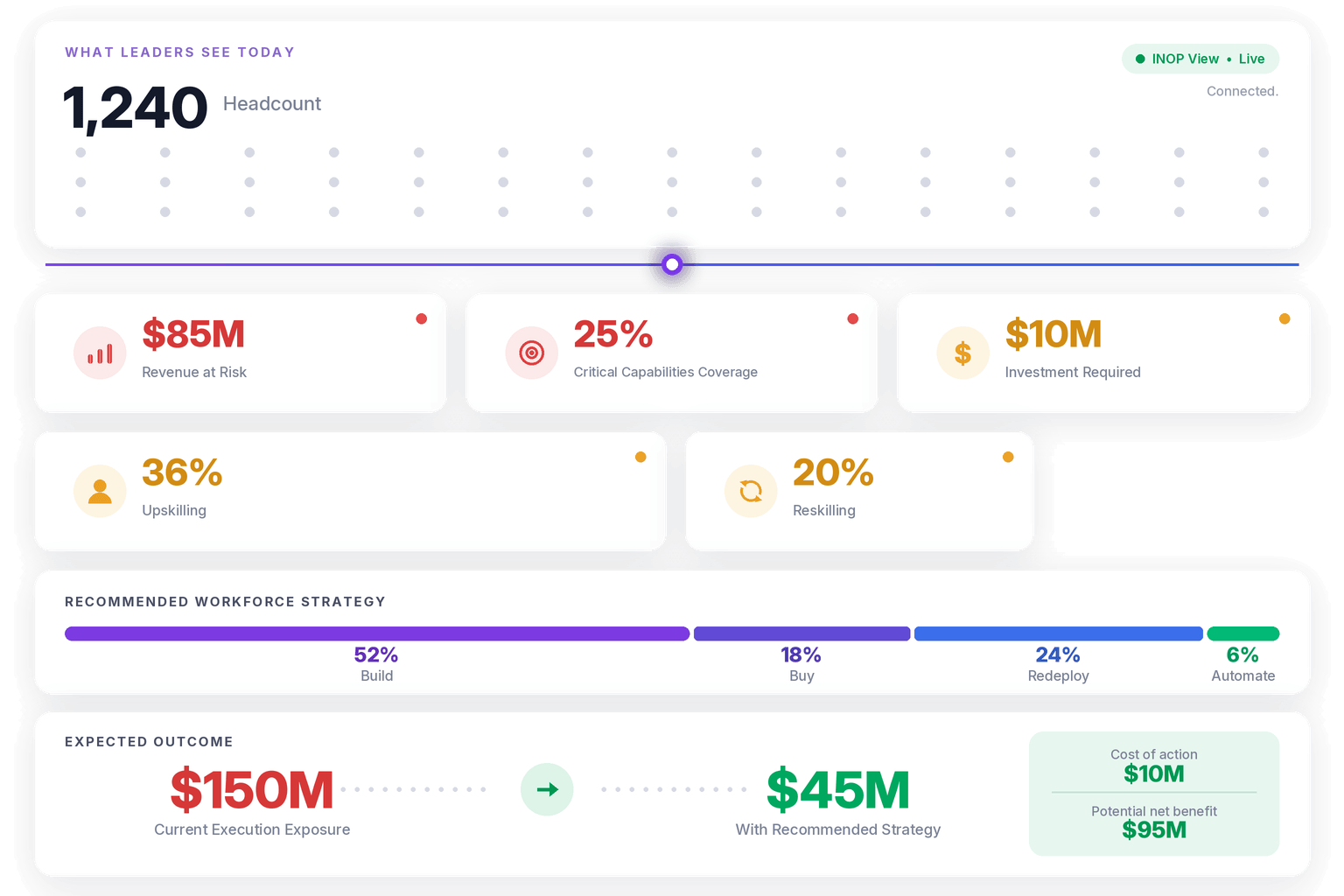
The most sophisticated application of talent intelligence is aligning human capital decisions with multi-year financial and strategic goals. Talent intelligence bridges the gap between financial planning and workforce planning, transforming HR from a cost center into a genuine strategic function. When the CFO is building a three-year plan that assumes 30% revenue growth from a new product line, the CHRO needs to be at the same table, armed with data that answers whether the organization has the talent to execute that strategy and, if not, what it will cost to acquire it.
How to Integrate Talent Intelligence with Your HRIS
Integrating talent intelligence with your HRIS is the technical foundation on which real-time people insights depend. Without a clean, bidirectional integration, your talent intelligence platform will be operating on stale data, and stale data produces stale predictions.
Most enterprise HRIS platforms including Workday, SAP SuccessFactors, and Oracle HCM offer API connectivity that enables real-time data exchange. The integration between a talent intelligence platform and an HRIS should accomplish three things.
Real-time employee record sync. Every new hire, promotion, compensation change, and departure should propagate to the intelligence layer within hours, not at the next monthly batch export. Any lag in this sync creates a gap between the model’s understanding of your workforce and reality.
Bidirectional skills data flow. When an employee completes a certification in your LMS or a manager updates a skills profile in the HRIS, that update should automatically flow into the talent intelligence platform’s skills taxonomy. Equally, when the intelligence platform infers a new skill from a project assignment or performance review, that inference should surface back to the HRIS for verification.
Triggered workflow automation. The most mature HRIS integrations allow talent intelligence signals to trigger automated workflows. A flight risk score crossing a threshold might automatically create a task for the employee’s manager in the HRIS. An internal mobility match might automatically notify the employee through the HRIS portal.
When evaluating talent intelligence platforms for HRIS integration, ask three specific questions: What is the latency between an HRIS event and its reflection in the intelligence layer? Does the platform support bidirectional skill updates or is data flow unidirectional? And what happens to data integrity when the HRIS is updated independently of the intelligence platform?
Building Your Talent Intelligence Tech Stack
A well-architected talent intelligence tech stack has three distinct layers. Organizations that buy ten disconnected point solutions consistently produce data fragmentation rather than intelligence.
The Data Foundation Layer
Your ATS and HRIS serve as the raw data infrastructure. Systems like Workday, SAP SuccessFactors, and Oracle HCM collect and store the transactional HR data that forms the raw material of intelligence. On their own, these systems are excellent record-keepers. They are not designed to generate strategic insight.
The Intelligence Layer
This is the critical layer that most organizations underinvest in. You need an AI-powered strategic workforce decision intelligence platform that sits on top of your fragmented data sources and synthesizes them into clear, actionable recommendations for the C-suite. The right platform ingests data from your ATS, HRIS, LMS, and external labor market feeds, and applies machine learning to surface patterns no human analyst could detect manually.
When evaluating platforms at this layer, ask three questions: How do they handle data from multiple source systems? What is the underlying methodology behind their predictive models? And how are insights surfaced, through static reports or dynamic, interactive decision tools?
Talent Intelligence Tools: What to Evaluate
The talent intelligence tools market has matured significantly since 2022. Enterprise buyers in 2026 are evaluating platforms across five capability dimensions:
Skills taxonomy breadth and update frequency. How many skills does the platform’s ontology cover, and how often is it updated to reflect emerging capabilities?
External data coverage. Which geographies, industries, and role types does the platform’s external labor market data cover with statistical reliability?
Predictive model transparency. Can the platform explain why it made a specific recommendation, or does it operate as a black box? Explainability is increasingly a procurement requirement.
HRIS and ATS integration depth. Does the platform offer pre-built connectors to your existing systems, or does every integration require custom engineering?
Scenario modeling capability. Can HR leaders run what-if analyses, for example what happens to our skills gap if we grow the product team by 40% while attrition holds at current rates?
The Talent Intelligence Platform Data Model
Understanding the underlying data model of any talent intelligence platform you are evaluating is critical to predicting whether it will produce accurate, reliable outputs in your specific context. The most robust talent intelligence platform data models are built around five core entities: the employee node with a dynamic skills profile updated continuously from multiple source signals, the role node with validated skills requirements and market compensation bands, the skill node with internal prevalence data and external supply-demand signals, the prediction node linking input factors to output scores with confidence intervals and driver attribution, and the market signal node mapping real-time external data to the internal taxonomy.
Platforms that treat skills as a flat list without a structured ontology and without market data mapped to internal roles will produce skills gap analyses that are technically accurate but strategically meaningless.
How Large Organizations Use Talent Intelligence Platforms
The adoption patterns among large organizations using talent intelligence platforms reveal a clear maturation curve. Early adopters, primarily Fortune 500 companies with dedicated people analytics teams, used these platforms primarily for recruiting efficiency. The second wave extended into retention and workforce planning. In 2026, the most sophisticated users are integrating talent intelligence directly into their capital allocation and M&A due diligence processes.
Typical use cases among organizations with 1,000 or more employees include running quarterly skills gap analyses against a rolling three-year strategic plan, using flight risk modeling to generate manager action lists reviewed in monthly HR business partner cycles, integrating compensation intelligence into every offer approval workflow so recruiters always have a real-time market position reference, building internal talent marketplaces that surface lateral move opportunities to employees whose skills match open projects, and using workforce scenario models to evaluate the talent implications of potential acquisitions before deals close.
For mid-market organizations with 250 to 1,000 employees, the most accessible entry points are skills-based hiring, external compensation benchmarking, and predictive retention, all of which deliver measurable ROI within six months and do not require a dedicated data science team to operate.
Overcoming the Real Implementation Hurdles
Implementing talent intelligence is not purely a technology problem. The three most common failure points are data quality, ethical governance, and change management.
The Data Hygiene Challenge
AI trained on bad data produces bad strategy. If your job architecture has 47 different variations of Software Engineer across your HRIS, your skills taxonomy will be incoherent and your skills gap analysis will be meaningless. Before activating any intelligence layer, organizations must invest in cleaning their job architecture, standardizing role taxonomies, normalizing historical data, and establishing data governance protocols to prevent future fragmentation. This work is unsexy. It is also non-negotiable.
Balancing Analytics Power with Employee Privacy
The predictive capability of talent intelligence creates a legitimate ethical tension. Using behavioral data to identify flight-risk employees is valuable from a retention perspective, but it also raises serious questions about consent, transparency, and the potential for surveillance. Leading organizations navigate this by establishing clear AI ethics frameworks, anonymizing individual-level data at the aggregation layer, and being transparent with employees about what data is being collected and how it is used. The goal is to use intelligence to create better outcomes for employees, not to monitor them. That distinction is not just ethical; it is essential for maintaining the employee trust that makes your engagement data meaningful in the first place.
Getting Humans to Trust the Algorithm
Experienced recruiters and hiring managers have spent years developing their own intuitions about talent. The most effective change management approach is not to position AI as a replacement for human judgment, but as an enhancement of it. When a recruiting team sees that candidates flagged by the AI as high-potential consistently outperform those sourced through traditional methods, trust builds organically. Building that proof of concept by running controlled comparisons and sharing outcome data transparently is often more effective than any top-down mandate.
Measuring the ROI of Talent Intelligence
For talent intelligence to receive C-suite support, it must be expressed in financial terms. Here are the four primary ROI levers and what organizations typically observe:
| ROI Lever | Typical Impact | Timeline | Primary Metric |
|---|---|---|---|
| Reduced Time-to-Fill | 20–45% faster | 3–6 months | Days-to-offer |
| Compensation Optimization | 5–12% reduction in offer variance | Immediate | Offer acceptance rate |
| Voluntary Attrition Reduction | 15–20% fewer exits | 12–18 months | Regrettable attrition rate |
| Quality-of-Hire Improvement | 15–25% performance advantage | 12 months | 90-day and 12-month performance scores |
For a company with 500 employees and an average salary of $90,000, reducing annual voluntary attrition by just 2 percentage points saves approximately $1.8 million in replacement costs. Over time, the quality premium from AI-matched hires compounds into measurable business outcomes that extend well beyond the HR function.
Conclusion: Talent Intelligence Data Is the New Baseline
Talent intelligence is no longer a luxury reserved for enterprises with dedicated data science teams and eight-figure HR technology budgets. In 2026, it is the baseline requirement for any organization serious about neutralizing execution risk and hitting its strategic goals.
The path forward is clear: start with your data foundation, build a talent intelligence database with a clean skills taxonomy, invest in an intelligence layer that unifies your fragmented HR data, establish ethical guardrails that protect employee trust, and measure everything against financial outcomes.
The organizations that delay will continue making slow, expensive, gut-based decisions while their competitors leverage talent intelligence data, predictive modeling, and real-time market signals to move faster, hire smarter, and retain better.
Frequently Asked Questions About Talent Intelligence
What is the difference between talent intelligence and people analytics?
People analytics focuses on analyzing historical HR data to understand what has already happened, turnover rates, hiring volumes, engagement trends. Talent intelligence goes further by combining that internal data with external labor market signals and applying predictive AI to forecast future workforce scenarios and guide proactive decision-making.
How much does talent intelligence platforms typically cost?
To survive in 2030, you must focus on capabilities that artificial intelligence cannot easily replicate. The most essential skills include digital literacy, advanced emotional intelligence, adaptability, and ethical decision-making. These abilities help individuals thrive in a tech-driven yet human-centered work environment.
Is talent intelligence only suitable for large enterprises?
Not anymore. While early talent intelligence platforms were designed primarily for Fortune 500 companies, the market has matured significantly. Mid-market organizations with as few as 500 employees can now access scaled versions of these capabilities, particularly in the areas of skills mapping, external market benchmarking, and predictive retention modeling.
How do you address employee privacy concerns with predictive HR analytics?
Best practice involves three steps: establish a clear AI ethics policy that defines what data will be collected, how it will be used, and who can access individual-level insights; anonymize data at the aggregation layer so that predictive insights are surfaced at the team or cohort level rather than naming individual employees in reports; and communicate transparently with employees about what the system does and does not do. Framing predictive retention analytics as a tool to identify and resolve systemic issues (rather than a surveillance mechanism) is essential for maintaining trust.
How long does it take to see ROI from a talent intelligence implementation?
Most organizations begin to see measurable improvements in time-to-fill and candidate quality within three to six months of activation. Retention and workforce planning ROI typically becomes measurable at the 12-month mark, once the predictive models have had sufficient time to validate their outputs against real outcomes. Full strategic ROI (where talent intelligence is genuinely informing C-suite decision-making) generally requires 18 to 24 months of consistent use and iteration.
What skills does an HR team need to operate talent intelligence platforms effectively?
The most important skill is not technical, it is interpretive. HR teams need practitioners who can read a predictive model’s output, understand its confidence intervals and limitations, and translate its recommendations into clear business language for senior stakeholders. On the technical side, basic data literacy, familiarity with HRIS and ATS integrations, and an understanding of skills taxonomy design are the most commonly required competencies. Data science expertise is valuable but typically sits within the platform vendor’s team rather than the client’s.
Book a Demo
Make confident workforce decisions that support strategy and value creation.