A skill gap assessment measures the difference between the skills a role currently requires and the skills the people in that role can actually demonstrate. Most organizations run one every year. Far fewer can say the result reflects reality, because most assessment methods still lean on self-report and manager opinion, two sources research consistently shows distort the picture rather than clarify it.
This guide walks through the assessment methods organizations actually use, where each one breaks down, and how to structure a skill gap assessment around verified data instead.
What a Skill Gap Assessment Actually Measures
A skill gap assessment compares two things at the role level: required proficiency and demonstrated proficiency. The gap between them is the number that should drive training budget, hiring decisions, and internal mobility, not a rounded impression from a performance review. The quality of that number depends entirely on how the underlying data was collected, and this is where most assessments quietly go wrong before the analysis even starts.Common Skill Gap Assessment Methods and Where Each One Breaks Down
Most organizations combine a few of the same methods. Each one has a specific, well documented failure mode.Self-Assessment and Manager Rating Scales
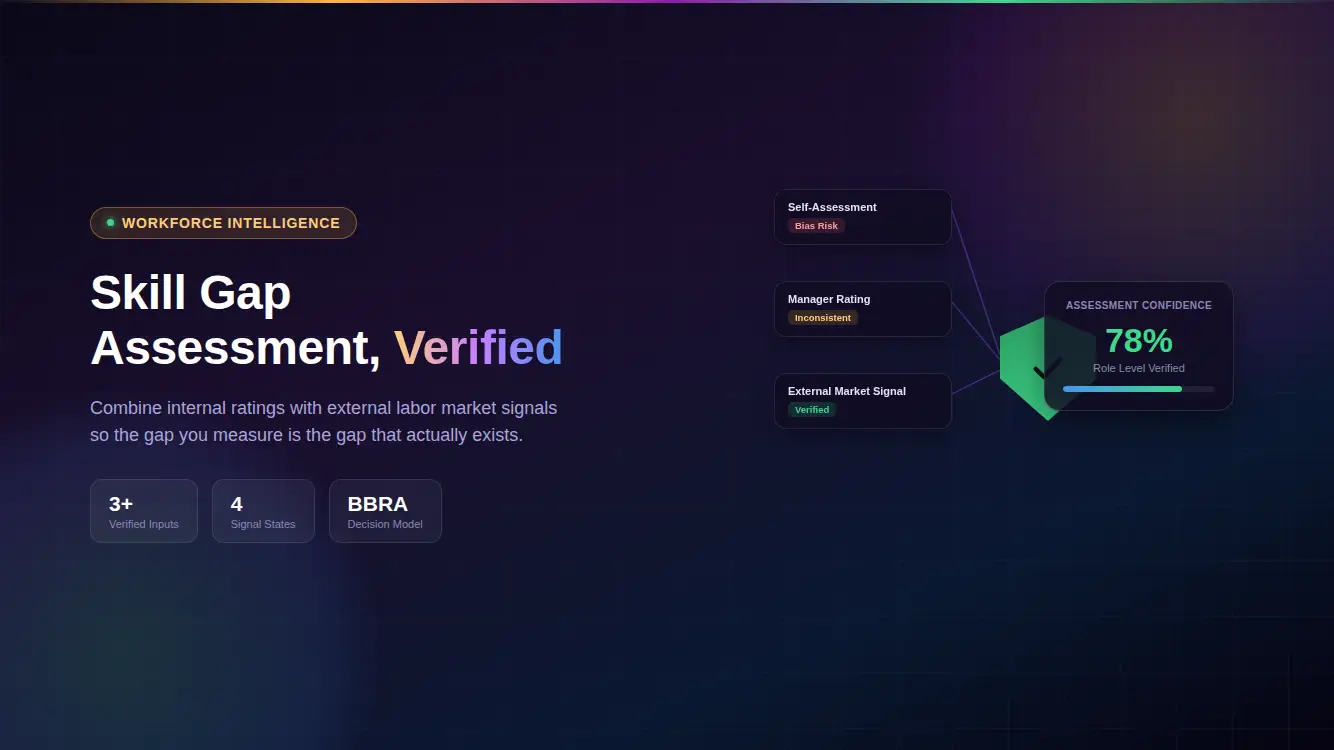
Rating employees on a numeric proficiency scale is the most common assessment method in use, and it is also the least reliable on its own. Employees tend to overrate skills they use daily and underrate ones they rarely apply, while managers vary widely in how generously they score, a pattern that produces workforce data that looks precise and is actually inconsistent from one team to the next. Combining multiple input sources, including performance data and demonstrated work output rather than opinion alone, is a step in the right direction, though even organizations doing this still often stop short of external verification, as recent research on skills identification methods has noted.Skills Inventories and Static Frameworks
A skills inventory built once and referenced for years looks efficient, but competency frameworks calibrated for the roles of a few years ago are a poor instrument for assessing a workforce operating today, a shift documented in recent analysis on skills gap identification. A static framework cannot register a skill that emerged or lost relevance after it was built, which means the assessment quietly drifts out of date the moment it stops being updated.Quantitative Scoring Models
Scoring employees numerically against a defined skill list, then aggregating the results into an organizational gap percentage, gives leadership a clean number to report, according to recent skill gap assessment research. The method works well for individual development conversations. It works less well at scale, because the same self-report and manager bias problems get baked into every input feeding the aggregate score, which means a clean-looking number can still be built on unreliable data.See how INOP verifies skill gap assessment data against external labor market signals. Book a demo to walk through a live assessment for your workforce.
How to Run a Skill Gap Assessment on Verified Data
The fix is not to abandon self-report and manager input entirely. It is to stop treating them as the primary source of truth and start using them as one input among several verified data points.Assess at the Role Level, Not the Title Level
Two employees with the same job title can carry meaningfully different capability. A skill gap assessment that measures at the title level averages away the exact variation the assessment exists to find. Assessing at the role and task level, with proficiency benchmarks specific to what that role actually requires now, produces a far more actionable picture.Cross-Check Internal Ratings Against External Labor Market Signals
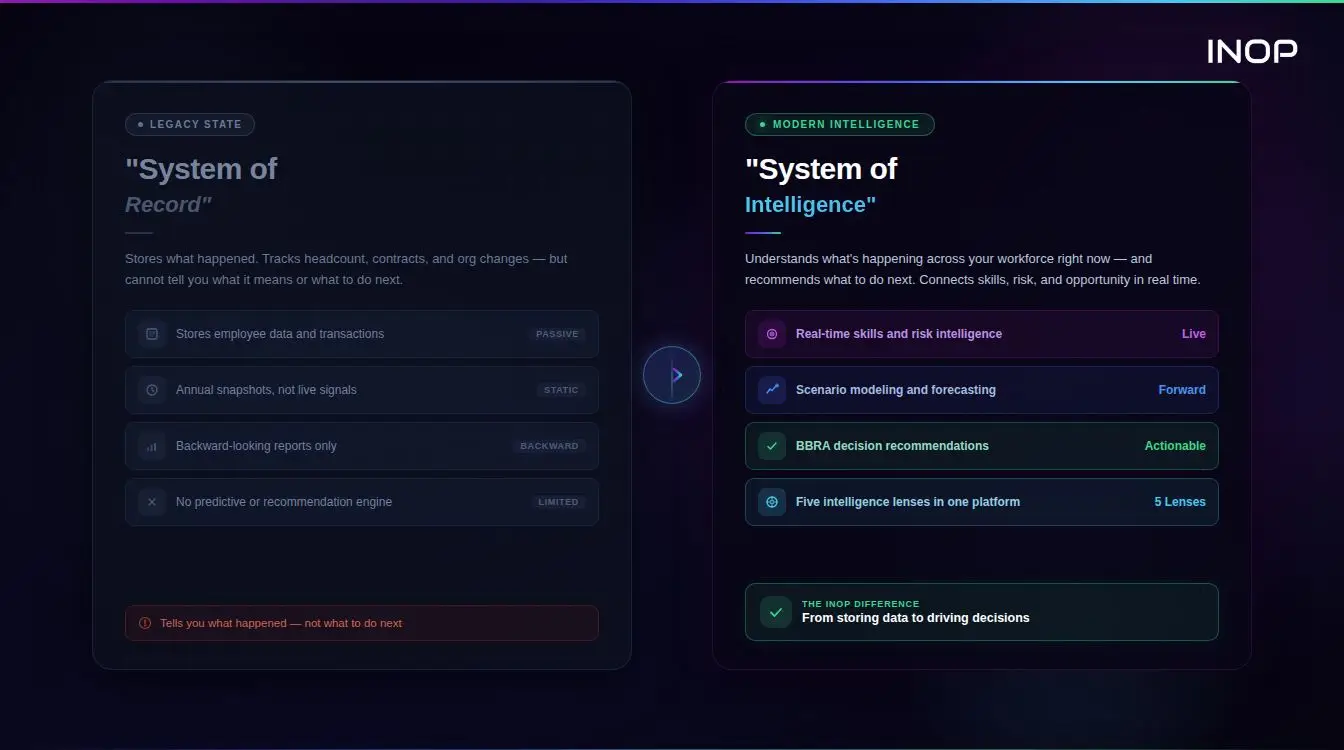
An internal skills inventory only tells you what your organization believes it has. It says nothing about whether that skill is still valuable outside your walls. skills intelligence platform addresses this directly by mapping external demand signals, classified as emerging, in demand, stable, or declining, against your existing skills taxonomy, so a skill gap assessment reflects current market reality rather than an internal framework that has quietly gone stale. This is also where bench strength problems tend to surface, since large organizations can hold hundreds of people with a given title yet still struggle to assemble a team with the exact combination of current, verified skills a project requires, a gap explored in recent enterprise skills intelligence research.Model the Response Before Committing Budget
An assessment result is not a plan. Once a gap is confirmed, it needs to be run through a decision model that weighs the cost and speed of building the capability internally against redeploying someone with adjacent skills, hiring externally, or automating the underlying task, rather than defaulting to training because that is the option every learning and development team already has in place.Applying INOP’s Five Intelligence Lenses to Skill Gap Assessment
A skill gap rarely stays contained to a training question, which is why INOP evaluates every assessment result through five intelligence lenses rather than a single proficiency score.- Strategy: Does this gap block a specific business priority, or is it being flagged because it was easy to measure?
- Finance: What does closing the gap cost through each available pathway, and what does leaving it open cost?
- People: Who already holds adjacent capability, and where does the gap concentrate risk if it stays unaddressed?
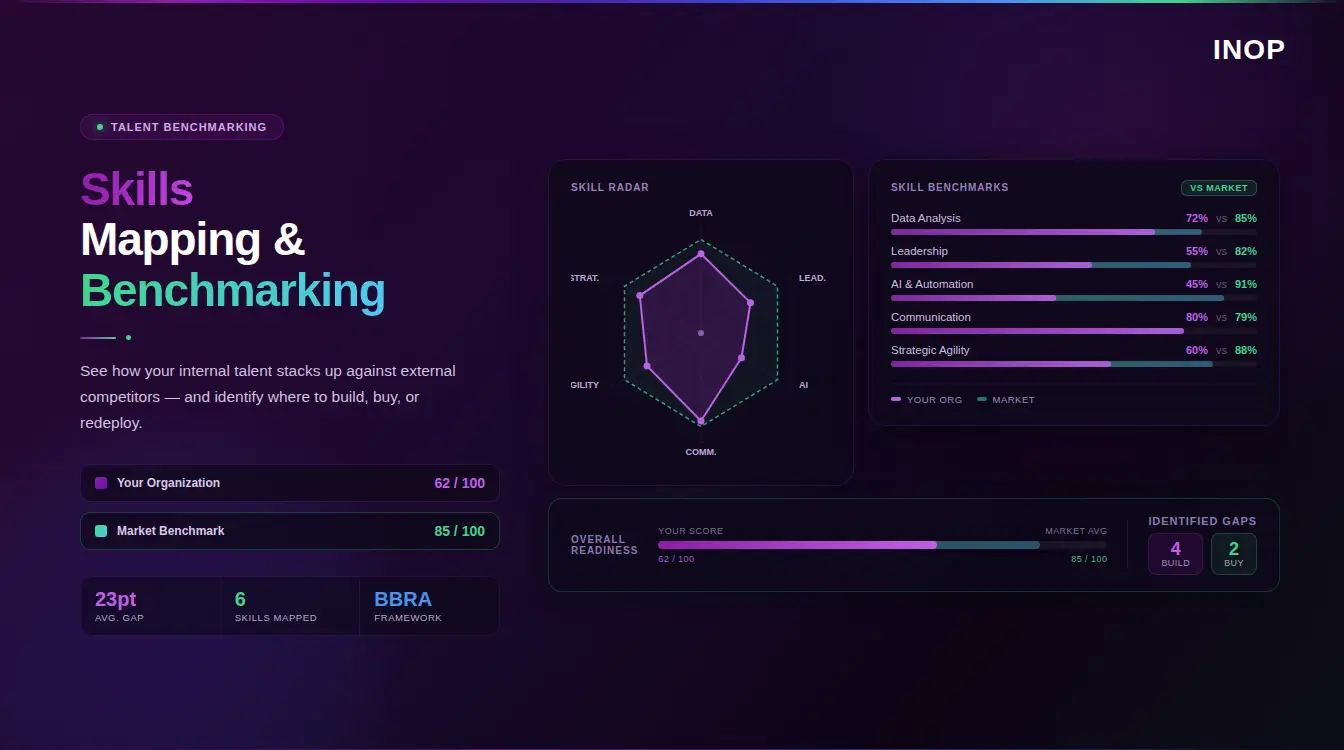
- Market: Does external labor market data confirm this skill is still worth investing in, or is demand for it already declining?
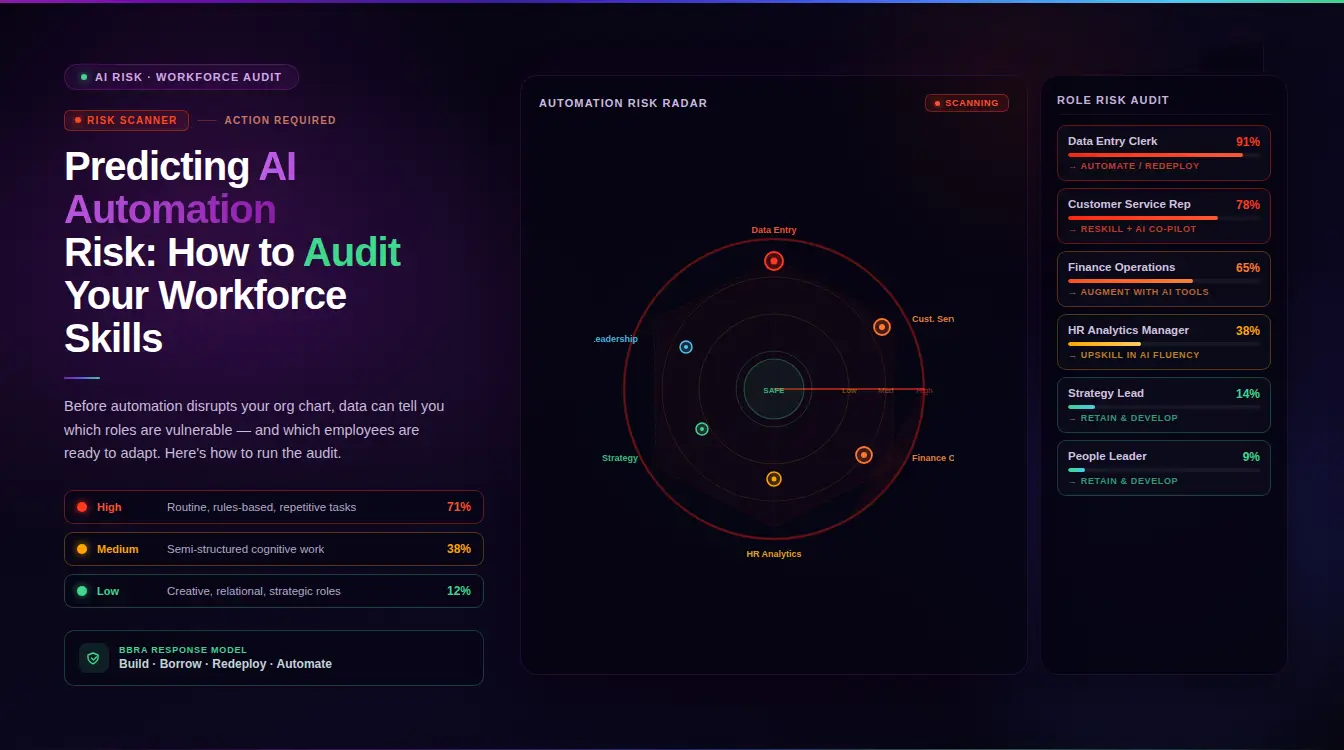
- AI and Automation: Could the task behind the gap be automated instead of staffed, changing what the assessment result actually calls for?
The BBRA Framework for Acting on Assessment Results
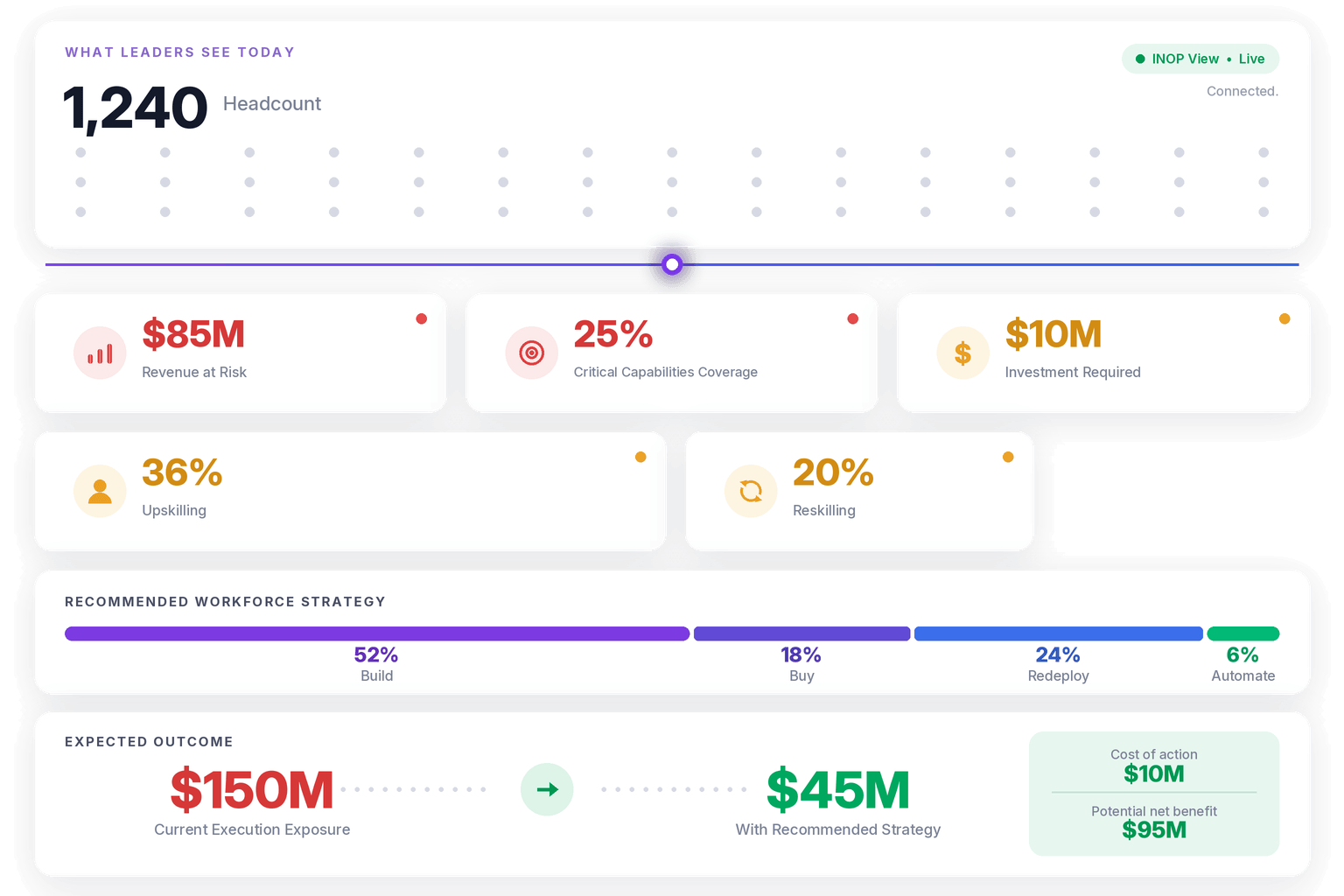
Once a skill gap assessment produces a verified result, INOP’s proprietary BBRA framework models four intervention pathways, Build, Buy, Redeploy, and Automate, against financial tradeoffs across four time horizons: thirty days, one hundred eighty days, one year, and three years. This is the step most skill gap assessments never reach. A gap gets identified, a training course gets assigned, and nobody compares that path against what redeployment or automation would have cost over the same time horizon. Running every confirmed gap through all four pathways turns an assessment result into an actual decision, with the tradeoffs visible before budget is committed.Want to see BBRA modeled against a real skill gap in your organization? Book a demo and INOP will walk through the pathway comparison live.