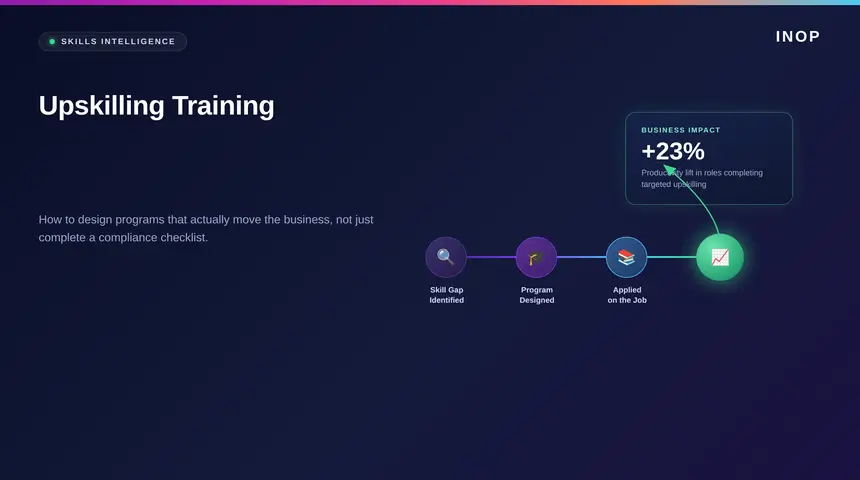
Upskilling training is the practice of deepening an employee’s capability within their current role, closing the gap between what they can do today and what the role increasingly requires. Most organizations already run some version of it. Far fewer can point to a business outcome, revenue, retention, productivity, that their upskilling training actually moved, because most programs get measured by completion rate rather than by whether the underlying capability gap actually closed.
This guide covers what separates upskilling training that shows up in the numbers from a course catalog that gets checked off and forgotten, the design principles that connect training to business outcomes, and how to decide when upskilling is actually the right investment compared to the alternatives.
What Upskilling Training Actually Requires
Upskilling training is not simply assigning courses. It requires starting from a specific, verified capability gap tied to a role, delivering training aimed directly at that gap, and confirming afterward that the gap actually closed. Skipping any one of those three steps produces activity, not upskilling. An organization can run an enormous volume of training and still have no idea whether it moved the business, because volume and completion rate measure participation, not capability change.
Why Most Upskilling Training Fails to Show ROI
The pattern behind weak upskilling ROI is consistent across organizations, and it rarely comes down to the quality of the content itself.
Measuring Completion Instead of Business Impact
Most learning and development functions can report course completion rates in detail and struggle to answer a much simpler question: did this training change anything the business cares about. Organizations with poor learning cultures see turnover in the range of 18 to 24 percent, while organizations with strong upskilling report turnover closer to 11 to 14 percent, a gap worth millions in avoided replacement cost, according to recent research on enterprise upskilling ROI. The same research found that companies using robust measurement frameworks, tracking both leading indicators like skill assessment scores and lagging indicators like business KPIs, see 2.3 times higher return than organizations tracking completion metrics alone.
The underlying problem is that completion rate and business impact are simply measuring different things, and treating them as interchangeable is where most upskilling training reporting goes wrong. A completion rate tells you an employee sat through a course or finished a module. It says nothing about whether that employee can now perform the task the training was meant to prepare them for, whether that capability shows up in their actual work output, or whether the business problem the training was funded to solve actually improved. An executive asking whether a training investment paid off is asking about the third thing. Most learning and development reporting only has an answer for the first.
Generic Programs Instead of Targeted Skill Gaps
A course catalog assigned broadly across the organization spreads training budget thin across employees who did not have the underlying gap in the first place, while under-serving the specific roles where the gap is most costly. Upskilling training that starts from a verified, role-level gap rather than a generic curriculum consistently produces a clearer line back to business outcomes, since the training and the business problem it is meant to solve are the same thing from the start.
See how INOP identifies exactly which roles need upskilling training before you spend the budget. Book a demo to walk through a live capability map for your organization.
What Effective Upskilling Training Programs Do Differently
A consistent design pattern separates upskilling training that moves the business from training that produces a completion certificate and nothing measurable afterward.
Start From Business Goals, Not a Course Catalog
Effective programs start with a different question than most learning and development teams ask. Instead of “what training do we need,” the better starting question is “what business outcome are we trying to achieve, and what capability gap is currently blocking it.” Working backward from a specific business priority, identifying the exact skills required to hit it, and then designing training around that gap produces upskilling that is far more likely to show up in a result the business actually notices.
Establish a Baseline Before Training Begins
Without documenting current performance before training starts, whether that is time-to-productivity for a role, a specific business KPI, or a technology adoption rate, there is no way to credibly measure what changed afterward. A baseline is not optional overhead. It is the only thing that turns a before-and-after comparison from a guess into evidence.
In practice, establishing a baseline takes very little extra effort if it happens before a program launches rather than as an afterthought once someone asks for proof of impact. It means picking two or three metrics that plausibly connect to the skill gap being addressed, recording where they stand today, and setting a review date to check them again after training. A sales team upskilling on a new product line might track demo-to-close time and win rate. A technical team upskilling on a new platform might track deployment frequency or defect rate. The specific metric matters less than the discipline of choosing it and recording it before training begins, since that single step is what separates a program leadership can defend with data from one that relies on anecdote.
Upskilling Training vs Other Workforce Investment Options
Upskilling training is not automatically the right response to every capability gap, and treating it as the default answer is one of the more expensive mistakes an organization can make. Upskilling deepens capability within a person’s current role. It is a different investment than reskilling, which prepares someone for a different role entirely, than redeployment, which moves someone with adjacent skills into the gap directly, or than external hiring, which brings in capability the organization does not currently have anywhere internally. INOP’s guide on upskilling vs reskilling covers how to decide which of these two specific paths deserves the next dollar of training budget, a decision that depends heavily on how far the current role sits from where the business actually needs the employee to be.
INOP’s Five Intelligence Lenses Applied to Upskilling Training
Deciding whether, and how, to invest in upskilling training rarely stays contained to a learning and development budget line. INOP evaluates every upskilling investment through five intelligence lenses so the decision reflects the full picture.
- Strategy: Does closing this gap through training unblock a specific business priority, or is the training being assigned because it was available rather than urgent?
- Finance: What does the training path cost against redeployment, hiring, or automation, and over what time horizon does it pay back?
- People: Who is closest to the required capability already, and does that change whether training is even the fastest path to closing the gap?
- Market: Is the skill being trained toward one the external labor market is actively rewarding, or one that is already losing relevance?
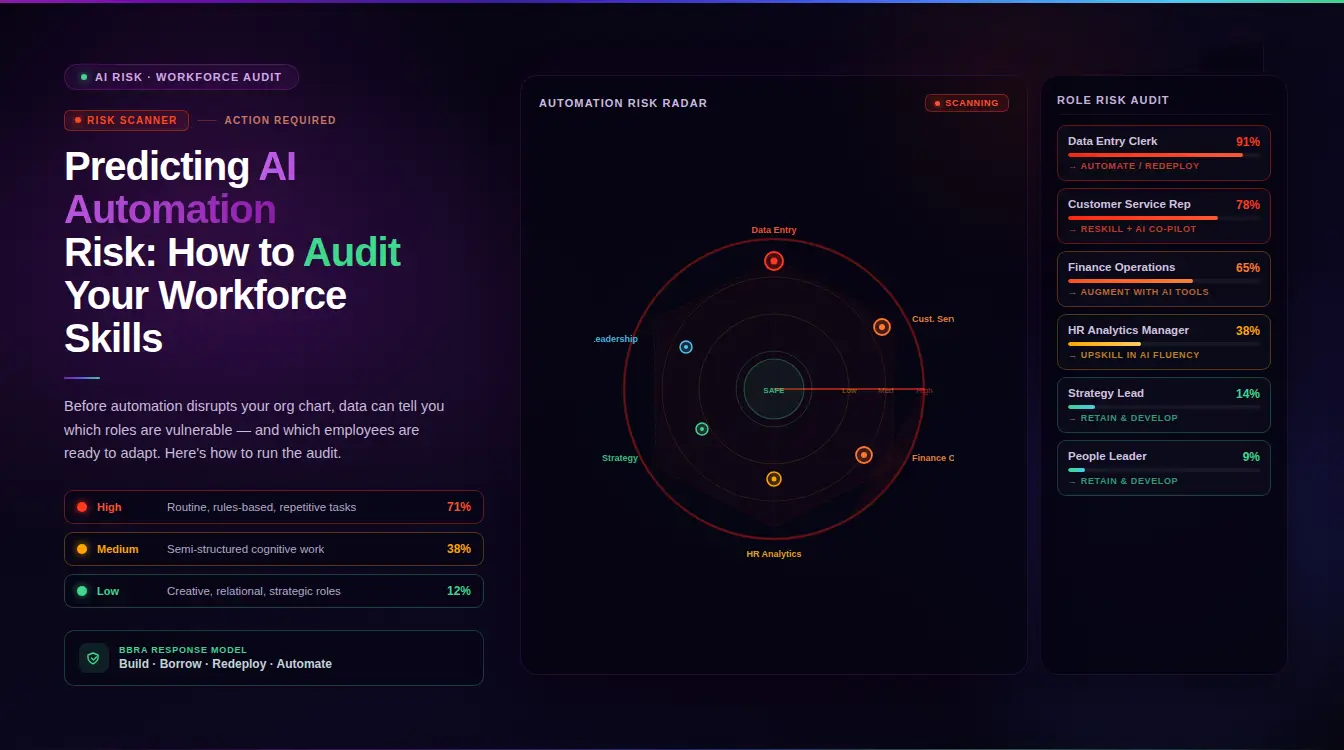
- AI and Automation: Could the underlying task be automated instead of trained for, changing whether upskilling training is the right investment at all?
BBRA: Deciding When Upskilling Training Is the Right Investment
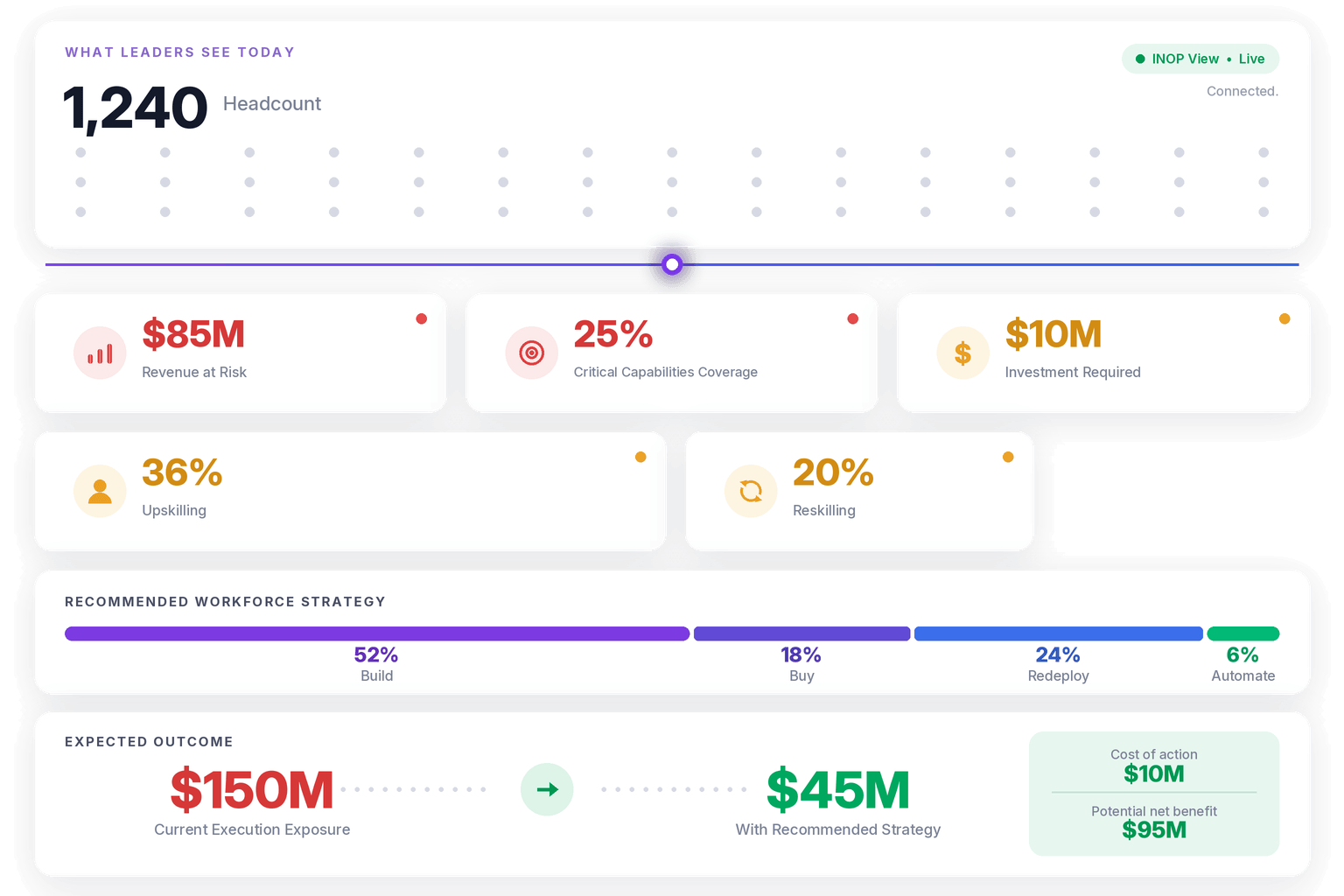
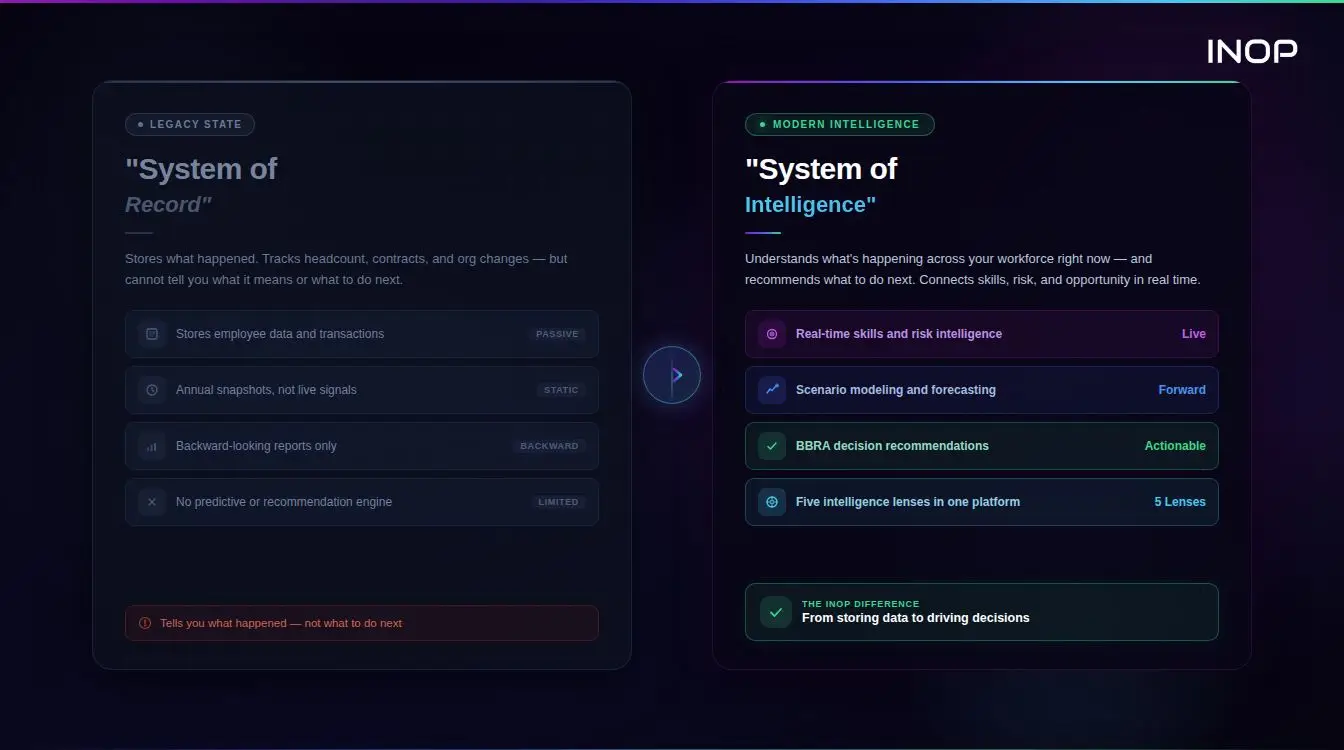
Upskilling training maps directly onto the Build pathway inside INOP’s proprietary BBRA framework, which models Build, Buy, Redeploy, and Automate against financial tradeoffs across four time horizons: thirty days, one hundred eighty days, one year, and three years. Treating training as one of four modeled pathways, rather than the automatic default every gap gets assigned to, is what keeps upskilling investment disciplined and tied to an actual return.
Applied to a real gap, this means a role missing a specific technical capability does not default straight to a training assignment. It gets compared: would redeploying someone with adjacent skills close the gap in thirty days at a fraction of the cost of an eighteen month training path, does the scale of the gap justify external hiring given current market conditions, or does upskilling training genuinely deliver the fastest, most cost-effective path once real returns like the ones documented in current upskilling research, averaging 4.5 times return within eighteen months for well-targeted programs, are weighed against the alternatives.
How to Structure an Upskilling Training Program Step by Step
Beyond the design principles above, a handful of structural decisions determine whether an upskilling training program actually runs the way it was designed to, rather than drifting into the same generic, unmeasured pattern most training falls into by default.
Choosing the Right Delivery Method for the Gap
Not every capability gap calls for the same delivery format, and defaulting to whatever format the organization already has infrastructure for is a common way a program underperforms. A gap requiring hands-on practice and real-time coaching, a new technical tool, a complex process change, tends to respond better to instructor-led sessions or structured mentorship than to a self-paced video course, since the guidance and immediate feedback shorten the time it takes an employee to reach real proficiency. A gap that is more about awareness or reference knowledge, a policy update, a new compliance requirement, is often served perfectly well by asynchronous content that does not require scheduling a room full of people. Matching delivery method to the nature of the gap, rather than defaulting to whichever format is cheapest or most convenient to produce, is a small decision that compounds significantly across a large training population.
Involving Managers Before, During, and After Training
Training that happens entirely between an employee and a course platform, with no manager involvement, consistently underperforms training where the manager is part of the process. Before training starts, a manager who understands why a specific employee is being trained on a specific gap can reinforce the reasoning and connect it to the employee’s actual work. During training, manager check-ins catch confusion or disengagement early, when it is still cheap to address. After training, a manager who follows up on whether the new capability is actually showing up in the employee’s work is the single most reliable verification step available, often more immediate and more accurate than a formal assessment scheduled weeks later. Programs that route entirely around managers, treating training as purely an HR or learning and development responsibility, lose this layer of reinforcement entirely.
Setting a Realistic Timeline Based on Gap Size
Upskilling training timelines get compressed unrealistically more often than they get overestimated. A narrow, well-defined skill gap, a new tool feature, a specific process update, can often close within weeks. A broader capability shift, moving an employee from foundational to advanced proficiency in a genuinely new domain, realistically takes months, not a single workshop. Setting a timeline that matches the actual size of the gap, rather than the timeline a budget cycle happens to allow, is what keeps expectations from leadership aligned with what the program can actually deliver, and it is often the difference between a program judged a success and one judged a disappointment despite doing exactly what it was capable of doing.
Upskilling Training for Private Equity Operating Partners
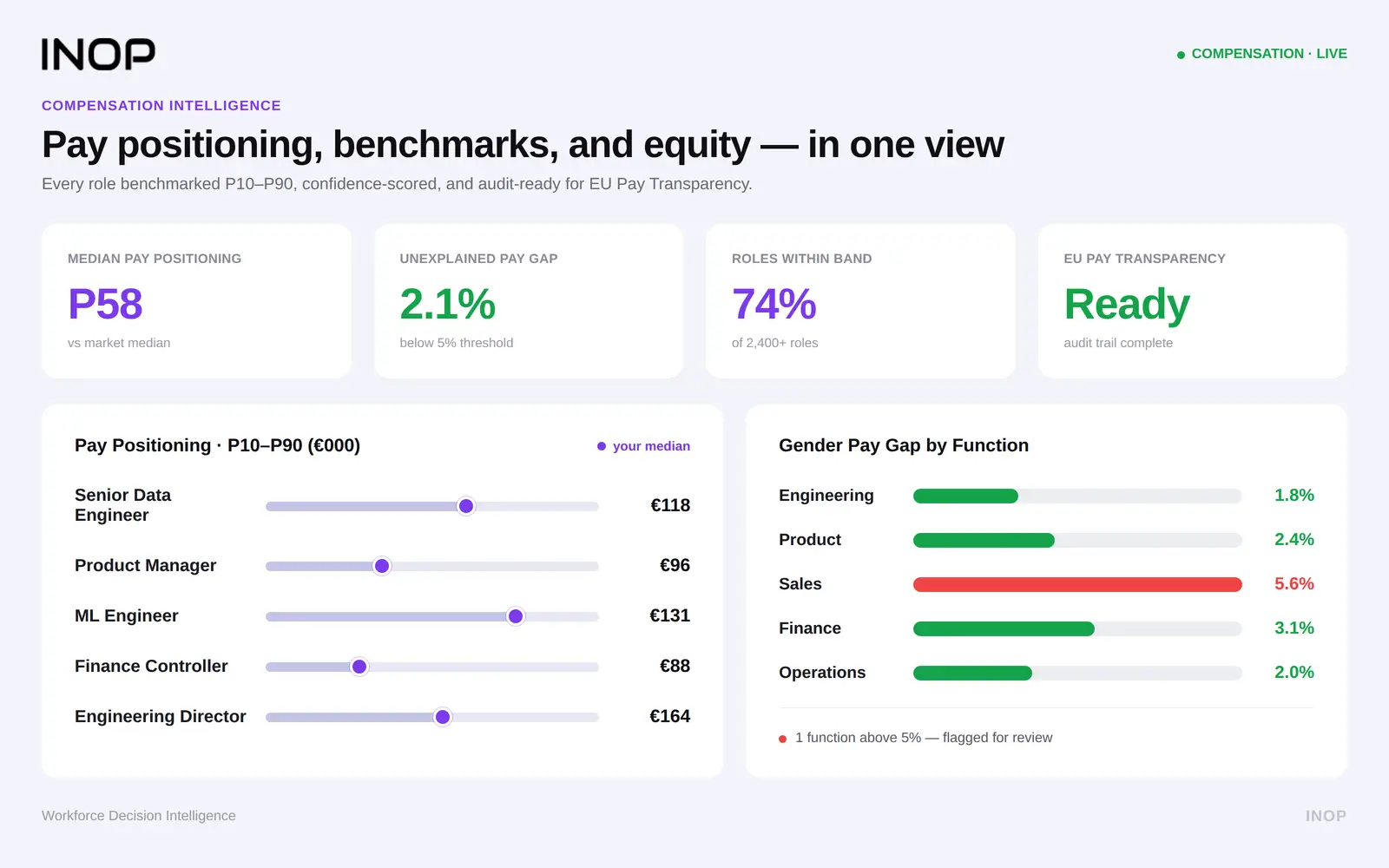
Inside a portfolio company, an upskilling training line item is either a real capability investment or a sunk training cost, and the difference is rarely visible from the budget alone. A portfolio company reporting strong training spend with no baseline measurement and no connection to a specific business outcome is running exactly the kind of activity-without-impact program that current research shows delivers a fraction of the return a targeted, measured program achieves. This distinction matters most during a hundred-day plan, when an operating partner is deciding whether existing training infrastructure can be trusted to close a capability gap quickly or whether the plan needs to account for a slower, more expensive path. A training budget line that looks reasonable on a P&L can be masking a program that has never once been tied to a measurable outcome. Standardizing this evaluation across a portfolio through INOP’s strategic workforce planning platform gives operating partners a consistent way to compare upskilling effectiveness across assets, rather than taking each portfolio company’s training report at face value. Where upskilling training closes a gap involving scarce, high-demand skills, INOP’s compensation analytics platform connects that finding back into pay benchmarking, since employees who close a high-value skill gap often need to be repriced to retain them once the capability is verified.
Common Mistakes in Upskilling Training Programs
Measuring completion instead of capability change. A finished course proves attendance, not competence. Without a post-training verification step compared against a documented baseline, there is no credible way to know whether the underlying gap closed.
Assigning training company-wide instead of role by role. Broad, undifferentiated rollouts waste budget on employees who did not have the gap in the first place and under-invest in the roles where closing it would matter most.
Defaulting to training for every identified gap. Some gaps close faster and cheaper through redeployment, hiring, or automation. Assuming upskilling training is always the answer is what turns a targeted investment into an expensive default, a distinction covered in more depth in INOP’s research on the business cost of ignoring skill gaps, including how organizations like Amazon have treated the build-versus-buy workforce decision as a structural question rather than a reflexive training assignment.
Skipping the baseline. Training rolled out without documenting current performance beforehand leaves no credible way to demonstrate impact afterward, regardless of how well the training itself was designed or delivered.
Ignoring how fast the target skill is moving. A training program built around a skill that is already declining in external demand is solving yesterday’s gap. INOP’s skills intelligence platform addresses this directly by mapping external demand signals, classified as emerging, in demand, stable, or declining, against your existing skills taxonomy, so upskilling training targets a skill actually worth the investment.
Treating every upskilling program the same regardless of scale. A single-team pilot and an organization-wide rollout require different levels of baseline rigor and measurement infrastructure. Case results from organizations that have scaled upskilling programs deliberately, such as the documented outcomes in INOP’s case studies on companies leveraging skills intelligence for growth, show measurable results specifically because the programs were targeted and tracked rather than deployed uniformly without regard to team-level context.
Letting the program run without a defined review cadence. Even a well-designed upskilling program loses value if nobody revisits whether it is still targeting the right gap. Skills that were scarce and worth training toward a year ago can lose relevance quickly, and a program running on autopilot without a scheduled checkpoint will keep training toward a gap that may have already closed or shifted elsewhere.
Frequently Asked Questions
What is the difference between upskilling training and generic corporate training?
Generic corporate training assigns the same courses broadly and measures success by completion. Upskilling training starts from a verified, role-specific capability gap, targets that gap directly, and verifies the skill actually closed afterward rather than just tracking attendance.
How long does it take to see ROI from upskilling training?
Leading indicators like skill assessment scores can appear within weeks. Business impact metrics such as productivity gains and retention improvements typically surface within one quarter of program completion for well-targeted programs, with fuller financial returns often visible within twelve to eighteen months.
Should every skill gap be closed through upskilling training?
No. Training is one of several available responses, alongside redeployment, external hiring, and automation. Comparing all four against cost and speed for each specific gap consistently produces better outcomes than defaulting to training automatically.
How do you measure the ROI of upskilling training accurately?
Compare training benefits, including reduced turnover costs, faster time-to-productivity, and measurable business KPI improvement, against total training costs, including both direct program costs and the indirect cost of employee time. Programs measured only by completion rate cannot produce this comparison at all.
How should private equity operating partners evaluate upskilling training at a portfolio company?
By checking whether training spend is tied to a documented baseline and a specific business outcome, not just a completion report. A high completion rate with no baseline measurement is a weak signal of actual return on the investment.
What delivery method works best for upskilling training?
It depends on the nature of the gap rather than a single universally best format. Hands-on, complex capability shifts tend to benefit from instructor-led sessions or mentorship, while awareness-level or reference knowledge is often served well by self-paced, asynchronous content. Matching the format to the gap matters more than standardizing on one delivery method across every program.
Ready to see which roles actually need upskilling training and which gaps close faster another way? Book a demo and INOP will map verified skill gaps against your workforce, run every one through BBRA, and show you exactly where training will move the needle first.