An
internal talent marketplace connects employees with roles, projects, and gigs inside the same company based on verified skills rather than job titles or manager sponsorship. Where traditional succession planning moves a small number of pre-identified people up a fixed hierarchy, a marketplace opens internal opportunity to the entire workforce and matches people to work using data. For organizations trying to spot
hidden talent at scale, this shift from manager nomination to system-driven matching is the difference between finding a handful of visible high performers and surfacing capability across the whole company.
This article covers how an internal talent marketplace actually works, why adoption is accelerating, and how HR and finance leaders can decide whether to build, buy, redeploy toward, or automate their way into one.
What Is an Internal Talent Marketplace
An internal talent marketplace is a platform, usually AI driven, where employees create a profile documenting their full skill set, not just their formal job history, and managers post open roles, short term projects, gigs, and mentorship opportunities against it. The system matches supply to demand algorithmically, surfacing people whose verified capabilities fit a need regardless of which department they currently sit in.
The word “marketplace” is doing real work in that definition. Unlike a job board, which is a static list, a marketplace is a two sided, continuously updating exchange. Employees can browse and self-nominate for opportunities without waiting for a manager to notice them. Hiring managers can search across the entire organization by skill rather than by who happens to be visible to them. That single change, replacing visibility with searchability, is what makes a marketplace structurally different from every internal mobility effort that came before it.
Internal Talent Marketplace vs Traditional Succession Planning
Succession planning and an internal talent marketplace solve related but distinct problems, and confusing the two leads organizations to under-invest in one while over-relying on the other.
Succession planning is vertical, slow moving, and deliberately narrow. It identifies a small pool of employees for a small number of critical roles, typically senior leadership positions, and develops them over years through structured programs and executive sponsorship. It works well for the roles it was designed for, but it depends entirely on manager and executive visibility, which means it inherits every blind spot those managers have.
An internal talent marketplace is horizontal and continuous. It is not trying to identify the next chief operating officer. It is trying to match thousands of smaller supply and demand signals every week: a six week data analytics project that needs a specific tool skill, a lateral move for an employee whose current role has plateaued, a stretch assignment that could develop a capability the business will need next quarter. Where succession planning asks “who is ready to lead,” a marketplace asks “who already has the skill this specific piece of work requires, right now.”
The two are complementary rather than competing. A marketplace generates the skills data and mobility patterns that make succession planning decisions more evidence based, and succession planning still has a role for the small number of roles where deep, multi-year development genuinely matters.
How an Internal Talent Marketplace Works
Every internal talent marketplace runs on the same basic mechanics, even though the vendors and interfaces vary widely.
Employees build or import a skills profile. In more mature implementations this profile is not purely self-reported. It is enriched with signals from project history, completed learning content, certifications, and peer endorsements, because self-reported skills alone are known to be inflated in some areas and understated in others, particularly among employees who are less inclined to self-promote.
Managers or project leads post an opportunity with a required skill profile attached, rather than a job description written around a fixed title. The matching engine compares the opportunity’s requirements against every employee profile in the system and returns a ranked list of internal candidates, often including people the hiring manager has never met.
Employees can browse open opportunities directly and apply, which is the mechanism that surfaces hidden talent the manager-nomination model consistently misses. The system tracks outcomes, so over time the organization builds a real record of who moved where, how the move performed, and which skill signals were actually predictive of success in a given type of role.
The Skills Data Layer Behind an Internal Talent Marketplace
The single biggest determinant of whether an internal talent marketplace succeeds or quietly fails within eighteen months is the quality of the skills data underneath it. A marketplace built on stale, self-reported, unverified skills data will make bad matches, and a handful of bad matches early in the rollout is usually enough to kill employee trust in the whole system.
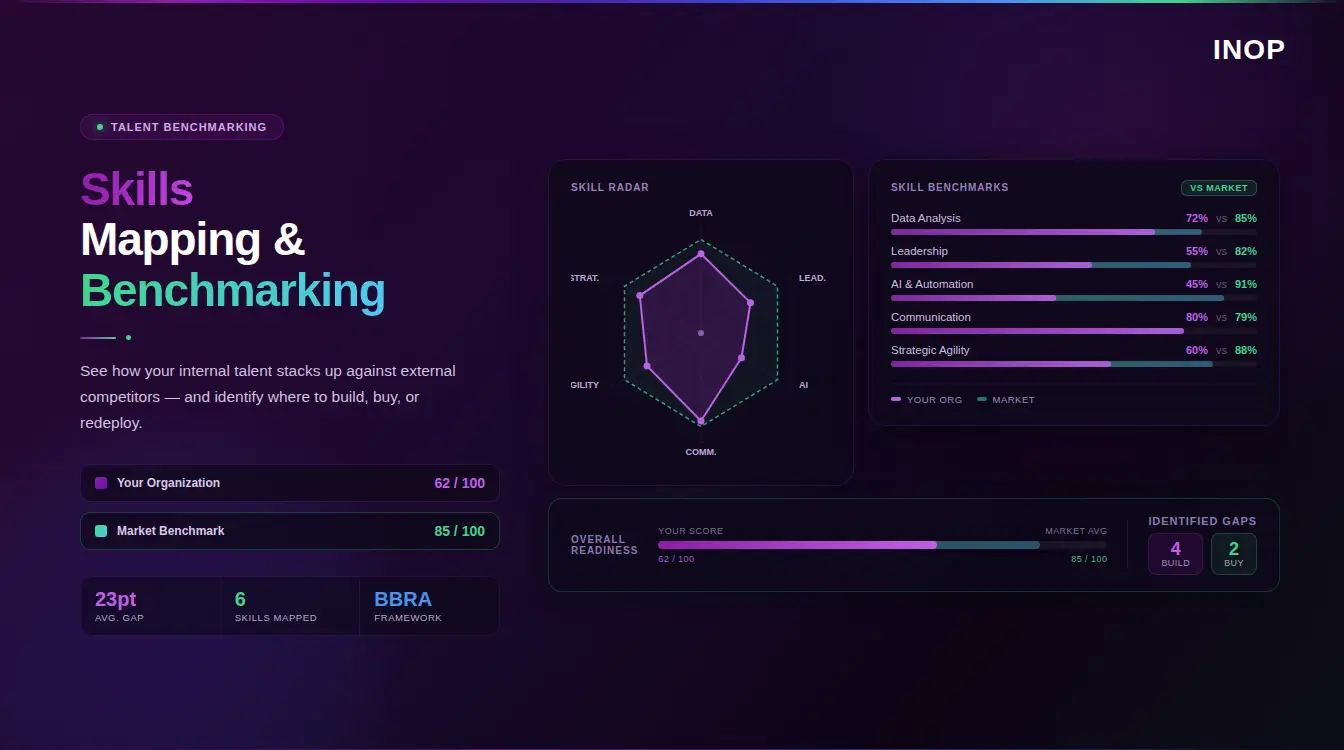
This is why skills data cannot be a one-time import from resumes and job titles. It needs to be a live layer that reflects what employees can actually do now, updated as they complete projects, acquire certifications, and develop new capabilities, and ideally benchmarked against real external demand signals so the organization knows which of those skills are becoming more valuable and which are declining. INOP’s
Skills Intelligence service was built for exactly this layer: it maps external demand signals onto an organization’s existing skills taxonomy across four signal states, Emerging, In Demand, Stable, and Declining, so a marketplace is matching people against skills that reflect where the business and the market are actually heading, not a static inventory from two years ago.
Why Internal Talent Marketplace Adoption Is Accelerating
Internal talent marketplace adoption has moved from early experiment to mainstream HR investment in a short window. Industry research tracked by
Phenom’s 2026 talent management trends report found that use of internal talent marketplaces grew from a quarter of organizations to more than a third in a single year, and that employees at companies with strong internal mobility stay substantially longer and are markedly more engaged than employees at companies without it.
The business case behind that growth is straightforward. External hiring is expensive and slow, and it carries a ramp-up cost and a cultural integration cost that internal moves do not. A skilled internal candidate who is genuinely under-utilized in their current role already knows the business, its systems, and its people. Every quarter that capability sits unused is a quarter the organization is paying full salary for partial output, a cost that never appears on a standard dashboard because nothing about the employee’s status looks abnormal.
Book a demo to see how INOP connects skills intelligence to internal mobility decisions, so your marketplace is matching against real capability data rather than static job titles.
Book a demo.
Five Intelligence Lenses for Evaluating a Marketplace Rollout
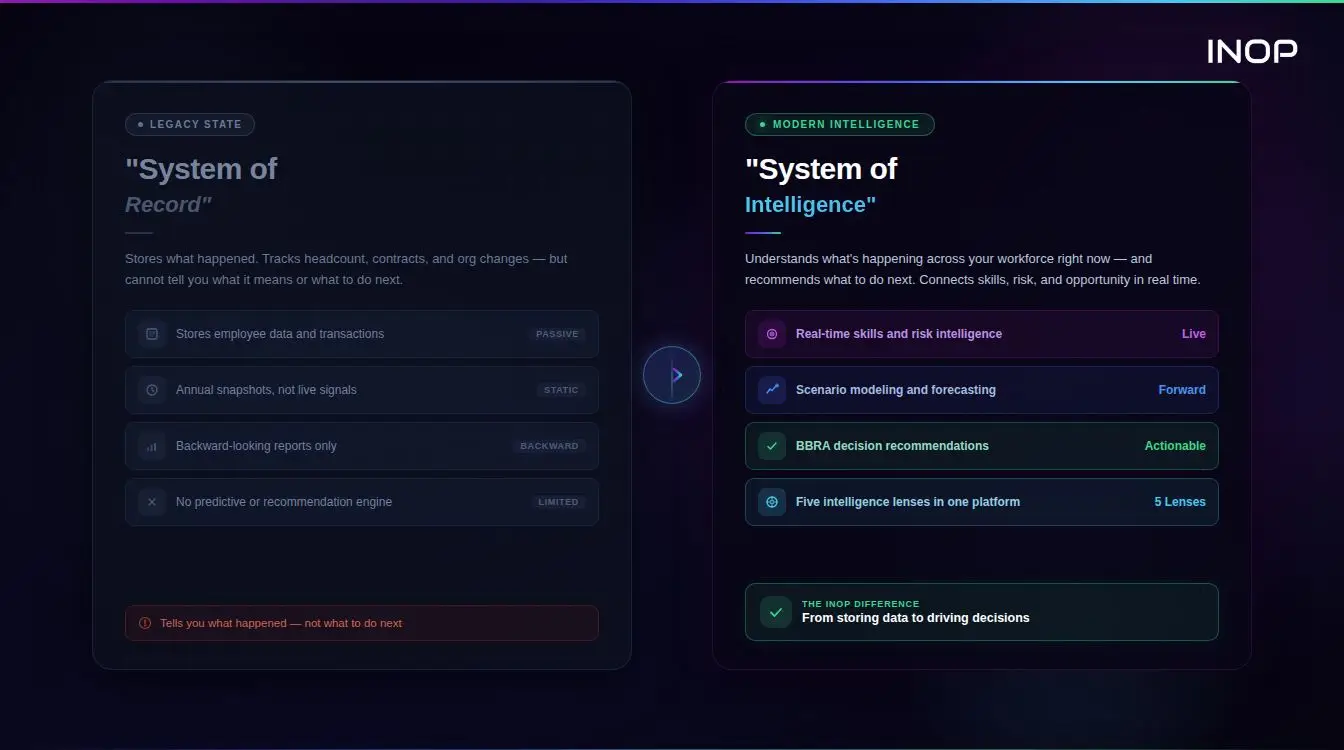
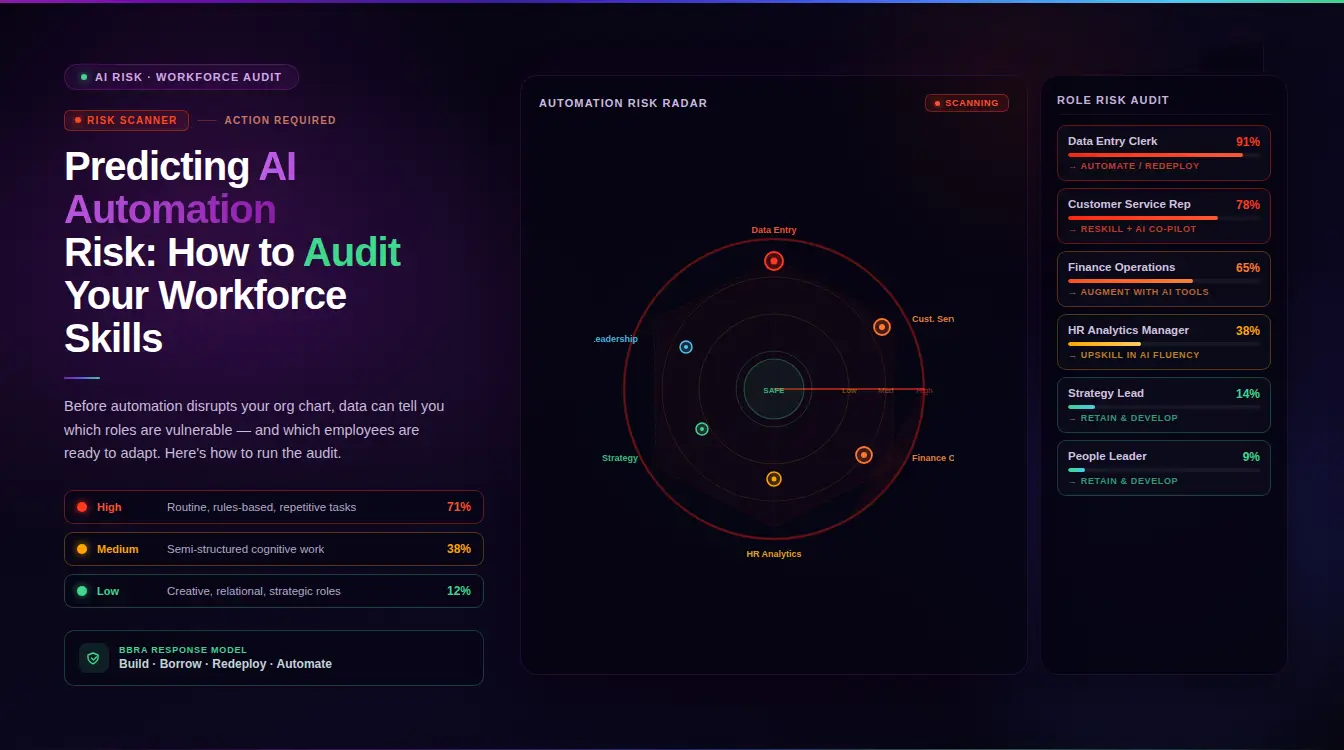
A marketplace rollout that is evaluated purely as an HR technology project tends to stall, because the decision to build one touches far more of the business than HR alone. INOP evaluates internal talent marketplace decisions across five intelligence lenses: Strategy, Finance, People, Market, and AI and Automation.
The Strategy lens asks whether internal mobility actually supports where the business is heading, not just where it has been. The Finance lens quantifies the cost of external hiring against the cost of internal redeployment for the specific roles a marketplace would serve. The People lens covers manager readiness, since managers who view their best people as belonging to their own team rather than the organization will quietly undermine a marketplace no matter how good the technology is. The Market lens checks internal skill supply against what is actually happening in the external labor market for the same skills, so mobility decisions are not made in a vacuum. The AI and Automation lens looks at which roles being filled through the marketplace are themselves at risk of automation, so the organization is not investing development budget in capability the business will not need in three years.
Deciding How to Build a Marketplace Using the BBRA Framework
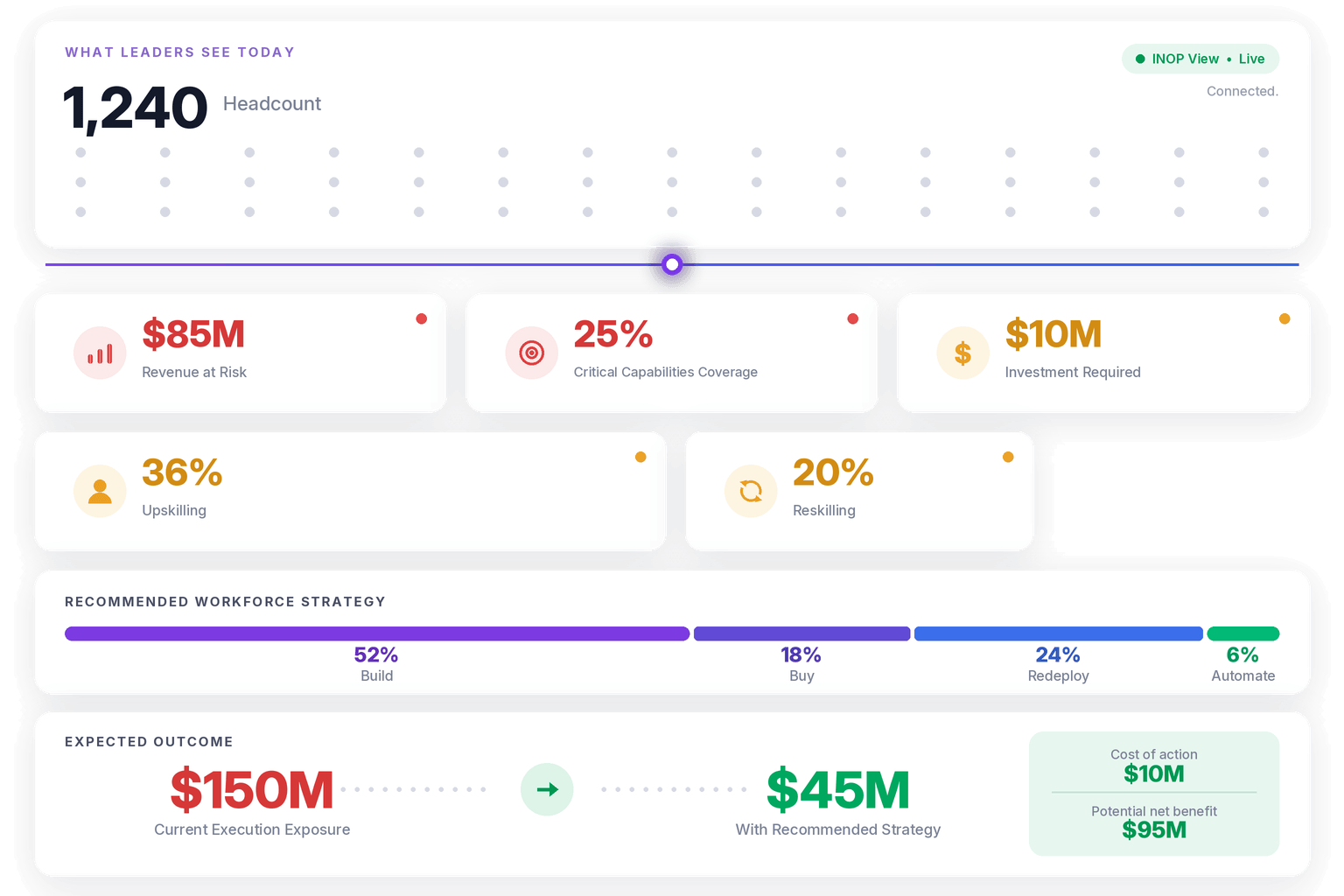
Once an organization has decided internal mobility is a priority, the next question is how to get there, and this is where INOP’s proprietary BBRA decision architecture applies directly. BBRA models every workforce capability decision across four pathways: Build, Buy, Redeploy, and Automate, each with its own financial trade-offs, mapped across four time horizons that run from an immediate thirty day view through a hundred and eighty day view, a one year view, and a three year view.
For an internal talent marketplace specifically, Build usually means developing existing employees toward a needed skill through structured stretch assignments and targeted training, which shows up fastest in the hundred and eighty day and one year horizons. Buy means external hiring, still sometimes the right call for genuinely novel capability the organization has none of internally, evaluated against its true fully loaded cost rather than just salary. Redeploy is the core marketplace pathway itself, moving an employee whose current role under-utilizes them into a role that needs exactly what they already have, which is typically the fastest and lowest cost pathway in the thirty day and hundred and eighty day horizons. Automate asks whether the work driving the request should exist as a role at all, or whether it is a candidate for automation instead of staffing.
Running every marketplace-generated request through all four pathways, rather than defaulting to external hiring because it is the most familiar process, is what turns a marketplace from a nice employee experience feature into a genuine capital allocation decision.
Common Pitfalls When Launching an Internal Talent Marketplace
Most failed marketplace rollouts fail for a small, predictable set of reasons. Skills data that is stale or purely self-reported produces bad early matches that destroy trust before the system has a chance to improve. Managers who are not incentivized to release talent quietly block transfers, so employees stop applying once they see that approved moves rarely actually happen. Opportunities that are only posted for junior or short-term gigs, never for anything meaningful, teach employees the marketplace is not worth checking. And a marketplace that is not connected to real workforce planning data ends up matching people to roles the organization will not actually need in a year, which wastes development investment on the wrong capabilities.
Each of these is solvable, but only if it is planned for before launch rather than diagnosed after adoption stalls.
Internal Talent Marketplace for PE Operating Partners
For private equity operating partners working across a portfolio, an internal talent marketplace has a use case that goes beyond any single company. Portfolio-wide skills visibility lets an operating partner see where a capability gap in one portfolio company could be filled by redeploying underutilized talent from another, rather than every company independently hiring externally for the same skill at the same time. This is particularly valuable during the first hundred days after an acquisition, when identifying which existing employees across the portfolio already have the capability a newly acquired business needs is often faster and cheaper than any external search, and it gives the operating partner a concrete, data-backed answer when the investment committee asks how talent risk is being managed across the portfolio rather than within each individual asset.
See how INOP’s
strategic workforce planning platform gives operating partners a single view of capability and risk across every portfolio company.
Book a demo to see it applied to your portfolio.
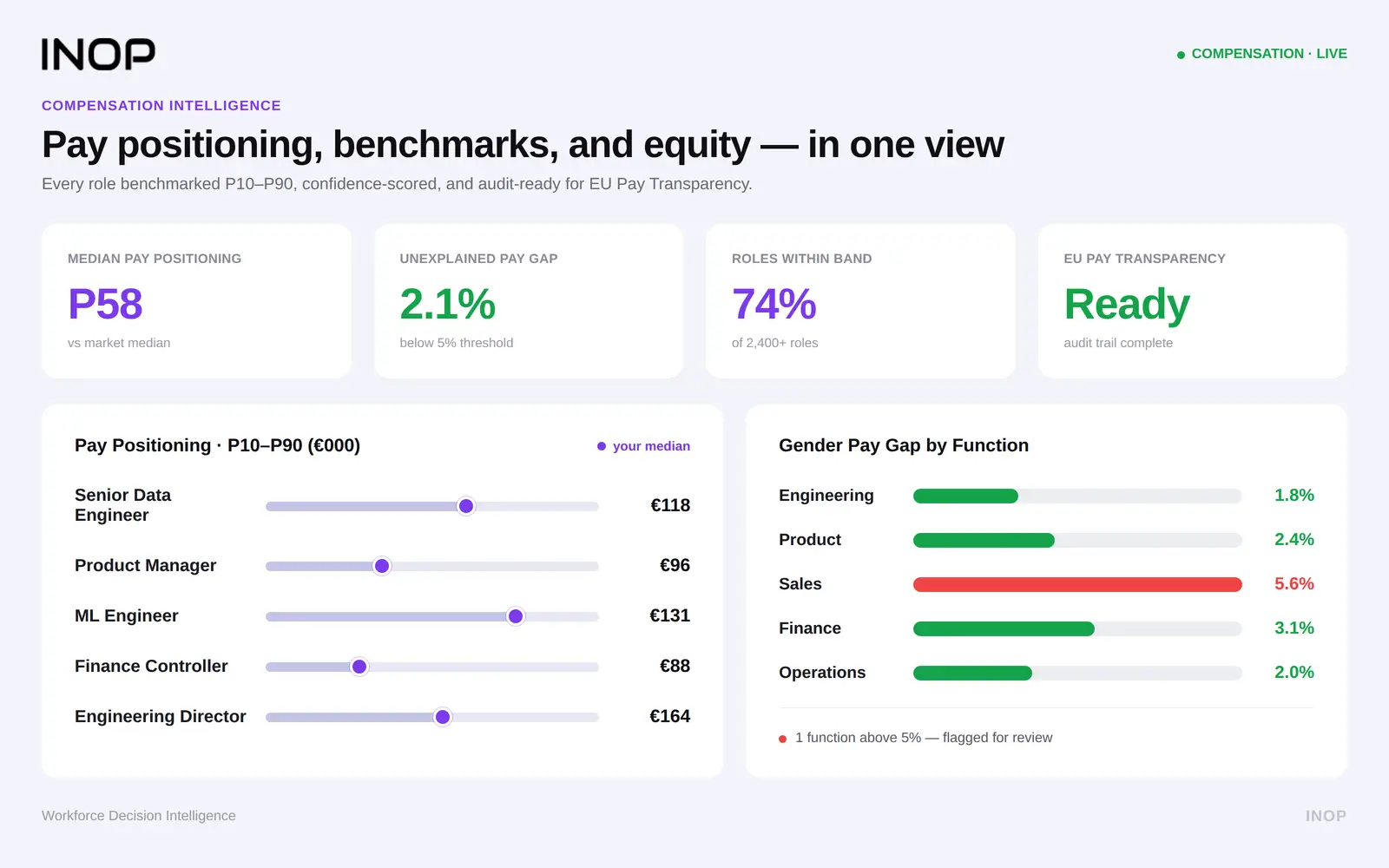
Pay data plays a role here too. Redeploying talent across portfolio companies only works if compensation structures are comparable and defensible across entities, which is where INOP’s
compensation analytics platform becomes relevant to a marketplace rollout, giving operating partners the pay benchmarking needed to move people across the portfolio without creating internal equity problems.
Frequently Asked Questions
What does internal talent marketplace mean?
An internal talent marketplace is a platform that matches employees to internal roles, projects, and gigs based on their actual verified skills rather than their job title, allowing anyone in the organization to be discovered and self-nominate for opportunities.
How is an internal talent marketplace different from an internal job board?
A job board is a static list employees browse manually. A marketplace actively matches people to opportunities using skills data, and it works in both directions, letting hiring managers search for talent and letting employees discover roles they were never told existed.
What data does an internal talent marketplace need to work well?
It needs a live, continuously updated skills layer that reflects what employees can actually do now, ideally combining self-reported skills with project history, learning records, and external market benchmarks, rather than a one-time import of resumes and job titles.
Does an internal talent marketplace replace succession planning?
No. Succession planning still serves a small number of senior, high stakes roles that benefit from years of deliberate development. A marketplace handles the much larger volume of lateral moves, short-term projects, and skill-based matches that succession planning was never designed to cover.
How should private equity operating partners think about internal talent marketplaces across a portfolio?
Operating partners can use portfolio-wide skills visibility to redeploy underutilized talent between portfolio companies instead of each company hiring externally for the same capability, which is especially valuable during post-acquisition integration when speed and cost both matter.