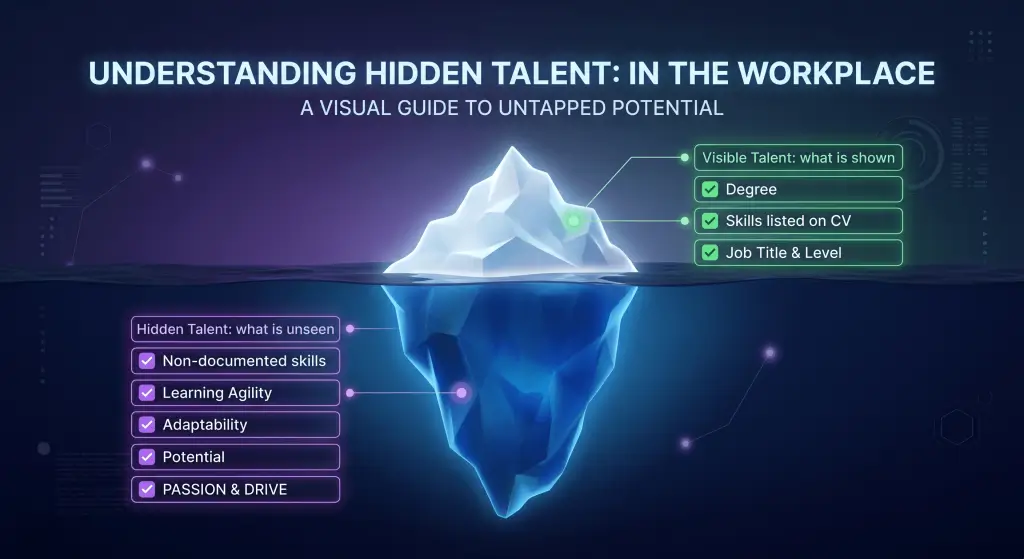
10 Clear Signs of Hidden Talents in Your Employees
Knowing how to spot hidden talent starts with recognizing the behavioral signals that often go unnoticed in traditional performance reviews. These signs are rarely found in KPI dashboards, they show up in how people carry themselves day-to-day.
1. They ask better questions than their peers. Employees with hidden depth don’t just execute, they interrogate problems. If someone consistently asks “why are we doing it this way?” rather than simply “what do I need to do?”, that’s a signal of critical thinking that likely exceeds their current role.
2. They complete stretch tasks faster than expected. When a project requires skills just beyond someone’s job description and they deliver it ahead of schedule with high quality, they’re showing you a ceiling you haven’t fully tested.
3. They become the informal go-to person. Before a formal subject-matter expert is assigned, notice who colleagues naturally turn to for help. That informal authority is a sign of hidden expertise.
4. They stay engaged during unstructured time. An employee who uses downtime to research, self-learn, or improve processes, without being asked, is demonstrating intrinsic motivation, one of the strongest predictors of long-term high performance.
5. They remain calm under pressure others find overwhelming. Resilience and composure in high-stress situations are signs of emotional intelligence and leadership readiness that few performance metrics capture.
6. They translate complex ideas simply. The ability to explain difficult concepts clearly, to a colleague, a client, or a new hire, indicates communication mastery and conceptual depth.
7. They improve the processes they inherit. Rather than just following a handover document, they refine it. This process-improvement instinct often signals operational and strategic thinking potential.
8. They build bridges across departments. Employees who naturally form working relationships outside their immediate team are demonstrating organizational awareness and collaborative intelligence, key traits for future leadership.
9. They advocate for others, not just themselves. When someone publicly credits teammates, escalates a colleague’s good idea, or mentors a peer without being asked, you’re looking at a leader who doesn’t yet have the title.
10. They bring solutions, not just problems. Any employee who walks into a conversation about a problem carrying at least one potential solution is demonstrating ownership thinking, a trait that belongs in a much more visible role.
HR Tip: Create a simple internal log for managers to flag these behaviors when observed. Over a quarter, patterns will emerge that point clearly to employees whose potential is being underused.
Hidden Talent Examples in the Workplace
To make the concept concrete, here are real-world hidden talent examples that organizations frequently discover, and benefit from, once they build the right systems to look:
Hidden leadership talent: A mid-level operations analyst who has been quietly organizing cross-team meetings, resolving interdepartmental conflicts, and coaching newer hires, all outside her formal job description. She has never been nominated for a leadership program because her title didn’t suggest it.
Hidden communication and training talent: A warehouse floor manager with no formal training background who produces clearer onboarding documentation than the HR team. He has an instinct for instructional design that could benefit the entire L&D function.
Hidden technical talent: A marketing coordinator who taught herself Python to automate her own reporting tasks. She now saves her team 12 hours per week and could contribute directly to product or data teams.
Hidden creative talent: A finance business partner who produces highly visual, story-driven financial summaries that get more engagement than standard reports. This skill, data storytelling, is one of the most sought-after competencies in modern analytics roles.
Hidden cross-cultural and language talent: A customer support agent fluent in Arabic, French, and English who has been handling English-only tickets for two years. Deploying her language capability could open new markets or significantly improve CSAT in underserved regions.
Hidden strategic thinking talent: A junior project coordinator who consistently identifies downstream risks in project plans before senior managers do. With mentoring and visibility, this employee is a future chief of staff or COO candidate.
These hidden talent examples share a common thread: the capability existed long before the organization knew about it. The cost of not discovering them isn’t neutral, it’s measured in turnover, missed innovation, and replacement hiring costs.
Real-World Examples of Hidden Talent Uncovered
IBM famously uses an internal marketplace that matches employees with gigs based on skills, not roles, helping uncover talent faster and drive internal mobility.
Adobe implemented a program where managers nominate “emerging talent,” leading to mentorship matches and development paths tailored to individual strengths.
A regional hospital found a facilities employee with an engineering degree who had migrated to the U.S. and worked in a non-clinical role. With support, he transitioned into an operational improvement analyst, boosting patient flow efficiency by 15%.
These examples highlight how identifying hidden talent creates measurable business value.
Types of Hidden Talents: A Practical Taxonomy for Managers
Not all hidden talent looks the same. Understanding the categories helps managers know what to watch for and how to develop each type when found.
- Cognitive hidden talent refers to exceptional analytical, strategic, or systems-thinking ability that the current role does not fully engage. This often surfaces when an employee handles an unusually complex problem with ease, or when they identify second and third-order consequences of decisions that others miss entirely.
- Creative hidden talent includes non-obvious problem-solving, visual thinking, narrative ability, or design sensibility. It frequently sits in roles where output is measured quantitatively, an analyst who writes unusually compelling reports, a project manager whose process documentation is genuinely elegant, an engineer who communicates architecture through illustrations that resonate immediately.
- Interpersonal hidden talent covers emotional intelligence, conflict resolution, facilitation, coaching, and the ability to build trust across different personality types. This is among the most underrecognized category because it produces no individual output metric, it shows up in how teams around a person perform, not in that person’s own deliverables.
- Technical hidden talent includes skills developed outside the current role, a second programming language, data analysis ability, a certification from a prior career, or self-taught proficiency in tools the organization uses but the employee was never asked about.
- Cross-cultural and language talent is systematically invisible in monolingual organizations. An employee with fluency in additional languages, cultural competency from an international background, or deep understanding of a market the organization is trying to enter represents strategic capability that rarely appears in any HR record.
- Leadership hidden talent is perhaps the highest-value category. It manifests as informal influence, team cohesion, conflict de-escalation, and the ability to motivate people without authority. It is most often found by watching what happens when a formal leader is absent from a team, who naturally steps into the coordination and direction role.
Neurodivergent Hidden Talent: The Most Structurally Overlooked Category
One category cuts across all six types above and is so consistently missed that it warrants separate treatment: neurodivergent talent. Employees with dyslexia, ADHD, autism spectrum conditions, dyscalculia, and other cognitive variations often possess exceptional capabilities in specific domains that neurotypical performance evaluation systems systematically fail to surface.
An employee with dyslexia who processes information differently may have developed exceptional pattern recognition and big-picture thinking. An employee with ADHD who struggles with repetitive structured tasks may demonstrate extraordinary creative synthesis and hyperfocus on novel problems. An employee on the autism spectrum who finds social communication taxing in certain contexts may bring an unparalleled precision and depth of analysis to technical or systems problems.
The structural problem is that most performance management systems evaluate the presentation of output rather than the substance. A brilliant analysis submitted late, a technically exceptional contribution delivered outside the expected format, or a high-capability individual whose social communication style diverges from norms — all are systematically downgraded in conventional appraisal systems, not because the capability is absent but because the evaluation criteria were designed around neurotypical expression.
The World Economic Forum’s 2023 research found that employers who actively design roles and evaluation processes to accommodate neurodivergent contributors consistently report capability gains that surprise them: the accommodation rarely costs anything meaningful, and the capability accessed is often in domains where the organization had a genuine gap.
The practical implication for hidden talent identification: explicitly include neurodivergent employees in talent spotting conversations, separate the assessment of output quality from output presentation style, and design stretch assignments that match the individual’s cognitive strengths rather than their social performance profile.
Why Spotting Hidden Talent Matters More Than Ever
Internal talent mobility has become one of the most effective ways to address skill gaps and boost retention. According to a 2023 LinkedIn Workplace Learning Report, companies that excel at internal mobility retain employees nearly two times longer than those that don’t.
Identifying and nurturing hidden talent:
- Improves employee engagement and morale
- Enhances workforce agility
- Reduces recruitment costs and time-to-fill
- Supports succession planning
- Encourages a learning culture
The financial case is equally concrete. SHRM estimates the cost of replacing an employee at between 50% and 200% of their annual salary depending on seniority. When a high-potential employee leaves because they were never developed or given visibility, that cost is absorbed in full, while the organization also loses institutional knowledge and capability it never knew it had.
There is also a quieter productivity loss that appears on no dashboard. When a capable employee is locked in a role that underutilizes them, the organization is paying full price for partial output. Identifying and redeploying that talent is not an additional expense, it is a recovery of value already on the payroll.
In a world where top performers are hard to find and expensive to hire, unlocking existing talent isn’t just smart, it’s essential.
Suggested Article: software compensation
The Financial Cost of Hidden Talent Staying Hidden
Most organizations frame the hidden talent conversation as a development opportunity. Finance frames it differently when given the right data: as a productivity loss that is already on the payroll.
Hidden Talent in PE Portfolio Companies
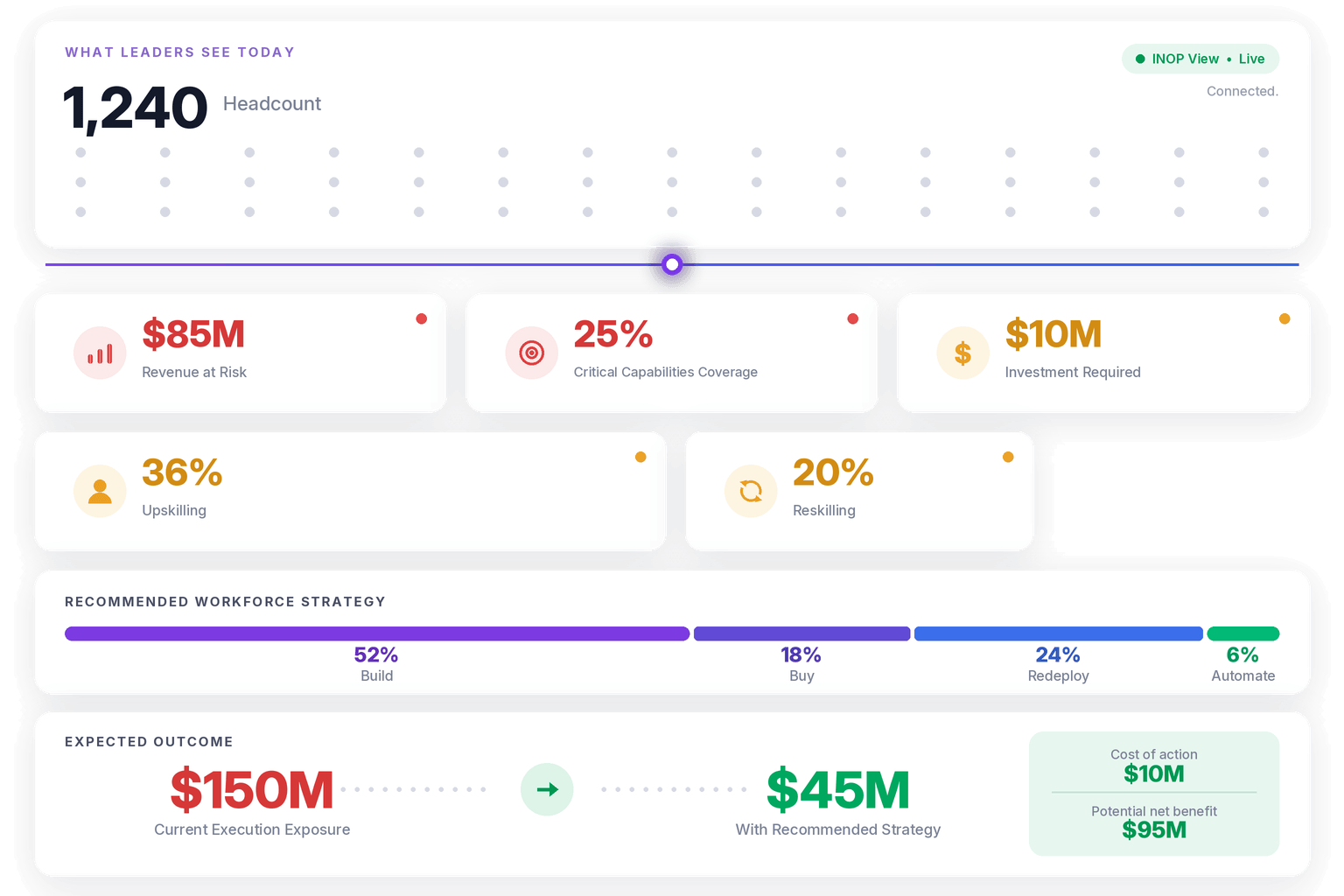
For PE operating partners, hidden talent is value creation already sitting inside the portfolio. In the first hundred days after close, operating partners rarely have a reliable view of who holds which capabilities across a portfolio company. INOP for PE firms gives them a verified skills baseline across the workforce, so value creation plans can staff critical initiatives from inside first, and exit narratives can point to documented capability depth rather than an org chart.
The Capacity Utilization Problem
Every employee whose capability meaningfully exceeds their role utilization represents a gap between what the organization is paying for and what it is getting. Unlike a vacant role, where the productivity cost is visible and creates urgency, an underutilized role looks like normal employment on every dashboard. The employee shows up, delivers adequate output, and nothing in the standard metrics signals that they could be generating two or three times the value in a role better matched to their capability.
The scale of this problem is larger than most organizations realize. Research from McKinsey found that employees spend an average of 28% of their workweek on tasks that could be handled by someone at a lower skill level, while simultaneously having capabilities that the organization is not accessing at all. The employee who is 40% utilized against their actual capability is not a performance problem. They are a deployment problem — and deployment problems are cheaper to fix than replacement cycles.
The Quantified Cost of Getting This Wrong
Organizations with formal talent identification and internal mobility programs show measurable financial advantages over those that do not. According to research cited by iMocha, organizations with formal employee recognition and development programs experience 31% less voluntary turnover than those without any program. Given that SHRM estimates the cost of replacing an employee at 50% to 200% of annual salary, a 100-person organization retaining just three additional employees per year through better talent visibility is recovering $150,000 to $600,000 in avoided replacement costs annually, before accounting for the productivity gap during vacancy and ramp-up.
The revenue case is equally concrete. Research cited by diversity-inclusion-speakers.com found that highly aligned companies, those that successfully match individual strengths to organizational needs, grow revenue 58% faster and are 72% more profitable than their unaligned peers. Alignment is not achieved through better recruiting. It is achieved through better internal capability visibility.
Redeploying Hidden Talent Through INOP’s BBRA Framework
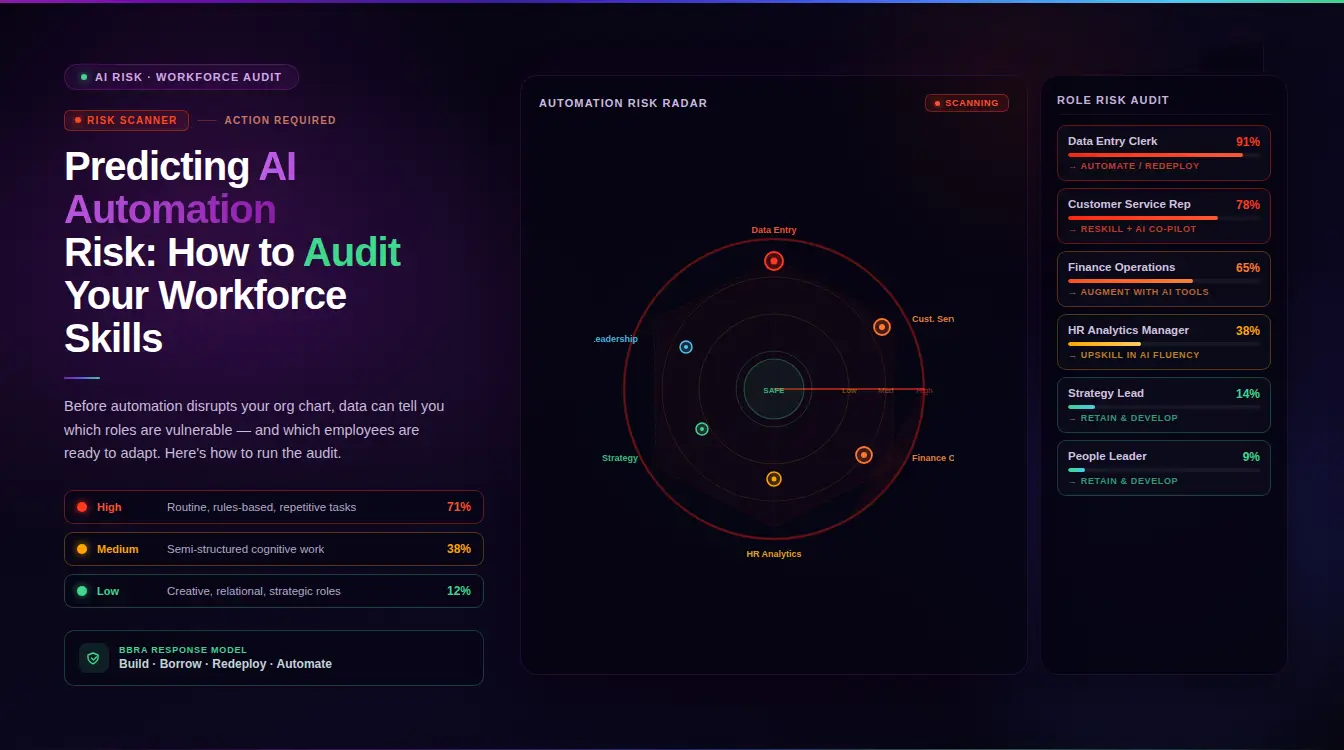
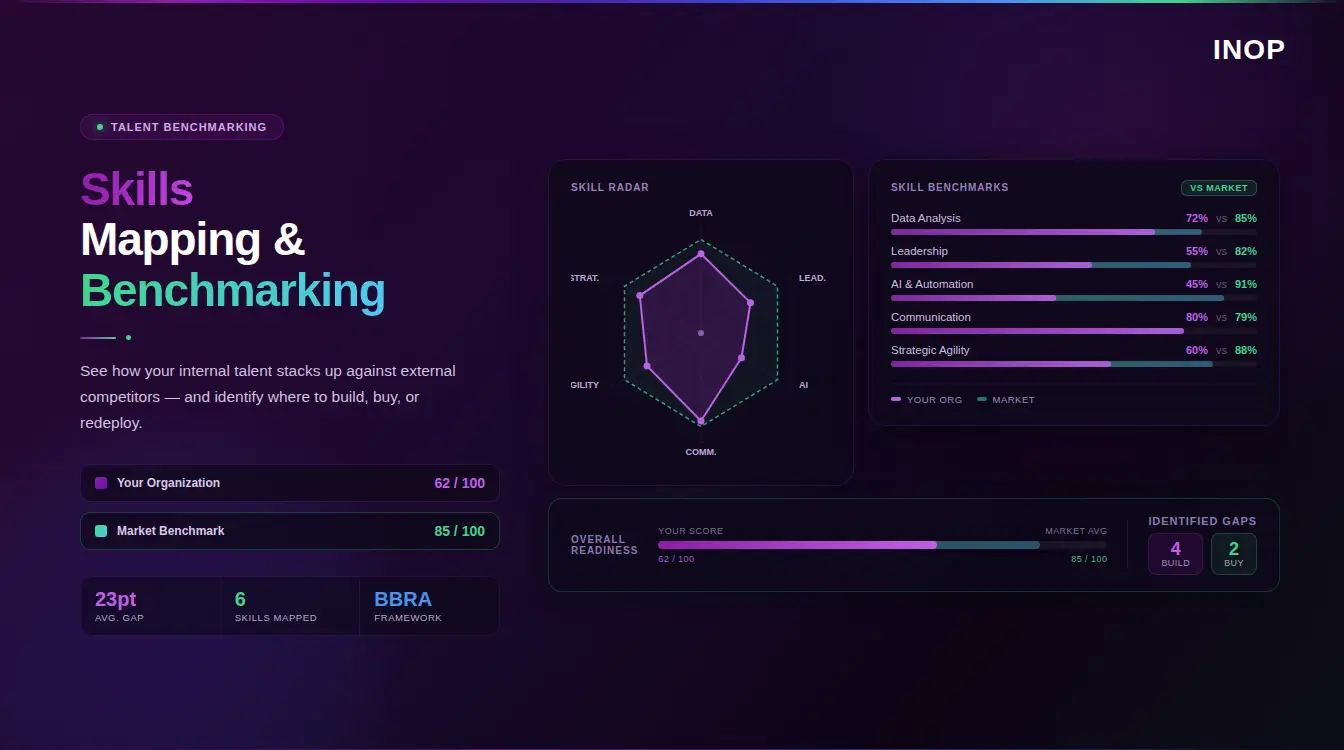
INOP’s proprietary BBRA decision architecture (Build, Buy, Redeploy, Automate) treats hidden talent as a Redeploy option that most organizations never price. When a new capability need appears, INOP models all four pathways side by side, with financial trade-offs across 30-day, 180-day, one-year, and three-year horizons. Hidden talent changes that math: an employee who already holds most of a role’s verified skills turns a slow, expensive option into a fast Redeploy or a short Build.
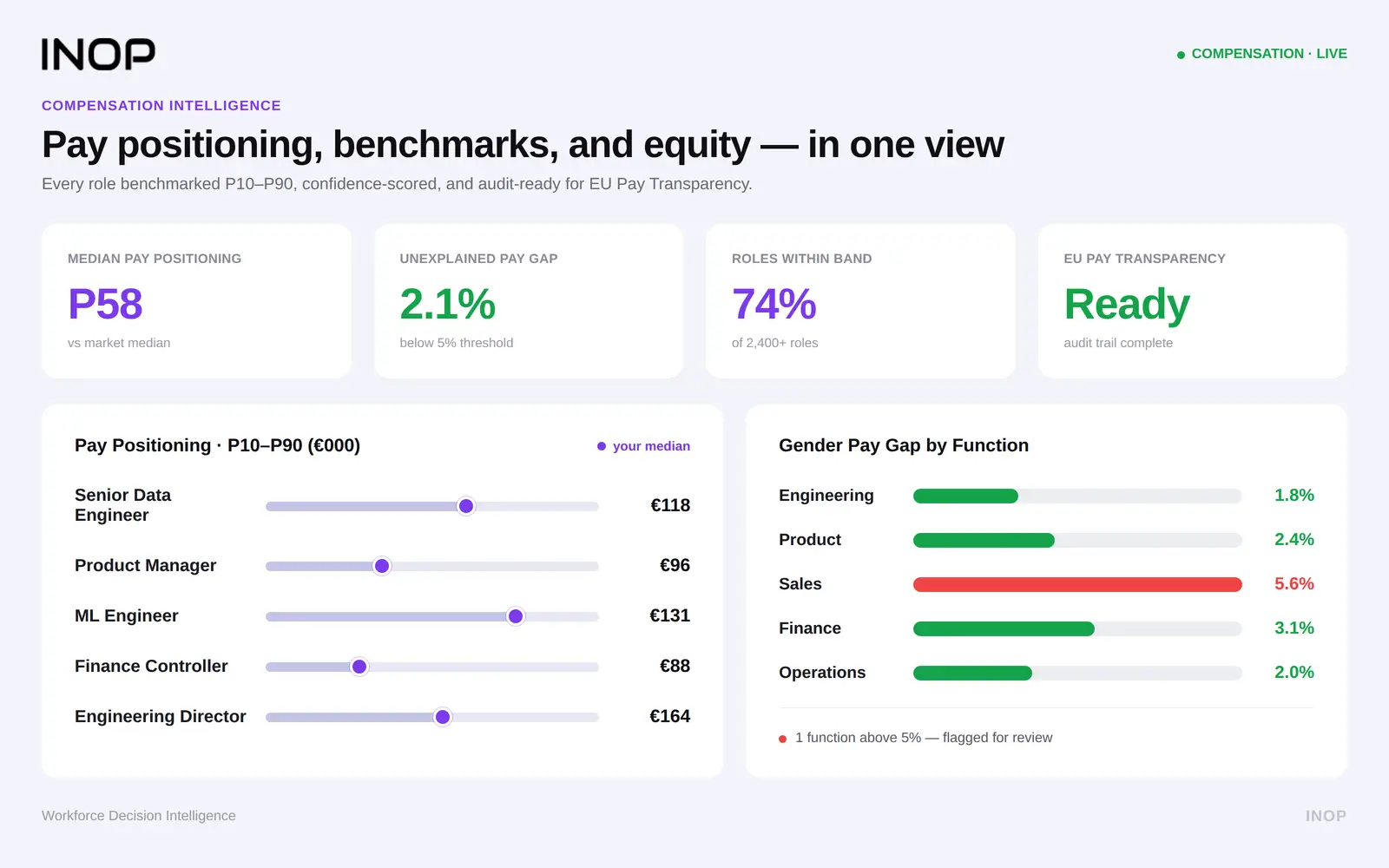
INOP reads every option through five intelligence lenses: Strategy, Finance, People, Market, and AI and Automation. That shows not only which path costs least today, but which skills the business will still need in three years and which ones automation is about to absorb. When a redeployment moves someone into a larger role, INOP’s compensation analytics platform benchmarks the new pay level against live market data, so the move closes a capability gap without opening a pay equity gap.
Your next hire might already be on the payroll. Book a demo to see how INOP’s strategic workforce planning platform maps verified capability against your future needs, so hidden talent stops staying hidden.
How to Spot Hidden Talent: Key Strategies
To spot hidden talent effectively, leaders need a combination of keen observation, thoughtful systems, and open-mindedness. Here’s how to uncover that potential:
Watch for Non-Obvious Strengths
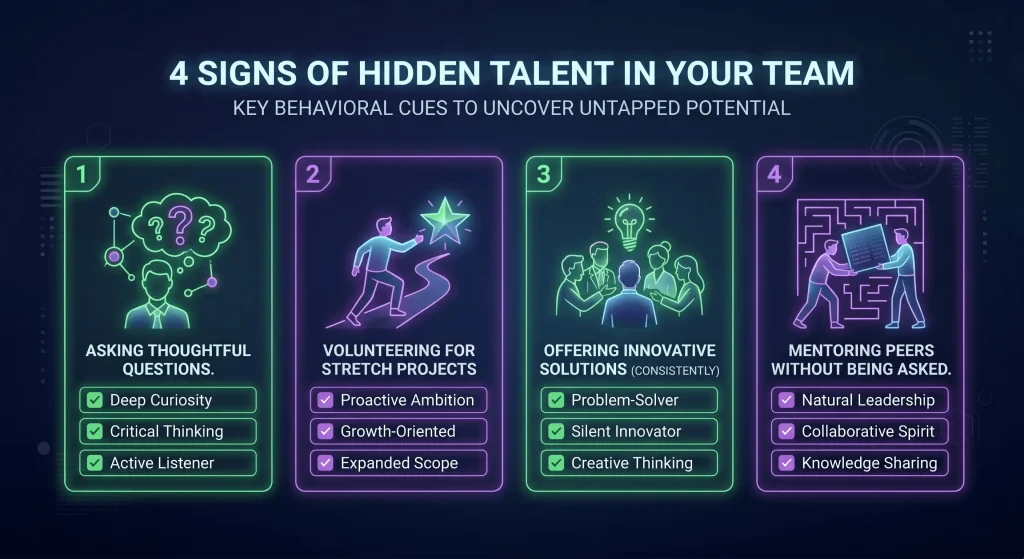
Some of the best talent won’t self-promote. Pay attention to behaviors like:
- Asking thoughtful questions during meetings
- Volunteering for projects outside their scope
- Offering innovative solutions quietly but consistently
- Mentoring peers without being asked
These are signs of people who are engaged, curious, and growth-oriented, key indicators of hidden potential.
Conduct Skills-Based Assessments
Rather than relying solely on resumes or titles, use skills-based assessments to objectively evaluate employees across departments. These could include:
- Role simulations
- Critical thinking tests
- Peer evaluations
- Problem-solving challenges
This helps identify transferable skills and high performers who may have been overlooked in traditional performance reviews.
Leverage Data and Performance Analytics
Modern HR technology and performance management platforms can help uncover hidden talent through data points such as:
- Speed of skill acquisition
- Cross-functional collaboration frequency
- Engagement in learning & development (L&D) programs
- Internal mobility patterns
For example, an employee consistently completing advanced training ahead of peers may be ready for a more challenging role.
Solicit Peer and Manager Feedback
Sometimes colleagues see potential that managers miss. Encourage 360-degree feedback loops or “talent spotting” sessions where teams can highlight coworkers who:
- Excel under pressure
- Solve complex problems quietly
- Exhibit leadership without authority
This democratized view of talent can surface contributors across departments and hierarchies.
Observe Informal Leadership
Leadership isn’t confined to job titles. Look for employees who naturally:
- Rally teams during tight deadlines
- Act as go-to problem solvers
- Step up when no one else does
These behaviors often signal future managers or project leads.
Create Safe Spaces for Visibility
Some talent remains hidden because people feel they don’t have permission to showcase it. Building psychological safety, where individuals feel empowered to share ideas or take on stretch assignments — helps them shine.
Leaders should model curiosity, humility, and openness to encourage this kind of environment.
While many organizations focus on external recruitment, talent intelligence platform and strategies can be just as effective when applied internally, helping you identify high-potential employees who may otherwise be overlooked.
Talent Spotting: Building a Formal Practice From an Informal One
Talent spotting is the structured discipline of identifying high-potential employees earlier than formal performance systems do, using behavioral observation, project outcomes, and peer intelligence rather than waiting for an annual review cycle to surface capability.
In organizations with mature talent development practices, talent spotting is a named role and a defined process. “Talent spotting officers”, usually a cross-functional group of senior managers trained in recognizing potential indicators — meet quarterly to discuss emerging contributors across functions. The deliberate cross-functional design is critical: it prevents any single manager’s blind spots from determining which employees get developmental visibility.
The core skill in talent spotting is separating performance from potential. A high performer in their current role is easy to identify, their output speaks for itself. A high-potential employee is harder to spot because their capability exceeds their current opportunity rather than their current output. The behavioral signals that distinguish high potential from high performance include: how someone responds when their approach fails (do they analyze or deflect?), how they behave when given ambiguous problems with no obvious right answer, and how they interact with people outside their reporting line.
Formalizing talent spotting as a practice, with structured observation criteria, regular cross-functional discussion, and a clear connection to internal mobility opportunity — produces a more diverse, more accurate view of organizational talent than any individual manager’s assessment.
Identifying Internal Candidates Who Aren’t Obvious on Paper
One of the hardest talent-spotting problems is identifying internal candidates for a role who aren’t obvious on paper. Resumes and internal job histories capture what someone was hired to do, not what they’ve actually become capable of since. A candidate who looks underqualified by title can be the strongest internal fit once you look at demonstrated skills rather than job history alone.
This is where a live, structured skills inventory outperforms a resume-based search. Instead of filtering candidates by past titles, HR and hiring managers can filter by verified capability: who has actually demonstrated the skill, in what context, and how recently. This is the core function of skills intelligence: surfacing external demand signals against your existing skills taxonomy so you can see which internal employees already match a role’s real requirements, not just its job description.
How to Identify Hidden Talent in Your Company: A Practical 5-Step Process
To identify hidden talent in your company, start with a structured process rather than manager intuition alone: audit your current skills inventory, map those skills against strategic gaps, run dedicated talent spotting conversations, create cross-functional stretch assignments, and make internal opportunities visible to everyone, not just employees already known to leadership. Below is how each step works in practice.
Step 1: Audit your current skills inventory. Before you can identify what’s hidden, you need a baseline of what’s known. Conduct a skills audit across your workforce, not just job titles and formal qualifications, but self-reported skills, past experience, certifications, and side projects. Tools like Talent Intelligence Platform can automate this at scale.
Step 2: Map skills to strategic gaps. Once you have a skills inventory, cross-reference it against your organization’s current and future capability needs. This reveals not only who has undiscovered skills, but which of those skills are immediately valuable to the business.
Step 3: Run structured talent spotting conversations. Train managers to hold quarterly “development conversations”, distinct from performance reviews, focused entirely on growth interests, past experiences outside the current role, and aspirations. These conversations consistently surface unexpected talent.
Step 4: Deploy cross-functional stretch assignments. Create deliberate opportunities for employees to work outside their function, even briefly. A 4-week cross-functional project will reveal more about an employee’s true capability than a year of performance reviews within their current scope.
Step 5: Create a visible internal opportunity board. Make internal roles, short-term gigs, and mentorship opportunities visible to all employees. Let employees self-nominate rather than waiting for managers to put them forward. Many of the most significant hidden talents in any organization belong to employees who simply never knew an opportunity existed for them.
Key insight: The organizations that are best at identifying hidden talent don’t just have better managers — they have better systems. Structured processes reduce bias and widen the net.
What to Actually Ask in Talent Spotting Conversations
- “If you could take on any role in this company for three months, what would it be and why?”
- “What’s a skill or experience you have that this job has never asked you to use?”
- “What kind of problem, if someone handed it to you today, would make you feel genuinely energized?”
- “Is there a project in another team you’ve seen recently that you wish you’d been part of?”
- “What are you learning outside of work right now?”
Training Managers to Spot Hidden Talent: A Practical Programme
The most effective hidden talent identification system depends on the quality of manager observation, and most managers have never been trained to observe for potential rather than performance. Performance and potential look alike on the surface — both involve high-quality output — but they diverge on the dimensions that matter most for identifying hidden talent: how someone behaves when the work is ambiguous, when the outcome is uncertain, and when nobody is watching.
The Core Skill: Separating Performance from Potential
Standard management training teaches managers to evaluate performance: did the employee deliver the agreed output, to the agreed standard, within the agreed timeline? Hidden talent identification requires a different observational lens: does this employee demonstrate capability that their current role does not fully engage?
The behavioral indicators of potential that are most reliably distinct from performance include: how someone behaves during unstructured time or downtime between deliverables (do they seek out additional challenge, or do they coast?); how someone responds when their approach fails (do they analyze the failure for learning, or do they attribute it externally?); how someone interacts with people outside their reporting line (do they build relationships across the organization, or do they operate exclusively within their immediate team?); and how someone handles truly novel problems with no precedent (do they demonstrate adaptive thinking, or do they require significant scaffolding to proceed?).
None of these observations appear in a standard KPI review. They are only visible to a manager paying attention to the right signals.
A Three-Part Manager Training Framework
Organizations that have successfully institutionalized hidden talent identification typically run manager training across three components:
The first is awareness training: helping managers understand the cognitive biases that cause them to overlook hidden talent. Proximity bias causes them to notice employees they interact with most frequently. Affinity bias causes them to recognize talent in employees who remind them of themselves. Recency bias causes them to weight the most recent quarter’s performance over longer-term capability signals. Making these biases named and visible in a structured training context allows managers to self-monitor in ways that pure performance observation cannot produce.
The second is observation criteria: giving managers a specific, documented set of behavioral signals to watch for rather than asking them to develop their own intuitive assessment. The 10 signs detailed in this article are a starting point. Organizations that operationalize these into a structured observation log, where managers record specific behavioral instances they notice in real time, consistently surface more diverse and more accurate talent nominations than organizations relying on end-of-year recollection.
The third is conversation skills: equipping managers with the specific questions that surface hidden capability in development conversations. The questions listed in the talent spotting section of this article are a proven starting point. Many managers never ask employees what they would do if they could work in a different function, because they are afraid of losing them. Manager training needs to explicitly reframe this: the manager who develops people beyond their current role is the manager the organization should be rewarding most.
The Quarterly Talent Review: Operationalizing What Managers Observe
Observation without a structured outlet produces data that stays in a manager’s head. The mechanism that converts individual manager observation into organizational intelligence is the quarterly talent review: a structured, cross-functional conversation where managers share observations about emerging capability in their teams with their peers and with HR leadership.
The format that works best is not a high-stakes succession planning committee. It is a low-pressure, forward-looking conversation: “Which employees on your team have shown you something in the last quarter that surprised you about their capability or potential?” This framing invites genuine observation rather than formal nomination, and consistently produces names that would never emerge through a standard performance review process.
Cross-functional presence in the review is essential. The same manager blind spots that cause hidden talent to stay hidden in day-to-day work also operate in a single-manager talent review. Peer managers who have interacted with an employee on cross-functional projects often hold observations the direct manager has never made, and those observations are precisely the ones that reveal whether potential generalizes beyond the current team context.
The Role of Technology in Spotting Hidden Talent
Modern talent intelligence platforms are revolutionizing internal talent discovery. AI-driven tools now help organizations:
- Map employee skills in real-time
- Match people to internal roles and projects
- Track non-traditional indicators of high potential (engagement, learning agility, network influence)
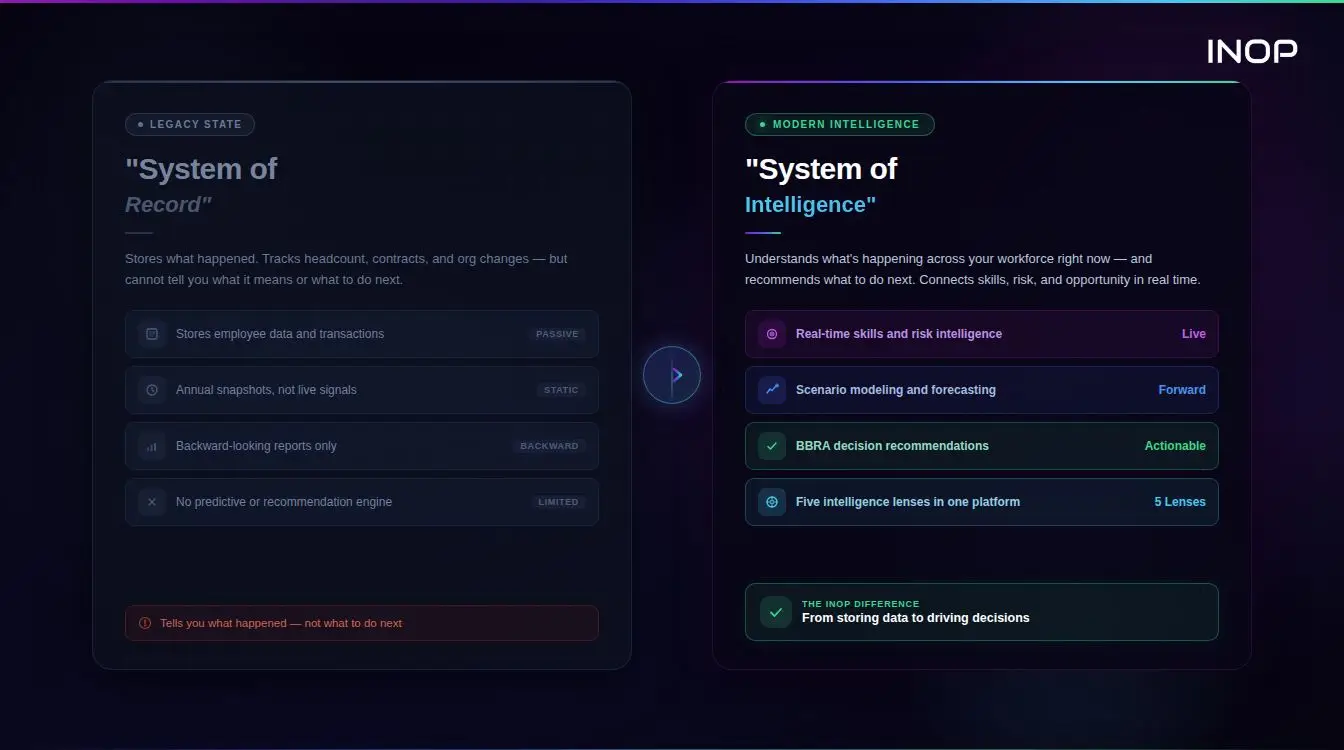
AI-driven skills identification works by analyzing patterns most managers never see: project history, cross-functional contributions, learning activity, and collaboration data, then mapping those signals against a structured skills taxonomy. This is how modern platforms identify hidden employee skills at scale: not by asking employees to self-report, but by inferring capability from what they’ve actually done. Platforms like INOP’s Skills Intelligence apply this at the organizational level, tracking four signal states, Emerging, In Demand, Stable, and Declining, so HR teams can see not just who has hidden skills, but which of those skills the business will actually need next.
These tools remove bias, uncover hidden capabilities, and allow employees to self-nominate for opportunities — all while saving HR teams countless hours.
Organizational Network Analysis: Surfacing Hidden Talent Through Relationships
One of the most powerful and underused tools for identifying hidden talent is organizational network analysis (ONA) — a methodology that maps the informal relationships, communication patterns, and collaboration networks inside an organization to reveal influence, knowledge flow, and capability that formal org charts completely miss.
In a standard org chart, talent visibility is determined by reporting lines. In a network analysis, talent visibility is determined by who is actually sought out, relied upon, and connected to across the organization. Employees who appear mid-level by title but sit at the center of a large, cross-functional communication network are almost always performing a coordination, facilitation, or knowledge-brokering role that their job description doesn’t capture.
ONA tools analyze collaboration data from communication platforms, project management systems, and calendar records (with appropriate privacy governance) to produce a map of who is connecting whom, which employees are bridging disconnected parts of the organization, and where information and influence are actually flowing. Microsoft Viva Insights, Humanyze, and Worklytics are platforms that offer organizational network analysis features in enterprise environments.
These are the tools that surface hidden talent through network analysis rather than through a static org chart. Where an org chart identifies hidden talent within company hierarchies by reporting line, ONA identifies it by actual influence and information flow, which is a fundamentally more accurate picture of who is really driving outcomes.
The talent implications are direct: employees who serve as informal connectors — bridging engineering and product, linking regional teams to headquarters, or connecting new employees to institutional knowledge — are demonstrating organizational intelligence and relational capability that are among the strongest predictors of leadership potential. ONA makes this capability visible before it ever shows up in a performance review.
The Hidden Talent Assessment Matrix
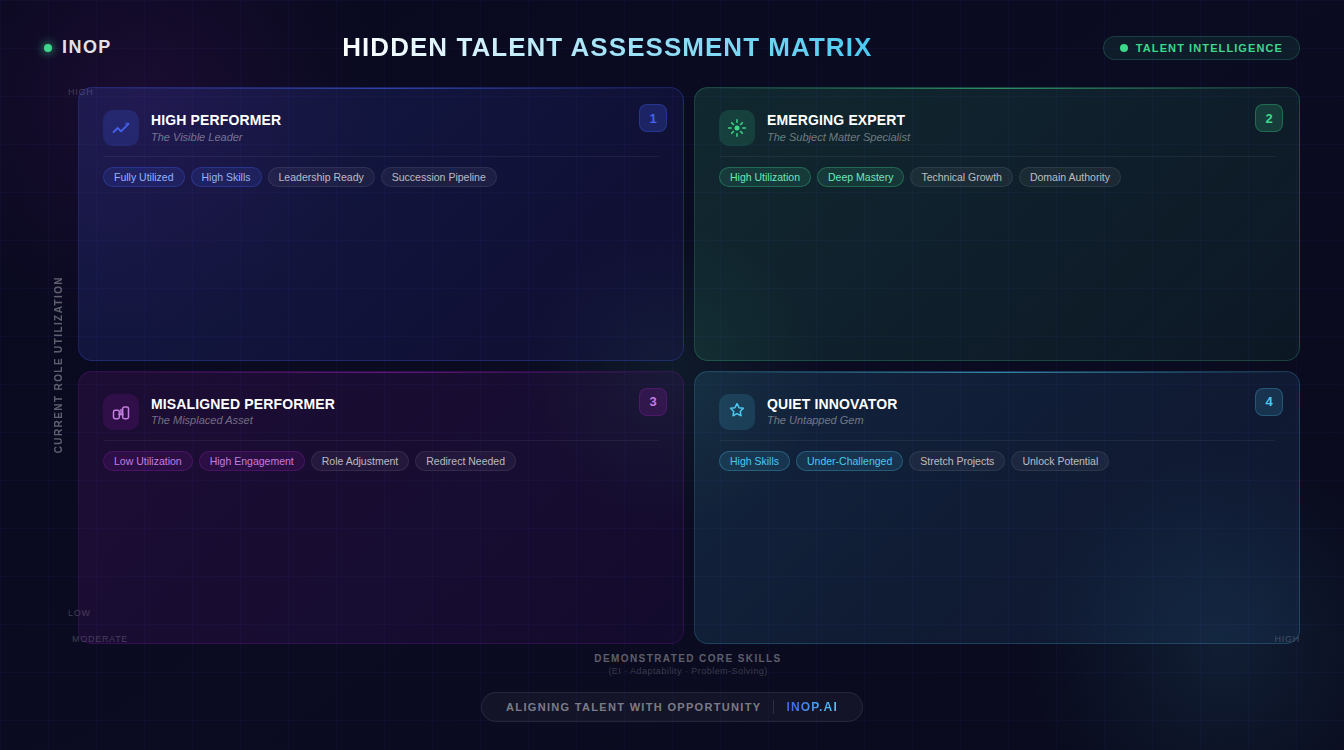
One of the most effective ways for HR leaders and managers to systematically identify untapped potential is by utilizing a Hidden Talent Assessment Matrix. While traditional 9-box grids focus strictly on past performance versus expected potential, a hidden talent matrix maps Current Role Utilization against Demonstrated Core Skills (such as emotional intelligence, adaptability, and cross-functional problem solving).
By plotting your team on this matrix, you can quickly identify:
• The Quiet Innovators: High core skills, but low utilization in their current role. These employees are bored and at risk of leaving if not challenged.
• The Misaligned Performers: Moderate to low performance in their daily tasks, but high engagement in cross-departmental projects. They aren’t bad employees; they are just in the wrong seat.
Barriers That Keep Talent Hidden
When Talent “Goes Stealth”: Recognizing the Warning Signs
One of the most costly and underrecognized talent risks in any organization is what practitioners call talent going stealth — the quiet disengagement of high-potential employees who stop demonstrating their capabilities because they’ve stopped believing the organization will recognize or reward them.
Unlike a formal resignation, stealth disengagement is invisible in standard HR metrics. Performance doesn’t collapse — it plateaus. Attendance remains consistent. But contribution contracts sharply, and your most capable people begin redirecting their energy toward external opportunities or personal projects.
Signs that a high-potential employee has gone stealth:
- They stop volunteering for stretch projects they previously pursued
- Their contributions in meetings become minimal and transactional
- They no longer initiate conversations with senior leaders
- Their learning and development engagement drops
- They begin taking more frequent, shorter absences
How to track when talent goes stealth
The best way to track when talent goes stealth is through behavioral data, not opinion surveys. Modern talent analytics platforms monitor patterns like declining participation in cross-functional collaboration, reduced learning and development activity, and shrinking internal network interactions, all leading indicators that precede formal attrition by months. Manager instinct alone catches this too late; by the time disengagement is visible in a one-on-one, the employee has often already disengaged for weeks.
Managers can supplement data signals with a simple practice: maintain a “30-day check-in rhythm” with every high-potential employee on their team. Not a formal review — just a brief, genuine conversation about what they’re working on and what they’d like to work on next.
The best way to keep talent from going stealth is to make visibility the default, not the exception.
To successfully spot hidden talent, you must also remove the blockers. Common obstacles include:
Organizational Silos
Departments operating in isolation limit opportunities for talent to surface beyond their immediate team.
Unconscious Bias
Managers may overlook talent that doesn’t fit traditional molds — in terms of communication style, background, or education.
Rigid Job Descriptions
Narrow definitions of roles discourage people from stretching or applying different skills.
Overloaded Managers
This managerial blind spot is well documented at a generational scale. According to the Deloitte 2025 Gen Z and Millennial Survey, many younger workers feel their managers focus more on supervising daily tasks than nurturing development. When managers are stretched thin and focused on output rather than growth, the hidden capabilities of their teams stay hidden. The result is not just missed potential; it is accelerated attrition, since learning and development opportunities rank among the top reasons Gen Z and millennials choose to stay with an employer.
When leaders are overwhelmed, they default to the status quo and may not take time to look beyond obvious performers.
Hybrid and Remote Work Structures
The shift to hybrid and distributed work has significantly amplified the hidden talent problem. Most talent-spotting mechanisms, informal observation, skip-level visibility, spontaneous hallway conversations, depend on physical proximity. In a hybrid environment, those signals disappear for anyone not regularly in the office.
Research from Microsoft’s 2022 Work Trend Index found that managers are more likely to perceive remote and hybrid employees as less productive than in-office peers, regardless of actual output. The employees most affected are often the same profiles most likely to have hidden potential: introverts, early-career contributors, and those from cultural backgrounds where self-promotion is not the norm.
In distributed teams, talent visibility is no longer a byproduct of being present, it requires deliberate infrastructure. Collaboration platforms, asynchronous skills profiles, and structured internal opportunity boards matter more, not less, in remote-first or hybrid organizations.
Lack of Career Visibility
Employees can’t show potential if they don’t know what’s possible. Transparent career paths are crucial.
Why Cultural Fit Criteria Hide More Talent Than Any Other Barrier
Of all the barriers that keep internal talent invisible, the most structurally embedded is also the least examined: the informal cultural criteria that shape which employees get noticed, nominated for opportunities, and flagged as high potential. These criteria rarely appear in a written policy. They operate through the judgments managers make when deciding who gets stretch assignments, who gets invited to present to leadership, and who gets described as “not quite ready” without further explanation.
The same bias that distorts external hiring decisions runs through internal talent identification. The problem with hiring for cultural fit is not unique to recruitment. It is replicated inside organizations wherever evaluation relies on informal impression rather than structured behavioral criteria. An employee whose communication style differs from the prevailing norm, whose background is less familiar to their manager, or whose strengths do not match the dominant model of what “talent” looks like in that organization can demonstrate high capability for years without ever being recognized for it.
This is why internal mobility programs and hidden talent initiatives frequently underperform despite genuine organizational intent. The tools designed to surface internal talent still rely on manager nominations and cultural pattern-matching, which means they replicate the same filters that kept that talent hidden in the first place. Replacing informal nomination with structured, criteria-based identification processes removes the cultural filter without removing the standards, and consistently uncovers capability that the nomination model would have missed.
Building a Culture That Nurtures Hidden Talent
It’s one thing to find hidden talent — it’s another to help it thrive. Here’s how to foster a culture that unlocks it:
Promote Internal Mobility
Encourage lateral moves, cross-functional projects, and internal applications. Spotlight stories of employees who changed paths successfully.
Invest in Mentorship & Coaching
Mentors help employees see potential in themselves and build confidence to grow.
Customize Development Plans
One-size-fits-all learning doesn’t work. Tailor growth plans to stretch skills and support aspirations.
Recognize Contribution, Not Just Titles
Celebrate innovation, collaboration, and problem-solving — not just promotions or sales wins.
Explore more: Building Skill based organisation Complete Guide
Activate Hidden Talent with a Visible Problem to Solve
Recognition and development plans matter, but neither activates hidden talent as fast as giving someone genuine ownership of a meaningful problem. There is a critical difference between adding to someone’s workload and giving them a deliverable with real stakeholder visibility and decision authority.
The activation sequence that consistently works: identify the individual, match them to a problem that slightly exceeds their current scope, give them direct access to the stakeholders involved, and make the outcome attributable to them by name. Then repeat it. Two or three cycles of this shifts how the organization perceives someone, from “reliable contributor” to “someone we should be investing in”, faster than any formal program.
The risk of not doing this is real. Organizations that identify hidden talent but fail to act quickly enough lose those employees to companies that will. The window between recognition and attrition is shorter than most leaders assume.
Talent Visibility: Making Hidden Capability Permanently Visible
Talent visibility is the organizational state in which employee capabilities — not just job titles and performance ratings — are consistently surfaced to the people making talent decisions. It is the structural answer to the hidden talent problem: instead of relying on managers to notice and advocate for undiscovered employees, talent visibility creates systems where capability data is accessible, searchable, and connected to opportunity.
Organizations with strong talent visibility share three characteristics. First, they maintain a live skills inventory that goes beyond job descriptions — documenting what employees can actually do, including capabilities developed outside the current role. Second, they make internal opportunities visible to all employees, not just those already known to hiring managers. Third, they actively attribute outcomes to individuals — when a cross-functional project succeeds, the contributors are named and recognized in ways that update the organization’s understanding of who has what capability.
The practical tools that create talent visibility range from internal talent marketplaces and skills-based profiles in HRIS systems to structured “talent spotting” meetings where managers share observations about team members’ emerging capabilities with peers and leadership. The technology matters less than the habit: organizations that talk about their people’s capabilities — not just their titles and performance scores — consistently surface hidden talent faster and retain it longer.
How to Discover Your Own Hidden Talent at Work
The strategies for identifying hidden talent apply from both directions. Managers look outward across their teams; employees who understand this process can take a more deliberate role in making their own capabilities visible, which benefits both them and their organization.
Reflect on What Feels Effortless
Hidden talent often disguises itself as “just the way I think” or “something anyone could do.” If you find yourself finishing certain types of tasks significantly faster than colleagues, explaining complex ideas in ways others struggle to, or naturally gravitating toward problems that others avoid, that ease is a signal worth examining. What feels routine to you may be genuinely unusual organizational capability.
Look at What Colleagues Ask You For Informally
The requests that come to you outside your job description are among the most reliable indicators of hidden talent. If people regularly ask you to review their writing, explain a technical concept, mediate a team disagreement, or build a quick analysis — those informal requests are the organization’s unconscious recognition of your capability. Keep a log of these requests for a month. The pattern will reveal something your job title does not.
Review Your History Before Your Current Role
Past careers, education, side projects, and community involvement all carry skills that the current role may never have asked for. A teacher who moved into operations brings instructional design and behavior management capability. A former athlete brings performance under pressure and coaching instinct. A volunteer project leader brings fundraising, stakeholder management, and organizational skills. These prior-life capabilities are the most commonly overlooked category of hidden talent in any workforce.
Ask Your Manager Directly and Ask the Right Question
Rather than asking “how am I doing?”, try: “Is there a problem in this organization that you think I could help solve that has nothing to do with my current role?” This question invites the manager to think about your capability rather than your performance, and often produces a very different, more revealing answer.
Internal Talent Marketplace vs. Traditional Succession Planning
Historically, organizations relied on traditional succession planning to move talent upward. However, succession planning is strictly vertical and heavily biased toward employees who are already highly visible to upper management. It does not spot hidden talent.
To solve this, modern companies are deploying an Internal Talent Marketplace. An internal talent marketplace is an AI-driven platform where employees can create profiles highlighting their full range of skills, not just their job titles. Managers can then post short-term gigs, cross-functional projects, or mentorship opportunities to this marketplace.
The platform’s algorithm automatically matches the project with the internal employees who possess the exact skills required, completely bypassing department silos and manager bias. This democratizes career advancement and ensures that the quiet, hidden talent on your team is given an equal opportunity to shine.
Conclusion: Start Looking Inward First
To build a resilient workforce capable of mastering the [emerging skills of 2030], you don’t always need to look outside. You may already have what you need, if you know how to spot hidden talent effectively.
Start by creating a culture where curiosity is encouraged, data informs decisions, and everyone has the opportunity to grow beyond their job title. Your next game-changer might already be on the team, quietly waiting to be noticed.
Are you ready to unlock the full potential of your workforce? Start by paying closer attention to what’s already within reach.
Frequently Asked Questions
What does “hidden talent” mean in an organization?
Hidden talent refers to the skills or potential an employee possesses that are not yet visible or utilized in their current role.
Why is it important to spot hidden talent?
It helps with internal mobility, reduces turnover, lowers recruitment costs, and improves workforce agility and engagement.
How can I identify hidden talent in my company?
Use skills assessments, observe informal leadership behaviors, gather 360-degree feedback, and track data like learning engagement and cross-functional involvement, ideally through a structured process rather than manager judgment alone.
What tools help in spotting hidden talent?
Talent analytics platforms, performance management software, and internal mobility tools that map skills and match people to opportunities.
What is the best way to track when talent goes stealth?
Behavioral data, not surveys. Watch for declining participation in cross-functional work, dropping L&D engagement, and shrinking internal network activity. These signals typically appear months before a formal resignation.




One reply on “Hidden Talent Meaning, signs of hidden talents, and How to Identify It at Work”
[…] cost goes beyond engagement. When managers are absorbed by supervision, the hidden talent inside their teams never surfaces, and capable people leave before anyone notices what they could […]