AI workforce automation is the use of AI systems, agents that plan, reason, and complete multi-step tasks rather than follow a fixed script, to take on work people currently do. It differs from older rules-based automation in one specific way: an AI agent can handle a task that changes shape mid-stream, pull from multiple tools, and make a judgment call about what to do next. That capability is why so many companies have already deployed agents. It is also why so few have gotten them running reliably in production.
This guide covers what separates AI workforce automation that holds up from a pilot that gets quietly shelved, why governance decides more of that outcome than the underlying model does, and how to treat an AI agent deployment as a real workforce decision instead of a technology purchase.
What AI Workforce Automation Means
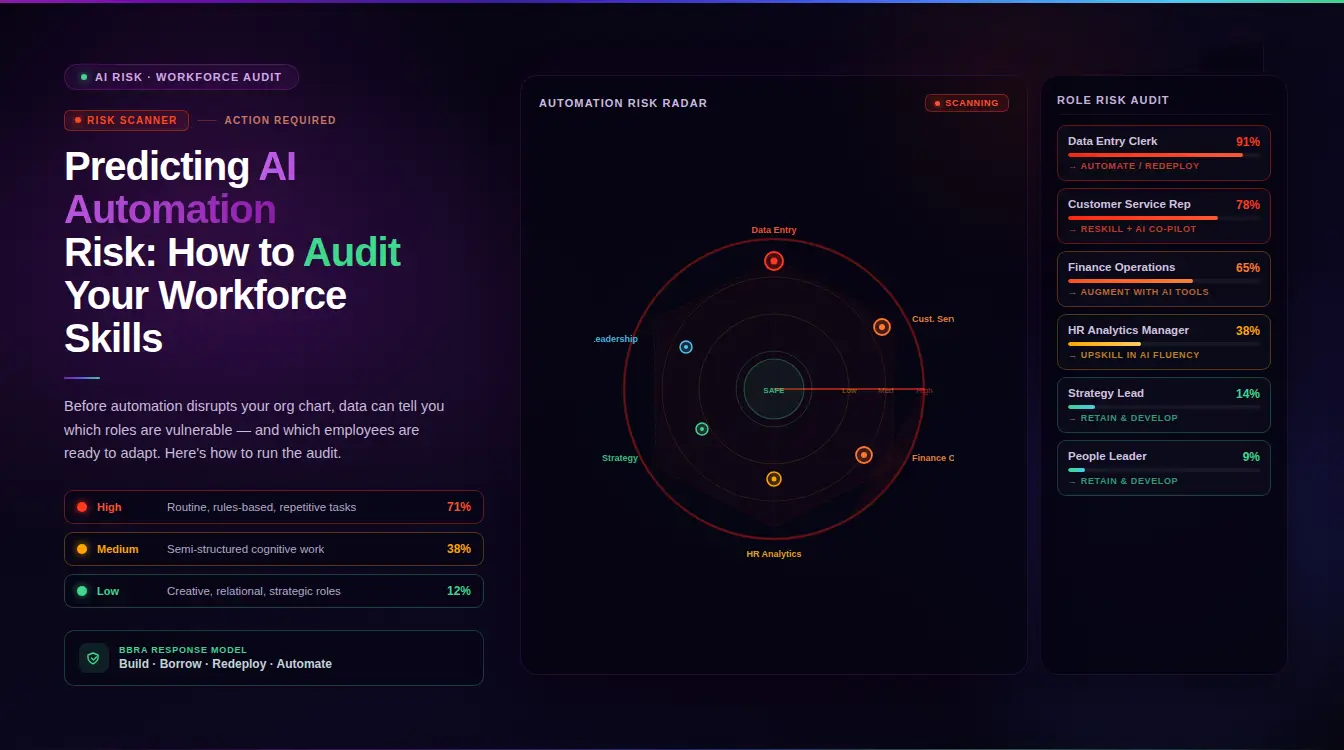
An AI agent is not a chatbot with extra steps. Give it a goal and it plans a sequence of actions, calls tools, checks its own output, and adjusts when the first approach fails. That’s the shift from earlier automation: robotic process automation follows a script written in advance. An AI agent decides the script as it goes. Enterprise software has already started reflecting this. Around 40 percent of enterprise applications are expected to embed some form of AI agent this year, up from under 5 percent a year earlier.
Adoption Outpaced Production, and the Gap Is Wide
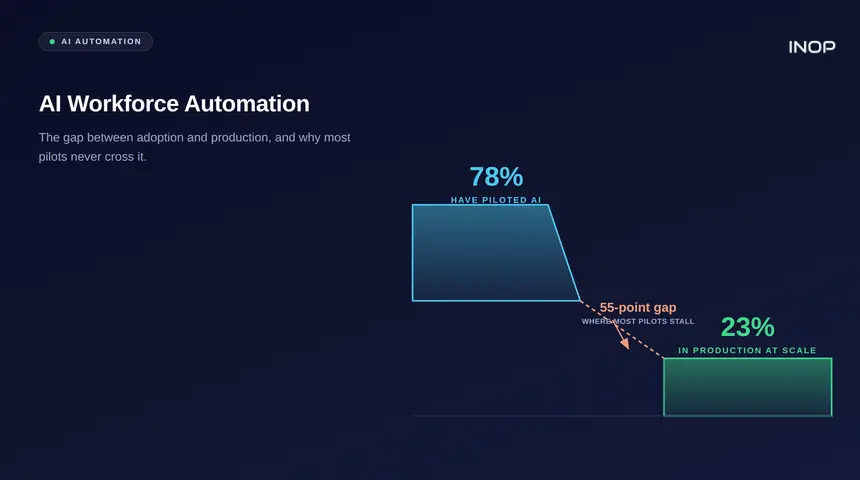
Almost every large company has run an AI agent pilot. Far fewer have one running in production doing real work without a human catching every mistake. GRFA’s 2026 tracking puts enterprise agent adoption at 79 percent and production deployment at 11 percent, a gap wide enough that Gartner expects more than 40 percent of current agentic AI projects to get canceled before they reach that stage. The pattern shows up everywhere: companies buy the technology, run a demo that impresses a steering committee, then discover that turning a demo into something a business unit can depend on every day is a different problem entirely.
Cost pressure explains part of the rush. It doesn’t explain the abandonment rate. The World Economic Forum projects that 41 percent of employers plan to reduce headcount by 2030 as agents take on more task volume, which tells you the economic case for automation is real. What it doesn’t tell you is why so many of those same organizations can’t get an agent past the pilot stage once the demo ends.
See how INOP scores which tasks are ready for AI workforce automation. Book a demo to walk through a live view for your organization.
Why Governance Decides Which Pilots Survive
Gartner, Deloitte, and IBM all point to the same constraint on scaling agentic AI: governance, not model quality. An agent that hallucinates a tool call, takes an action nobody authorized, or exposes data it shouldn’t have touched does more damage in a week than a slow rollout costs in a year. IBM’s own incident tracking found enterprises facing an average of 54 AI-agent incidents annually, more than a third of which led to data exposure or a breach. That number explains why a working pilot so often stalls before scaling: the team running it discovers, usually the hard way, that nobody built the guardrails an autonomous system needs.
The fix isn’t slower adoption. It’s matching the architecture to the task. Route agents toward work where autonomous judgment adds real value, keep simple retrieval on assistants, and leave rules-based workflows to standard automation instead of forcing every task through an agent because the technology is available. Organizations that make this distinction consistently outperform the ones deploying agents everywhere at once.
Why the Economics Change Task by Task
An agent that works well in one function can lose money in another, and the difference usually comes down to two things: how expensive mistakes are in that domain, and how much human review the task still needs even after automation. Customer service agents, for instance, deliver measurable value fast because a wrong answer is cheap to catch and correct. Financial reconciliation or contract review carries a much higher cost per error, which means the same agent architecture that pays for itself in one department can run at a loss in another because the review overhead never drops.
This is also where a purely technical automation-potential score misleads. A task can score high on what an agent is capable of doing and still fail the economic test once governance, review time, and error cost get counted in full. Running the cost comparison before deployment, not after the first incident, is the difference between an agent program that pays for itself and one that bleeds budget while looking productive on a dashboard.
INOP’s Five Intelligence Lenses Applied to AI Workforce Automation
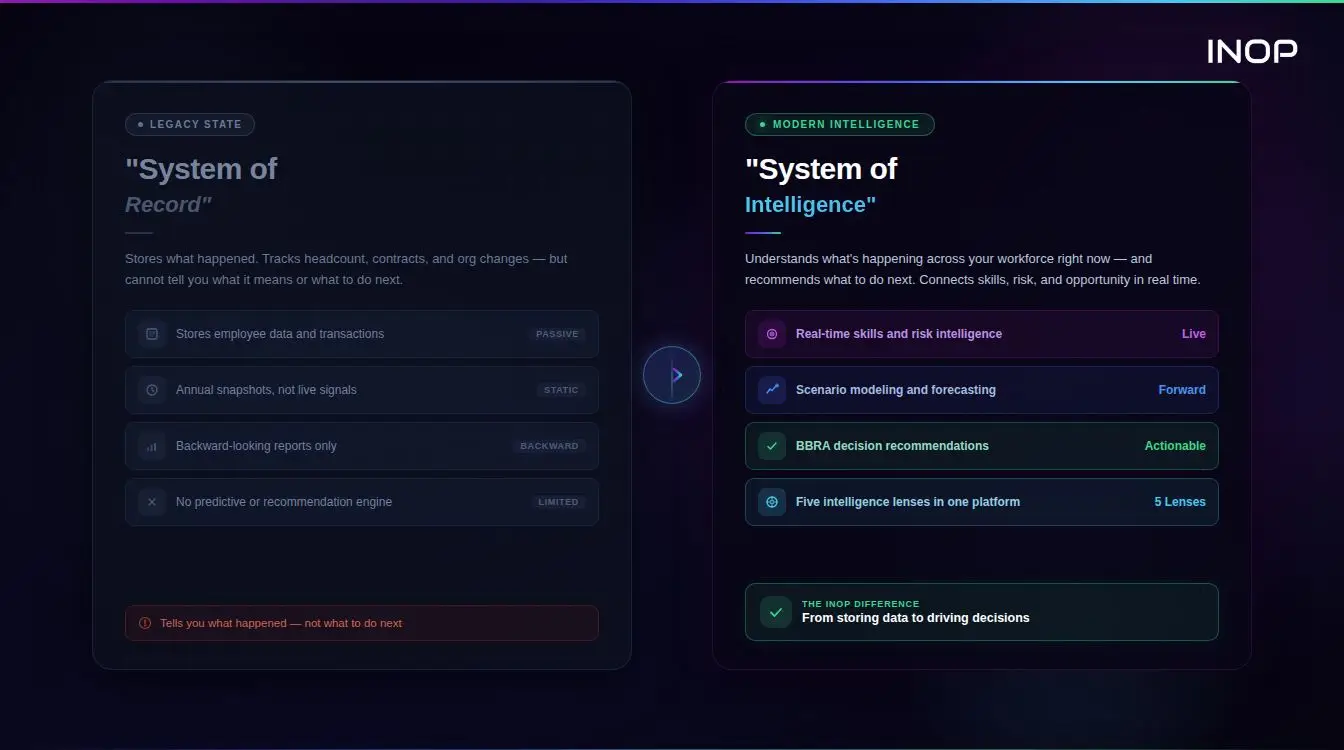
Technical readiness for an AI agent is one input. INOP runs every AI workforce automation decision through five intelligence lenses before it becomes a rollout.
| Lens | What It Evaluates in an AI Workforce Automation Decision |
|---|---|
| Strategy | Whether the task sits on a path that matters to the business, not a task that merely happens to be technically automatable |
| Finance | The real deployment and governance cost against what the task currently costs to run with people |
| People | Who currently owns the task, and what happens to their capacity once an agent takes part of it over |
| Market | How fast agent capability in this specific domain is maturing, since some categories are far more reliable than others right now |
| AI and Automation | Whether this task needs agentic judgment, or whether a simpler, cheaper form of automation would do the job |
That last lens matters more than it looks. Trusting an agent’s recommendation without checking it is its own risk, one covered in more depth in INOP’s guide on AI automation bias and why over-trusting an automated output distorts workforce decisions.
BBRA: Deciding Where AI Agents Belong
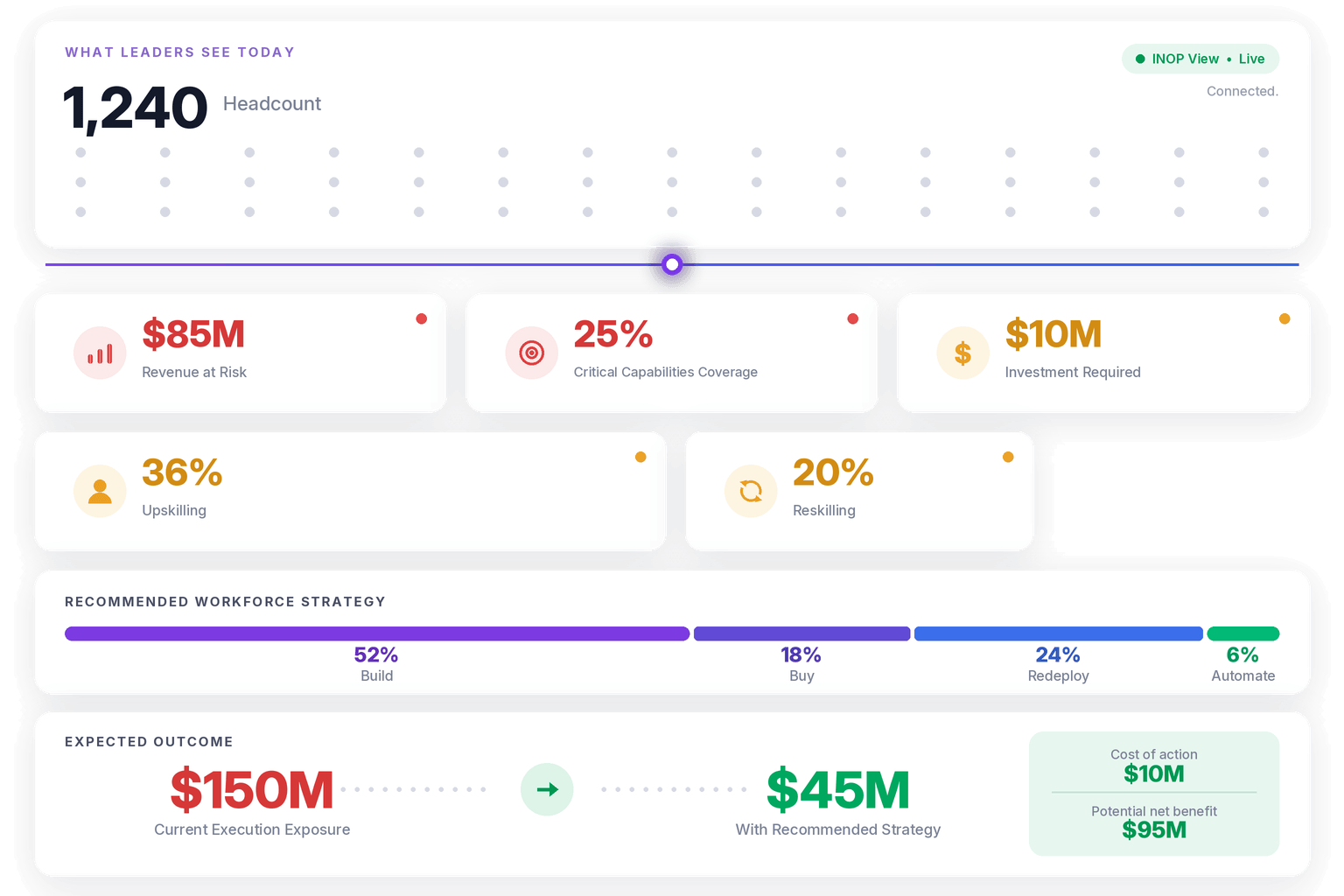
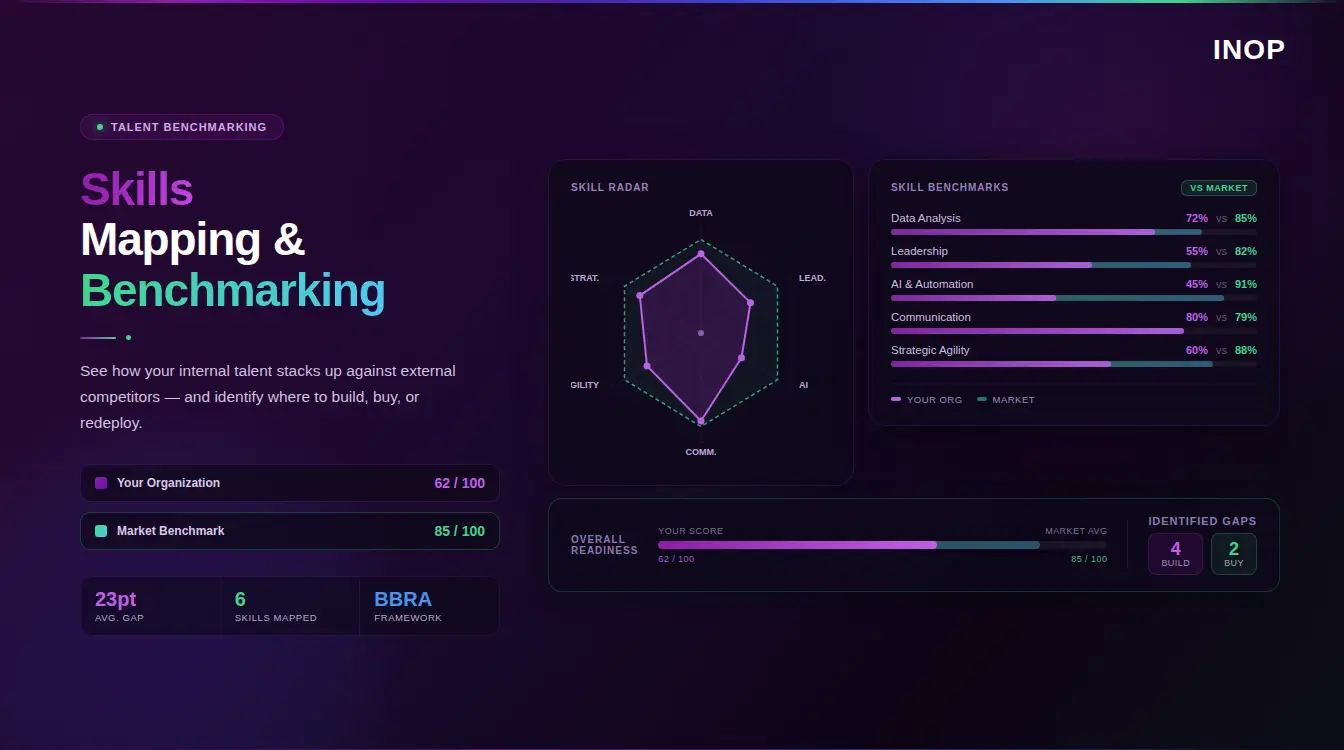
Once a task clears the five lenses, INOP’s proprietary BBRA framework, Build, Buy, Redeploy, and Automate, gives the deployment decision a real comparison instead of a default yes. BBRA weighs all four pathways against financial tradeoffs across four time horizons: thirty days, one hundred eighty days, one year, and three years.
A task can be technically ready for an agent and still be the wrong one to automate first. Redeploying the person who owns it might unlock more value elsewhere. Upskilling them to supervise the agent, rather than replacing them outright, might produce a better outcome over a year than either option alone. Buying a pre-built agent solution might close the gap faster than building one internally, depending on how specialized the task is and how much the organization already knows about it. Running that comparison, instead of automating whatever task looks easiest, is what separates the 11 percent of companies with agents in production from the 79 percent still stuck somewhere before it.
AI Workforce Automation for Private Equity Operating Partners
A portfolio company claiming AI-driven cost savings deserves a direct question: is the agent in production, or still in pilot. Given how wide the adoption-to-production gap runs across the broader market, a savings projection built on a pilot that hasn’t scaled is optimistic at best. Standardizing this check across a portfolio through INOP’s strategic workforce planning platform gives operating partners a consistent way to separate real, production-grade AI workforce automation from a demo that impressed a steering committee once and never went further.
Common Mistakes in AI Workforce Automation
Treating a working pilot as proof the deployment will scale. A pilot succeeds under close supervision and a narrow scope. Production means the agent runs without someone watching every output, a much higher bar most pilots were never built to clear.
Skipping governance until after something breaks. Governance built in after an incident costs more than governance built in before deployment, and it costs the organization trust it doesn’t get back easily.
Deploying agents everywhere instead of matching architecture to task. Not every task needs autonomous judgment. Forcing simple retrieval or rules-based work through an agent adds cost and risk for no real benefit over simpler automation.
Left alone, it drifts back into the same low-value tasks the automation was supposed to eliminate. What determines whether an AI deployment becomes genuine workforce transformation or a headcount efficiency claim with no lasting structural change is exactly this: whether the people, roles, skills, and culture dimensions are deliberately redesigned around the new human-AI configuration, or left to absorb the change informally. Left alone, it drifts back into the same low-value tasks the automation was supposed to eliminate.
Never verifying the skills behind the task being automated. INOP’s skills intelligence platform keeps the underlying skills and task data current against external market signals, so a deployment decision reflects where a skill stands now rather than an assumption from six months ago.
This failure pattern is not unique to AI automation projects. It runs through workplace transformation efforts more broadly. INOP’s guide on workplace transformation strategy documents the same dynamic: organizations that define quantified success metrics before approving a redesign achieve a 54% success rate, compared with 12% for those that do not. The automation-specific version of this mistake, committing to an AI deployment without a verified financial model behind the expected savings, is the same mistake at a smaller scope.
Frequently Asked Questions
What is the difference between AI workforce automation and traditional automation?
Traditional automation follows a fixed script written in advance. AI workforce automation uses agents that plan a sequence of actions, adjust when something fails, and handle tasks that change shape mid-stream, capability rules-based automation was never built to handle.
Why do so many AI agent pilots fail to reach production?
Governance, more often than the underlying model. A pilot running under close supervision hides gaps that only show up once the agent runs unsupervised at scale, and most organizations discover those gaps after deployment rather than before.
Which tasks are the best candidates for AI workforce automation?
Tasks where autonomous judgment adds real value, not every task that happens to be technically possible to automate. Simple retrieval and rules-based workflows are usually better served by an assistant or standard automation than a full agent.
What happens to employees once their tasks get automated by an agent?
Their remaining capacity needs a deliberate plan, redeployment, upskilling to supervise the agent, or in some cases a genuine reduction, modeled against the alternatives rather than assumed to sort itself out.
How should private equity operating partners evaluate a portfolio company’s AI workforce automation claims?
By asking whether the deployment is running in production or still in pilot. Given current adoption-to-production gaps across the market, a savings estimate built on pilot results alone is likely to overstate what the company will realize.
Ready to see which tasks in your workforce are ready for AI automation, and which aren’t? Book a demo and INOP will walk through the five-lens model and BBRA, live.