What is workforce transformation? It is the deliberate, ongoing redesign of an organization’s people, roles, skills, and culture to keep pace with how work itself is changing, rather than a single restructuring, a training rollout, or a new software rollout treated as a finished project. Most explanations stop at a definition and move straight to a list of benefits. The more useful starting point is understanding why it touches four different dimensions of the organization at once, and why, unlike most initiatives, it does not have a natural end date.
This guide covers a clear definition of workforce transformation, the four dimensions it has to address simultaneously, how it differs from related terms like workplace transformation and digital transformation, and how to move from understanding the concept to actually executing it.
What Is Workforce Transformation?
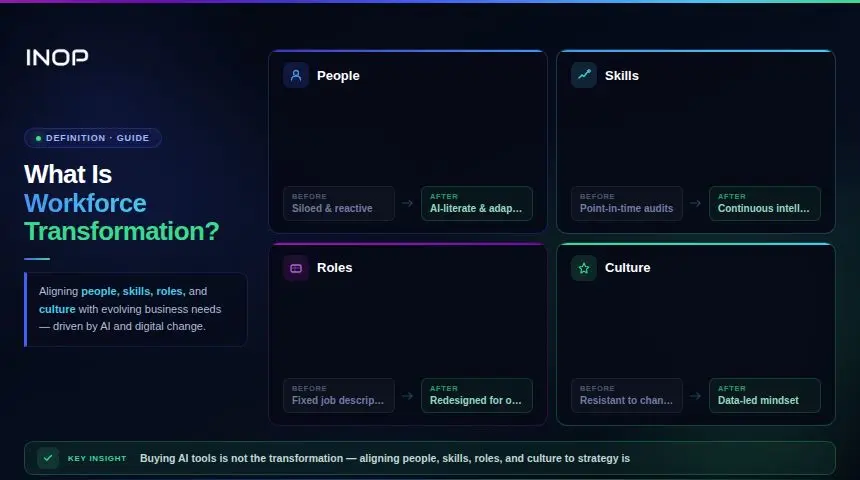
Workforce transformation is the structured process of realigning an organization’s people, skills, roles, and culture with evolving business needs, driven by shifts in technology, market conditions, and strategy. It connects workforce planning directly to business goals rather than treating talent decisions as a downstream HR function, and it uses current data, not last year’s org chart, to decide where investment in people should actually go. When managed effectively, it helps organizations close critical skill gaps, improve productivity, support internal career growth, and prepare employees for roles that do not exist yet. The same research is clear that transformation is more than digital upgrades or a reorganization on an org chart. It is about preparing the workforce to meet a future business need head on, not simply reacting once that need has already arrived.
The Four Dimensions Workforce Transformation Touches
Workforce transformation does not happen in a single department or through a single initiative. Organizations that do it well tend to focus on four areas simultaneously, since progress in one dimension without the others rarely holds.
People and Skills
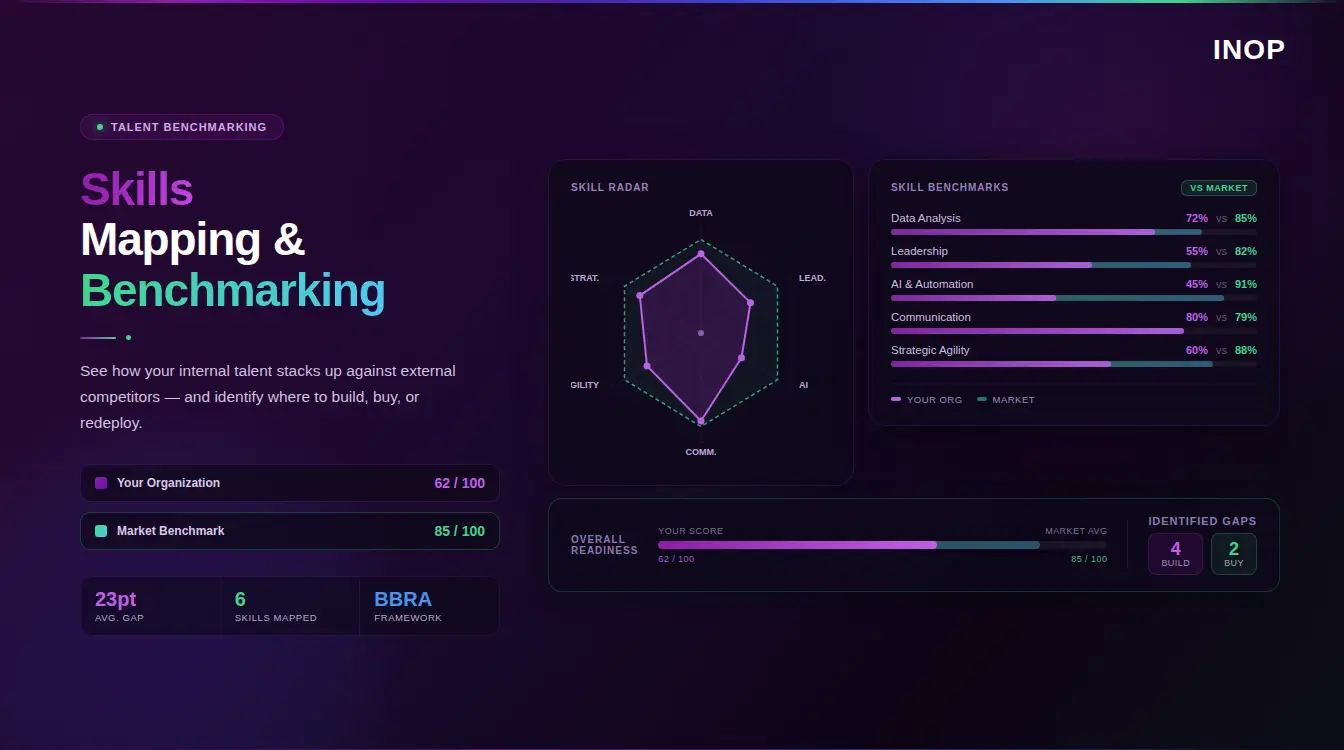
This is the dimension most people mean when they first hear the term: identifying which skills the organization needs now and will need soon, then closing that gap through targeted upskilling, reskilling, or new hiring rather than a generic training catalog assigned company-wide. Doing this accurately requires more than an internal skills inventory, since an organization only knows part of the picture without checking those skills against what is actually happening in the external labor market. INOP’s skills intelligence platform supports this dimension directly by mapping external demand signals against your existing skills taxonomy, so the people and skills dimension of transformation is grounded in current market reality rather than internal assumption.
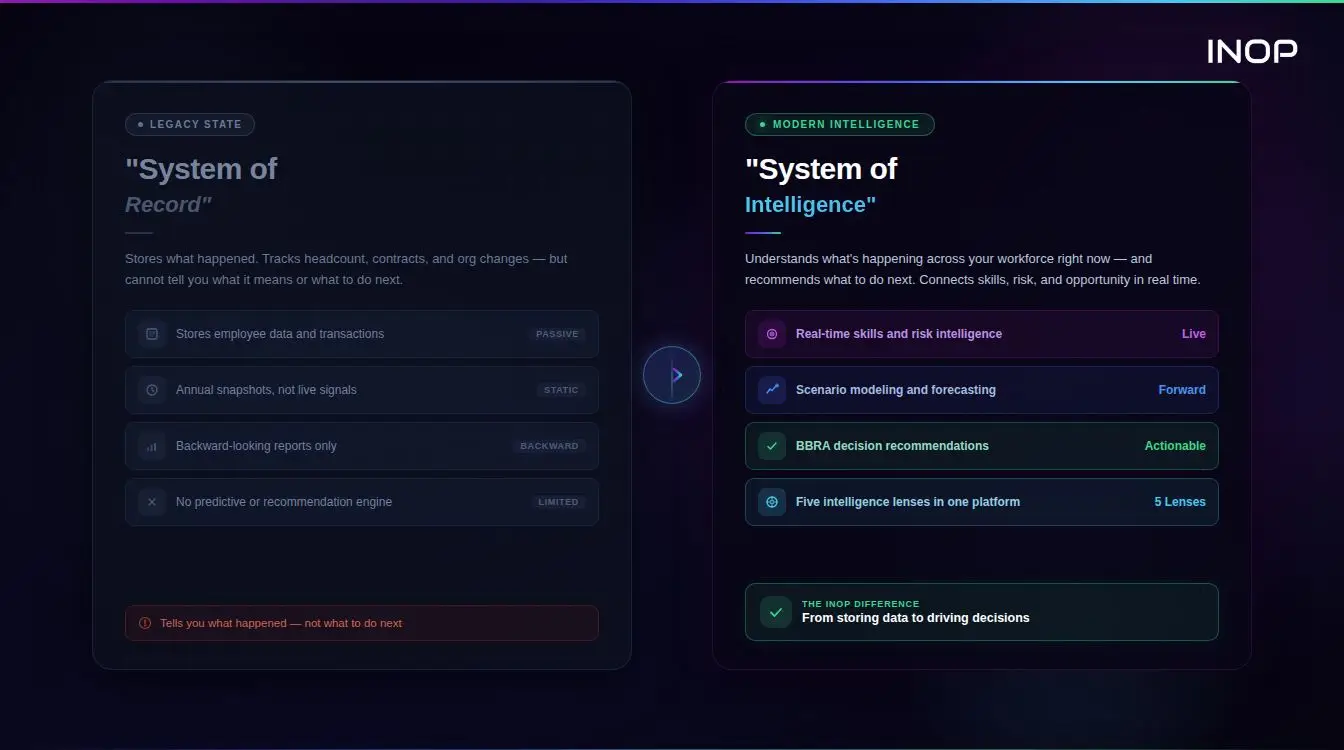
The operational discipline that runs this process continuously rather than as a periodic project is workforce optimization: the matching of capacity to demand in real time, using skills data, deployment decisions, and BBRA-structured gap analysis to keep the workforce aligned with what the business needs it to do at any given moment. Transformation describes the direction of change. Optimization is what keeps the organization on that trajectory between transformation cycles.
Roles and Structure
As required skills shift, the roles built around them have to shift too. Some roles expand, some narrow, and some get restructured entirely around a new combination of responsibilities that did not exist as a single job a few years earlier.
Technology and Tools
New technology, AI systems especially, changes what a role actually requires day to day. Workforce transformation treats technology as an input that reshapes work, not as the transformation itself, a distinction that separates genuine transformation from a tool rollout mistaken for one.
Adoption numbers alone do not capture whether this dimension is being addressed. Roughly 88% of organizations report regular AI use in at least one function, yet only 23% of leaders say their workforce is fully AI ready, and that readiness gap is widening. Building an AI enabled workforce is what the Technology and Tools dimension of transformation actually requires: not just deploying tools, but embedding the skills, governance, and cultural infrastructure that determines whether those tools change outcomes rather than usage statistics.
Culture and Adoption
The dimension most often skipped is also the one that determines whether the other three actually stick. Redesigned roles and new tools mean little if the culture around them does not support people actually adopting the change, which is why culture functions as the multiplier on everything else rather than a separate, optional workstream. Workforce agility, the ability to reallocate people across teams or functions in real time without chaos, is what actually separates organizations that can absorb disruption from those that cannot, and that agility depends almost entirely on whether the surrounding culture supports fast, well-communicated change rather than resisting it by default.
See how INOP connects all four dimensions of workforce transformation to a single decision layer. Book a demo to walk through a live view for your organization.
Why Workforce Transformation Never Really Ends
Unlike a single restructuring or a one-off training push, workforce transformation does not really conclude, because the forces driving it, industry shifts, technological change, evolving business strategy, keep replacing and reinforcing each other over time. The scale of what is driving this is not marginal. The World Economic Forum projects that by 2030, AI-powered disruption will affect 22 percent of all roles worldwide, with roughly 170 million new jobs created and 92 million displaced, a net gain of about 78 million positions globally but a massive amount of underlying churn inside that net figure, according to recent research on workforce transformation. An organization that treats transformation as a project with a defined end date is planning for a version of stability that current labor market data does not actually support.
Workforce Transformation vs Workplace Transformation vs Digital Transformation
These three terms overlap enough to cause real confusion, and the distinctions matter for deciding what to actually plan for. Workforce transformation focuses on who does the work, roles, skills, and capacity. Workplace transformation focuses on how work happens, workflows, structure, and governance, covered in more depth in INOP’s guide on workplace transformation strategy. Digital transformation is narrower still, centered on migrating operations, data, and tools into digital and cloud environments. All three intersect constantly, since a redesigned workflow usually requires different skills to execute it, but treating them as interchangeable is how a plan ends up addressing only one dimension while assuming it covered all three.
INOP’s Five Intelligence Lenses Applied to Workforce Transformation
A workforce transformation initiative that addresses only one of the four dimensions above, usually skills, without the others tends to stall. INOP evaluates every stage of workforce transformation through five intelligence lenses to keep all four dimensions connected.
| Lens | What It Evaluates in Workforce Transformation |
|---|---|
| Strategy | Whether the transformation effort is tied to a specific business priority, not a general modernization goal |
| Finance | The real cost and payback of the redesign, compared across build, buy, redeploy, and automate pathways |
| People | Whether current employees can realistically develop into the roles the transformation assumes, and on what timeline |
| Market | Whether the skills the transformation targets are actually gaining or losing relevance in the external labor market |
| AI and Automation | Which parts of the redesign genuinely warrant new technology versus which still depend on human judgment |
BBRA: Turning Workforce Transformation From Concept to Decision
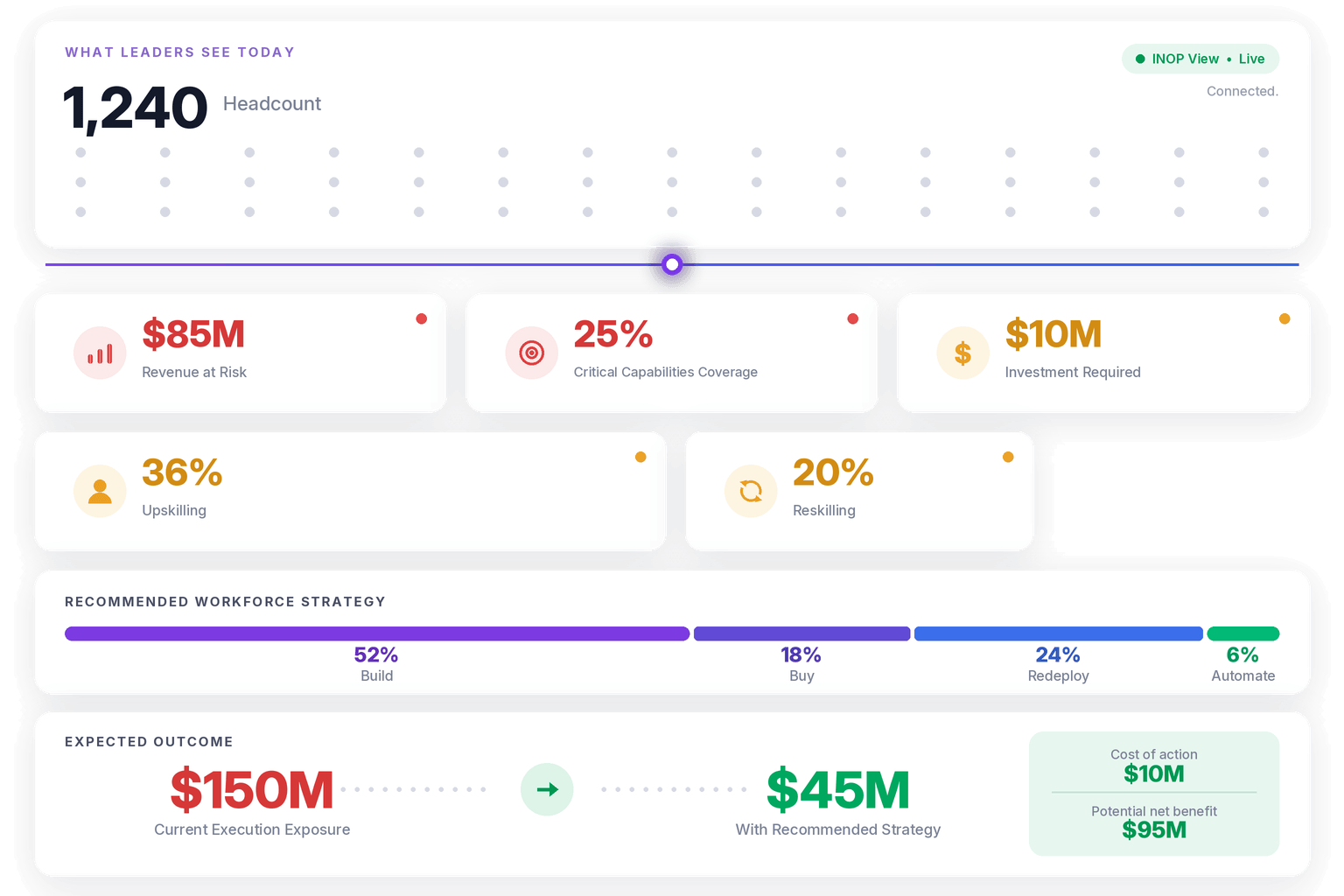
Understanding the four dimensions of workforce transformation is the starting point, not the plan itself. INOP’s proprietary BBRA framework, Build, Buy, Redeploy, and Automate, gives each specific gap identified during transformation an actual financial comparison, modeling all four intervention pathways against tradeoffs across four time horizons: thirty days, one hundred eighty days, one year, and three years.
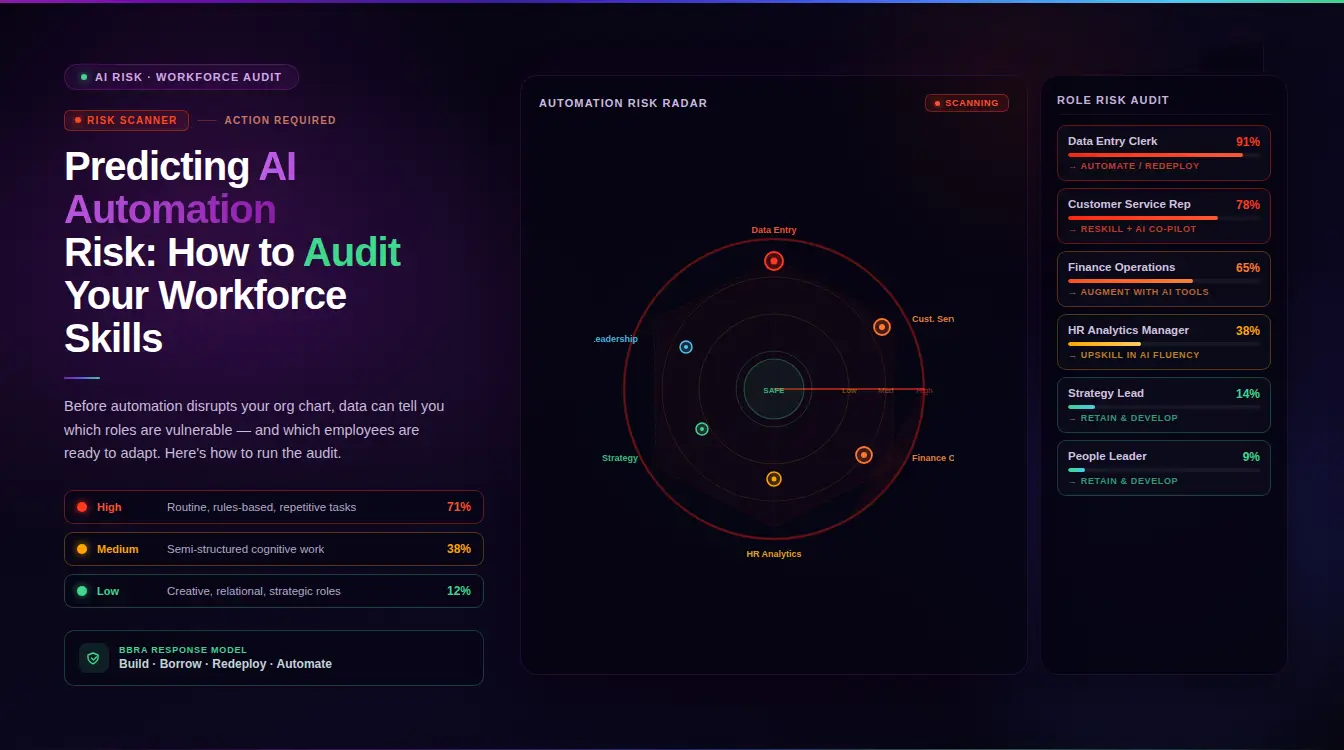
This is also where the difference between AI adoption and genuine transformation becomes concrete. Automation is not the transformation. It is what an organization does with the human capacity automation frees up, whether that capacity gets redirected toward higher-value work or simply cut, that determines whether real transformation happened. MIT’s research on enterprise AI pilots found that roughly 95 percent fail to deliver a measurable return, usually because companies treat AI as a technology purchase rather than a workforce redesign. For a deeper look at how AI-specific transformation efforts succeed or fail, INOP’s guide on AI transformation covers the data behind that gap in detail.
What Is Workforce Transformation for Private Equity Operating Partners
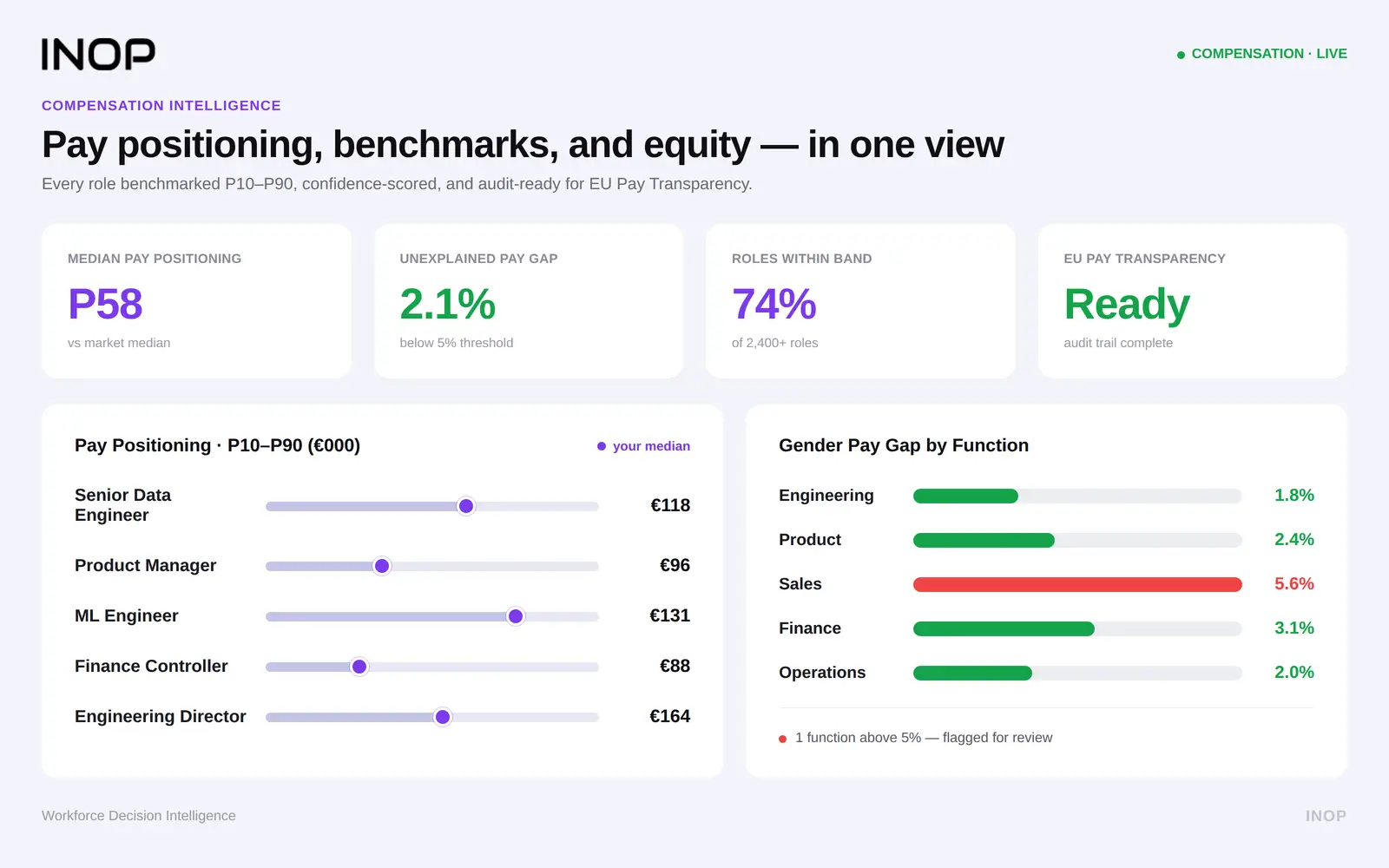
Inside a portfolio company, a workforce transformation claim deserves scrutiny across all four dimensions before it gets built into a value creation plan. A company reporting transformation progress that only shows movement in one dimension, new tools deployed, without corresponding change to roles, skills, or culture, is showing partial progress dressed up as complete transformation. Standardizing this evaluation across a portfolio through INOP’s strategic workforce planning platform gives operating partners a consistent way to check whether a portfolio company’s transformation claim covers all four dimensions or just the most visible one. Where transformation surfaces roles requiring scarce, high-demand capability, INOP’s compensation analytics platform connects that finding directly into pay benchmarking, since a redesigned role frequently carries a different market rate than the one it replaced.
Common Mistakes When Approaching Workforce Transformation
- Treating one dimension as the whole transformation. A technology rollout without corresponding change to roles, skills, and culture is a tool purchase, not workforce transformation, regardless of how the initiative gets labeled internally.
- Expecting a defined end date. Workforce transformation is continuous by nature, since the forces driving it, technology, market conditions, strategy, keep shifting. A plan built around a fixed completion date will look finished and stale at the same time.
- Confusing automation with transformation. Automating a task is an input into workforce transformation, not the transformation itself. What happens to the human capacity that automation frees up is what actually determines the outcome.
- Skipping the culture dimension. Redesigned roles and new technology stall without the cultural adoption to support them. Culture is frequently the most neglected of the four dimensions precisely because it is the hardest to measure directly.
- Not evaluating the build vs. buy decision for transformation support itself. Organizations often commit to self-directed transformation or commission a consulting engagement without explicitly comparing the two options. Workforce transformation consulting covers what that decision involves: what advisory support typically costs, where it adds genuine value that internal capability cannot replicate, and where a continuous data platform is a more cost-effective alternative across a three-year horizon.
Never connecting workforce transformation to an ongoing operating system. A transformation effort that produces a one-time redesign and no mechanism for keeping skills and roles current afterward reverts to static within a year or two. INOP’s guidance on workforce skills management covers how to keep the underlying skills and role data current on an ongoing basis, rather than treating transformation as a project with a finish line.
Frequently Asked Questions
What is workforce transformation in simple terms?
It is the ongoing process of reshaping who does work, what skills they need, how roles are structured, and how technology and culture support that change, driven by shifts in business strategy and market conditions rather than a single initiative with a fixed end date.
What is the difference between workforce transformation and digital transformation?
Digital transformation focuses narrowly on migrating operations, data, and tools into digital environments. Workforce transformation is broader, covering people, roles, skills, and culture, and often depends on digital transformation as one input among several rather than being defined by it.
Why does workforce transformation never really finish?
Because the underlying drivers, technological change, shifting market conditions, evolving business strategy, do not stop evolving. Treating transformation as a project with a completion date sets up an organization to fall behind again shortly after declaring the effort finished.
Is AI adoption the same as workforce transformation?
No. Buying and deploying AI tools is an input into workforce transformation, not the transformation itself. What determines whether real transformation occurred is what the organization does with the resulting change in capacity and capability, not the technology purchase alone.
How should private equity operating partners evaluate a portfolio company’s workforce transformation progress?
By checking whether progress spans all four dimensions, people and skills, roles and structure, technology, and culture, rather than accepting visible technology deployment as evidence that transformation has occurred across the organization.
Ready to see all four dimensions of workforce transformation connected to a single decision layer? Book a demo and INOP will walk through the five-lens model and BBRA, live.