Why boards and leadership teams must look beyond headcount reduction to understand execution risk, task exposure and value creation.
The P&L Trap
The financial case for enterprise AI is compelling. Automate work, increase productivity, reduce operating costs and create capacity for growth. For boards and executive teams under pressure to demonstrate returns on rapidly increasing AI investment, labour efficiency is one of the most visible parts of that equation. But it is also one of the easiest to misunderstand. Corporate investment in AI is accelerating faster than demonstrated enterprise returns. BCG’s 2026 AI Radar found that companies expected to roughly double AI spending from 0.8% of revenue in 2025 to around 1.7% in 2026. Yet PwC’s 2026 Global CEO Survey found that only 26% of CEOs reported lower costs from AI, while 56% reported neither revenue nor cost benefits. Just 12% reported both.
The problem is not that labour cost savings are irrelevant. They are measurable, financially material and, in some cases, a legitimate outcome of automation. The problem arises when they become a proxy for whether AI transformation is actually creating value. Reducing payroll can improve a cost line. It does not necessarily tell a board whether work has been redesigned effectively, whether critical capabilities have been preserved, whether productivity has increased, or whether the organisation is better positioned to execute its strategy. The distinction matters because AI does not transform organisations at the level of the job title. It changes the underlying work.
Roles Are Rarely Monolithic
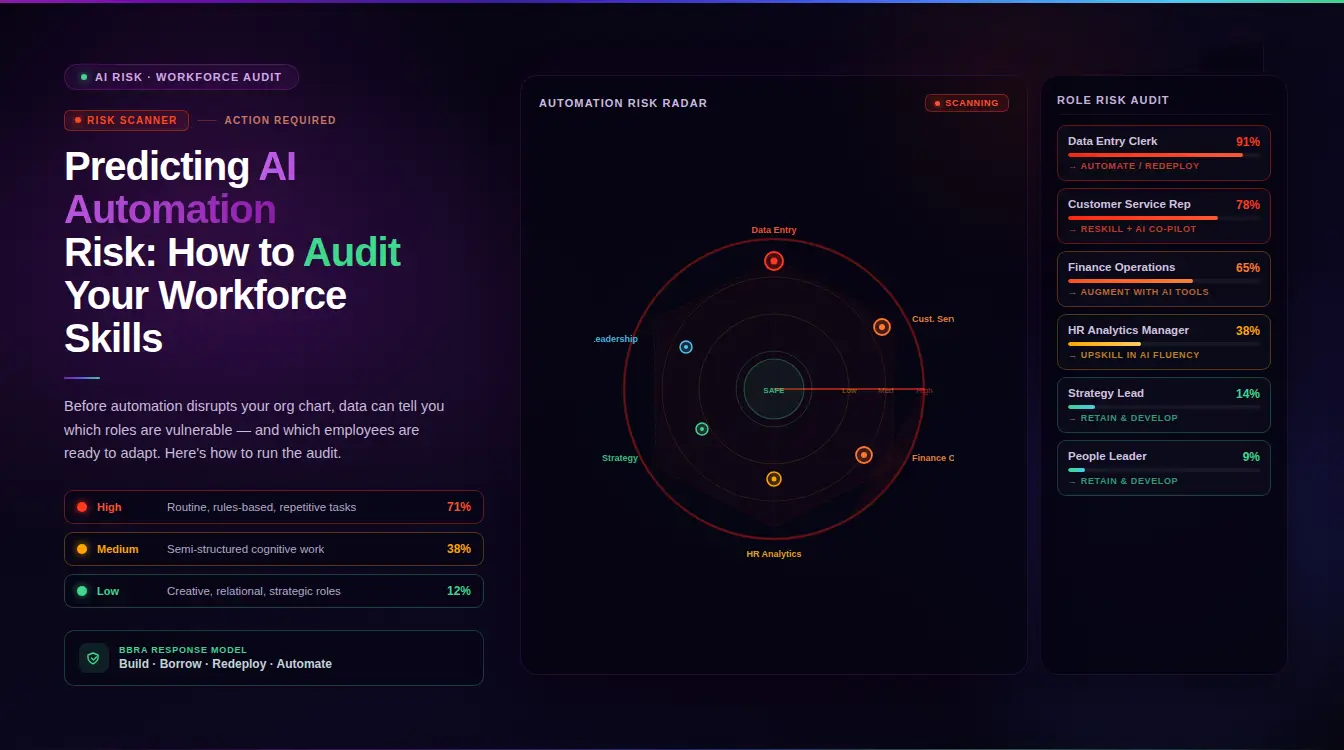
A job is not a single activity. It is a collection of tasks, decisions, interactions and responsibilities with different levels of exposure to automation. This distinction is increasingly visible in the evidence. The International Labour Organization’s 2025 global assessment of generative AI exposure used a task-level methodology covering nearly 30,000 occupational tasks. It found that one in four workers globally is employed in an occupation with some degree of GenAI exposure. But because most occupations continue to contain tasks requiring human input, the ILO concluded that transformation of jobs is more likely than wholesale redundancy. That distinction is fundamental.
AI exposure tells an organisation where work may change. It does not, by itself, determine whether a job should disappear. The ILO reinforced this point in 2026, cautioning that AI exposure indicators estimate the potential for technology to substitute for humans in particular tasks and should not be interpreted on their own as predictions of job losses. For boards, that creates an important governance question. If the unit of technological change is increasingly the task, why is the financial business case so often evaluated at the level of headcount?
A role may contain activities that can be automated alongside others that depend more heavily on human judgement, relationships, contextual knowledge, exception handling or accountability. Removing the role because part of its workload can be automated may therefore remove capabilities that the technology was never intended to replace. The more useful question is not simply how many roles AI can remove. It is what happens to the work after automation.
Automation Changes Work. It Does Not Simply Remove It
The early evidence on AI and employment remains more complicated than many corporate narratives suggest. Research published by Harvard Business Review in August 2026 argues that some organisations may be moving from automation potential to workforce reduction faster than the evidence warrants. The authors distinguish between automating tasks and redesigning work, warning that reducing headcount without understanding what happens to the remaining work can leave organisations smaller without necessarily making them more capable. The World Economic Forum’s Future of Jobs research points to the same complexity from another direction. While 41% expected to downsize their workforce where AI can replicate people’s work, 77% planned to upskill workers and 47% expected to transition employees from AI-disrupted roles into other parts of the organisation. These are not contradictory strategies. They illustrate why workforce transformation cannot be reduced to a single headcount number.
Some work will disappear. Some will be automated. Some employees will be redeployed. New capabilities will have to be hired or developed. Existing roles will change. And some activities that previously occupied employee time may become more valuable precisely because AI has created additional capacity. Gartner’s 2026 research illustrates this last problem particularly well. A survey of HR leaders found that only 7% of organisations provided guidance on how employees should use time saved by AI. Managers and HR leaders also differed considerably on where that capacity should be redeployed. Saving an hour of work does not create value automatically. The organisation still has to decide what to do with the hour.
The Costs That Labour Savings Can Hide
This is where a narrow labour-cost calculation becomes problematic. A simplified AI business case might compare the cost of technology with the labour expense that can potentially be removed. But workforce transformation carries its own economics. Work may need to be redesigned. Employees may need to be reskilled or redeployed. New capabilities may need to be recruited. Managers need to establish how AI changes responsibilities and performance expectations. Automated processes may require monitoring, exception handling and human judgement. And organisations may experience a transition period before anticipated productivity gains are realised. These costs do not invalidate the financial case for automation. They determine whether that case is realistic.
Gallup’s 2026 workplace research provides an indication of why implementation conditions matter. Among employees using AI weekly or more in organisations that had adopted it, only 17% gave AI the highest rating for its effect on productivity and efficiency. That figure rose substantially when frequent use was combined with a clear implementation plan, active manager support and employee engagement. The finding is associative rather than causal, but the implication for leadership is important: deploying technology and capturing organisational value from it are not the same thing. The economics of AI therefore need to include the transition required to turn technological capability into organisational performance.
From Labour Efficiency to Execution Capacity
A more complete AI business case begins with task-level visibility. Before translating automation potential into workforce reductions, leadership teams need to understand four things.
Task exposure: Which activities can be automated, which can be augmented and which continue to depend on human input? Where do human-to-AI handoffs occur, and where does accountability remain?
Transition capacity: Can the organisation move people from declining activities into work where capacity or capability is needed? What skills, management support and organisational infrastructure will that require?
Value protection: Which capabilities, relationships, knowledge and forms of judgement must be preserved as work is redesigned?
Operational resilience: Does automation reduce operational risk, or does it move risk elsewhere by creating new technological dependencies, concentrations or points of failure?
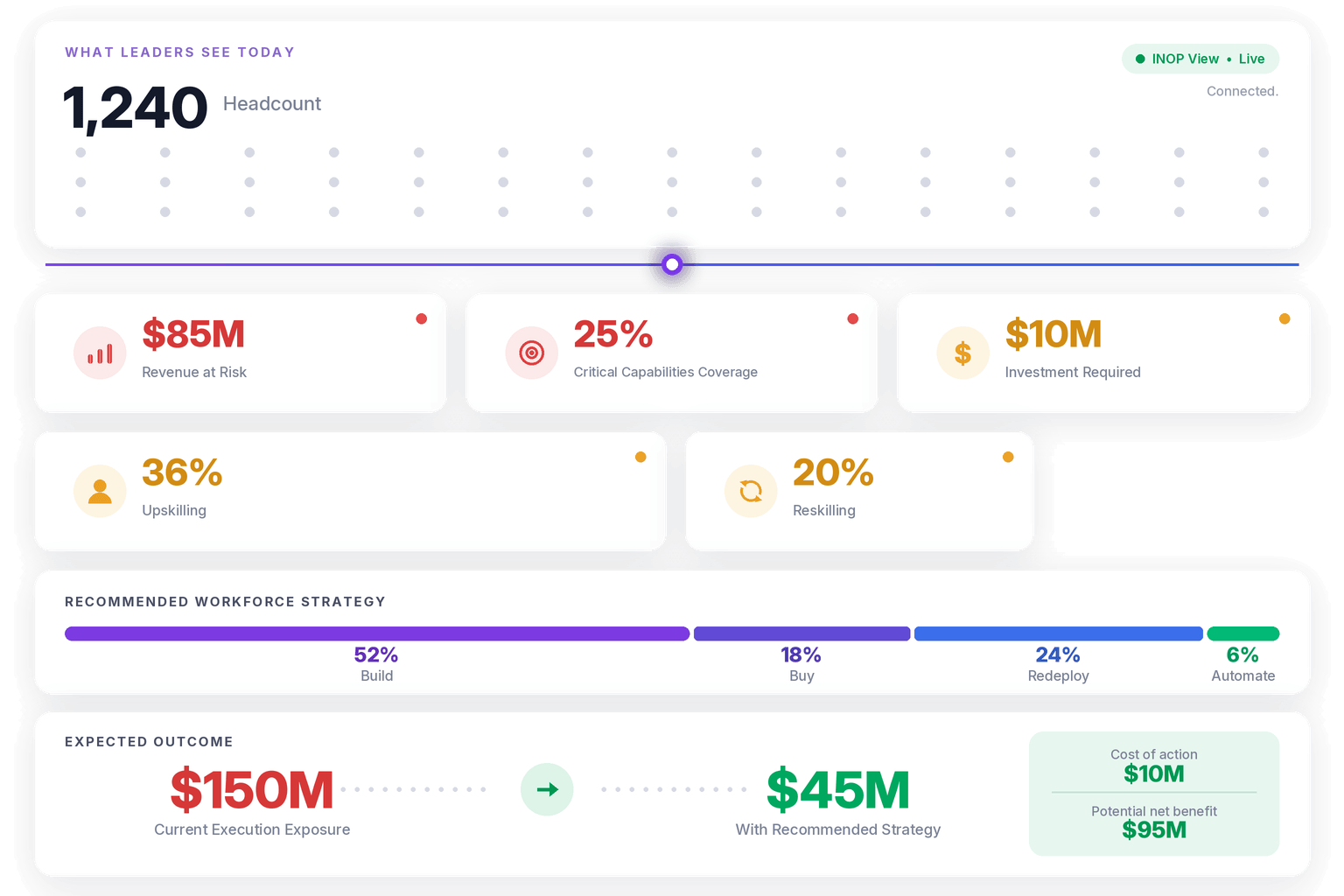
These questions change the financial calculation. Instead of asking only: How much labour cost can this technology remove? boards can ask: What combination of automation, augmentation, redeployment and capability investment produces the greatest value at an acceptable level of cost and risk? That is a materially different decision.
The Missing Side of the AI Business Case
This matters because the financial returns from AI remain uneven. PwC’s 2026 Global CEO Survey, covering 4,454 CEOs across 95 countries and territories, found that 56% had yet to see significant revenue or cost benefits from AI. Only 12% reported both. At the same time, the companies capturing value appear to be doing more than simply deploying technology. PwC found that CEOs reporting both revenue and cost gains were two to three times more likely to say AI was extensively embedded across areas including products and services, demand generation and strategic decision-making.
Recent research on AI transformation points in a similar direction. The challenge is increasingly moving from deploying individual tools to redesigning the workflows, roles and organisational systems around them. That suggests a more demanding calculation for boards. The relevant equation is not simply: Labour cost removed – technology cost = value created. It must also account for the investment required to redesign work, develop or acquire capabilities, manage the transition and reach the intended operating model. Time matters too. A projected annual saving may look compelling in isolation. But if achieving it requires significant reskilling, workflow redesign, new capabilities, management capacity and a lengthy transition period, those factors belong inside the investment decision rather than outside it. The projected saving may still be attractive. But the path to achieving it is part of its economics.
A Different Set of Questions for Boards
Effective board oversight requires decision-useful information connecting AI investment to workforce readiness, execution capacity and operational risk. That requires moving beyond the question of how many roles an AI deployment might eliminate.
Boards should also be asking:
- Which tasks are being automated, augmented or redesigned?
- What work remains, and where will that work move?
- Which capabilities must be retained, developed, recruited or redeployed?
- What will the workforce transition cost, and how long will it take?
- Where does human judgement or accountability remain necessary?
- Are anticipated labour savings creating new operational dependencies or concentrations of risk?
- How will we know whether the organisation is becoming more capable rather than simply smaller?
These are workforce questions, but they are also capital allocation questions. As AI investment grows, boards need to understand not only what the technology costs and what labour it may replace, but whether the organisation has the capabilities required to convert that investment into sustainable performance. The role of the board is not to maximise the number of positions removed by AI. It is to understand whether AI investment is strengthening the organisation’s ability to execute its strategy. Labour savings may be part of that equation. They should not be mistaken for the equation itself.