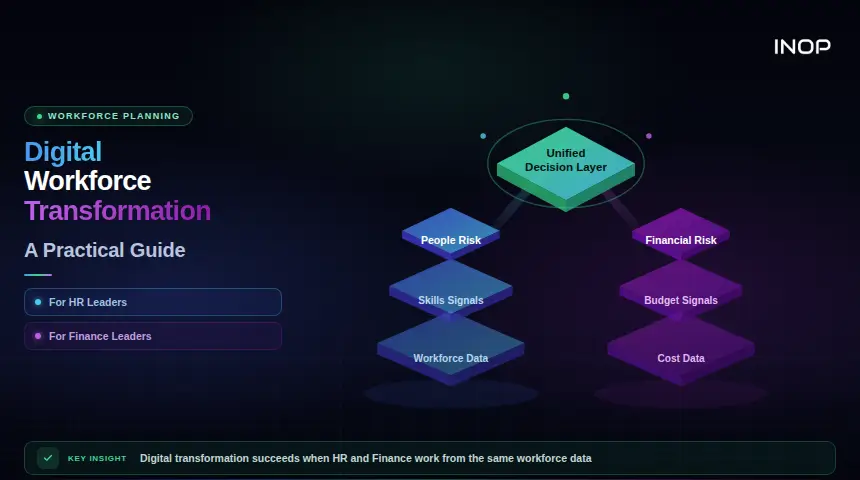
Digital workforce transformation means replacing fragmented, manual, or siloed HR systems with a connected technology and data foundation, so workforce decisions run on current data instead of periodic reports. Research on digital transformations broadly shows success rates around 14 percent, and a fragmented tech stack is one of the most common reasons why. INOP’s strategic workforce planning platform gives leaders one continuously updated view of roles, skills, and cost so those decisions don’t wait for the next system upgrade or annual review.
Digital workforce transformation is the process of building a connected technology and data foundation, replacing fragmented, manual, or siloed systems, so workforce decisions such as headcount, skills, and compensation planning can run on current, integrated data rather than periodic reports. For CHROs, HR technology leaders, finance partners, and PE operating partners, the real question isn’t whether to modernize. It’s which parts of the workforce tech stack need consolidation first, what a structured evaluation looks like, and how to avoid the fragmentation that undermines most transformation efforts before they start.
This guide covers what digital workforce transformation actually involves, why so many programs underdeliver, and how to evaluate your options before committing budget to a rebuild.
What Is Digital Workforce Transformation?
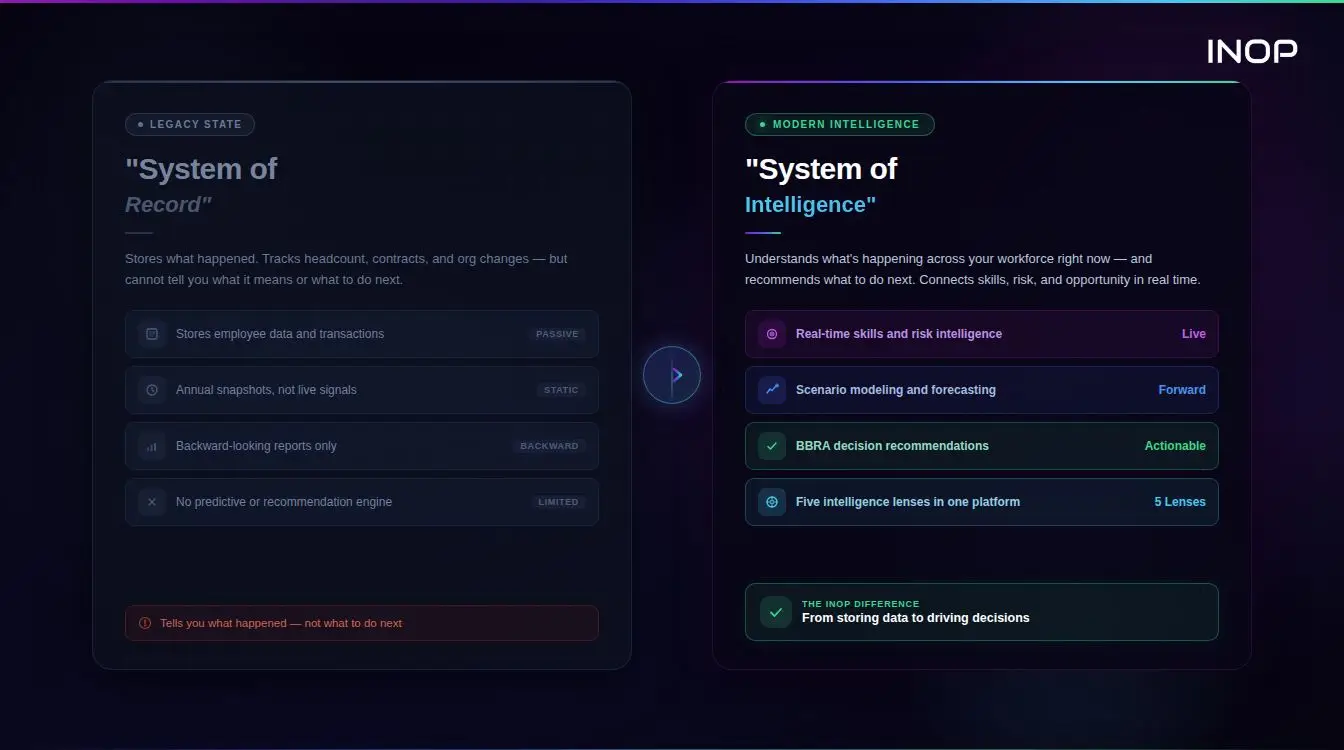
Digital workforce transformation connects the technology and data that support workforce decisions into a single, current source of truth, instead of leaving that information scattered across recruiting, HRIS, compensation, and learning systems that rarely talk to each other. The goal isn’t technology for its own sake. It’s decision quality: better data, updated more often, feeding decisions that used to run on a spreadsheet compiled once a quarter.
How Is Digital Workforce Transformation Different From HR Digitization?
HR digitization means moving an individual process, such as onboarding, time tracking, or payroll, from paper or manual work onto a digital tool. Digital workforce transformation is broader. It connects those digitized processes into one data foundation that supports organization-wide workforce decisions, not just faster execution of a single task. A company can digitize every individual HR process and still lack a connected view of its workforce if those systems don’t share data.
Why Do Most Digital Workforce Transformation Programs Underdeliver?
Most fall short not because the technology fails outright, but because the transformation stops at individual system upgrades instead of connecting them into a shared data foundation. McKinsey’s Global Survey on digital transformations found that only about 14 percent of organizations reported making and sustaining performance improvements from their digital transformation efforts, a lower success rate than for organizational transformations overall.
That gap between technology investment and measurable outcome is the core reason digital workforce transformation deserves more scrutiny than a routine software purchase. Buying a new HR platform doesn’t automatically produce a connected data foundation if the underlying roles, skills, and compensation data still live in disconnected systems that were never designed to talk to each other.
How Does Tech Stack Fragmentation Undermine Digital Workforce Transformation?
Fragmentation undermines digital workforce transformation because it recreates the same siloed data problem the transformation was supposed to fix, just with newer software. According to SHRM, citing the 2024 to 2025 HR Systems Survey from Sapient Insights Group, organizations were operating an average of 26 HR technology modules in 2024, more than double the 10 modules the average organization used just five years earlier.
That growth in tool count doesn’t automatically translate into better integration. Research from HCAMag found that 84 percent of businesses use three or more workforce management systems, with 28 percent using six or more, and that fragmented systems consume a meaningful share of HCM and payroll technology spend simply managing the resulting complexity.
| Fragmented Tech Stack | Connected Digital Foundation | |
|---|---|---|
| Data currency | Updated on each system’s own schedule, often stale between reviews | Reflects current data across roles, skills, and cost |
| Decision speed | Requires manual reconciliation across systems before a decision can be made | Decisions draw from one current source |
| Ownership | Split across HR, IT, and individual system administrators | Clear ownership of a shared data foundation |
| Cost visibility | Software costs plus hidden integration and reconciliation costs | Consolidated cost with reduced manual reconciliation |
How Should Organizations Evaluate Their Digital Workforce Transformation Approach?
Before committing to a platform rebuild or consolidation project, HR, IT, and finance leaders need answers to four questions: which workforce decisions actually need continuously updated data, what the approach costs across different time horizons, who owns the data once implementation is complete, and how success will be measured.
| Evaluation Criterion | Question to Ask | Why It Matters |
|---|---|---|
| Decision-data fit | Which workforce decisions need continuously updated data, and which are fine with a periodic update? | Prevents over-investing in real-time infrastructure for decisions that don’t need it |
| Time-horizon cost | What does this cost at 30 days, 180 days, one year, and three years? | A platform’s licensing cost and its true three-year cost, including integration, are rarely the same number |
| Data ownership | Who owns the workforce data once implementation is complete? | Determines whether the data foundation outlives the vendor relationship or the project team |
| Success metric | What outcome, not activity, defines success for this transformation? | Keeps evaluation focused on decision quality rather than a completed system migration |
What Does INOP’s BBRA Framework Add to Digital Workforce Transformation Decisions?
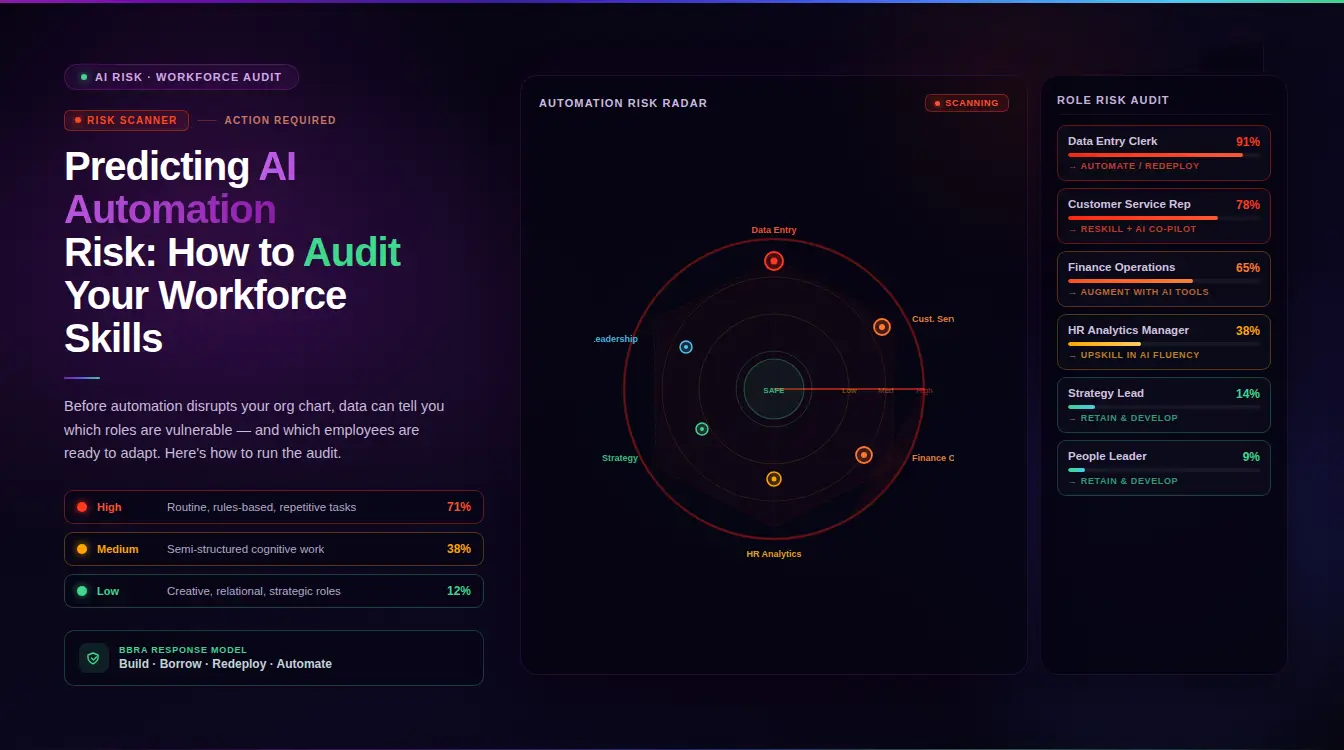
INOP’s BBRA framework (Build, Buy, Redeploy, Automate) is INOP’s proprietary decision architecture for exactly this kind of choice. It models all four pathways for a given capability or workforce decision, with financial trade-offs mapped across four time horizons, 30-day, 180-day, one-year, and three-year, so a decision to build internal tooling, buy a platform, redeploy existing systems, or automate a manual process rests on the same comparable basis.
The BBRA model draws on five intelligence lenses: Strategy, Finance, People, Market, and AI and Automation. The Strategy lens checks fit against business priorities. The Finance lens models cost across the time horizons above, including the reconciliation and integration costs a fragmented stack often hides. The People lens accounts for change readiness during the transition. The Market lens benchmarks the decision against comparable organizations. The AI and Automation lens assesses whether a given workforce process is ready for automation today or still needs human ownership.
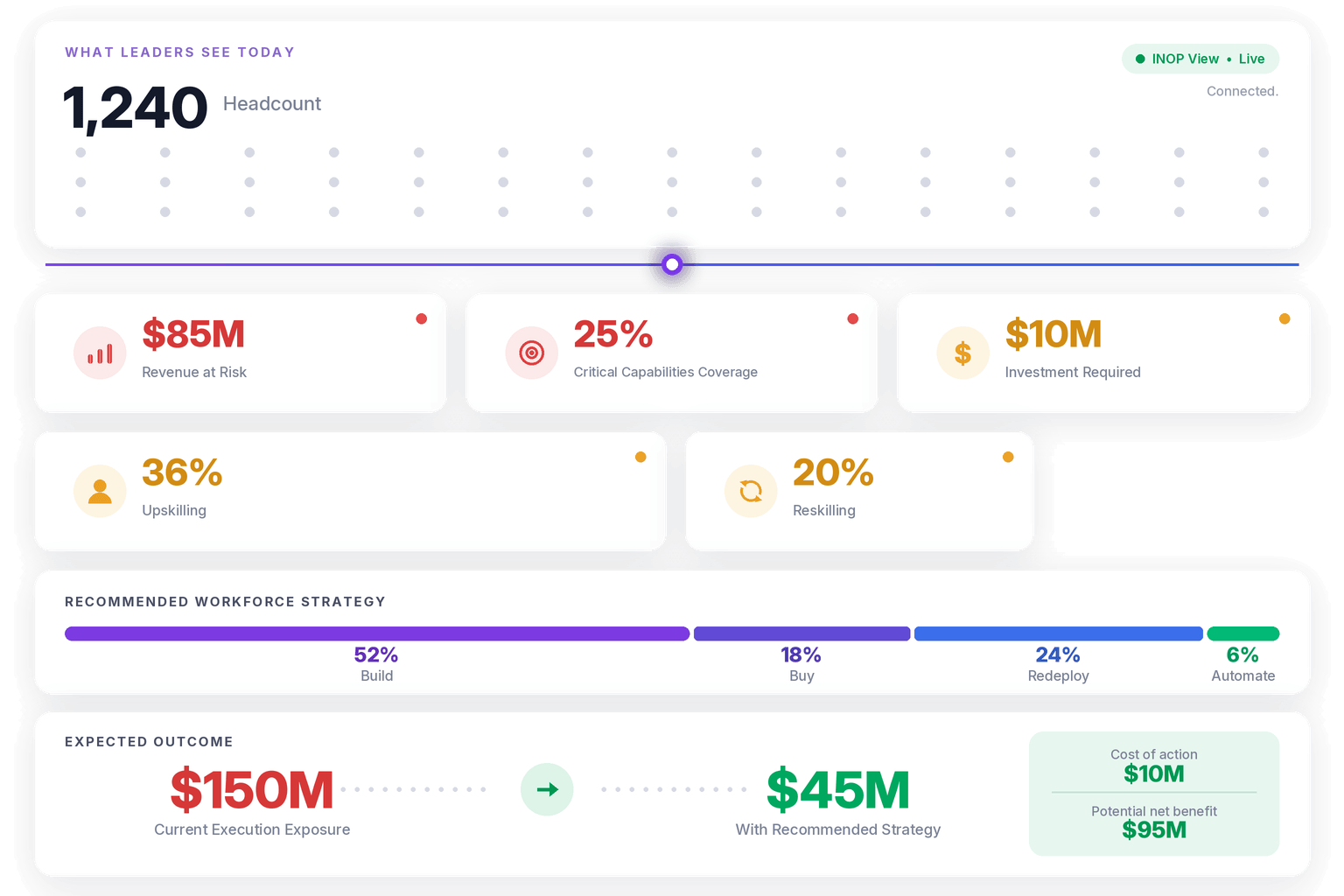
INOP’s strategic workforce planning platform applies this same structured approach to give workforce leaders one continuously updated view of roles, skills, and cost, instead of another disconnected system layered on top of the existing stack.
Ready to see how BBRA applies to your own digital workforce transformation decisions? Book a demo with INOP.
How Does Digital Workforce Transformation Change Compensation and Skills Data?
A connected data foundation changes not just how workforce decisions get made, but how current the underlying compensation and skills data actually is, which is often the difference between a decision based on this quarter’s reality and one based on last year’s snapshot.
How Should Compensation Data Evolve During Digital Workforce Transformation?
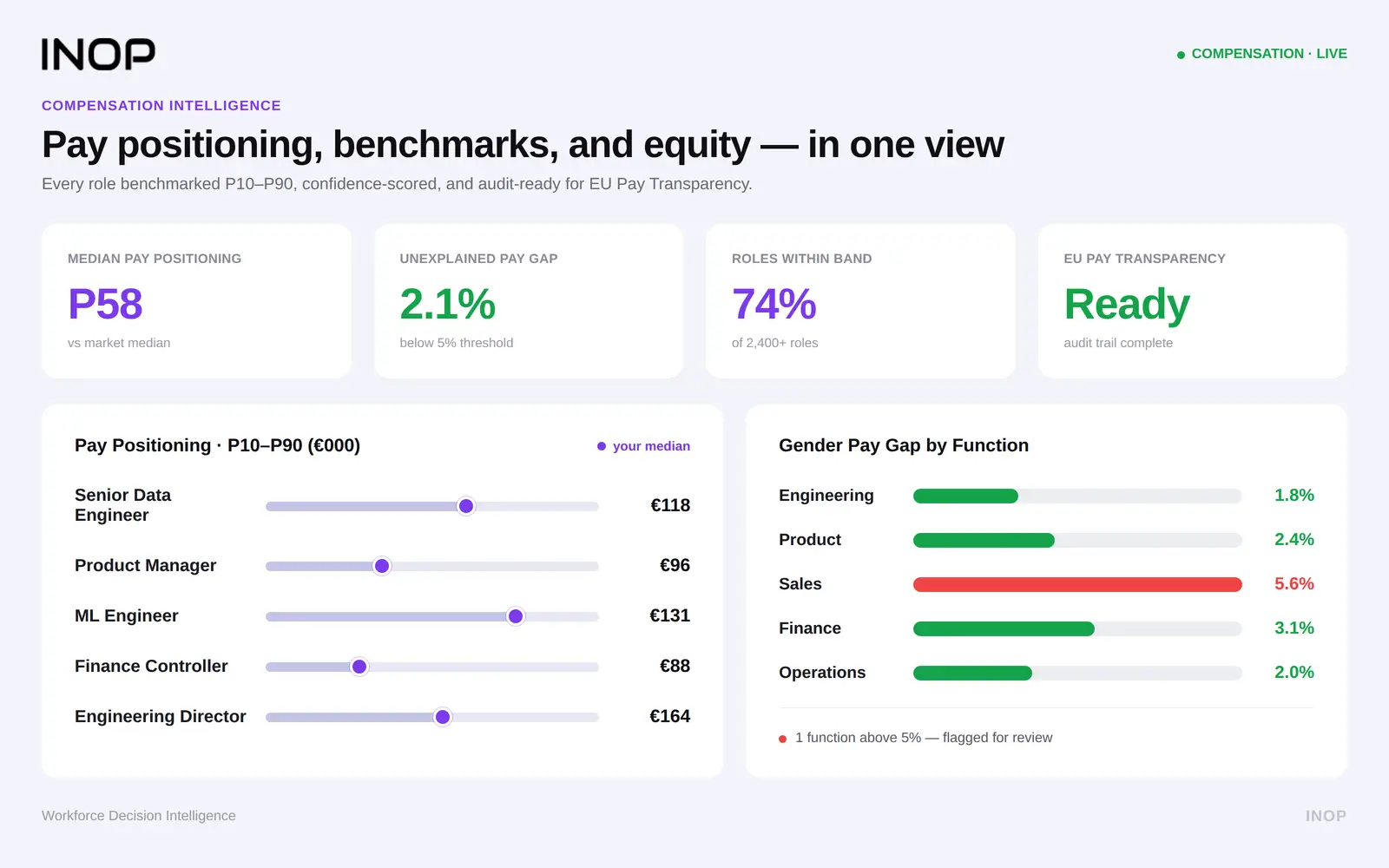
In a fragmented tech stack, compensation data is often scattered across a compensation system, an HRIS, and a spreadsheet used for the annual review cycle, which means pay benchmarks go stale between updates. A connected digital foundation keeps that data current as roles and market conditions change, instead of waiting for the next scheduled review to catch up.
What Skills Data Foundation Does Digital Workforce Transformation Require?
Digital workforce transformation works best when it starts from an accurate picture of the skills already inside the organization, rather than building that picture for the first time mid-transformation. Without that foundation, teams end up making role and reskilling decisions on outdated assumptions about who can already do what.
INOP’s skills intelligence tracks skills across four signal states, Emerging, In Demand, Stable, and Declining, using a large skills taxonomy, so the data feeding a digital workforce transformation reflects current skill supply and demand rather than a stale annual audit.
That same connected data foundation is also what makes it possible to surface hidden talents already inside the organization, people whose actual capabilities never made it into a job title or a system field, before a transformation defaults to sourcing those skills from outside.
What Should PE Operating Partners Know About Digital Workforce Transformation Across a Portfolio?
PE operating partners face digital workforce transformation as a portfolio-wide data and technology decision, not a single-company project. The same consolidation project can be urgent for one portfolio company with a badly fragmented stack and unnecessary for another that already runs on connected systems, so a uniform technology rollout across every company in a fund rarely fits.
Deloitte’s 2026 Global Human Capital Trends research frames this shift in similar terms at the organizational level, describing a move from static plans to dynamic, continuously adapted decision-making as a defining choice facing leaders today. Gartner’s research on workforce planning makes the same point more directly: static, linear workforce planning cannot keep pace with the rate of change most organizations now face, and Gartner recommends ongoing, scenario-based planning built on current data instead.
Applying the BBRA framework’s Finance lens consistently across a portfolio gives operating partners a comparable, time-horizon-based view of where a digital workforce transformation investment is justified and where the existing systems are good enough for now.
Considering how to sequence digital workforce transformation investment across your portfolio? Book a demo to see how INOP’s five intelligence lenses support that comparison.
Frequently Asked Questions
What is digital workforce transformation?
Digital workforce transformation is the process of building a connected technology and data foundation, replacing fragmented, manual, or siloed systems, so workforce decisions such as headcount, skills, and compensation planning can run on current, integrated data rather than periodic reports.
Is digital workforce transformation the same as HR digitization?
Not exactly. HR digitization means moving individual processes, like onboarding or payroll, onto digital tools. Digital workforce transformation is broader: it connects those digitized processes into a single data foundation that supports ongoing, organization-wide workforce decisions, not just individual task efficiency.
Why do digital workforce transformation programs often underdeliver?
McKinsey’s research on digital transformations found that only about 14 percent of organizations reported making and sustaining performance improvements from their efforts, a lower success rate than transformations overall, most commonly due to fragmented execution rather than a flawed initial strategy.
Why do organizations end up with so many HR systems?
HR technology adoption has grown quickly without matching consolidation. Industry survey data shows organizations operating more than double the number of HR technology modules they used five years earlier, often because point solutions get added faster than older ones are retired.
How do we evaluate a digital workforce transformation approach?
Start by identifying which workforce decisions need continuously updated data versus a one-time system upgrade, then compare options on cost across multiple time horizons, data ownership after implementation, and a defined success metric, rather than choosing based on feature lists alone.
What is the BBRA framework?
BBRA (Build, Buy, Redeploy, Automate) is INOP’s proprietary decision architecture for workforce and technology choices. It models all four pathways for a given capability, with financial trade-offs mapped across four time horizons, so a digital workforce transformation decision rests on consistent data.
How does digital workforce transformation affect compensation data?
A fragmented tech stack often means compensation data is scattered across multiple systems and goes stale between review cycles. A connected data foundation keeps pay benchmarks current as roles and market data change, rather than relying on data collected once a year.
How should PE operating partners approach digital workforce transformation across a portfolio?
Treat it as a portfolio-wide data and technology decision, not a single-company project. Each portfolio company’s existing systems and data maturity differ, so a consistent evaluation framework applied company by company works better than one technology rollout imposed uniformly across the fund.