Organisations are investing in AI literacy to prepare employees for a changing workplace. Training programmes are introducing staff to generative AI tools, prompt engineering, responsible use and the limitations of automated outputs. These are necessary investments. Employees cannot be expected to use AI effectively without understanding the technology or the risks associated with it. Yet a workforce that knows how to use AI is not necessarily a workforce that is ready to work differently.
In its October 2026 analysis of how AI is changing organisations, McKinsey reported a striking distinction: 70% of respondents met its measure of personal AI readiness, while only 27% of leaders met its measure of organisational readiness for an agentic future. Although these measures reflect different respondent groups and questions, they point towards a wider challenge. Individual confidence in using AI does not necessarily translate into organisational preparedness. The distinction is not simply between employees who can and cannot use AI. It is between knowing how to operate a technology and possessing the judgement, expertise and authority required to act on its outputs. An employee may be proficient in prompting an AI system yet lack the domain knowledge to challenge its conclusions. A manager may understand how automation improves efficiency without knowing how decision rights, responsibilities and oversight should change when the work itself is redesigned.
As AI becomes embedded in business processes, leadership must determine whether employees have the capabilities, judgement and authority required for their changing responsibilities, and whether the organisation can translate those changes into business value.
When AI Changes the Work, It Changes the Role
Much of the discussion about AI’s workforce implications begins with identifying tasks that can be automated or augmented. This is a useful starting point, but it does not fully explain what happens to a role after AI becomes part of its execution. Consider a data engineer responsible for building pipelines, writing transformations, testing systems, troubleshooting incidents and maintaining documentation. AI may reduce the time required for some of these activities. At the same time, the engineer may assume greater responsibility for validating AI-generated code, managing exceptions, overseeing automated processes and ensuring the reliability of the data architecture.
The role may become less focused on producing routine technical outputs and more focused on design, technical judgement, quality assurance and governance. This is an illustrative example, not a prediction of how every data engineering role will evolve. Its importance lies in the questions it raises. Which responsibilities remain? Which new responsibilities emerge? What skills become more important? And how prepared is the employee to perform the redesigned role? Research from the OECD has examined how AI exposure is associated with changing job tasks and skill requirements. Its findings suggest that the effects differ across occupations and skill categories, reinforcing the importance of examining changes in actual work rather than assuming a uniform impact across the workforce.
As AI assumes a greater share of routine execution, some roles will place increasing emphasis on validation, coordination and judgement. Employees who previously produced initial outputs may become responsible for assessing their reliability, investigating exceptions and determining when human intervention is necessary. These responsibilities may demand deeper domain expertise, an understanding of underlying assumptions and the ability to recognise errors that are not immediately apparent. For organisations, this means training needs cannot be established solely by identifying the AI tools employees will use. They must also understand the responsibilities employees will retain, the work they will take on and the capabilities those responsibilities require.
The Skills Development Challenge
AI also raises a less visible question about how organisations develop expertise over time. Many professional roles have traditionally relied on junior employees performing foundational tasks before progressing towards more complex responsibilities. Analysts learn through preparing initial research, checking information and correcting mistakes. Engineers develop judgement through writing, testing and troubleshooting code. Finance professionals build expertise by working through reconciliations, analyses and reporting processes. Some of these activities are now candidates for automation. McKinsey’s research highlights the possibility that AI may reduce the foundational work through which employees have historically acquired the experience needed for more senior responsibilities. This creates a challenge for organisations that expect employees to exercise increasingly sophisticated judgement while potentially removing parts of the work that helped them develop it.
The issue is how organisations will replace learning opportunities that may disappear. If an analyst no longer prepares the first draft of a report, how will they develop the judgement to challenge an AI-generated analysis? If an engineer spends less time writing routine code, how will they acquire the experience to identify subtle errors or architectural weaknesses?
Traditional training programmes may need to be supplemented by structured exposure to complex cases, supervised review, simulations, mentoring and opportunities to exercise judgement in real operational settings. This has implications for workforce planning. Organisations need to understand not only the skills required immediately after AI adoption, but how they will maintain a pipeline of experienced professionals capable of performing critical roles in the future. Completing a training programme is not equivalent to being ready to assume a new responsibility. An employee may acquire basic knowledge of AI governance within weeks but require substantially more experience to assess complex technical, operational or regulatory risks independently.
Workforce readiness therefore concerns both the capabilities required today and the organisation’s ability to sustain and renew those capabilities over time.
AI Creates New Work as Well as Efficiencies
Automation is often discussed in terms of time saved. Yet the introduction of AI can also create responsibilities that did not previously exist or increase the demands associated with existing activities. AI-generated outputs may require validation. Automated processes need monitoring. Exceptions must be investigated. Data quality, permissions and escalation procedures require attention. Someone must determine when an output is reliable enough to use and when a decision requires further human judgement. These responsibilities consume time and require expertise. An organisation might substantially reduce the time required to produce an initial analysis while increasing the demands placed on employees responsible for reviewing it. If the volume of AI-generated output grows faster than the organisation’s capacity to validate it, the bottleneck may move from production to approval.
The organisation may have accelerated one stage of the workflow without improving the performance of the process as a whole. Microsoft’s 2025 Work Trend Index provides an indication of how leaders expect responsibilities to evolve. In its survey, 41% of leaders anticipated their teams training AI agents within five years, while 36% expected employees to be managing them. These findings describe expectations rather than established workforce outcomes, but they illustrate the growing importance of responsibilities associated with human-agent collaboration. For organisations evaluating AI’s productivity potential, it is important to distinguish between the time released from existing tasks, the additional time required for new or expanded responsibilities and the capacity genuinely available for other work.
Even where AI reduces the total time required for a role, the remaining capacity may not be immediately deployable. Released time can be fragmented across the working week. Employees may lack the capabilities required for alternative assignments. The organisation may also need to redesign workflows or adjust responsibilities before that capacity can be used effectively. These distinctions matter because efficiency improvements do not automatically translate into financial savings or additional output.
Accountability Cannot Be Delegated to a Tool
As AI becomes more deeply embedded in business processes, questions of responsibility become increasingly important. Who determines whether an AI-generated recommendation is appropriate? Who approves its use? Who investigates errors? Who has the authority to challenge or override an automated decision? And who remains accountable when an AI-assisted process produces an adverse outcome? These questions cannot be answered through AI literacy training alone. The NIST AI Risk Management Framework emphasises clearly defined roles, responsibilities and communication arrangements in managing AI risk. Its governance function addresses organisational accountability, risk management processes and the capabilities needed to support effective oversight.
The International Bar Association’s August 2026 discussion of AI board members similarly raises questions about the use of AI in corporate decision-making and the continuing legal responsibilities of human directors. AI may support analysis and decision processes, but its use does not, by itself, displace the governance obligations of those responsible for organisational decisions. These principles have practical implications throughout the organisation. Assigning an employee to review an AI-generated output does not necessarily establish meaningful oversight. The reviewer must have sufficient domain expertise to recognise errors, access to the information required for validation and the authority to question or escalate the result.
A manager reviewing an automated financial forecast may struggle to challenge assumptions that are not transparent. A compliance professional may be responsible for reviewing an AI-assisted process without sufficient time or resources to assess its risks. In both cases, accountability may exist on paper without the capabilities needed to exercise it effectively. A September 2026 Baker Tilly UAE article on AI governance illustrates the possibility of an accountability gap: employees assume tools have been approved, management assumes controls are operating and boards assume risks have been assessed. The concern is whether the organisation can establish that these responsibilities are actually being fulfilled.
Leadership needs to know who is responsible for AI-assisted decisions, whether those individuals possess the necessary expertise and whether they have the time, authority and support required to discharge their responsibilities.
From AI Literacy to Workforce Readiness
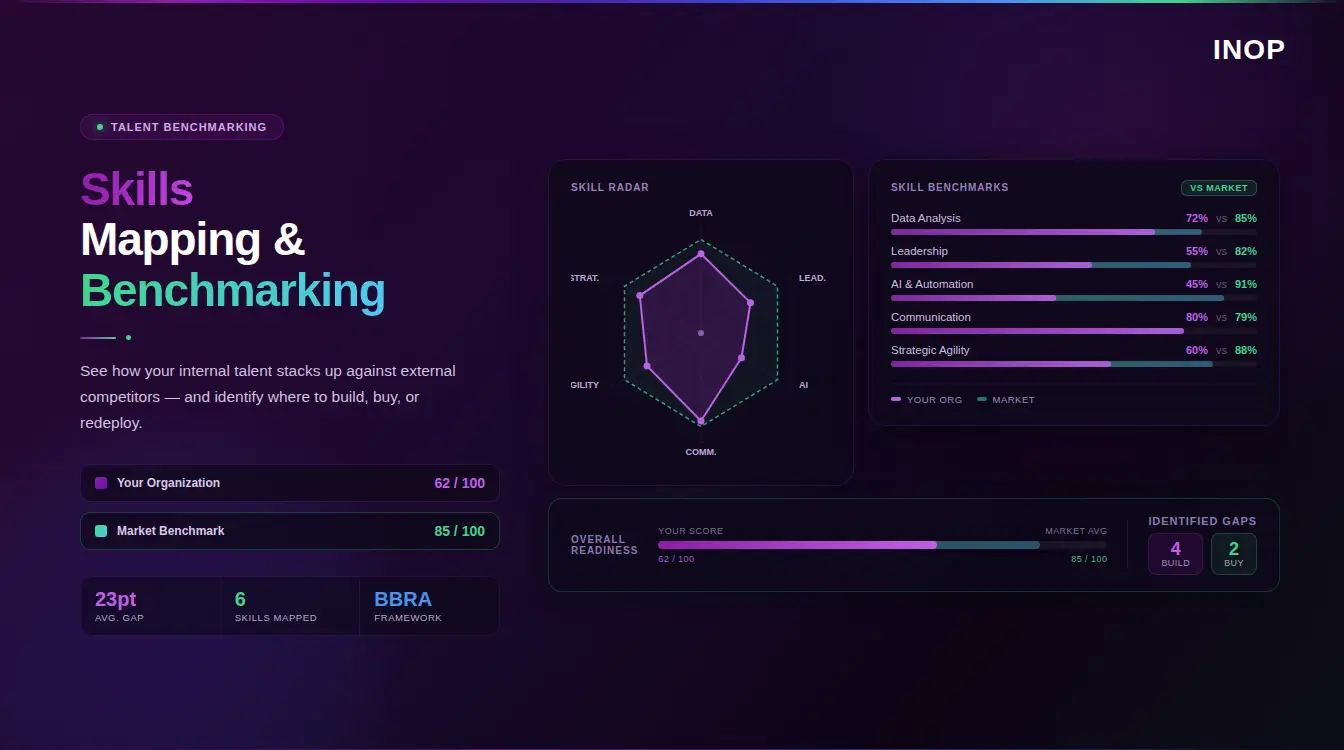
The challenge for organisations is to move beyond measuring whether employees understand AI towards assessing whether they can perform effectively in the roles that emerge after its adoption. This requires a more detailed view of the workforce than training completion rates, tool usage or general skills inventories. Three areas deserve particular attention.
- Decision rights and accountability. Organisations need to understand where human approval remains necessary, who has authority to challenge or override automated outputs and how exceptions are escalated. Responsibilities must be clear, but they must also be supported by the expertise and capacity needed to fulfil them.
- Domain capability. Employees responsible for validating AI-assisted work need the knowledge and judgement to assess its reliability. Familiarity with a tool cannot substitute for understanding the business, technical or regulatory context in which its outputs will be used.
- Execution risk and operational capacity. Organisations must understand whether teams can manage exceptions, maintain quality and absorb new oversight responsibilities as AI changes the volume, complexity and distribution of work.
Employees may possess the necessary skills but struggle to perform effectively when decision rights are unclear or review processes create delays. Equally, well-designed workflows depend on people with the expertise and capacity to exercise their assigned responsibilities.
McKinsey’s October 2026 analysis argues that organisations must adapt their operating models as AI changes how work is performed. Its research suggests that more extensive workflow redesign is associated with stronger reported AI outcomes, although these survey findings do not establish causation. Workforce readiness also requires attention to sustainable workloads.
Employees who spend less time producing routine outputs may face greater cognitive demands when reviewing complex cases or managing exceptions. Specialist oversight can become a scarce resource. Training and supervision consume time, while the need to maintain operational performance continues. Organisations that underestimate these demands risk creating new execution constraints even as AI improves the efficiency of individual tasks.
Connecting Workforce Readiness to Sustainable Value
The business case for AI is frequently expressed through productivity improvements and potential cost reductions. These are important considerations, but they provide an incomplete picture of value creation. AI may allow employees to produce more work, improve the quality of outputs, respond to customers more effectively, accelerate innovation or devote greater attention to complex problems. It may also support more sustainable workloads by reducing repetitive activities and allowing employees to focus on work requiring human judgement. The value of these outcomes depends on whether organisations can realise and measure them. McKinsey’s 2026 research provides a useful indication of the challenge. While 80% of respondents reported improvements in individual productivity, only 37% reported a positive impact on EBIT. These are self-reported findings, but they reinforce the distinction between improvements in individual work and measurable financial performance at organisational level. The gap should not be interpreted as evidence that the remaining organisations have failed. Financial benefits may take longer to materialise, and some AI investments may be intended to improve quality, resilience or customer experience rather than immediately reduce costs.
Nevertheless, the findings raise an important question: what organisational conditions allow improvements in individual productivity to become sustained business value? Part of the answer lies in how organisations redesign work and deploy their capabilities. If AI releases employee time, leadership must determine whether that capacity can be redirected towards activities that support strategic priorities. If AI changes the responsibilities of a role, the organisation must ensure that employees can perform those responsibilities effectively. If automated processes create new risks or oversight demands, appropriate governance and operational capacity must be established. The choices will differ across organisations and roles.
Some may reinvest capacity in higher-value work or service quality. Others may use it to support growth without proportionate increases in staffing. Some may improve workload sustainability, while others may realise cost efficiencies through changes in workforce demand. None of these outcomes follows automatically from adopting AI. They depend on the organisation’s ability to understand the work being transformed, develop the capabilities required and make informed decisions about how resources are deployed.
What Boards and Executives Need to Know
For boards and executive teams, the central question is whether AI adoption is strengthening the organisation’s capacity to execute its strategy. AI literacy rates and adoption figures provide useful indicators, but they cannot answer that question on their own. Leadership needs visibility into how critical roles are changing, where new responsibilities are emerging, which capabilities are becoming more important and whether the workforce can meet those requirements. It also needs to understand where accountability sits, whether human oversight is effective and how the demands of AI-enabled work affect operational capacity.
Rather than relying exclusively on the number of employees trained or the volume of AI tools deployed, management should explain the workforce implications of material AI initiatives: the roles affected, the capabilities required, the readiness gaps identified, the arrangements for human oversight and the expected contribution to business performance. This would help boards assess AI adoption as a matter of organisational execution and governance, and distinguish the promise of automation from the organisation’s ability to realise it.
The question is no longer only whether employees know how to use AI. It is whether the organisation has the workforce capability to execute its strategy as AI changes the work itself.