Your organisation may already have AI pilots running, licences signed and teams in training. The harder question is whether any of it will scale: whether the people, leaders, data and controls behind those pilots can support AI across the business, and what it will take to close the gaps if they cannot.
An AI readiness assessment answers that question. It is a structured check of whether your organisation has what it needs to put AI into everyday work and get measurable value from it.
For CHROs, the findings show where to invest in skills and capabilities. For CFOs, they show what closing each gap will cost, and what leaving it open will cost. For PE operating partners, they show whether a portfolio company has the workforce capability to deliver the AI ambitions in its value creation plan.
The value of the assessment ultimately depends on what leaders can do with the findings. A readiness score may show where the organisation stands today, but boards also need to understand what closing the identified gaps will cost, where investment is most urgent and which actions should come first.
What Is an AI Readiness Assessment?
An AI readiness assessment tests the organisation against the conditions AI needs to work in production: a defined strategy, usable data, capable infrastructure, governance for automated decisions and people who can redesign and run AI-enabled workflows. The assessment should show where the gaps are and, importantly, which of them pose the greatest constraint to implementation and value creation.
The scope of an AI readiness assessment can vary considerably. Some approaches concentrate primarily on technology infrastructure and data, while others extend into strategy and the operating model. A workforce-led assessment adds another layer by looking at roles and tasks, where the practical impact of AI on work becomes visible.
Is an AI Readiness Assessment the Same as an AI Maturity Assessment?
The two overlap but answer different questions. A maturity assessment looks at how far AI has already spread through the organisation. A readiness assessment looks at whether the organisation can take the next step, including the capabilities, data and controls that a specific set of AI initiatives will require.
A readiness assessment is particularly useful before a major rollout, while maturity assessments can help track progress as adoption develops. The distinction matters because understanding how far AI adoption has progressed does not, on its own, provide a plan for what needs to happen next.
Why Do Most Organisations Score Lower on AI Readiness Than They Expect?
Visible AI activity can easily be mistaken for readiness. An organisation may have pilots underway, licences in place and employees being trained while still lacking some of the capabilities, data, governance or operating structures required to scale successfully. A readiness assessment looks beneath that activity to test whether those foundations are actually in place.
Cisco’s AI Readiness Index surveyed more than 8,000 senior IT and business leaders across 30 markets and found that about 13 percent of organisations qualify for its fully ready Pacesetter group, a share that has held for three years. That group outperforms its peers on the measures of AI value Cisco tracks.
RAND’s review of AI project failure points to where that gap tends to sit. In interviews with 65 experienced data scientists and engineers, 84 percent named leadership-driven causes, such as misunderstanding or miscommunicating the problem a project was meant to solve, as the primary reason AI projects fail.
What Should an AI Readiness Assessment Measure?
A robust AI readiness assessment should look across seven dimensions: strategy, data, technology, governance, workforce capability, leadership and change readiness. Each requires its own evidence, and weakness in one area can limit the organisation’s ability to translate strength elsewhere into results.
| Dimension | What to Measure | Evidence That Holds Up |
|---|---|---|
| Strategy | AI use cases tied to business outcomes | Use cases with named owners and agreed success metrics |
| Data | Quality, access, lineage and governance of the data each use case needs | Data sources mapped to each use case |
| Technology | Infrastructure, integration and capacity to scale | Integration map covering current systems |
| Governance | Decision limits for AI systems, monitoring and audit trails | Documented controls per initiative |
| Workforce capability | Skills and proficiency against the tasks AI will change | Skills data mapped to roles and tasks, down to employee level where available |
| Leadership | AI literacy and sponsorship across leadership layers | Leadership scored layer by layer |
| Change readiness | Capacity to absorb new workflows and move people between roles | Culture and mobility indicators |
Data readiness is particularly important before an AI rollout, and it sits within a wider set of foundations. Gartner research published in April 2026 found that organisations reporting successful AI initiatives invest up to four times more, as a share of revenue, in foundational areas such as data quality, governance, AI-ready people and change management than organisations that report poor outcomes from AI.
Why Is Workforce Readiness the Layer Most Assessments Miss?
Workforce capability is sometimes assessed through self-reported surveys, while greater analytical depth is given to infrastructure and data. Yet the organisational side of AI transformation can be just as consequential. BCG’s AI Radar research found that top-performing organisations follow a 10-20-70 principle, dedicating 10 percent of their effort to algorithms, 20 percent to data and technology, and 70 percent to people, processes and cultural transformation.
A workforce readiness assessment should answer three questions for each role: Which tasks will AI change? Do the people currently in the role have the skills the redesigned work will require? Are there people in adjacent roles who could move into it?
INOP’s guide to automation potential distinguishes between what AI can do within a role and what an organisation should automate, providing a starting point for the first question.
How Should Governance Readiness Be Scored?
Governance readiness should be assessed at the initiative level before deployment. For each use case, this means looking at the decisions AI systems can make without human approval, how unexpected behaviour will be identified and whether there is an adequate audit trail.
The governance gap is particularly visible in agentic AI. Deloitte’s 2026 State of AI in the Enterprise research, a survey of 3,235 business and IT leaders across 24 countries, found that only 21 percent of organisations have a mature governance model in place for agentic AI, while 74 percent of respondents expect their companies to use AI agents at least moderately by 2027.
How Do You Run an AI Readiness Assessment?
A practical AI readiness assessment can be structured around six stages, with each stage linked to the decisions leadership will ultimately need to make.
- Set scope. Name the AI initiatives, business units and populations in question, and the decisions the assessment must inform.
- Collect data. Gather organisation structure, role profiles, headcount, finance plans and strategy documents, then add external market and automation exposure data.
- Score readiness. Rate each of the seven dimensions, with workforce capability scored at role and task level.
- Price the gaps. Estimate the cost of closing each gap and the cost of leaving it open.
- Decide and sequence. Choose a pathway for each gap and order the actions across near-term and multi-year horizons.
- Monitor. Refresh scores as skills demand, AI capability and internal data change.
Plan the refresh cycle at the start. Skills demand and AI capability both move faster than an annual review, so a score from last year describes an organisation you no longer run.
How Should You Choose an AI Readiness Assessment Approach?
The right approach depends on the decisions the assessment needs to support. An organisation primarily concerned with infrastructure will need greater depth on technology and data. Where the question is how and where to invest in people and capabilities, the assessment needs greater workforce depth and a clear view of the cost of different interventions.
| Approach | Strengths | Limits |
|---|---|---|
| Self-assessment survey | Fast and low cost; builds awareness | Relies on self-reported confidence; no cost figures |
| Technology readiness assessment | Deep on infrastructure, data pipelines and security | Thin on roles, skills and leadership |
| Consulting diagnostic | Strategy and operating model context; stakeholder alignment | Point-in-time; findings age after the engagement ends |
| Workforce decision intelligence platform | Role and task-level scoring, priced gaps, continuous updates | Needs organisational data to start |
When comparing approaches, six criteria are particularly useful:
- Granularity: it scores capability at role and task level.
- Evidence: it can draw on verified data rather than relying solely on self-reported confidence.
- Financial output: it prices each gap and the cost of inaction.
- Pathways: it compares reskilling, redeployment, external capability and automation.
- Currency: it updates as market and internal conditions change.
- Explainability: a board member can trace each finding to its sources.
How Does INOP Assess AI Readiness Across Roles, Leaders, and Skills?
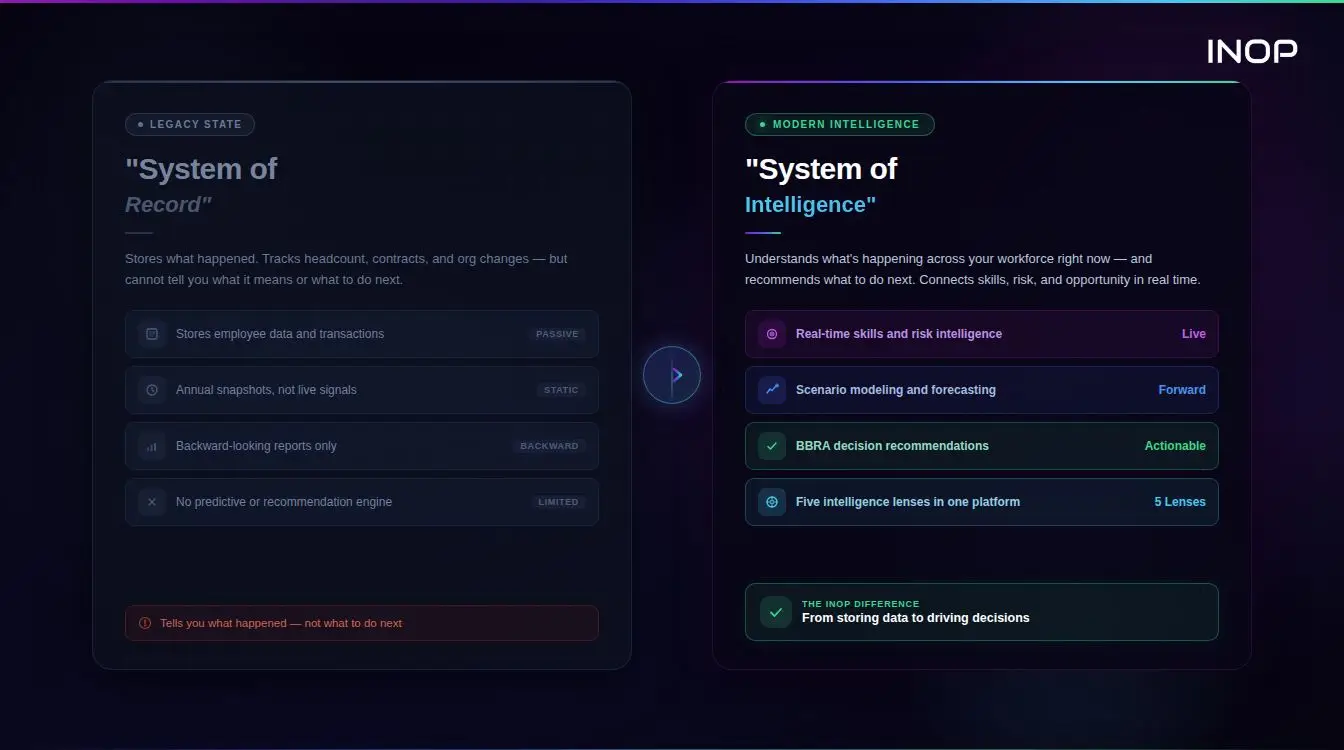
INOP assesses AI readiness from the organisation as a whole down to business units, departments, countries and individual employees. Where employee-level data is not available, INOP works with role and task-level data. INOP goes deep on the workforce, leadership, culture and execution layers of readiness rather than scoring data infrastructure, so it complements a technology and data assessment rather than replacing one.
INOP’s risk model works in three layers:
- Layer one: a weighted composite of five domains: Capability, Leadership, Role-Value, Mobility & Agility, and Cultural.
- Layer two: Strategic Execution Risk, derived across those five domains and your workforce plan. It estimates the probability and cost of workforce-driven strategic failure, and INOP treats it as a derived measure, not a sixth domain alongside the other five.
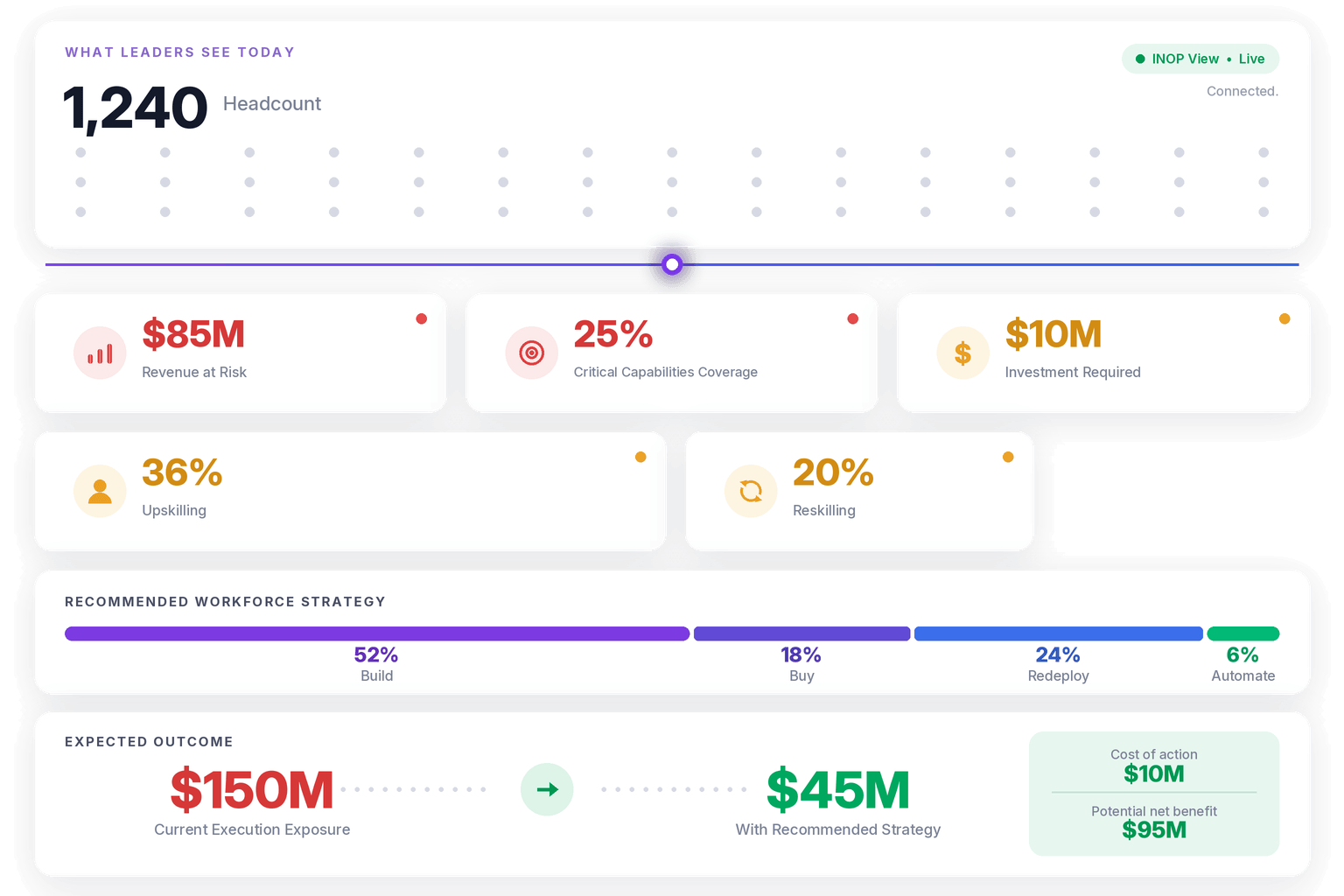
- Layer three: Execution Materiality, which connects each gap to the work it blocks and sizes four financial exposure layers: delay probability, cost of delay, strategic exposure and remediation cost.
Execution Materiality is where readiness becomes a number a board can act on. A capability or leadership gap can look manageable on its own. Connected to the programme it could delay, the same gap carries a cost of delay and a remediation cost that leaders can weigh against the cost of closing it. The assessment also looks at AI literacy and succession readiness across each layer of leadership.
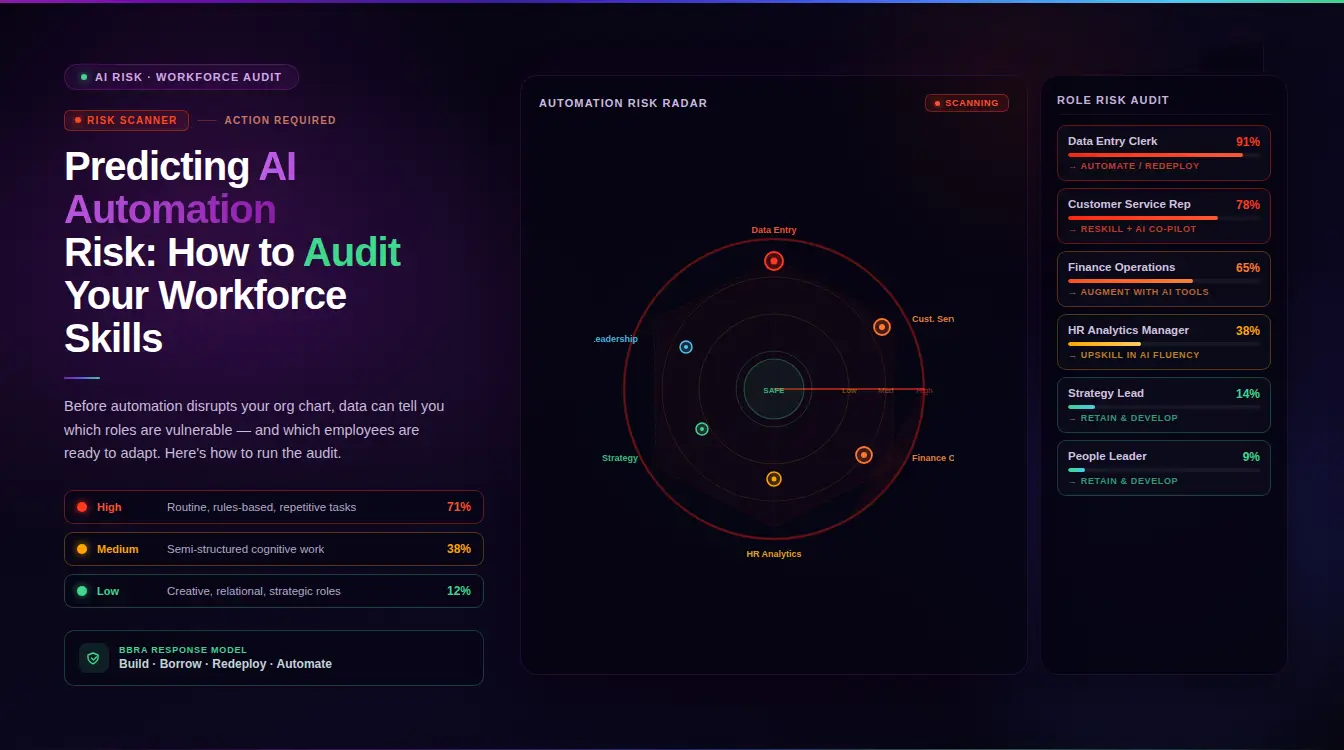
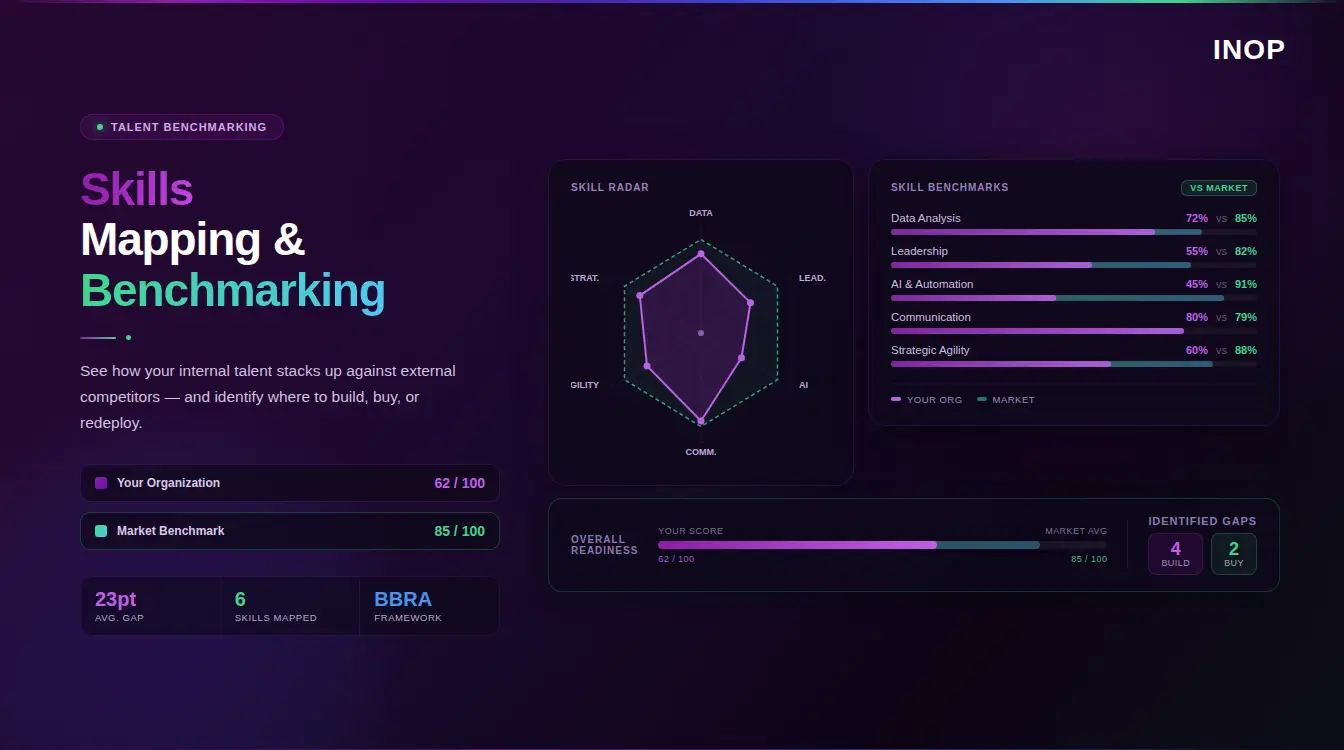
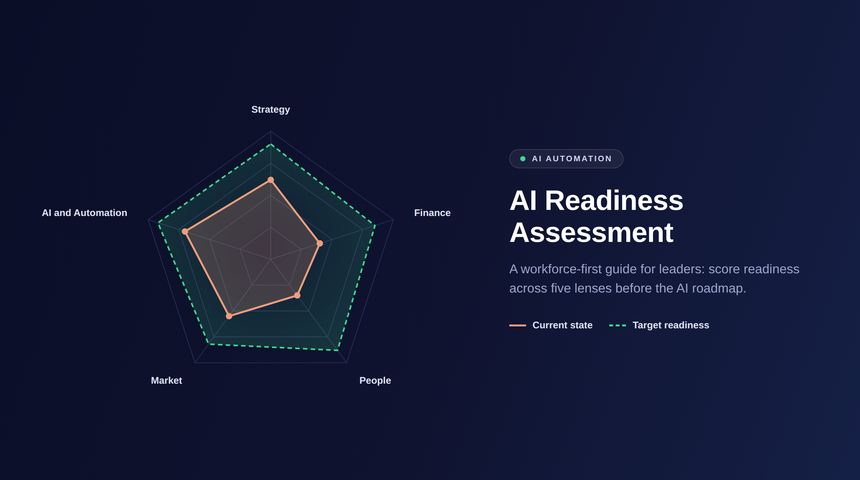
Each score draws on five intelligence lenses: Strategy, Finance, People, Market, and AI and Automation. For automation, INOP assesses tasks within each role as not impacted, partially augmented or fully automatable, calibrated against ten external research frameworks.
The next step is deciding how to address the gaps identified. INOP’s proprietary BBRA decision architecture compares four pathways: Build, Buy, Redeploy and Automate. Each option is priced across 30-day, 180-day, one-year and three-year horizons, giving leaders a clearer basis for deciding where to invest and when.
Once the required data has been submitted, INOP’s strategic workforce planning platform can deliver an initial analysis within 48 hours. Outputs include confidence scores and source attribution, while readiness scores can be updated as market signals, AI exposure and internal workforce data change.
See where AI readiness gaps exist across your workforce, what they could cost to address and which options are available. Book a demo
Which Skills Signals Belong in an AI Readiness Assessment?
An AI readiness assessment needs two views of skills: what your people can do today and where external demand for those skills is heading. INOP’s skills intelligence maps external demand signals against an organisation’s existing skills taxonomy, INOP’s taxonomy or a combination of both. Skills are then classified as Emerging, In Demand, Stable or Declining, alongside an assessment of potential AI and automation impact.
The internal baseline can draw on employee-level data where it exists, or on role and task-level data and role-based benchmarks, rather than relying solely on self-reported confidence. INOP’s guide to AI skills gap analysis sets out how to build that baseline.
How Do Pay Benchmarks Change the Cost of Closing Readiness Gaps?
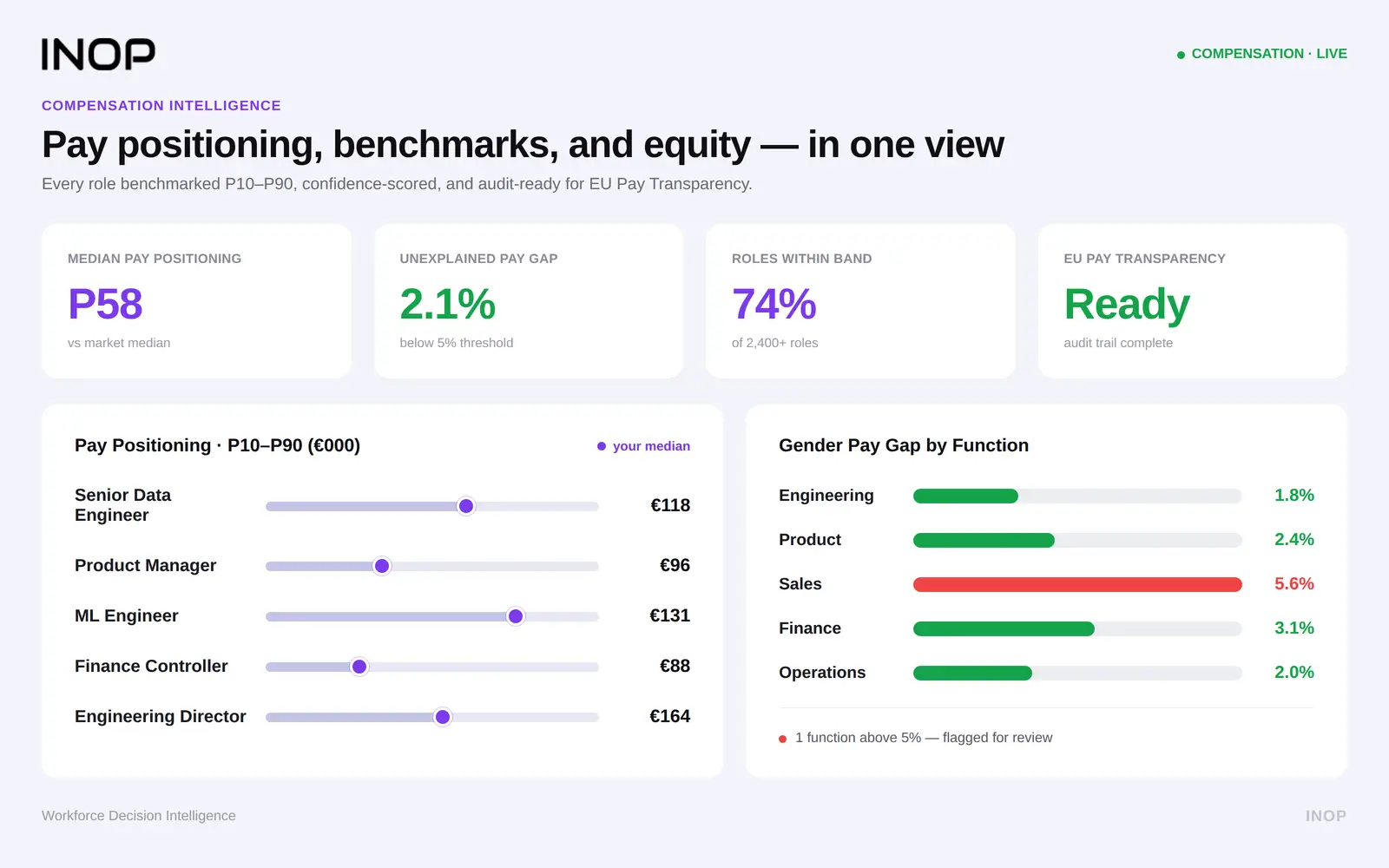
A readiness gap becomes a budget decision once each option for closing it has a price, and pay sits at the centre of that price. INOP’s compensation analytics platform provides real-time salary benchmarks by role, level and geography, from P25 to P90, across more than 2,400 role profiles and a taxonomy of 22,700 skills, with job posting data updated daily. The same benchmarks price each Build, Buy, Redeploy and Automate pathway, including the market cost of AI and machine learning skills.
Those benchmarks show what bringing a capability in from outside would cost against building it in-house, and how pay for a role shifts once AI redesigns the work.
How Should PE Operating Partners Use an AI Readiness Assessment?
For PE operating partners, an AI readiness assessment can support both diligence and value creation planning. Applying a consistent approach across portfolio companies also makes it easier to compare readiness and identify where AI assumptions in a value creation plan depend on capabilities that may not yet exist.
Put four questions to each portfolio company:
- Can the current workforce run the AI-enabled workflows the plan assumes?
- Which leaders sponsor the AI roadmap, and how AI-literate is each leadership layer?
- What does closing each gap cost across the holding period, and what does inaction cost?
- Which initiatives have governance controls in place before AI systems reach production?
INOP applies the same risk layers, five intelligence lenses and BBRA horizons across portfolio companies, allowing readiness scores, Execution Materiality and pathway costs to be compared on a consistent basis.
See how INOP can help compare workforce readiness and the cost of closing capability gaps across your portfolio. Book a demo
Frequently Asked Questions
What is an AI readiness assessment?
An AI readiness assessment is a structured evaluation of whether an organisation has the strategy, data, technology, governance and workforce capability needed to deploy AI and generate measurable value. It can also help identify where the most significant gaps exist and what may be required to address them.
What does an AI readiness assessment measure?
A robust assessment looks across strategy, data, technology, governance, workforce capability, leadership and change readiness. Workforce capability can then be examined in greater detail at role and task level to understand whether the organisation has the skills required for the work AI will change.
How long does an AI readiness assessment take?
Timing depends on scope and data availability. As a reference, INOP’s process runs two to three weeks of data collection, then delivers initial analysis within 48 hours of complete data submission, followed by platform access and continuous monitoring as conditions change.
What is the difference between AI readiness and AI maturity?
AI maturity looks at how far AI has already spread through the organisation. AI readiness looks at whether the organisation has the data, controls, leadership and workforce capabilities required to take the next step. Readiness is therefore particularly useful before a major rollout, while maturity can help track how adoption develops over time.
How many organisations are ready for AI?
Cisco’s AI Readiness Index, a survey of more than 8,000 senior IT and business leaders across 30 markets, places about 13 percent of organisations in its fully ready group. That share has held steady for three years, and this group outperforms peers on the measures of AI value Cisco tracks.
How do PE operating partners use an AI readiness assessment?
PE operating partners use an AI readiness assessment in diligence and value creation planning to test whether a company’s workforce, leaders and controls can deliver the AI assumptions in its plan. Applying one method across the portfolio lets them compare readiness and gap costs company by company.