Agentic AI transformation means redesigning how work gets done so autonomous AI agents handle multi-step tasks while people focus on judgment, oversight, and strategic decisions. The practical starting point for workforce leaders isn’t a tool purchase. It’s identifying which roles and tasks are exposed, deciding whether to build, buy, redeploy, or automate each capability, and putting governance in place before scaling. INOP’s strategic workforce planning platform models these trade-offs across time horizons so HR and finance can make the call together.
Agentic AI transformation is the process of redesigning workflows, roles, and decision rights so autonomous AI agents can plan, execute, and adjust multi-step tasks with limited human intervention, while people shift toward oversight, judgment, and strategic direction. For CHROs, HR leaders, and PE operating partners, the question isn’t whether agentic AI arrives. It’s which roles absorb it first, what new skills and pay structures follow, and how quickly the organization can move from pilot to production without losing control of cost or risk.
This guide walks through what agentic AI transformation actually changes for workforce planning, how to evaluate an approach before adopting one, and what it means for compensation, skills, and governance.
What Is Agentic AI Transformation?
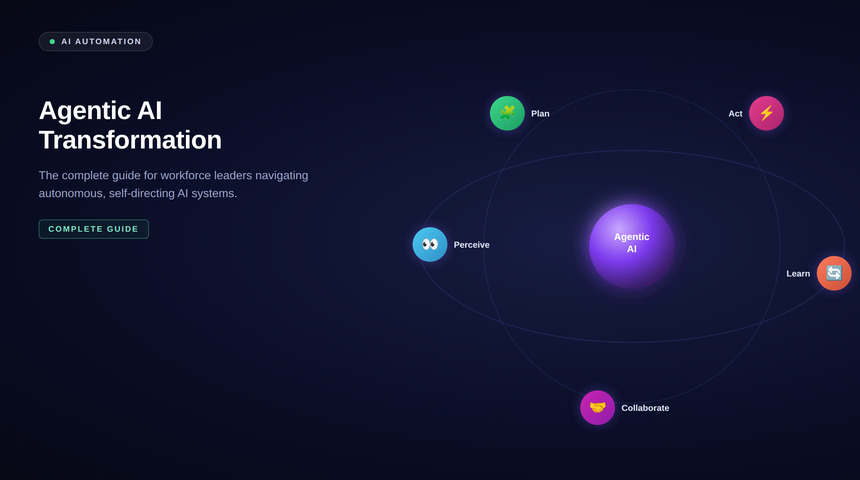
Agentic AI transformation describes the shift from AI as a support tool to AI as an autonomous participant in work. An agent perceives a task, plans a sequence of steps, calls other tools or systems, and completes the objective with minimal step-by-step direction from a person.
For workforce planning, this changes the basic unit of analysis. Instead of asking which tasks a team can automate, leaders now ask which outcomes an agent can own end to end, and what the human role around that agent looks like once it does.
How Does Agentic AI Differ From Generative AI?
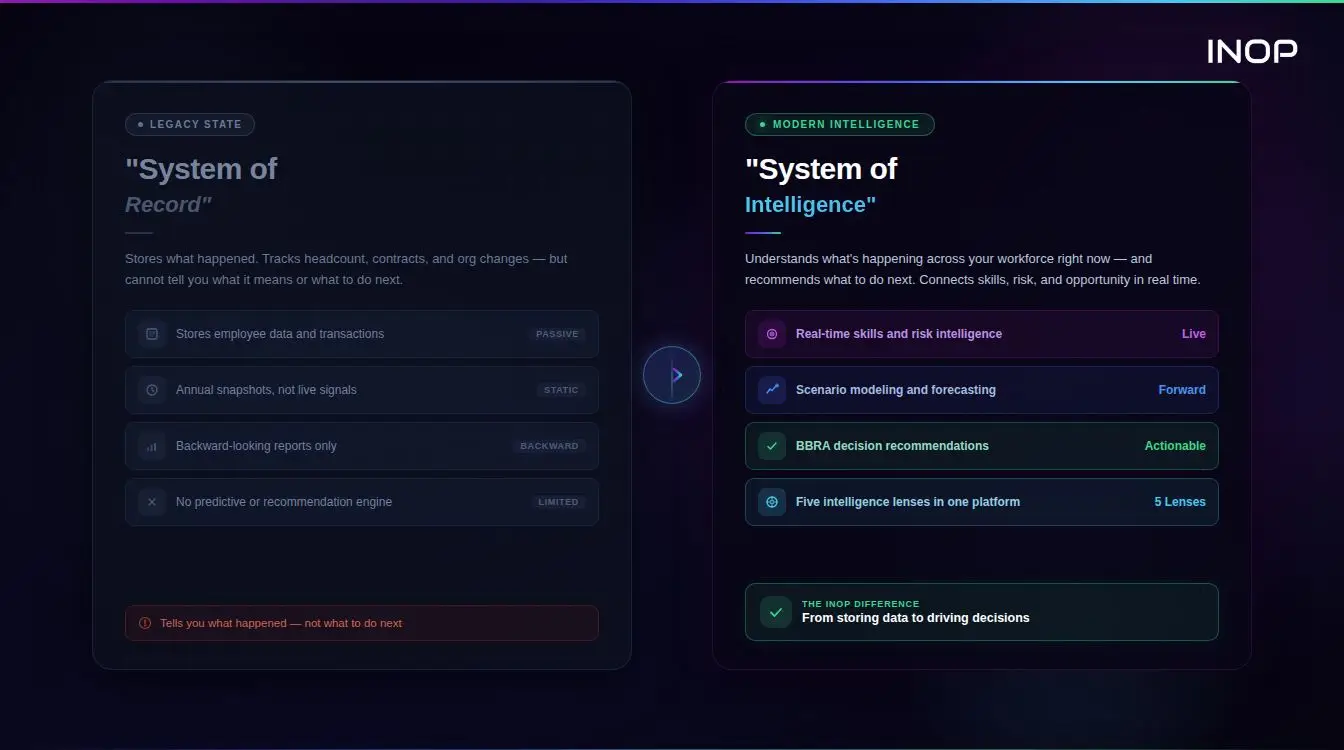
Generative AI responds to a single prompt and produces content, code, or an answer. Agentic AI plans a sequence of steps, chooses and uses tools, and pursues a goal across multiple actions without a new prompt at each step. The practical difference for workforce leaders: generative AI assists a task, agentic AI can own it.
Why Is Agentic AI Transformation Accelerating Now?
Adoption is accelerating because the technology has moved from isolated pilots into infrastructure embedded inside production software, even though most organizations have not yet scaled agents into full production use.
According to Gartner’s 2026 CIO and Technology Executive Survey, only 17% of organizations had deployed AI agents at the time of the survey, yet more than 60% expected to do so within two years, one of the most aggressive adoption curves Gartner has measured among emerging technologies. That gap between current deployment and near-term intent is the clearest signal that agentic AI transformation is a planning problem now, not a future one.
The gap shows up in usage data too. Organizations are investing well ahead of daily habit change: many employees still use generative AI tools only occasionally rather than as part of their default workflow, which means the organizational and skills work has to catch up with the technology rollout, not the other way around.
What Is Slowing Agentic AI Transformation From Pilot to Production?
Data quality, system integration, and unclear governance are the most common blockers cited across current industry research, not the underlying capability of the models themselves. Organizations that treat these as foundational work before scaling consistently report smoother production rollouts than those that scale first and govern later.
How Does Agentic AI Change Workforce Planning?
Agentic AI changes workforce planning by shifting the unit of analysis from headcount to task ownership. For every role, planners now need to know which tasks an agent can absorb, which tasks stay human, and how quickly that mix is likely to shift over the next planning cycle.
This is a harder question than a simple headcount forecast, because exposure varies by function, by process maturity, and by how well-documented the underlying task actually is. INOP’s strategic workforce planning platform models this task-level shift across roles, so planning teams can see where agent capacity changes staffing needs before the change shows up in a budget variance.
Which Roles Are Most Exposed to Agentic AI?
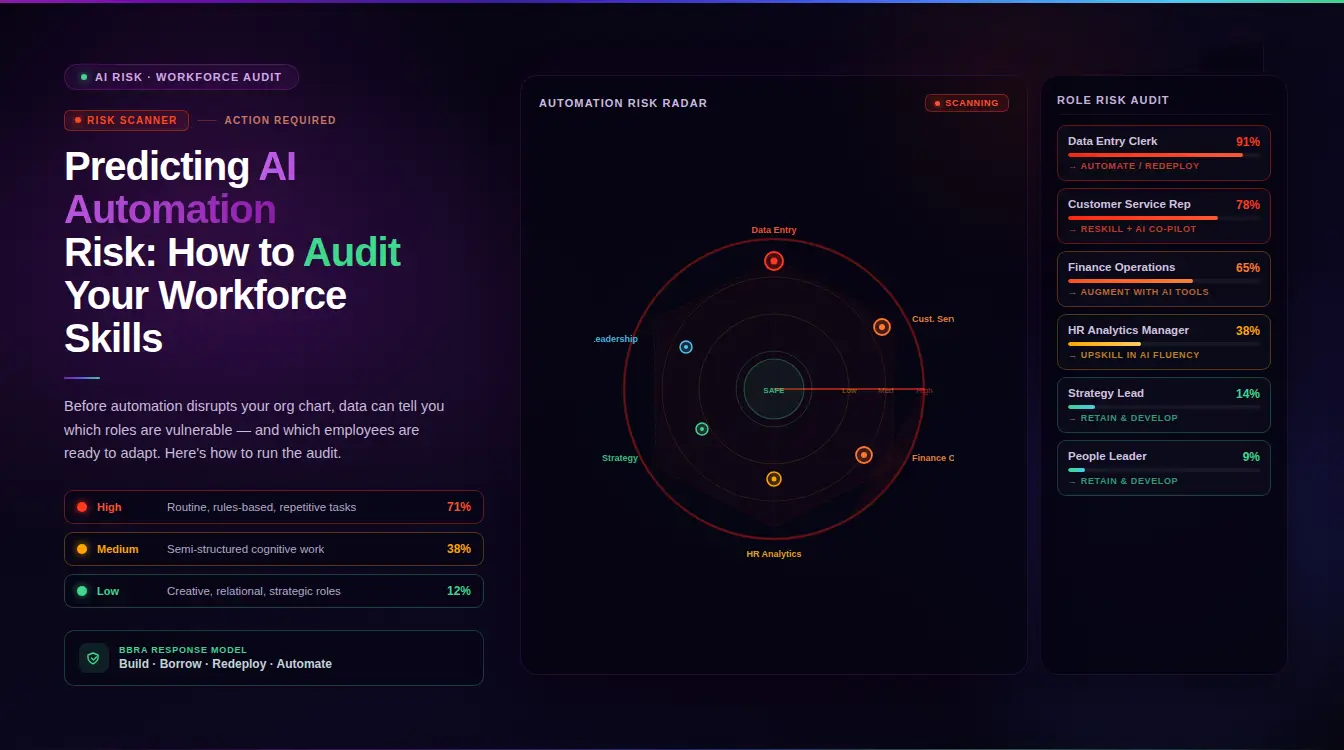
Roles built around repeatable, well-documented, multi-step digital tasks, such as first-line support, routine data analysis, and structured drafting, show the highest exposure today. Roles that depend heavily on context, negotiation, or judgment under ambiguity remain harder for agents to fully own, even as they get support from agent-assisted tools.
What New Roles Does Agentic AI Create?
Agentic AI transformation also creates new roles centered on directing, auditing, and improving agent performance. Agent orchestration, workflow design, and quality review are showing up consistently in early production deployments. Some organizations are already redeploying staff from routine execution roles into these oversight and design roles rather than treating the shift purely as headcount reduction.
That redeployment pattern is showing up beyond the technology sector. PwC’s 2026 Global AI Jobs Barometer, which analyzed roughly a billion job postings, found that AI adoption is restructuring entry-level work broadly, changing the skills employers expect and how organizations train and retain talent, not just which tasks get automated. That finding reinforces why workforce planning, not just technology procurement, has to lead an agentic AI transformation.
How Should Organizations Evaluate an Agentic AI Transformation Approach?
Before choosing any agent or platform, workforce and finance leaders need answers to four questions: which pathway fits each task, what it costs across different time horizons, who owns oversight, and how success gets measured.
| Evaluation Criterion | Question to Ask | Why It Matters |
|---|---|---|
| Task ownership fit | Should this task be built internally, bought from a vendor, filled by a redeployed employee, or automated with an agent? | Prevents defaulting to a single pathway for every task regardless of fit |
| Time-horizon cost | What does this cost at 30 days, 180 days, one year, and three years? | Short-term pilot cost and long-term structural cost are rarely the same shape |
| Governance ownership | Who is accountable if the agent’s output is wrong or its action needs to be reversed? | Without a named owner, agent errors have no clear escalation path |
| Success metric | What outcome, not activity, defines success for this task? | Keeps evaluation focused on results rather than adoption for its own sake |
Answering these four questions consistently, task by task, is what separates a structured agentic AI transformation from a scattered set of pilots.
What Does the BBRA Framework Add to Agentic AI Transformation Decisions?
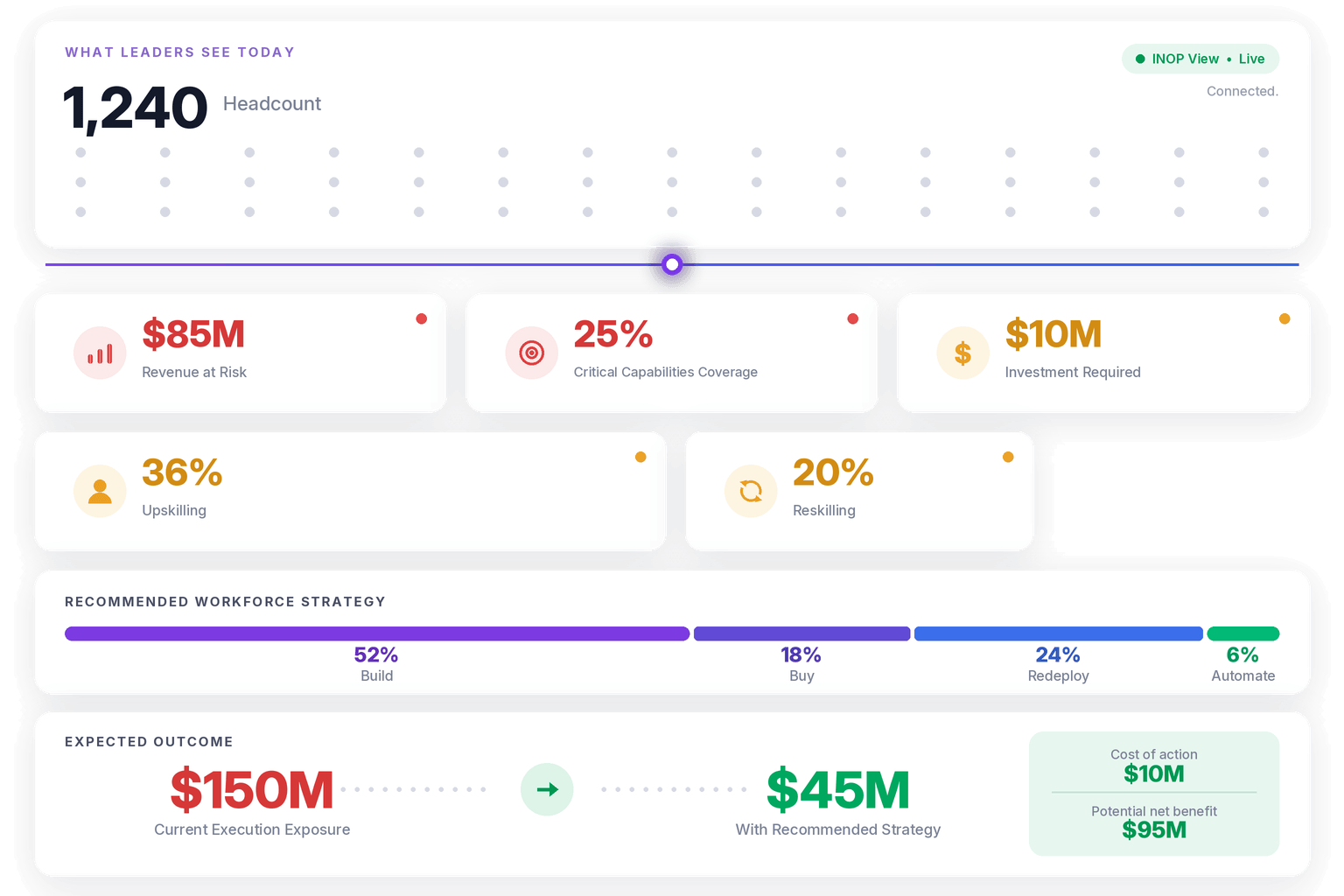
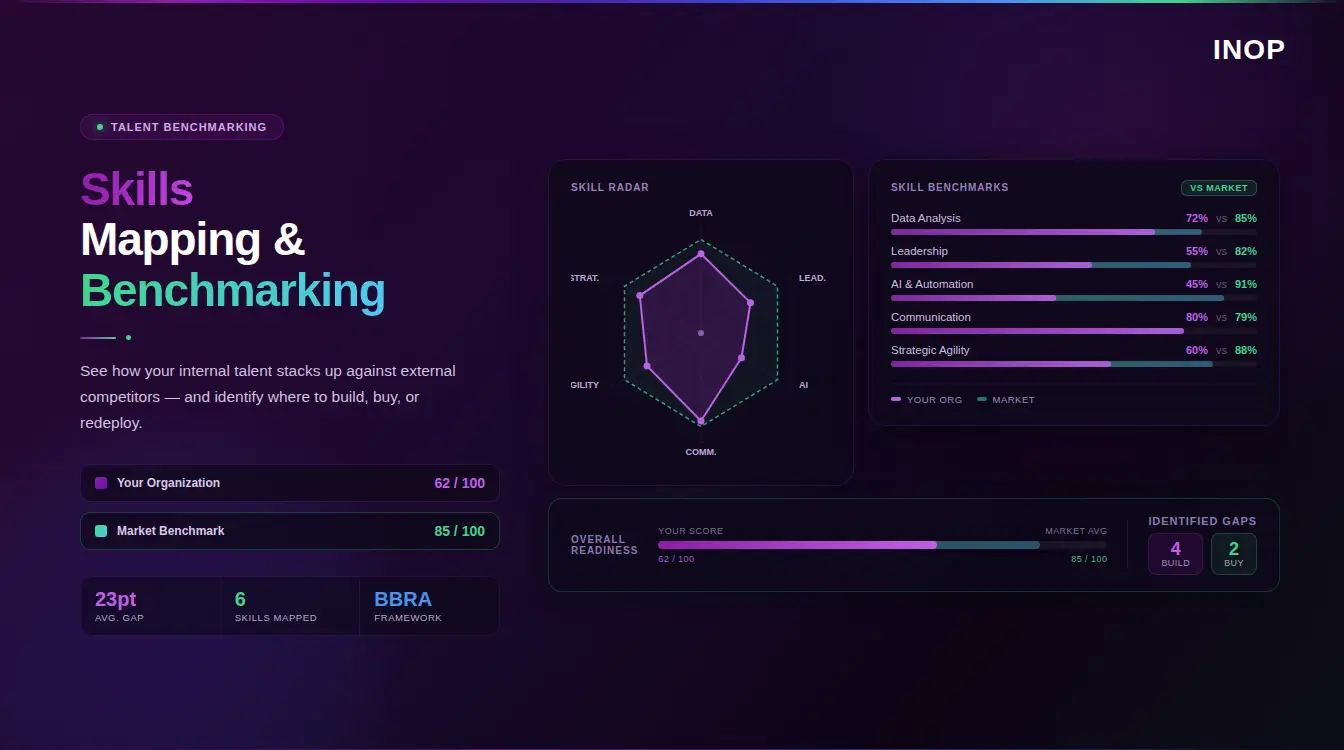
INOP’s BBRA framework (Build, Buy, Redeploy, Automate) is INOP’s proprietary decision architecture for exactly this kind of choice. It models all four pathways for a given task or role, with financial trade-offs mapped across four time horizons, 30-day, 180-day, one-year, and three-year, so leaders compare options on the same basis instead of case-by-case guesswork.
The BBRA model draws on five intelligence lenses: Strategy, Finance, People, Market, and AI and Automation. Each lens surfaces a different constraint on the same decision. The Strategy lens checks fit against business priorities. The Finance lens models cost across the time horizons above. The People lens accounts for redeployment feasibility and change readiness. The Market lens benchmarks the decision against comparable organizations. The AI and Automation lens assesses whether the task is genuinely agent-ready today or still needs human ownership.
Ready to see how BBRA applies to your own role-by-role decisions? Book a demo with INOP.
How Does Agentic AI Transformation Affect Compensation and Skills Strategy?
Agentic AI transformation changes both what a role is worth and what skills it requires, often faster than annual compensation cycles or training budgets are built to track.
How Should Compensation Structures Change for Agentic-Era Roles?
Roles that shift from doing a task to directing and auditing an agent typically call for different pay benchmarks than the role they replaced, and static salary bands built for pre-agentic job descriptions fall out of date quickly. A support role redefined around agent oversight, for example, is not the same job it was two years ago, even if the title on the org chart hasn’t changed.
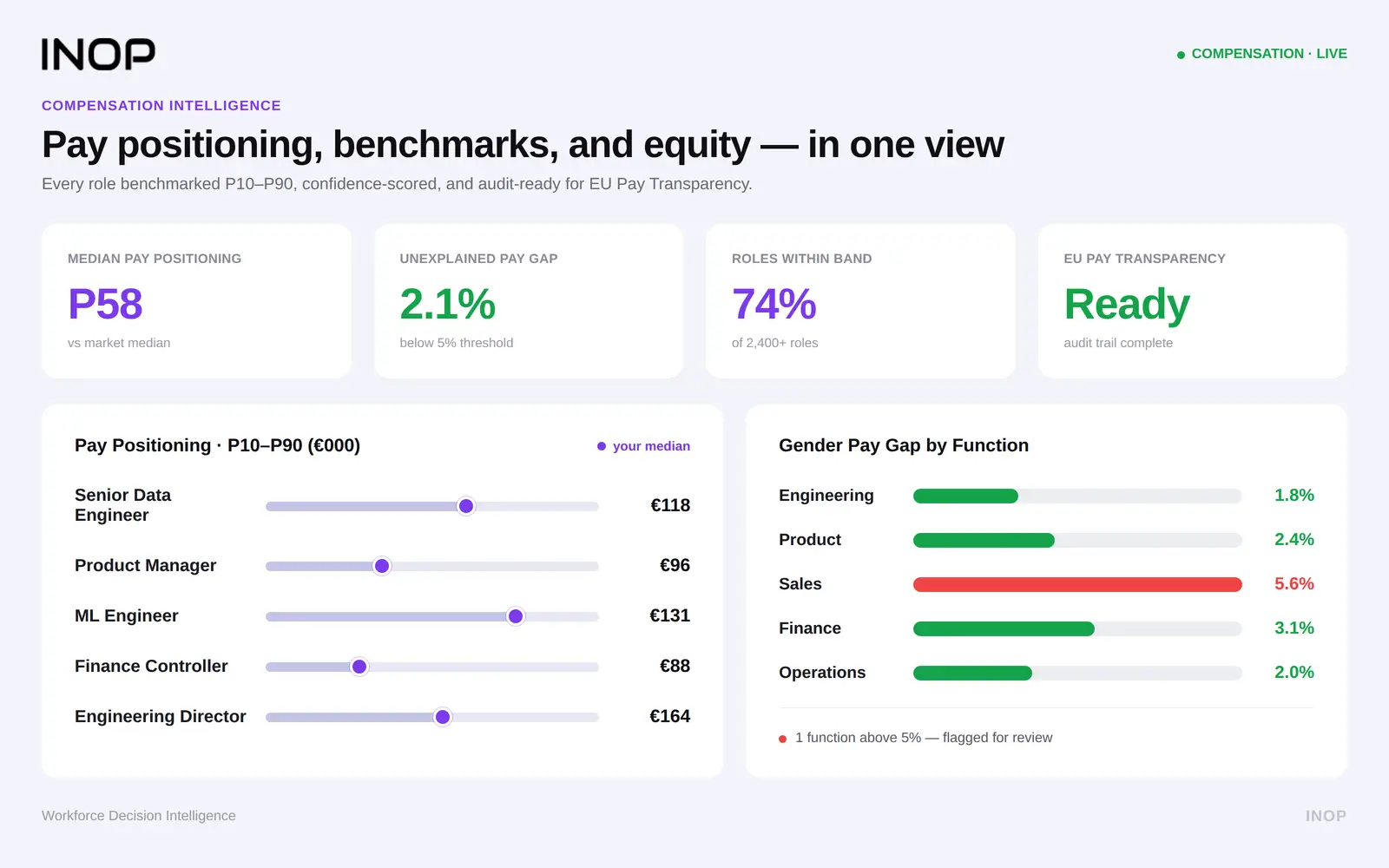
INOP’s compensation analytics platform tracks how pay benchmarks move as roles are redefined around agent oversight, drawing on a global postings dataset, so compensation teams aren’t relying on outdated job architecture to set new bands.
Which Skills Matter Most in an Agentic AI Workforce?
Judgment, agent orchestration, and the ability to evaluate AI output rather than simply accept it are consistently ranked among the most durable skills in current workforce research, alongside the domain expertise that agents still can’t originate independently.
McKinsey’s Skill Change Index work on the AI age finds that skill impact varies widely by category: people-centric skills face comparatively limited exposure, while routine and manual tasks sit at the other end of the spectrum. That unevenness is exactly why a blanket reskilling plan tends to underperform a skills strategy built at the individual skill level.
INOP’s skills intelligence tracks these shifts across four signal states, Emerging, In Demand, Stable, and Declining, using a large skills taxonomy, so a skills strategy can update as fast as the underlying demand data does, instead of waiting for the next annual review.
What Should PE Operating Partners Know About Agentic AI Transformation Across Portfolio Companies?
PE operating partners face agentic AI transformation as a portfolio-wide question, not a single-company one. The same role can carry different exposure depending on each portfolio company’s process maturity, data quality, and existing technology stack, so a single playbook applied uniformly across the fund tends to underperform a consistent evaluation framework applied company by company.
The stakes are material at the leadership level too. PwC’s 29th Global CEO Survey found that only about three in ten CEOs were confident in revenue growth over the next twelve months, with returns on AI investment still uneven across most organizations, even as a smaller group of companies with stronger AI foundations pulled ahead on margin and confidence. For operating partners, that split is the core diligence question: which portfolio companies have the foundations to convert agentic AI investment into measurable value, and which are still at the pilot stage.
Applying the BBRA framework’s Finance lens consistently across a portfolio gives operating partners a comparable, time-horizon-based view of agentic AI transformation readiness company by company, rather than a set of disconnected vendor pitches.
How Do You Build a Governance Model for Agentic AI Transformation?
A governance model for agentic AI transformation needs three things in place before any agent goes into production:
- Clear decision rights defining what an agent can act on without human approval, and what always requires sign-off
- An audit trail that records what the agent did, in what sequence, and why
- A named owner accountable for outcomes when an agent’s action needs to be reviewed or reversed
Research from BCG on scaling agentic AI finds that the organizations succeeding at scale share a pattern: they build the “unglamorous” infrastructure, decision architecture and data readiness, before pushing for wide deployment, rather than treating governance as a follow-on step after rollout. That sequencing, foundations before scale, is the single clearest pattern separating organizations that scale agentic AI successfully from those stuck cycling through pilots.
Building that governance model alongside a structured BBRA evaluation, rather than after agents are already in production, is the difference between an agentic AI transformation that compounds and one that has to be unwound. Book a demo to see how INOP’s five intelligence lenses support governance decisions from the start.
Frequently Asked Questions
What is agentic AI transformation?
Agentic AI transformation is the redesign of workflows, roles, and decision rights so autonomous AI agents can plan and execute multi-step tasks with limited human direction, while people shift toward oversight, judgment, and strategic decisions. It changes how organizations plan headcount, skills, and compensation.
Is agentic AI transformation the same as automation?
Not exactly. Traditional automation follows fixed rules for a single task. Agentic AI plans a sequence of steps, chooses tools, and adapts its approach to reach a goal, which is why it requires new governance and oversight models rather than simple rule-based controls.
How long does an agentic AI transformation take?
Timelines vary by task complexity and data readiness. Organizations typically model this in stages, from a 30-day pilot decision through 180-day rollout, one-year scaling, and three-year structural change, rather than treating it as a single fixed-length project.
What is the BBRA framework?
BBRA (Build, Buy, Redeploy, Automate) is INOP’s proprietary decision architecture for workforce and technology choices. It models all four pathways for a given role or task, with financial trade-offs mapped across four time horizons, so leaders compare options on a consistent basis.
Which jobs are most at risk from agentic AI transformation?
Roles built around repeatable, well-documented, multi-step digital tasks, such as first-line support, routine data analysis, and structured drafting, show the highest exposure today. Risk is best assessed at the task level within a role, not by job title alone.
How should PE operating partners prepare portfolio companies for agentic AI transformation?
Treat it as a portfolio-wide question, not a single-company decision. Exposure and readiness vary by each company’s process maturity and data quality, so operating partners need a consistent evaluation framework applied company by company, rather than one playbook forced across the fund.
Does agentic AI transformation eliminate the need for human oversight?
No. Every governance model reviewed in current industry research keeps a human owner accountable for outcomes, with defined approval thresholds and audit trails for agent actions. Oversight shifts in nature, from doing the task to directing and auditing it.
What is the difference between agentic AI and generative AI?
Generative AI responds to a single prompt and produces content, code, or an answer. Agentic AI plans a sequence of steps, uses tools, and pursues a goal across multiple actions without a new prompt at each step. Generative AI assists a task; agentic AI can own it.