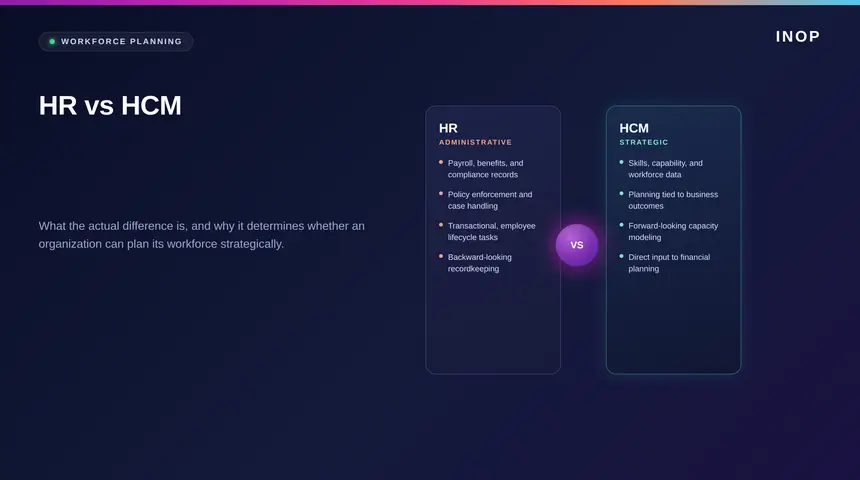
The short answer to HR vs HCM: HR, or human resource management, handles the day-to-day operational work of managing people, payroll, compliance, recruitment, and employee records. HCM, or human capital management, takes a broader, strategic view, treating employees as assets to be developed rather than administrative records to be processed, and encompassing everything HR does plus workforce planning, succession, and talent development on top of it. The two terms get used interchangeably by software vendors constantly, which is exactly why so many HR leaders end up confused about what they actually need.
This guide breaks down the real difference between HR and HCM, where the two overlap, and why neither one, on its own, actually tells you what to do with the workforce data both of them collect.
HR vs HCM: The Core Difference in One Table
| Dimension | HR (Human Resource Management) | HCM (Human Capital Management) |
|---|---|---|
| Primary focus | Day-to-day people administration | Long-term workforce strategy and development |
| Core activities | Payroll, compliance, recruitment, records | All of HR, plus succession, talent development, workforce planning |
| View of employees | Personnel to be managed and processed | Assets to be developed for long-term value |
| Orientation | Reactive, process driven | Proactive, strategy driven |
| Typical software | HRIS, core payroll systems | Full HCM suites (Workday, Oracle HCM, SAP SuccessFactors) |
HR vs HCM: Why the Confusion Persists
Part of the confusion is that HRM and HCM share a common goal and are sometimes used interchangeably by the same organizations that draw a sharp line between them elsewhere. The two approaches are not an either-or choice in practice. Leveraging both, the operational discipline of HR and the strategic scope of HCM, together is what actually drives productivity and growth, rather than treating one as a replacement for the other, according to NetSuite’s research on HRM versus HCM. HR remains the operational engine underneath even the most sophisticated HCM deployment, which is why the distinction is best understood as scope and orientation rather than one function replacing the other.
What HR Actually Covers
Human resource management is the more traditional, narrower discipline. It manages the day-to-day interactions between an organization and its employees, hiring and onboarding, processing payroll, administering benefits, and maintaining employee records. Much of what HR does is reactive by design: a job opening gets filled, a raise gets processed, a compliance requirement gets met. That is not a criticism of the function. It is the necessary operational backbone every organization needs regardless of how sophisticated its broader talent strategy is.
What HCM Actually Covers
Human capital management builds on that same foundation but extends much further, encompassing workforce planning, succession management, learning and career development, and analytics aimed at treating the workforce as a long-term strategic asset rather than a set of records to maintain. HCM did not replace HR. It absorbed HR’s operational core and added a strategic layer on top of it.
HCM as a Technology Category
In practice, most people encounter the HR versus HCM distinction through software. HRIS platforms handle core administrative data, employee records, basic payroll interfaces, and compliance reporting. HCM suites add workforce planning modules, advanced talent management, succession tools, and predictive workforce modeling on top of that same underlying data, according to recent research comparing HRIS, HRMS, and HCM systems. The practical distinction vendors themselves use is functional rather than purely definitional: a product marketed as HRIS that happens to include payroll, time tracking, and applicant tracking functions like an HRMS, while a suite layering in enterprise workforce planning and predictive analytics is being sold, correctly, as HCM.
HCM as a Strategic Philosophy
Separate from the software category, HCM also describes a management philosophy, one that views employees the way a CFO views capital: as an asset that generates a return when developed well and represents a cost or a risk when neglected. This framing is what pushes organizations toward workforce planning, skills development, and succession strategy as core business priorities rather than HR-only concerns. Decisions grounded in this kind of centralized, data-backed view tend to be fairer and more defensible than decisions made without it, since a data-driven approach to performance, retention, and work allocation reduces the risk of decisions being second-guessed as arbitrary or biased, according to recent research comparing HR and HCM approaches. An organization can run modern HCM software and still operate with an HR mindset underneath it, treating the additional modules as unused features rather than genuinely shifting how it thinks about its people.
See how INOP sits alongside your HCM system to turn workforce data into an actual decision. Book a demo to walk through a live view for your organization.
Where HR and HCM Overlap and Where They Diverge
The two are not competing categories, and framing HR versus HCM as an either-or choice misses how organizations actually use both. HRM and HCM are interdependent in most organizations: HR handles the operational execution, hiring someone, processing a benefits enrollment, resolving a compliance question, while HCM provides the strategic layer that decides where the organization needs to invest in talent next. The confusion mostly comes from vendors, not from the underlying concepts. Deloitte’s research finds that organizations now use an average of seven to ten HR tools, many of which overlap in function or fail to integrate cleanly, according to recent research on HR technology fragmentation. That same research points to a consequence worth taking seriously: despite all this tooling, Gallup finds only 23 percent of employees worldwide feel engaged at work, suggesting that buying more HR and HCM software does not automatically translate into a better-managed workforce.
Why Neither HR nor HCM Is a Decision Intelligence Layer
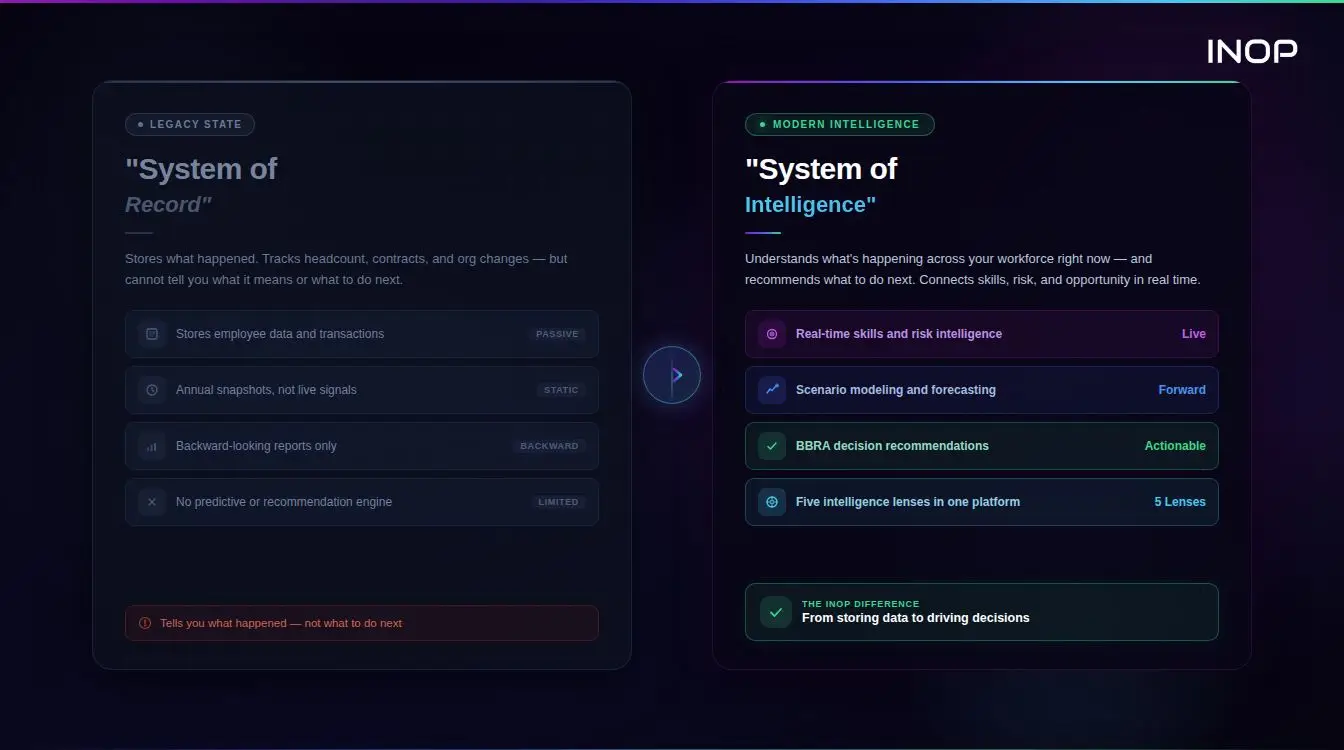
Here is the gap that matters most for anyone evaluating their workforce technology stack: both HR and HCM systems are, fundamentally, systems of record. They store, administer, and report on workforce data, employee profiles, compensation history, organizational hierarchy, performance records, exceptionally well. What they generally do not do is tell you what to actually decide. An HCM suite can show you that a critical skill is concentrated in two employees. It rarely tells you whether the right response is training, redeployment, external hiring, or automation, and it almost never models the financial tradeoff between those options across different time horizons. That gap is not a flaw in HCM software. It reflects what the category was built to do: administer and report, not decide.
This gap is where a lot of real exposure hides. An HCM system can show you turnover trending upward in a department, a leadership pipeline thinning out, or a critical skill concentrated in one or two people, all without ever flagging that these are actually connected signals of the same underlying human capital risk. The data sits there, technically visible, but nothing in a standard HR or HCM platform scores it, prioritizes it, or connects it to a response. That step, turning scattered workforce data into a ranked view of what actually threatens the business, is a different capability than administering payroll or running a compliance report, and it’s usually where organizations discover their HCM investment stopped short of what they actually needed.
INOP’s Five Intelligence Lenses: The Layer HCM Systems Don’t Cover
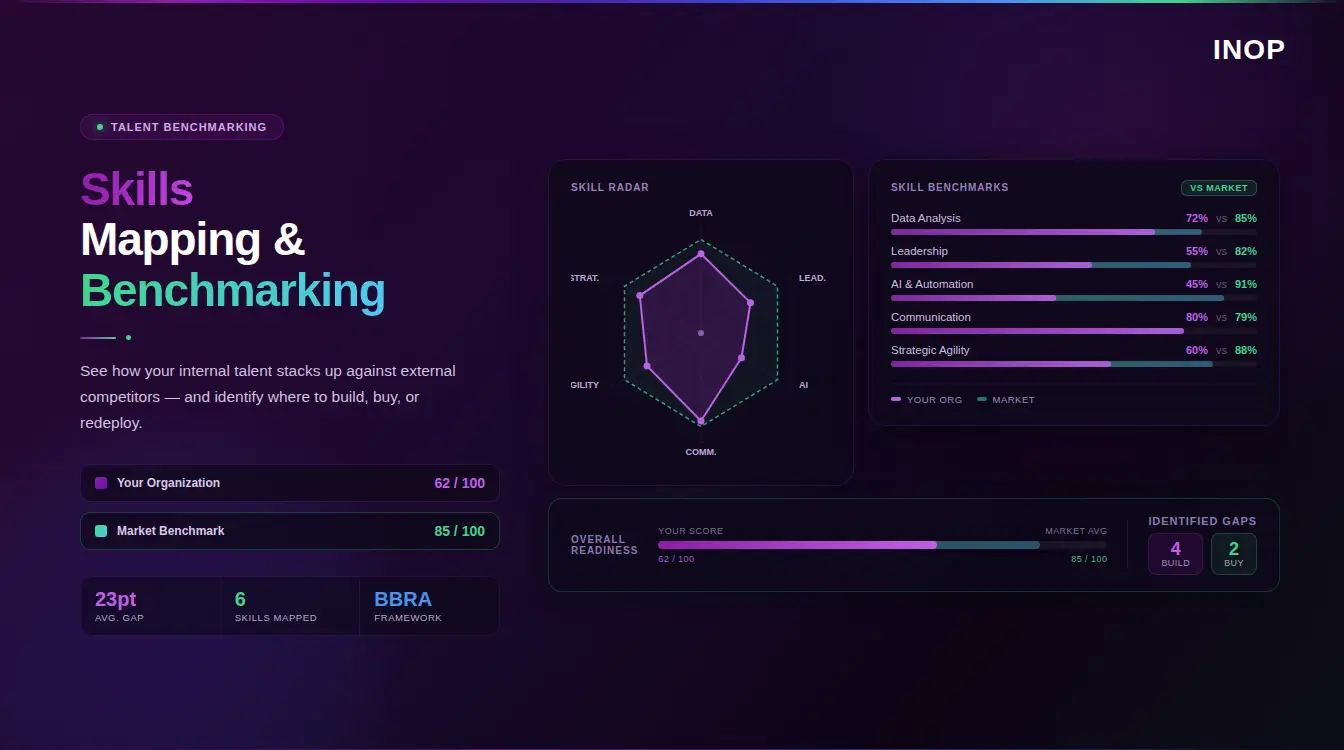
INOP is built to sit on top of the HR and HCM data your organization already has, rather than replace it, applying five intelligence lenses to turn that stored data into an actual workforce decision.
- Strategy: Does a workforce gap or opportunity sitting in your HCM data connect to a specific business priority worth acting on now?
- Finance: What would closing that gap actually cost through different pathways, a comparison HCM reporting alone will not surface?
- People: Who inside the organization already holds adjacent capability that HCM records show but nobody has connected to the opportunity?
- Market: How does your internal HCM data compare to what is actually happening in the external labor market for the same roles and skills?
- AI and Automation: Could a task behind a workforce gap be automated, changing what your HCM data should actually be telling you to do?
BBRA: Turning HCM Data Into a Modeled Decision
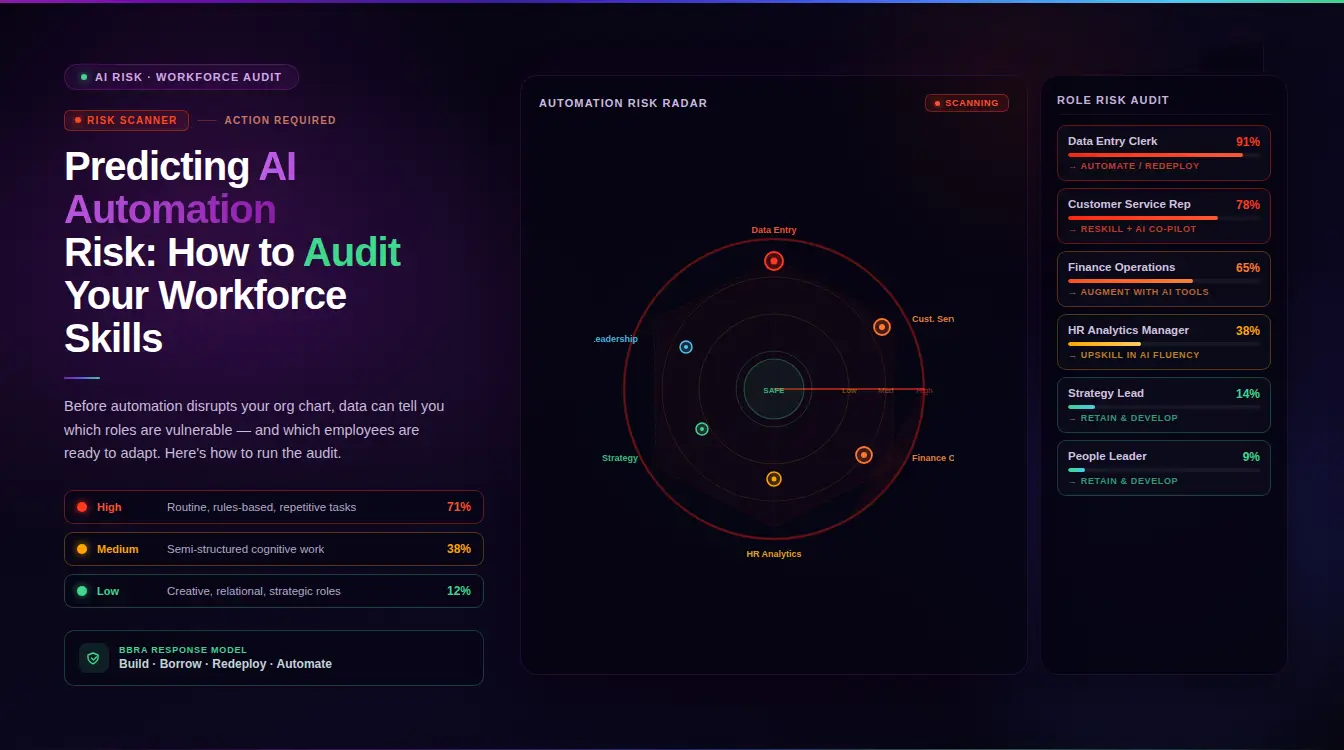
Once a gap or risk surfaces in HR or HCM data, INOP’s proprietary BBRA framework, Build, Buy, Redeploy, and Automate, gives that finding an actual decision structure. BBRA models all four intervention pathways against financial tradeoffs across four time horizons: thirty days, one hundred eighty days, one year, and three years, turning a static data point sitting in your HCM system into a modeled, comparable recommendation. For a deeper look at how this connects specifically to headcount and workforce planning data, INOP’s guide on headcount planning process, tools, and KPIs covers how HCM platforms function as the system of record that feeds this decision layer, and INOP’s broader guide to talent intelligence and data-driven HR explains how fragmented HR and HCM data gets synthesized into a single decision-ready view.
HR vs HCM for Private Equity Operating Partners
Inside a portfolio company, the maturity gap between HR and HCM often shows up as a due diligence blind spot. A portfolio company running a full HCM suite can look strategically mature on paper while actually using the platform as an expensive system of record, collecting workforce data without ever turning it into a modeled decision. Standardizing this evaluation across a portfolio through INOP’s strategic workforce planning platform gives operating partners a consistent way to assess whether a portfolio company’s HCM investment is actually driving strategic decisions or simply administering payroll and compliance more efficiently than a basic HRIS would. Where HCM data surfaces roles carrying scarce, high-demand skills, INOP’s compensation analytics platform connects that finding directly into pay benchmarking, closing a gap most HCM reporting modules leave open.
Common Misconceptions About HR and HCM
Assuming HCM software automatically makes an organization strategic. Buying an HCM suite does not, by itself, change how an organization thinks about its workforce. Many organizations use expensive HCM platforms in exactly the same reactive, administrative way they used a basic HRIS.
Treating HR and HCM as competing categories. The two are not an either-or choice. HR provides the operational execution HCM’s strategic layer depends on, and neither functions well without the other.
Believing more HR tools automatically improve outcomes. Organizations running seven to ten overlapping HR tools do not show correspondingly higher engagement, a signal that tool fragmentation itself can undermine the strategic value HCM is supposed to deliver.
Expecting an HCM platform to make workforce decisions. HCM systems store and report on workforce data exceptionally well. They rarely model the tradeoff between training, redeployment, hiring, and automation, which is a different layer of capability entirely, and one worth evaluating separately from how well a platform administers payroll and benefits. INOP’s skills intelligence platform is built specifically to close this gap by mapping external labor market signals against the skills data your HCM system already holds.
Frequently Asked Questions
Is HCM just another name for HR software?
Not quite. HCM software typically includes everything a core HRIS does, employee records, payroll interfaces, compliance reporting, plus additional strategic modules for workforce planning, succession, and predictive analytics that a basic HRIS does not include.
Do small companies need HCM, or is HR enough?
Smaller organizations often manage well with core HR and HRIS tools alone. HCM’s broader strategic modules tend to deliver more value as an organization grows in complexity, spans multiple locations, or needs to plan workforce capacity against longer-term business goals.
What is the difference between HCM and HRIS specifically?
HRIS refers to systems focused on storing and managing core HR data and administrative processes. HCM is broader, layering workforce planning, talent development, succession, and analytics on top of that same administrative foundation.
Can an organization use HCM software without becoming strategically mature?
Yes, and it happens often. Purchasing HCM software does not automatically change how an organization uses its workforce data. Many organizations run sophisticated HCM platforms while still using them primarily for the same administrative tasks a basic HRIS would handle.
How should private equity operating partners evaluate a portfolio company’s HR versus HCM maturity?
By checking whether the organization’s HCM investment actually drives workforce decisions, not just whether the software license exists. A portfolio company can run enterprise HCM software and still lack any real strategic workforce planning capability underneath it.
Ready to turn the data sitting in your HR or HCM system into an actual workforce decision? Book a demo and INOP will walk through how your existing data connects to BBRA and the five-lens model, live.