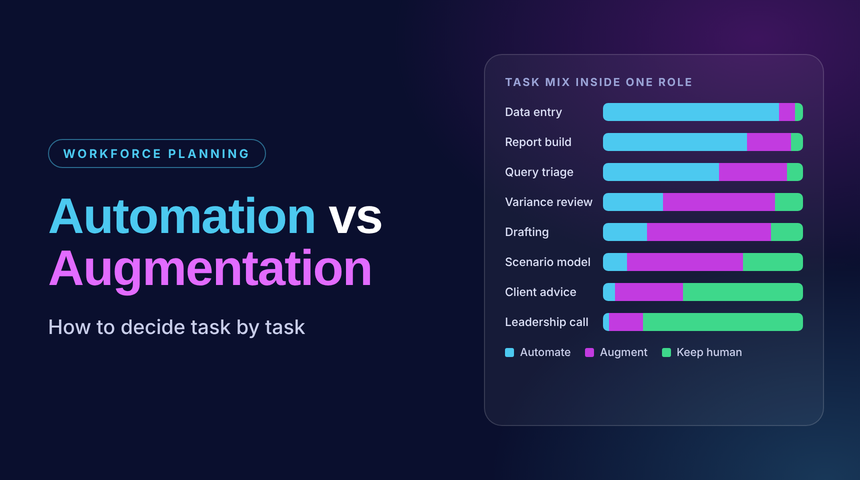
Every AI programme eventually faces a choice: should AI perform the work, or help people do it better? The distinction between AI automation and augmentation is often discussed in terms of jobs, but the decision begins at task level. Most roles contain a combination of activities that can be automated, tasks where AI can support employees, and responsibilities that still require human judgement.
The consequences extend beyond productivity. Automating a task may reduce the time needed to complete it, but that does not necessarily mean the organisation needs fewer employees. Leaders must consider how work will change, which capabilities they need to retain and what happens to any capacity released.
Getting these decisions right requires an understanding of the work the organisation needs to deliver its strategy, both today and in the future. This article examines how leaders can assess automation and augmentation at task level and connect those choices to workforce planning and investment decisions.
What Is the Difference Between AI Automation and Augmentation?
AI automation means technology performs a task with little or no human involvement in its execution, although oversight may still be required. AI augmentation means technology supports a person who remains responsible for the task and its outcome. Both can improve productivity, but they change the work and the human role in different ways.
Anthropic’s Economic Index, which analyses how people use its Claude models for work, distinguishes between the two approaches. It defines augmentation as AI collaborating with a user to perform a task, and automation as AI directly performing a task, such as formatting a document. In its analysis of Claude usage, 57% of interactions leaned towards augmentation and 43% towards automation.
| AI Automation | AI Augmentation | |
|---|---|---|
| Who performs the task | The AI system | A person, supported by AI |
| Human role | Oversight, exception handling, quality checks | Judgement, direction and final decision |
| Typical value | Faster processing, lower operating costs where savings can be realised | Productivity, quality and capacity release |
| Best suited to | Repetitive, rules-based, high-volume tasks | Complex, variable or judgement-heavy tasks |
| Main risk | Errors at scale and loss of know-how | Uneven adoption and unclear productivity gains |
| Workforce effect | Reduced time required for affected tasks | Potential capacity release, depending on how work is redesigned |
Why Is AI Automation vs Augmentation a Task-Level Decision?
Roles bundle many different tasks together. A finance analyst may spend part of the week on data reconciliation, which suits automation, and part on scenario analysis for leadership, where AI can speed up the work, but judgement stays human. Deciding at job title level forces one answer onto work that needs several.
Research on occupational exposure points the same way. The International Labour Organization’s analysis of how generative AI might affect occupations estimates that about a quarter of global employment falls into one of its exposure gradients. It concludes that the transformation of jobs is the most likely impact, since nearly all occupations include tasks that still need human input.
In October 2026, Gartner predicted that by 2029, 30% of employees terminated and replaced by AI would be rehired, often at a higher cost, if organisations failed to overhaul workforce planning. This is a forecast rather than an observed rehiring rate. Gartner also found that only 19% of organisations surveyed had workforce planning practices that effectively accounted for changes in work, AI adoption and business priorities.
The findings raise an important question for leaders considering automation: have they established what work the organisation will need in the future before deciding which roles or capabilities to reduce?
What Does the Research Say About Automation and Augmentation?
Research suggests that automation and augmentation will coexist, although their application will vary considerably across roles and tasks.
McKinsey Global Institute’s research on skill partnerships in the age of AI estimates that current technology could, in theory, automate activities accounting for about 57% of US work hours. The same research finds that approximately 72% of skills are used in both activities that AI could perform and work that still requires people. This suggests that AI adoption may change how existing skills are applied, even where individual tasks become automated.
A study of 5,179 customer support agents published by the National Bureau of Economic Research, Generative AI at Work, found that access to an AI assistant increased productivity, measured by issues resolved per hour, by 14% on average and by 34% among novice and lower-skilled workers. The largest gains were recorded among employees with less experience.
Employers are preparing for both outcomes. According to the World Economic Forum’s Future of Jobs Report 2025, 41% of surveyed employers expect to reduce their workforce as AI automates certain tasks, while 77% plan to upskill employees.
When Should You Automate and When Should You Augment?
The decision depends on the nature of the task, the consequences of an error and the strategic value of the capability involved. Repetitive, rules-based tasks with predictable outcomes may be suitable for automation. Tasks that require judgement, context or human relationships are generally better suited to augmentation or continued human responsibility.
However, technical suitability is only the starting point. Organisations must also consider whether they have the systems, governance and workforce capabilities to implement the proposed changes safely and effectively.
Five criteria can help assess each task:
- Repeatability: Does the task follow consistent steps with predictable inputs, or does it vary from case to case?
- Error consequence: What happens if the output is incorrect, and how quickly would the error be detected?
- Judgement content: Does the task require interpretation, contextual understanding or decisions that should remain with people?
- Strategic value: Is the capability involved important to the organisation’s strategy, and does it need to be retained or developed internally?
- Volume and cost: Is the task performed frequently enough for automation to release meaningful capacity or reduce costs?
| Task Profile | Likely Approach | Example |
|---|---|---|
| High-volume, rules-based tasks with manageable error consequences | Automate | Invoice matching, routine data entry, standard report formatting |
| Variable, judgement-heavy tasks with significant error consequences | Augment with appropriate human review | Credit assessments, clinical documentation, legal research |
| Relationship-based or strategically critical tasks | Retain human responsibility using AI where appropriate | Client negotiations, leadership decisions, change management |
| Tasks combining routine and judgement-intensive activities | Automate routine elements and augment the remainder | Customer support: automated triage with human-led resolution of complex cases |
From Task Choice to Workforce Decision
A task-level assessment is necessary, but it is not the final decision. Leaders must also consider how automation and augmentation will affect future work requirements, workforce capabilities and investment priorities. The framework below connects these decisions to strategic workforce planning.
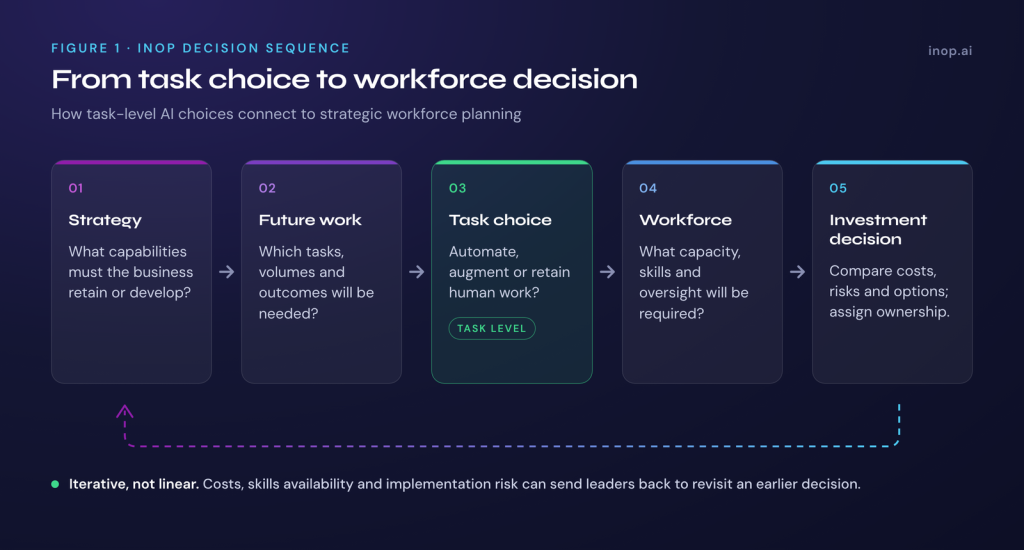
Figure 1. An INOP decision sequence linking task-level AI choices to workforce planning.
Note: Workforce planning is an iterative process. Assessing costs, skills availability and implementation risks may require leaders to revisit their initial automation or augmentation decisions.
This sequence matters because a technically automatable task does not necessarily justify eliminating a role. Future demand, exception handling, supervision and the cost of rebuilding lost capability can change the decision.
What Are the Risks of Getting AI Automation vs Augmentation Wrong?
Over-automating strips human judgement from tasks that still require it. Errors can spread at scale before anyone catches them, and the organisation risks losing the expertise needed to correct or redesign processes later. Entry-level tasks deserve particular care: they are often where people develop the expertise the organisation relies on in senior roles.
Under-automating has a cost too. Highly skilled people remain tied up in routine work, the business carries costs that competitors may have reduced, and opportunities to improve productivity are missed because workflows have not been redesigned.
A third risk sits between the two: treating augmentation as a technology rollout. Giving people access to AI tools is not the same as redesigning their work. Without clear changes to tasks, performance expectations and skills, the capacity released through augmentation may not translate into measurable business value.
How Do Automation and Augmentation Change Roles and Skills?
Automation can reduce the hours required for particular tasks. Augmentation can change how employees use their time. Neither automatically translates into lower headcount or higher-value work. Leaders need to establish how the redesigned role will function and what will happen to any capacity released.
Four questions follow each decision:
- Where does the freed capacity go? Determine how much capacity can realistically be redeployed, used to absorb growth without additional headcount, or removed from the cost base.
- Which skills become more important? Redesigned roles may require stronger judgement, problem framing, oversight of automated processes and the ability to evaluate AI output.
- Which people need to move? Where automation substantially changes or removes existing roles, identify opportunities for redeployment into roles where employees’ skills can transfer.
- What does the change cost over time? Compare the costs of implementation, reskilling, redeployment and ongoing oversight against expected savings and productivity gains over different time horizons.
Before implementing these changes at scale, leaders should assess whether the workforce, leadership and organisational controls are ready to support the redesigned work.
How Does INOP Help Leaders Decide Between Automation and Augmentation?
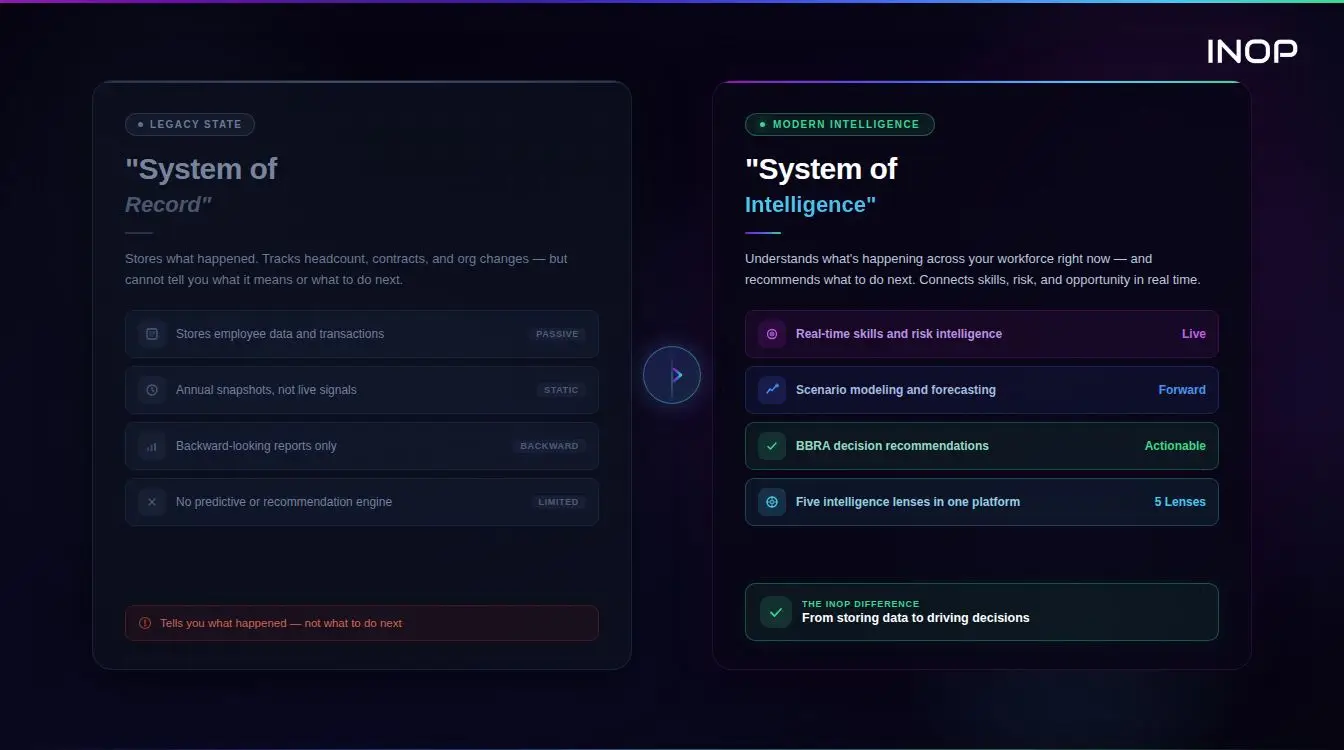
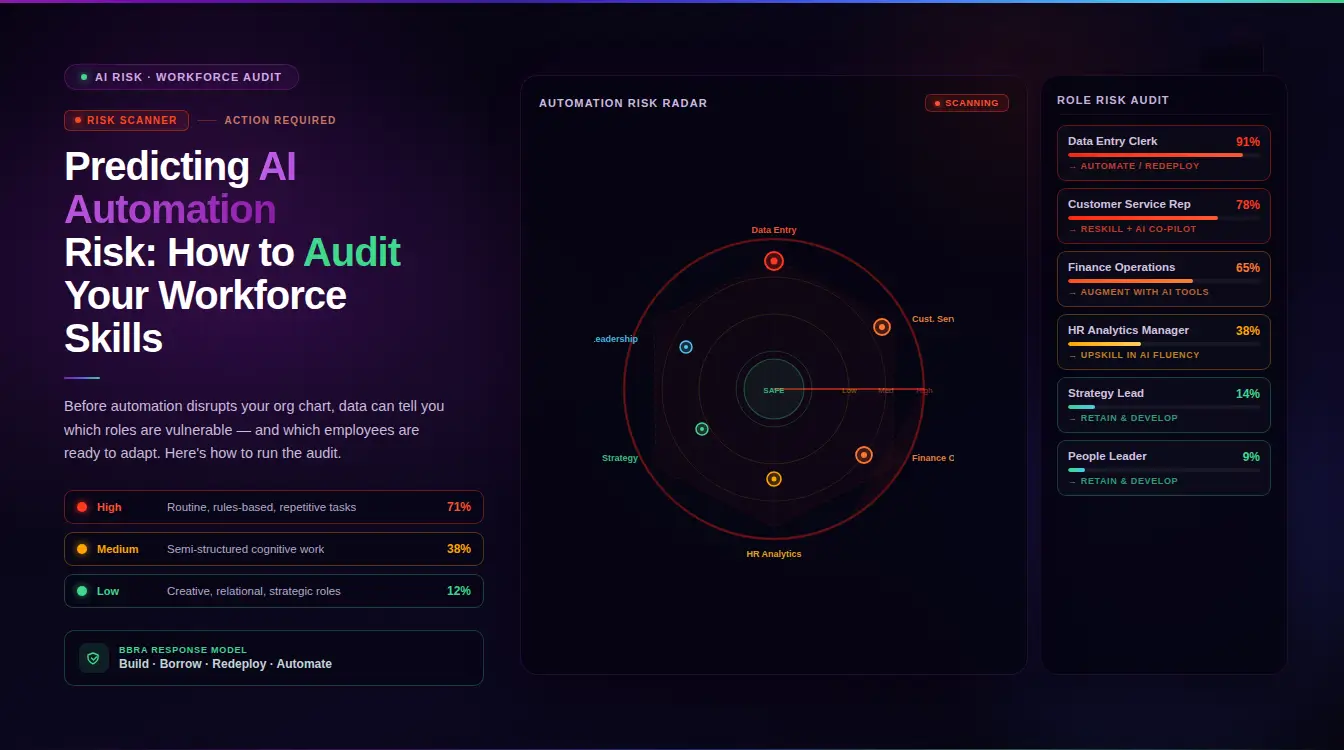
INOP assesses the workforce capabilities needed to execute business strategy as AI changes tasks and roles. Using five intelligence lenses (Strategy, Finance, People, Market, and AI & Automation), it identifies capability gaps, evaluates execution risk and compares possible responses. AI is never assessed in isolation but is considered alongside strategy, finance, people and the market. The assessment examines tasks in the context of the strategy they support, the people performing them, the cost of change and the organisation’s operating requirements. At the skill and task levels, INOP classifies work as not impacted, partially augmented or fully automatable, using a methodology calibrated against ten external research frameworks.
For partially augmented tasks, it models potential time savings, estimating the capacity released and the associated financial return. For fully automatable tasks, it estimates cost savings, FTE impact and transition costs. Results can be examined at the organisational, business unit, departmental, country and individual employee levels, with role- and task-level data used where employee-level information is unavailable.
Beyond assessing AI’s impact, INOP identifies the opportunities it creates and evaluates how ready the organisation is to capture them, including the readiness of leaders and employees. It compares each role’s skills and task mix before and after AI adoption, showing which skills decline, change or become critical, and which roles grow, change, merge or emerge. For every affected employee group, it maps potential redeployment paths based on skills adjacency, including the time and cost required for upskilling or reskilling.
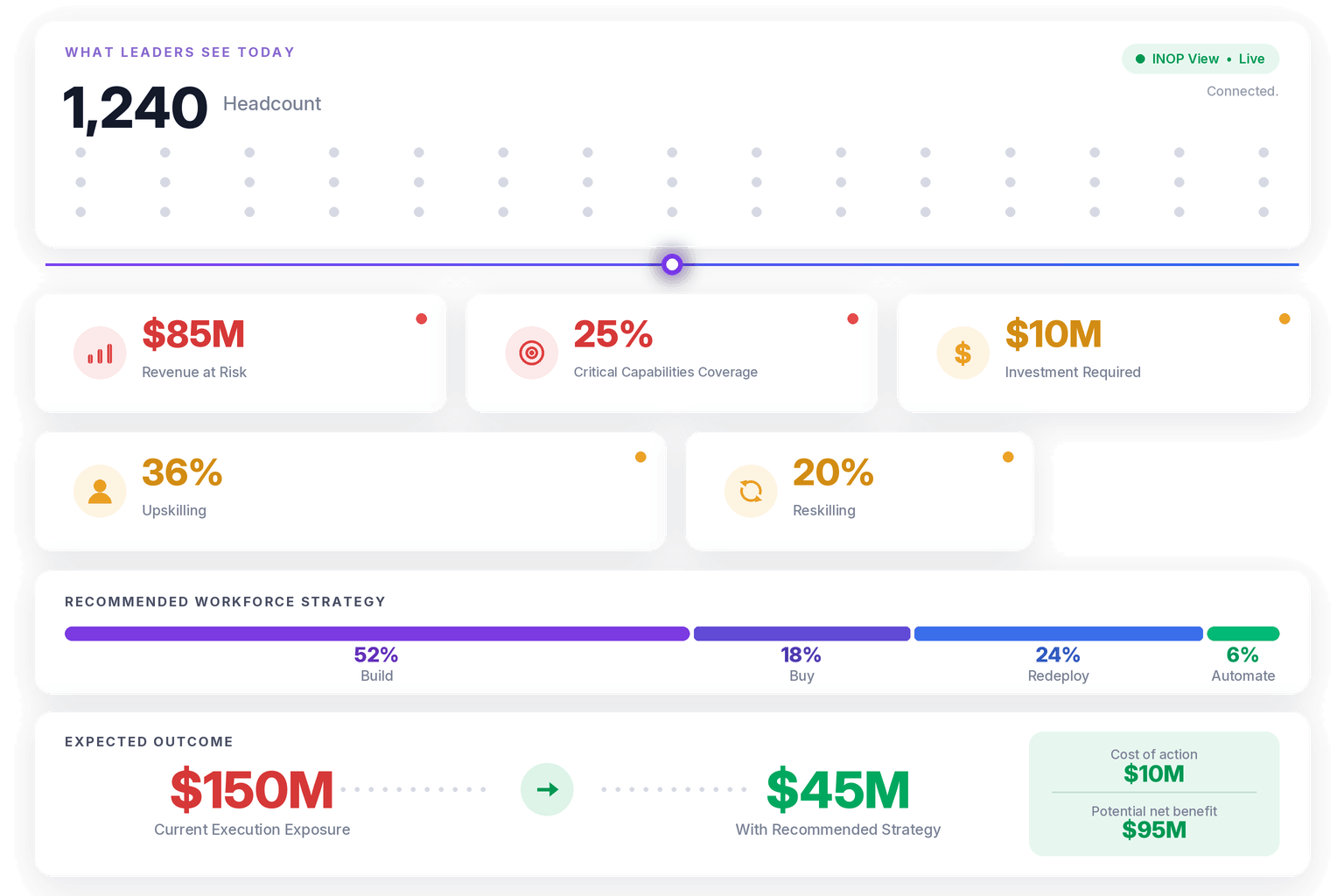
In a large IT services company, INOP found that AI could release approximately 20% of workforce capacity within three years while headcount stays flat. The work would shift rather than disappear: approximately three in four employees would require upskilling, while one in ten would move into new roles. INOP’s BBRA decision architecture then compares four possible responses: Build, Buy, Redeploy and Automate. Each pathway is evaluated over 180-day, one-year, two-year and three-year horizons. This allows leaders to assess automation alongside reskilling, redeployment and external hiring within a consistent financial framework.
Explore how different automation and augmentation decisions could affect your workforce capabilities, costs and ability to execute strategy. Book a demo.
How Should PE Operating Partners Assess Automation and Augmentation Plans?
PE operating partners should test whether the AI assumptions in a value creation plan rest on task-level evidence. A plan that books automation savings without showing which tasks change, which capabilities the company keeps and what transition costs apply carries more risk than its headline numbers suggest. Put four questions to each portfolio company:
- Which tasks does the plan automate, which does it augment, and on what evidence?
- How much capacity does augmentation release, and where will that capacity go?
- Which critical capabilities could the company lose if it automates too far?
- What will reskilling, redeployment and other transition requirements cost, and when will the expected savings materialise?
INOP uses a consistent task classification methodology, five intelligence lenses and BBRA decision framework to assess automation and augmentation plans across portfolio companies. This helps operating partners compare workforce implications, transition costs and potential returns while accounting for differences between businesses.
Explore how INOP can help evaluate the workforce assumptions and financial implications of AI plans across your portfolio. Book a demo.
Frequently Asked Questions
What is the difference between AI automation and augmentation?
AI automation means technology performs a task with little or no human involvement in its execution. AI augmentation means AI supports a person who remains responsible for the task and its outcome. Automation reduces the human effort required to complete a task, while augmentation helps people perform their work more effectively.
Is AI augmentation better than automation?
Neither is better in every case. Automation suits repetitive, rules-based and high-volume tasks where error risks can be managed. Augmentation suits tasks that depend on judgement, context or relationships. Most roles contain both, so the best approach is to decide task by task rather than for a whole role.
How do you decide whether to automate or augment a task?
Assess each task based on its repeatability, the consequences of an error, how much judgement it requires, the strategic value of the capability involved, and its volume and cost. Repetitive, low-risk, high-volume tasks are candidates for automation, while judgement-heavy or strategically critical tasks are candidates for augmentation.
Does AI augmentation improve productivity?
Research suggests it can. A National Bureau of Economic Research study of 5,179 customer support agents found that access to an AI assistant increased productivity by 14% on average and by 34% among novice and lower-skilled workers. The gains depend on the nature of the work, how AI is implemented and how employees use the tools.
How should PE operating partners evaluate automation plans in portfolio companies?
PE operating partners should check that automation and augmentation assumptions rest on task-level evidence, that the company knows where released capacity will go, and that transition costs are assessed across the holding period. Applying a consistent methodology across the portfolio helps operating partners compare workforce implications, costs and potential returns between companies.