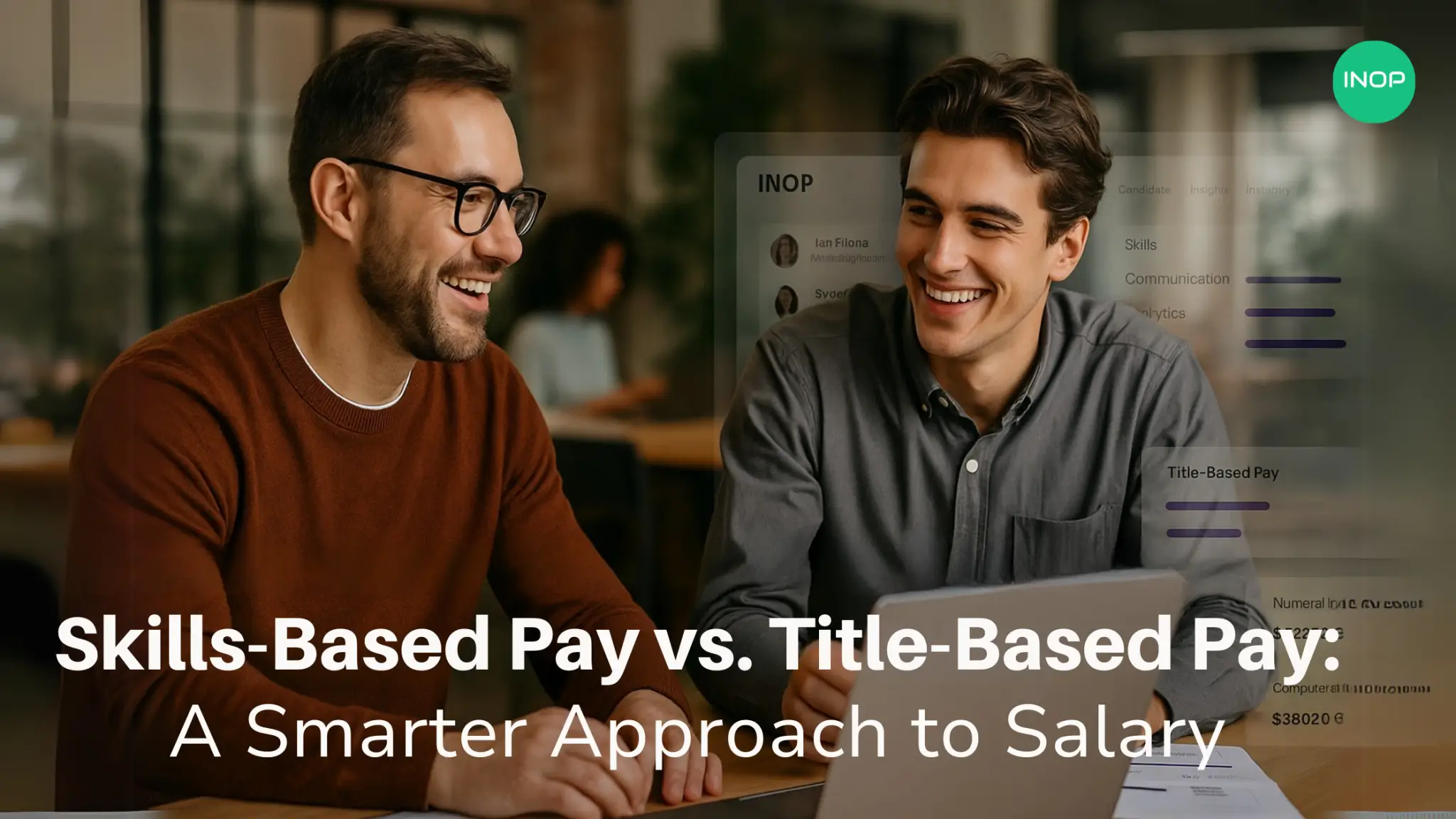
Skills-based pay bands are replacing traditional salary structures in organizations that have realized job titles are a poor proxy for actual value. Two employees can hold the same title, one with three verified skills and another with twelve, and a title-based system pays them identically. A skills-based pay band structure fixes this: compensation reflects what an employee can demonstrably do, not what their business card says they are.
This guide covers everything HR leaders and Total Rewards teams need to design, implement, and govern skills-based pay bands: the structural mechanics, a step-by-step design process, worked salary examples across three role families, benchmarking methodology, pay transparency compliance, and the governance model that determines whether the system holds up over time.
What Are Skills-Based Pay Bands?
Skills-based pay bands are compensation structures where salary ranges are anchored to the specific capabilities employees possess rather than the job titles they hold. Instead of assigning everyone with the title “Software Engineer” to the same pay grade, a skills-based band structure creates defined ranges for each level of verified competency, and employees move between those ranges as their skill portfolio expands.
The distinction from traditional pay bands is both structural and philosophical. Traditional bands ask: what position does this person hold? Skills-based bands ask: what can this person actually do, and what is that capability worth in the market right now?
This approach connects directly to skills-based pay versus job-based pay as a broader compensation philosophy. Where job-based pay treats the position as the unit of value, skills-based pay treats the person’s verified capability portfolio as the unit of value. Pay bands are the structural mechanism that makes this philosophy operational at scale.
Key Structural Features
Every skills-based pay band system shares three structural features that distinguish it from credential-based alternatives.
The first is defined proficiency anchors. Each band has explicit skill requirements expressed as observable behaviors at defined proficiency levels, not credential lists. Band 3 in a data analytics function does not require “5 years of experience.” It requires “SQL at advanced level, Python at intermediate level, and demonstrated ability to build and maintain production dashboards independently.” The specificity is what makes the system defensible and useful.
The second is validated advancement. Movement between bands happens through a structured assessment process, not manager discretion or time accumulation. An employee who demonstrates Band 4 competencies after 18 months in Band 3 advances immediately, with documentation. An employee who has been in Band 3 for five years but has not developed the required competencies does not advance on tenure alone.
The third is market-anchored ranges. Each band has a minimum, midpoint, and maximum derived from external market data for the specific skill level, not from historical salary averages or general job title benchmarks. Compensation analytics platforms that connect real-time market intelligence to internal band structures make this benchmarking continuous rather than annual.
Why Organizations Are Moving to Skills-Based Pay Bands
The shift is being driven by four forces that are all accelerating simultaneously in 2026.
Skills obsolescence is outpacing job description cycles. The half-life of a learned skill has dropped to fewer than five years in technology-adjacent roles. A pay system tied to job titles written two years ago is compensating for capabilities that may no longer represent the employee’s actual current value, in either direction. Skills-based bands create a live connection between what someone can do and what they earn.
Pay transparency legislation is demanding defensible criteria. Laws in California, Colorado, New York, Illinois, Washington, and across the EU require employers to explain why two employees earn different amounts. “Different job titles” is not a sufficient answer when the roles are functionally equivalent. Skills-based pay bands provide an auditable, consistent rationale: this employee holds Band 4 because of these three verified competencies; that employee holds Band 3 because of these two verified competencies and a gap in the third. For a deeper look at how compensation benchmarks support pay transparency compliance, INOP’s guide covers the methodology in detail.
Internal mobility requires capability visibility. Organizations trying to redeploy talent internally cannot do so efficiently when compensation is tied to job titles rather than skills. When an employee’s skills profile determines both their band and their deployment eligibility, internal moves become faster and less politically complex. The employee’s pay travels with their verified capability, not with a title negotiation.
The talent market prices skills, not titles. External candidates increasingly know what specific skills are worth. Competing for a machine learning engineer by benchmarking “Senior Software Engineer” salaries produces systematically incorrect offers because the title aggregates wildly different capability profiles. Skills-based bands align internal pay to the granular market reality of what specific capabilities command.
Want to see how INOP connects real-time market data to skills-based pay band design? Book a 20-minute demo.
Skills-Based Pay Band Examples with Salary Figures
The following worked examples show how skills-based pay bands function in practice across three role families. These are illustrative models built on current market benchmarking data. They are not prescriptive templates, but they demonstrate the structural logic that any organization can adapt to its own taxonomy and market positioning.
Example 1: Software Engineering Pay Bands (US Market, 2026)
| Band | Label | Core Skills Required | Base Salary Range |
|---|---|---|---|
| Band 1 | Foundational Engineer | Python or JavaScript at foundational level, version control, basic API integration, code review participation | $75,000 to $95,000 |
| Band 2 | Developing Engineer | Two languages at intermediate level, cloud deployment foundational (AWS/GCP/Azure), CI/CD pipelines, independent task completion | $95,000 to $125,000 |
| Band 3 | Proficient Engineer | Full-stack proficiency, cloud architecture intermediate, system design, independent feature ownership, junior mentoring | $125,000 to $160,000 |
| Band 4 | Senior Engineer | Distributed systems expertise, cloud architecture advanced, performance optimization, technical leadership across projects | $160,000 to $210,000 |
| Band 5 | Principal Engineer | Architecture design at expert level, cross-team technical strategy, AI/ML integration, thought leadership, organizational impact | $210,000 to $280,000+ |
Movement between bands is triggered by skills validation, not time in role. An engineer who demonstrates Band 3 competencies after 18 months at Band 2 advances immediately without waiting for an annual review cycle. An engineer who has spent four years at Band 2 without developing cloud architecture capability does not advance on tenure alone.
Example 2: Data Analytics Pay Bands (US Market, 2026)
| Band | Label | Core Skills Required | Base Salary Range |
|---|---|---|---|
| Band 1 | Analyst I | SQL intermediate, Excel advanced, data visualization foundational, basic statistical analysis | $60,000 to $78,000 |
| Band 2 | Analyst II | Python or R intermediate, BI tools proficient (Tableau/Power BI), A/B testing foundational, independent dashboard ownership | $78,000 to $100,000 |
| Band 3 | Senior Analyst | Machine learning foundational, statistical modeling intermediate, dashboard automation, stakeholder communication advanced | $100,000 to $130,000 |
| Band 4 | Lead Analyst | ML intermediate to advanced, predictive modeling, team leadership, cross-functional project ownership, roadmap contribution | $130,000 to $165,000 |
| Band 5 | Principal / Head of Analytics | Advanced analytics, AI integration, strategic advisory, organizational capability building, executive stakeholder management | $165,000 to $220,000+ |
The data analytics example illustrates how skills-based bands handle the breadth-versus-depth decision explicitly. Band 3 requires foundational machine learning alongside advanced stakeholder communication, signaling that the organization values analysts who can translate technical work into business decisions, not just those who go deeper technically. This specificity would be invisible in a title-based system.
Example 3: Clinical Healthcare Pay Bands (US Market, 2026)
| Band | Label | Core Skills / Certifications Required | Base Salary Range |
|---|---|---|---|
| Band 1 | Registered Nurse (General) | RN license, BLS certification, foundational patient assessment, documentation proficiency | $62,000 to $78,000 |
| Band 2 | Specialized RN | ACLS certified, one completed clinical specialization (ICU, pediatrics, oncology, emergency), charge nurse eligible | $78,000 to $96,000 |
| Band 3 | Senior / Charge RN | Two active specializations, charge nurse experience documented, preceptor qualification, quality improvement contribution | $96,000 to $115,000 |
| Band 4 | Clinical Nurse Specialist | MSN or advanced certification, complex case management, policy development participation, interdisciplinary team leadership | $115,000 to $140,000 |
| Band 5 | Advanced Practice RN | APRN license, prescriptive authority, independent practice capability, research or clinical protocol contribution | $140,000 to $185,000+ |
Healthcare illustrates a significant advantage of skills-based pay in credentialed industries: many skill validations are handled externally through licensing and certification bodies, reducing the internal assessment burden considerably compared to knowledge-work roles where all validation must be designed and managed internally.
How to Build Skills-Based Pay Bands: A Step-by-Step Process
Building a skills-based pay band system is a structured project, not a policy announcement. The following six-step process reflects what successful implementations share in common across industries.
Step 1: Conduct a Job Architecture Audit
Before building pay bands, map what you are building them for. Pull every unique job title in your HRIS and map it against actual role function and level. In most organizations, this audit reveals significant title proliferation: roles that are structurally equivalent are compensated differently because they carry different titles inherited from different managers, different acquisitions, or different eras of organizational design.
Calculate your title-to-headcount ratio. A healthy architecture in an organization of 500 or more employees maintains roughly 10 to 15 employees per unique job title. A 2,000-person organization with 1,400 unique job titles does not have 1,400 distinct roles. It has an accumulated history of ad hoc decisions that no pay band system can make rational without first rationalizing the underlying architecture.
The output of this step is a clean mapping of every current employee to a role family and level. This is the structural foundation that pay bands sit on. Build it before selecting any technology.
Step 2: Define the Skills That Drive Value at Each Level
For each role family and level, document the specific capabilities that differentiate performance. This is a capability list, not a credential list. What can someone at this level demonstrably do, at what proficiency, that produces business value?
Keep the skill list focused. Aim for 8 to 15 core skills per role family, with clear proficiency definitions at each band level. The definitions must have concrete behavioral anchors, not vague descriptors. “Advanced Python” is not a usable definition. “Writes production-grade Python independently, optimizes for performance, reviews peer code effectively, and can architect new modules from functional specifications” is a definition you can assess against consistently.
Distinguish between skills required on day one of a band and skills that can be developed during the band’s tenure as part of the development plan. This distinction prevents the common mistake of requiring Band 4 skills to enter Band 3, which creates a progression cliff that no one can cross.
For organizations building their first skills taxonomy, connecting internal role definitions to external demand signals ensures that the skills you are incentivizing reflect market value rather than only organizational preference. INOP’s skills intelligence platform maps internal skill taxonomies against real-time external market demand, identifying which capabilities are appreciating in market value and which are commoditizing.
Step 3: Benchmark Pay Ranges Against External Market Data
Each band needs a minimum, midpoint, and maximum derived from market data for the specific capability level, not from generic job title surveys. This is where skills-based compensation benchmarking differs structurally from traditional benchmarking: you are pricing verified proficiency levels, not job title categories that aggregate enormously different skill portfolios under the same label.
Primary data sources for skills-based compensation benchmarking include Radford (Aon) for technology and life sciences roles, Mercer WIN for broad multi-industry coverage, Willis Towers Watson for financial services and professional services, and Lightcast for real-time labor market intelligence showing how premium values for specific skill clusters are moving. For most organizations, combining two sources provides adequate confidence for range-setting.
Set your market positioning strategy before setting ranges. A 50th percentile strategy places your band midpoints at market median. A 75th percentile strategy places midpoints at the third quartile. This positioning decision reflects your talent market competitiveness goals and should be set at an organizational level with CFO and CHRO alignment, not varied by department or manager preference.
Step 4: Define Band Width and Overlap
Pay band width, the spread between band minimum and maximum, typically ranges from 40% to 60% for most role families. Wider bands accommodate more variation in individual skill depth within a level. Narrower bands provide more structure but require more frequent advancement decisions and create more cliff effects at band transitions.
Band overlap between adjacent bands is a deliberate design choice. Overlap of 15% to 25% between adjacent bands allows experienced employees in a lower band to earn more than newly-advanced employees in the next band above them. This reflects organizational reality and reduces compression complaints during transitions. Zero overlap creates cliff effects that feel arbitrary to employees and generate ongoing exception requests that erode the system’s consistency.
Step 5: Establish Skill Validation Methods by Skill Type
A skills-based pay band is only as defensible as the method used to confirm that skills are actually present. Validation methods vary by skill type and must be documented at the design stage, not improvised during the first advancement cycle.
Technical skills are most reliably validated through structured assessments, live coding exercises, work sample reviews, or recognized external certifications. Manager validation alone is insufficient for technical skills because managers frequently cannot assess proficiency depth in skills they do not personally hold at the relevant level.
Professional skills including project management, stakeholder communication, and analytical thinking are best validated through documented behavioral evidence: project outcome records, structured 360 feedback against defined behavioral criteria, and manager assessment using a standardized rubric rather than general impression. The rubric anchors, not the manager’s comfort level, should determine the score.
Soft skills require the most careful design because they carry the highest subjectivity risk. Define them as observable behaviors with specific example anchors at each proficiency level, and require multiple validation sources rather than single-assessor judgment. An employee who self-reports advanced leadership should have that validated by peer observations, a manager assessment against behavioral criteria, and ideally documented evidence from a stretch assignment.
Document every validation event: the date, the method used, who conducted it, and the outcome. This record is your first line of defense in a pay equity audit or an individual challenge under pay transparency legislation.
Step 6: Build the Governance Model
The most common failure in skills-based pay band implementations is the absence of governance. Without a defined process for who approves band advancements, how often skills can be reassessed, and how the taxonomy updates as role requirements evolve, the system drifts back toward inconsistency within 18 to 24 months and the original problems return.
Minimum governance requirements include a defined taxonomy owner, typically Total Rewards or HR Operations, with documented authority to approve or reject changes to skill definitions and band criteria. A skills validation calendar that triggers reassessment at least annually, with clear process steps and approval chain. A band advancement committee or defined approval authority that prevents individual manager advocacy from driving advancement decisions outside the validation process. And an annual market data review that updates band ranges against current benchmarking, with a mid-year pulse check for roles in fast-moving skill markets.
Skills-Based Pay Bands and Pay Transparency Compliance
Pay transparency legislation is one of the most significant structural drivers of skills-based pay band adoption in 2026. Understanding how the two connect is important for any organization operating in affected jurisdictions.
Laws requiring employers to post salary ranges, explain pay differences between employees, and provide employees with access to compensation criteria are all easier to satisfy when pay is tied to explicit, auditable skill criteria rather than negotiation history, manager discretion, or title-based grade assignments.
Under California SB 1162, Colorado’s Equal Pay for Equal Work Act, New York Labor Law 194-b, and the EU Pay Transparency Directive (requiring full implementation by June 2026 for organizations with 100 or more employees), employers must be able to explain why two employees in similar roles earn different amounts. A skills-based pay band framework provides exactly this justification: the criteria are published, the skill validation is documented, and the connection between proficiency and pay position within the band is explicit and consistent.
Organizations without skills-based structures that are now required to publish salary ranges frequently discover that their published ranges expose internal equity problems they were not previously required to defend. Pay compression, geographic inconsistency, and negotiation-driven pay gaps all become visible simultaneously when ranges are published. Skills-based pay bands provide both the structure and the documentation that makes pay transparency a genuine equity mechanism rather than a compliance exercise.
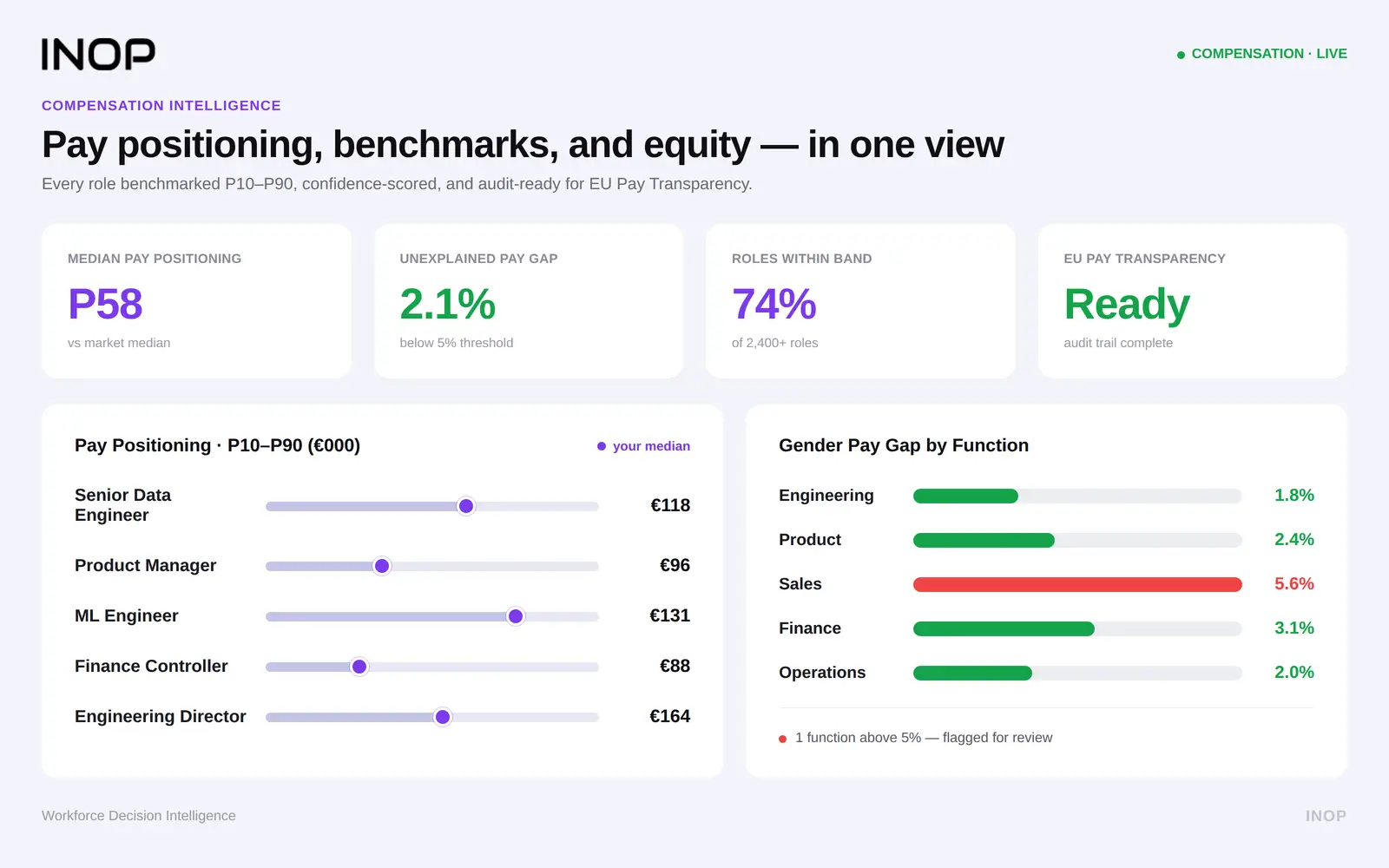
INOP’s compensation analytics platform is built for exactly this intersection, connecting skills-based pay band design to real-time market benchmarking and internal equity analysis with audit-ready reporting outputs that satisfy EU Pay Transparency Directive requirements and CSRD disclosure obligations.
Top Solutions for Skills-Based Compensation: Tools and Platforms
Implementing skills-based pay bands requires technology support at two layers: skills data management and compensation analytics. These are distinct problems requiring distinct tools, though some platforms address both.
Compensation Analytics and Pay Band Design Platforms
INOP’s compensation analytics platform connects real-time market benchmarking data to internal skills profiles, allowing Total Rewards teams to model pay band ranges against live market intelligence rather than annual survey data. It supports skills-based pay band design, internal equity analysis, pay transparency compliance reporting, and audit-ready documentation. Book a demo to see how INOP handles skills-based compensation design in practice.
Radford (Aon) is the market-standard compensation survey for technology and life sciences roles, with granular data by skill level and geography. Mercer WIN provides broader multi-industry benchmarking with real-time update frequency. Payscale and Levels.fyi offer strong individual contributor and engineering compensation data, particularly useful for organizations benchmarking against market-visible salary transparency data.
Skills Management and Assessment Platforms
These tools handle the skills assessment and validation layer that feeds pay band decisions. iMocha provides workforce-wide skills gap analysis with HRIS integration, enabling verified skills profiles to be connected directly to compensation band placement decisions. TalentGuard builds competency frameworks that map skill proficiency to career and compensation levels. Workday and SAP SuccessFactors both offer skills tagging within their HCM platforms for organizations already in those ecosystems.
For a broader comparison of skills intelligence platforms and how they connect to compensation decisions, INOP’s guide on skills intelligence covers the market in detail.
Skills-Based Pay Benchmarking Data Sources
Benchmarking skills-based pay requires more granular data than traditional title surveys. Lightcast labor market intelligence tracks real-time salary data by specific skill cluster, showing how premium values for individual capabilities are moving in the market on a rolling basis. LinkedIn Salary Insights provides role-plus-skill salary data at geographic granularity. Willis Towers Watson’s Compensation Survey provides validated benchmarking for professional and managerial roles across industries.
For organizations building a complete predictive compensation capability, connecting these benchmarking sources to an internal analytics layer allows real-time monitoring of skill premium drift, enabling proactive pay band adjustments before retention risk materializes.
How to Address Common Challenges
Managing Cost Escalation
The most frequently cited concern about skills-based pay bands is that costs will escalate as employees advance through bands faster than budget planning anticipated. This is a real risk in organizations that underestimate how many employees are already performing at a higher skill level than their current pay band reflects.
The mitigation is a phased implementation that begins with a skills baseline assessment before announcing the new system. Understanding the distribution of verified skills against proposed bands before communicating the change allows Total Rewards to model the cost of initial band placements and set realistic budget expectations. Organizations that launch without this baseline frequently discover a larger population of immediate advancement candidates than projected.
Salary compression between adjacent bands is the other cost management pressure. Overlap design, documented earlier, manages this partially. The governance model handles the rest by preventing informal advancement outside the defined validation process.
Assessing Soft Skills Objectively
Soft skills are harder to assess consistently than technical skills, but the difficulty is often overstated. The solution is moving from labels to behavioral anchors. “Leadership” is not assessable. “Identifies a team-level problem before it escalates, convenes the relevant stakeholders without being asked, and facilitates a resolution that the team acts on” is assessable through observation, structured feedback, and documented outcomes.
Design assessment rubrics with three to five behavioral anchors per proficiency level before the system launches, and train both managers and employees on what each anchor looks like in practice in your specific organizational context.
Keeping Skills Profiles Current
Skills data decays faster than most organizations expect. A skill assessed as advanced two years ago may be intermediate today if the technology has moved and the employee has not kept pace. Build update triggers into your operating model: skills profiles refresh at performance review cycles, certification completions trigger automatic profile updates, and annual strategic reviews realign the taxonomy to evolving business requirements.
The goal is making skills profile maintenance a natural byproduct of existing workflows rather than a separate administrative task. When an employee completes a certification, the HRIS should prompt a profile update immediately. When a project closes, the project owner should document which skills were demonstrated and at what level. Distributed, trigger-based updating is far more reliable than centralized annual updates.
Skills-Based Pay Bands in PE Portfolio Companies
For private equity operating partners, pay band rationalization is one of the most consistently underestimated value creation opportunities in portfolio company transformation. Most acquisition targets have accumulated title and pay inconsistency over years of ad hoc hiring decisions, acquisition integrations, and manager-level compensation exceptions. The result is a workforce where people in structurally equivalent roles earn materially different amounts for reasons that cannot be defended by capability difference.
A systematic pay band audit in the first 12 to 18 months of ownership typically reveals three recoverable cost categories. The first is overpayment for credentials rather than verified capability: employees whose compensation was set based on previous employer leverage or negotiation skill rather than demonstrated contribution. The second is underpayment risk: high-capability employees earning below market for their actual skills who represent near-term attrition risk that would cost significantly more to replace than to retain through a targeted pay adjustment. The third is compression: situations where long-tenured employees at lower bands are earning at or above recently-advanced employees in higher bands, creating equity perception problems that drive voluntary turnover.
Skills-based pay bands make all three patterns visible and quantifiable. When every employee’s compensation is mapped against a verified skills profile and a market-benchmarked band, the outliers in both directions surface immediately. Operating partners can then make data-driven decisions about which anomalies to address, in what sequence, and at what cost, rather than relying on HR intuition or manager advocacy.
For exit readiness, a documented skills-based pay structure provides human capital evidence that acquirers and their advisors increasingly expect: compensation tied to auditable capability criteria rather than title conventions, with clear governance that ensures the structure will hold after close. This positions the workforce as a documented asset rather than an undifferentiated cost line.
INOP’s compensation analytics platform is built for this use case, connecting verified skills data to real-time market benchmarks and internal equity analysis in a format that operating partners and investment committees can interrogate directly. Book a demo to see how INOP supports PE portfolio compensation strategy.
Connecting Skills-Based Pay Bands to Broader Workforce Strategy
Skills-based pay bands do not operate in isolation. Their value compounds when connected to the other talent systems that depend on accurate, current skills data.
Internal mobility becomes structurally easier when compensation travels with verified capability rather than with a job title that must be negotiated anew at each move. An employee whose skills profile qualifies them for a Band 3 role in a different function can move without a compensation negotiation: their profile determines their band placement, and the band determines their range. This reduces the friction cost of internal mobility significantly.
Workforce planning becomes more accurate when the planning team can model future capability supply against required demand, rather than counting headcount by title. Understanding that your current Band 2 engineering population is on a development trajectory that will produce 23 Band 3 engineers within 18 months is a planning input that title-based headcount models cannot generate. For more on connecting skills data to strategic workforce planning, INOP’s platform connects band-level skills intelligence directly to scenario modeling and financial forecasting.
Succession planning improves when candidates are evaluated against the skills required for the target role rather than their seniority in the current one. A Band 4 engineer with the specific architecture and leadership competencies required for a principal role is a stronger succession candidate than a Band 4 engineer with longer tenure but narrower skill development, regardless of how long each has been in the band.
For a complete view of how skills-based compensation connects to the broader question of rewarding employees for actual contribution, INOP’s analysis of future skills-based compensation models covers where the market is moving over the next three to five years.
Frequently Asked Questions
What is the difference between traditional pay bands and skills-based pay bands?
Traditional pay bands are tied to job titles or seniority levels. An employee’s position in a band is primarily determined by their grade, how long they have been at a level, or their previous salary. Skills-based pay bands tie an employee’s position to their verified capability portfolio: what they can demonstrably do, assessed against defined proficiency criteria, and validated through documented methods. The same title can legitimately place two employees in different bands if their skill profiles differ materially, and advancement happens when competencies are demonstrated rather than when time is served.
What is an example of a person-based pay structure?
A person-based pay structure compensates employees for the capabilities they hold rather than the specific job they are classified in. A manufacturing organization that creates five pay bands based on machine operation certifications is one example: an employee certified on basic assembly equipment earns Band 1 wages; when they qualify on robotics programming, they advance to Band 3 regardless of whether their job title changed. A software organization that advances engineers based on language and architecture proficiency assessments rather than years of experience is another. The compensation follows the person’s verified skill portfolio rather than their position classification.
Which companies use skills-based pay?
Several major organizations have publicly documented skills-based pay implementations. IBM restructured internal compensation around skills proficiency after eliminating degree requirements for over 50% of US positions, reporting improved internal mobility and reduced time-to-fill for technical roles. Walmart tied pay increases directly to completed certifications through its Live Better U program. Cisco built a technical skills pay framework for engineering roles across five proficiency levels, reporting a 58% increase in skills acquisition rates. Kaiser Permanente applies certification-based pay premiums for clinical specializations, with 8% to 15% premiums for verified specialty credentials. Boeing and Procter and Gamble have used skill-block pay for manufacturing technicians since the 1980s, providing some of the longest-running evidence that skills-based pay structures produce durable retention and productivity outcomes.
How do you evaluate which skills deserve higher pay?
Skill premiums should reflect three factors in combination. First, external market scarcity: skills in short supply relative to employer demand command higher premiums, and this changes over time as technology evolves. Lightcast and similar labor market data sources track real-time skill premium movements. Second, internal business criticality: a skill that is scarce externally but irrelevant to your business strategy should not receive a premium just because the market values it elsewhere. Third, replaceability lead time: skills that would take 12 months or more to recruit for externally carry higher retention value than skills that can be backfilled in 30 days.
How often should skills-based pay bands be reviewed?
Band ranges should be reviewed against external market data at minimum annually, with semi-annual reviews for roles in fast-moving markets like AI development, cybersecurity, and data science where skill premiums can shift materially within a 12-month window. The skills taxonomy itself should be reviewed annually with quarterly monitoring of emerging skills that may need to be added. Band ranges that are allowed to drift from market for two or more years create silent retention risks: high-capability employees discover the gap through external offers before internal pay cycles surface it.
Can small businesses use skills-based pay bands?
Yes, though implementation scales differently. Small organizations typically need simpler taxonomy structures, fewer bands per role family, and lighter-weight validation methods than large enterprises. The core principle applies at any scale: define the skills that matter for each role, set pay ranges based on those skill levels against market data, and advance people when they demonstrate the defined competencies. A 50-person organization can implement this with a well-maintained spreadsheet, clear proficiency definitions, and consistent manager training, without needing an enterprise skills platform.
What is skills-based pay benchmarking?
Skills-based pay benchmarking is the process of determining what specific, verified skill combinations are worth in the external talent market, rather than benchmarking generic job titles. It requires data sources that capture compensation at the skill level, including Lightcast, Radford, Mercer WIN, and skills-segmented survey data from Willis Towers Watson. The output is not a single market rate for “Senior Software Engineer” but differentiated rates for engineers at each proficiency combination: those with cloud architecture expertise earn differently from those without it, and those with AI integration capability earn differently again. This granularity is what makes skills-based pay bands externally defensible rather than arbitrary.
How do skills-based pay bands affect diversity and equity?
When implemented with consistent validation methods and transparent criteria, skills-based pay bands reduce the demographic pay gaps that persist in title-based systems. In title-based systems, negotiation leverage, manager relationships, and credential prestige all influence pay in ways that correlate with demographic characteristics. Skills-based bands replace these subjective inputs with criteria that are documented, applied consistently, and auditable. Research from organizations including Mercer and SHRM consistently shows that pay transparency tied to explicit criteria reduces unexplained pay gaps. The risk to monitor is whether the validation methods themselves introduce bias, which requires demographic analysis of advancement rates by band and validation outcome rather than assuming structural fairness from the band design alone.
Book a Demo
Make confident workforce decisions that support strategy and value creation.