Continuous upskilling is the practice of building skill development into the regular rhythm of work rather than treating it as a scheduled event that happens once a year. It is not a bigger training budget or a longer course catalog. It is a structural commitment, protected time, ongoing measurement, and manager accountability, that makes learning something employees do as part of their job rather than something they have to find extra hours for. Most organizations still run the opposite model, and the gap between the two approaches is becoming one of the more expensive blind spots in workforce planning.
This guide covers what actually separates continuous upskilling from a well-funded annual training program, the structural signals that make it real rather than aspirational, and how to keep it disciplined enough to still tie back to a business outcome.
What Continuous Upskilling Actually Means
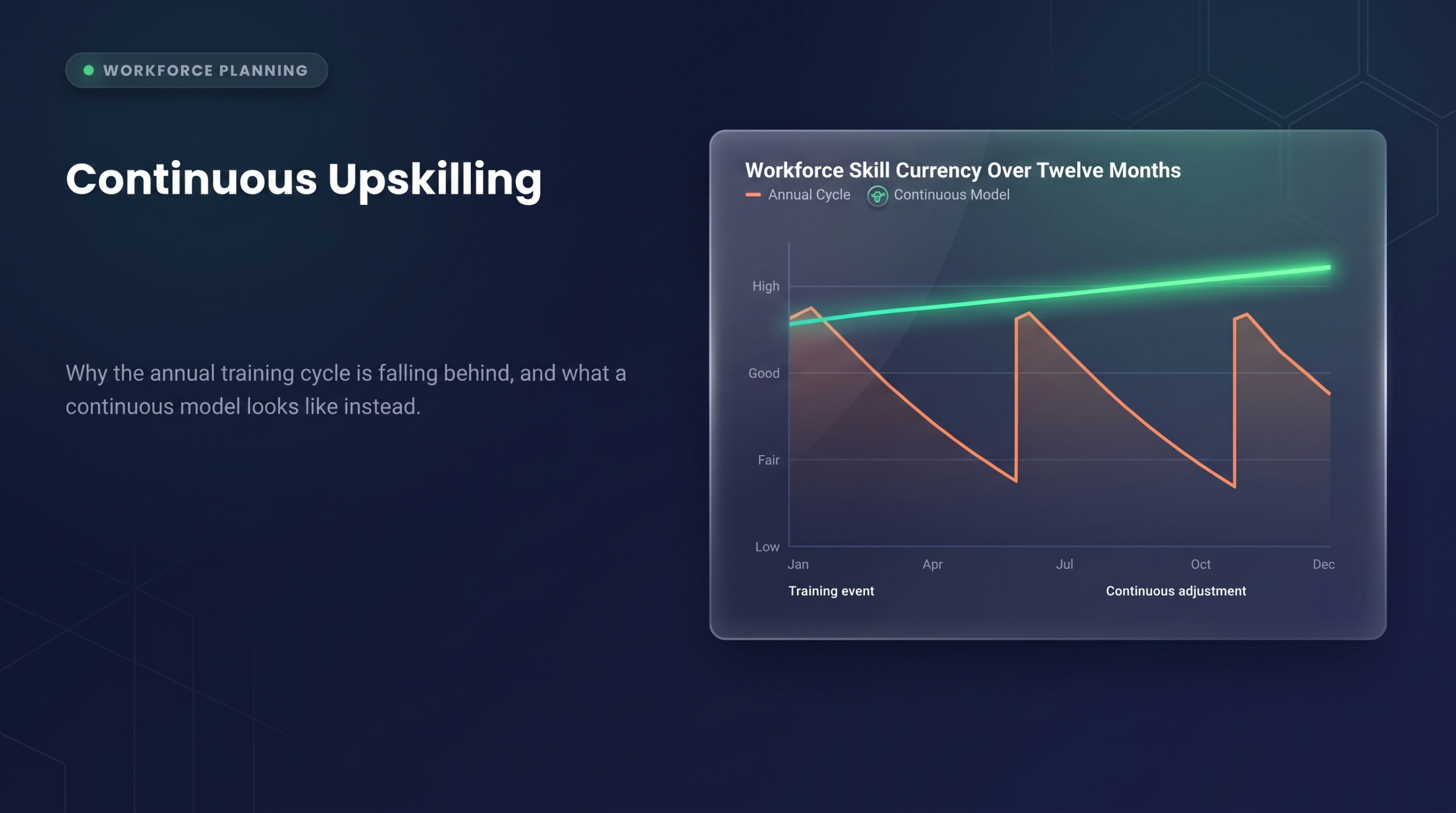
Continuous upskilling is not simply training more often. A quarterly version of the same annual course catalog is still episodic, just on a shorter cycle. The real distinction is structural: continuous upskilling is embedded in how work gets done, measured through proficiency change and internal mobility rather than completion rates, and owned jointly by the employee and the organization rather than delegated entirely to either one. An annual training cycle is designed to close a defined gap at a specific moment and then ends, regardless of whether the gap actually closed. Continuous upskilling has no end date, because the underlying problem, skills becoming outdated faster than a fixed curriculum can track, does not have one either.
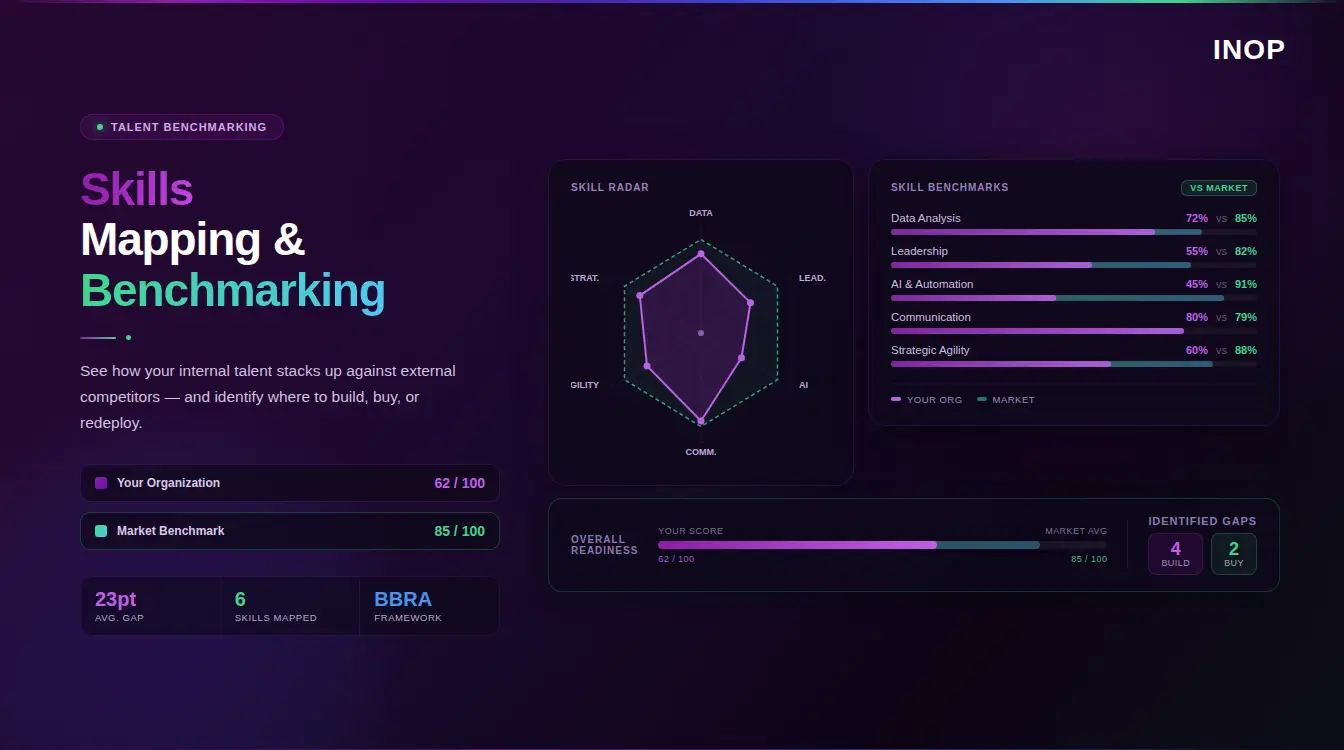
Continuous upskilling is only structurally sustainable when it is connected to a planning framework that identifies which skills to build before the need becomes urgent. Most organizations still run upskilling programs on a fixed annual budget cycle driven by manager requests rather than a live gap analysis. The difference between episodic and continuous upskilling is not the frequency of training programs. It is whether the strategic workforce planning framework underneath it is designed to continuously identify where Build is the right response before the gap constrains execution.
Why the Annual Training Cycle No Longer Works
The case for continuous upskilling is not cultural preference. It is a direct response to how fast skill requirements are now moving. The World Economic Forum’s Future of Jobs Report 2025 projects that 39 percent of workers’ core skills will change by 2030, which means an employee who was fully qualified and strongly reviewed three years ago is, statistically, carrying meaningful obsolescence risk within the next five, according to the WEF’s skills outlook analysis. Separately, LinkedIn’s workplace learning research has consistently found that 94 percent of employees say they would stay at a company longer if it invested in their career development, and that organizations with a strong learning culture report a retention rate around 57 percent, roughly double the 27 percent rate seen at companies with only a moderate learning culture, according to LinkedIn’s research on developing employees. That retention gap carries real weight once it is measured against SHRM’s benchmark of roughly 4,700 dollars in average cost per hire to replace someone. An annual training cycle built to absorb that pace of change is a structural lag an organization is choosing to maintain, not an unavoidable constraint.
The mechanics of why an annual cycle falls behind are straightforward once laid out. A training plan typically takes months to move from identifying a need to actually delivering content, by which point the skill landscape it was designed around has often already shifted. A gap identified in January and addressed through a program built for the next fiscal year’s training calendar is being closed against a version of the role that may no longer exist by the time training is delivered. Continuous upskilling closes that lag by treating skill development as something that responds to signals as they appear, rather than batching every identified need into a single annual planning cycle regardless of urgency.
The Structural Signals That Make Continuous Upskilling Real
Plenty of organizations describe themselves as having a continuous learning culture. Far fewer actually have the structural signals that make the description accurate rather than aspirational.
It Shows Up in the Calendar Before the Culture
Protected learning time that gets canceled the moment a deadline appears is not protected time. Continuous upskilling requires structural commitment: time genuinely blocked on the calendar, not a policy document that says learning is valued while every actual schedule treats it as the first thing to sacrifice under pressure. If learning time consistently loses to urgency, the organization does not have a continuous learning culture regardless of what it says in an all-hands presentation.
It Shows Up in How Managers Are Evaluated
A learning culture that depends entirely on individual employee initiative will not survive a demanding quarter. It becomes real when developing direct reports is part of how a manager’s own performance gets assessed, not a suggestion layered on top of their actual job. Managers who face no consequence for treating development as optional will, predictably, treat it as optional, and no amount of executive messaging about valuing growth changes that incentive on its own.
See how INOP keeps continuous upskilling tied to verified skill gaps instead of a generic calendar. Book a demo to walk through a live view for your organization.
Continuous Upskilling vs a Single Training Program
Continuous upskilling and a well-designed training program are not competing approaches, and treating continuous learning as a replacement for targeted programs misunderstands what each one is for. A single training program is still the right tool for a specific, bounded gap, a new tool rollout, a compliance update, a defined technical certification. Continuous upskilling is the surrounding infrastructure that keeps those individual programs from being the organization’s only response to skill development. It is also worth being precise about a closely related distinction: continuous upskilling is not the same question as upskilling vs reskilling, which is about whether a specific gap is best closed by deepening capability in a current role or preparing someone for a different one entirely. Continuous upskilling is the ongoing operating model. Upskilling versus reskilling is a decision made within that model, role by role, gap by gap.
INOP’s Five Intelligence Lenses Applied to Continuous Upskilling
An ongoing learning culture without discipline behind it tends to drift into busywork, activity for its own sake rather than activity tied to what the business actually needs. INOP evaluates continuous upskilling investment through five intelligence lenses to keep it anchored to real outcomes.
| Lens | What It Evaluates in Continuous Upskilling |
|---|---|
| Strategy | Whether ongoing skill development is concentrated where it supports a specific business priority, rather than spread evenly regardless of urgency |
| Finance | Whether the organization tracks internal mobility and reduced external hiring, the two outcomes that actually justify continuous upskilling spend |
| People | Whether managers are actually evaluated on developing their teams, or that responsibility sits entirely with employees and learning and development |
| Market | Whether ongoing learning stays aligned with what is gaining or losing relevance externally, mapped through INOP’s skills intelligence platform against your existing skills taxonomy |
| AI and Automation | Whether any portion of ongoing training targets a task better addressed through automation than continued human skill development |
BBRA: Keeping Continuous Upskilling Disciplined
Continuous upskilling can become an expensive, unfocused habit if every emerging gap defaults straight to more training. INOP’s proprietary BBRA framework, Build, Buy, Redeploy, and Automate, keeps that discipline intact by modeling all four intervention pathways against financial tradeoffs across four time horizons: thirty days, one hundred eighty days, one year, and three years, applied continuously rather than only at the start of an annual cycle.
In practice, this means a gap surfacing mid-quarter does not wait for the next scheduled training cycle to get addressed, and it does not automatically get folded into the ongoing learning calendar either. It gets compared: would continuous upskilling close it fastest given the infrastructure already in place, would redeploying someone with adjacent skills solve it sooner, does the gap’s scale justify external hiring, or does the underlying task make more sense to automate. Running that comparison continuously, rather than once a year, is what keeps an always-on learning culture from turning into an always-on training budget with no clear return.
Continuous Upskilling for Private Equity Operating Partners
Inside a portfolio company, the presence of a training budget says very little about whether continuous upskilling is actually happening. A company can spend heavily on learning and development while still running on an annual cycle in every practical sense, protected time that evaporates under deadline pressure, managers with no accountability for developing their teams, and no measurement beyond completion rates. Standardizing this evaluation across a portfolio through INOP’s strategic workforce planning platform gives operating partners a consistent way to distinguish genuine continuous upskilling infrastructure from a well-funded annual program wearing different language. Where continuous upskilling closes gaps involving scarce, high-demand skills, INOP’s compensation analytics platform connects that finding directly into pay benchmarking, since employees who continuously build verified, in-demand capability often need to be repriced to retain them.
Common Mistakes in Continuous Upskilling
Announcing a learning culture before building the structure behind it. A culture initiative announced at an all-hands and never reflected in the calendar or in manager accountability is forgotten by the next budget cycle. The structural commitment has to come first, not the messaging.
Measuring only completion rates. Completions tell you whether learning happened, not whether it transferred into actual capability. Skill proficiency change and internal mobility rate are the metrics that actually indicate continuous upskilling is working.
Letting protected learning time lose to urgency by default. If learning time is the first thing sacrificed whenever a deadline appears, it was never actually protected, regardless of what the policy document says.
Treating every emerging gap as a training problem. Not every gap that surfaces mid-cycle is best solved by more learning content. Comparing training against redeployment, hiring, and automation continuously, the same discipline covered in INOP’s guidance on the human capital risks CHROs are already tracking, keeps continuous upskilling from becoming an unfocused default response to every gap that appears.
Ignoring how continuous upskilling connects to real outcomes elsewhere in the organization. Programs that treated learning as infrastructure rather than a course catalog have produced measurable results at scale, the kind documented in INOP’s case studies on companies leveraging skills intelligence for growth, and the difference between those results and a stalled program usually comes down to whether the structural commitment was real or aspirational.
Frequently Asked Questions
What is the difference between continuous upskilling and traditional training?
Traditional training is designed to close a defined gap at a specific moment and ends when that moment passes. Continuous upskilling is embedded in the ongoing rhythm of work, measured through proficiency change and internal mobility rather than completion, and has no fixed end point because skill requirements keep shifting.
How much does continuous upskilling cost compared to annual training?
Cost depends far more on structure than on total spend. Organizations that build continuous upskilling into protected time and manager accountability often see better returns from the same budget than organizations spending more on a once-a-year training push, since the difference is discipline and consistency rather than raw investment.
Is continuous upskilling the same as continuous learning?
They overlap heavily but are not identical. Continuous learning is the broader organizational model. Continuous upskilling specifically refers to the ongoing development of job-relevant skills within that model, distinct from lifelong learning, which extends beyond work into general personal growth.
How do you measure whether continuous upskilling is actually working?
Skill proficiency change, internal mobility rate, and reduced dependency on external hiring are stronger indicators than completion rate or learning hours logged. A program showing high completion and no movement in these other metrics is producing activity, not capability change.
How should private equity operating partners evaluate continuous upskilling at a portfolio company?
By checking whether protected learning time and manager accountability actually exist in practice, not just whether a training budget line does. A company can spend heavily on learning and development while still operating on an episodic, annual model underneath the label.
Ready to see continuous upskilling tied to verified gaps instead of a generic learning calendar? Book a demo and INOP will walk through how ongoing skill signals connect to BBRA, live.
Make confident workforce decisions that support strategy and value creation.