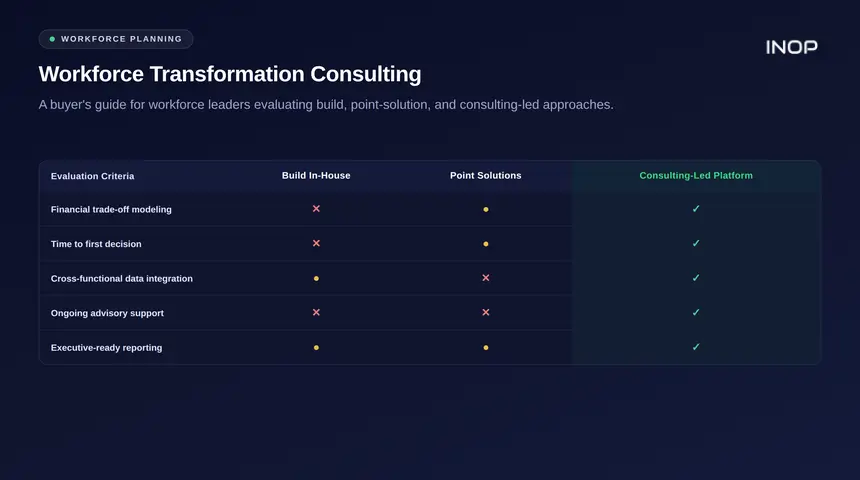
Workforce transformation consulting diagnoses your current workforce, designs a future-state role and skills model, and supports the transition through change management. It typically costs low hundreds of thousands of dollars for a mid-size enterprise strategy phase and takes months to complete. About seventy percent of large transformations fall short of their goals, usually because of weak change management, not a bad strategy. A continuous platform like INOP’s strategic workforce planning platform doesn’t replace advisory judgment, but it gives the underlying data a stronger foundation to work from.
Workforce transformation consulting is advisory work that diagnoses how a workforce is currently structured, designs a future-state model of roles, skills, and headcount aligned to business strategy, and supports the organization through the transition. For CHROs, HR leaders, and PE operating partners, the real decision isn’t whether transformation is needed. It’s whether to hire a consulting firm, build the capability internally, adopt a data platform to run parts of the process continuously, or combine more than one of these.
This guide covers what a typical engagement involves, what it costs, why so many fall short of their goals, and how to evaluate your options before committing budget.
What Does Workforce Transformation Consulting Actually Involve?
A typical engagement covers three phases: a diagnostic of the current workforce (structure, roles, skills, cost), design of a future-state model aligned to business and technology strategy, and support through the transition, including reskilling plans, role redesign, and change management.
Firms differ in how much of each phase they deliver. Some focus almost entirely on diagnostic and design work and hand off implementation to internal teams. Others run the full engagement end to end, including governance, stakeholder workshops, and post-project measurement.
How Is Workforce Transformation Consulting Different From Change Management Consulting?
Workforce transformation consulting covers the full arc: diagnosing the current state, designing the future one, and managing the transition. Change management consulting is narrower. It focuses specifically on the people side of a change already in motion, communication, training, and adoption, whether that change originated from a workforce transformation, a system rollout, or a reorganization.
How Much Does Workforce Transformation Consulting Cost?
Cost varies significantly by scope, but strategy design work for a mid-size enterprise commonly runs in the low hundreds of thousands of dollars, with implementation support typically priced as a percentage of the total transformation budget rather than as a separate flat fee.
That range covers the diagnostic and design phases. Ongoing change leadership coaching, skills gap analysis, and training delivery are usually billed as additional line items on top of the core strategy engagement, which is why total program cost can run well beyond the initial strategy quote once implementation begins.
Why Do Most Workforce Transformation Consulting Engagements Fail to Deliver?
Most fail not because the strategic design was wrong, but because change management during implementation was weak. McKinsey’s Transformation Practice has found that roughly seventy percent of large-scale organizational transformations fall short of their stated objectives, a pattern its researchers describe as consistent across both technology-enabled and conventional transformation programs.
Separate research from Prosci, drawn from thousands of change practitioners, found that projects with excellent change management were roughly seven times more likely to meet or exceed their objectives than those with poor change management. The strategic plan and the execution discipline are two different disciplines, and the second one is where most engagements break down.
What Separates Workforce Transformation Consulting Engagements That Work From Ones That Don’t?
Engagements that succeed treat change management as a core workstream from day one, not an afterthought layered on once the design phase ends. They also tend to define measurable objectives early and revisit them at fixed checkpoints, rather than measuring success only at the end of the engagement.
How Does Workforce Transformation Consulting Compare to a Continuous Planning Platform?
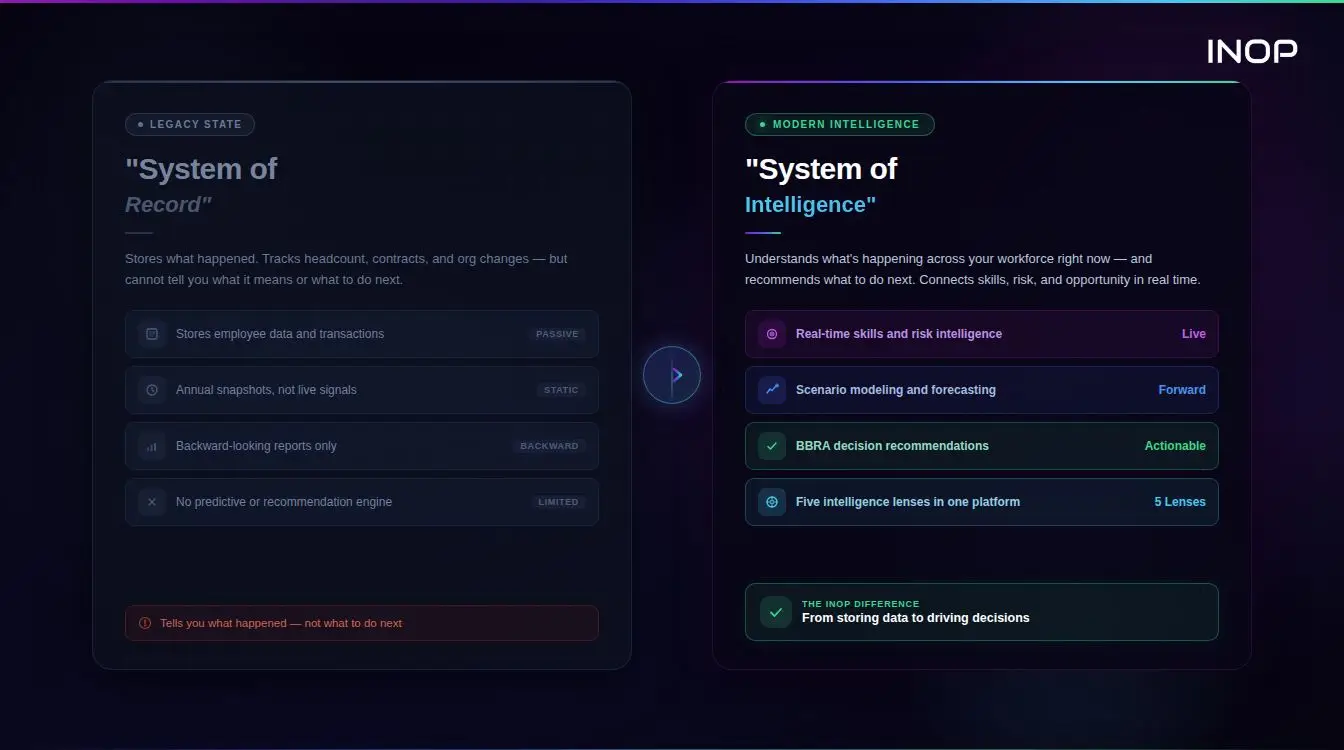
Consulting engagements are typically point-in-time: a diagnostic, a design, a rollout, then a handoff. A continuous workforce planning platform runs the same underlying analysis on an ongoing basis, so role and skills data stay current between consulting engagements instead of going stale until the next one is commissioned.
| Workforce Transformation Consulting | Continuous Planning Platform | |
|---|---|---|
| Timing | Project-based, typically months per engagement | Ongoing, updates as conditions change |
| Best suited for | Strategic judgment, stakeholder alignment, complex change leadership | Continuous role, skills, and cost modeling between engagements |
| Data currency | Reflects conditions at the time of the diagnostic | Reflects current data on an ongoing basis |
| Typical cost structure | Project fee plus implementation support | Subscription-based platform access |
Gartner’s research on workforce planning has been direct about the limitation of the traditional approach: static, linear workforce planning cannot keep pace with the rate of disruption most organizations now face, and Gartner recommends scenario-based, ongoing planning instead of a single annual exercise. That gap shows up in adoption data too, with Gartner-sourced research cited by Workday finding that only about fifteen percent of organizations are actively engaged in strategic workforce planning today, despite it ranking as a top priority for HR leadership.
That’s the practical case for pairing the two approaches rather than choosing one exclusively. INOP’s strategic workforce planning platform gives workforce leaders continuously updated role, skills, and cost data between consulting engagements, so the next diagnostic starts from current data instead of a spreadsheet that was accurate six months ago.
How Should You Evaluate a Workforce Transformation Consulting Provider or Platform?
Before signing a statement of work or a platform contract, workforce and finance leaders need answers to four questions: which parts of the work need human strategic judgment, what each option costs across different time horizons, who owns the data once the engagement ends, and how success will be measured.
| Evaluation Criterion | Question to Ask | Why It Matters |
|---|---|---|
| Judgment vs. data fit | Does this part of the work need strategic judgment and stakeholder negotiation, or does it need continuously updated data? | Prevents paying consulting rates for work a platform can run continuously, and vice versa |
| Time-horizon cost | What does this cost at 30 days, 180 days, one year, and three years? | A consulting engagement’s sticker price and its true three-year cost are rarely the same number |
| Data ownership | Who owns the workforce data and models once the engagement or contract ends? | Determines whether the next transformation starts from scratch or from an existing data foundation |
| Success metric | What outcome, not activity, defines success for this engagement? | Keeps evaluation focused on results rather than deliverables checked off a list |
What Does INOP’s BBRA Framework Add to a Workforce Transformation Decision?
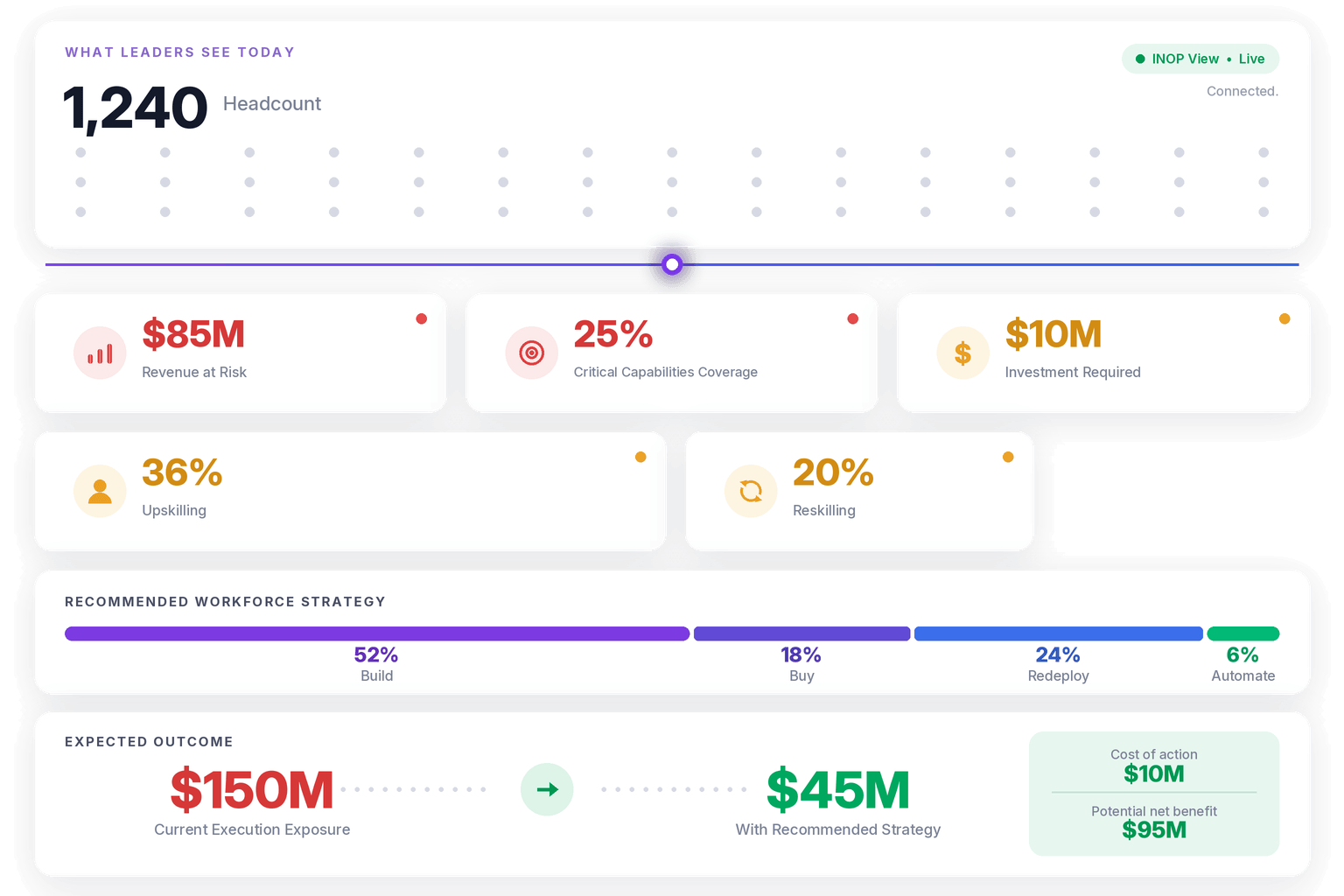
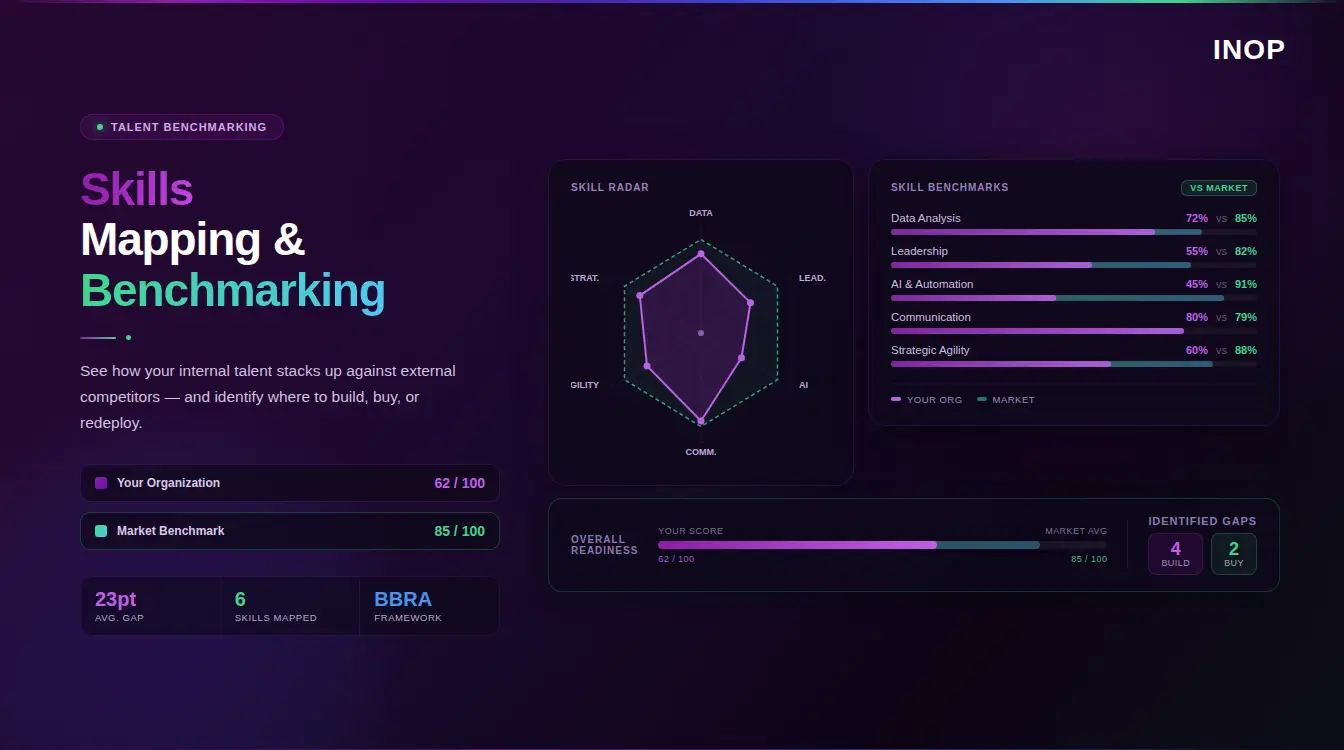
INOP’s BBRA framework (Build, Buy, Redeploy, Automate) is INOP’s proprietary decision architecture for exactly this kind of choice. It models all four pathways for a given role or capability, with financial trade-offs mapped across four time horizons, 30-day, 180-day, one-year, and three-year, so a decision to hire a consulting firm, build a capability internally, redeploy existing staff, or automate a task rests on the same comparable basis.
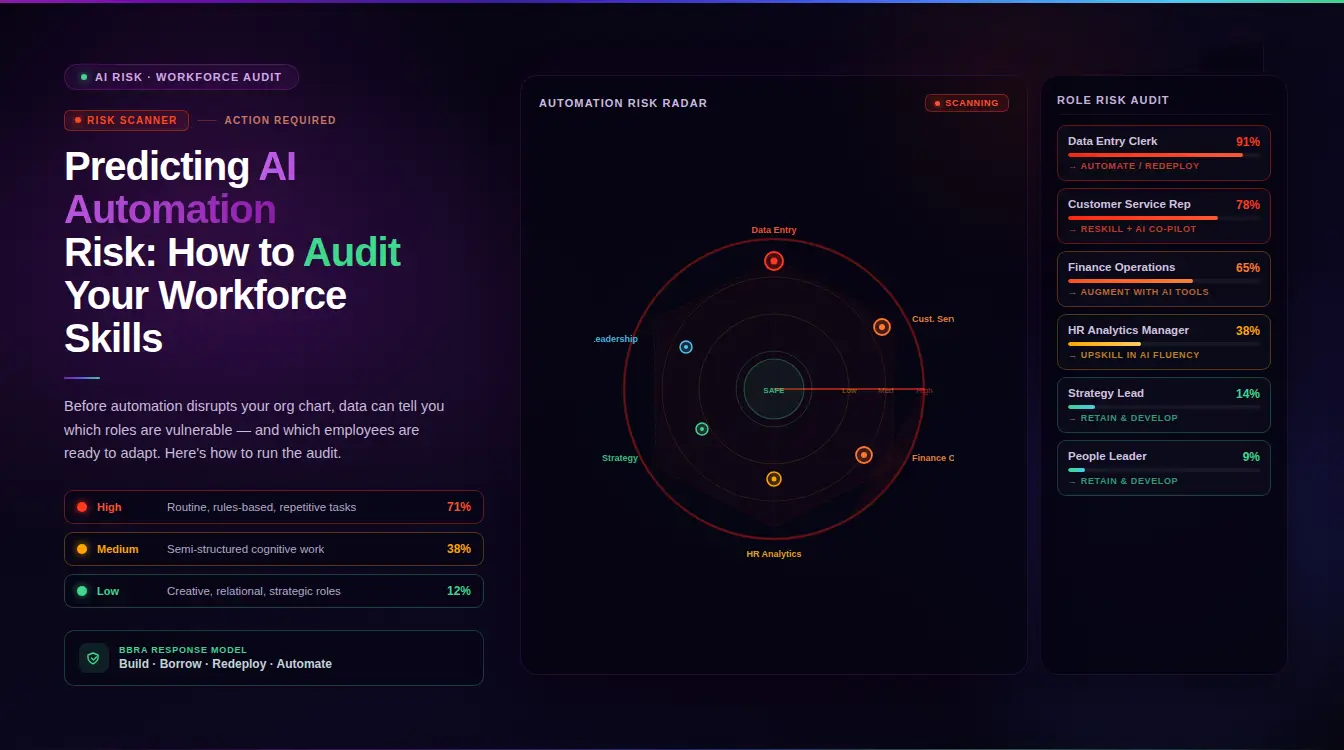
The BBRA model draws on five intelligence lenses: Strategy, Finance, People, Market, and AI and Automation. The Strategy lens checks fit against business priorities. The Finance lens models cost across the time horizons above, including the true cost of a consulting engagement against the alternatives. The People lens accounts for redeployment feasibility and change readiness. The Market lens benchmarks the decision against comparable organizations. The AI and Automation lens assesses whether a task is ready to be automated today or still needs human ownership.
Ready to see how BBRA applies to your own build, buy, redeploy, or automate decisions? Book a demo with INOP.
How Does Workforce Transformation Affect Compensation and Skills Planning?
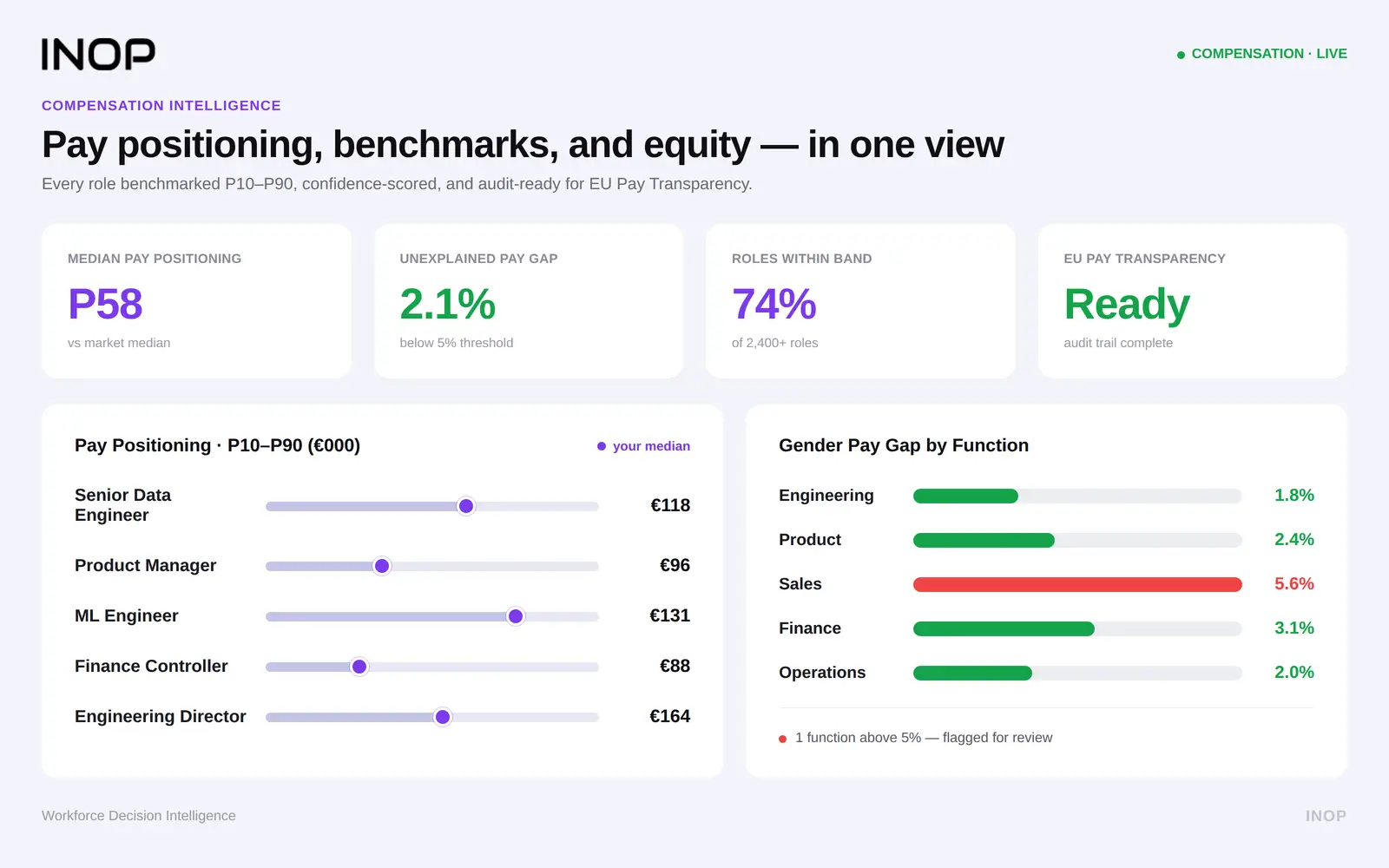
A workforce transformation, consultant-led or otherwise, almost always changes what roles are worth and what skills they require, often faster than annual compensation cycles or training budgets are built to track.
How Should Pay Structures Change During Workforce Transformation?
Roles redesigned during a transformation frequently carry different responsibilities than the job description they replaced, and static salary bands built for the pre-transformation org chart fall out of date quickly. A role redefined around new oversight or coordination responsibilities is not the same job it was before the engagement started, even if the title hasn’t changed.
What Skills Data Do You Need Before Starting Workforce Transformation Consulting?
A consulting engagement moves faster, and costs less to run, when the diagnostic phase starts from existing skills data rather than building a skills inventory from scratch. Knowing which skills are already emerging, in demand, stable, or declining inside the organization gives a consulting team a starting point instead of a blank page.
What Should PE Operating Partners Ask Before Hiring Workforce Transformation Consulting Firms Across a Portfolio?
PE operating partners face workforce transformation consulting as a portfolio-wide spend decision, not a single-company one. The same consulting scope of work can be appropriate for one portfolio company and unnecessary for another, depending on how mature each company’s existing workforce data and process design already are.
A consistent evaluation framework applied company by company, rather than one consulting engagement structure imposed uniformly across the fund, keeps advisory spend proportional to what each company actually needs. Applying the BBRA framework’s Finance lens across a portfolio gives operating partners a comparable, time-horizon-based view of where a consulting engagement is worth the spend and where a lighter, data-led approach is sufficient.
Considering how to evaluate workforce transformation spend across your portfolio? Book a demo to see how INOP’s five intelligence lenses support that comparison.
Frequently Asked Questions
What is workforce transformation consulting?
Workforce transformation consulting is advisory work that diagnoses an organization’s current workforce structure, designs a future-state role and skills model aligned to business strategy, and supports the transition, including reskilling plans, org design, and change management.
How much does workforce transformation consulting cost?
Cost varies by scope, but strategy design phases commonly run in the low hundreds of thousands of dollars for mid-size enterprises, with implementation support typically priced as a percentage of the total transformation budget rather than a flat fee.
How long does a workforce transformation consulting engagement take?
Duration depends on scope, from a focused diagnostic that takes weeks to a full redesign and rollout that can span many months. Strategy design phases are typically shorter than the implementation and change management phases that follow.
Why do workforce transformation consulting engagements sometimes fail?
Research from McKinsey’s Transformation Practice finds that roughly seventy percent of large-scale transformations fall short of their objectives, most often due to weak change management rather than a flawed strategic design. Execution discipline matters as much as the plan itself.
Do we need a consulting firm, or can workforce planning software replace it?
Software and consulting solve different problems. A platform can continuously model role, skills, and cost trade-offs, but strategic judgment, stakeholder alignment, and change leadership still benefit from experienced advisory support, especially for large or politically complex transformations.
What is the BBRA framework?
BBRA (Build, Buy, Redeploy, Automate) is INOP’s proprietary decision architecture for workforce and technology choices. It models all four pathways for a given role or task, with financial trade-offs mapped across four time horizons, so decisions rest on consistent data.
How does workforce transformation affect compensation?
Roles redesigned during a workforce transformation often carry different responsibilities than the job description they replaced, which means static salary bands can fall out of date quickly. Compensation benchmarks need to be revisited alongside the new role architecture, not after it.
How should PE operating partners approach workforce transformation consulting across a portfolio?
Treat it as a portfolio-wide decision, not a single-company one. Each portfolio company has different process maturity and data readiness, so operating partners benefit from a consistent evaluation framework applied company by company rather than one consulting engagement structure for the whole fund.