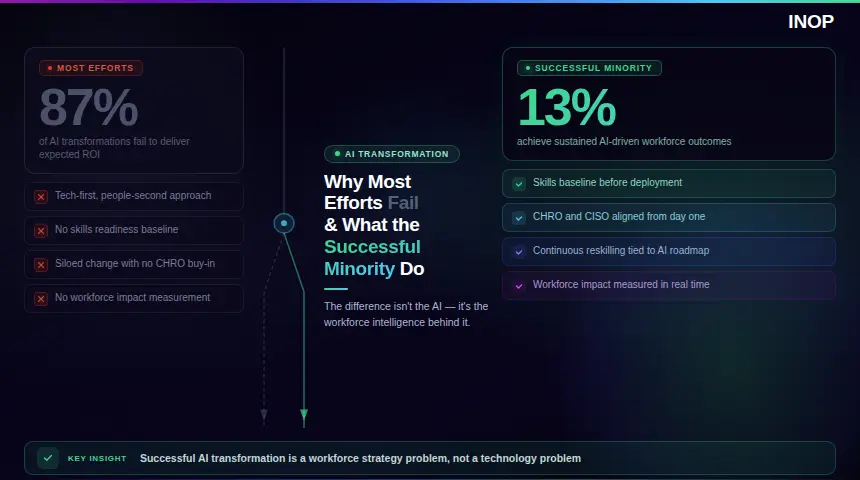
AI transformation is the process of reshaping how an organization operates, makes decisions, and creates value around AI capability, not simply installing new tools on top of an unchanged workforce. Most organizations are attempting it right now. Most of them are also failing, not because the technology does not work, but because transformation efforts are being run as technology projects rather than workforce transformations, and the data on why is now hard to ignore.
This guide covers what the current failure data actually shows, what separates the organizations succeeding from the majority that are not, and how to structure AI transformation around workforce capability instead of technology procurement.
What AI Transformation Actually Requires
AI transformation is not the same as AI adoption. Adoption means employees are using new tools. Transformation means the organization’s actual capability, how work gets done, who does it, and what skills it requires, has genuinely changed as a result. Most initiatives currently branded as AI transformation are really adoption projects wearing a bigger label, which is a large part of why the failure rate is so high.
RAND Corporation reports that more than 80 percent of AI projects fail to reach durable production value, roughly twice the failure rate of conventional IT projects, while MIT’s Project NANDA found that about 95 percent of generative AI pilots never deliver a measurable return, according to recent research compiling AI project failure statistics. S&P Global’s Voice of the Enterprise survey found that 42 percent of companies abandoned most of their AI initiatives in 2025, up sharply from 17 percent the year before.
AI Transformation Is Not the Same as Digital Transformation
The two get used interchangeably, which causes real confusion about what each one actually requires. Digital transformation is largely a technology and process challenge: moving operations, data, and channels into digital and cloud environments on a defined project timeline. AI transformation builds on that foundation but is a different kind of effort entirely, one that requires continuous experimentation and simultaneous change across workforce capability, governance, and culture rather than a fixed scope delivered once. An organization can complete a digital transformation successfully and still fail at AI transformation, because the second one is being measured against a workforce and decision-making bar the first one was never built to clear.
McKinsey’s most recent survey found that 88 percent of organizations already use AI in at least one business function, yet only 31 percent are scaling their efforts beyond that, and just 7 percent are realizing value from AI at widespread deployment, according to Harvard Business School’s research on AI and digital transformation. That drop-off between initial use and actual scaled value is the same pattern showing up across every failure statistic in this guide, described from a different angle. It is also worth noting the upside is real when transformation is done well: IDC research finds that for every dollar invested in generative AI, organizations realize an average return of 3.7 times, with top-performing leaders reaching 10.3 times, according to Databricks’ research on AI transformation strategy. The gap between the average and the top performers is almost entirely explained by the workforce and governance disciplines covered in the rest of this guide.
Why Most AI Transformation Initiatives Fail
The recurring causes behind these numbers are strikingly consistent across independent research, and none of them are primarily technical.
Technology-First Thinking Skips the Workforce Layer
Boston Consulting Group’s research across its case work is direct on where AI value actually comes from: only about 10 percent comes from the algorithms themselves and another 20 percent from the underlying technology, while the remaining 70 percent comes from the workforce changes built around it, according to BCG’s research on AI transformation as workforce transformation. Organizations that treat AI transformation as an IT deployment are, by this data, investing in the 30 percent of value that matters least while under-resourcing the 70 percent that actually determines the outcome.
Vague Success Metrics Doom Initiatives Before They Start
Gartner’s April 2026 research found that 57 percent of infrastructure and operations AI failures stemmed directly from unrealistic expectations set at the outset, according to recent research on AI project failure rates. The same research found organizations that define quantified success metrics before a project is approved achieve a 54 percent success rate, compared with just 12 percent for those that do not, a gap large enough to function as a filter on its own for which initiatives are worth funding.
See how INOP builds the workforce layer your AI transformation actually depends on. Book a demo to walk through a live workforce readiness view for your organization.
What the Successful Minority Do Differently
A consistent set of disciplines separates the organizations landing in the successful minority from everyone else, and workforce confidence sits at the center of it. It is worth being precise about what “successful” means in this context, since the bar most research applies is not a flashy demo or a positive pilot review. It means the initiative reached durable production use, delivered a measurable business outcome tied to the metric defined before approval, and held up past the first budget cycle without needing to be quietly re-scoped or abandoned. By that standard, the gap between the successful minority and everyone else is less about which AI model an organization chose and almost entirely about how disciplined the surrounding workforce and governance process was.
Leader Confidence in Workforce Capability Predicts Success
Organizations where leaders express genuine confidence in their workforce’s capability achieve 2.3 times higher transformation success rates, according to NTT DATA research cited in recent analysis of enterprise AI implementation failure. That confidence has to be earned with verified data, not assumed, since the same research found that 31 percent of workers admit to actively undermining AI efforts through refusing tools, entering poor data, or slow-rolling projects when they do not trust the direction leadership has set.
Narrow Scope, Verified Data, Then Expand
The organizations achieving rapid AI-driven acceleration are not attempting enterprise-wide transformation on day one. They are solving specific, well-defined problems with measurable outcomes and expanding only once results are proven, the same pattern RAND and MIT NANDA both independently identify as the primary distinction between the successful minority and the majority that stall. This mirrors what Writer’s 2026 enterprise research found at the individual level: AI super-users deliver five times the productivity of average users, yet only 29 percent of organizations see significant ROI from generative AI overall, according to Writer’s research on enterprise AI adoption. Individual wins are not automatically translating into organizational outcomes, which is exactly the gap that scoping discipline and workforce verification are meant to close.
Applying INOP’s Five Intelligence Lenses to AI Transformation
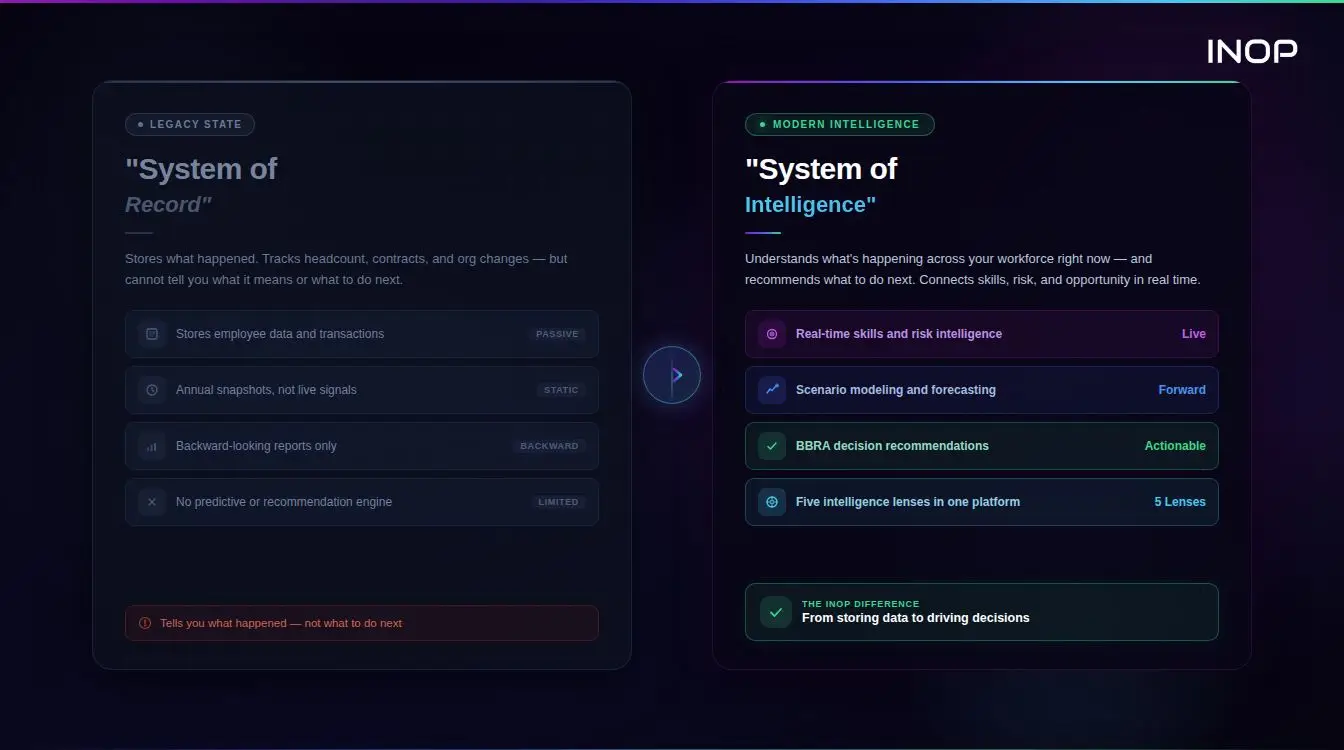
A transformation initiative rarely fails for a single reason, which is why INOP evaluates every stage of an AI transformation effort through five intelligence lenses rather than a technology readiness score alone.
- Strategy: Is this initiative scoped narrowly enough to prove value quickly, or is it attempting enterprise-wide change before anything has been demonstrated?
- Finance: Does the initiative have quantified success metrics defined before approval, given how directly that determines success rate?
- People: Does workforce capability actually support this initiative, verified against real data rather than leadership assumption?
- Market: How does the organization’s AI-related capability compare to what the external labor market and competitors are demonstrating?
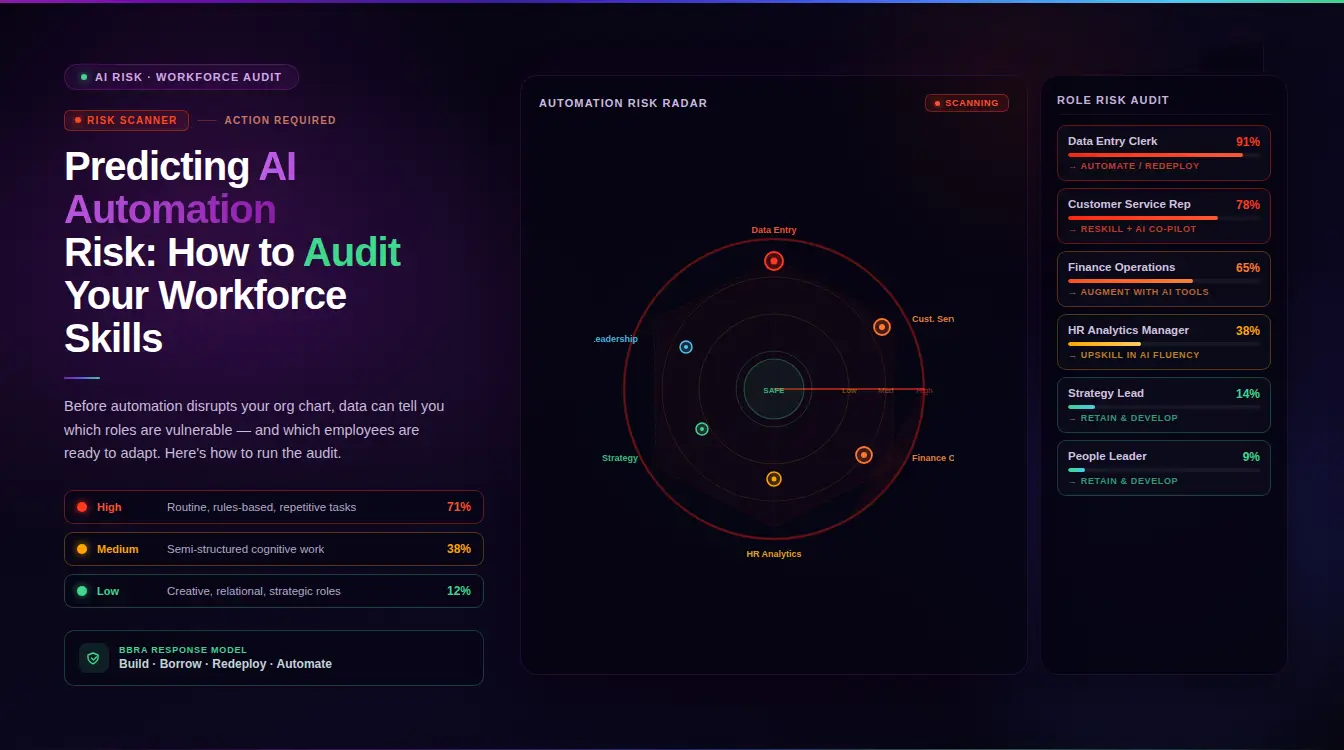
- AI and Automation: Is the initiative targeting a task genuinely suited to automation, or chasing a broader transformation the underlying workforce and data are not ready to support?
BBRA: Turning Transformation Decisions Into a Modeled Plan
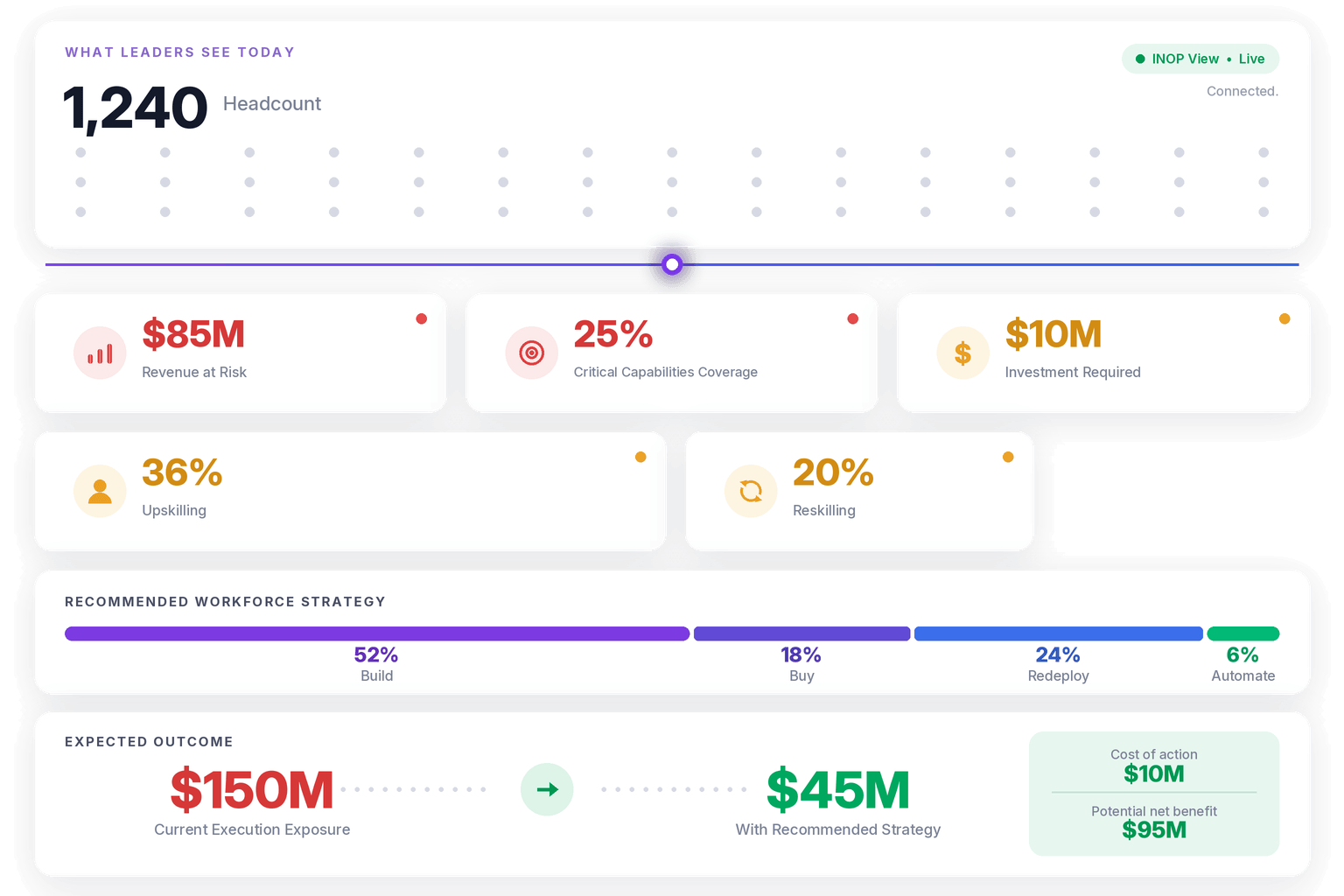
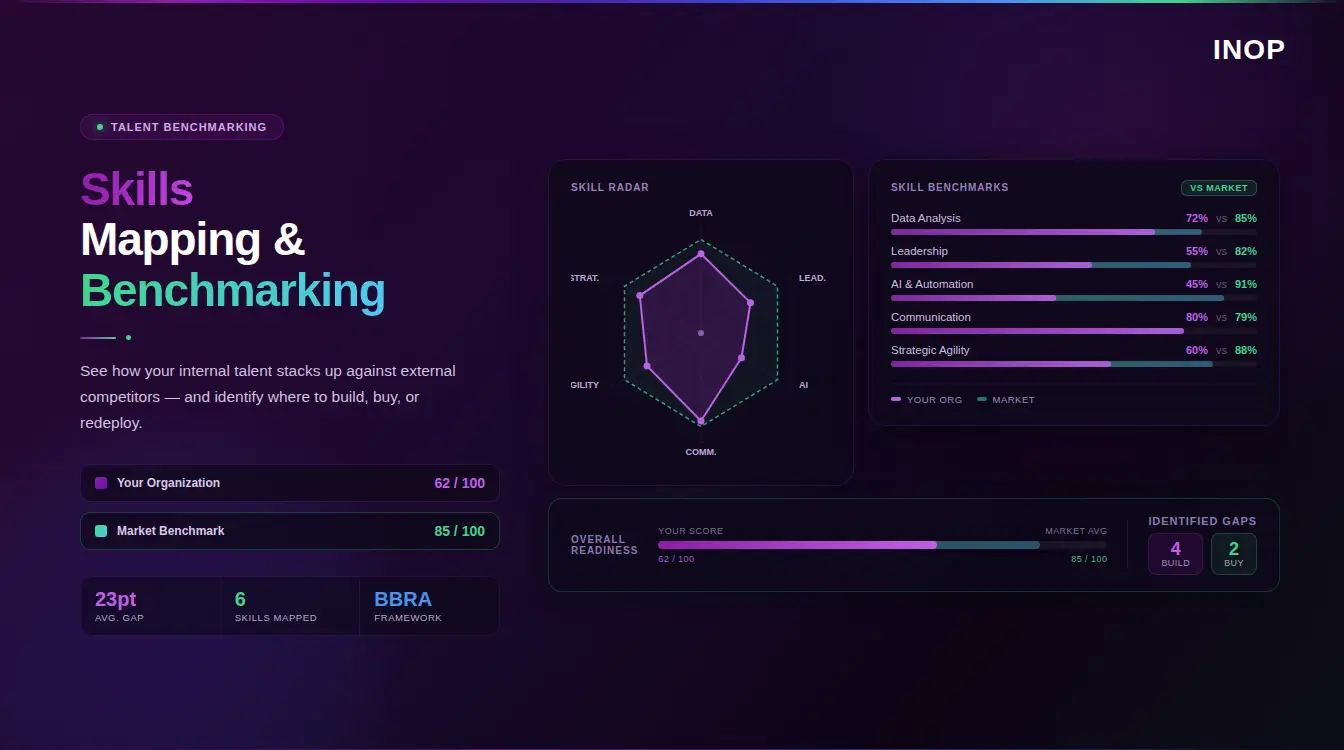
Closing the workforce capability gap behind a stalled transformation effort is rarely a single decision. INOP’s proprietary BBRA framework, Build, Buy, Redeploy, and Automate, models four intervention pathways against financial tradeoffs across four time horizons: thirty days, one hundred eighty days, one year, and three years, giving transformation leaders a structured way to close the gap between where workforce capability currently sits and what the initiative actually requires.
Applied to a stalled AI transformation effort, this means a capability gap does not get addressed with a generic training rollout by default. It gets modeled: would targeted upskilling close it fastest, would redeploying someone with adjacent capability be quicker, does the scale of the gap justify external hiring given current market scarcity, or does the underlying task make more sense to automate outright. Workers with verified AI skills already command wage premiums up to 56 percent higher than their peers, according to recent research on AI workforce trends, which makes the build versus buy comparison inside BBRA especially consequential for any organization trying to close a capability gap at scale.
AI Transformation for Private Equity Operating Partners
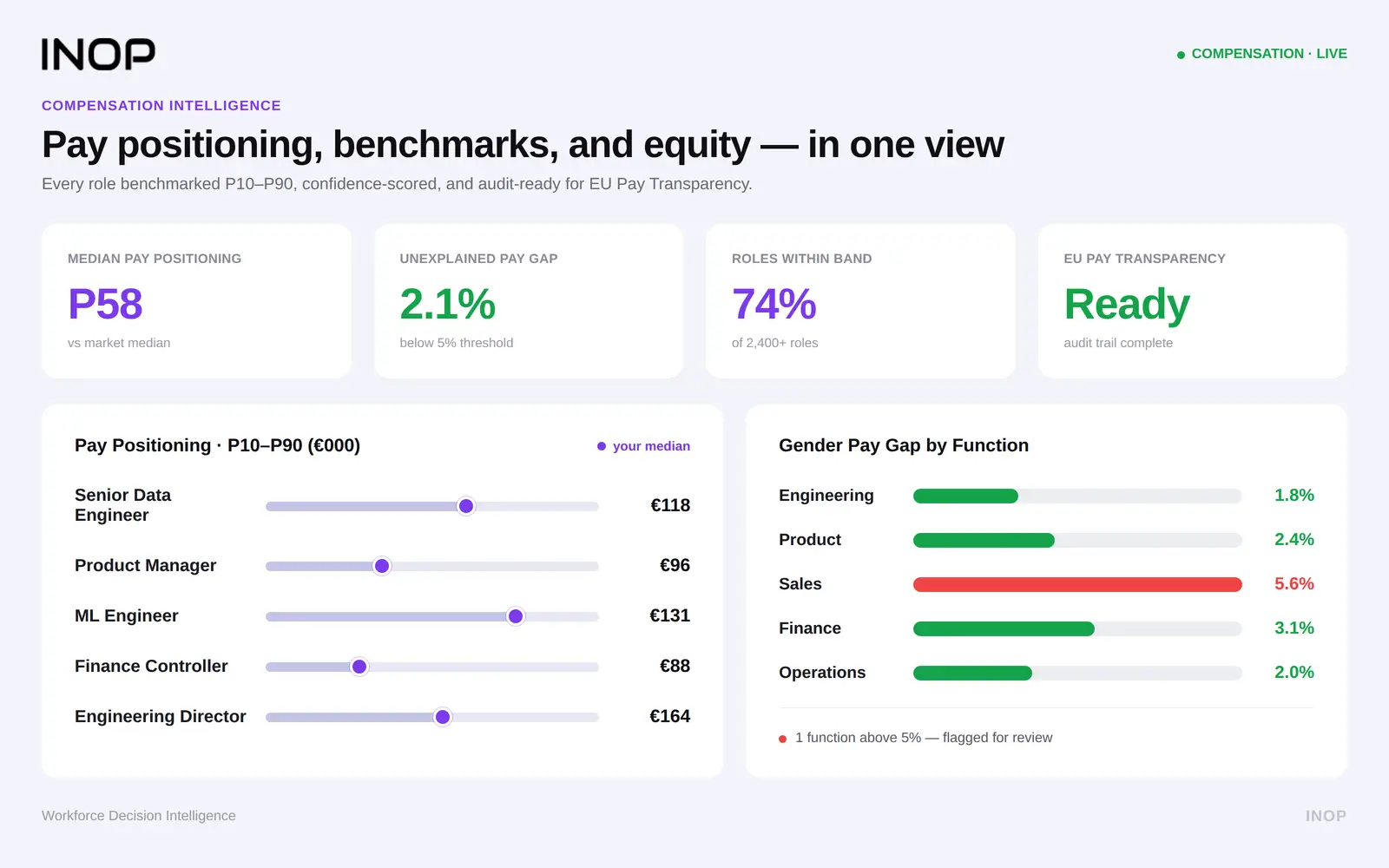
Across a portfolio, AI transformation claims are one of the most overstated line items in a management presentation, and the failure data explains why skepticism is warranted. A portfolio company reporting an AI transformation underway, without quantified success metrics defined at the outset or verified workforce capability behind it, is statistically more likely to be one of the roughly 80 percent of initiatives that fail to reach durable value than one of the minority that succeed. Standardizing AI transformation readiness across a portfolio through INOP’s strategic workforce planning platform gives operating partners a consistent, verified way to separate genuine transformation progress from a technology pilot that has not yet proven anything. Where a transformation effort surfaces roles carrying scarce, high-value AI capability, INOP’s compensation analytics platform connects that finding directly into pay benchmarking, since the wage premium on verified AI skill is now large enough to create real retention exposure if left unaddressed.
Common Mistakes in AI Transformation
Treating transformation as a technology procurement decision. With roughly 70 percent of AI value coming from workforce changes rather than the underlying technology, an initiative funded and staffed as an IT project is under-resourcing the majority of what actually determines success.
Skipping quantified success metrics. The gap between a 54 percent success rate with defined metrics and a 12 percent success rate without them is too large to treat as optional.
Attempting enterprise-wide change before proving a narrow use case. The organizations landing in the successful minority consistently start small, measure rigorously, and expand from demonstrated results rather than launching broad transformation on day one.
Assuming workforce readiness instead of verifying it. Leadership confidence in workforce capability strongly predicts success, but that confidence needs to be grounded in verified data. INOP’s skills intelligence platform supports this directly by mapping external demand signals against your existing skills taxonomy, so workforce readiness claims are backed by evidence rather than assumption.
Underestimating the cost of building internal capability from scratch. Reskilling an existing employee to close an AI-related capability gap is estimated to be roughly 23 percent more cost-effective than hiring externally, a gap detailed in INOP’s research on the business case for an AI skills engine, yet many transformation budgets default to external hiring without ever comparing the two paths directly.
Letting executive sponsorship fade after the first demo. A promising pilot generates initial enthusiasm that often does not survive contact with the slower, less visible work of scaling it. Sustained sponsorship through that middle stretch, not just at launch, is one of the disciplines that consistently distinguishes initiatives that reach production from ones that quietly stall.
Frequently Asked Questions
What is the actual failure rate for AI transformation initiatives?
Independent research from RAND, MIT, Gartner, and S&P Global consistently puts enterprise AI project failure rates between 70 and 95 percent, depending on how failure is defined, with the common thread being organizational and workforce readiness gaps rather than technology limitations.
Why does AI transformation fail even when the underlying technology works?
Because roughly 70 percent of AI value comes from workforce and process changes built around the technology, not the technology itself. An initiative that installs new tools without changing how work actually gets done rarely produces a measurable transformation.
What is the fastest way to improve AI transformation success rates?
Define quantified success metrics before a project is approved. This single discipline is associated with a 54 percent success rate compared with 12 percent for initiatives without one, making it one of the highest-leverage changes an organization can make.
Should AI transformation start with a narrow pilot or an enterprise-wide rollout?
A narrow, well-defined pilot with measurable outcomes, expanded only after results are proven. This pattern consistently separates organizations achieving rapid AI-driven acceleration from those pursuing broad transformation without first demonstrating value.
How should private equity operating partners evaluate a portfolio company’s AI transformation claims?
By checking for quantified success metrics defined at the outset and verified workforce capability data, not just a stated intent to transform. Given current failure rates, an AI transformation claim without either of those is statistically more likely to fail than succeed.
What is the difference between AI transformation and digital transformation?
Digital transformation is primarily a technology and process shift, moving operations into digital and cloud environments on a defined project scope. AI transformation requires that same foundation plus continuous, simultaneous change in workforce capability, governance, and culture, which is why organizations can succeed at one and still fail at the other.
Ready to build the workforce layer that actually determines whether your AI transformation succeeds? Book a demo and INOP will map your workforce’s verified AI readiness, run every capability gap through BBRA, and show you exactly where to focus first.