A workforce report can identify a capability gap without telling leadership what to do about it. It may show that an organisation lacks expertise in a critical function, that training expenditure has increased or that workforce productivity has improved. Each finding is useful. None, on its own, establishes whether management should invest in development, recruit externally, redesign work or reconsider a proposed transformation.
That distinction matters as artificial intelligence becomes part of corporate investment and operating decisions. An AI programme may depend on capabilities that are not yet available, assumptions about productivity that have not been tested or changes to work that will take longer than the financial plan allows.
Leadership needs evidence that can inform a choice: what the organisation requires, what it currently possesses, which responses are feasible, what each would cost and what happens if the assumptions prove wrong.
Workforce reporting provides part of that evidence. But the existence of workforce information does not establish that it is sufficiently relevant, reliable or connected to strategic decisions.
The question is therefore not simply whether organisations report enough about their people. It is whether workforce information changes the decisions they make.
What reporting can and cannot establish
Research on workforce disclosure shows why the quality of the underlying information matters. In a February 2025 staff paper, the International Sustainability Standards Board (ISSB) reported findings from engagements conducted between June 2024 and January 2025 with more than 300 individuals from 158 investor organisations and other stakeholders. Participants expressed strong interest in human capital information, while identifying problems with its availability, quality and comparability. They also wanted clearer connections to business strategy.
The CIPD and Railpen’s 2025 Future of Workforce Reporting study examined annual reports released in 2024 by 96 FTSE 100 companies. Only 10% disclosed total training costs and 41% reported training hours per employee. Just 13% referenced AI skills training, while 14% reported an AI governance policy or strategy. These are findings about public disclosure. They do not establish that companies lack the corresponding information internally or that their boards cannot make informed decisions.
Reporting standards are also developing. ISO 30414:2025 sets out requirements and recommendations for internal and external human capital reporting, covering areas including workforce costs, productivity, skills, development, mobility and succession planning. In September 2026, the ISSB renamed its Human Capital research project Workforce-related Disclosures to better reflect its scope. It remained a research project at that meeting.
Contemporary workforce reporting therefore cannot be dismissed as a collection of retrospective administrative measures. A detailed skills inventory or reliable workforce cost data can support planning and oversight. A specific investment decision, however, also requires an assessment of future capability demand, implementation constraints and the consequences of alternative responses.
Connecting workforce evidence to the investment case
INOP’s The Workforce Disclosure Gap examines workforce visibility and the information investors need to assess human capital risk. The Automation Accountability Gap extends that concern to the relationship between technical automation potential, implementation readiness and board oversight. The question developed here is what management should do when that evidence reveals a constraint on a proposed investment.
Consider an illustrative insurer planning to introduce AI into its claims-handling operations. The investment case assumes that employees will acquire the capabilities needed to oversee the new workflows within the planned implementation period. But the workforce assessment suggests that developing those capabilities may take longer.
The insurer’s capability gap is the starting point, not the decision. Management must establish whether the required expertise can be developed internally, recruited externally or obtained through redeployment, and whether the claims-handling rollout itself should change. Each option has different implications for cost, timing and delivery risk. Internal development requires evidence about current proficiency, the learning required and the time employees and managers can devote to the transition. External recruitment requires an assessment of labour-market availability, hiring costs and the time new employees need to become effective. Redeployment requires an understanding of both the receiving role and the work that would be left behind. Revising the deployment timetable requires an estimate of how delayed capability affects expected benefits.
If the transition takes longer than the financial case assumes, management must assess what happens to the expected benefits and the cost of running existing and new processes in parallel. Additional development might shorten the transition, but only if training is the constraint. Experienced recruits would still need to learn the insurer’s products and systems. A phased rollout could test readiness before further capital is committed. Retaining the original timetable may also be justified, provided management can explain why the evidence supports it.
KPMG’s 2026 Transforming the Enterprise: Human Resources reports that 11% of organisations have evolved their Total Workforce Management approach. The study includes 120 HR leaders within a wider sample of more than 1,750 transformation leaders across 20 countries and territories. Its proposed operating model includes workforce intelligence and decision support, integrating employees, external talent and digital labour. This describes an organisational approach, without demonstrating better investment decisions. The relevant question is whether bringing these sources of workforce information together helps management evaluate the choices before it.
A framework for evaluating workforce evidence
We propose five tests for assessing whether workforce information is useful for a particular decision. This is an analytical framework, rather than a formal definition established by ISO or the ISSB.
| Test | What leadership needs to establish |
|---|---|
| Decision relevance | Which investment, operational or strategic choice does the evidence inform? |
| Evidence reliability | How complete, current and dependable are the data, and which conclusions rely on assumptions? |
| Timing and consequences | When is the capability required, and what happens if it is unavailable? |
| Comparison of alternatives | Which responses are feasible, and how do their costs, risks and expected outcomes differ? |
| Evaluation | What evidence will show whether the response worked, and when should the decision be revisited? |
Applying these tests requires attention to how the evidence is produced. Skills assessments, financial forecasts and operational data may use different definitions or reporting periods. Management should reconcile material differences and distinguish observed conditions from estimates. A precise-looking forecast is difficult to challenge if its underlying assumptions are hidden.
Figure 1 shows how workforce evidence moves through analysis and evaluation into an investment decision, and how subsequent outcomes inform review. In the insurer’s case, the critical test is whether the proposed transition timetable is supported by evidence, rather than treated as a fixed assumption.
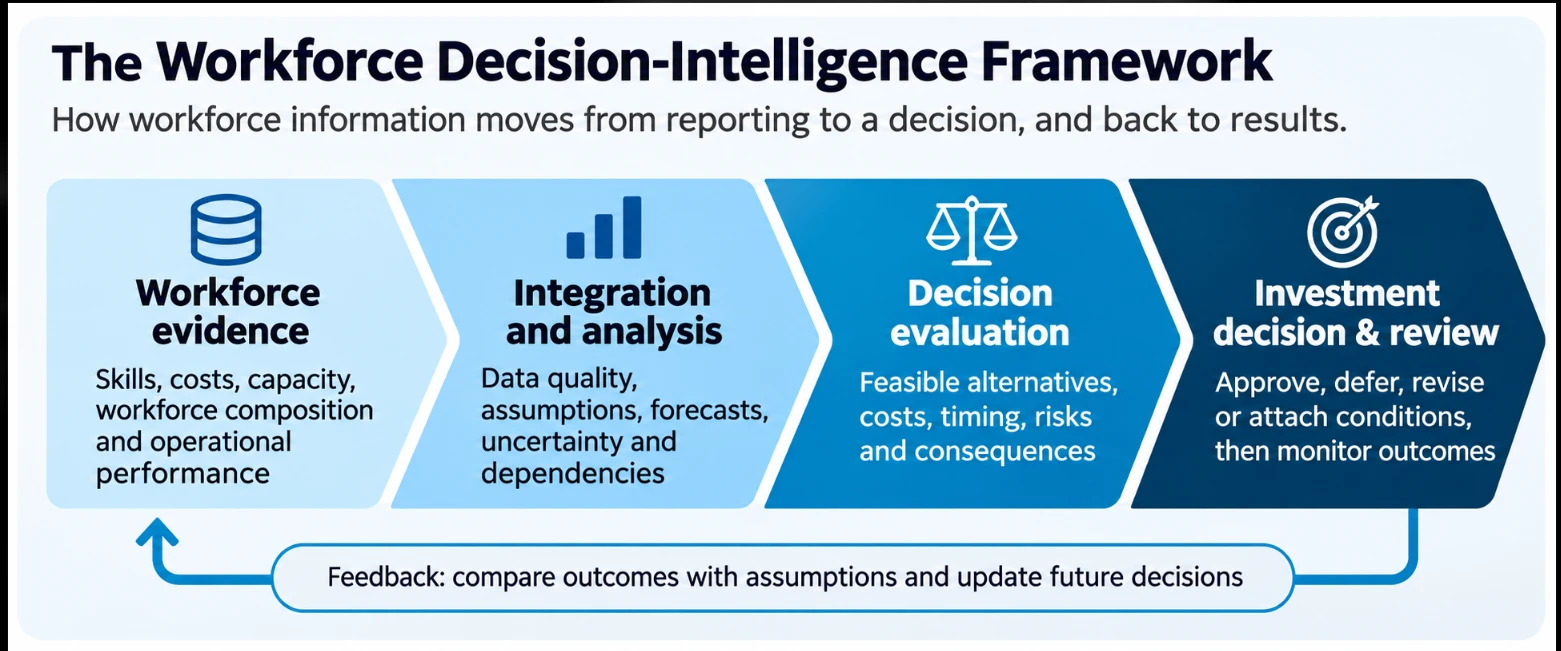
The framework makes the assumptions behind an investment decision easier to examine. It does not imply that workforce evidence can predict outcomes with certainty. Its usefulness depends on whether decisionmakers can see the assumptions, compare alternatives and recognise when the original case needs to be reconsidered.
What the board should require from management
For a material AI investment, directors should be able to trace the proposed budget and timetable to the workforce assumptions on which they depend. If the benefits require employees to acquire new capabilities, the board needs to understand the basis for the proficiency estimate and how the investment performs if development takes longer.
For the insurer, management could present the original plan alongside a phased alternative, setting out the capabilities each requires and the consequences for cost and delivery. Directors might approve an initial phase and release further investment once employees demonstrate the required performance in practice. They might equally approve the full commitment if management can defend the original timetable. Either way, the workforce assumption is visible in the decision. The purpose of this challenge is to test the investment case. Directors need sufficient evidence to judge material assumptions and oversee delivery, while management remains responsible for designing and implementing the workforce response.
Approval should also establish how progress will be reviewed. If a capability is critical to the expected benefits, management should identify the evidence that will demonstrate its availability, the point at which a shortfall becomes material and who will bring a revised proposal forward. Reporting that training has been completed would not, by itself, answer whether employees can perform the required work.
Recording the reasons for the decision
A decision record provides a practical way to retain this reasoning. Alongside the intended business outcome, it should identify the required capabilities, the evidence supporting their availability and the uncertainties that could affect delivery. Where gaps exist, it should compare the feasible responses and explain why management recommends one over the others.
The record should preserve the assumptions behind approval, including estimated costs and time to proficiency, any conditions on further investment and the basis for subsequent review. This allows directors and executives to compare actual delivery with the case they approved, rather than relying on a succession of progress reports that no longer show the original expectations.
The analysis should be proportionate to the decision. A modest development commitment does not warrant the same process as a major transformation. For a material investment, however, the relationship between workforce evidence and the chosen course of action should be clear enough to challenge and revisit.
The record should also make clear who is responsible for monitoring the assumptions behind the investment and when material changes must return to leadership.
What boards and executives need to know
Better workforce information does not guarantee a better investment decision. Management may have reliable data and still underestimate implementation costs, misjudge the time required to develop capabilities or choose an unsuitable response. What matters is whether the evidence is used to challenge assumptions, compare alternatives and adjust decisions when circumstances change.
The test is practical. When workforce evidence identifies a material constraint, does it change the proposed investment, its timetable, the resources committed or the conditions attached to approval? If the evidence reveals a significant risk but none of these changes, leadership should be able to explain why the original plan remains credible.
Workforce reporting remains essential. Organisations need reliable information about their people, capabilities, costs and performance. But reporting what the organisation has is only the starting point. When workforce assumptions underpin a material investment, the board should be able to see how that information shaped the decision, and should expect to be told when it no longer supports it.