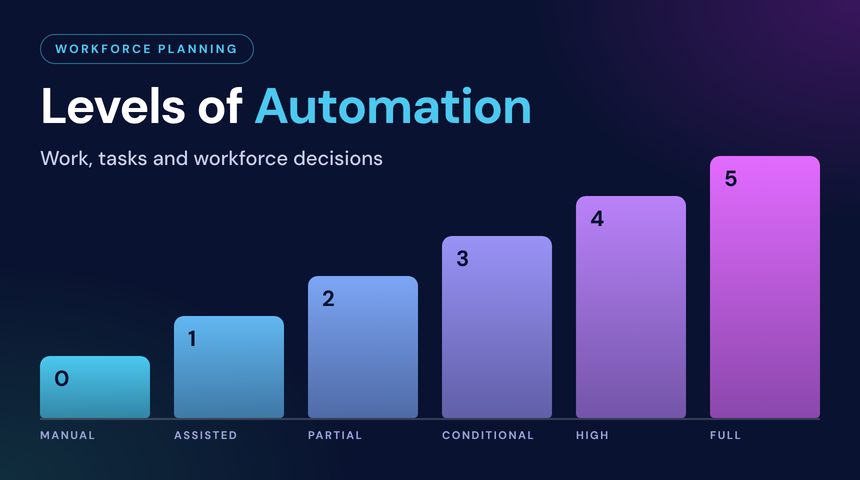
The levels of automation describe how much of a task a machine performs and how much a person still decides. The concept comes from research on human-machine interaction, and it now applies directly to knowledge work, where AI is changing how tasks are done without necessarily changing job titles. Leaders face a practical question: at which level does each task in the organisation run today, and at which level should it run to deliver the strategy? This guide sets out a six-level scale for work tasks, shows how to apply it role by role, and explains how INOP connects each level to cost, capability and risk.
What the Levels of Automation Measure
A level of automation is a statement about how one task is split between a machine and a person. It is not a score for a job, a team or a piece of software. A single role holds many tasks, and those tasks usually sit at different levels at the same time. A finance analyst may prepare a variance report at one level, reconcile data at another and still make every forecasting judgement themselves.
That distinction explains why a headline such as “this job is 40 per cent automatable” says little on its own. The level of automation of each task tells you far more, because it shows which responsibilities stay with people and gives a starting point for assessing the skills, oversight and investment needed to change how the task is done.
Where the Scale Comes From
Two established frameworks help explain how automation levels are defined.
In their 2000 research, Parasuraman, Sheridan and Wickens examined ten levels of automation for decision and action selection, ranging from full human control to autonomous machine action. Building on earlier work, they also identified four functions that can be automated to different degrees: information acquisition, information analysis, decision and action selection, and action implementation.
A separate framework, SAE J3016, defines six levels of driving automation from Level 0 (no driving automation) to Level 5 (full driving automation).
These frameworks provide useful reference points, but neither was designed for knowledge work. The six-level scale presented here adapts their underlying principles to assess how tasks are divided between people and AI.
Why Automation Scales Need Adapting for Knowledge Work
Knowledge work presents a different challenge. A single role contains multiple tasks, and those tasks may involve different levels of human judgement and AI support. The same task may be performed by a person, an AI system or a combination of both, depending on how the work is organised. As AI capabilities improve, organisations may also need to reconsider which tasks to automate and which to keep under human control. The scale therefore needs to be applied at task level before the findings are aggregated across roles, departments, business units and the organisation.
INOP supports this assessment using role- and task-level data, without requiring employee-level data. This allows organisations to examine automation opportunities and workforce capability requirements without starting from individual employee profiles.
A Six-Level Scale for Work Tasks
| Level | Name | Who does what | Example in knowledge work |
|---|---|---|---|
| Level 0 | Manual | A person performs the entire task without automation. | An analyst builds a pay comparison manually using several sources. |
| Level 1 | Assisted | A tool assists with parts of the task, while the person performs and controls the work. | An analyst uses a tool to retrieve benchmark data, then independently analyses the findings. |
| Level 2 | Partial | AI performs a defined part of the task, and a person reviews each output before it is used. | AI drafts a summary, which a person checks and edits before use. |
| Level 3 | Conditional | AI completes the task within defined conditions, while a person handles exceptions and cases requiring intervention. | AI classifies and routes cases automatically, while a person handles flagged exceptions. |
| Level 4 | High | AI completes the task autonomously within specified operating conditions, resolving routine exceptions and escalating those beyond its limits. People monitor performance, audit results and intervene when necessary. | AI reconciles data across systems, resolves routine data discrepancies and escalates unresolved cases. People monitor performance and audit samples. |
| Level 5 | Full | AI completes the task across its entire intended operating scope, including exception handling, without routine human review or operational fallback. Organisational governance and accountability remain. | An AI system executes a fully automated, predefined reporting workflow without routine human intervention, subject to organisational governance. |
What the Research Shows About Automation and Work
Research points to substantial change in how work is done. In the World Economic Forum’s Future of Jobs Report 2025, employers estimate that 22 per cent of work tasks are currently done mainly by technology and expect that share to reach 34 per cent by 2030. McKinsey estimated in 2023 that activities accounting for up to 30 per cent of hours worked across the US economy could be automated by 2030.
Exposure is not the same as replacement. The International Labour Organization’s 2025 research finds that one in four workers worldwide is in an occupation with some generative AI exposure and concludes that transformation of jobs is the most likely outcome. These findings show the potential scale of change, but they do not show how individual tasks are currently divided between people and technology. That requires a task-level assessment.
To estimate how much of a specific role can move up the scale, see our guide to automation potential. To understand the associated workforce risks, read our guide to automation risk.
The Two Thresholds That Change the Risk
Two moves on the scale deserve more attention than the rest. The first is the step from Level 2 to Level 3. At Level 2, a person reviews every output. At Level 3, human involvement shifts towards handling exceptions. This transition to exception-based oversight changes the skills and judgement required: employees must move from checking every result to recognising when intervention is necessary.
Over time, reviewers may become less likely to question results from systems they have learned to trust. That risk is explored in our article on automation bias in workforce decisions.
The second is the step from Level 3 to Level 4. Routine case-by-case review gives way to system-level monitoring and oversight. Accountability therefore needs to be established in advance: who owns the rules, who monitors performance, who audits the results and who is responsible when errors occur. Moving a task to Level 4 without these arrangements creates operational and governance risks that may not be reflected in the initial implementation budget. INOP’s Automation Accountability Gap report examines the wider challenge of translating automation potential into implementation readiness and accountable workforce decisions.
How to Assign Levels of Automation Across a Role
The method has three steps, and each one produces something a leadership team can act on.
Step 1: Break the Role Into Tasks
List the tasks that make up the role, grouped by the outcome they serve. For each task, record the skills it needs. This is where skills intelligence comes in. INOP reads each skill against four signal states: Emerging, In Demand, Stable and Declining.
For tasks relying heavily on Declining skills, management should examine whether demand for the underlying work is changing and whether employees need to develop capabilities for other responsibilities. Tasks requiring Emerging skills may need additional human capability.
These signals show how demand for skills is changing, but they do not determine whether a task should be automated. That also depends on the nature of the task, technological feasibility, cost and risk.
Step 2: Apply the Levels of Automation Function by Function
Score the current level for each of the four functions: information acquisition, information analysis, decision and action selection, and action implementation. Apply the scale to the output of each function: the information retrieved, the analysis produced, the decision made or the action carried out.
For example, information acquisition may operate at Level 3 when AI retrieves information automatically within defined conditions and people handle missing or conflicting records. The same task may remain at Level 1 for decision-making if a person independently evaluates the evidence and decides what action to take.
Scoring each function separately shows where automation is already operating and where human judgement and oversight remain necessary.
Step 3: Set a Target Level Against the Strategy
The target level for a task should reflect what the strategy requires, taking account of technological feasibility, cost, risk and workforce readiness. INOP’s strategic workforce planning platform links the target level to the demand the strategy creates and the capabilities the organisation holds. Where those capabilities fall short, our guide to AI skills gap analysis explains how to assess the gap. After implementation, AI workforce impact measurement can help determine whether the change delivered what was intended.
Worked Example: Automation Decisions in Corporate Governance Research
Illustrative scenario informed by research-management experience. Automation levels are hypothetical.
Consider a corporate governance research team responsible for monitoring company disclosures, extracting governance information and producing analysis for clients.
Management is assessing where AI could take over routine activities while preserving research accuracy and accountability. The objective is to improve research quality and create opportunities for analysts to undertake more substantive work.
The table illustrates how individual tasks could move between automation levels and what workforce investments those changes might require.
For readability, the table summarises the illustrative current and target automation levels for each task. A full assessment would score information acquisition, analysis, decision-making and implementation separately.
| Research task | Current → Target | Primary lens | BBRA response |
|---|---|---|---|
| Monitor company disclosures | L1 → L3 | AI & Automation | Automate: Routine monitoring; analysts handle flagged exceptions |
| Extract governance data | L0 → L2 | Finance | Automate + Build: AI extracts governance data for analyst verification, reducing manual processing while retaining quality controls. |
| Validate research findings | L0 → L0 | People | Build: Develop analytical judgement and quality-control skills |
| Produce client research | L0 → L1 | Strategy | Build: Develop deeper analytical capabilities, using AI-assisted evidence retrieval while retaining human judgement. |
| Explain findings to clients | L0 → L0 | People | Build + Redeploy: Develop client-facing capabilities and reassign analysts from routine research processing to client-facing responsibilities, with supervised meetings, coaching and feedback. |
The proposed changes could release time for deeper research and client engagement, but management would need to account for verification, coaching and supervision before treating that capacity as a business benefit.
Why a Higher Level of Automation Is Not Always Better
A higher level of automation may reduce the cost of performing a task, but it is not automatically the better choice. INOP never assesses automation in isolation. Every change in level is tested against five intelligence lenses:
- Strategy: Does this task serve the strategy, and would a higher level help deliver it?
- Finance: What would the change cost, what could it save, and over which time horizon?
- People: Which skills and roles would change, and does the organisation have the capability to operate at the new level?
- Market: What does competitor activity reveal about automation trends, and what does the labour market show about the skills involved?
- AI and Automation: Which level can the technology reliably support today, and what oversight would it require?
The result is a recommendation, not a score. INOP’s Execution Materiality measure shows the consequences of leaving a capability gap unresolved, including the cost of inaction. A gap with limited consequences for strategy execution may be a lower priority. A gap that threatens strategy delivery and carries a high cost or risk of inaction warrants greater attention, although moving to a higher level of automation may not be the right response.
Closing the Gap With BBRA: Build, Buy, Redeploy or Automate
Once the current and target automation levels are clear, the next question is what capabilities and investments are needed to make the change. INOP uses BBRA, its decision architecture, to model four pathways: Build (developing capabilities internally, for example through reskilling), Buy (hiring externally), Redeploy (moving existing capabilities to where they are needed) and Automate (using technology to perform tasks). Each pathway carries different costs, timelines and risks, which INOP models across four horizons: 30 days, 180 days, one year and three years.
Moving a task up the automation scale is one option, but it may not address the underlying capability gap on its own. Build can develop the skills needed to perform or oversee the task, while Buy brings in capabilities the organisation lacks. If automation releases capacity in one team, Redeploy can put it to work elsewhere, provided employees have the required skills or can develop them.
The horizons matter because the relative costs and benefits change over time. Automation can require upfront investment in technology, integration, testing and oversight, while Build, Buy and Redeploy have their own costs and lead times. Comparing all four pathways side by side shows which response, or combination of responses, fits best, rather than choosing automation by default.
Book a demo to see how INOP applies BBRA to your organisation’s roles and tasks, including the costs and trade-offs of different workforce decisions.
Levels of Automation for Private Equity Operating Partners
Operating partners and deal teams face a specific version of this question. Where a portfolio company’s value creation plan assumes savings from AI, those savings depend on whether the underlying tasks can be automated to the level assumed, at an acceptable cost and within the planned timeframe. The levels of automation give investment teams a common language for testing those assumptions.
Four questions turn the scale into a diligence and value creation tool. At which level does each major task run today? Which level does the plan assume, and by when? What capability and cost does it take to get there? And what is the cost of inaction if the move does not happen?
INOP answers these questions at task, role, department, business unit and country level, so results can be compared across a portfolio. Because the assessment uses role- and task-level data, portfolio companies do not need to provide individual employee profiles to establish an initial view of automation opportunities.
INOP also distinguishes between capacity released through automation and savings that can realistically be reflected in the financial plan. The one-year and three-year horizons in BBRA show which changes could deliver value within the investment timetable and which will take longer to pay back.
Common Mistakes When Using the Levels of Automation
- Scoring jobs instead of tasks. A job title hides how varied the work is. Two people with the same title can have very different task mixes.
- Treating a higher level as the goal. The right level is the one the strategy needs at an acceptable cost and risk. Sometimes that is Level 2 with strong human oversight.
- Ignoring the supervision shift. When a task moves from Level 2 to Level 3, the skill changes from checking every output to deciding when to intervene. Plans that skip this step leave a gap between the tool and the people expected to oversee it.
- Treating the score as a one-time snapshot. Models improve and tasks change. The level a task could support may therefore change, even if its current operating level does not. An assessment reviewed once a year can become outdated within months.
- Assessing automation apart from strategy and cost. Knowing a task’s automation level is only the starting point. Deciding whether to change it means weighing the strategy it serves, the budget it affects, the people who do the work, the market the business competes in and the technology available. That is why INOP evaluates automation decisions through all five intelligence lenses. For a wider view of how automation programmes fit into workforce decisions, see our overview of workforce automation.
Frequently Asked Questions
What are the levels of automation?
The levels of automation are a scale that describes how a task is shared between a machine and a person. The best-known versions run from a level where the person does everything to a level where the machine acts alone. For work tasks, a six-level scale from Level 0 (manual) to Level 5 (full automation) is practical and easy to communicate.
How many levels of automation are there?
It depends on the model. The Parasuraman, Sheridan and Wickens model uses ten levels for decision and action selection, while SAE J3016 defines six levels of driving automation, from Level 0 to Level 5. INOP applies a six-level scale to knowledge work at task level.
Which level of automation is best for knowledge work?
No single level is best. The right level depends on the strategy the task serves, the cost of moving to it, the capability the organisation holds and the risk of an error. Many high-value tasks perform best at Level 2 or Level 3, where AI does the heavy lifting and a person keeps accountability. Routine, rules-based tasks are the usual fit for Level 4.
How do levels of automation relate to automation versus augmentation?
In INOP’s framework, augmentation covers Levels 1–3, where a person and AI share the task or people remain responsible for handling exceptions. Automation covers Levels 4–5, where AI completes the task with little or no routine human involvement. The scale shows that this is a spectrum, not a choice between two options. Our article on AI automation vs augmentation covers the difference in more detail.
How can private equity operating partners use levels of automation in a portfolio company?
Operating partners can use the scale to test whether an AI savings assumption is realistic. They map the current level of each major task, compare it with the level the value creation plan assumes, and check the capability and cost needed to close the gap. INOP provides that view across entities, business units, departments and countries, with the cost of inaction attached to each gap.
Subscribe to receive Workforce Decisions every fortnight: Subscribe to tou newsletter