Most organizations discover their headcount problems after they have already paid for them. A product launch stalls because the engineering team is three roles short. A profitable quarter gets quietly eroded by a support function that was overstaffed during a growth phase that did not materialize. A critical initiative misses its window because the capability to execute it was not in place when the moment arrived. In each case, the root cause is the same: headcount decisions were made on assumptions instead of data.
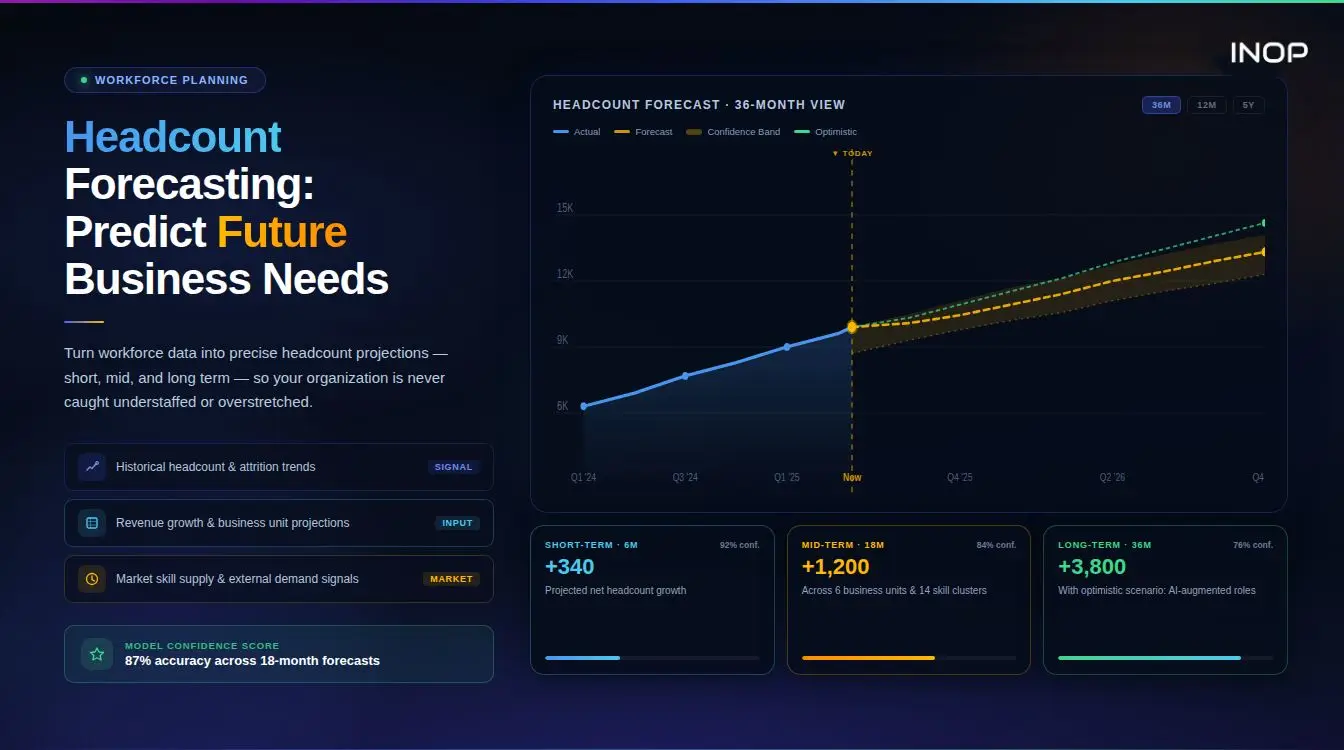
Headcount forecasting is the discipline that changes that equation. At its core, it is the process of using historical trends, strategic plans, financial projections, and capability data to predict how many people an organization will need, in which roles, with which skills, and by when. Done well, it transforms workforce decisions from reactive scrambles into planned, financially grounded choices that leadership teams can defend and act on with confidence.
Headcount forecasting answers the quantitative question: how many people will we need, and when? Workforce optimization answers the qualitative question that has to come first: are the people we currently have deployed, developed, and incentivized in a way that produces the results the business plan requires? Running headcount forecasting without first running workforce optimization consistently overestimates external hiring need, because it treats the current workforce as fully utilized when, in most organizations, 20 to 25% of capacity is available for redeployment before a single new hire is made.
This article covers what headcount forecasting actually involves, why most approaches fail to deliver on their promise, what the data inputs and methods look like in practice, and how CHROs can build a forecasting capability that connects workforce decisions to business outcomes in a way that finance and the board will engage with.
Why Headcount Forecasting Has Become a Strategic Imperative
There was a period when workforce planning was largely a budgeting exercise. HR submitted a headcount request in the annual planning cycle, finance approved a number, and hiring proceeded accordingly. The business environment was stable enough that the difference between planned and actual headcount was manageable. That period is over.
Organizations using predictive workforce forecasting are 2.5 times more likely to avoid critical talent shortages during business pivots, according to a 2024 Gartner analysis. Meanwhile, 73% of companies using headcount planning software report improved workforce planning accuracy compared to organizations still relying on manual processes and spreadsheets.
The financial stakes of getting it wrong are substantial in both directions. Understaffing produces burnout, turnover, quality failures, and missed revenue. According to Gallup, staffing shortages are the most commonly cited barrier to delivering quality products and services, and the downstream costs compound quickly through overtime, emergency hiring, and the reputational cost of delivery failures. Overstaffing is equally expensive in a different way. Labor costs account for roughly 70% of total business expenses for many organizations, according to the Bureau of Labor Statistics, and carrying unnecessary headcount directly impresses on profitability and cash flow while simultaneously reducing engagement among the people who are there.
The cost of individual hiring errors adds an additional layer. CareerBuilder data shows the average financial loss per bad hire reaches $17,000 for entry-level to mid-level roles, and can exceed $240,000 for specialized or executive positions. When hiring decisions are made reactively, under time pressure and without clear strategic context, error rates rise. When headcount forecasting provides the forward-looking context, hiring managers have both the time and the clarity to make better decisions.
The Difference Between Headcount Planning and Headcount Forecasting
These terms are often used interchangeably, but they describe meaningfully different activities, and conflating them is one of the reasons workforce planning so frequently underperforms.
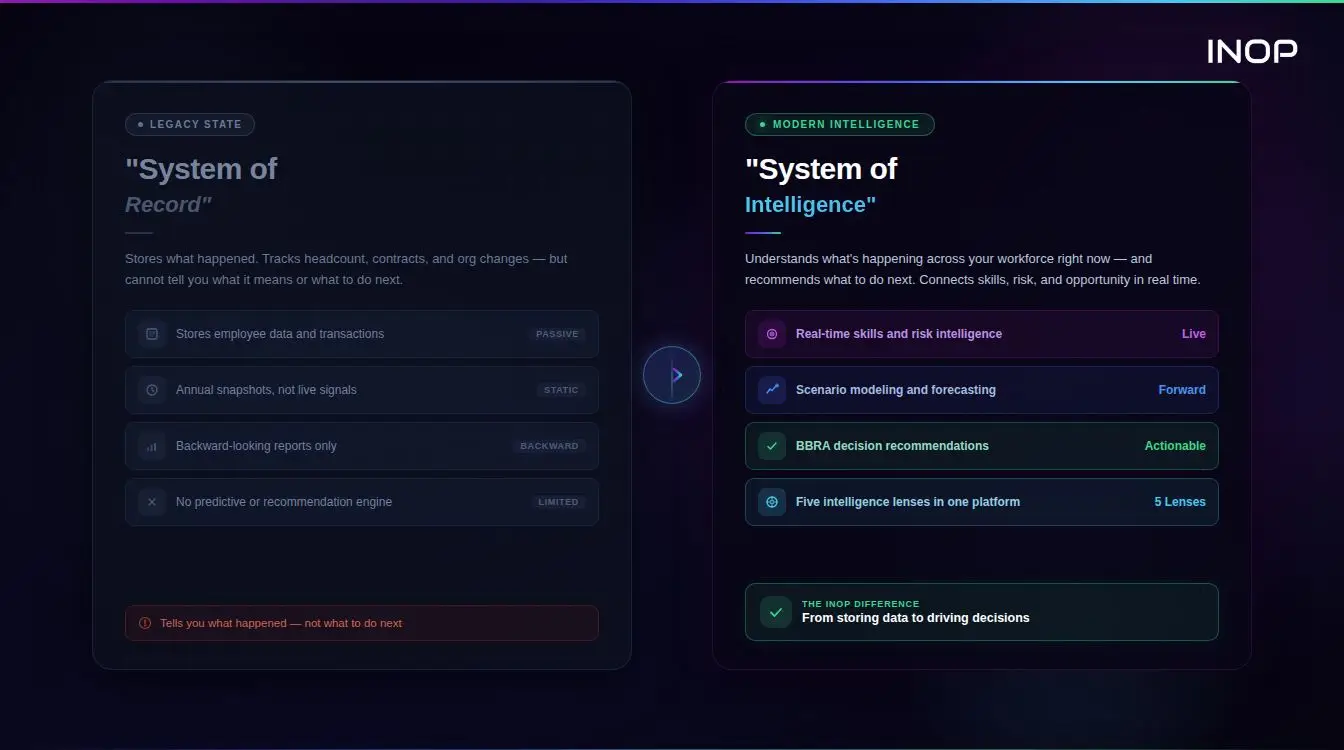
Headcount planning is backward-looking and operational. It asks: how many people do we have, what are they costing us, and what adjustments do we need to make to stay within budget? It is a necessary activity. It is not a strategic one.
Headcount forecasting is forward-looking and strategic. It asks: how many people will we need, in which roles and capabilities, over what time horizon, to execute the business strategy we have committed to? It uses historical data as an input rather than a blueprint, and it integrates signals from strategy, finance, market conditions, and operational performance to produce a demand picture that the business can plan around.
Headcount planning focuses on the number of positions to fill. Workforce planning is broader, including costs, skills, timing, and business impact. The distinction matters because many organizations invest considerable effort in headcount planning and then wonder why they are consistently surprised by talent gaps and overspend. The answer is that they are optimizing the operational activity while neglecting the strategic one.
Effective headcount forecasting incorporates the outputs of headcount planning but extends well beyond it. It translates business strategy into talent demand, models the supply side of the equation, identifies the gap, and produces a set of options for closing it, each with a cost and a timeline. That is the input an executive team can act on.
The Data Foundation: What Headcount Forecasting Requires
The quality of a headcount forecast is a direct function of the quality of the data that feeds it. Most forecasting failures are data failures at their root, not modeling failures. Here is what a robust data foundation looks like across five domains.
Internal Workforce Data
The starting point is a precise current-state picture. This means headcount by role, function, location, and seniority level. It means attrition rates broken down by the same dimensions, because aggregate attrition figures obscure the patterns that actually matter. A 12% annual attrition rate looks manageable until you discover that it is concentrated in a single business-critical function running at 28% turnover.
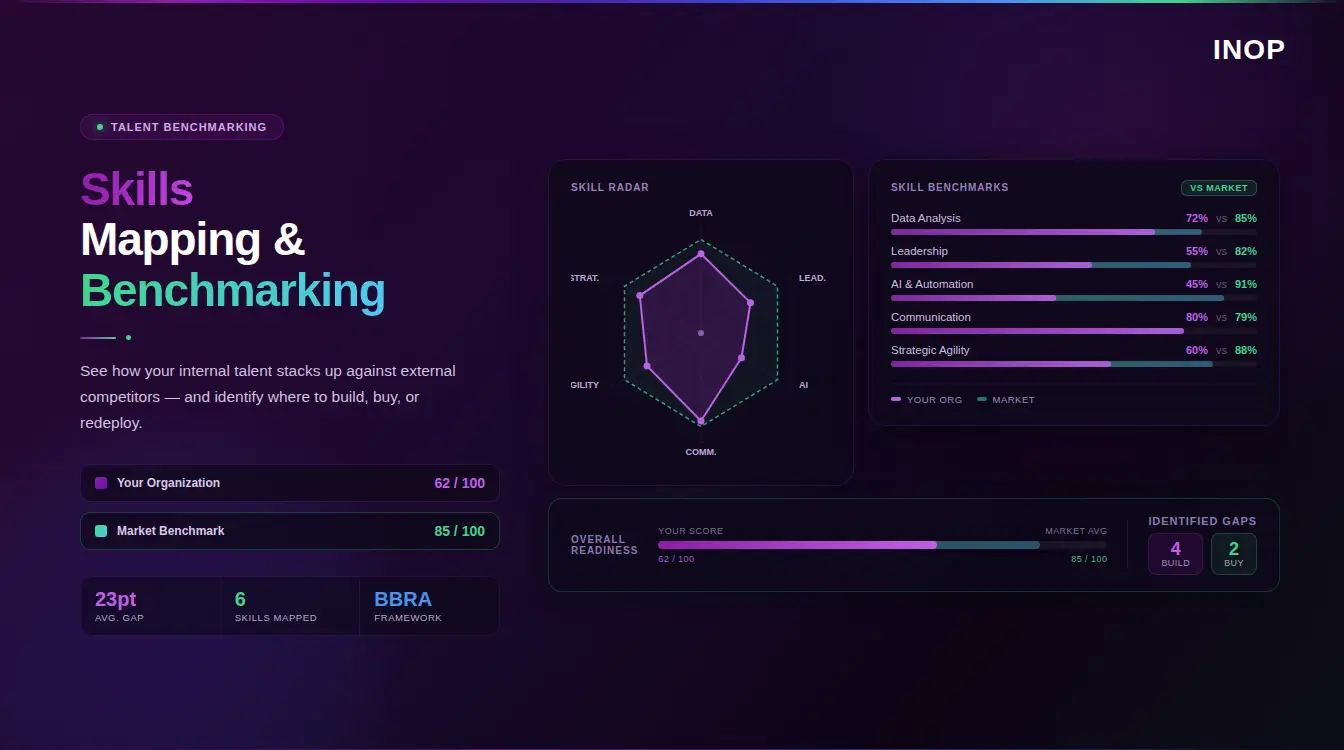
It also means skills data. Role-level headcount without capability context produces a forecast that tells you how many people you have but not whether they can execute the strategy. Only 26% of HR leaders say they have a robust skills taxonomy in place to guide workforce planning, according to Deloitte’s 2024 Human Capital Trends research, which means most headcount forecasts are built on an incomplete picture of current capability. Connecting headcount data to skills intelligence, as INOP’s strategic workforce planning methodology is designed to do, is the step that elevates a headcount count into a capability forecast.
Business Strategy and Financial Projections
A headcount forecast disconnected from the business strategy is a historical trend line with an extrapolation attached. It is better than nothing. It is not useful for planning. The forecast needs to be anchored to what the business has committed to do: revenue targets, new market entries, product launches, digital transformation programs, cost reduction initiatives. Each of these has workforce implications that need to be modeled explicitly rather than assumed.
Finance and HR must collaborate to align talent strategy with business goals and financial performance. When HR plans headcount in isolation, the outputs are systematically disconnected from the financial reality the business is operating in. When the forecast is built collaboratively, with finance providing the economic parameters and HR providing the talent supply and demand expertise, the result is a workforce plan that both functions can stand behind and that leadership can use as a decision-making tool.
Market and External Signals
The internal data tells you where your workforce is today. The external market tells you whether the people you need tomorrow will be available, and at what cost. This is where labor market signals become essential inputs to the forecast rather than background noise.
For each significant capability category in your forecast, the relevant questions are: is this skill increasingly scarce or increasingly available in the markets where we hire? What is the current and projected compensation premium for this capability? How long, realistically, does it take to hire someone with this profile? Are there adjacent capabilities that could substitute if primary supply is constrained?
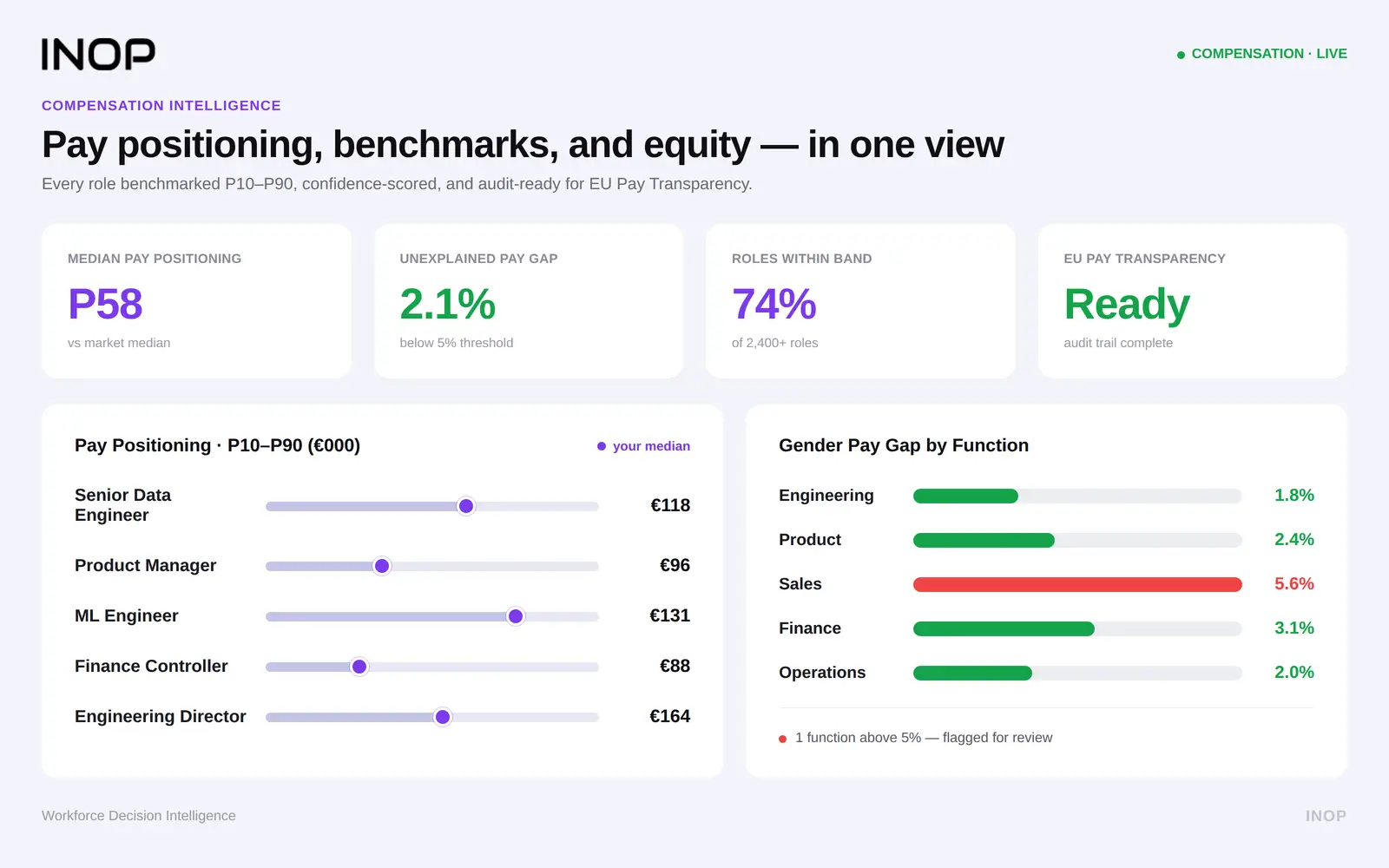
INOP’s compensation analytics capabilities provide exactly this calibration, connecting internal headcount planning to live external market data so that cost assumptions in the forecast reflect the talent market as it actually exists rather than as it existed when the model was last refreshed.
Historical Hiring and Attrition Patterns
Historical data is not a forecast, but it contains patterns that forecasts should account for. Seasonal hiring cycles, average time-to-fill by role and level, offer acceptance rates, first-year attrition, and the lag between a hiring decision and productive contribution all affect the relationship between forecast headcount and actual capacity. A forecast that assumes a ten-week time-to-fill for data engineering roles in a competitive market is structurally wrong if the historical average is eighteen weeks.
These patterns also reveal where assumptions have been consistently optimistic. If the organization has forecast 80% internal fill rates for leadership positions over three successive planning cycles and consistently achieved 45%, that is not a hiring execution problem. It is a forecasting assumption problem that needs to be corrected at the model level.
AI and Automation Impact Modeling
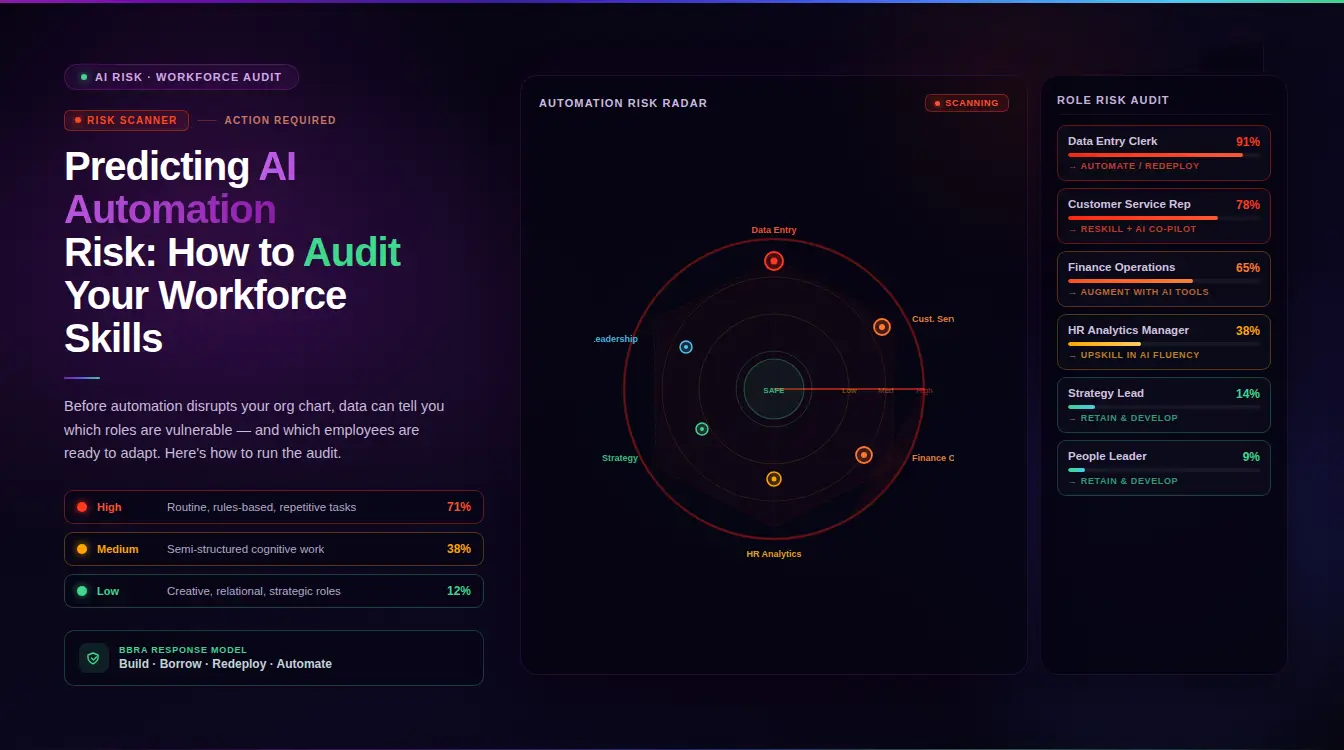
McKinsey found that 65% of organizations were already using generative AI by late 2024, up sharply from the previous year. The workforce planning implication is significant: the task composition of many roles is changing faster than annual planning cycles can track. A headcount forecast built on role definitions from 18 months ago may be forecasting demand for human capacity in areas where automation is already reducing the requirement.
Modeling AI and automation impact at the role and task level, identifying where technology is displacing human effort, augmenting it, or creating new capability requirements, is increasingly a core component of a credible headcount forecast rather than a speculative add-on. INOP’s skills intelligence service incorporates AI and automation impact modeling at the skill level, providing the forward-looking signal that keeps headcount forecasts calibrated to where work is actually going.
Headcount Forecasting Methods: Choosing the Right Approach
No single forecasting method is universally superior. The right approach depends on your planning horizon, data maturity, and the pace of change in your business environment. Most effective forecasting models combine methods.
Top-Down Forecasting
Top-down forecasting starts with business strategy and financial projections and works downward to derive headcount requirements. A revenue growth target of 25% in a specific market, for example, is translated into the sales capacity, operational support, and technical capability required to deliver it. The workforce requirement is derived from the business plan rather than extrapolated from historical headcount.
The strength of top-down forecasting is its direct connection to strategy. Its limitation is that it can produce unrealistic numbers if the business planning assumptions themselves are optimistic, or if the translation from business outcomes to workforce requirements is done without sufficient operational input.
Bottom-Up Forecasting
Bottom-up forecasting aggregates hiring intentions and capacity requirements from individual functions and business units. Department heads identify their planned headcount additions, replacements, and reductions, and these are consolidated into an organizational forecast.
The strength of bottom-up forecasting is operational accuracy. Function leaders have the best visibility into near-term capacity needs. The limitation is that aggregated bottom-up forecasts tend to systematically exceed budget, because each function optimizes for its own needs without the organizational constraint perspective that finance and HR can provide. Bottom-up forecasting works best when it is bounded by the strategic and financial parameters established through top-down analysis.
Trend-Based and Regression Modeling
Trend-based approaches use historical data on headcount, attrition, productivity, and business performance to identify relationships that can be projected forward. Regression modeling formalizes those relationships statistically, allowing planners to ask questions like: given projected revenue growth and our historical ratio of revenue to headcount in this function, what is the implied staffing requirement?
These approaches are reliable in stable environments with sufficient historical data. They become less reliable during periods of rapid change, when the historical relationships that anchor the model are shifting. An organization undergoing a digital transformation cannot assume that its historical headcount-to-revenue ratio in an operations function reflects what that function will require once automation is embedded.
Scenario Planning
Scenario planning builds multiple versions of the headcount forecast under different assumptions about business performance, market conditions, and strategic direction. Rather than a single point estimate, the output is a range of plausible futures, each with its own workforce implication.
The practical value of scenario planning is that it forces decision-makers to confront the assumptions embedded in the baseline forecast and to prepare contingencies for the scenarios that differ from it. An organization that has modeled both an accelerated growth scenario and a market contraction scenario is better positioned to respond to either than one that has committed to a single number.
Scenario planning also creates the basis for the BBRA decision framework, INOP’s proprietary decision architecture for workforce action. With multiple headcount scenarios on the table, the Build, Buy, Redeploy, and Automate levers can be evaluated across scenarios rather than optimized for a single expected case. A headcount gap that would be addressed through hiring in the base scenario might be addressed through accelerated redeployment in the downside scenario, reducing the organization’s commitment to external labor costs in a period of uncertainty.
Want to see how INOP connects headcount forecasting to strategic workforce planning and financial modeling?
Book a demo and explore what a data-driven headcount forecast built for your organization would look like.
Translating the Forecast Into Financial Language
The headcount forecast is only as useful as its ability to drive decisions. For it to do that, it needs to be expressed in the financial terms that the rest of the executive team operates in. This is where many HR-led forecasting processes lose traction.
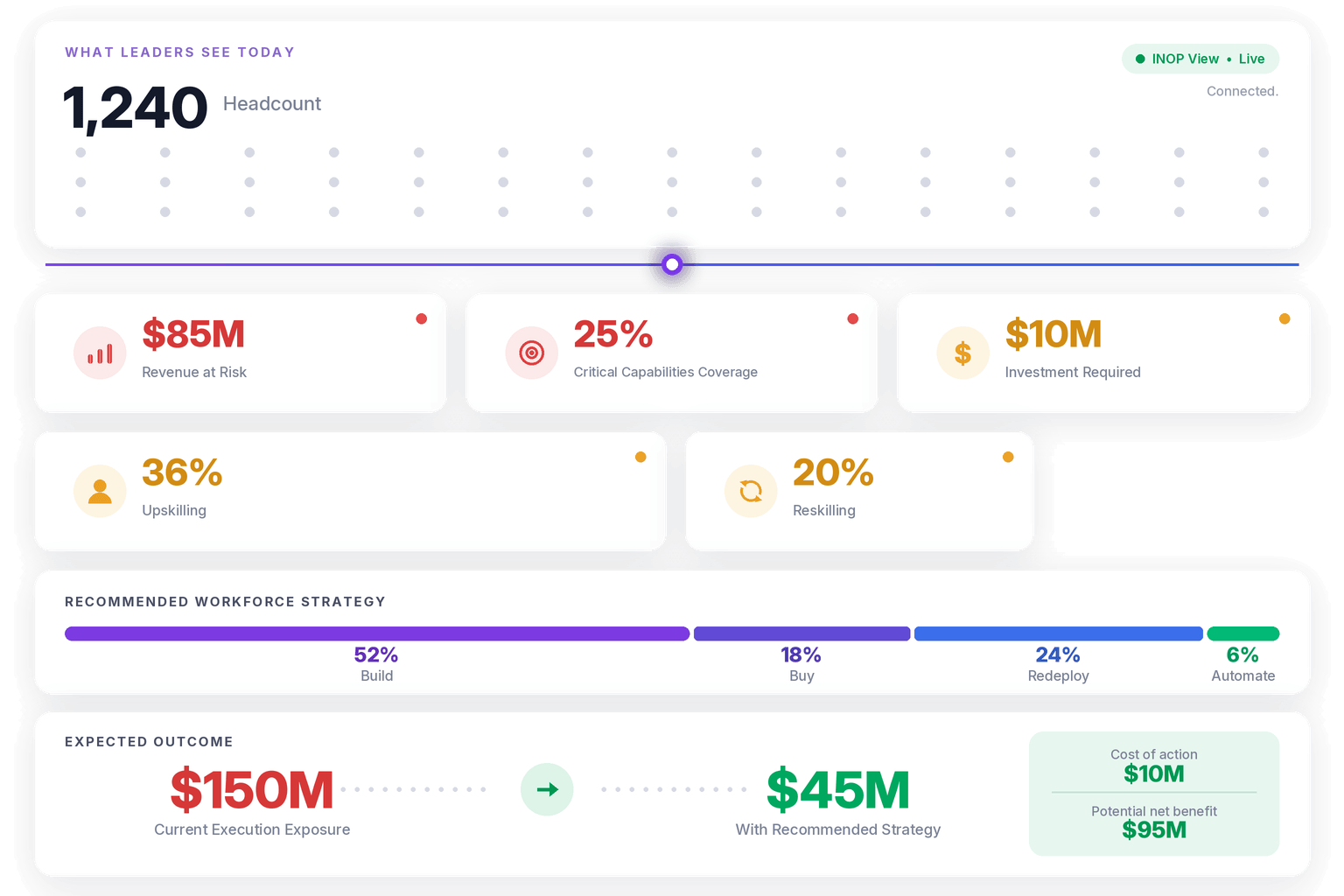
A headcount number is not a financial input. It becomes one when it is translated into total cost of workforce, incorporating base salary, benefits, payroll taxes, occupancy costs, technology and tooling costs per head, and management overhead. It becomes strategically useful when it is connected to the financial exposure of the gap, the cost of the proposed intervention, and the return on that investment.
INOP’s workforce intelligence architecture organizes this translation across five analytical lenses: Strategy, Finance, People, Market, and AI/Automation. The Finance lens specifically addresses the cost of workforce gaps and the ROI of closing them. When headcount forecasting outputs are fed through this framework, the result is not a staffing request but a capital allocation proposal, one that compares the cost of the gap against the cost of the intervention and produces a defendable return calculation.
This is the framing that earns CHROs a genuine seat in financial planning discussions. It is also the framing that PE operating partners increasingly expect from portfolio company management teams: workforce decisions presented with the same financial rigor as any other significant business investment.
Building the Cost of Gap Model
For each material headcount gap identified in the forecast, the cost of leaving it unfilled can be modeled across several dimensions. Productivity loss quantifies the output reduction from operating below required capacity. Revenue impact captures the direct relationship between staffing shortfalls and revenue generation in customer-facing functions. Execution risk models the cost of project delay or strategic initiative failure attributable to the gap. And downstream attrition cost accounts for the additional turnover risk in teams that are chronically understaffed.
Gallup research shows that disengaged employees, a predictable outcome of chronic understaffing, cost U.S. businesses hundreds of billions annually in lost productivity. When this chain of consequences is modeled from headcount gap through to financial impact, the numbers typically dwarf the cost of the hiring investment that would have prevented them.
Common Forecasting Failures and How to Avoid Them
Even well-resourced HR functions make predictable errors in headcount forecasting. These are the patterns worth watching.
Treating the Forecast as an Annual Event
Workforce dynamics move faster than annual planning cycles. A headcount forecast built in October and revisited in the following October has twelve months of market movement, organizational change, and strategic adjustment that it has not accounted for. The most effective forecasting practices treat the model as a continuous system, updated quarterly at minimum and recalibrated against business performance data as it becomes available.
Forecasting Headcount Without Forecasting Capability
A forecast that tells you how many people you need without specifying what they need to be able to do is only half a plan. The other half is the capability picture: which skills, at what proficiency levels, in which combinations. Without it, hiring managers make role-specific decisions in isolation from the broader capability architecture the strategy requires. The result is headcount that is technically adequate and strategically misaligned.
The shift from role-based headcount to skills-based forecasting is one of the defining trends in modern workforce planning. Organizations leading in this space are not asking “how many data engineers do we need” but “what specific capabilities in data architecture, pipeline development, and governance do we need, at what proficiency levels, by when.” That question produces a fundamentally different and more useful answer.
Assuming the Forecast Will Be Accurate
A headcount forecast is not a prediction. It is a structured set of assumptions about the relationship between business performance and workforce requirements. The assumptions will be wrong in some dimensions. The value of the forecast is not that it eliminates uncertainty but that it forces explicit choices about which assumptions to make, makes those assumptions visible, and creates the basis for rapid recalibration when reality diverges.
Organizations that treat their headcount forecast as a commitment rather than a model consistently underperform on workforce planning flexibility. The goal is a forecast that is directionally sound and quickly updatable, not one that is precise enough to eliminate the need for judgment.
Planning in Silos
When HR and Finance operate in isolation, risks multiply: overspending on recruitment, poor resource allocation, and inaccurate forecasts can undermine organizational performance. The same is true when HR plans without operational input from the functions whose headcount is being forecast. A headcount forecast built by HR using finance data but without engagement from the business unit leaders who will actually make the hiring decisions is structurally incomplete.
Effective headcount forecasting is a collaborative process. HR provides the analytical framework and the talent market expertise. Finance provides the economic constraints and the investment return framework. Business unit leaders provide the operational demand signal. And leadership provides the strategic direction that anchors the whole exercise. When any one of these inputs is missing, the forecast reflects that absence.
Ready to connect your headcount forecast to a strategic workforce plan that finance and the board will engage with?
Book a demo with INOP and see how our platform integrates workforce intelligence across strategy, finance, and people data.
The Role of Headcount Forecasting in PE Portfolio Management
For private equity operating partners, headcount forecasting carries a specific and high-stakes application: assessing whether a portfolio company’s workforce is structured to execute the value creation plan, and identifying the capability gaps and cost risks that could threaten it.
During diligence, headcount forecasting surfaces the hidden workforce costs in a target’s current state: concentration risk in critical roles, attrition patterns that indicate structural retention problems, and headcount distributions that do not match the operational model the value creation plan assumes. These signals are not visible in financial statements, but they have direct financial consequences that due diligence needs to quantify.
During the value creation period, the headcount forecast becomes the operational workforce plan. It translates the plan’s growth and efficiency assumptions into specific headcount requirements, with timelines and cost models attached. It identifies where talent needs to be brought in, where it can be developed from within using the Build lever of INOP’s BBRA framework, where redeployment from other portfolio assets might be possible, and where automation can reduce the headcount requirement entirely.
The five analytical lenses at the core of INOP’s workforce intelligence architecture, Strategy, Finance, People, Market, and AI/Automation, give operating partners the same analytical rigor on workforce decisions that they already apply to financial performance. Headcount forecasting, built on this foundation, is not an HR deliverable. It is a strategic and financial tool that belongs at the center of portfolio company management.
Conclusion
Headcount forecasting is not a sophisticated statistical exercise available only to large organizations with mature people analytics functions. It is a structured discipline for thinking clearly about the relationship between your business strategy and your workforce requirements, and for making that thinking visible in financial terms that the whole executive team can act on.
The organizations doing this well share a few characteristics. They treat the forecast as a continuous model rather than an annual event. They connect headcount data to capability data, so the forecast answers not just how many but what kind. They collaborate across HR, finance, and business leadership to build a plan that reflects organizational reality rather than departmental assumptions. And they connect the gap between current state and required state to a financial exposure model that makes the case for investment in language the CFO and the board already speak.
INOP’s strategic workforce planning platform is built to support exactly this approach, connecting headcount forecasting to skills intelligence, compensation analytics, and the BBRA decision framework in a single integrated model. If you want to explore what a data-driven headcount forecast built for your organization would look like, the most direct path is a conversation with our team.
And if you are working through headcount forecasting challenges in your own organization and want to share what you are navigating, leave a comment below. The most useful thinking in this space comes from the practitioners who are doing it.
Frequently Asked Questions
What is headcount forecasting and how is it different from headcount planning?
Headcount planning is an operational activity focused on managing current staffing levels within a budget. Headcount forecasting is a forward-looking, strategic process that uses business strategy, financial projections, historical data, and market intelligence to predict how many people an organization will need, in which roles and capabilities, and by when. Planning optimizes the present. Forecasting prepares for the future.
What data is needed for accurate headcount forecasting?
A robust headcount forecast requires five categories of input: internal workforce data including current headcount, attrition patterns, and skills inventory; business strategy and financial projections that translate organizational plans into workforce demand; external market signals on talent availability, compensation trends, and hiring timelines; historical patterns in hiring performance and attrition by role and function; and AI and automation impact modeling that accounts for how technology is reshaping role requirements. The more complete the data across these five dimensions, the more reliable the forecast.
How far ahead should a headcount forecast look?
Most organizations maintain a rolling 12-to-18-month operational headcount forecast updated quarterly, alongside a longer-range three-to-five-year strategic workforce forecast reviewed annually and refreshed when significant strategic changes occur. The appropriate horizon depends on the lead times involved in acquiring or developing the capabilities the strategy requires. If a critical capability takes 18 months to build internally, the forecast needs to look at least that far ahead to inform the decision.
How do you connect headcount forecasting to financial planning?
The connection runs through total cost of workforce modeling. Each headcount scenario in the forecast needs to be translated into the fully loaded cost of that workforce: base salary, benefits, occupancy, technology, and management overhead. The gap between the current state and the forecast requirement then needs to be expressed as a financial exposure, and the cost of the chosen intervention, hiring, development, redeployment, or automation, needs to be modeled against that exposure to produce a return-on-investment figure. That framing is what makes headcount forecasting a financial planning input rather than an HR deliverable.
What is scenario planning and why does it matter for headcount forecasting?
Scenario planning builds multiple versions of the headcount forecast under different business assumptions: an accelerated growth scenario, a base case, and a downside case. Each scenario produces a different workforce requirement and a different cost profile. The value is that it forces explicit discussion of the assumptions embedded in the forecast and prepares the organization to respond to outcomes that differ from the expected case, rather than being caught off guard when the single-point forecast proves inaccurate.
How should PE operating partners use headcount forecasting in portfolio companies?
Operating partners use headcount forecasting during diligence to identify hidden workforce risks in a target’s current state: concentration in critical roles, attrition patterns suggesting structural retention problems, and headcount distributions misaligned with the operational model the value creation plan assumes. During the value creation period, the headcount forecast becomes the operational workforce plan, translating growth and efficiency targets into specific capability requirements with timelines and cost models. The goal is to give workforce decisions the same financial rigor as capital allocation decisions.
How does AI change headcount forecasting?
AI affects headcount forecasting in two ways. It is a tool that improves forecasting capability through predictive modeling and pattern recognition in large workforce datasets. And it is a variable that changes what needs to be forecast. As automation reshapes the task composition of roles, headcount requirements in affected functions change. A credible headcount forecast in 2026 models both the augmentation effects, where AI increases the output of existing headcount, and the displacement effects, where AI reduces the human capacity required for specific tasks, rather than assuming that historical role structures will persist unchanged.
Make confident workforce decisions that support strategy and value creation.