Imagine this: two employees are up for promotion. One has consistently delivered on projects, while the other has shown exceptional growth in relevant skills over the past year. Which one gets the job?
In today’s fast-changing workplace, promotions and upskilling can no longer rely solely on tenure or gut feeling.Skills data is rapidly becoming the most strategic tool for fair, forward-thinking talent development. In today’s fast-changing workplace, promotions and upskilling can no longer rely on tenure or gut feeling alone, they need real, measurable information about what employees can actually do.
This article explores how organizations can effectively use skills data to support promotions and upskilling decisions. We’ll discuss what skills data is, how to collect and analyze it, and why it matters now more than ever.
Understanding Skills Data: What It Is and Why It Matters
Skills data refers to structured information about an individual’s competencies, including both hard skills (e.g., coding, data analysis) and soft skills (e.g., leadership, communication). This data can be gathered from:
- Performance reviews
- Learning and development (L&D) platforms
- Project outcomes
- Certifications and training history
- Self-assessments and manager evaluations
Unlike job titles or years of experience, skills data offers a granular and dynamic picture of what an employee can actually do, and how well they’re doing it.
According to a 2025 survey of 1,250 HR and Finance professionals conducted by PSB Insights and commissioned by Paycom, ongoing employee development is the second-highest organizational priority for 2026, behind only technology upgrades. Separately, Pluralsight’s 2025 research found that 89% of organizations report upskilling is more cost-effective than hiring new talent to close the same capability gap. Gallup’s research adds the retention dimension: companies that double the number of employees who feel they have opportunities to learn and grow could see a 14% increase in productivity and 18% increase in profit.
Upskilling vs. Reskilling: Why the Distinction Matters for Skills Data Strategy
Upskilling and reskilling are frequently used interchangeably. They describe different interventions with different costs, timelines, and organizational implications.
Upskilling develops deeper or broader capability within a skill domain an employee already works in. A data analyst who extends from SQL proficiency to Python, or a project manager who develops from basic stakeholder management to executive-level communication, is upskilling. The employee’s role orientation stays broadly the same. The skills data signal that identifies an upskilling need is a gap between current proficiency and the next level required for the role or career stage.
Reskilling develops capability in a domain the employee has not previously worked in, usually because automation, strategic change, or market shifts have reduced the business need for their current skill set. A customer service representative who transitions into a data operations role, or a financial analyst whose routine modeling work is being automated who moves into financial strategy, is reskilling. The employee’s role orientation changes. The skills data signal that identifies a reskilling need is the intersection of two things: the AI or automation risk level attached to the current skill set, and the availability of adjacent capability that could form the foundation for the new domain.
Skills data is the instrument that makes the upskilling-reskilling distinction actionable rather than theoretical. Without it, organizations default to generic “future skills” training programmes that partially address upskilling needs and barely address reskilling needs. With verified capability profiles, the gap between where an employee is and where the business needs them to be is specific enough to route to the right intervention.
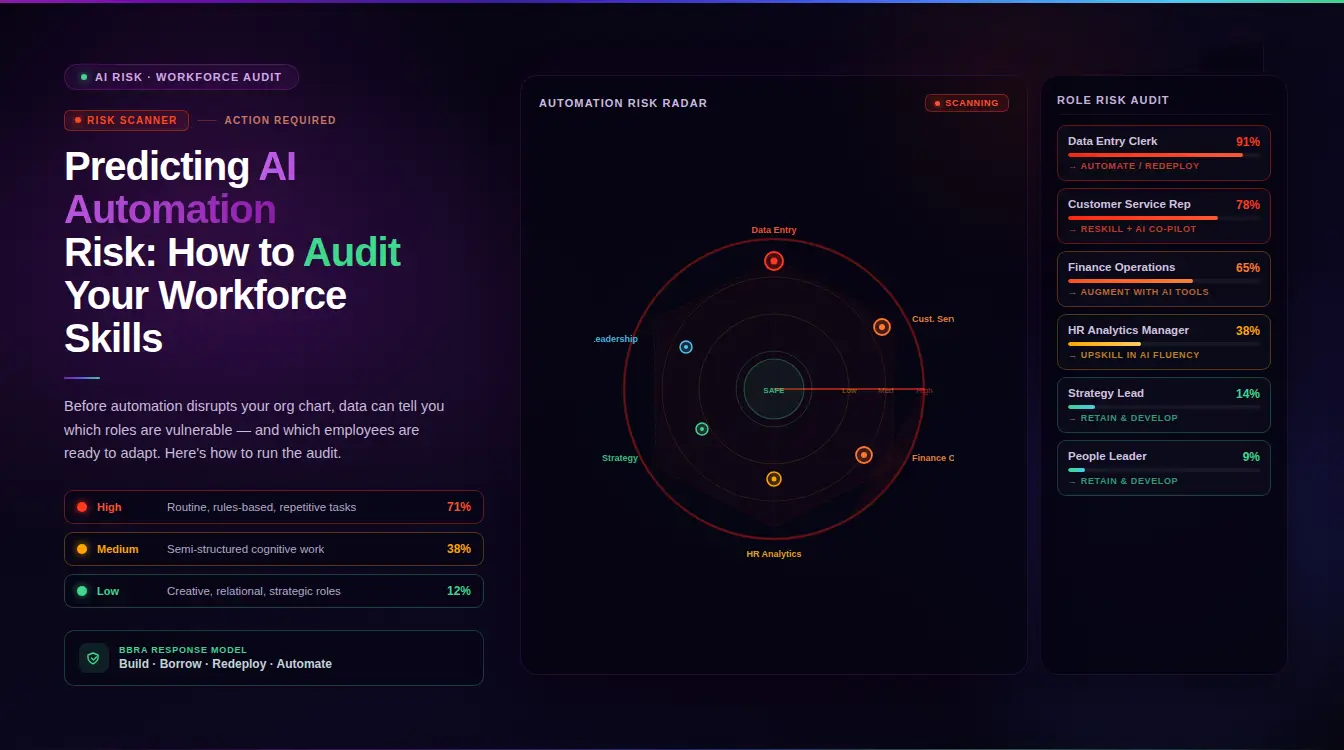
For organizations modeling which roles face the highest reskilling pressure from AI and automation, INOP’s guide on predicting AI automation risk covers how to audit the workforce before that pressure becomes a crisis.
Benefits of Using Skills Data for Promotions and Upskilling
More Transparent Promotions
Using skills data ensures that promotion decisions are based on objective evidence, not subjective opinions or office politics. This improves internal mobility and employee trust.
Strategic Upskilling
Skills gaps can be identified at both the individual and organizational level. This allows companies to design targeted learning paths, reducing wasted resources on irrelevant training.
Future-Readiness
When skills data is analyzed across teams, leaders can forecast talent needs and proactively develop capabilities that align with long-term business goals.
Building the Business Case for Skills Data Investment
Most L&D and HR leaders who understand the value of skills data face an internal hurdle before implementation: justifying the investment to Finance or senior leadership in financial terms rather than HR terms. The following three arguments consistently close that gap.
The cost comparison argument. Pluralsight’s 2025 research found that 89% of organizations report upskilling is more cost-effective than hiring new talent to fill the same capability gap. The fully loaded cost of an external hire for a mid-level technical role, including search fees, ramp time, and first-year productivity adjustment, typically runs $90,000 to $150,000. A targeted upskilling programme for an internal employee with adjacent capability to close the same gap typically runs $2,000 to $15,000 in direct programme cost. The financial case is not that upskilling is always the right answer. It is that the comparison should happen before every external hire, and most organizations skip it because they do not have the skills data to run it.
The retention argument. According to LinkedIn’s Workplace Learning Report, 94% of employees say they would stay at a company longer if it invested in their learning and growth. Gallup’s research adds the financial translation: companies that double the number of employees who feel they have learning and growth opportunities could see an 18% increase in profit. At an average replacement cost of $50,000 to $150,000 per mid-level employee departure, retaining five additional employees annually through a credible development programme covers most skills data infrastructure costs in the first year.
The strategic execution argument. According to the WEF’s Future of Jobs Report 2025, 63% of employers identify skills gaps as the biggest barrier to business transformation between 2025 and 2030. A skills data programme that identifies the capability gaps between the current workforce and the skills required to execute the organization’s three-year plan produces a planning instrument that HR and Finance can work from jointly. That planning instrument, presented to the CFO as a capital allocation input rather than an L&D budget request, consistently earns a different quality of attention.
How to Collect and Organize Skills Data Effectively
You can’t use what you don’t measure. Here’s how to start building a solid skills data foundation:
Create a Skills Taxonomy
A skills taxonomy is a structured list of the capabilities required for roles across the organization. It should include:
- Core skills (required for most roles)
- Role-specific skills
- Emerging skills (for future readiness)
Map Skills to Roles and Levels
Use frameworks like Skills Framework for the Information Age (SFIA) or develop your own internal models. Define what skills are needed for each job level — and what mastery looks like.
Leverage Technology
Use talent intelligence platforms or HRIS tools that can collect and track skills-related data from various sources:
| Tool Type | Example Platforms | Function |
|---|---|---|
| Learning Management Systems (LMS) | Coursera for Business, SAP SuccessFactors | Track training and certifications |
| Talent Management Systems | Workday, Oracle HCM Cloud | Link skills to roles and performance |
| AI-Powered Skills Analytics | Gloat, Eightfold.ai | Predict skill gaps, recommend upskilling |
Encourage Self- and Peer-Assessments
Create a culture where employees regularly evaluate themselves and each other against defined skill criteria. This adds richness and balance to the dataset.
Using Skills Data to Support Promotions
Here’s how you can put skills data into action for fair and insightful promotion decisions:
Define Role Requirements Clearly
Every promotion should be based on defined skill thresholds. For example, a promotion from Marketing Specialist to Marketing Manager might require:
- Strategic thinking
- Leadership skills
- Budget management
- Campaign ROI analysis
Having this list documented and communicated sets a transparent benchmark.
Create Skills Dashboards
Use visual dashboards to show individual progress against role requirements. This can help managers:
- Spot promotion-ready candidates
- Provide data-backed feedback
- Justify decisions to stakeholders
Combine Quantitative and Qualitative Inputs
While data is critical, context matters. Blend skills data with:
- Peer feedback
- Project outcomes
- Cultural contributions
This hybrid approach ensures promotions reward well-rounded excellence.
How Skills Data Reduces Promotion Bias
Promotion decisions made without structured skills data are disproportionately influenced by three well-documented cognitive biases. Understanding them explains why skills data works as a corrective — not just a process improvement.
Proximity bias causes managers to advance employees they interact with most frequently, physically co-located team members, those who attend optional social events, or those in high-visibility roles. Remote employees, deep individual contributors, and those in support functions are routinely disadvantaged. Skills data surfaces capability regardless of who the manager sees most often.
In-group bias causes leaders to overestimate the readiness of employees who share their background, communication style, or career trajectory. Research from Gallup shows this pattern is one of the most consistent drivers of demographic homogeneity in leadership pipelines, and one of the most difficult to surface without comparative data. When promotion panels review skills profiles rather than personal impressions, in-group candidates are no longer systematically advantaged.
Recency bias causes promotion decisions to weight recent performance disproportionately, the project that went well last quarter overshadows 18 months of consistent delivery. A complete skills data record, built over time across multiple sources, creates a more accurate picture of sustained capability than any single evaluator’s recent memory.
Addressing these biases is not just an ethical obligation, it is a competitive advantage. Organizations that promote based on verified capability rather than perceived fit develop deeper, more diverse leadership pipelines and experience lower post-promotion failure rates.
How to Conduct a Skills Gap Analysis Using Skills Data
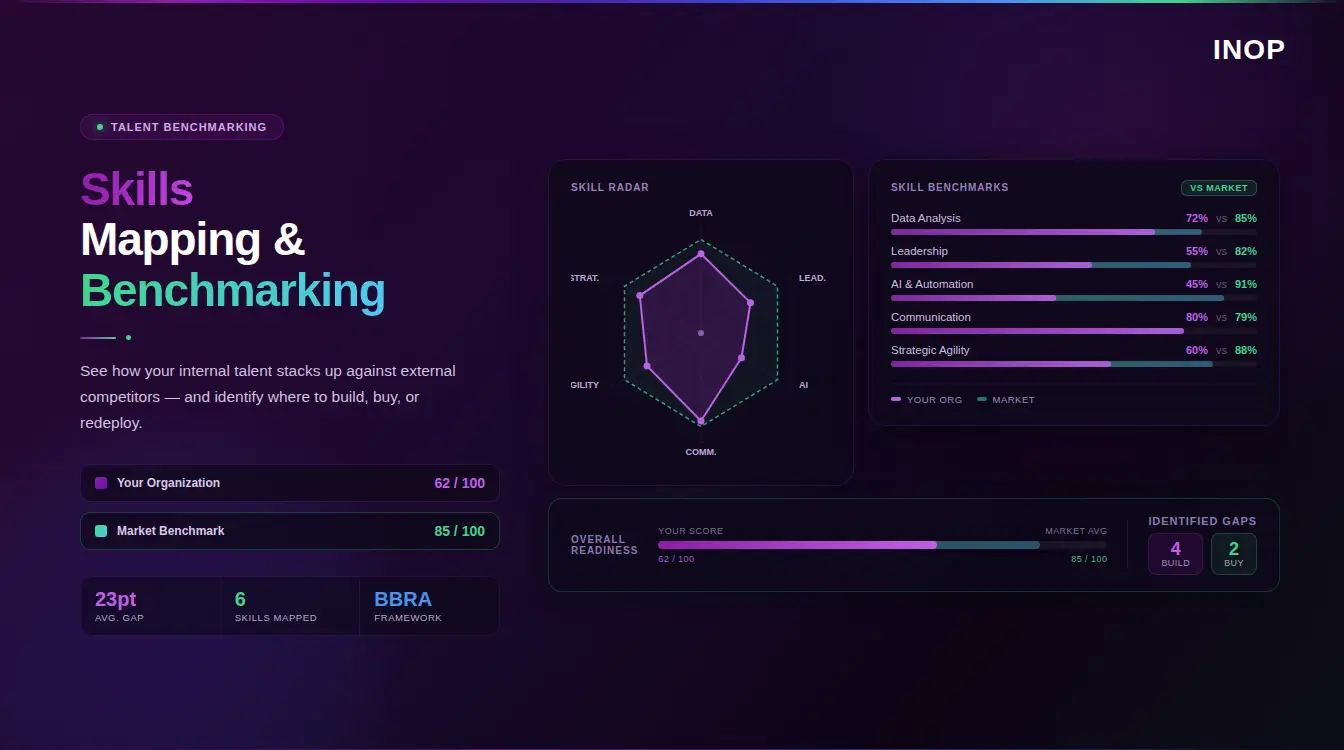
A skills gap analysis is the engine that turns raw skills data into development decisions. It compares what an employee currently demonstrates against what their current or target role requires, then produces a prioritized action plan. When done at scale, across teams, departments, or the whole organization, it becomes a workforce planning instrument that tells leaders where talent risk is concentrated and where development investment will generate the most return.
The Four-Level Framework for Skills Gap Analysis
Skills gap analysis can be run at four distinct levels, each producing different actionable outputs:
Individual level compares one employee’s verified skills against their role requirements or their target next role. This is the foundation for personalized development plans and promotion readiness decisions. An employee who scores intermediate on Python when the senior role requires advanced, for example, has a clear, nameable development target.
Team level maps the collective skills of a team against the skills required to deliver a specific project or business objective. This reveals whether a team can execute its roadmap with current capability or whether upskilling or targeted hiring is needed first. A team of ten engineers where six are beginner-level in cloud infrastructure has a very different risk profile than one where three are expert-level.
Department level assesses capability across an entire function, identifying patterns in where skills are clustered and where they are absent. This level is most useful for L&D budget allocation, it tells you which capability investments will have the broadest impact.
Organizational level maps the full workforce against strategic goals. At this level, skills gap analysis becomes a direct input into workforce planning: which capabilities does the organization need to build, buy, or borrow over the next 12 to 36 months?
Step-by-Step Skills Gap Analysis Process
Step 1: Define the target skill profile. For each role or level, document the specific skills required, including proficiency level for each, not just presence or absence. “Python: Advanced” is a usable criterion. “Python: Yes/No” is not. Proficiency matters because an organization with ten beginner-level Python practitioners has a fundamentally different capability position than one with three expert-level practitioners.
Step 2: Assess current skills with multi-source data. Collect skills data from performance reviews, learning platform completions, certifications, project outcomes, manager assessments, and self-assessments. No single source is sufficient, each has blind spots. Self-assessments tend to overstate proficiency; manager assessments tend to understate it for employees with low visibility; performance reviews often miss technical skills entirely.
Step 3: Map the gap. Compare current skills against the target profile at each proficiency tier. Document not just which skills are missing, but how far each employee or team is from the required level, and what would be needed to close the gap, a short course, a structured project experience, a certification, or extended coaching.
Step 4: Prioritize by business criticality. Not all skill gaps are equally urgent. A gap in a capability that underpins a major business initiative this quarter is more pressing than one relevant only to a future state roadmap. Overlay gap findings with business priorities to produce a ranked action plan rather than an undifferentiated list.
Step 5: Build development plans and review them. Assign each identified gap a development action, training, mentoring, stretch assignment, or external certification, with a timeline and a responsible owner. Skills gap analysis only creates value when it produces decisions, not just documentation. Schedule quarterly reviews to update the data as employees develop.
Skills Data for Succession Planning and Leadership Pipelines
Promotion decisions and succession planning are related but distinct: promotions address immediate readiness, while succession planning addresses long-term pipeline strength. Using skills data for both — rather than just for the immediate vacancy, is what separates reactive talent management from strategic workforce development.
How Skills Data Reduces Bias in Succession Decisions
Succession planning is particularly vulnerable to cognitive bias. Without structured skills data, leaders tend to nominate successors based on visibility and familiarity rather than demonstrated capability. This produces successor lists that systematically underrepresent employees with less managerial face time, including remote employees, those with non-traditional career paths, and high performers who do their best work independently rather than visibly.
Skills data counters this by shifting the succession question from “who do I think of when I picture this role?” to “who has demonstrated the capabilities this role requires?” When succession decisions are anchored to verified competency profiles rather than manager nominations, the candidate pool broadens and the decision is more defensible to employees who expect fairness in advancement.
Building Promotion Readiness Scores with Skills Data
A promotion readiness score is a structured, data-driven assessment of how prepared an employee is for a given next role. Rather than a binary “ready or not ready” judgment, it expresses readiness as a percentage match between an employee’s current verified skills and the target role’s requirements, along with a time-to-readiness estimate based on their development trajectory.
Key inputs to a readiness score typically include: skills match percentage against the target role profile, rate of skills acquisition over the past 6–12 months, performance ratings on skills directly relevant to the next role, and peer or manager validation of skills in applied contexts. Organizations using readiness scores alongside skills data report faster, more confident promotion decisions, less post-promotion regret, and stronger buy-in from employees who can see exactly what “ready” means and how to get there.
Using Skills Data for Personalized Upskilling
Not all employees need the same training. Skills data allows organizations to personalize learning like never before.
Identify Individual Skills Gaps
Run a skills gap analysis to compare current vs. desired skills for an employee’s role or next step. For example:
| Skill | Current Level | Required Level | Gap |
|---|---|---|---|
| Python Programming | Intermediate | Advanced | Yes |
| Data Visualization | Beginner | Intermediate | Yes |
| Stakeholder Mgmt. | Advanced | Advanced | No |
This data becomes a roadmap for targeted development.
Recommend Tailored Learning Paths
Modern L&D systems can match skills gaps with relevant resources, from internal training to external certifications.
For instance, if a product manager lacks agile methodology knowledge, the system might suggest a Scrum Master course or internal coaching sessions.
Align Upskilling with Career Goals
Let employees choose from personalized development plans based on their career aspirations. This fosters motivation and retention, especially among high performers.
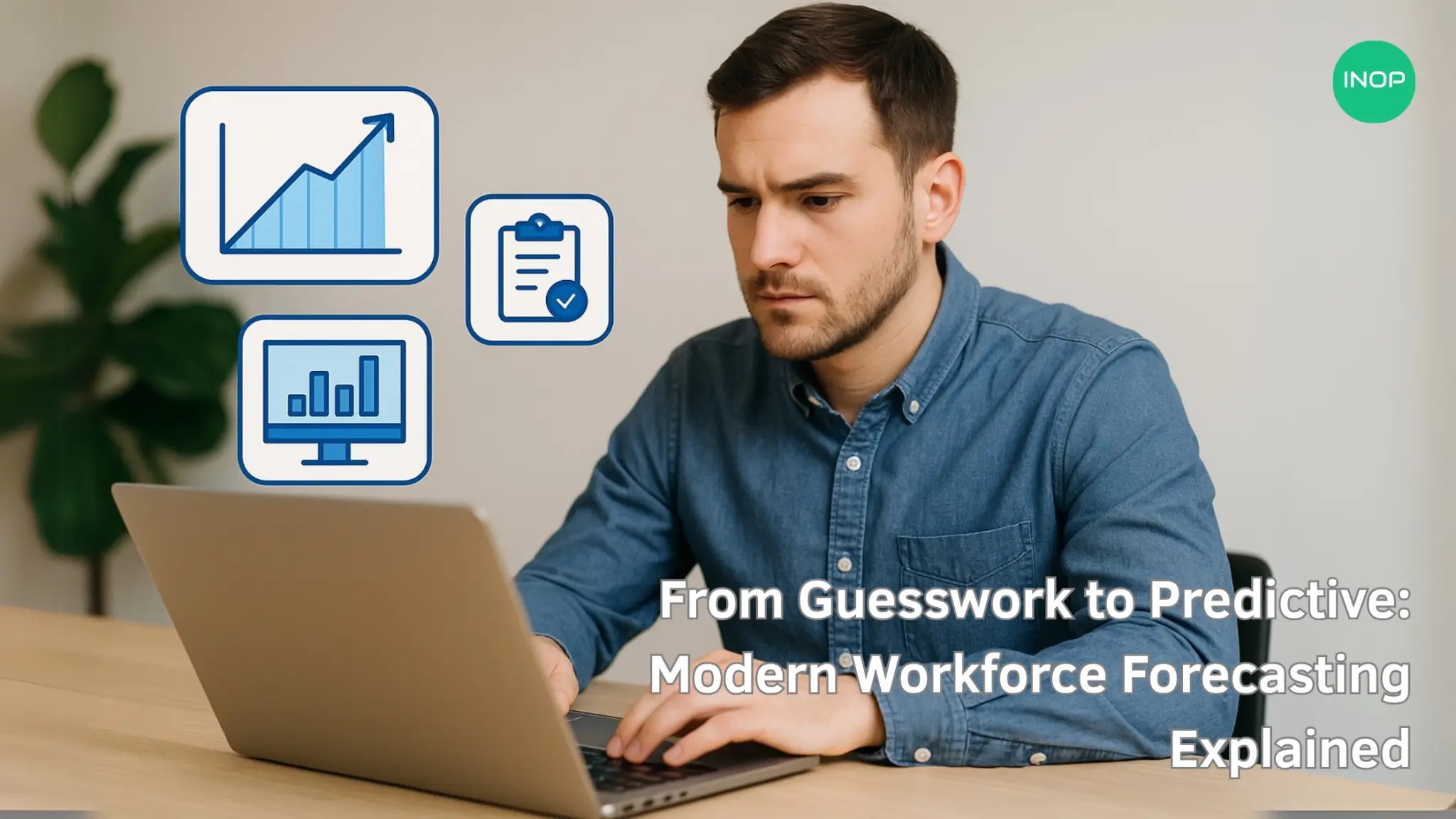
Effective workforce forecasting plays a critical role in aligning skills development with long-term organizational goals. When businesses rely on outdated or reactive models, they risk underestimating talent gaps or overinvesting in the wrong areas. Shifting to a data-driven, predictive approach can provide far greater accuracy and strategic clarity. To dive deeper into how modern forecasting methods are transforming HR planning, explore our in-depth guide: From Guesswork to Predictive: Modern Workforce Forecasting Explained.
The Manager Enablement Gap: Why Skills Data Alone Is Not Enough
The most consistent finding in 2026 upskilling research is not about technology or budget. It is about managers. HR.com’s Future of Upskilling and Employee Learning 2026 research found that less than half of employees believe their managers actively encourage skill development, and only 52% say they have identifiable career paths and opportunities for growth. In large organizations, the figure drops further: only 42% of employees in large organizations agree their managers encourage development, compared to 60% in mid-size organizations.
This gap matters for skills data strategy because skills data is only as valuable as the managers who use it. A comprehensive skills inventory that identifies development priorities for every employee in the organization produces no development unless managers are equipped and motivated to act on those priorities in the conversations they have with their teams. Skills data without manager enablement produces an HR analytics output that nobody acts on.
The practical implication is that rolling out a skills data programme requires a parallel investment in two manager-specific capabilities. First, managers need to understand how to read and interpret skills gap data for their team members in a way that produces development conversations rather than anxiety. Second, managers need to be held accountable for development outcomes, not just for performance outputs, which requires adding development metrics to manager performance criteria and not just to the L&D team’s KPI dashboard.
In organizations where managers are explicitly evaluated on their team’s skills development velocity and internal mobility rates, upskilling programmes consistently outperform those where development is positioned as an HR initiative that managers can choose how much to engage with. Skills data is the instrument. Manager behaviour is the intervention.
AI Upskilling: The Category That Requires a Different Approach
AI upskilling in 2026 is not a single training programme or a certification path. It is a continuous capability development requirement that spans every function simultaneously, in a domain where the tooling, the expected proficiency standards, and the most relevant applications are all changing faster than most formal L&D cycles can track.
Skills data for AI upskilling requires three specific design decisions that general upskilling frameworks do not fully address.
The first is distinguishing between AI fluency and AI expertise. Most employees need AI fluency, the ability to use AI tools effectively in their specific work context, evaluate AI outputs critically, and understand where AI judgment requires human verification. A much smaller population needs AI expertise — the technical capability to build, fine-tune, configure, or evaluate AI systems. Conflating these produces upskilling programmes that over-invest in technical depth for populations who need only applied fluency, and under-invest in fluency development for populations who need it most urgently.
The second is connecting AI skills gaps to role-specific automation risk. An employee whose role involves significant proportions of the tasks McKinsey identifies as automatable has a more urgent AI upskilling need than one whose role is concentrated in judgment-intensive, interpersonal, or creative work that AI currently augments rather than replaces. Skills data connected to automation impact modeling, rather than operating in a separate system from it, produces AI upskilling prioritization that reflects actual risk rather than departmental enthusiasm.
The third is building AI upskilling into the continuous learning cycle rather than treating it as a discrete programme. A one-time AI training cohort produces a burst of activity and a capability snapshot that is already partially obsolete by the time the last employee completes it. AI capabilities are evolving on a monthly, not annual, basis. Skills data cadences for AI-relevant competencies need to match that pace.
For HR leaders connecting AI upskilling to a broader workforce automation risk assessment, INOP’s guide on AI automation bias and workforce decisions covers the governance framework that should accompany any AI-driven upskilling strategy.
Real-World Examples of Skills Data Driving Promotions and Upskilling
Siemens: Reskilling at Scale with Skills Intelligence
When Siemens faced the shift to Industry 4.0, smart factories, IoT integration, and advanced robotics, it used skills data to identify which of its manufacturing workforce already had adjacent capabilities that could be developed toward digital roles, rather than defaulting to external hiring. By mapping existing skills against emerging role requirements, Siemens was able to design targeted upskilling pathways for specific employee segments, reducing external hiring costs while preserving institutional knowledge. The skills data foundation also enabled more transparent promotion criteria in technical roles, where advancement had previously been tied heavily to tenure.
Unilever: Connecting Upskilling to Internal Mobility
Unilever’s “Flex Experiences” platform uses skills data to match employees to internal gig projects based on their current capabilities and development aspirations. Employees who take on projects in new skill areas build verified competency records that feed directly into promotion readiness assessments. This closed loop between skills data, experiential learning, and promotion criteria has increased internal mobility rates and reduced the time between skill development and formal advancement.
Western Digital: Skills-First Upskilling for Frontline Workers
To prepare frontline workers for complex new product lines, Western Digital implemented a structured skills development program that tracked capability gains at the individual level throughout training. Promotions and role reassignments were tied directly to verified skill acquisition rather than time served. The program resulted in a 49% increase in employees receiving targeted skills training and a 21% improvement in engagement scores, evidence that transparent, skills-based advancement creates motivation as well as capability.
Measuring the Impact of Skills Data on Promotions and Upskilling
Building a skills data infrastructure is an investment. Like any investment, it requires measurement to know whether it is generating return and where to adjust.
Key Metrics to Track
Promotion accuracy rate: What percentage of promotions made using skills data result in strong performance at the new level within 6–12 months? Compare this to your historical baseline before structured skills data was in use. Improved accuracy is the clearest indicator that your skills criteria are correctly calibrated to role requirements.
Internal fill rate for open roles: What percentage of vacancies are filled by internal candidates who were identified through skills data rather than external hires? An increasing internal fill rate signals that your skills inventory is surfacing talent that would otherwise have been invisible and that your upskilling investment is producing promotion-ready employees.
Skills development velocity: How quickly are employees closing identified gaps after development plans are assigned? Track average time from “gap identified” to “gap closed at required proficiency level.” Slow velocity can indicate that learning resources are poorly matched to identified gaps, that employees lack time or support for development, or that assessment criteria need recalibration.
Demographic distribution of promotions: Are promotion rates consistent across gender, ethnicity, tenure, location, and job family? Skills data enables this audit. If promotion rates diverge significantly across demographic groups, that is a signal to investigate whether skills criteria are being applied consistently or whether upstream data collection has a systematic gap.
Upskilling program completion and application rates: Completion rate alone is a vanity metric, it measures attendance, not capability development. The more meaningful measure is the application rate: what percentage of employees who complete a development program demonstrate the target skill at the required proficiency level within 90 days?
Challenges to Watch For
Using skills data effectively requires overcoming certain hurdles:
- Data Quality: Incomplete or biased data can lead to poor decisions. Regular updates and multi-source inputs help.
- Change Management: Teams may resist new processes. Transparent communication and leadership buy-in are essential.
- Over-Reliance on Automation: Data should inform, not dictate. Human judgment must remain a core component.
Integrating AI for workforce planning can take your skills data strategy to the next level. By leveraging artificial intelligence, companies can analyze skills trends, forecast future talent needs, and make more informed decisions about promotions and upskilling. Whether you’re managing a global workforce or planning team expansion, AI-driven workforce planning solutions can help align talent development with real-time business priorities, giving you a proactive edge in a rapidly changing environment.
The Future: Skills Data as Strategic Currency
As work becomes more project-based and skills evolve rapidly, companies that treat skills data as a strategic asset will lead the future of talent development.
According to the World Economic Forum’s Future of Jobs Report 2025, 63% of employers identify skills gaps in the local labor market as the biggest barrier to business transformation between 2025 and 2030. SHRM’s 2026 research found that roughly half of businesses added new skills to job descriptions in 2025, a signal that role requirements are evolving faster than most organizations’ talent development cycles can track.
The Skills Half-Life Problem: Why Static Skills Data Fails
The half-life of professional skills is shrinking. Capabilities that defined career success five years ago are becoming obsolete while new competencies emerge faster than most formal education systems or annual performance reviews can track. According to the World Economic Forum’s Future of Jobs Report 2025, 63% of employers identify skills gaps in the local labor market as the biggest barrier to business transformation between 2025 and 2030.
This half-life dynamic has a direct implication for how organizations use skills data. A skills inventory collected once during an annual review cycle is already partially stale the day it is published. In fast-moving domains like AI development, cloud infrastructure, and data engineering, skills assessed as current twelve months ago may already require recalibration against what the role now demands. An organization that builds promotion and upskilling decisions on skills data that is 14 months old is building on a foundation that the market has already moved past.
Continuous skills data collection, through regular self-assessment cycles, learning platform integration, manager validation, and project outcome tracking, is not a technology preference. It is the minimum requirement for skills data to remain a reliable basis for the decisions that affect employees’ careers and the organization’s capability position. INOP’s skills intelligence platform tracks external demand signal states for skills across four categories, Emerging, In Demand, Stable, and Declining, connecting internal skills inventory data to live market calibration rather than letting it drift against a static historical baseline.
Skills Data for Promotions and Upskilling in PE Portfolio Companies
For private equity operating partners, skills data applied to promotions and upskilling serves a specific value creation function that general enterprise frameworks do not address directly. The challenge is twofold: accelerating capability development fast enough to match the value creation plan’s execution timeline, and building a leadership pipeline strong enough to sustain performance through the hold period without dependency on a small number of critical individuals.
Portfolio companies acquired from founder-led or private backgrounds frequently have no structured skills data infrastructure. Promotion decisions have been made on tenure, personal relationship, and manager discretion. Upskilling has been generic or budget-constrained. The result is a workforce where the actual capability distribution is invisible until execution pressure reveals it, usually at the worst possible moment for the investment thesis.
In the first 90 days post-acquisition, a skills data baseline for the roles most critical to the value creation plan identifies three things the succession chart does not: which individuals are genuinely ready for advancement versus holding titles that exceed their verified capability, where the capability gaps most directly threaten execution of the key milestones in the first 18 months, and which upskilling investments, if made now, will produce the development velocity the plan requires before those milestones arrive.
Promotion decisions made on skills data during the hold period also reduce two specific PE risks. The first is key-person concentration: when capability is visible across the organization rather than opaque, the succession bench for each critical role is real rather than nominal, reducing the executive departure risk that operating partners identify as one of the highest-probability threats to hold period execution. The second is post-exit discovery risk: a portfolio company where promotions are demonstrably skills-based and where upskilling investment is tied to verified capability development presents a stronger human capital narrative in buy-side due diligence than one where HR can only document training spend rather than capability outcomes.
INOP’s skills intelligence platform provides the skills baseline and continuous capability tracking that makes this work at PE portfolio speed. For operating partners evaluating how skills data connects to the broader workforce intelligence investment, book a demo to see how INOP approaches promotion readiness and upskilling for PE portfolio environments.
Frequently Asked Questions About Skills Data for Promotions and Upskilling
What is skills data and why does it matter for promotions?
Skills data is structured information about an employee’s verified competencies, what they can do, at what proficiency level, as evidenced by performance reviews, assessments, certifications, project outcomes, and manager validation. It matters for promotions because it replaces subjective impressions with objective, comparable evidence, making advancement decisions more accurate, more defensible, and more equitable.
How do you collect skills data across an organization?
Skills data is collected from multiple sources: learning management system completions and certifications, performance review records, project outcome data, self-assessments, peer and manager evaluations, and AI-powered inference from work activity in tools like project management platforms. No single source is sufficient, multi-source collection reduces individual bias and provides a more complete picture of actual capability.
What is the difference between skills data and performance data?
Performance data measures outcomes, what an employee delivered, how a project went, what their rating was. Skills data measures capability, what an employee can do and at what proficiency level. Both inform promotion decisions, but they answer different questions. Performance data tells you what has been achieved; skills data tells you what can be achieved in the next role. The most accurate promotion decisions use both in combination.
How do you use skills data to make upskilling more effective?
Skills data makes upskilling effective by replacing generic training programs with targeted development actions matched to identified gaps. Instead of sending all employees through the same course catalog, a skills gap analysis pinpoints the specific competency shortfall for each employee and recommends the development resource most likely to close it. This reduces wasted training spend and accelerates the time from development investment to demonstrated capability.
Can small organizations use skills data effectively?
Yes, though the approach scales differently. Large organizations typically need dedicated skills intelligence platforms (Gloat, Eightfold, TechWolf). Smaller organizations can build effective skills data processes using structured assessments, a well-maintained skills taxonomy in a spreadsheet or lightweight tool, and a consistent cadence of manager and peer evaluation. The principle is the same at any scale: decisions informed by documented, multi-source evidence produce better outcomes than decisions based on individual judgment alone.