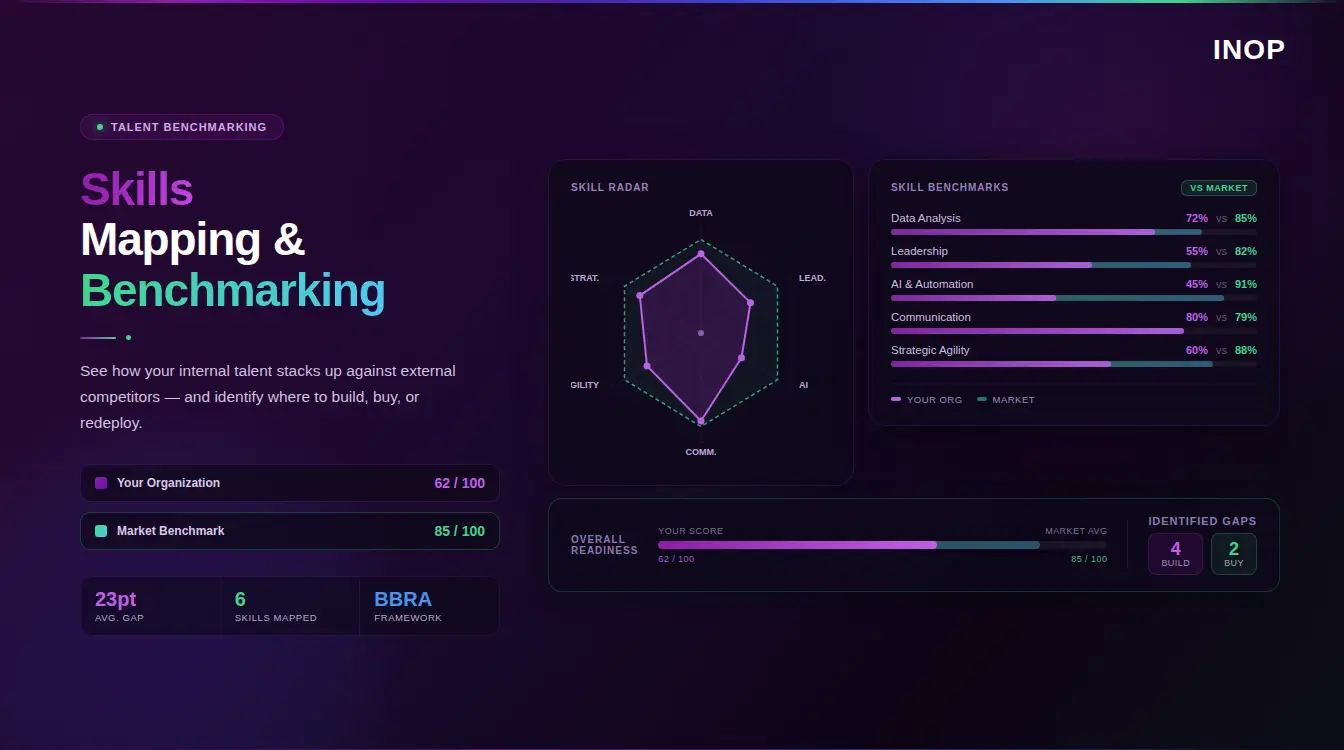
Most companies still pay for titles. Most employees, meanwhile, create value through skills. The distance between those two realities is where pay dissatisfaction, stalled mobility, and avoidable attrition tend to live. A cleaner approach is to price the capabilities a role actually uses and connect those capabilities to clear routes into the next job. In practice, that means linking skills-based compensation with career pathing—turning pay from an annual argument into a working system. Companies that invest here see tangible gains: firms with strong learning cultures report 57% higher retention and 23% more internal mobility versus peers, according to LinkedIn’s Workplace Learning Report.
Done well, this isn’t a grand reinvention. It’s operating hygiene: define the few capabilities that drive outcomes in a job family, decide what “level” looks like for each, reward demonstrated application, and publish the path to the next role and band. Reviews become easier to run, mobility speeds up, and employees can see how growth gets recognised. The market is also rewarding skill depth: job ads that require AI skills carry sizable wage uplifts—around 28% on average in recent Lightcast analysis—making it even more important to calibrate bands to verified capability rather than title alone.
What skills based compensation looks like
- Define the skills that matter
For each role family, identify 5–7 capabilities that correlate with impact (e.g., LLM prompt design for support automation; cost modeling for workforce planning). - Price skills, not just titles
Benchmark the external value of scarce or rising skills and reflect that in bands. Adjust as markets move. - Reward verified application
Give more weight to evidence—projects shipped, KPIs moved, peer/manager validation—than to course certificates. - Keep it explainable
Document the link: “These skills demonstrated at Level 3 map to Band B2; here’s what Level 4 looks like.”
Why it must connect to career paths
Pay answers “where am I now?” Pathing answers “what’s next and how do I get there?” Linking the two turns development from an annual negotiation into a shared plan.
- Line-of-sight: Current profile → target role → skill gaps → suggested learning and stretch work → likely band on arrival.
- Fewer exceptions: Clear rubrics reduce ad-hoc adjustments and the perception of favouritism.
- Faster mobility: People move internally sooner because they know what proof is required.
B2B: A scale-up fixes promotion gridlock
A 500-person SaaS company kept losing mid-level engineers. Titles were capped; the promotion bar felt arbitrary. They built a skills ladder for back-end, front-end, and platform tracks, priced critical skills (e.g., performance profiling, security hardening), and made paths public. Managers had permission (and incentives) to export talent across teams. Within two quarters: internal fill rate rose, time-to-productivity for internal moves dropped, and exit interviews mentioned “clearer growth” as a reason to stay.Rollout plan for employers (B2B)
- Start narrow: Choose one job family with tangible outputs (Engineering, Data, RevOps).
- Draft short rubrics: 5–7 capabilities per level; observable, plain language.
- Attach evidence: Define acceptable proof (PRs, dashboards, incident reviews, customer outcomes).
- Publish paths internally: Skills → level → band, visible to employees and managers.
- Incentivise exports: Reward managers who develop and export talent, not just retain it.
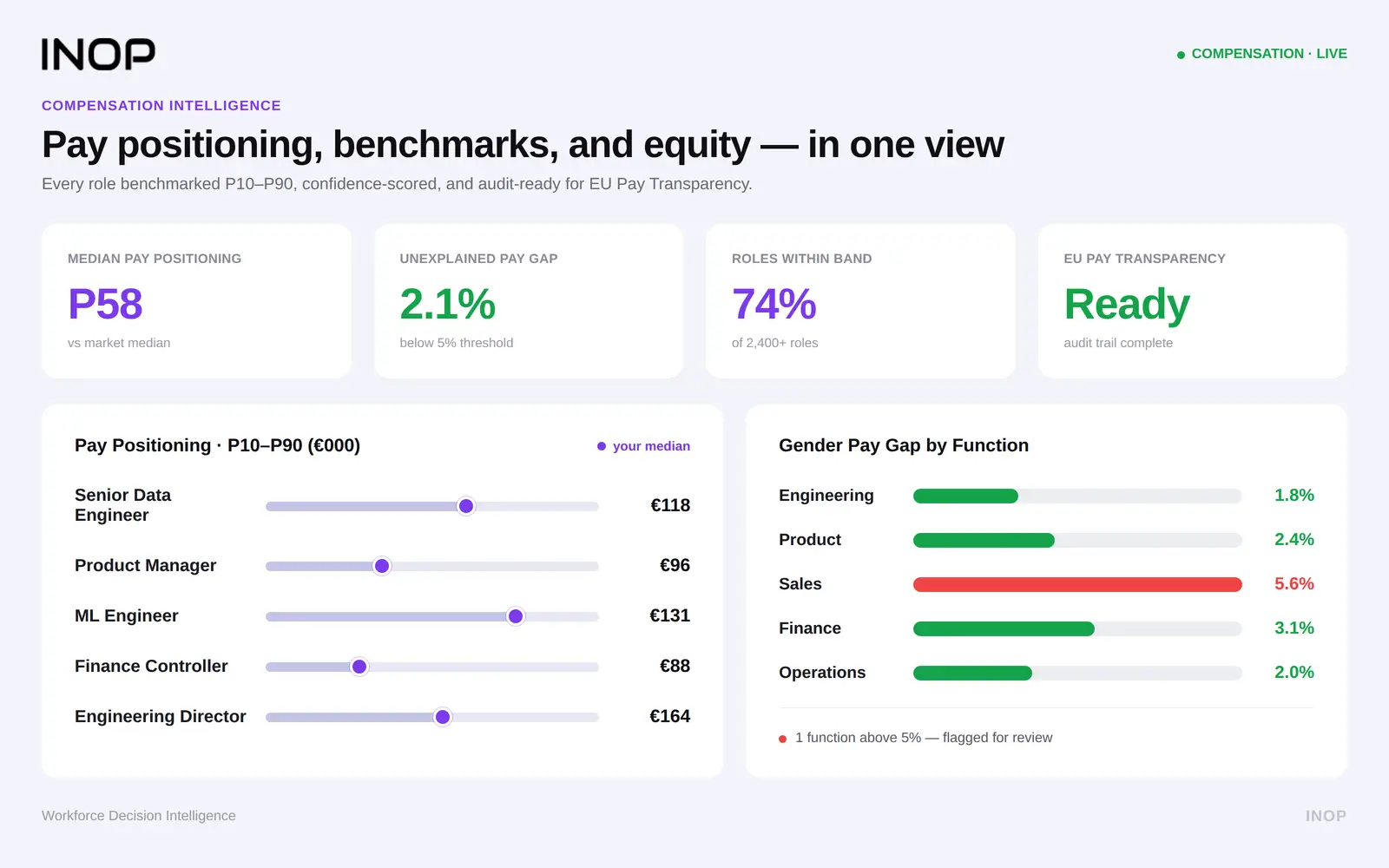
- Audit and tune: Review variance in pay within level, equity across locations, and update language where calibration shows friction.
What to track: internal fill rate, time-to-productivity after internal moves, promotion cycle time, variance in pay within level, and employee understanding of “what moves the band.”
Practical playbook for professionals (B2C)
- Keep a skills portfolio: Capability, proof, and business outcome on one page.
- Ask for the rubric: If it doesn’t exist, propose one based on market norms for your target role.
- Choose learning with line-of-sight: Courses and projects that map directly to a level change.
- Negotiate with evidence: Show how new skills changed outcomes and where that places you on the band.
Common pitfalls—and simple fixes
- Too many skills on the page → Keep only those that predict outcomes; relegate the rest to examples.
- Certificate-driven promotions → Treat badges as signals, not proof; verify in production.
- Manager hoarding → Track and recognise talent exports.
- Set-and-forget rubrics → Revisit quarterly; markets and work evolve.
How to measure “good”
- Internal fill rate rises and time-to-productivity for internal moves falls.
- Fewer ad-hoc pay exceptions as rubric-based decisions cover most cases.
- Employees can state, in plain language, which capabilities move them to the next level and what that means for pay.
- Tighter pay variance within level across teams and locations, supporting fairness and compliance.
Where INOP fits
INOP streamlines the mechanics so teams don’t have to juggle spreadsheets:
- Current skills taxonomies per role family, tied to real work.
- Market-aware pricing that keeps bands aligned with the external value of scarce capabilities.
- Personalised paths showing “you are here,” gaps to a target role, suggested learning and stretch assignments, and indicative bands.
- Explainable recommendations for managers—clean rationales you can share in compensation and promotion conversations.
Paying for skills and showing people where those skills lead is not a trend piece—it’s basic operating hygiene. Link compensation to skill evidence and publish the paths. You’ll make faster, fairer decisions, move talent where it’s needed, and give employees a credible plan to grow.
Ready to connect pay to real, verifiable skills? Book a 20-minute INOP walkthrough to see skills pricing, paths, and explainable decisions in action—and pilot it with one job family to prove the impact.