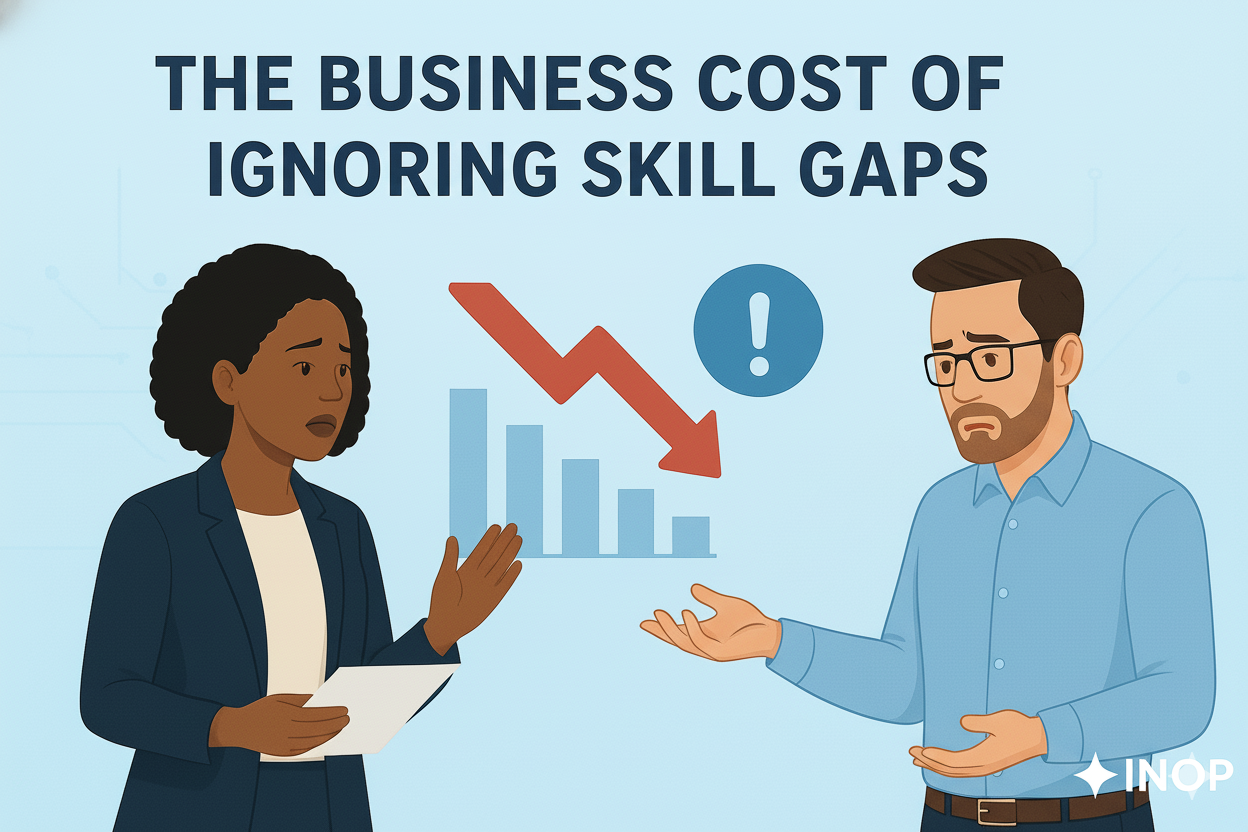
Every year, thousands of businesses fail to hit their targets — not because strategy was wrong or capital was short, but because their teams simply do not have the skills required to execute. The cost of skill gaps is one of the most underestimated financial liabilities in the modern enterprise, quietly compounding across productivity losses, recruitment cycles, stalled innovation, and revenue left on the table.
What makes this particularly dangerous is how invisible it feels until it becomes a crisis. Organizations tend to discover their skill gap exposure through missed deadlines, poor project outcomes, or when a competitor pulls ahead in a capability they have been slow to build. By then, the damage is already done.
This article delivers a complete breakdown of what skill gaps actually cost businesses in financial, operational, and strategic terms, with specific focus on the challenges facing mid-market organizations between 250 and 1,000 employees. More importantly, it outlines what high-performing leadership teams are doing to identify gaps systematically and close them before the costs compound.
What Are Skill Gaps and Why Do They Keep Widening?
A skill gap is the measurable distance between the capabilities your workforce currently holds and the capabilities your business strategy demands. That gap can exist at the individual level, a sales manager who lacks digital selling proficiency (at the team level) an engineering function without sufficient cloud-native expertise, or across entire organizational layers where no one has flagged the disconnect until it shows up in results.
Skill gaps are not static. They widen in direct proportion to the pace of change in your industry. Every new technology adopted, every regulatory shift absorbed, every market expansion pursued adds to the capability requirements your workforce must meet. When organizations do not invest in continuous development, the distance between current capabilities and required capabilities grows, often faster than leaders realize.
Technical vs. Soft Skill Gaps: Different Costs, Same Damage
Technical skill gaps are the most visible category. Insufficient proficiency in data analytics, AI-adjacent workflows, cybersecurity protocols, or cloud infrastructure are gaps that manifest in project failures, security incidents, and poor technology ROI. These are quantifiable and, crucially, they are the skill gaps most commonly surfaced in workforce intelligence reviews.
Soft skill gaps are harder to see but equally costly. Communication breakdowns that derail cross-functional projects, managers who cannot give structured feedback, leadership teams that lack the strategic thinking to navigate ambiguity, these gaps do not appear on a skills audit unless you design one to find them. Research consistently shows that failures attributed to poor performance are more often rooted in soft skill deficiencies than technical ones.
Both categories carry significant financial exposure. The strategic mistake is treating them separately.
Why Skill Gaps Accelerate in Mid-Market Organizations
Mid-sized companies between 250 and 1,000 employees occupy a particularly exposed position in the skills economy. They have outgrown the nimbleness of a startup, where everyone learns on the fly and context is shared instinctively, but they have not yet built the formal learning infrastructure that enterprise organizations invest in.
The result is predictable: skills gaps develop faster than they are identified, and when they surface, they tend to surface simultaneously across multiple functions. Mid-market organizations also face greater competition for skilled talent from both enterprise employers who can pay more and smaller firms that can offer more flexibility. Running systematic skill gap analysis is not optional at this scale, it is a basic operational requirement.
Why Skill Gap Identification Must Come Before the Crisis
Most organizations do not struggle to address skill gaps once they know they exist. The problem is that they find out too late. By the time disengagement scores drop, turnover climbs, or a project stalls publicly, the gap has been costing the business for months. The visible damage is the last stage of a problem that started long before any dashboard flagged it.
This is the central challenge of skill gap identification: the signals that most organizations watch, survey results, absenteeism, and exit interview themes, are lagging indicators. They confirm a gap that already exists. They do not help you catch one that is forming.
The signals that actually identify a gap early are a different set entirely. Role concentration, where a specialized capability sits with only one or two people on a team, is a structural warning sign regardless of whether anyone has flagged performance concerns. Output patterns at the team level often reveal capability shortfalls long before a formal review would surface them. And external market divergence, where the skills a role requires are shifting in the labor market faster than the organization’s internal expectations for that role have moved, can signal a widening gap before internal performance data shows any problem at all.
Organizations that build identification into an ongoing process rather than a periodic audit catch gaps while they are still small enough to address with targeted development. Those that wait for the lagging signals pay full price: the productivity losses, the turnover costs, and the revenue the business did not generate while the gap went unaddressed. The difference between those two outcomes is not strategy or budget. It is timing.
The Financial Cost of Skill Gaps: A Line-by-Line Breakdown
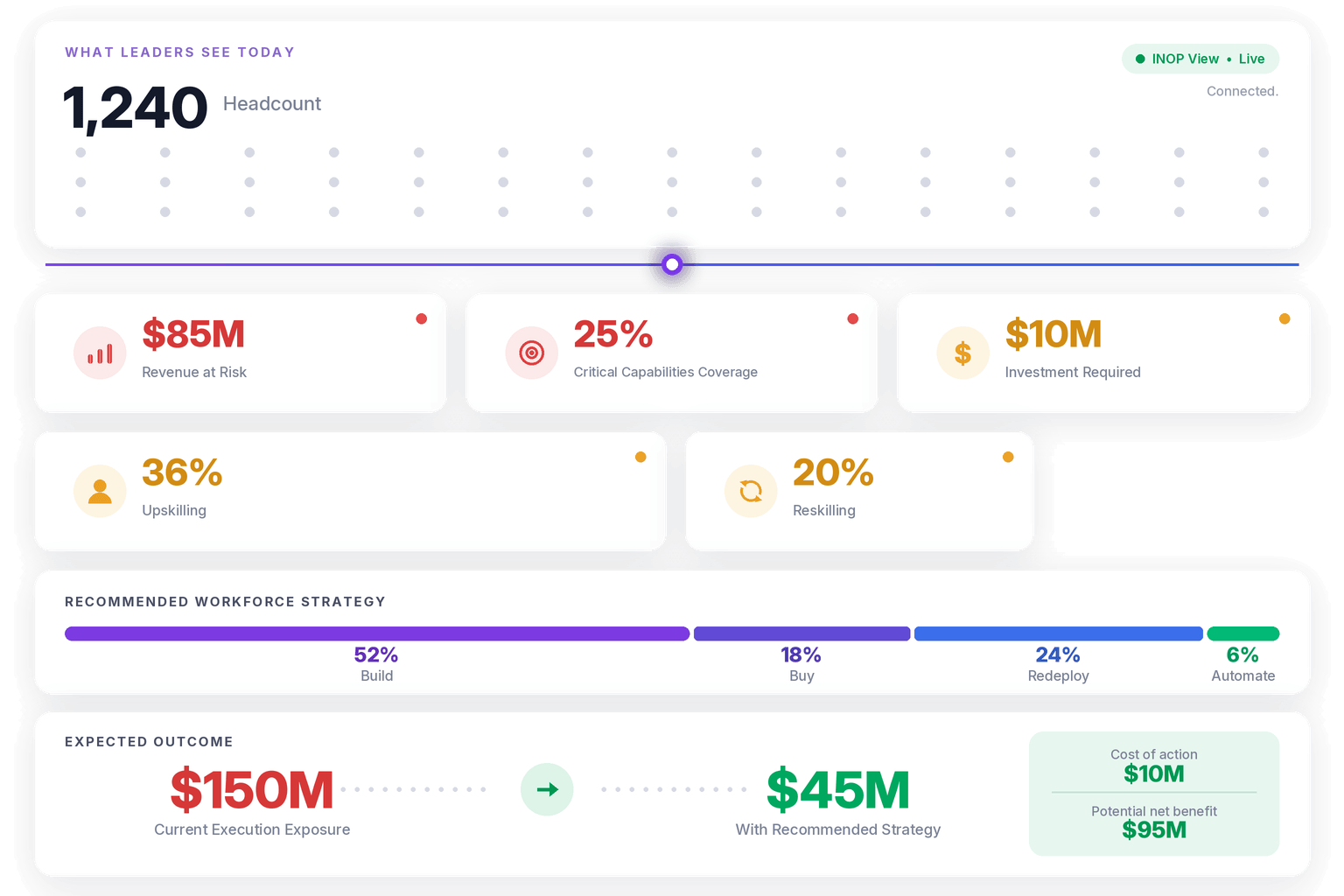
The aggregate numbers are sobering. Companies lose an estimated $1.3 million annually due to skill gaps, when you account for lost productivity, elevated recruitment costs, project rework, and missed revenue. For organizations between 250 and 1,000 employees, that figure is not theoretical, it represents a meaningful drag on operating margins in a size band where every point of margin matters.
Here is where that money goes.
Productivity Losses That Do Not Show Up in Your P&L
When employees lack the skills to complete work at the required level, the output is slower, the quality is lower, and the rework cost is higher. A McKinsey analysis found that businesses with unaddressed skill gaps experience productivity drops of up to 20%. That is one full day per week, per affected employee, where work is being done below the threshold of effectiveness.
The problem compounds when you consider that productivity losses from skill gaps are almost never attributed correctly. They show up as project overruns, missed deadlines, and quality issues — all of which get managed tactically rather than traced back to the underlying capability deficiency. Organizations that do not run structured skills assessments are, in effect, paying for skill gap losses while treating them as something else.
Recruitment and Turnover Costs Caused by Skill Gaps
The average cost to fill a single open position in the United States currently stands at approximately $4,000, with time-to-hire stretching to 42 days or more for roles requiring specialized skills. When skill gaps are not addressed through internal development, organizations are forced into a cycle of external recruitment that is expensive, slow, and often unsuccessful. Nearly 70% of HR leaders report difficulty finding external candidates with the right competency profile, meaning that even after incurring full recruitment costs, the hire frequently does not close the gap that triggered the search.
There is also a compounding attrition dynamic. Employees who feel under-equipped for their roles are 12 times more likely to consider leaving than those who feel confident in their capabilities. High turnover in skill-intensive roles does not just create direct replacement costs — it destroys institutional knowledge, disrupts team performance, and creates a visible signal to remaining employees that the organization is not investing in their growth.
Lost Revenue Opportunities: The Most Underestimated Number
Productivity losses are at least partially visible. Lost revenue opportunities are almost entirely invisible because they represent business that was never pursued or was pursued and failed, and the root cause is rarely connected back to workforce capability gaps.
Sales teams without digital prospecting and CRM fluency miss pipeline. Product teams without AI-integrated development skills fall behind competitors in feature velocity. Marketing functions without data analytics capability cannot optimize spend or demonstrate attribution. Each of these is a revenue event, not just an operational inefficiency.
The organizations most exposed to this dynamic are those going through growth transitions: scaling into new markets, launching new product lines, or integrating acquisitions. These moments demand new capabilities on compressed timelines. Without a clear picture of workforce readiness, leaders are making significant investment decisions with a fundamental blind spot.
The Macro Picture: What Skill Gaps Cost the Global Economy
The business-level numbers sit inside a larger economic story. The World Economic Forum estimates that unaddressed skill gaps could result in $11.5 trillion in lost global GDP by 2028. This is not background context — it reflects the structural reality that workforce capability is now a macroeconomic variable, not just a human resources concern. For boards, CFOs, and PE-backed leadership teams thinking about long-term value creation, skills exposure is enterprise risk, not departmental overhead.
The Different Forms a Skill Gap Takes (And Why the Distinction Matters)
Not all skill gaps carry the same cost profile or require the same response, and treating them as a single category is one reason so many gap-closing initiatives fail to move the needle.
Understanding what is a skill gap at a structural level reveals three distinct types, each with different financial consequences. Hard skill gaps are the most visible: a specific technical ability a role requires that the workforce does not currently hold. These show up in output data relatively quickly and are the most straightforward to address through targeted training or hiring.
Soft skill gaps are harder to detect but frequently more damaging. Leadership, communication, adaptability, and conflict resolution deficiencies do not always surface in performance metrics until they have already caused team dysfunction, missed decisions, or employee exits. A technically strong employee promoted into management without the behavioral skills for it is a common and expensive example.
Future skill gaps are the most strategically dangerous of the three. They do not hurt the business this quarter. They will. When a company’s internal capability baseline stops tracking with where the market is moving, the gap opens quietly and compounds over time until it forces a crisis-level response.
The distinction between individual and organizational gaps matters equally. An individual gap sits with one employee and can often be closed with targeted development. An organizational gap is systemic, the company as a whole lacks a capability it needs to compete, and no amount of individual training will resolve it without a broader strategic response. Confusing the two wastes both budget and time, producing training programs that address the symptom without closing the underlying shortfall.
The difference between upskilling programs that move the needle and those that produce only completion reports almost always comes down to targeting. AI driven upskilling uses verified skill gap data and external market signals to direct training at the specific capabilities that are actually blocking business outcomes, rather than assigning courses company-wide and measuring success by attendance.
Hidden Costs That Quietly Compound Over Time
Direct financial losses are large. But some of the most damaging consequences of skill gaps are harder to put a number on, and precisely because they are harder to measure, they tend to go unaddressed the longest.
Employee Morale, Disengagement, and the Retention Loop
Being regularly placed in situations where you lack the capability to succeed is demoralizing. It creates a specific type of workplace stress (one that is chronic rather than acute) that gradually erodes engagement and performance. Employees who feel inadequately equipped for their roles disengage quietly, long before their formal exit.
This creates what is effectively a retention loop: skill gaps lead to underperformance, underperformance leads to disengagement, disengagement leads to attrition, and attrition forces expensive external recruitment that frequently fails to close the original gap. Interrupting that loop requires addressing the capability deficit at its source rather than managing the downstream symptoms.
Innovation Stagnation: When Your Team Is Too Busy Surviving to Lead
Organizations with persistent skill gaps do not innovate. They cannot. When significant workforce capacity is consumed by compensating for capability shortfalls, reworking substandard outputs, managing handoffs that do not work cleanly, firefighting project failures, there is no cognitive bandwidth left for the kind of forward-looking thinking that produces competitive advantage.
This has a compounding effect over time. While a skills-deficient organization is focused on keeping operations functional, competitors with stronger capability foundations are deploying those capabilities toward market differentiation. The gap in innovation output between the two organizations grows quarter by quarter, and it is very difficult to close once it has become structural.
Customer Experience and Reputation Damage
Service quality is a direct function of workforce capability. When customer-facing teams lack the skills to resolve issues effectively, or when product quality suffers because development teams are working with outdated technical knowledge, the customer experiences the gap directly. Research indicates that 67% of customers will leave a brand after a single poor experience, and many of those poor experiences are rooted in workforce capability shortfalls that management has not identified or addressed.
In B2B contexts, the reputational consequences are even more acute. A missed delivery, a poor implementation, or a recurring service failure does not just cost that client relationship, it costs every reference, every introduction, and every renewal that relationship would have generated.
The Financial Risks of Skill Gaps in Technology-Driven Organizations
Technology-intensive organizations carry a specific and elevated skills risk profile that deserves its own treatment. The pace of technology change means that capability half-lives (the period over which a given technical skill remains current and valuable) are shortening rapidly across most domains.
Why CFOs and CTOs Should Own This Problem Together
Skills risk in technology-driven organizations is not a talent acquisition problem. It is a financial risk problem. The CFO needs to understand it in those terms: unidentified skill gaps in technology functions create exposure across cybersecurity (the average data breach now costs $4.88 million according to IBM’s 2024 Cost of a Data Breach Report), technology ROI (investments in platforms and infrastructure that cannot be fully utilized because the team lacks proficiency), and operational continuity (single points of failure where critical technical knowledge sits in one or two people).
The CTO needs to understand it in capability planning terms: which technology investments are being made on the assumption of skills that do not yet exist in the team? Where are the gaps between the architecture you are building and the team’s current ability to build and maintain it? These questions belong in strategic planning, not in retrospective incident reviews.
When CFOs and CTOs align on skills risk as a shared financial and operational variable, the organization develops the visibility to manage it proactively rather than reactively.
Skills Obsolescence in Executive and Senior Hiring
One of the most expensive and least discussed skill gap categories is skills obsolescence at the senior level. Executive and senior individual contributor hiring operates on long timelines (searches of 3 to 6 months are common) and the cost of a mishire at senior levels is typically estimated at 3 to 5 times the annual salary of the role. When senior hires bring in skills that are already partially obsolete relative to the direction of the industry, that cost is amplified by the lag time before anyone is willing to name the problem.
This is a structural risk for organizations that rely heavily on CV-based assessment and reference feedback in senior hiring. Neither surface signals the gap between a candidate’s existing skill profile and the forward-looking capability the role actually demands. INOP’s Talent Intelligence Platform addresses this by assessing candidates against current and projected skill requirements, not just historical experience, giving hiring committees a materially more accurate picture of true capability fit.
Skill Gap Analysis: How to Identify Where Your Workforce Is Exposed
You cannot manage what you have not measured. Most organizations that underestimate their skills exposure do so not because they are indifferent to the problem, but because they lack a systematic process for surfacing it. Ad hoc manager feedback, annual performance reviews, and gut-feel assessments are not skill gap analysis, they are noise that occasionally produces a signal.
How to Run a Skills Audit That Actually Surfaces Real Gaps
A rigorous skill gap identification process begins with role-level capability mapping: for every significant role category in your organization, define the skills required to perform that role at target proficiency, both today and 18 to 24 months from now, accounting for strategic direction. This future-state component is where most audits fall short; they assess against current requirements while business strategy is already demanding capabilities that do not yet exist in the workforce.
Against that requirement baseline, assess current workforce capabilities through a combination of manager evaluation, employee self-assessment, structured skills testing where appropriate, and performance data analysis. Where is project delivery consistently underperforming? Where are error rates elevated? Where are timelines routinely missed? These are frequently skill gap signals wearing performance problem costumes.
The output of a thorough skills audit should be a capability heat map: which roles and functions are well-covered, which are under-resourced, and which represent strategic risk if not addressed on a defined timeline.
Skills Gap Challenges Specific to Mid-Sized Companies (250–1,000 Employees)
Mid-market organizations running skill gap analysis face a set of challenges that are specific to their scale. Three are particularly common.
The first is resource intensity. A rigorous skills audit takes time to design and execute. Mid-market HR teams frequently lack the bandwidth to run one without deprioritizing other operational work, which is why many organizations default to informal assessments that do not produce actionable data.
The second is role heterogeneity. In organizations of 250 to 1,000 people, role structures are often evolving, new functions are being added, existing roles are being split or merged, and the definition of what “good” looks like in a given position is frequently in flux. This makes it harder to establish the stable competency baselines that a useful skills audit requires.
The third is data fragmentation. Relevant skills data, from the ATS, the HRIS, the performance management system, the LMS, tends to sit in separate systems with no integration layer that connects it into a coherent workforce capability picture. Without that integration, skills gap analysis is manual, slow, and only as current as the last time someone aggregated the data by hand.
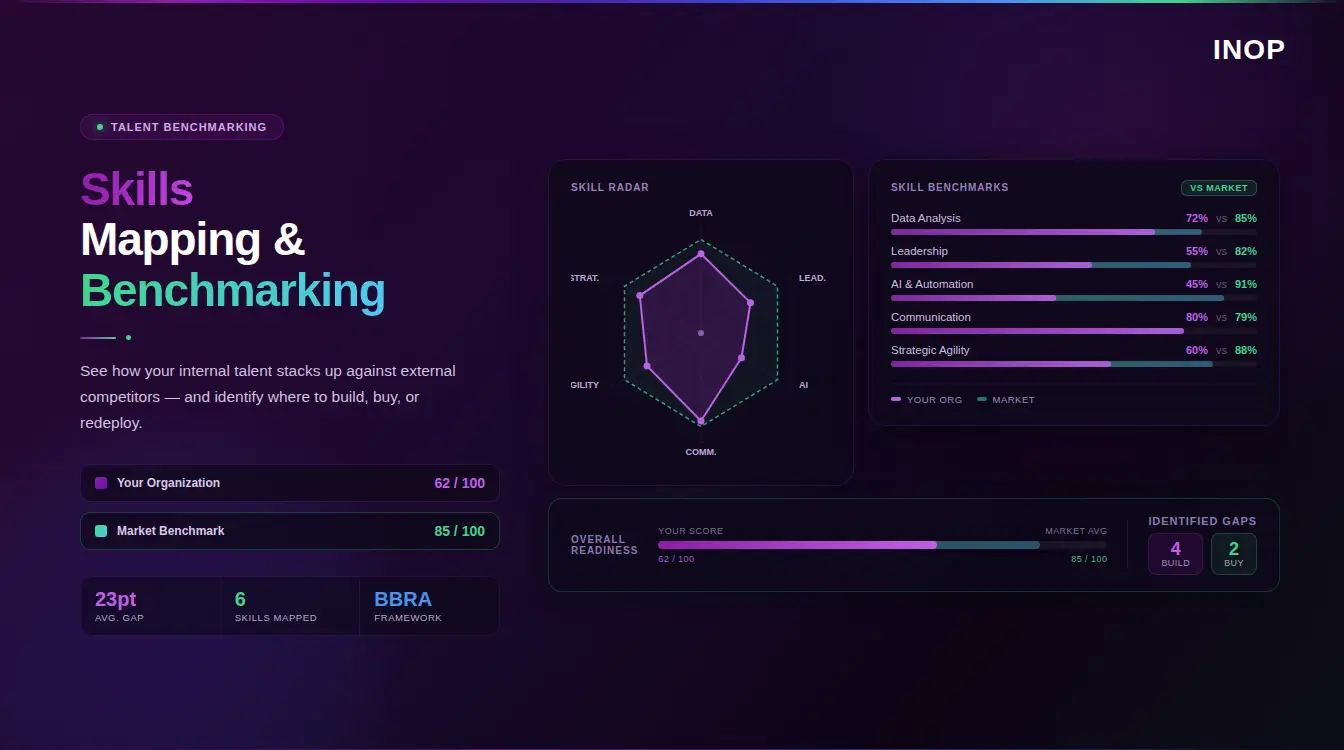
INOP’s Skills Intelligence capability is specifically designed to address this structural challenge: integrating data across workforce systems to produce a continuous, real-time view of capability coverage, not a quarterly snapshot that is out of date before it is presented.
Using Workforce Intelligence Platforms for Ongoing Skills Mapping
The shift from periodic skills audits to continuous skills monitoring is one of the most important operational improvements available to mid-market and enterprise HR functions. A strategic workforce planning platform does not just capture current capability state — it tracks capability evolution over time, flags emerging gaps as business priorities shift, and provides the data infrastructure needed to make skills investment decisions with confidence.
The organizations getting the most value from these platforms use them to connect skills data to business outcomes directly: which capability investments correlated with improved project delivery? Which development programs reduced time-to-competency for specific role transitions? Which skill clusters are consistently correlated with higher retention? This kind of analysis transforms skills development from a cost center framing into a value creation narrative, which is what CFO conversations require.
Strategic Approaches to Closing Skill Gaps That Actually Work
Identifying gaps is the diagnostic. Closing them requires a deliberate, resourced strategy that matches the scale and urgency of the exposure.
Upskilling vs. Reskilling: Choosing the Right Path
Upskilling deepens capability in an employee’s existing domain. A finance analyst developing proficiency in predictive modeling, a recruiter building fluency in talent market intelligence platforms, an operations manager developing data visualization skills, these are upskilling investments that increase the ceiling on existing role performance.
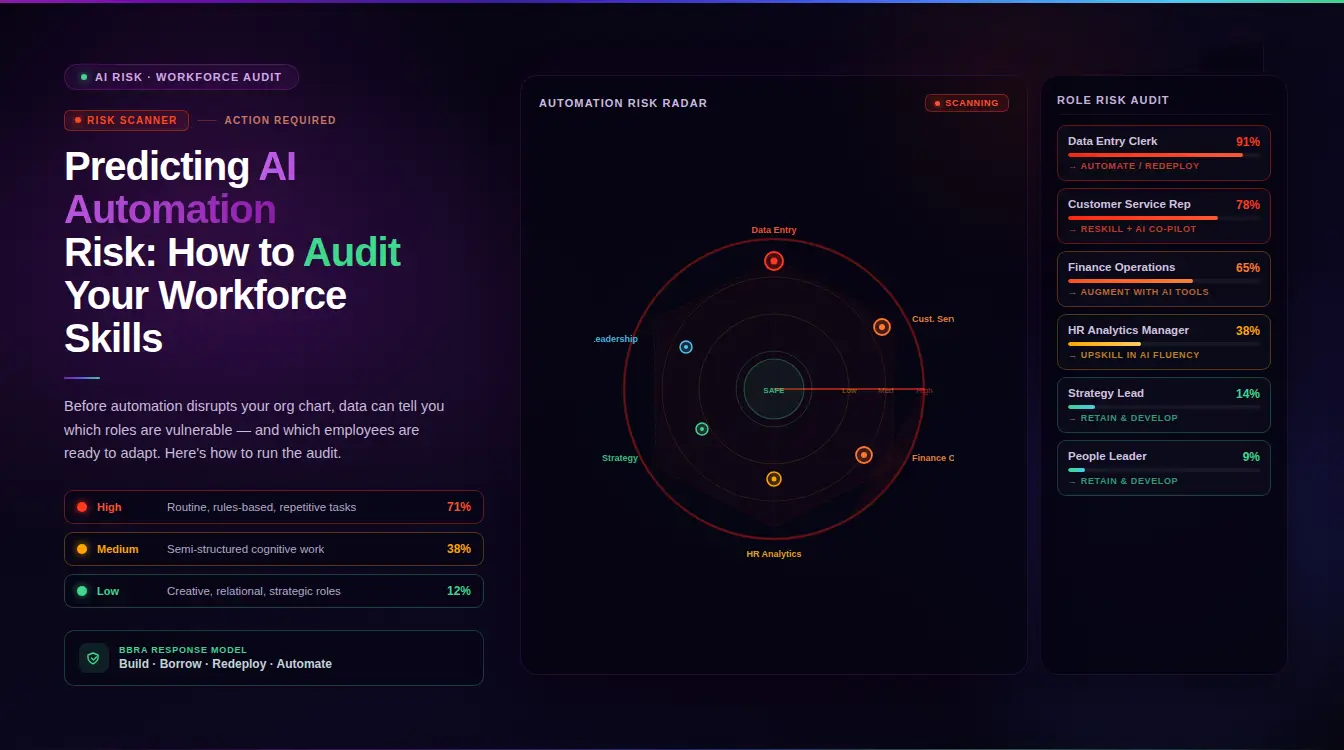
Reskilling repositions employees for materially different role requirements, typically in response to structural changes in the business. Automation displacing a process-heavy role, a business pivot that creates demand for entirely new capabilities, or a post-acquisition integration that requires different competency profiles, these are reskilling scenarios.
The strategic choice between them is not primarily a training question, it is a workforce architecture question. When is it faster and cheaper to develop the capability internally versus hiring it in? When does internal development create loyalty and institutional knowledge value that external hiring destroys? When is the skill gap too wide or the timeline too compressed for internal development to work? Answering these questions rigorously, with actual data rather than instinct, is what separates reactive workforce management from strategic workforce planning.
Organizations like Amazon have demonstrated what long-term commitment to this question looks like, having pledged $700 million to workforce upskilling programs on the basis that developing existing talent is structurally more efficient than continuous external recruitment. The principle scales down, the investment quantum does not need to, but the intention does.
Building Personalized Learning Pathways at Scale
Generic training programs produce generic outcomes. The fundamental problem with most organizational learning interventions is that they treat skill gaps as uniform when they are in fact highly individual: two employees in the same role may have entirely different capability profiles, requiring entirely different development paths to reach the same proficiency destination.
Modern learning platforms make personalized development pathways operationally feasible at scale. By integrating skills assessment data with learning content libraries and role-level competency targets, these systems can generate individual development plans that are directly responsive to each person’s actual gaps rather than a notional average. The engagement uplift from this approach is material, employees invest more seriously in development programs that are visibly designed for their specific growth, not generic compliance.
Microlearning formats, which deliver development content in focused modules of 5 to 15 minutes rather than multi-hour blocks, address the biggest practical barrier to learning completion: time. Skills development that can happen in the workflow, rather than requiring sustained blocks of dedicated training time, sees significantly higher completion rates and better knowledge retention.
Cross-Functional Collaboration Between HR, Finance, and Operations
Skill gap strategy fails when it is owned exclusively by HR. The demand signal, which capabilities are required, at what level, by when, originates in business functions and in the strategic planning process. When HR develops learning programs without active input from operations, finance, and business unit leadership, those programs frequently miss the mark: addressing theoretical gaps rather than the real capability constraints that are actually slowing the business down.
The organizations that close skill gaps most effectively establish cross-functional capability councils, standing forums where HR, finance, and business function leaders review workforce capability data together, align on priority gaps, and co-own the investment decisions required to close them. This governance structure transforms skills development from an HR initiative into a business priority, which is what it needs to be if it is going to receive the resourcing and leadership attention it requires.
Building a Culture Where Continuous Learning Is the Default
Technology and programs create the conditions for skills development. Culture determines whether those conditions are actually used.
Leadership behavior is the most powerful cultural signal available. When executives visibly participate in development activities, speak openly about skills they are building, and make resourcing decisions that protect learning time rather than perpetually sacrificing it to short-term delivery pressure, the message reaches every level of the organization. The inverse is equally powerful: when leaders treat learning as something that happens after the real work is done, employees learn quickly that development is performative rather than valued.
Time allocation is a structural requirement, not a scheduling nicety. Employees who are expected to complete skills development on top of already full workloads will complete it at the margins, quickly, without retention, and with minimal application back to actual work. Organizations that integrate learning time into workload planning and role expectation-setting see materially higher engagement with development programs and, more importantly, materially higher transfer of learning into job performance.
Psychological safety is the often-overlooked prerequisite. When acknowledging a skills gap is treated as an admission of failure rather than a normal part of professional growth, people hide their development needs. They take on work they are not equipped for rather than flagging the gap. They avoid situations where their limitations might be visible. The result is that skills gaps go unaddressed for longer and cost more when they eventually surface. Cultures that normalize continuous learning, that treat capability development as a permanent feature of professional life rather than a remediation program, produce better skills outcomes at every level.
Measuring the ROI of Closing Skill Gaps
Sustaining organizational commitment to skills development requires demonstrating its financial return. The measurement framework should connect development investment to business outcomes, not just to learning metrics.
Productivity improvements are the most direct measure. Track output volume, quality rates, error frequency, and time-to-completion for key deliverables before and after targeted development interventions. Even conservative improvements in these metrics produce significant financial returns when measured across a workforce cohort.
Revenue impact requires more analytical work but is available. Can you connect improved capability in specific functions to revenue growth, deal conversion rates, customer retention, or product quality improvements? These connections are not always linear, but they are almost always traceable with the right data infrastructure.
Retention impact is measurable and financially significant. The correlation between skills investment and employee retention is strong and consistent across industries. Organizations that track the relationship between development program participation and voluntary turnover rates consistently find that investing in capability development produces retention improvements worth multiples of the training cost.
Time to competency measures how quickly new hires or employees transitioning into new roles reach full productivity. Effective skills development programs compress this timeline, reducing the period during which the organization is paying full salary for below-target performance.
Skills coverage ratio, the percentage of required competencies available in your workforce at proficient levels across all critical roles, is the strategic headline metric. Tracking its movement over time provides the clearest available signal of whether your skills strategy is working.
Frequently Asked Questions
What is the average cost of skill gaps to businesses?
The average company loses approximately $1.3 million annually due to skill gaps, when you account for direct costs including productivity losses (studies indicate up to 20% reduction in output), recruitment expenses averaging $4,000 per position, and ongoing training costs, as well as indirect impacts including lost revenue opportunities, decreased customer satisfaction, and innovation delays. For mid-market organizations in the 250–1,000 employee range, this figure represents a particularly acute margin risk. Larger enterprises with more extensive skill exposure can see costs reaching tens of millions annually when competitive disadvantage and market share erosion are factored in.
How can companies identify skill gaps in their workforce?
Effective skill gap identification requires a structured, multi-source approach rather than relying on manager feedback alone. The process starts with role-level competency mapping, defining what capabilities are required for each significant role category, both now and in 18 to 24 months based on strategic direction. Against that baseline, capability is assessed through a combination of performance data analysis, manager evaluation, employee self-assessment, and objective skills testing where appropriate. Patterns of project delays, elevated error rates, and missed deadlines frequently indicate skill gaps that are not being surfaced through conventional performance management. Workforce intelligence platforms that integrate data across HR systems provide continuous skills visibility, replacing periodic audits with real-time capability monitoring.
What are the specific skill gap challenges for mid-sized companies?
Organizations between 250 and 1,000 employees face three challenges that are specific to their scale. First, resource intensity: thorough skills audits require dedicated time that lean HR teams frequently cannot protect from operational pressures. Second, role heterogeneity: in mid-market organizations, role structures are often evolving, making it difficult to establish stable competency baselines. Third, data fragmentation: relevant capability data typically sits across multiple disconnected systems, ATS, HRIS, LMS, performance management, with no integration layer connecting it into a coherent workforce picture. These challenges make the case for purpose-built workforce intelligence platforms that aggregate and analyze capability data continuously rather than relying on manual, periodic audits.
Is it better to hire new talent or upskill existing employees?
In most cases, upskilling existing employees delivers better ROI than external recruitment. Internal development typically costs 20–30% less than filling the equivalent gap through hiring, and upskilled employees reach productive performance levels faster because they already carry the organizational context, process knowledge, and cultural fluency that new hires require months to build. Existing employees also demonstrate stronger retention when they see the organization investing in their growth. That said, external hiring makes strategic sense when the required capability gap is too wide to close through development on the timeline the business requires, when niche expertise is needed quickly for a specific initiative, or when the organization is entering an entirely new domain with no internal foundation to build from.
How long does it take to close significant skill gaps?
Timeline varies substantially based on the complexity of the capability being developed and the starting point of the individual or cohort. Focused technical skills training, a specific software platform, an analytical methodology, a structured process, can produce meaningful proficiency improvement in 3 to 6 months with consistent application. More complex capability development, such as advanced data analytics, leadership effectiveness, or strategic thinking, typically requires 6 to 12 months of sustained investment. For transformational shifts, reorienting a workforce toward digital operations, AI-adjacent workflows, or entirely new business models, realistic timelines extend to 18 to 24 months or longer. The organizations that achieve the best outcomes treat skills development as an ongoing operational discipline rather than a project with a defined endpoint.
What financial risks do skill gaps create in technology-driven organizations?
Technology-intensive organizations carry an elevated and specific skills risk profile. Skill gaps in cybersecurity functions create direct financial exposure, the average cost of a data breach now exceeds $4.8 million. Gaps in cloud infrastructure competency reduce the ROI of technology investments by preventing full platform utilization. Gaps in data analytics capability prevent organizations from extracting strategic value from the data assets they have built significant infrastructure to collect. Perhaps most insidiously, skills obsolescence at the senior level — where executive and technical leaders are hired based on historical experience rather than forward-looking capability, creates strategic drift that is expensive and slow to correct. CFOs and CTOs who treat skills exposure as a shared financial risk, rather than a talent management problem, are significantly better positioned to identify and address it before it compounds.
Can skill gaps affect employee retention?
The relationship between skill gaps and retention operates in both directions and is well-documented. Employees who feel under-equipped for their roles, who face recurring situations where they lack the capability to perform effectively, experience chronic workplace stress that drives disengagement and, eventually, voluntary exit. Research indicates that employees in this position are 12 times more likely to be actively considering leaving. Simultaneously, employees who see that their organization is not investing in their capability development leave for organizations that will. LinkedIn research consistently shows that approximately 94% of employees would remain with an employer longer if the organization invested meaningfully in their career development. The practical implication is that skills investment programs should be understood and measured as retention interventions, not just performance improvement initiatives, the financial return through reduced turnover alone frequently justifies the cost.
What role does technology play in addressing skill gaps?
Technology accelerates and scales skills development in ways that traditional training approaches cannot match. Workforce intelligence platforms, such as INOP’s Skills Intelligence capability, provide the data infrastructure needed for continuous skills monitoring, integrating capability data from across HR systems to produce real-time visibility into gaps and coverage. Learning management systems deliver personalized development content based on individual skills profiles. AI-driven tools can recommend development pathways, predict emerging skill requirements based on business strategy, and match employees with internal opportunities that develop the capabilities they need. Microlearning platforms embed development into workflow rather than requiring dedicated training blocks, producing higher completion rates and better knowledge retention. Analytics tools close the loop by measuring whether learning investments are translating into improved on-the-job performance and business outcomes. Technology is an enabler with material impact, but it amplifies strategy rather than replacing it.