Reskilling is how an organisation moves people into work their current role does not cover, so they can take on the jobs its strategy needs next. You train an accounts payable clerk to run data quality checks, or a customer service agent to configure the AI tools that now handle first-line queries. The skills shift. The person, and everything they know about your customers and processes, stays.
The pressure to do this well is rising. AI and automation change tasks faster than annual training plans can follow, and most leadership teams now ask a sharper question than “what training should we offer?” They want to know which capabilities the strategy depends on, where the gaps are, and whether reskilling is the right way to close each one.
This guide covers what reskilling means, how it differs from upskilling, why programmes stall, and a practical method for building one that delivers measurable results.
What Is Reskilling?
Reskilling means training employees in a new set of skills so they can move into a different role, often in another function or job family. The move is the point. A reskilled employee ends up doing different work, rather than the same work to a higher standard.
Two examples show the range. A warehouse supervisor learns demand forecasting and moves into the supply chain planning team. A claims handler whose routine cases now run through automated triage learns process design and becomes the person who tunes and audits that workflow.
Reskilling vs Upskilling: What Is the Difference?
Upskilling deepens or extends the skills a person uses in their current role. Reskilling prepares them for a different role. Most organisations need both, and the choice for each employee depends on whether their role will still exist in a recognisable form.
| Upskilling | Reskilling | |
|---|---|---|
| Goal | Better performance in the current role | A move into a different role |
| Skill distance | Short: builds on existing skills | Longer: adds new skill sets, often in a new domain |
| Typical trigger | New tools or methods within the same job | Declining demand for a role, or new roles the strategy creates |
| Time to proficiency | Weeks to a few months | Several months, sometimes longer |
| Example | A financial analyst learns to use AI for variance commentary | A payroll administrator retrains as an HR data analyst |
Redeployment sits next to both. It moves people whose skills already fit another role, with little or no training. In practice, a redeployment plan often includes a short reskilling step to close the last part of the gap.
Why Does Reskilling Matter Now?
The skills your workforce holds today will not cover the work your strategy needs in a few years. The scale of change has moved reskilling from an L&D initiative to a planning decision for the executive team.
The World Economic Forum’s Future of Jobs Report 2025 puts numbers on it. If the world’s workforce were 100 people, 59 would need training by 2030. Employers expect 29 of them to be upskilled in their current roles and 19 to be upskilled and redeployed elsewhere in the organisation, while 11 would be unlikely to receive the training they need. Employers also expect 39% of workers’ core skills to change or become outdated over the same period, and half plan to move staff from declining to growing roles.
Role changes add to the pressure. McKinsey Global Institute’s research on generative AI and the future of work in America estimates an additional 12 million occupational shifts in the US by 2030, about 25% more than its projection two years earlier. Workers in the lowest wage brackets were up to 14 times more likely than the highest earners to need to change occupations.
Many employees want to make that move. BCG’s global survey of workers found that 68% were willing to retrain for a new job, with interest highest among early and mid-career employees.
What Are the Benefits of Reskilling?
A well-targeted reskilling programme gives the organisation capability it would otherwise have to build from scratch or bring in from outside. The main benefits fall into five areas.
- Retained knowledge. Reskilled employees keep their understanding of your products, customers, systems and culture. External capability takes months to acquire that context.
- Faster time to productivity. People who already know how the business works often reach full performance in a new role sooner than someone joining from outside.
- Lower transition cost. Reskilling can cost less than releasing people from declining roles and sourcing the same capability from outside, once you include severance, onboarding and lost productivity.
- Internal mobility and retention. Visible routes into new roles give employees a reason to build their careers with you.
- AI readiness. As automation changes tasks, reskilling moves people into the oversight, design and judgement work that AI-enabled processes still need.
The benefits depend on targeting. Reskilling people into roles the business does not need, or into skills the market is moving away from, adds cost without adding capability.
Why Do Reskilling Programmes Fail?
Most programmes stall for planning reasons, before the training itself has a chance to work. Watch for six patterns:
- Training without a destination. Employees complete courses, but no one has defined the roles they should move into or how many of those roles the business will need.
- Unclear skills gaps. Leaders know they need “more digital skills” but cannot say which skills, in which roles, at what proficiency.
- No comparison with the alternatives. The organisation reskills by default, even where redeployment, external capability or automation would close the gap faster or at lower cost.
- No time to learn. Employees must fit training around a full workload, so completion rates fall and managers resist releasing people.
- Weak manager support. Line managers see reskilling as losing team members and slow the move into the new role.
- Measuring activity instead of outcomes. Reports track enrolments and completion rates, so leaders cannot see whether anyone moved roles or whether the business gained capability.
How Do You Build a Reskilling Programme That Works?
Start from the strategy and work back to the training. The steps below follow the order in which the decisions depend on each other.
Link the Programme to Business Strategy
Define which capabilities the strategy needs over the next one to three years, and which roles will grow, shrink or change. Reskilling earns executive support when it answers a business question, such as how the organisation will staff a new product line or absorb the impact of automation in operations.
Map the Skills Gap at Role and Task Level
Compare the skills your people hold today with the skills the future roles require. Work at task level where you can, because AI changes tasks inside roles and two people with the same job title can face different exposure. INOP’s guide to AI skills gap analysis sets out a method based on verified workforce data, and competency mapping helps define the proficiency each role needs.
Find Adjacent Skills and Destination Roles
Look for employees whose current skills sit close to those the new role requires. A customer service agent who resolves complex complaints already holds much of what a customer success role needs. Short skill distances mean faster, cheaper reskilling and a higher chance of success. Many organisations already hold this capability without knowing it, and our article on how to spot hidden talent inside your organisation explains how to find it.
Compare Reskilling With the Other Options
Test each gap against the alternatives before you commit. For some gaps, building the skill in-house is the right answer. For others, redeploying people who already have the skills, bringing in external capability or automating the work will deliver faster or at lower cost. Price each option over the short and long term, and include the cost of doing nothing.
Choose the Right Learning Methods
Match the method to the skill and the learner. Most reskilling programmes combine several:
- Structured courses and certifications for technical foundations.
- On-the-job learning and project rotations so people practise the new role with support.
- Mentoring and job shadowing to transfer judgement that courses cannot teach.
- Short, modular content that employees can fit around their work.
Protect Time and Involve Managers
Give employees paid time to learn, and set clear expectations with their managers. Agree the transition date in advance, so the receiving team plans for the new arrival and the releasing team plans for cover.
Measure Outcomes Beyond Completions
Track outcomes beyond completion rates. The Kirkpatrick Model offers four levels: reaction, learning, behaviour on the job and results for the organisation. For reskilling, the third and fourth levels matter most: did people move into the new roles, do they perform there, and did the business close the capability gap it set out to close? Add financial measures such as cost per transition compared with the alternatives.
Keep the Skills Picture Current
Refresh the skills data as the market and the strategy change. A skills gap analysis from last year may point people towards skills that demand has already moved away from.
What Does a Reskilling Programme Look Like in Practice?
Siemens offers one example. In December 2022 the company announced its SiTecSkills Academy, which runs certified upskilling and reskilling courses in digitalisation and sustainability from 19 regional training centres in Germany. Siemens reported that around 2,000 employees completed about 170 training programmes in fiscal 2022, with a 97.8% success rate. The academy targets employees in manufacturing, service, sales, finance, controlling and business support, and is open to external partners.
The approach shows three features of programmes that work: a defined set of target skills, certified learning paths, and a clear link to the capability shortages the business faces.
How Does INOP Help Leaders Plan Reskilling?
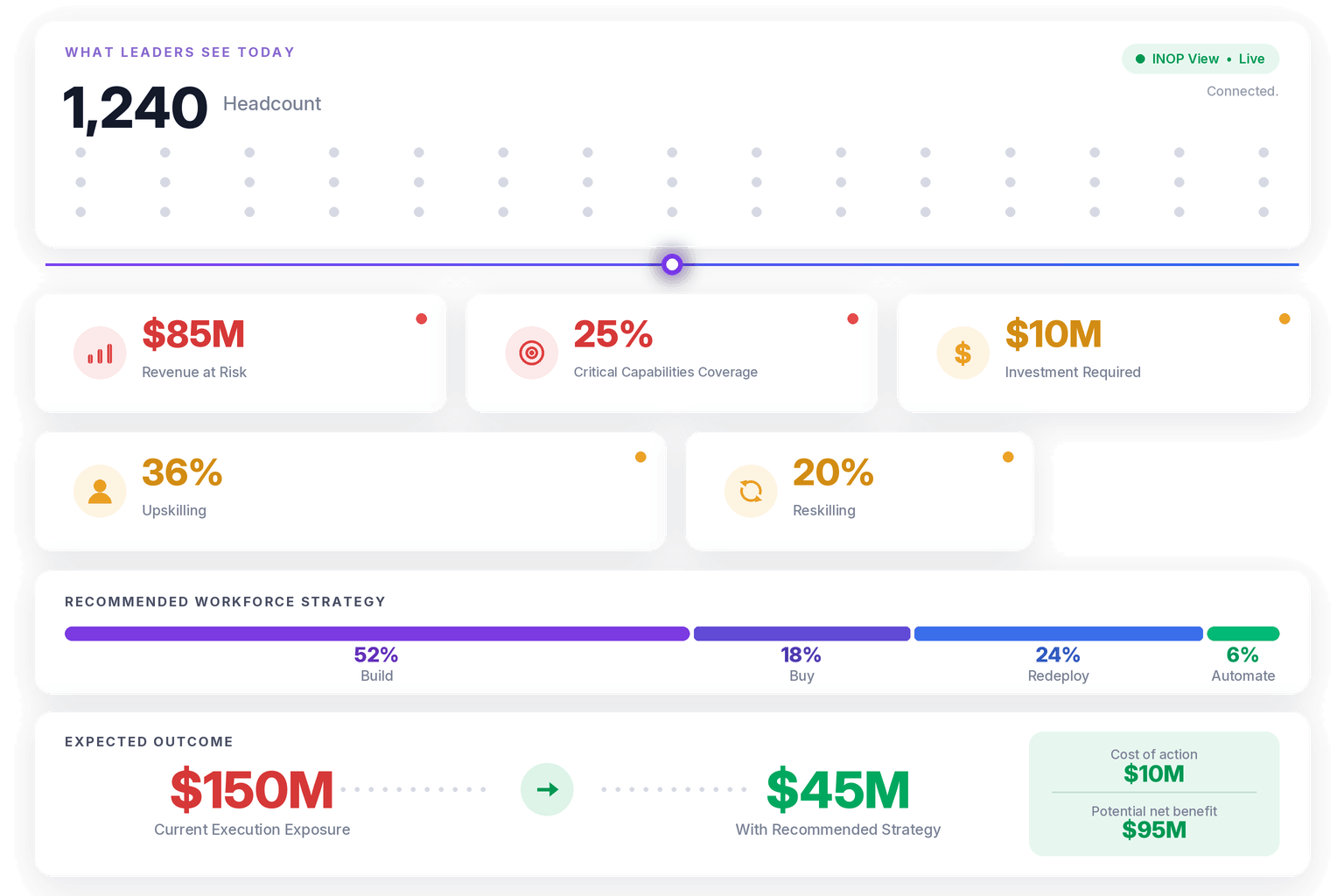
Reskilling comes down to one question: does the organisation have the capabilities to execute its strategy today, and to stay ready as AI changes the work? INOP answers that question by connecting strategy, finance, people, market and AI data in one model. It shows which capabilities are in place, where the gaps and risks are, what those gaps cost if nothing changes, and the available options for closing each one.
INOP never assesses reskilling in isolation. Each recommendation draws on five intelligence lenses: Strategy, Finance, People, Market, and AI and Automation. A skills gap only matters in relation to the strategy it affects, the budget involved, the people who could close it and the market the business competes in.
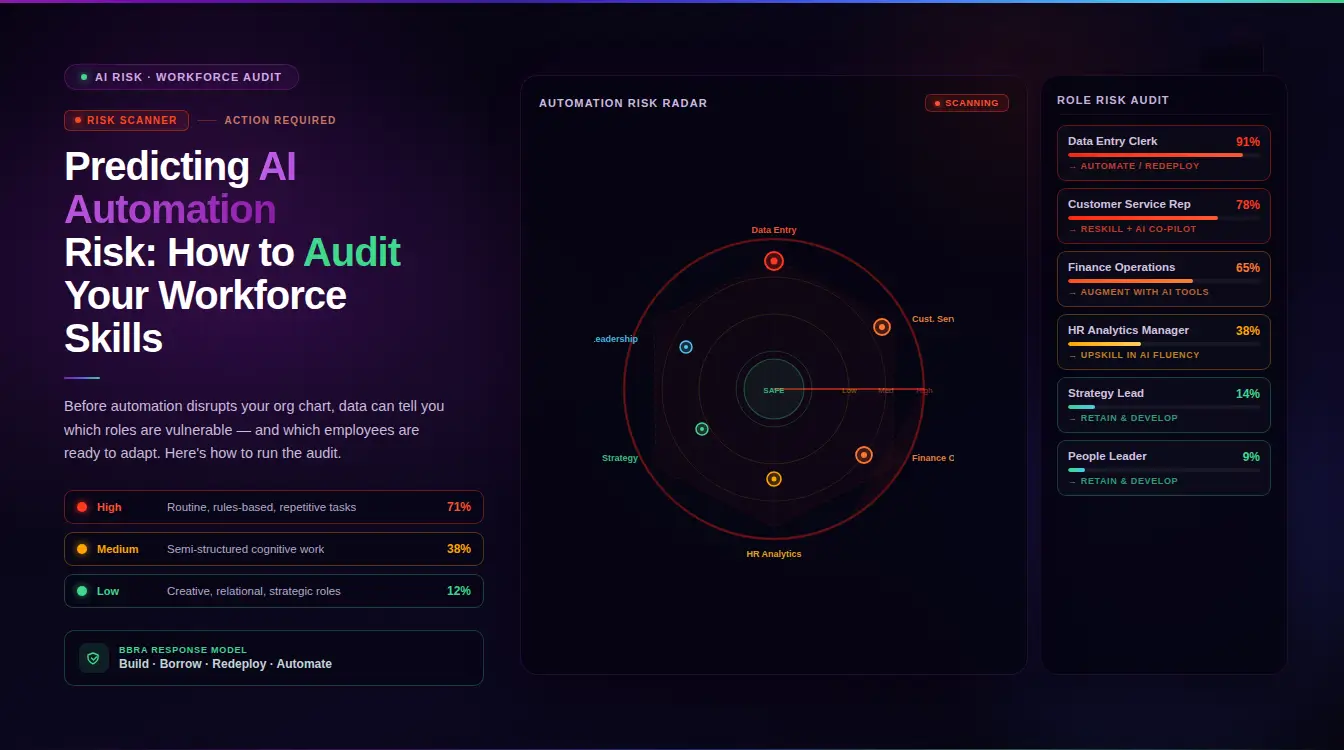
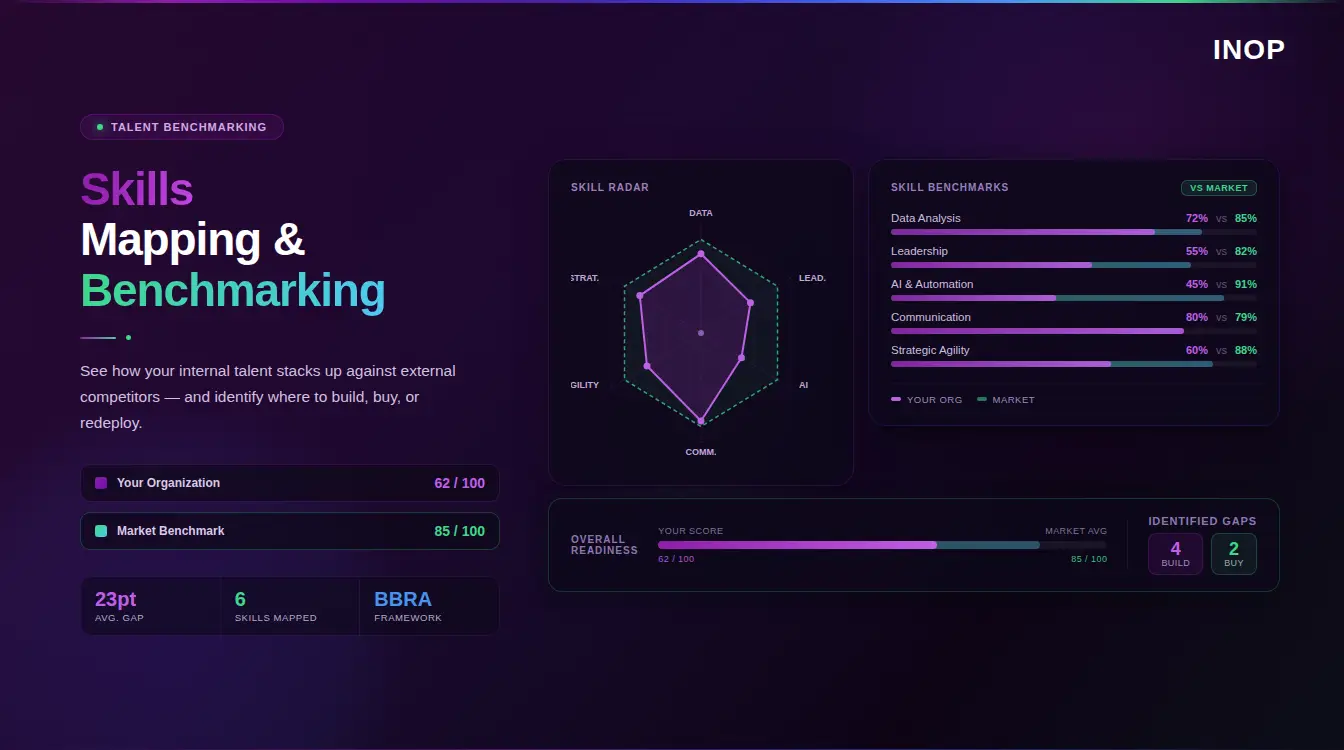
INOP’s skills intelligence maps external demand signals to your own taxonomy, INOP’s taxonomy or a blend of both, and classifies each skill as Emerging, In Demand, Stable or Declining, alongside its exposure to AI and automation. That signal shows where reskilling will pay off and where it would train people in skills the market is leaving behind.
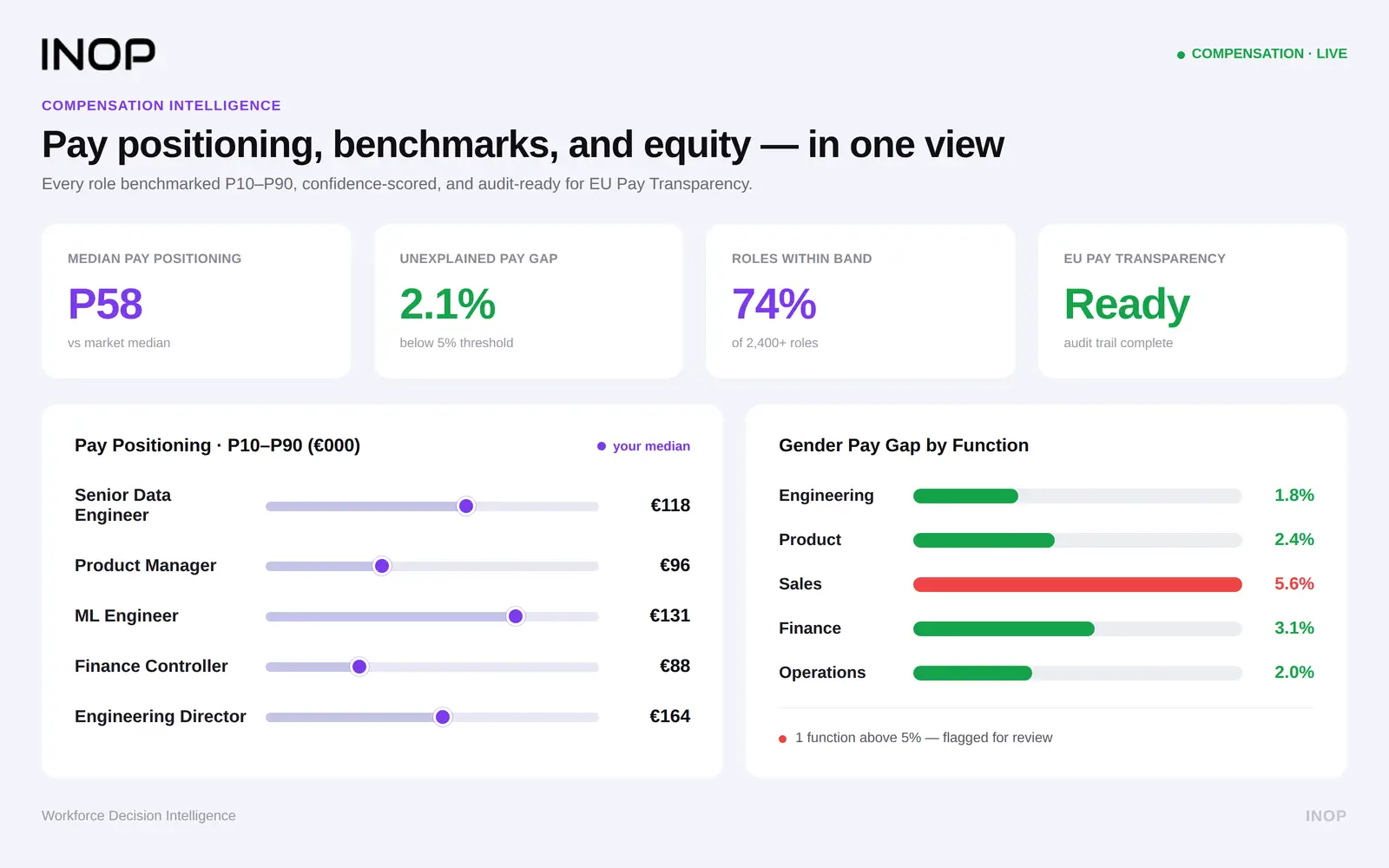
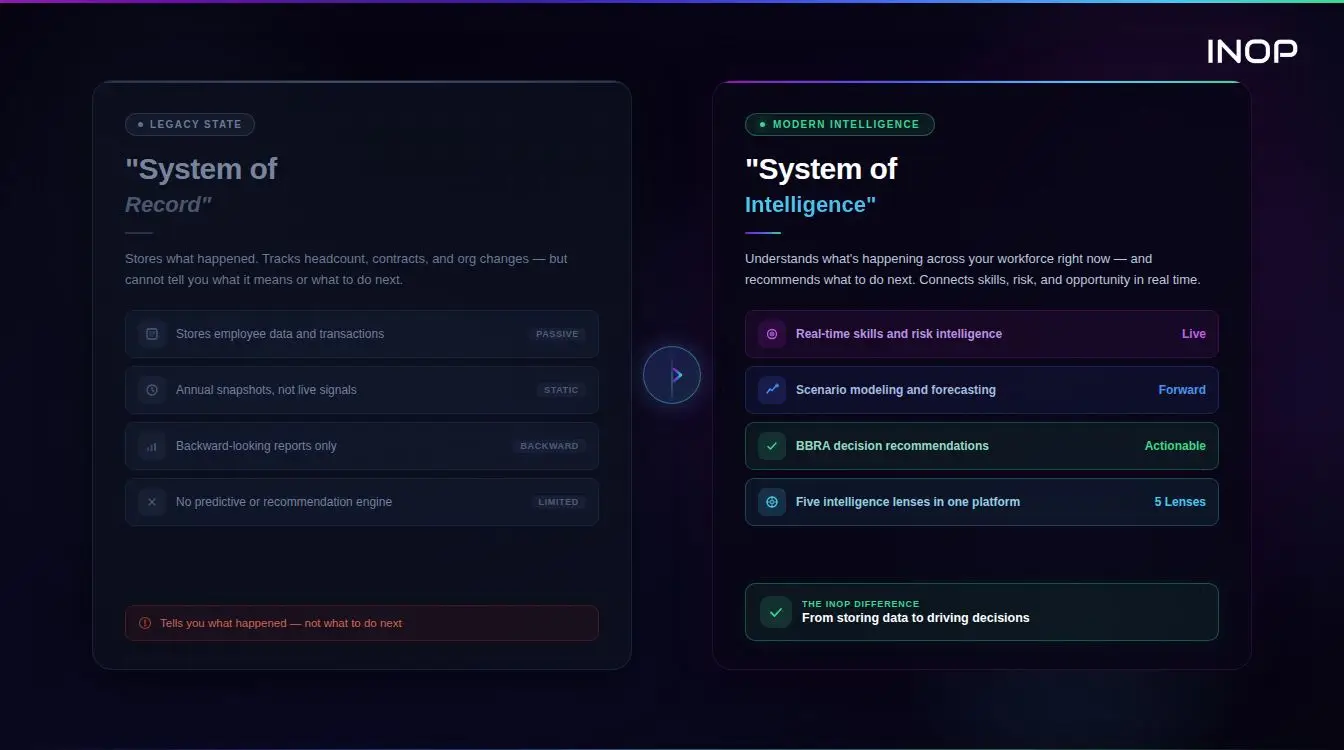
INOP’s BBRA decision architecture then compares four pathways for each gap: Build, Buy, Redeploy and Automate. Build is the reskilling route. INOP prices each pathway across 30-day, 180-day, one-year and three-year horizons, using current pay benchmarks from its compensation analytics platform, so leaders can see when reskilling an existing employee costs less than the alternatives and when it does not.
The strategic workforce planning platform scores readiness across five domains: Capability, Leadership, Role-Value, Mobility & Agility, and Cultural. Mobility & Agility shows how far people can move into new roles, which is the condition reskilling depends on. Execution Materiality then links each gap to the work it blocks, so leaders can see the cost of leaving it open. Results can be read at organisation, business unit, department, country and individual level, and INOP works with role and task-level data where employee-level data is unavailable.
See which capability gaps your strategy depends on, where reskilling will close them and what each option costs. Book a demo.
How Should PE Operating Partners Approach Reskilling Across a Portfolio?
PE operating partners should treat reskilling as a value creation lever with a cost and a timeline, tested in the same way as any other assumption in the plan. Where a value creation plan relies on AI or a new operating model, the company needs people who can run the redesigned work, and reskilling is often the fastest way to keep the knowledge that makes the business valuable.
Put four questions to each portfolio company:
- Which capabilities does the value creation plan depend on, and which of them does the company lack today?
- Which gaps will reskilling close, and which need redeployment, external capability or automation instead?
- How long will reskilled employees take to reach full performance, and does that fit the holding period?
- What does each option cost, and what does leaving the gap open cost?
INOP applies the same five intelligence lenses and BBRA horizons in each company you assess, so reskilling plans and their costs can be compared across your portfolio on one basis.
See whether your portfolio companies have the capabilities to deliver their value creation plans, and what closing the gaps will cost. Book a demo.
Frequently Asked Questions
What does reskilling mean?
Reskilling means training employees in a new set of skills so they can move into a different role, often in another function or job family. It differs from upskilling, which improves performance in the current role. Organisations use reskilling to fill new roles their strategy creates and to support people whose roles are declining.
What is the difference between reskilling and upskilling?
Upskilling builds on a person’s existing skills so they perform better in their current role, for example learning new software. Reskilling prepares them for a different role, such as moving from payroll administration into HR data analysis. Reskilling tends to involve a longer skill distance and more time to reach full proficiency.
How do you measure the success of a reskilling programme?
Measure outcomes rather than activity. Track how many employees moved into the target roles, how they perform there and whether the business closed the capability gap it set out to close. Add financial measures, such as cost per transition compared with redeployment, external capability or automation, and the time each person takes to reach full proficiency.
When is reskilling better than bringing in external capability?
Reskilling tends to work best when employees already hold adjacent skills, when knowledge of the business matters for the new role, and when the timeline allows for learning. External capability can be faster for scarce specialist skills. Comparing both options on cost and timing, alongside redeployment and automation, shows which fits each gap.
How should PE operating partners evaluate reskilling plans in portfolio companies?
PE operating partners should check that reskilling plans link to the capabilities the value creation plan depends on, that time to proficiency fits the holding period, and that each gap has been compared with redeployment, external capability and automation. Applying one method across the portfolio makes these plans comparable company by company.