A skill gap framework is the underlying structure that turns skill gap analysis from a one-time project into a repeatable system. Most organizations have run a skill gap analysis at some point. Far fewer have a framework, meaning a defined taxonomy, a data collection method, a decision process, and a governance cadence that keeps the whole thing current. Without that structure, every gap analysis starts from scratch, and the insight decays the moment the report ships.
This guide breaks down the five components a durable skill gap framework needs, why most frameworks quietly stop working within a year of being built, and how to design one that stays useful as skill requirements keep shifting under it.
What a Skill Gap Framework Actually Is
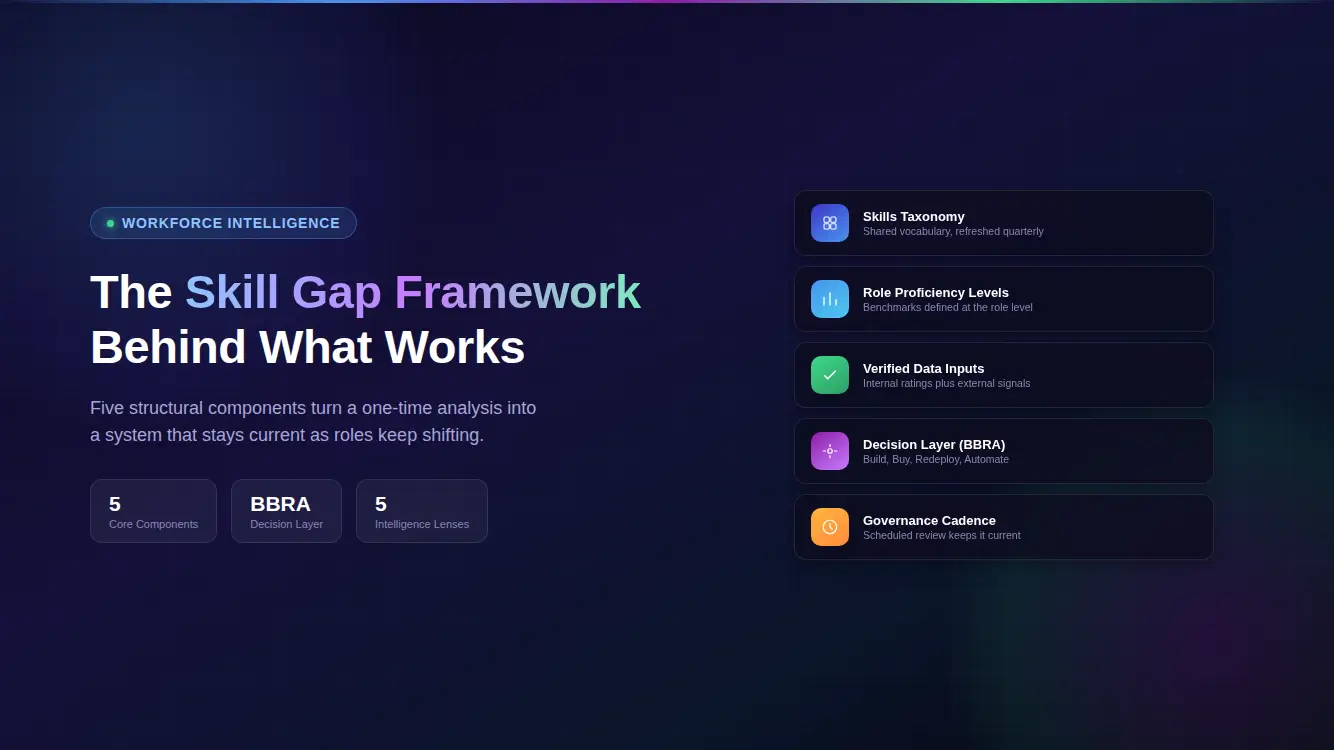
A skill gap framework is not the same thing as a skill gap analysis. An analysis is a single exercise that produces a snapshot. A framework is the system that makes running that analysis reliable and repeatable, month after month, without rebuilding the underlying structure each time. It typically includes a skills taxonomy that defines what capabilities matter and how they are named, proficiency benchmarks tied to specific roles, a method for collecting data on current capability, a process for deciding what to do about a confirmed gap, and a cadence for keeping all of it current as roles and skill requirements change. Organizations that treat skills data as ongoing infrastructure rather than a project consistently outperform those that treat it as a one-time exercise, a distinction backed by recent research showing that high-functioning skills environments refresh their underlying data roughly twice a year, since skills data older than eighteen months functions as a liability rather than a planning asset.The Five Components Every Skill Gap Framework Needs
Frameworks that hold up over time share the same five structural components. Missing any one of them is usually what causes the whole system to quietly stop being useful.A Skills Taxonomy That Gets Refreshed, Not Built Once
Every framework starts with a shared vocabulary for what a skill actually means inside your organization, so that “data analysis” means the same thing whether a manager in finance or a manager in operations is rating it. Building that taxonomy once and leaving it untouched is one of the most common ways a framework quietly goes stale, since a taxonomy needs to function as a living system rather than a static reference document to stay useful as roles evolve. Fast-moving sectors in particular tend to revisit their taxonomy on a quarterly basis, not annually.Role-Level Proficiency Requirements
A taxonomy names the skills that matter. Proficiency requirements define how much of each skill a given role actually needs, and at what level, which is what turns a skills list into something you can measure a gap against. Planning at the role-family level instead of the individual role level tends to mask exactly the variation a framework exists to surface, particularly as the same role family increasingly requires very different skill mixes across departments and locations within the same company.Verified Data Inputs, Not Self-Report Alone
A framework needs a defined method for collecting current capability data, and that method needs more than one input source. Self-assessment and manager rating alone introduce inconsistency that compounds every time the framework runs, since one manager may rate generously while another sets a much higher bar. Cross-checking those inputs against verified external data is what keeps the framework’s output trustworthy enough to act on.A Decision Layer That Turns Gaps Into Action
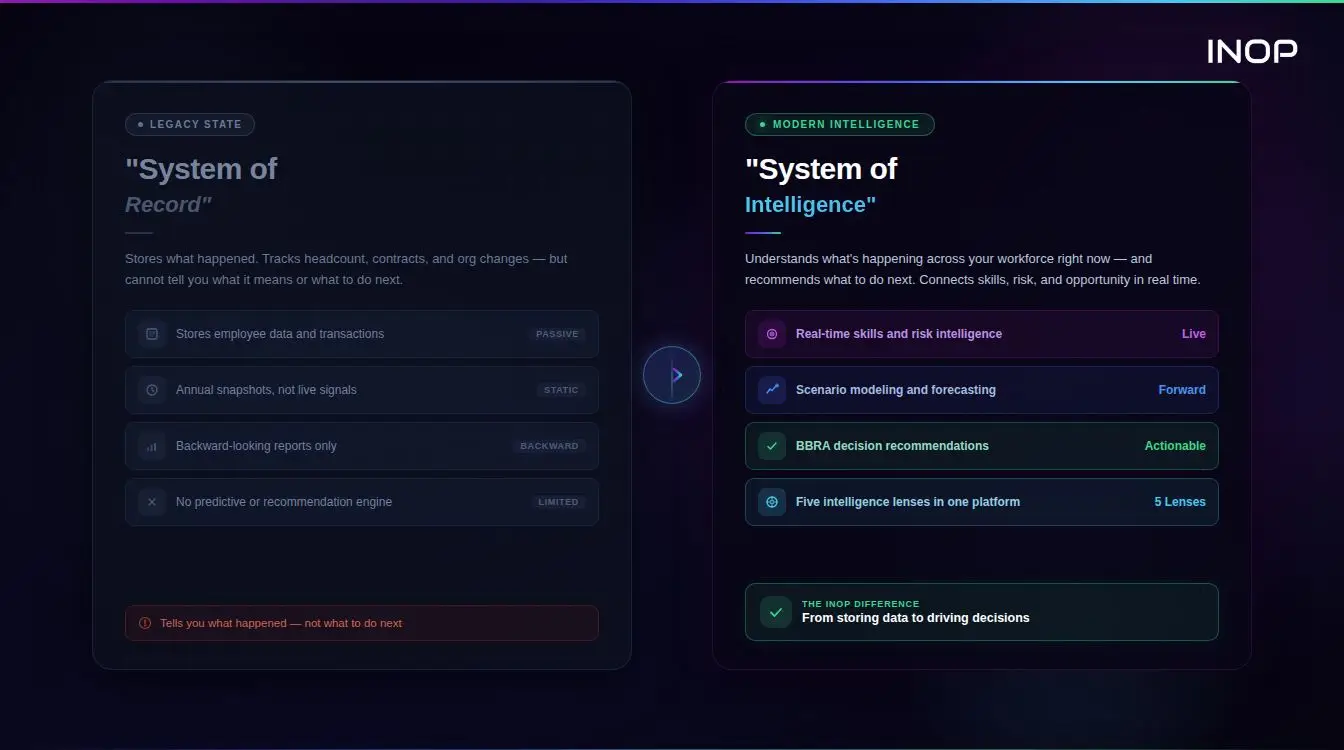
A framework that stops at identifying gaps produces reports, not outcomes. The decision layer is what connects a confirmed gap to a specific response, whether that is training, redeployment, hiring, or automating the underlying task, modeled against real cost and time tradeoffs rather than defaulting to whichever option is easiest to assign.A Governance Cadence
The final component is often the one organizations skip entirely: a defined, recurring process for reviewing and updating the other four components. Without a governance cadence, the taxonomy drifts out of date, proficiency benchmarks stop matching actual role requirements, and the framework becomes exactly the static exercise it was built to replace.See how INOP structures a skill gap framework around verified, continuously updated data. Book a demo to walk through a live framework built for your workforce.
Why Most Skill Gap Frameworks Fail Within a Year
The failure pattern is consistent across organizations, and it rarely comes down to a lack of effort at launch. Most frameworks are built with real investment, sometimes around a structured multi-pillar approach that looks comprehensive on paper, according to recent research on skills-based workforce planning models, and then left unmaintained, which is functionally the same as never building a framework at all. The taxonomy gets built once, during a dedicated project, and then nobody owns keeping it current. Proficiency benchmarks get set against the roles that existed at launch and never get revisited as those roles evolve. The data collection method stays anchored to annual surveys, which cannot keep pace with skill requirements that shift within a single quarter for fast-moving technical roles. And the decision layer, if it exists at all, tends to default to training as the answer for every gap, regardless of whether training is actually the fastest or most cost-effective path. None of these failures show up immediately. A framework can look functional for a year or two while quietly drifting out of alignment with what the business actually needs, which is why the governance cadence matters as much as the other four components combined. It also explains why effective workforce planning is increasingly described as a continuous, integrated practice rather than a linear, one-time process.How INOP’s Five Intelligence Lenses Fit Into a Skill Gap Framework
A skill gap framework that only measures skill data misses most of what actually drives a good workforce decision. INOP structures every gap identified inside a framework through five intelligence lenses before it becomes an action.- Strategy: Does this gap block a specific business priority the framework should be prioritizing over other identified gaps?
- Finance: What does closing this gap cost through each available pathway, modeled explicitly rather than assumed?
- People: Who already holds adjacent capability, and where does this gap concentrate attrition or succession risk?
- Market: Does external labor market data confirm this skill is still worth investing in, given how quickly demand for specific skills shifts?
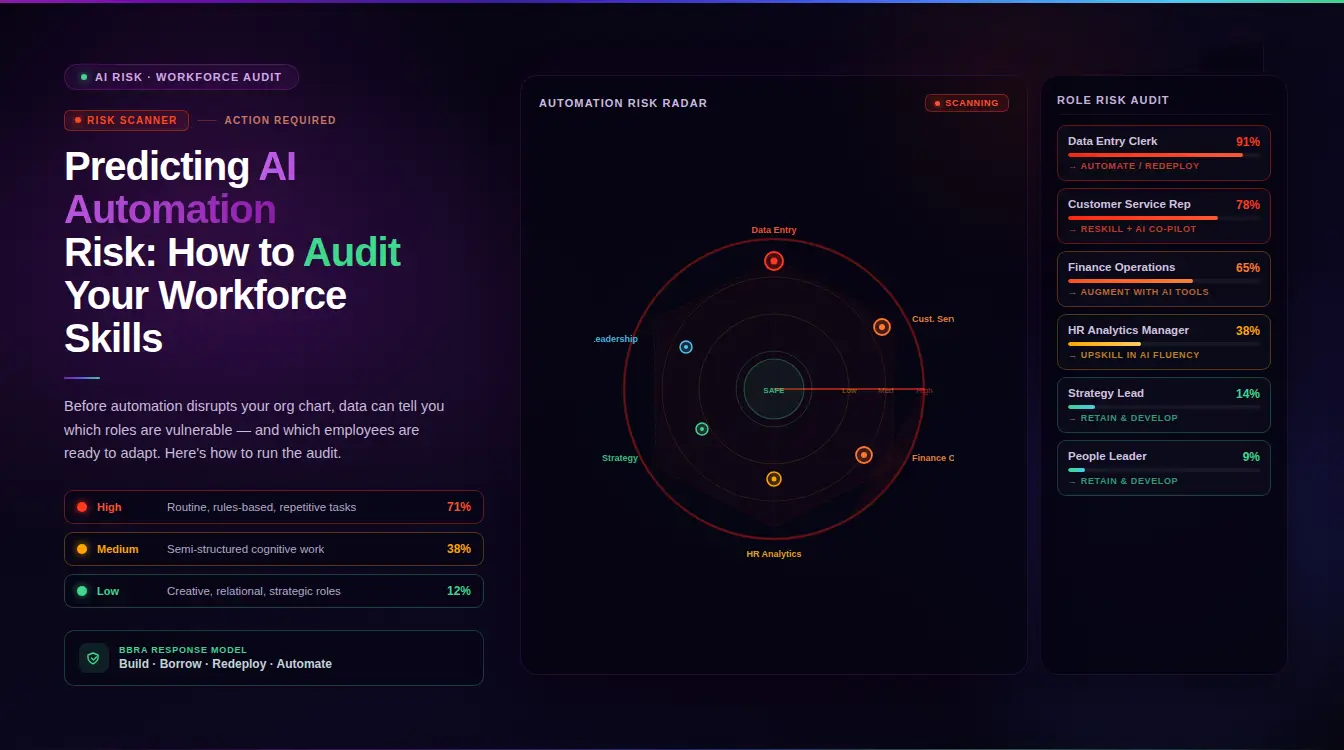
- AI and Automation: Could the task behind this gap be automated, which would change what the framework should recommend entirely?
BBRA: The Decision Layer of the Framework
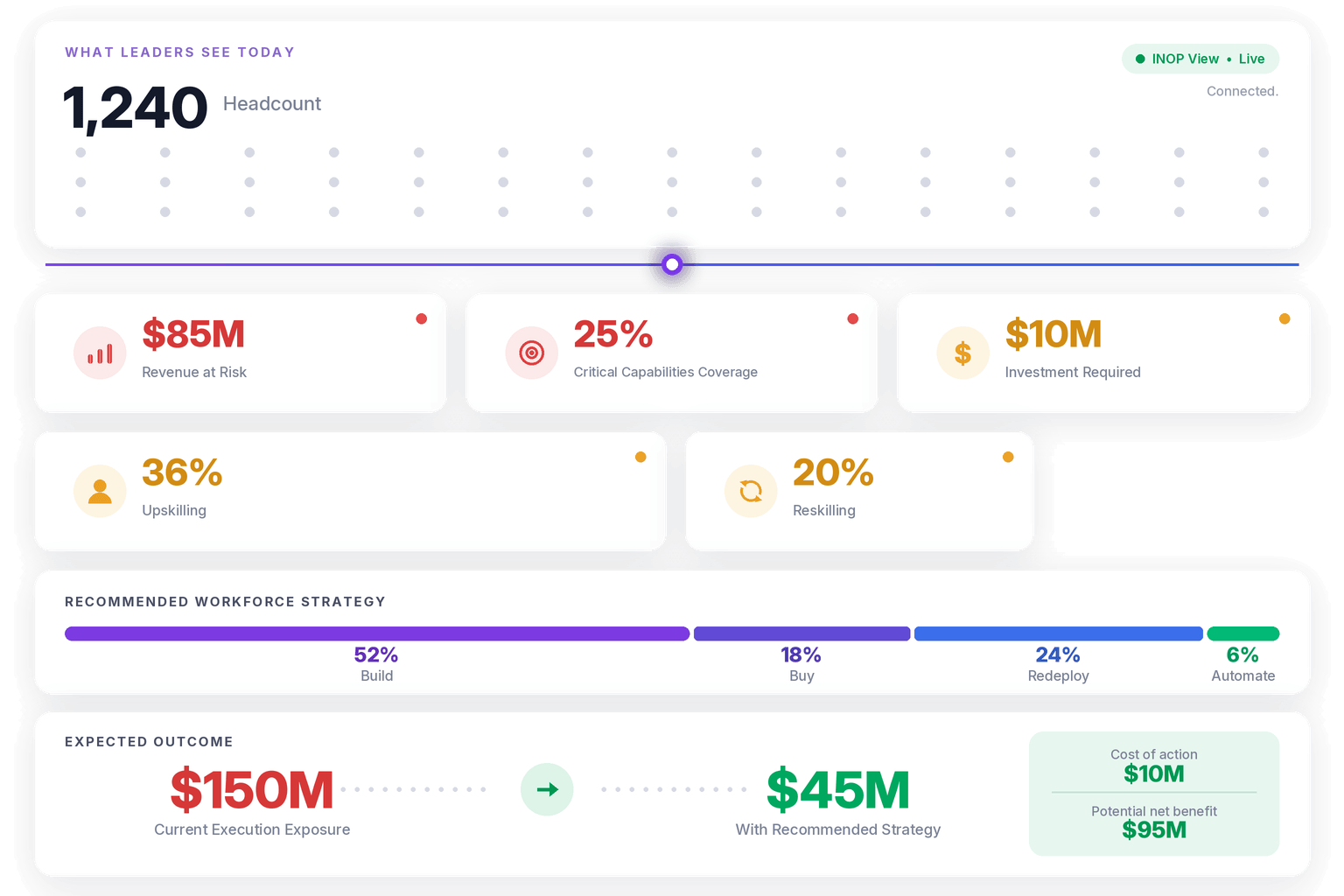
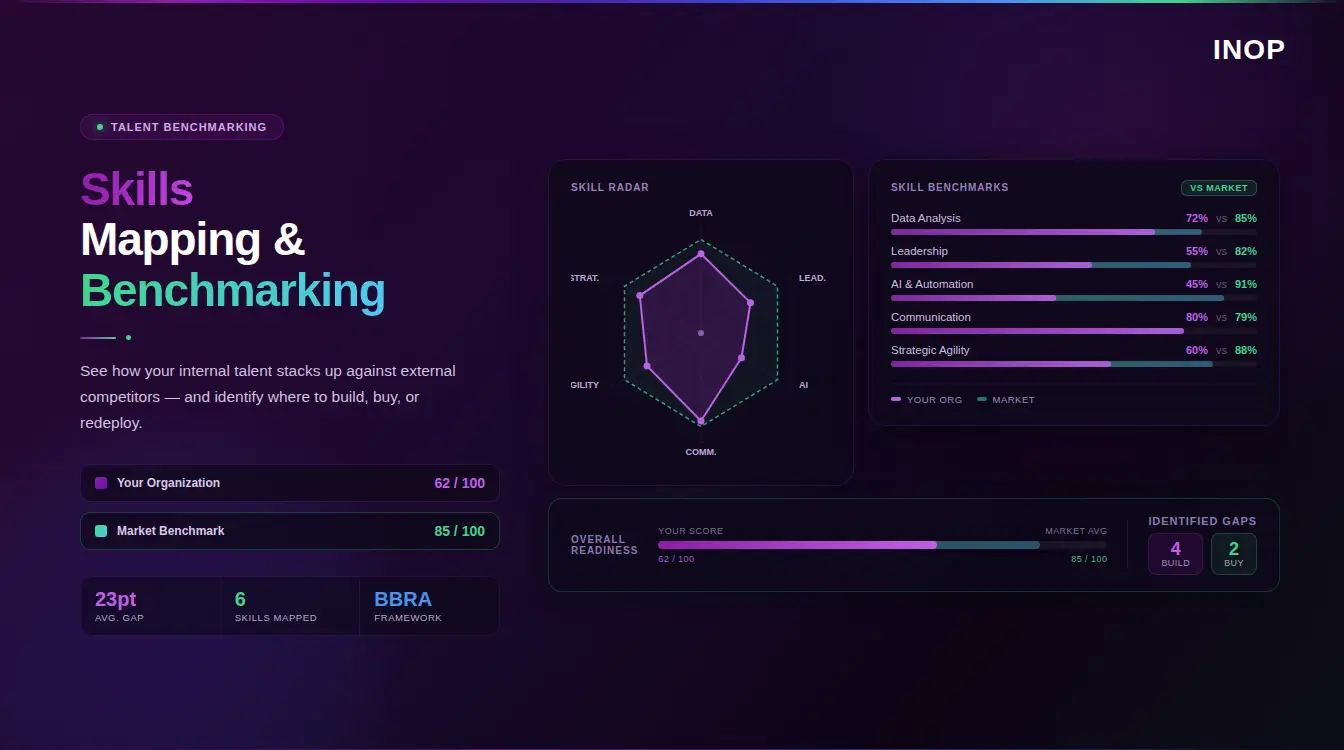
INOP’s proprietary BBRA framework, Build, Buy, Redeploy, and Automate, is designed to function as the decision layer inside a broader skill gap framework. Rather than treating every confirmed gap as a training assignment by default, BBRA models all four intervention pathways against financial tradeoffs across four time horizons: thirty days, one hundred eighty days, one year, and three years. This is the piece most homegrown skill gap frameworks are missing. Organizations invest heavily in the taxonomy and the data collection method, then default to the same response, usually training, for every gap the framework surfaces. Embedding BBRA as the decision layer means every gap gets compared across build, buy, redeploy, and automate before budget is committed, so the framework’s output is a modeled recommendation rather than an assumption.Want to see BBRA embedded as the decision layer for your own skill gap framework? Book a demo and INOP will walk through a live pathway comparison.