By Hein Knaapen and Aniel Mahabier
Years ago at ING, CEO Ralph Hamers set an ambitious strategic agenda, Think Forward, built on speed and simplification. He asked early and often whether the bank was moving fast enough to stay ahead of a wave of fintech disruption that had not yet fully arrived. The mandate was not about HR or capability in the abstract. It was about whether the bank could keep its customers, win new ones, and move before competitors did rather than in response to them. There was no time to wait for a complete picture of every capability across the bank. What mattered was identifying, fast, which behaviours and capabilities would actually determine whether the strategy held. That narrow focus, on a handful of things that mattered most, was what protected the bank’s ability to execute and compete.
We see the same dynamic today. Future readiness, AI impact, market volatility, and shifting labour dynamics have pushed strategic workforce decision intelligence onto the boardroom agenda, but the reason it belongs there is strategy execution and capital allocation, not workforce risk as a topic in its own right. Many companies respond by trying to cover everything at once: a full capability inventory, every role assessed, before anything gets prioritised. The intention is thorough. The effect is paralysis. The link to execution is lost in the scope.
We have come to believe this is the wrong starting point, not because data does not matter, but because perfect, complete data never arrives. The problem is the question being asked, and the instinct to cover all of it instead of moving in phases, starting with what is critical, where investment will matter most, and building out from there.
The better starting question
Most workforce strategy still opens with: what skills does our workforce have? It is an inventory question, disconnected from what a CEO or a board actually tracks: strategy execution, performance, risk exposure, and what it will cost them if that risk is not mitigated.
There is a better question, answerable today with the information already sitting inside most organisations: which capabilities actually determine whether we execute the strategy we have committed to? That shift, from cataloguing what exists to identifying what drives execution, changes the entire nature of the conversation. It is no longer a data project owned by HR. It is a strategy execution question owned by the business.
Defining critical roles: value creating and value defending
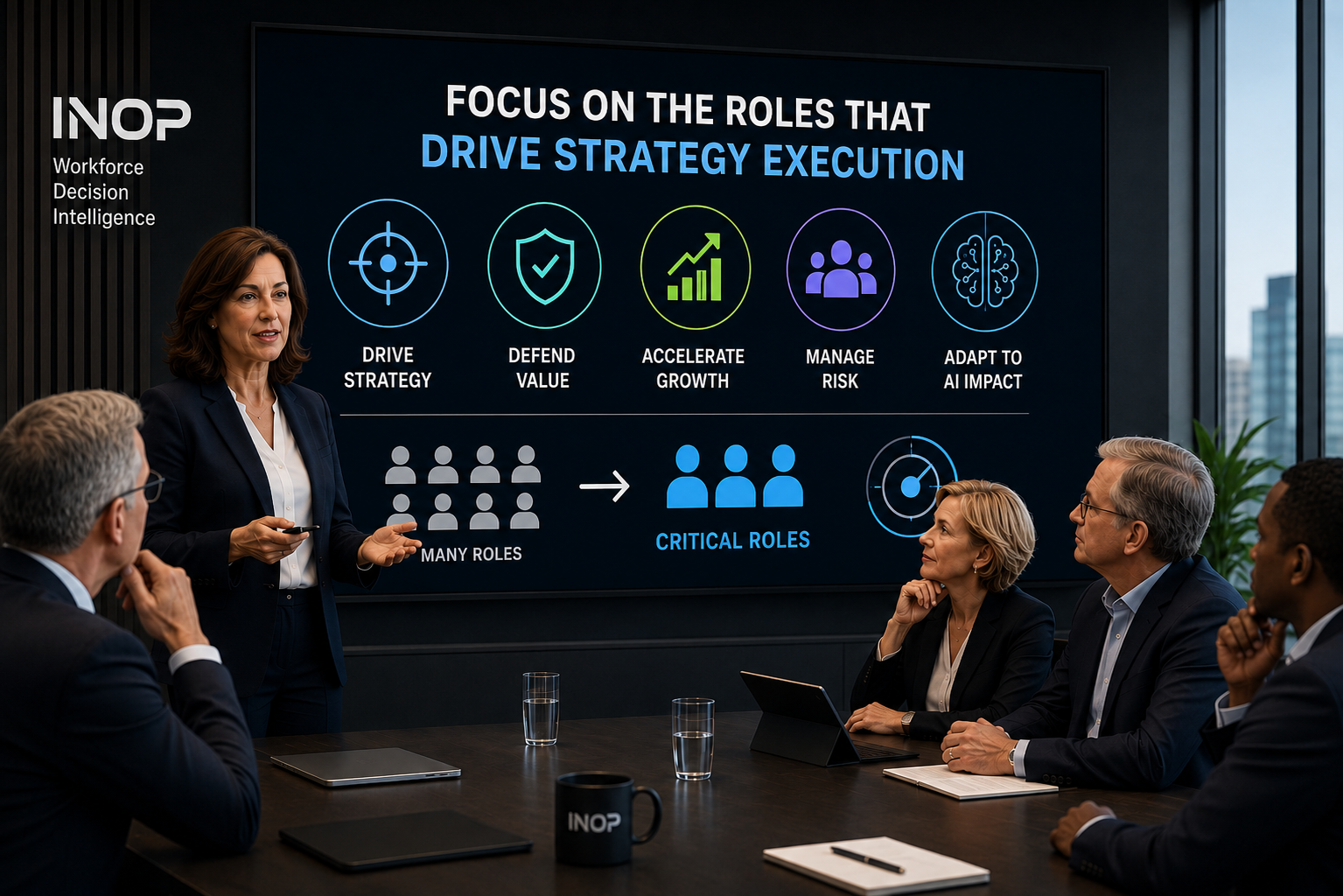
Capabilities and roles are not the same thing, and the distinction matters. Capabilities tell you what the strategy actually requires. Roles are where those capabilities live, and where you can act: hire, build, redeploy, or automate. Identifying critical roles is not a workshop exercise built on gut feel and seniority. In our view, a role is critical for one of two reasons: it creates value, by driving growth, innovation, or competitive advantage, or it defends value, by protecting revenue, clients, or compliance that would otherwise be exposed. Most genuinely critical roles do both at once.
Establishing which roles meet that bar requires five lenses at once; no single one tells the full story: where the role sits in the execution of strategy, what financial value it creates or protects, how scarce that profile is in the external market, what sector and regulatory pressure is bearing down on it, and how AI is already reshaping or replacing the work itself.
A role that scores high on only one of these dimensions is interesting. A role where all five intersect, and where the value creating or value defending case is clear, is critical, in the literal sense: a point on which something turns. That intersection, not any single signal in isolation, is what separates a genuinely critical role from one that simply feels important to the person who holds it.
What this makes possible immediately
Once you know which roles are genuinely critical to execution, you have a precise, defensible starting point for everything that follows, and a first read on how future-ready the organisation really is.
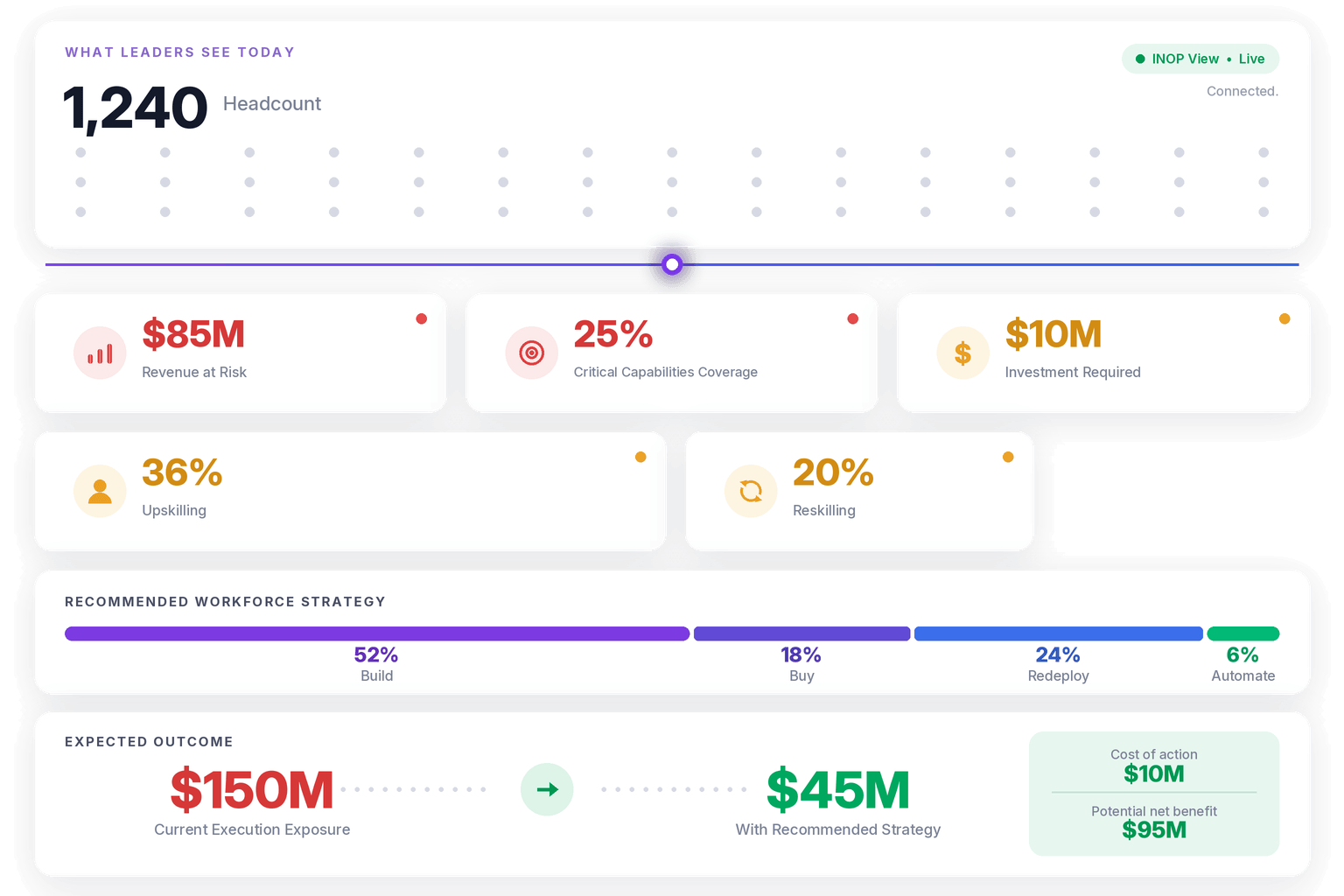
You can see where role gaps are quietly creating value leakage, not for lack of effort, but because the capability the role requires, the skill, the person, the seniority, is not in place. You can put a number on that leakage, in retained revenue, in business won or lost, in the language your CFO and your board already speak fluently.
The same clarity cuts the other way. The roles that defend value are frequently the roles that, properly resourced, accelerate growth: closing business faster, deepening accounts, driving the innovation that keeps you ahead. Critical role intelligence is not a defensive exercise alone. Used well, it tells you where to invest to grow, not only where to stop the loss.
The question business leaders ask us most often is no longer whether workforce risk is real. It is what doing nothing actually costs. A role gap that nobody has costed feels optional, and workforce initiatives built on optional things lose momentum the moment priorities shift. A role gap with a number on it, tied to leakage or growth, does not.
That pressure is no longer coming only from inside the business. Boards face growing scrutiny from investors on whether the organisation can execute its strategy, with evidence rather than assurance. For boards and PE operating partners assessing portfolio companies, an execution-grounded view of critical role exposure belongs in the governance and capital allocation conversation, not just the operational one.
The compounding effect: how clarity earns broader adoption
There is a second, quieter benefit, and one we have both seen play out repeatedly: starting with critical roles builds organisational momentum rather than fatigue.
Leadership sees value fast, because the first output is a handful of roles tied directly to strategic and financial exposure, not a 400-row spreadsheet no one commissioned. That early credibility changes how the organisation engages with workforce data: quality improves not because someone mandated a cleanup, but because there is now a clear, strategic reason to invest in getting it right. A small number of critical roles, properly understood, becomes the proof point that earns the mandate to move to the next layer of capability, and the one after that. The intelligence layer expands in phases, on the back of demonstrated value, rather than being rolled out everywhere at once and asked to prove itself retroactively.
Our angle
Strategy conversations stall when nobody in the room can say, with any precision, which capabilities are truly critical. Those are the capabilities that decide whether the company can execute its strategy, hold its ground against competitors, keep innovating and demonstrate sound risk management. That is the moment vague concern takes over from clear decision-making.
The moment you enter that room instead with a defensible, financially grounded view of critical role exposure, showing where value is leaking and where growth could accelerate if the right capability were in place, the nature of the conversation changes entirely. It stops being a debate about whether workforce risk is real, and becomes a decision about protecting and growing the business. That is where strategic workforce decision intelligence should start. Not with everything you know about your people. With what actually drives the result.
Curious how strategic workforce decision intelligence applies to your organisation? Learn more → https://inop.ai/strategic-workforce-planning/
Make confident workforce decisions that support strategy and value creation.