Most organisations now run some form of AI training. Far fewer can say whether that training closed a gap the business needed closed. AI driven upskilling changes the starting point. Instead of assigning a course catalogue and counting completions, it uses skills data and AI-generated signals to decide who needs which skill, how urgently and by which route, then checks whether capability improved. This guide explains what AI driven upskilling involves, why generic programmes fall short and how to build a programme that puts your training budget where your strategy needs it.
What Is AI Driven Upskilling?
AI driven upskilling is the use of skills data, task analysis and external market signals to target training at the capability gaps that block business outcomes. AI plays two roles. It analyses roles, tasks and skills to find the gaps, and it personalises learning paths so each employee works on what they lack. The AI skills themselves are often part of the content, but the method applies to any skill the strategy depends on.
AI Driven Upskilling vs Generic AI Training
| Generic AI training | AI driven upskilling | |
|---|---|---|
| Starting point | A course catalogue | A skill gap tied to a business outcome |
| Who gets trained | Everyone, or whole job families | People whose tasks and goals need the skill |
| Learning path | The same for every learner | Personalised to each person’s current level |
| Decision on training | Assumed | Compared with redeployment, external capability and automation |
| Success measure | Completion rate | Capability gained and work performed |
Why Do Generic Upskilling Programmes Fall Short?
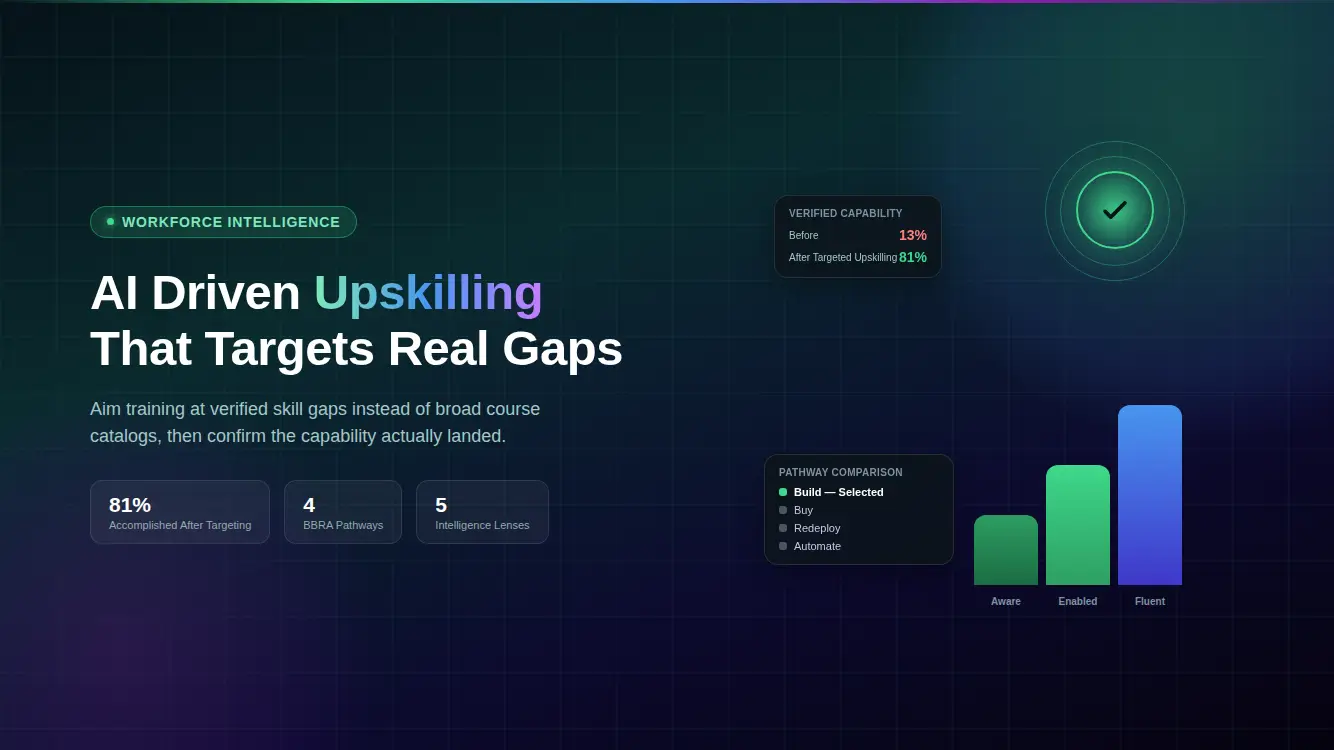
The gap between training activity and capability is wide. Workera’s analysis of 88,000 enterprise AI skills assessments found that only 13% of employees were rated Accomplished in Agentic AI before any upskilling began, even in organisations already investing in AI. Four patterns explain most of the shortfall.
Training Assigned by Job Title
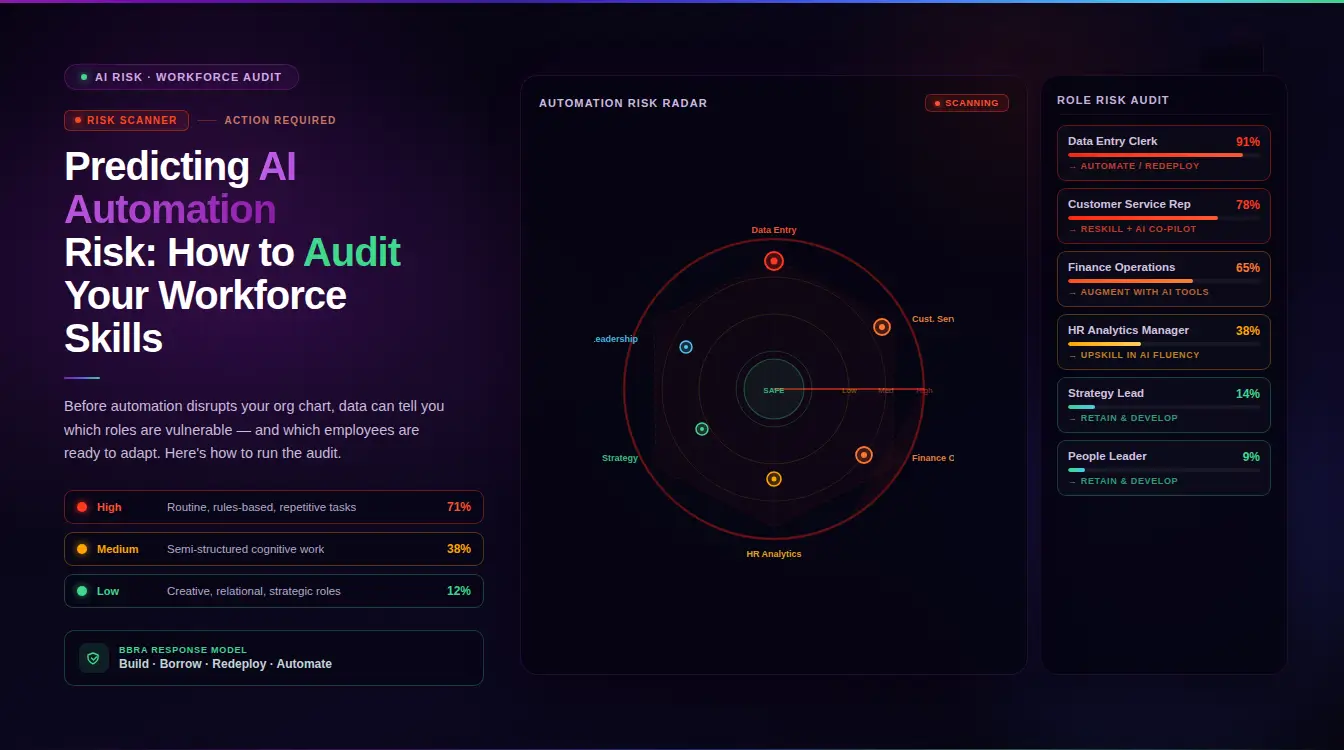
AI changes tasks inside roles, so two people with the same title can need different skills. A role where 20% of tasks face automation risk needs a different plan from one where 70% do. Assigning the same course to both wastes time for one and leaves the other short.
Budgets That Ignore the Rest of the Transformation
Training on its own rarely delivers AI value. BCG’s research on AI transformation as workforce transformation estimates that about 10% of AI value comes from algorithms, 20% from technology and 70% from rethinking the people side. Upskilling sits inside that 70%, alongside role redesign, governance and culture. Our guides to workforce transformation and the AI enabled workforce cover the other parts.
Annual Cycles That Lag Behind Skill Demand
The World Economic Forum’s Future of Jobs Report 2025 expects 39% of workers’ core skills to change or become outdated between 2025 and 2030. A training plan set once a year cannot follow demand that moves this fast. Skills that looked critical in January can be commoditised by the autumn.
Completion Counted as Capability
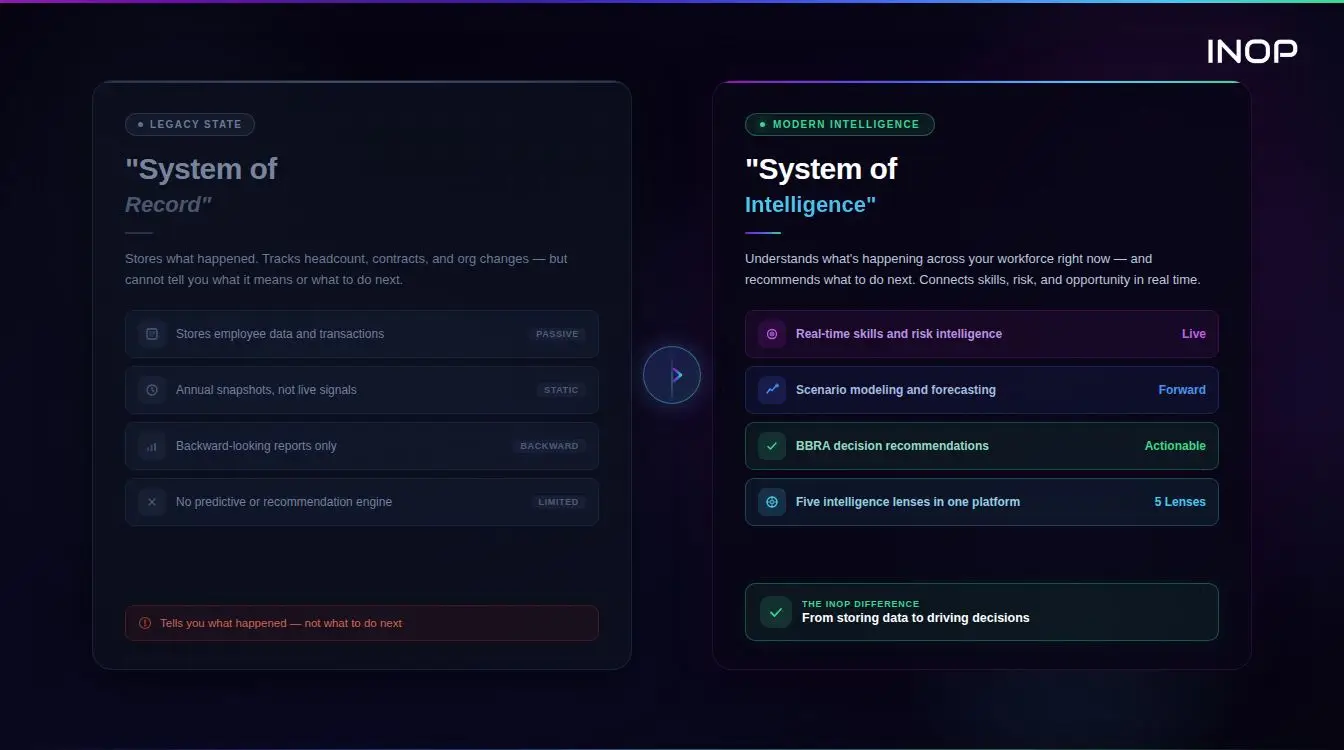
A finished course shows attendance. It does not show whether someone can perform the work. When HR systems record completions and nothing else, leaders cannot tell which gaps closed. Moving from a system of record to a system of intelligence gives you that missing view.
How to Build an AI Driven Upskilling Programme
Work from the gap to the training, then back to the evidence. Six steps make up the sequence.
Map Tasks and Skill Gaps by Role
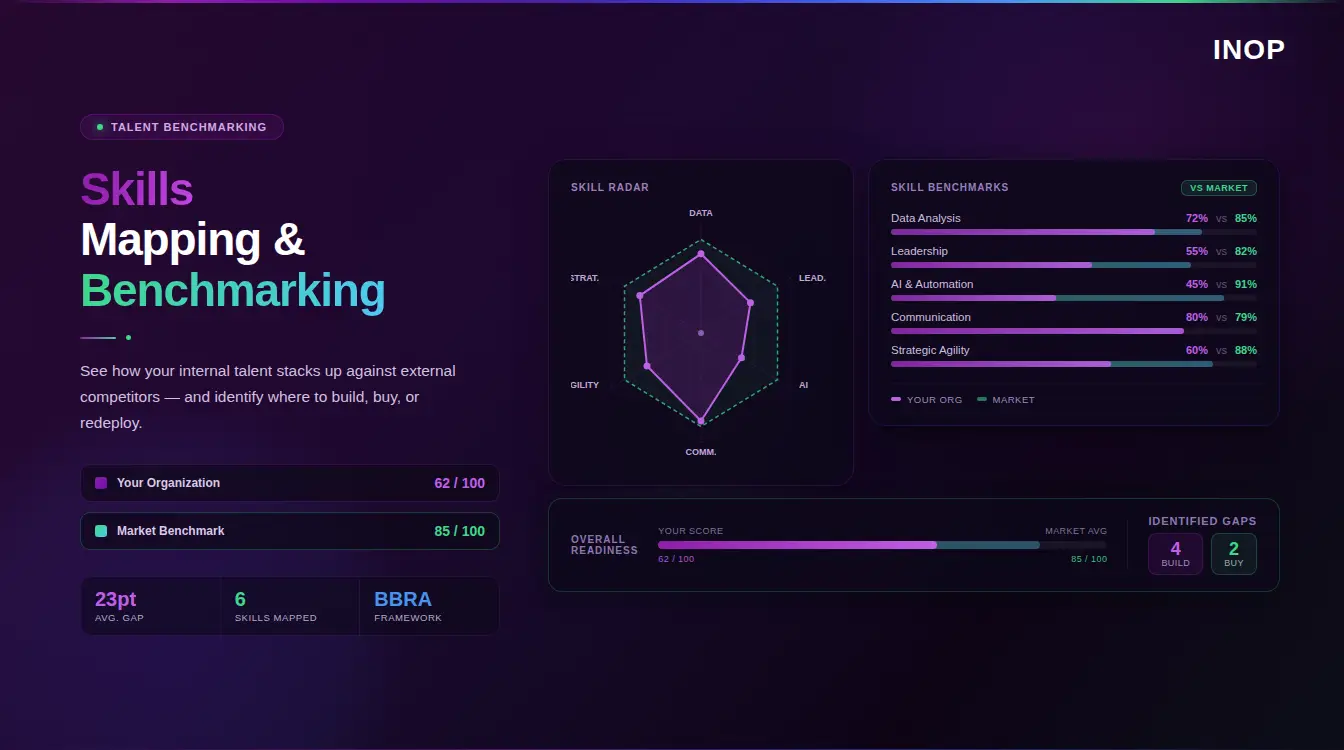
Break each role into the tasks people perform and classify how AI will change each one. Then compare the skills the future tasks need with the skills people hold today. Use evidence from work output, assessments and manager input rather than self-ratings alone. Our guide to auditing workforce skills for AI automation risk sets out the method.
Read External Demand Signals
Internal data shows what your people can do. External data shows which skills are gaining value and which are losing it. Combine both before you choose what to train, so you do not invest in skills the market is moving away from.
Compare AI Driven Upskilling With the Other Options
Training is one way to close a gap. Redeploying someone who already holds the skill, bringing in external capability or automating the task may be faster or cheaper. A redeployment that closes a gap in 30 days can beat an 18-month learning path. Compare the options on cost and time before you commit budget, and where the move is into a new role, see our guide to reskilling.
Personalise the Learning Path
Use the gap data to give each employee a path that starts at their current level. AI-based learning platforms can recommend content, adjust difficulty and suggest practice tasks. Pair digital content with on-the-job projects, because people build AI skills fastest by applying them to their own work.
Protect Time and Involve Managers
Time is the most common barrier. Gallup reports that 89% of CHROs name time away from job responsibilities as their organisation’s biggest obstacle to development, and less than half of US employees (45%) took part in training for their current job in 2024. Agree learning time in advance and make managers responsible for protecting it. LinkedIn’s Workplace Learning Report 2024 found that learners who set career goals engage with learning four times more than those who do not, so link each path to a goal the employee recognises.
Measure Capability Gained
Re-assess each person against the same benchmark you used to find the gap. Track whether they now perform the tasks the role needs, and whether the business outcome the gap was blocking has moved. Report cost per gap closed, compared with the alternatives.
How INOP Targets AI Driven Upskilling
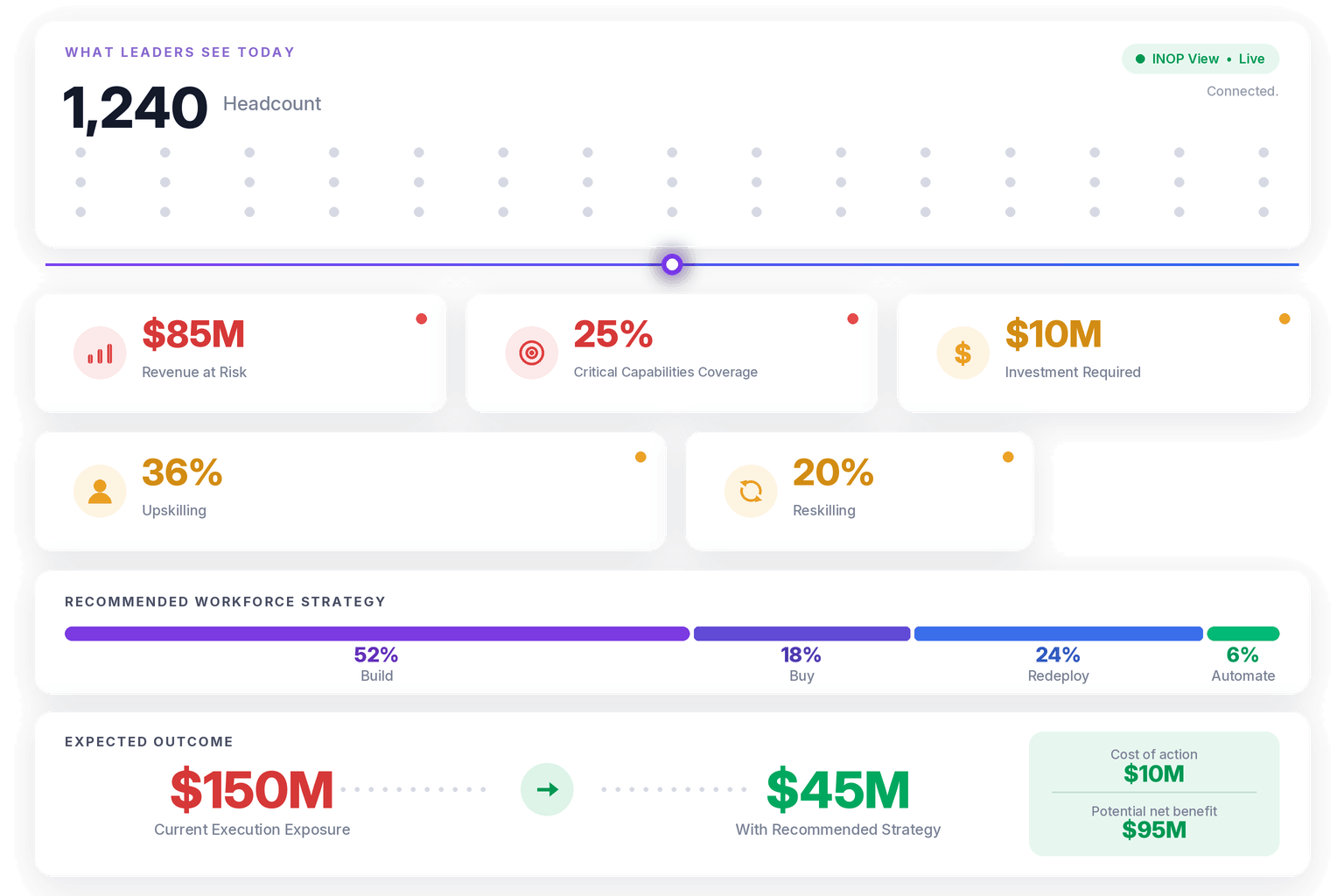
INOP starts from one question: does the organisation have the capabilities to execute its strategy today, and to stay ready as AI changes the work? Upskilling earns budget when it closes a gap the strategy depends on. INOP never assesses it in isolation. Each decision passes through five intelligence lenses:
- Strategy. Does closing this gap unblock a specific initiative?
- Finance. What does upskilling cost compared with the alternatives, and when does it pay back?
- People. Who is closest to the capability, and where is attrition risk concentrated?
- Market. Is the skill gaining or losing value outside the organisation?
- AI and Automation. Could AI take over the task instead?
INOP’s skills intelligence maps external demand signals to your own taxonomy, INOP’s taxonomy or a blend of both, and classifies each skill as Emerging, In Demand, Stable or Declining, alongside its exposure to AI and automation. That shows where upskilling will hold its value.
INOP’s proprietary BBRA decision architecture then compares four responses for each gap: Build, Buy, Redeploy and Automate. Build is the upskilling route. Buy brings in external capability, Redeploy moves people whose skills already fit, and Automate covers tasks AI can take over. Our article on AI workforce automation covers that last pathway. INOP models each option with its financial trade-offs across 30-day, 180-day, one-year and three-year horizons, so Build becomes a choice rather than a default.
The strategic workforce planning platform scores readiness across five domains: Capability, Leadership, Role-Value, Mobility & Agility, and Cultural. Strategic Execution Risk is derived from those domains and the workforce plan, and Execution Materiality shows what each open gap costs. Results are available at organisation, business unit, department, country and individual level, and INOP works with role and task-level data where employee-level data is unavailable.
See which skill gaps your strategy depends on, and whether upskilling or another route closes each one fastest. Book a demo.
AI Driven Upskilling for PE Operating Partners
For an operating partner, an upskilling line item is either a capability investment or a sunk cost. The difference shows in the evidence behind it. A portfolio company that reports high completion rates but cannot show which gaps closed has a training programme. One that links spend to specific gaps and re-assesses capability afterwards has an upskilling strategy.
Ask each portfolio company:
- Which capabilities does the value creation plan depend on, and which gaps does the training target?
- How was each gap identified, and how will the company show it has closed?
- Was upskilling compared with redeployment, external capability and automation?
- How will pay change for employees who gain high-demand skills?
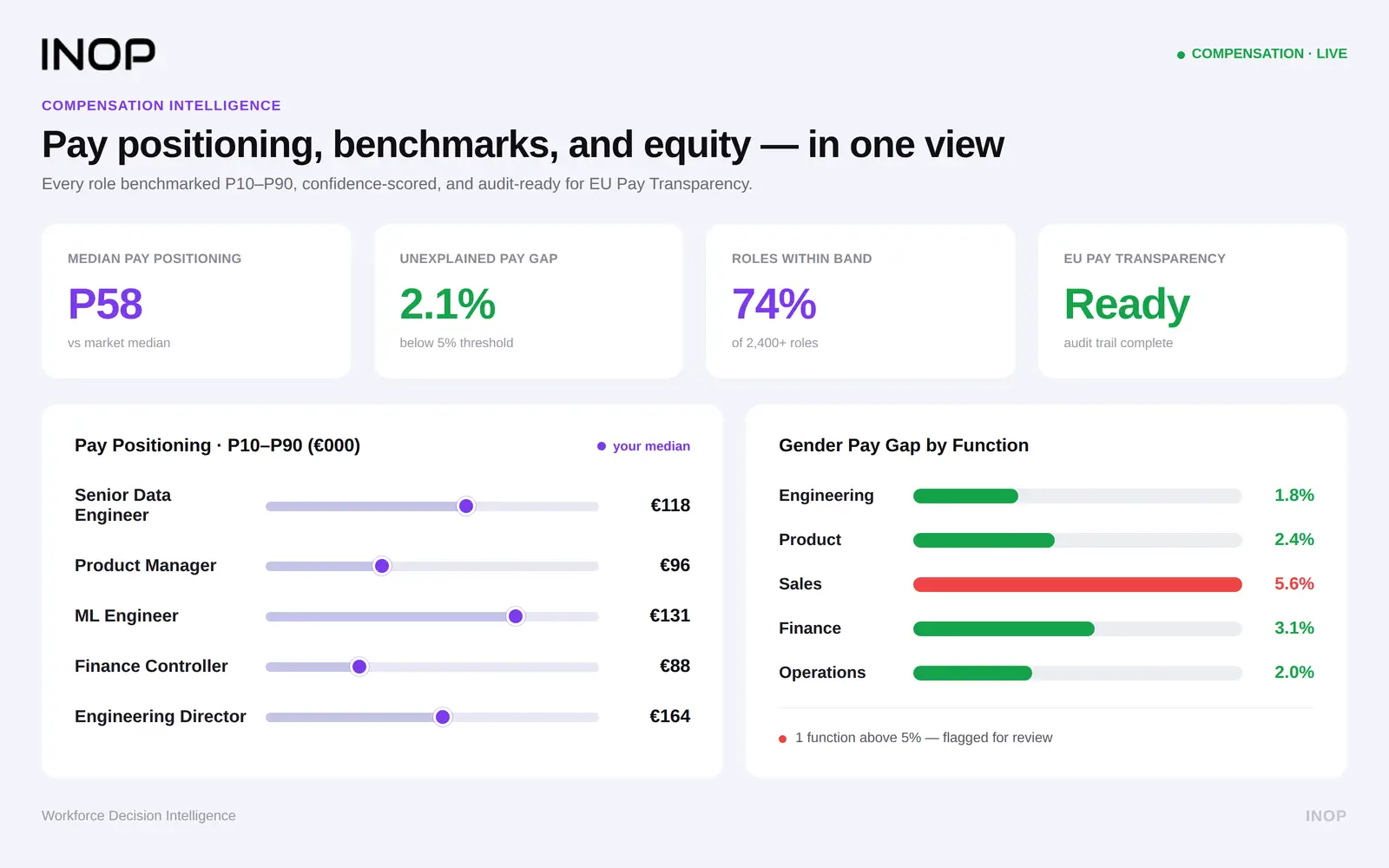
The last question matters for retention. INOP’s compensation analytics platform benchmarks pay from P25 to P90, so you can price newly gained skills before the market does it for you. INOP applies the same lenses and BBRA horizons across each company you assess, so upskilling plans can be compared across a portfolio on one basis.
See whether your portfolio companies are investing in the capabilities their value creation plans need. Book a demo.
Common Mistakes in AI Driven Upskilling Programmes
- Measuring completion instead of capability. Completion rates rise while gaps stay open.
- Assigning training company-wide. Broad mandates spread budget thin and frustrate people who already hold the skill.
- Treating upskilling as the default fix. Some gaps close faster through redeployment, external capability or automation.
- Ignoring how fast the skill is moving. A skill that is declining in the market is a poor target for a long learning path.
- Leaving pay unchanged. Employees who gain scarce skills become targets for other employers.
Frequently Asked Questions
What is the difference between AI driven upskilling and generic AI training?
Generic AI training assigns broad courses and measures completion. AI driven upskilling starts from a role-specific skill gap tied to a business outcome, compares training with the other ways to close it, personalises the learning path and measures the capability gained.
How is AI driven upskilling different from reskilling?
Upskilling deepens capability in a person’s current role. Reskilling prepares them for a different role. Both benefit from the same gap mapping, option comparison and capability measurement, and many organisations run them side by side.
Can AI driven upskilling close AI capability gaps without external capability?
It can close many gaps, especially where employees hold adjacent skills and know the business well. For scarce specialist skills on short timelines, external capability may be faster. Comparing both options on cost and timing, alongside redeployment and automation, shows which fits each gap.
How should PE operating partners evaluate upskilling programmes across a portfolio?
Check whether training spend links to specific capability gaps in the value creation plan, whether the company re-assesses capability after training and whether it compared upskilling with other options. High completion rates without capability evidence are a weak readiness signal.
How often should an AI driven upskilling programme be reviewed?
Review it at least quarterly. Skill demand and AI capability change faster than annual L&D calendars, so the gaps a programme targets can shift within a year.
Make confident workforce decisions that support strategy and value creation.