Companies with a formal workforce plan grow revenue 2.4 times faster than companies that hire reactively, according to McKinsey’s 2025 Workforce Planning Index. The CIPD’s 2025 Resourcing and Talent Planning Report adds a sharper data point: organizations with active workforce plans report 23% higher first-year retention than those that hire purely on requisition. These are not soft HR metrics. They are the financial case for workforce planning, and they explain why CHROs, CFOs, and CEOs are treating this discipline as a board-level priority rather than an HR administrative function.
This guide covers ten specific benefits of workforce planning, the data behind each one, the sub-intents that most guides miss, and how organizations across different industries and ownership structures are capturing these benefits in practice. If you are making the internal case for workforce planning investment, building a process from scratch, or trying to understand why your current approach is not producing the outcomes you expected, the sections below address each of those needs directly.
Want to see what workforce intelligence looks like when it drives financial decisions, not just HR reports? Book a 20-minute demo with INOP.
What Is Workforce Planning and What Does It Actually Involve?
Workforce planning is the structured process of forecasting future talent demand, comparing it against current supply, and closing the gap through hiring, internal mobility, upskilling, or restructuring. A modern workforce plan covers an 18 to 36 month horizon, runs at least three scenarios, integrates skills data alongside headcount data, and gets refreshed quarterly rather than annually.
The difference between workforce planning done well and workforce planning done poorly is not the framework. It is the data quality and the connection to business strategy. A plan built on generic headcount trends and manager gut feel produces a spreadsheet that Finance ignores. A plan built on verified skills data, driver-based demand modeling, and external market benchmarks produces a capital allocation instrument that the CFO uses in budget reviews.
Strategic Workforce Planning vs. Operational Workforce Planning
These two terms describe the same discipline at different time horizons, and confusing them is one reason workforce planning often feels like it is not producing strategic value.
Operational workforce planning addresses the next 3 to 12 months: filling open roles, managing seasonal demand, adjusting staffing to project pipelines. Most HR teams do this reasonably well because the signals are short-term and relatively visible. Strategic workforce planning addresses the next 1 to 5 years: which capabilities does the organization need to execute its strategy, where will the supply come from, what does it cost to build versus hire versus automate, and how does talent investment connect to financial projections?
The organizations seeing 2.4x revenue growth from workforce planning are running the strategic layer. They are not just filling roles faster. They are deciding which roles need to exist, which capabilities the market will price at a premium in 18 months, and where automation changes the headcount equation before it shows up in operational pressures.
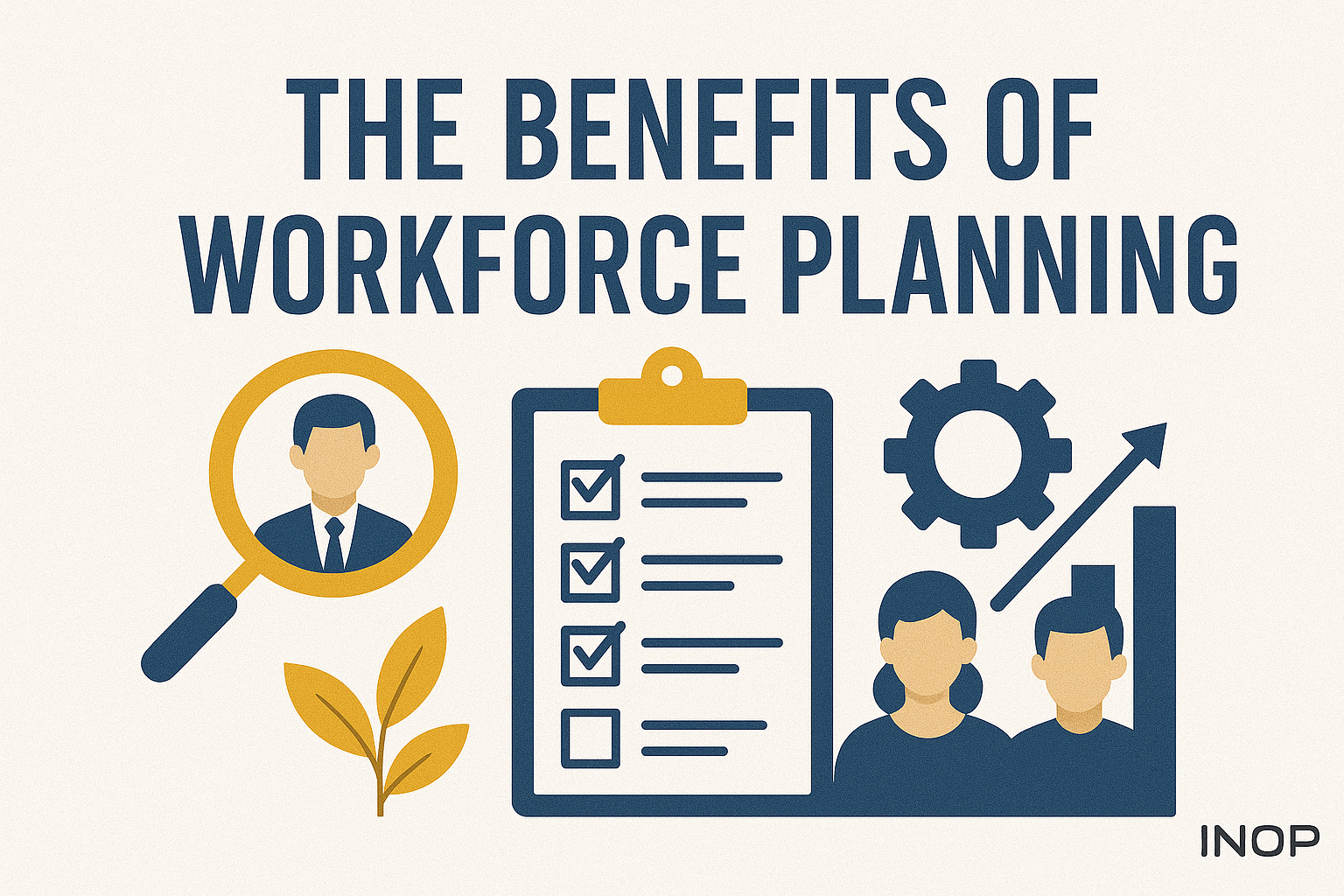
Ten Benefits of Workforce Planning Backed by Data
Benefit 1: Revenue Growth That Outpaces Reactive Competitors
McKinsey’s 2025 Workforce Planning Index documented a 2.4x revenue growth advantage for companies with formal workforce plans over those that hire reactively. The mechanism is straightforward. Reactive organizations discover capability gaps when a project stalls or a client deadline slips. Planned organizations identify those gaps 12 to 18 months before the impact point and close them before execution is affected. The planning advantage is not just operational. It compounds: organizations that plan more accurately also allocate learning and development budgets more precisely, which produces faster capability development at lower per-employee cost.
Benefit 2: Labor Cost Reduction of 15 to 30 Percent
Deloitte’s workforce planning research found that organizations practicing structured workforce planning reduce labor costs by up to 15%. Klearskill’s 2026 analysis puts reactive hiring premiums at 19% to 30% above planned hiring costs. Both figures reflect the same underlying dynamic: last-minute hiring is expensive across every cost category simultaneously. Agency fees run higher when timelines are compressed. Overtime costs accumulate while positions are open. Onboarding is rushed and first-year performance suffers.
For an organization making 200 professional hires annually at an average salary of $80,000, closing even half the gap between reactive and planned hiring costs saves $1.5 million to $2.4 million in recruitment spend annually, before accounting for the productivity gains from better-matched hires who stay longer.
Benefit 3: 23 Percent Higher First-Year Retention
The CIPD’s 2025 Resourcing and Talent Planning Report found that organizations with active workforce plans report 23% higher first-year retention than those hiring purely on requisition. The reason is precision in role definition. When a hire decision emerges from a workforce plan with verified skills requirements and a clear understanding of the business need, the role is defined more accurately than when a manager opens a requisition because someone left last week. Better-defined roles produce better candidate matches. Better matches produce better retention outcomes.
First-year retention matters disproportionately because the replacement cost for an employee who leaves in their first year is higher than for one who leaves after three years: onboarding and training costs are fully sunk, knowledge transfer is minimal, and the role opens again before the first hire reached full productivity.
Benefit 4: Skills Gap Identification Before Execution Fails
Workforce planning done at the skills level rather than the headcount level identifies capability gaps before they constrain execution. Most organizations discover skill shortfalls when a project cannot be staffed, a transformation slows because the required expertise is absent, or a key person leaves and it becomes clear their role was dependent on knowledge nobody else holds.
A structured workforce plan surfaces these risks 6 to 18 months before impact. That lead time is the difference between a controlled response and a crisis response. Building a cloud architecture capability through internal development takes 12 to 18 months. Identifying the gap at month two of a 12-month digital transformation timeline, rather than at month nine, changes whether the organization builds that capability or burns budget on emergency contracting.
For more on how skills gap analysis connects to strategic execution, INOP’s guide on skill gap analysis examples covers five industry-specific worked examples with specific gap identification and closure processes.
Benefit 5: Succession Coverage That Reduces Leadership Risk
Workforce planning identifies succession gaps before they become crises. Planning helps organizations identify that many members of a senior leadership team will be retiring over the next five years, giving them time to develop successors now rather than scrambling when departures happen.
An unplanned leadership transition costs 200% or more of the departing executive’s annual salary in search fees, productivity loss, and strategic delay. A succession plan built on verified readiness scores, not manager nominations, identifies the strongest internal candidates and closes their development gaps on a defined timeline. The financial case is direct: preventing one C-suite succession crisis through planned development typically returns five to ten times the investment in the planning process.
Benefit 6: Scenario Resilience When Business Conditions Shift
PwC’s 2026 Global CEO Survey found that CEO confidence in 12-month revenue growth fell from 56% in 2022 to 30% in 2026. Workforce plans built on a single set of business assumptions break when those assumptions change, which they routinely do. Organizations running three scenarios, a base case, a downside case, and an accelerated growth case, can adjust their talent plans by reweighting scenarios rather than rebuilding models from scratch when conditions shift.
Scenario-based workforce planning also changes the internal dynamic around headcount requests. When Finance can see a specific workforce plan that ties each headcount addition to a revenue driver or capability requirement under each scenario, workforce investment decisions become analytically grounded rather than politically driven.
Benefit 7: The Automation Dividend
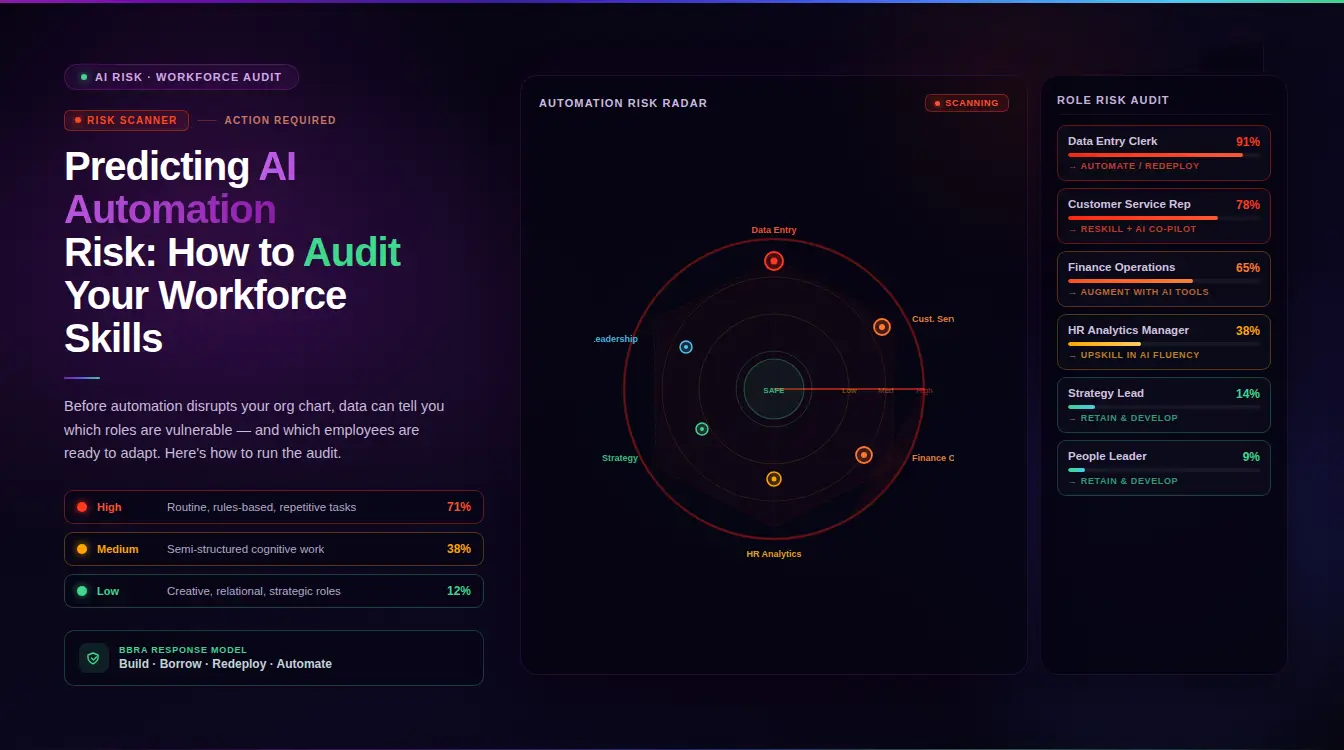
McKinsey’s 2025 Generative AI in the Workplace research found that 28% of routine knowledge tasks can now be augmented or automated. Workforce planning is where that tradeoff gets recognized in financial terms before it shows up as an operational surprise.
A 100-person target headcount in certain functions can now be delivered with 75 to 80 people plus the right AI tooling. That 20 to 25 person difference represents $2 million to $3 million in annual labor cost at a $100,000 average salary, and it is accessible to any organization that builds automation scenario modeling into their workforce plan. Organizations that exclude automation from their workforce planning are effectively leaving this cost reduction off the table while their competitors capture it.
INOP’s AI/Automation intelligence lens explicitly models which roles and tasks face automation risk across four time horizons: 30 days, 180 days, one year, and three years. This is the planning layer that converts a vague “AI will affect our workforce” concern into specific, time-bound headcount and skills decisions.
Benefit 8: Compensation Competitiveness Without Overpaying
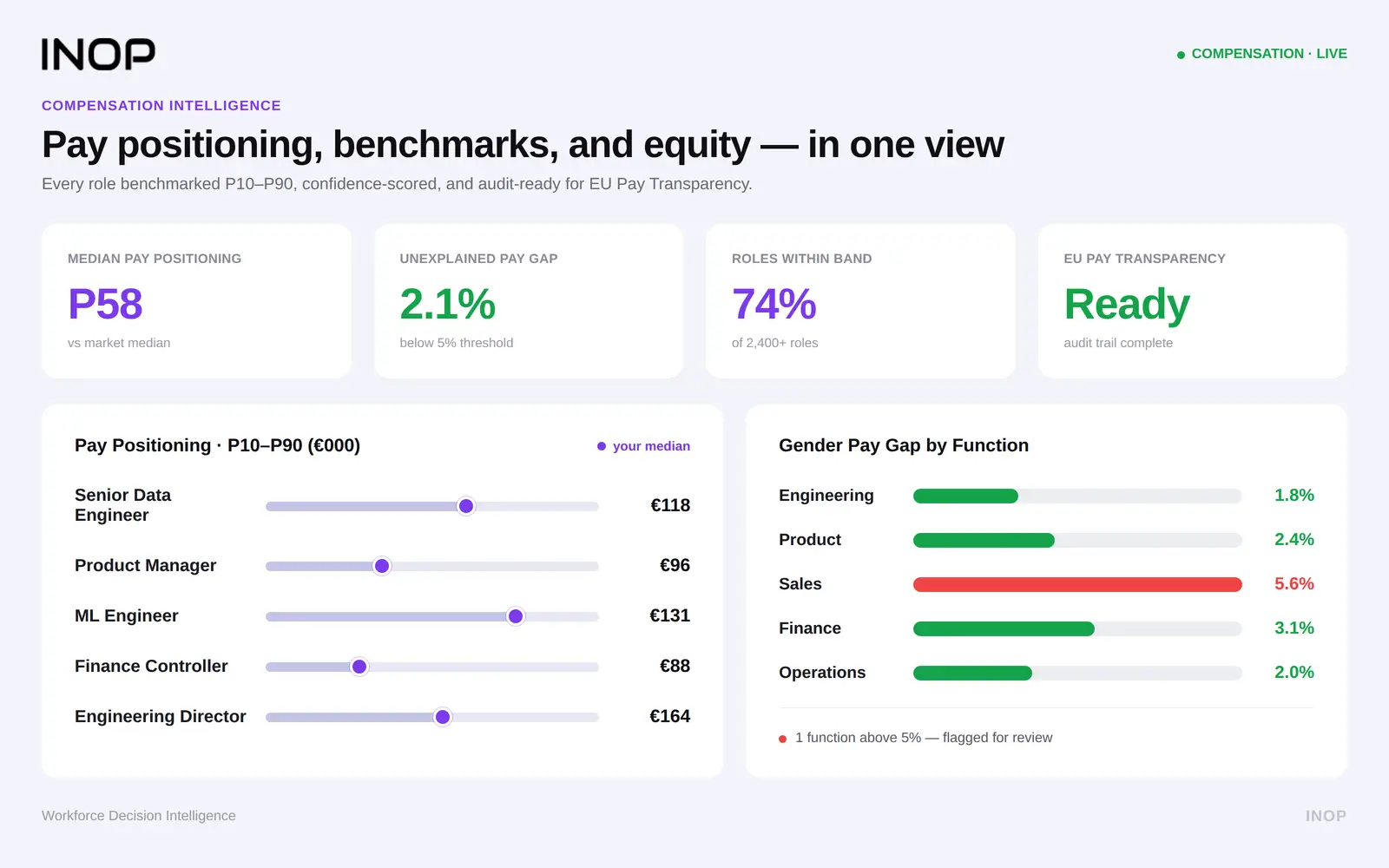
Workforce planning that incorporates skills-level compensation benchmarking produces more accurate pay positioning than title-level benchmarking. Two employees with the same title but materially different skill profiles should command different market rates, and a plan that recognizes this distinction avoids two failure modes simultaneously: overpaying for capabilities the role does not require, and underpaying for capabilities that generate above-average attrition risk when discovered by external recruiters.
Organizations that connect workforce planning to compensation analytics with real-time market data reduce unexplained attrition in high-value roles and reduce compensation budget variance from plan, because pay decisions are grounded in current market data rather than annual survey benchmarks that may be 12 to 18 months stale by the time they are applied.
Benefit 9: DEI Progress That Is Structural Rather Than Aspirational
Strategic workforce planning helps HR teams identify representation gaps and develop hiring strategies that reduce unconscious bias and help close those gaps. Organizations that attract and hire candidates from diverse backgrounds increase the range of skills and experiences in their teams, improving creativity and innovation.
Research shows companies with diverse workforces outperform their peers financially by 35%. The planning mechanism that drives this is explicit gap identification: when a workforce plan shows that 70% of senior leadership comes from two demographic groups, and that this concentration persists across the succession bench, there is a specific, data-grounded prompt to change hiring and development practices. Aspiration without data produces no structural change. A workforce plan that tracks demographic composition alongside capability composition gives HR the specific evidence required to move DEI from a stated priority to a measured outcome.
Benefit 10: Finance-HR Alignment That Makes Both Functions More Effective
Workforce planning done in isolation from financial planning produces two separate plans that conflict at the budget review. HR plans headcount based on organizational needs. Finance plans headcount based on cost targets. Neither plan reflects the other’s assumptions, and the reconciliation conversation happens too late to change either plan meaningfully.
When workforce planning is built into the financial planning cycle, with shared demand assumptions, a shared cost model, and a shared planning calendar, the conflict disappears because there is one plan rather than two. Finance brings essential data on labor budgets, cost modeling, and ROI thresholds. Operations teams supply demand forecasting and capacity projections. HR translates these business drivers into actionable talent plans. This alignment ensures that workforce decisions are both strategically sound and financially viable.
For CHROs making the case for this integration, the practical argument is not about HR gaining influence. It is about Finance getting more accurate headcount cost forecasts. When Finance runs the budget with stale headcount assumptions and actual staffing deviates significantly, mid-period variances require budget revisions that erode the CFO’s confidence in the planning process. Shared workforce planning removes that variance at the source.
Benefits of Workforce Planning for Small and Medium Businesses
Most workforce planning guides are written for large enterprises with dedicated HR analytics teams and established planning infrastructure. The principles apply at any scale. The implementation differs.
For a 50-person business, a workforce plan does not require a dedicated platform or a data science team. It requires three things: a clear view of current capability across critical roles, a 12-month projection of which roles will be needed based on business plans, and a quarterly review that asks whether the projection still holds. A well-structured spreadsheet with honest skills assessment data, updated quarterly, produces planning quality that most 50-person businesses have never had and that directly affects whether they can scale their delivery teams ahead of client growth rather than behind it.
The benefits of workforce planning for small businesses are concentrated in two areas: avoiding the over-hiring and subsequent layoff cycle that damages culture and employer brand, and ensuring that development investment goes into the capabilities that will matter most in the next 12 months rather than into generic training that fills time without building strategic capacity.
How to Build the Internal Business Case for Workforce Planning
Most internal business cases for workforce planning fail because they lead with process design rather than financial impact. A CFO or CEO who sees a proposal for a workforce planning initiative reads the cost and the process description and has no basis for evaluating the return. The case that succeeds leads with the cost of the current state.
Calculate three numbers before presenting anything. The first is your reactive hiring premium: what did last-minute hiring cost over the last 12 months in agency fees and overtime versus what planned hiring would have cost? The second is your first-year attrition cost: how many employees left within 12 months of hire, and what did replacing each one cost in recruitment, onboarding, and productivity loss? The third is your skills gap cost: how many projects ran over budget or missed deadlines because the required capability was not available when needed?
For most organizations, these three calculations produce a current-state cost that significantly exceeds the investment required for a structured workforce planning capability. When the CFO can see that the current approach is costing $3 million annually in avoidable costs, an investment of $400,000 in planning infrastructure is not a cost. It is a 650% ROI.
Real Companies, Real Outcomes
Merck KGaA: From Headcount Exercise to Strategic Capability
Merck KGaA faced a growing need to evolve its workforce planning from a simple headcount exercise into a strategic, skills-driven capability. The company introduced a centralized skills taxonomy to create a common language across regions and departments, laying the groundwork for AI-enabled scenario planning. HR and business teams could assess future demand against variables like retirement rates, salary inflation, labor availability, and expansion plans. The result was a planning function that earned genuine executive attention: “When you’re able to have strategic yet concrete discussions focused on business ROI and workforce opportunities, suddenly people are listening,” said Alexis Saussinan, Global Head of People Insights and Effectiveness at Merck KGaA.
EPAM Systems: Thirty Years of Skills-Led Planning
EPAM Systems, a global software engineering company with over 50,000 employees, has executed a skills-based workforce strategy since its founding in 1993. What began as manually tracking skills in spreadsheets evolved into deeply integrated workforce intelligence that connects every employee’s capability profile to project staffing, career development, and strategic planning simultaneously. The outcome is double the industry-average retention rate in a sector where technical talent attrition regularly runs 20% or above. EPAM’s case makes a point that most planning frameworks miss: the compounding return from workforce planning grows with time. The organizations seeing the largest benefits are those that built the discipline early and refined it over years, not those that deployed a platform last quarter.
Workforce Planning KPIs: What Good Looks Like
Workforce planning generates value that needs to be measured to be maintained. Without metrics, planning initiatives lose organizational support when they compete for budget with more visible operational priorities. These five KPIs measure whether a workforce planning capability is working.
Forecast accuracy at 6 and 12 months measures whether the headcount and skills plan produced six months ago reflects actual business outcomes. Organizations running structured planning consistently report 20 to 35% improvement in forecast accuracy over historical trend methods. Below 80% accuracy at six months signals a structural problem with the demand modeling assumptions.
Internal fill rate for planned roles tracks whether workforce planning is actually enabling internal mobility as a source of supply. When a gap identified in the workforce plan is filled by an internal candidate surfaced through skills matching rather than external hiring, the plan is working. Target 40% or above for organizations with mature skills data.
Time-to-skill versus time-to-fill is a distinction from the 2026 Adecco HR strategy report: while time-to-fill measures hiring speed, time-to-skill gauges how long it takes new hires to reach productivity, which is the more strategically relevant indicator. A workforce plan that produces faster time-to-fill without improving time-to-skill has optimized the wrong metric.
Reactive hiring ratio is the percentage of filled roles that were in the workforce plan versus those that emerged as unplanned urgent requests. High reactive ratios, above 40%, signal that the planning horizon is too short or that plan outputs are not feeding the recruiting pipeline effectively.
Workforce cost variance from plan is the metric Finance cares most about: how closely does actual headcount cost track the planned cost? Organizations with mature workforce planning report variance below 5 to 7%. Organizations without structured planning report 15 to 25% variance, which produces the mid-period budget revisions that erode Finance’s trust in HR-generated cost projections.
The Benefits of Workforce Planning for PE Portfolio Companies
Private equity operating partners face the benefits and the stakes of workforce planning in concentrated form. The hold period is finite, the value creation plan is specific, and the cost of execution gaps compounds against a timeline that does not forgive 12 months of reactive hiring before the planning function is rebuilt.
The three benefits that matter most in PE contexts differ from the general enterprise list. The first is rapid capability baseline visibility: within 90 days of acquisition, a structured workforce plan can identify whether the current workforce can execute the value creation thesis, where the critical gaps are, and what each closure pathway costs across the INOP BBRA decision framework. Without this baseline, the operating partner is making integration and growth decisions from incomplete information for the first 12 to 18 months of the hold period, exactly when the decisions carry the most weight.
The second benefit is financial precision in talent investment decisions. PE operating partners need to present workforce investment proposals in the same financial language as capital expenditure decisions: expected return, payback period, and risk-adjusted cost comparison across available options. A structured workforce plan with financial scenario modeling for each gap closure pathway produces this output. An HR headcount request does not.
The third benefit is exit readiness documentation. Institutional buyers increasingly conduct human capital due diligence as a standard part of the acquisition process, and a documented workforce planning capability with measurable outcomes produces a more defensible human capital narrative than a workforce plan that exists only as a list of open requisitions.
INOP’s strategic workforce planning platform is designed for this context, delivering the rapid capability baseline, financial scenario modeling, and ongoing monitoring that connects workforce decisions to value creation plan execution in PE portfolio environments. Book a demo to see how it works in practice.
Common Reasons Workforce Planning Fails to Deliver Benefits
Workforce planning initiatives fail consistently in two patterns. The first is treating it as an annual exercise. A plan built in October that is not reviewed until the following October has absorbed 12 months of business change that it cannot account for. A modern 2026 workforce plan covers an 18 to 36 month horizon and gets refreshed quarterly. Organizations that update their plans annually are planning for the environment they were in 12 months ago.
The second failure is building the plan in HR and presenting it to Finance rather than building it with Finance from shared assumptions. When HR and Finance run separate planning processes and reconcile at budget review, the reconciliation conversation is adversarial. Each function defends its numbers rather than solving the shared problem. This is a process design failure, not a data quality failure, and no technology investment resolves it without a change in how the planning process is structured.
A structural response to all three of these challenges is choosing a planning approach that makes the process repeatable and continuous rather than a periodic project. Understanding the major strategic workforce planning frameworks, from the generic five-phase model to the HCI competency approach to the BBRA decision framework, gives HR leaders a basis for selecting the method best matched to their organization’s maturity and pace of change, rather than defaulting to whichever model a consultant introduced years ago.
How to Start Workforce Planning: A Practical Sequence
For organizations building workforce planning capability from scratch, the practical sequence matters as much as the framework. These five steps apply whether you have a dedicated analytics team or a two-person HR department.
Step 1: Map the business strategy to capability requirements. For each of your organization’s three to five strategic priorities over the next 12 to 36 months, identify the specific capabilities required to execute. Do not start with headcount. Start with the work the business needs to do and work backward to the people required to do it.
Step 2: Assess current capability with multi-source data. Self-assessment alone produces overconfident skill ratings. Combine self-assessment with manager validation and, for technical roles, structured assessment. The output is a capability inventory at the individual and team level that you can compare against strategic requirements.
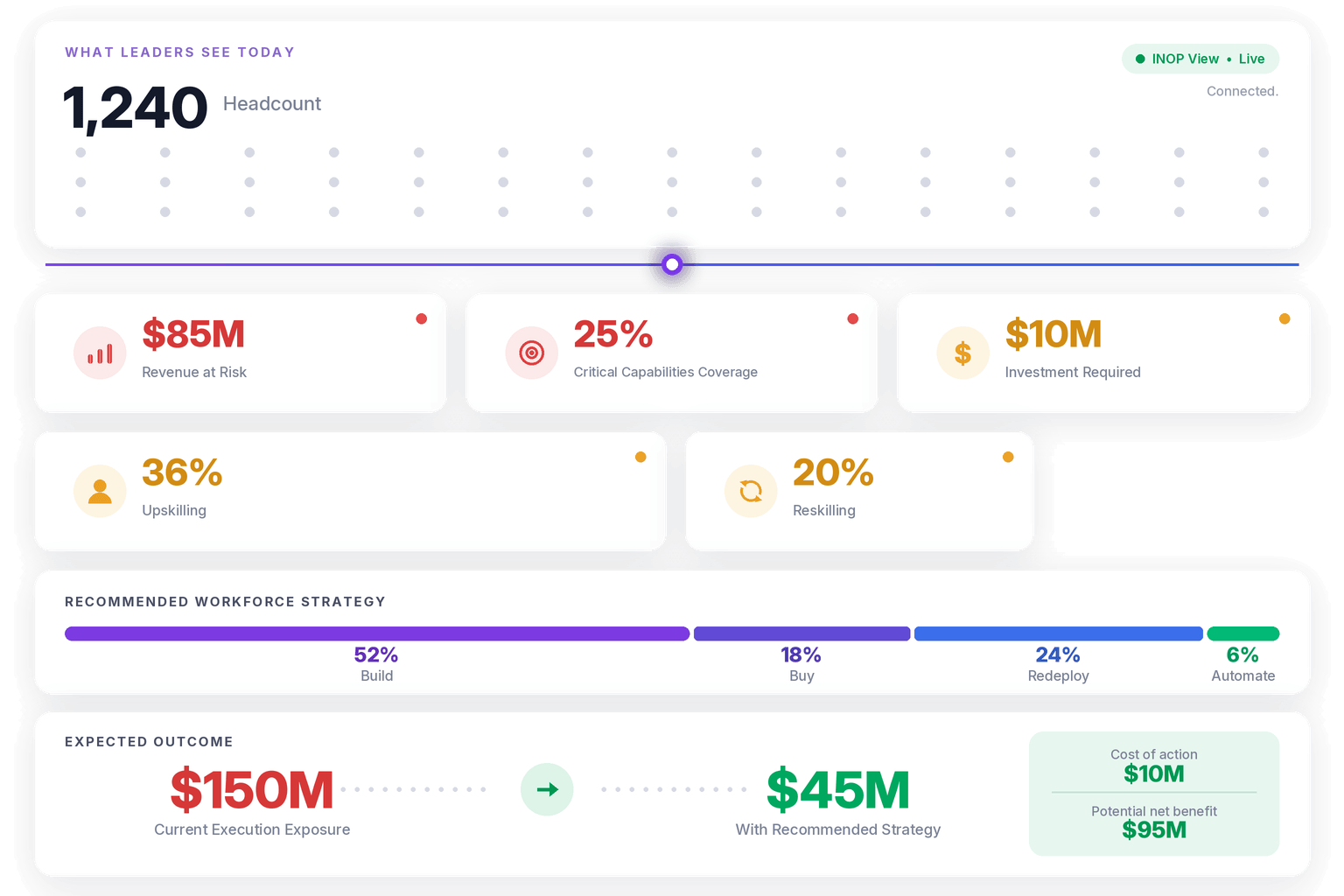
Step 3: Calculate the gap and cost each closure pathway. For each identified gap, model the cost and timeline of building internally, buying externally, redeploying internal talent with adjacent skills, or automating the task. This is the BBRA decision, and it is where workforce planning generates financial decisions rather than HR reports. For a deeper treatment of this process, INOP’s guide on closing skill gaps for strategic workforce planning walks through the full six-step identification and closure methodology.
Step 4: Build three scenarios. Your base case reflects current trajectory. Your downside case models what happens if revenue grows at half the planned rate or if a major technology transition takes longer than expected. Your upside case models what happens if a key opportunity accelerates. Each scenario requires a different workforce response, and having all three ready before you need them is what gives planning its agility value.
Step 5: Review quarterly and measure against plan. Set the five KPIs from the previous section before the plan launches, not after. Review them at the start of each quarterly cycle. Adjust assumptions when business conditions change rather than waiting for the annual rebuild. The organizations that extract the most from workforce planning are those that treat it as a continuous discipline rather than an annual deliverable.
Workforce Planning Tools: What to Evaluate
Technology supports workforce planning at three levels. Basic analytics platforms track headcount, turnover, and time-to-fill. These are table stakes for any organization above 100 employees and do not in themselves constitute workforce planning capability.
Workforce planning platforms model demand against supply, run scenario comparisons, and produce skills gap analysis at the organizational level. Visier, Orgvue, and Workday Adaptive Planning operate in this tier. They require data science support for implementation and ongoing model maintenance, which makes them most appropriate for organizations with dedicated people analytics teams.
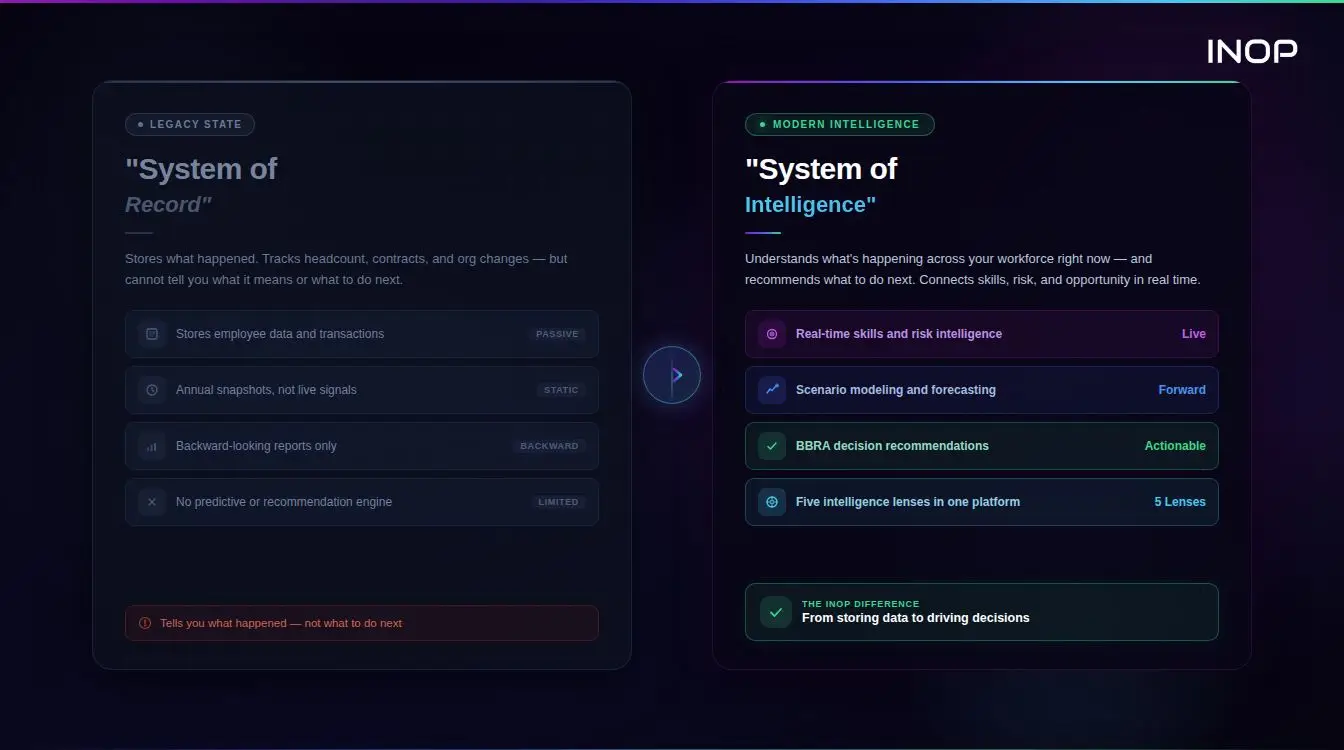
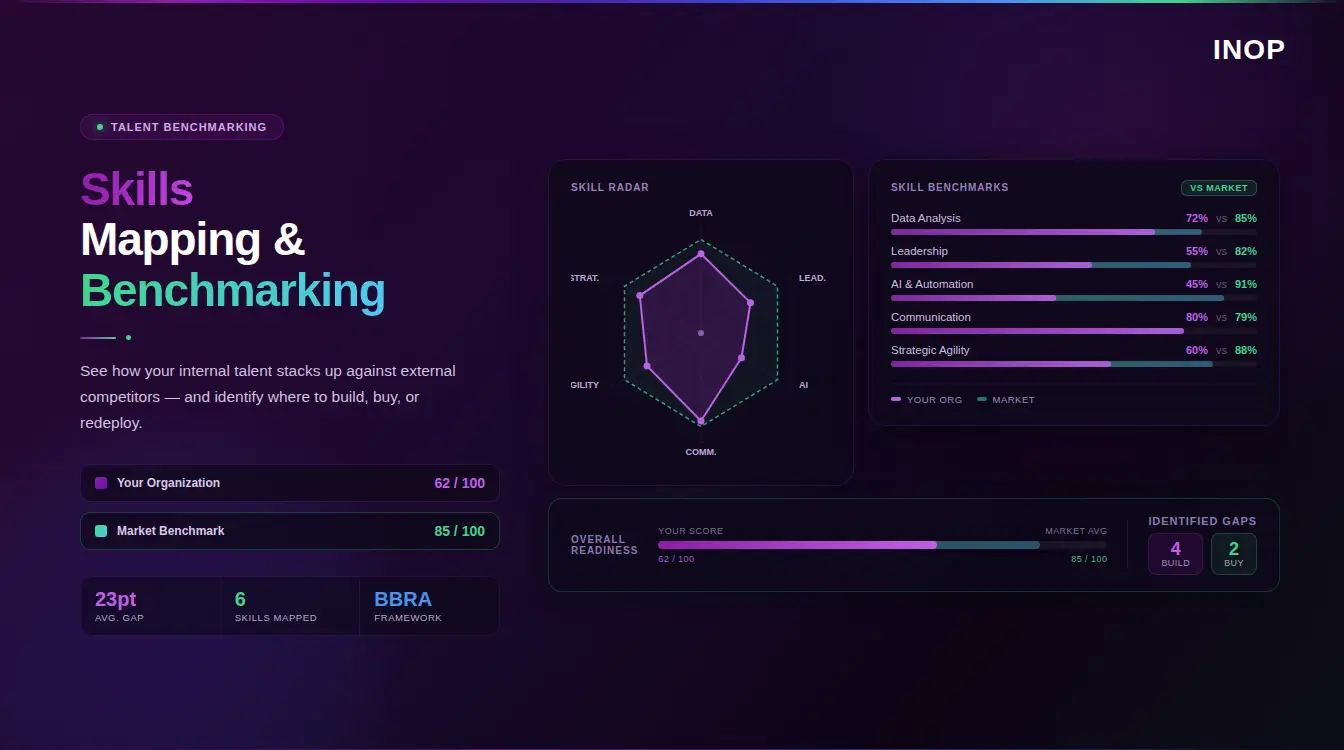
Workforce decision intelligence platforms connect planning outputs to structured decision support: BBRA-framed gap closure options with financial modeling, real-time skills intelligence with external market benchmarking, and compensation analytics integration so that each hiring or development decision is costed against current market data. INOP’s platform operates in this category, and the distinction from pure planning platforms is that INOP connects the forecast to the financial decision rather than stopping at the forecast. For a full comparison of the skills intelligence and workforce planning platform landscape, INOP’s guide on skills-based workforce planning tools covers the full category.
Ready to connect your workforce plan to financial decisions your CFO will trust? See how INOP’s workforce planning platform works in a 20-minute demo.
Frequently Asked Questions About the Benefits of Workforce Planning
What are the main benefits of workforce planning?
The ten most documented benefits of workforce planning are: revenue growth of 2.4 times that of reactive competitors (McKinsey 2025), labor cost reduction of 15 to 30%, first-year retention improvement of 23% (CIPD 2025), early identification of skills gaps before execution is affected, succession coverage that reduces leadership transition risk, scenario resilience when business conditions shift, automation cost savings from modeling the bot column in headcount plans, compensation competitiveness without budget overspend, DEI progress grounded in data rather than aspiration, and Finance-HR alignment that reduces mid-period budget variances. Each benefit is compounding: organizations that have been planning for three years consistently outperform those that started last quarter because planning discipline improves over time as data quality and model accuracy improve.
What is strategic workforce planning and how does it differ from operational workforce planning?
Strategic workforce planning addresses the next one to five years and asks which capabilities the organization needs to execute its long-term strategy. Operational workforce planning addresses the next 3 to 12 months and asks how to staff current roles and projects. Both are necessary. The difference is the time horizon and the type of decisions each informs: strategic planning feeds capital allocation and capability investment decisions at the executive level; operational planning feeds recruiting and staffing decisions at the team level. Organizations that only practice operational planning have high execution capacity in the short term but consistently find themselves surprised by capability gaps that were visible 18 months in advance to organizations running the strategic layer.
Can small businesses benefit from workforce planning?
Yes. For a 50-person business, a workforce plan does not require analytics infrastructure or a dedicated planning team. It requires three things: an honest assessment of current capability across critical roles, a 12-month projection of which roles will be needed based on the business plan, and a quarterly review that asks whether the projection still holds. The two benefits most directly available to small businesses are avoiding the over-hiring and subsequent layoff cycle that damages culture and employer brand, and ensuring that development investment goes into the capabilities that matter most in the next 12 months rather than into generic training.
What data does workforce planning require?
The minimum viable data set for a credible workforce plan includes current headcount with complete organizational structure by function, level, and location; rolling 12-month attrition segmented by role family and tenure band rather than blended across the organization; business driver projections from the strategic plan; time-to-fill by role family for current open positions; and skills profiles for roles critical to strategic execution. Skills data at the individual level, while highly valuable, can be built progressively once the headcount model is running. The most common data quality problem is attrition data: most organizations have blended company-wide attrition figures rather than the role-family and tenure-segmented data that makes supply modeling accurate.
How do you measure whether workforce planning is working?
The five KPIs that most directly measure workforce planning effectiveness are: forecast accuracy at six and 12 months (target 80% or above at six months), internal fill rate for planned roles (target 40% or above for organizations with mature skills data), time-to-skill for new hires versus time-to-fill, reactive hiring ratio as a percentage of total filled roles (target below 40%), and workforce cost variance from plan (target below 7%). Define these metrics before the planning process launches, not after. Organizations that define metrics retroactively produce compliance reporting rather than performance measurement.
What is the ROI of workforce planning?
Workforce planning ROI varies by organization size, current planning maturity, and which cost categories dominate in the business. The most consistently documented returns are: recruitment cost savings from shifting reactive to planned hiring (19 to 30% reduction per hire), first-year retention improvement of 23% with corresponding reduction in replacement cycles, and the labor cost savings from modeling automation scenarios in headcount planning. For a 500-person organization spending $12 million annually on personnel costs with a 15% annual movement rate, closing half the gap between reactive and planned hiring typically produces $800,000 to $1.5 million in first-year savings before accounting for productivity, retention, or strategic execution benefits.
How often should a workforce plan be updated?
A modern workforce plan covers an 18 to 36 month horizon and gets refreshed quarterly with a comprehensive annual rebuild. The quarterly refresh updates key demand driver assumptions and attrition signals against the current plan without rebuilding the entire model. The annual rebuild updates the skills taxonomy, scenario assumptions, and strategic alignment from the ground up. Organizations in fast-moving sectors, particularly technology, financial services, and healthcare, benefit from monthly monitoring of leading indicators such as engagement score trends and compensation competitiveness in critical roles, with model updates triggered by material changes rather than waiting for the quarterly cycle.
What role does AI play in workforce planning in 2026?
AI augments workforce planning in three specific ways that were not reliably available before 2024. First, skills inference: AI can infer employee skill profiles from work activity, project assignments, and communication patterns, reducing the data collection burden for organizations building their skills inventory from scratch. Second, scenario simulation: AI enables rapid generation and comparison of many simultaneous workforce scenarios, surfacing the optimal staffing configuration under different business assumptions faster than manual modeling allows. Third, automation impact modeling: AI can assess which tasks within each role are candidates for automation across different time horizons, informing the “automate” pathway in workforce gap closure decisions. According to WEF 2026 research, rapid adoption of generative AI, persistent skills shortages, hybrid operating models, and pressure on labor costs mean single-year hiring cycles no longer deliver the agility organizations need.