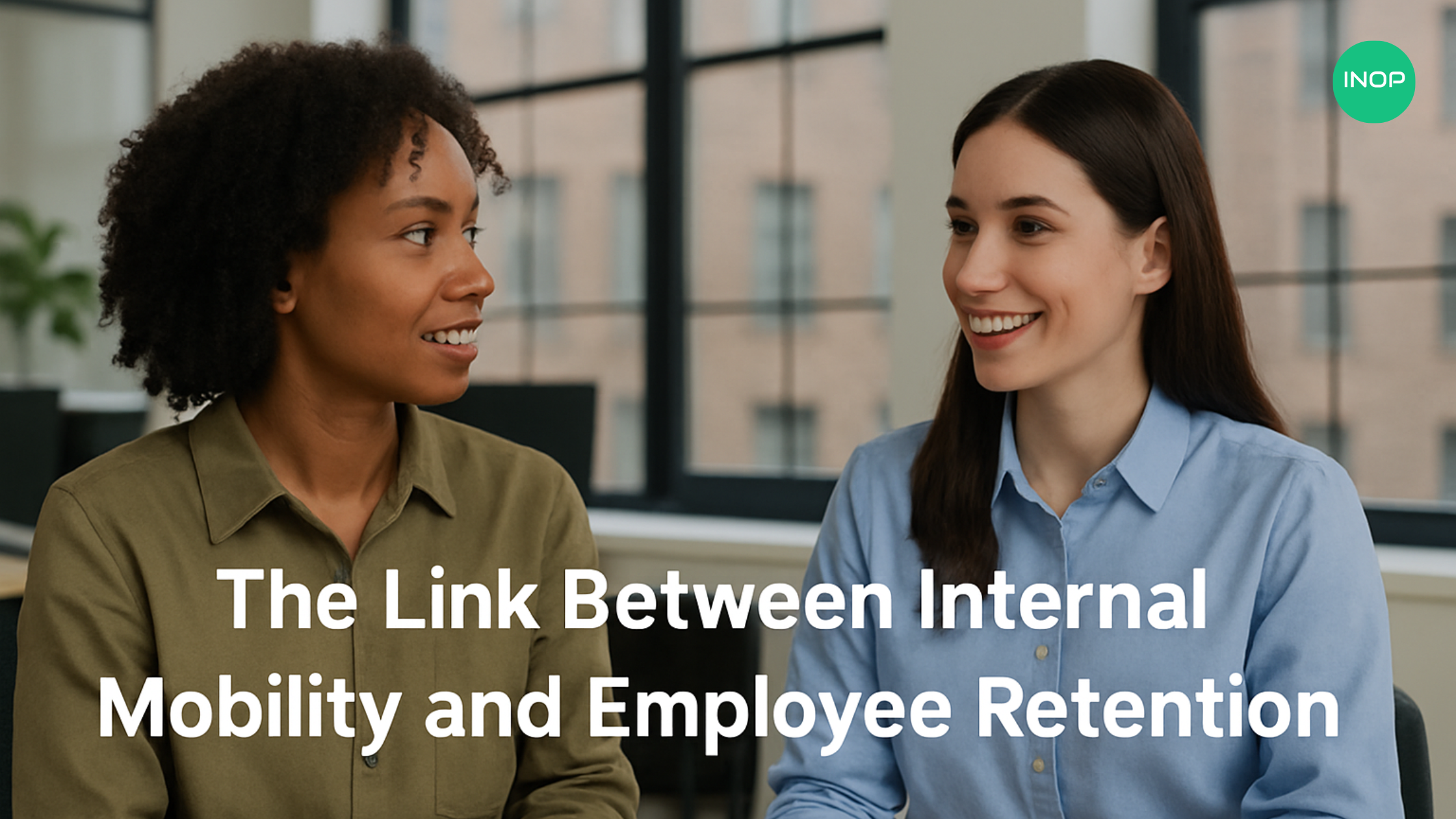
AI for internal mobility uses skills data and machine matching to surface employees for internal roles, projects, and career paths they’d otherwise never see, before those employees start looking outside the company instead. It’s the layer that turns internal mobility from a program that depends on who knows whom into one that runs on evidence: verified skills, real interest, and a live view of where the business actually needs capability.
This guide covers what AI for internal mobility actually does differently from a traditional internal job board, how it supports more equitable access to opportunity, what the research says about the link between internal mobility and retention, the tools available, and how to roll it out without treating it as a hiring initiative.
What Is AI for Internal Mobility
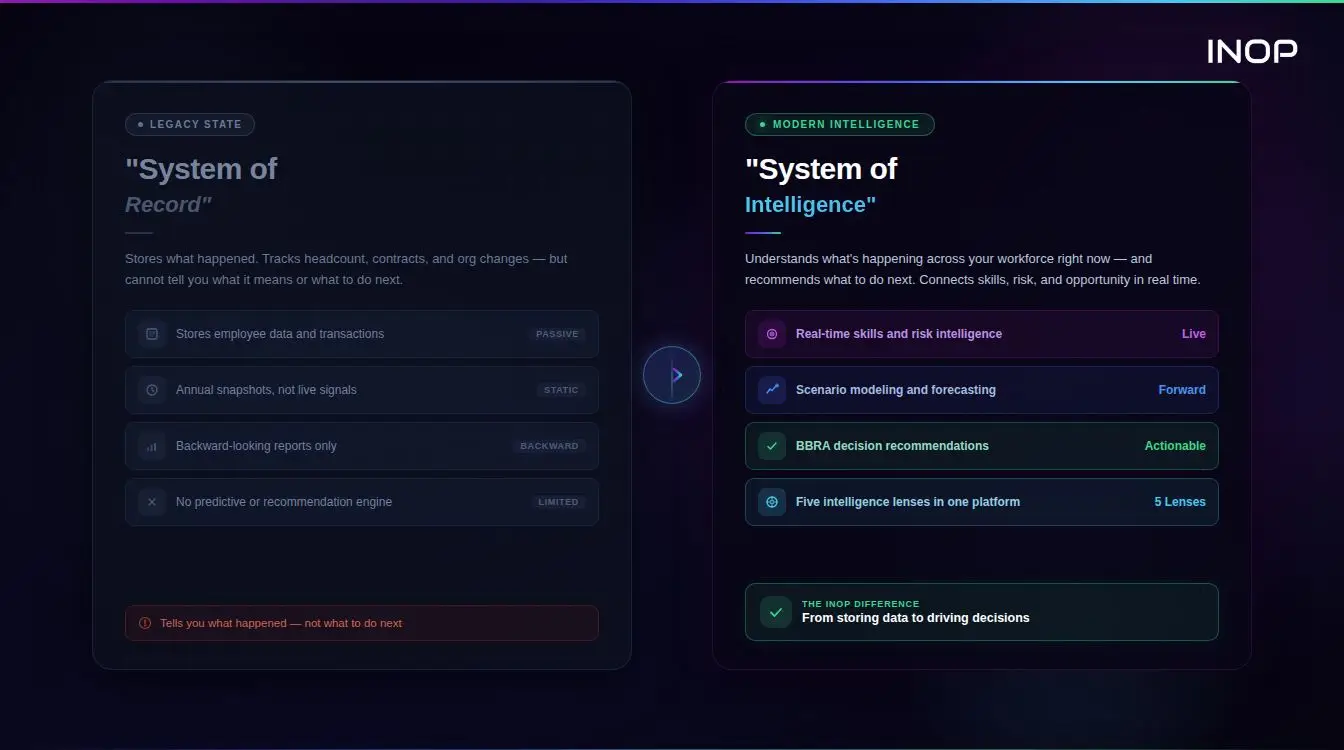
Traditional internal mobility relies on job postings, employee awareness, and manager willingness to let someone move. It works reasonably well for the subset of employees who are already visible, well-networked, and actively watching internal job boards. It works poorly for everyone else. AI for internal mobility replaces that passive, visibility-dependent model with active matching: employee skills profiles, built from assessments, project history, and verified capability data, are continuously compared against open roles, projects, and emerging needs, and matches get surfaced proactively rather than requiring the employee to find them first.
How AI for Internal Mobility Differs from Traditional Internal Mobility Programs
The practical difference shows up in three places. Coverage: a manual internal job board only reaches employees who check it; an AI-driven system evaluates the entire workforce against every open opportunity, continuously. Timing: manual matching happens after a role is posted; AI matching can happen before a role is even formally open, surfacing internal readiness as a business need starts to form. Evidence: manual internal moves often depend on a manager’s personal impression of an employee; AI-driven matching is grounded in structured skills data, which is auditable in a way a manager’s gut sense never is.
How AI Supports Equitable Internal Mobility
Internal mobility has historically had a visibility problem, and that problem falls unevenly. Employees who are well-networked, in the right meetings, or simply better known to leadership get considered for stretch opportunities more often than equally capable colleagues who aren’t. This is not a hypothetical concern; a large share of HR leaders say internal mobility is a top priority precisely because of its retention impact, and 86% of HR leaders report internal mobility as a top retention priority in recent survey research, yet most organizations still run the process informally, which reproduces exactly the visibility gap a formal program is meant to fix.
AI for internal mobility addresses this directly by evaluating every employee against every relevant opportunity on the same structured criteria, rather than relying on whichever employees happened to be visible to the people making the decision. That doesn’t make the system automatically fair. Poorly built matching models can encode the same biases present in historical promotion data if that data trains the system without correction. Getting equity right requires auditing match outcomes across demographic groups on a regular cadence, being deliberate about which signals the model weighs, and treating the AI as a candidate-surfacing tool that expands who gets considered, not a final decision-maker that replaces human judgment entirely.
Studies on Internal Mobility and Retention in Skills-Led Organizations
The connection between internal mobility and retention is one of the better-documented relationships in workforce research. Employees at companies that hire regularly from within stay meaningfully longer than employees at companies that default to external hiring, roughly 41% longer according to LinkedIn’s Global Talent Trends research. The retention advantage isn’t limited to promotions either; lateral moves, stretch projects, and cross-functional assignments all show a meaningful positive effect on how long employees stay.
The cost side of the research is equally clear. External hires are paid meaningfully more than internally promoted employees for comparable roles, and despite the higher cost, tend to receive lower performance evaluations in their first two years, according to peer-reviewed research from Wharton’s Matthew Bidwell, cited in Pin’s internal mobility research summary. That combination, higher cost and weaker early performance for external hires relative to internal moves, is the core financial argument for prioritizing internal mobility before external search, independent of any retention benefit at all.
Despite this evidence, formal programs remain the exception rather than the rule. Only about a third of organizations run a structured internal mobility program at all, according to Symphony Talent’s research summary on internal mobility, which means most organizations are leaving a well-documented retention and cost advantage on the table simply because the process was never formalized.
Want to see how this research translates into your own workforce data? Book a demo to walk through INOP’s approach.
Internal Mobility Rate: What Good Looks Like
Internal mobility rate, the share of open roles filled by existing employees rather than external hires, is the headline metric most organizations track, but it’s only useful alongside a few supporting numbers. Track internal fill rate by role family and level, not just as a single company-wide figure, since it often hides that senior roles are filled almost entirely externally while junior roles are filled almost entirely internally, a pattern that usually signals a mobility program that isn’t reaching mid-career employees. Track time from an employee expressing interest to being seriously considered for a role, which reveals whether the process is fast enough to compete with an external offer. And track mobility rate against retention for movers versus non-movers within the same tenure band, which is the number that actually demonstrates the program is working rather than simply happening.
Workforce Intelligence Tools for Internal Mobility
| Tool | Best For | Core Function |
|---|---|---|
| Gloat | Enterprise internal talent marketplace | AI-matched internal mobility and project staffing at scale |
| Eightfold AI | Skills inference from work history | Builds skills profiles from project activity, not just self-report |
| Fuel50 | Career pathing and employee-facing exploration | Visual career pathways tied to skills gap analysis |
| Workday Talent Marketplace | Enterprises already on Workday | Internal opportunity matching within existing HCM |
| SeekOut | Internal talent search for recruiters and HRBPs | Search-based internal candidate discovery |
Most enterprise talent management suites now include some internal mobility functionality, but the depth varies significantly. Purpose-built internal marketplace platforms like Gloat and Fuel50 tend to offer richer employee-facing discovery and career pathing; HCM-native options like Workday’s Talent Marketplace offer tighter integration with existing systems but often shallower matching intelligence. The right choice depends on whether the bigger gap in your organization is technology or process, since even the best matching engine underperforms without a workforce data layer accurate enough to match against.
How AI for Internal Mobility Works in Practice
Skills Matching and Career Pathing
The core mechanism is straightforward: employee skills profiles, ideally built from a mix of self-report, manager validation, and verified project or assessment data, are matched against the skills requirements of open roles and projects, with the system surfacing ranked opportunities rather than requiring the employee to search manually.
Predictive Retention Signals
More mature implementations layer in predictive signals, flagging when a high-value employee’s engagement or internal search activity suggests flight risk, so a manager or HR partner can proactively surface a relevant internal opportunity before that employee starts interviewing elsewhere rather than after they’ve already resigned.
Manager and Employee Experience
The best-designed systems balance two audiences that don’t always want the same thing. Employees want visibility into every relevant opportunity. Managers want some control over losing a strong performer to another team. Programs that ignore manager concerns entirely tend to generate quiet resistance that undermines adoption; the more durable approach gives managers structured notice and a defined transition window rather than veto power over an employee’s internal move.
Rolling Out AI for Internal Mobility Without Starting From Hiring
Because internal mobility tools sit adjacent to talent acquisition systems, it’s tempting to roll them out as an extension of the recruiting function. That’s a mistake. Internal mobility works best when it’s positioned as a development and retention initiative that HR business partners and people managers own, with recruiting involved only for the subset of moves that require a formal transfer process. Starting the rollout with a single high-attrition-risk business unit, proving retention impact there, and expanding from that evidence tends to build far more durable organizational buy-in than an enterprise-wide launch framed around the recruiting team’s tooling.
See how skills data becomes proactive internal matches, not just a searchable directory. Book a demo to see INOP’s approach.
AI for Internal Mobility in PE Portfolio Companies
For private equity operating partners, AI-driven internal mobility offers a fast, low-cost lever for stabilizing a portfolio company’s workforce during the highest-risk period of an acquisition, the first several months post-close, when attrition risk is elevated and external hiring is often frozen or slow to restart. Surfacing existing employees for critical open roles, rather than defaulting to a paused or newly rebuilding external pipeline, keeps critical functions staffed without incurring the cost and time lag of external search during exactly the window when stability matters most.
Across a multi-company portfolio, a consistent approach to internal mobility data also gives operating partners a comparable view of workforce agility across entities, useful both for identifying which portfolio companies have real bench strength for leadership transitions and for building a defensible retention and internal development narrative ahead of an exit.
Common Pitfalls
Launching it as a recruiting tool. Framing internal mobility as an extension of talent acquisition undersells its retention value and tends to produce a program only recruiting cares about.
Skipping the equity audit. A matching model trained on historical promotion data without correction can quietly reproduce the same visibility bias a formal program is meant to fix.
No manager change management. Programs that ignore manager concerns about losing team members generate quiet resistance that undermines adoption regardless of how good the matching technology is.
Measuring activity instead of retention. Tracking how many employees have a profile or how many matches were surfaced is a vanity metric unless it’s connected to whether movers actually stay longer than non-movers.
Thin underlying skills data. Even the best matching engine underperforms if the skills data it’s matching against is outdated, self-reported without validation, or inconsistent across business units.
How INOP Approaches AI for Internal Mobility
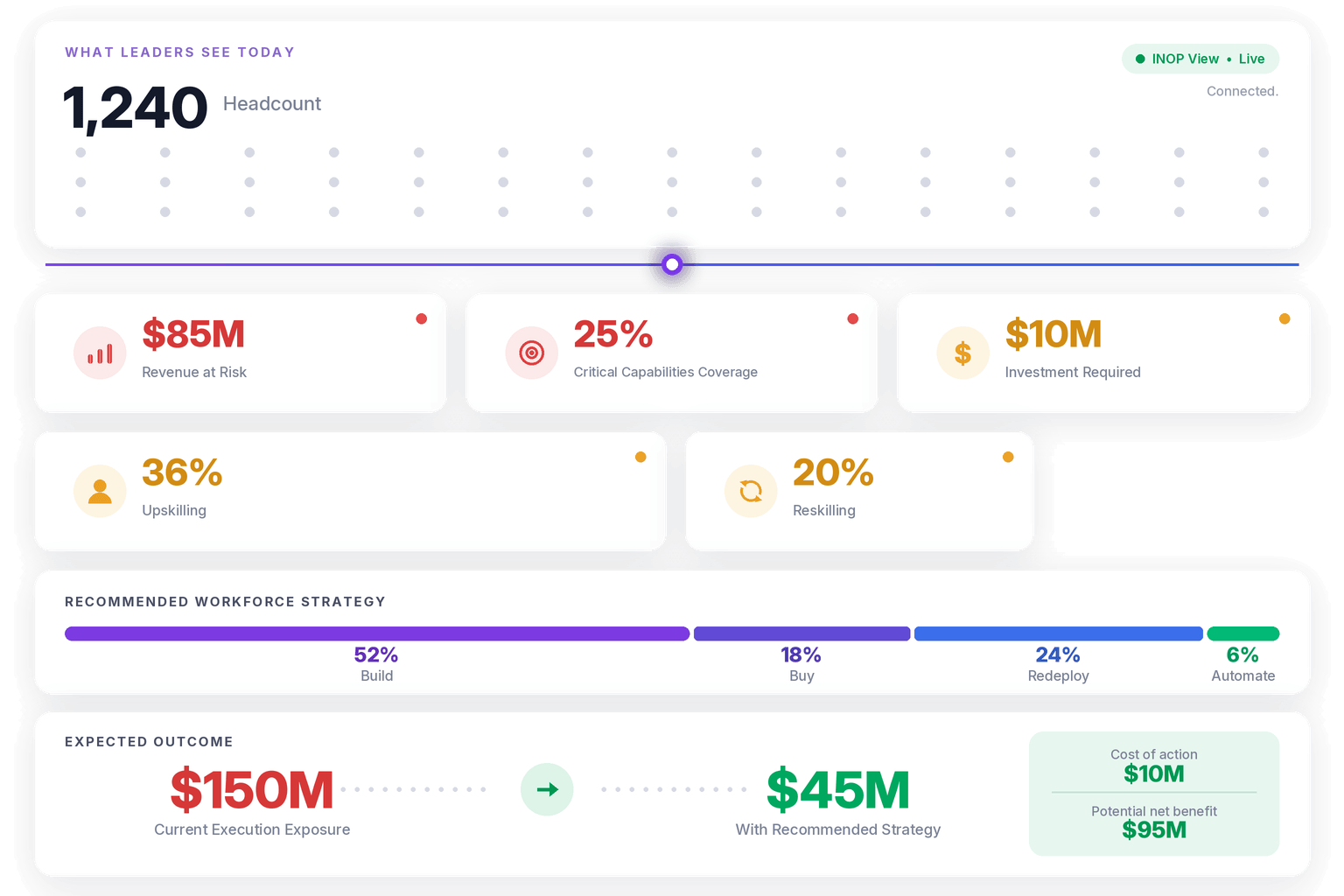
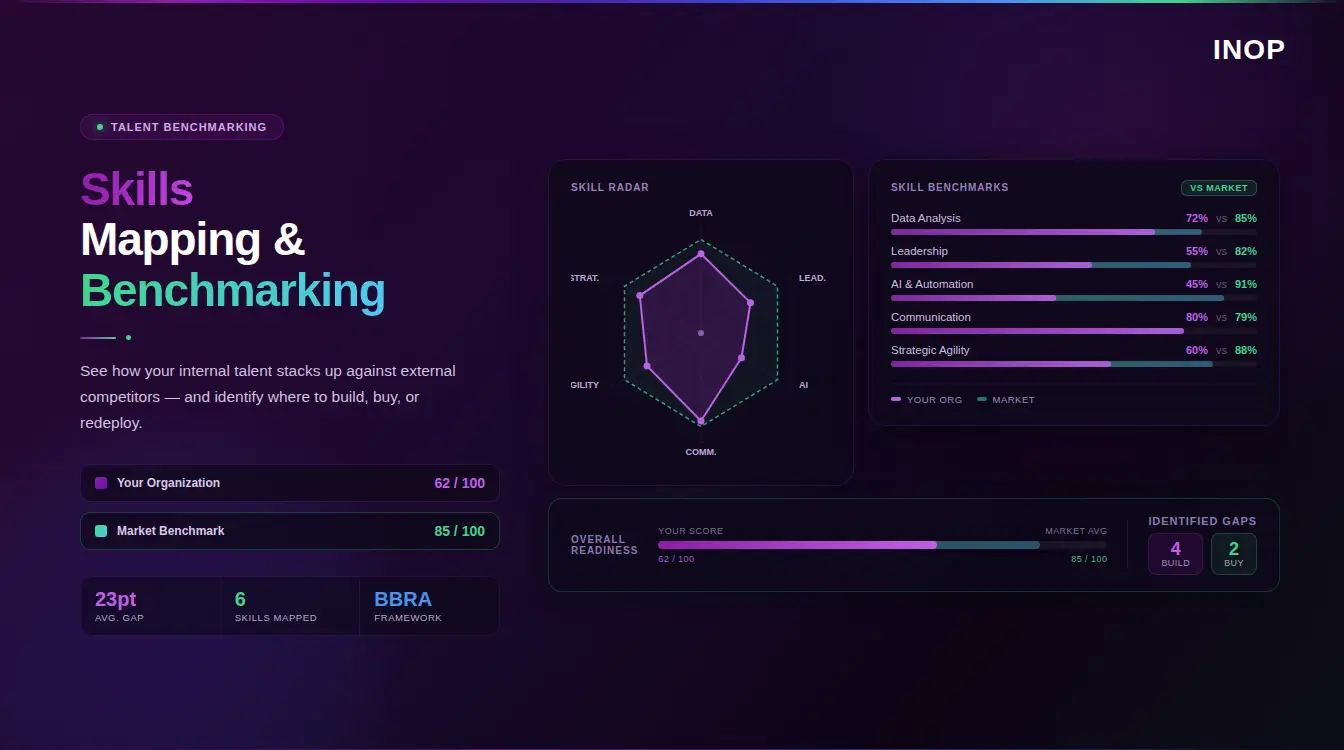
INOP treats internal mobility as one output of a broader, continuously updated view of workforce capability, synthesized across five integrated lenses: Strategy, Finance, People, Market, and AI and Automation.
Matching runs on INOP’s Skills Intelligence, which keeps employee skills profiles current and validates them against external labor market demand signals, so internal matches are grounded in verified, current capability rather than a stale profile or a manager’s informal impression.
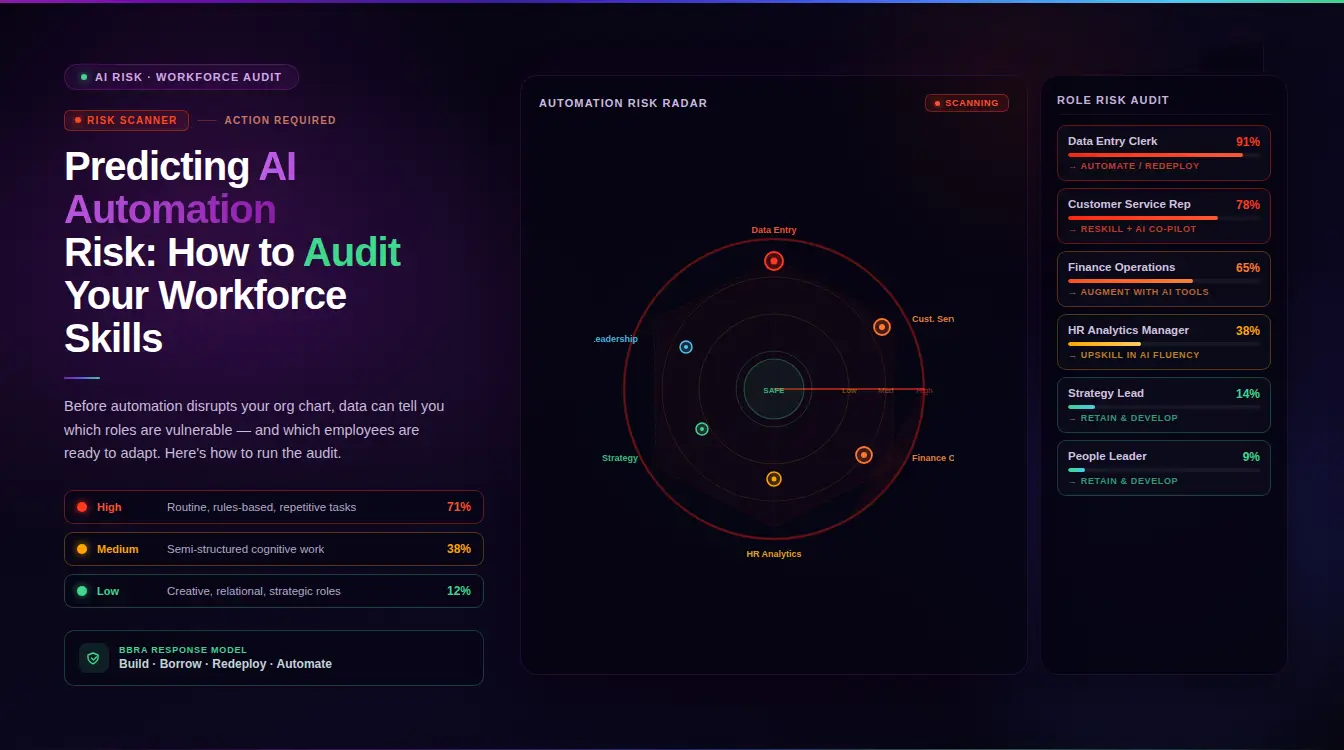
Every internal mobility decision is evaluated within INOP’s Strategic Workforce Planning platform through Build, Buy, Redeploy, Automate (BBRA), INOP’s proprietary decision architecture, which weighs the financial trade-off of redeploying an existing employee against external hiring across thirty-day, one-hundred-eighty-day, one-year, and three-year horizons, so redeployment gets evaluated with the same rigor a hiring decision would get, not treated as a fallback option.
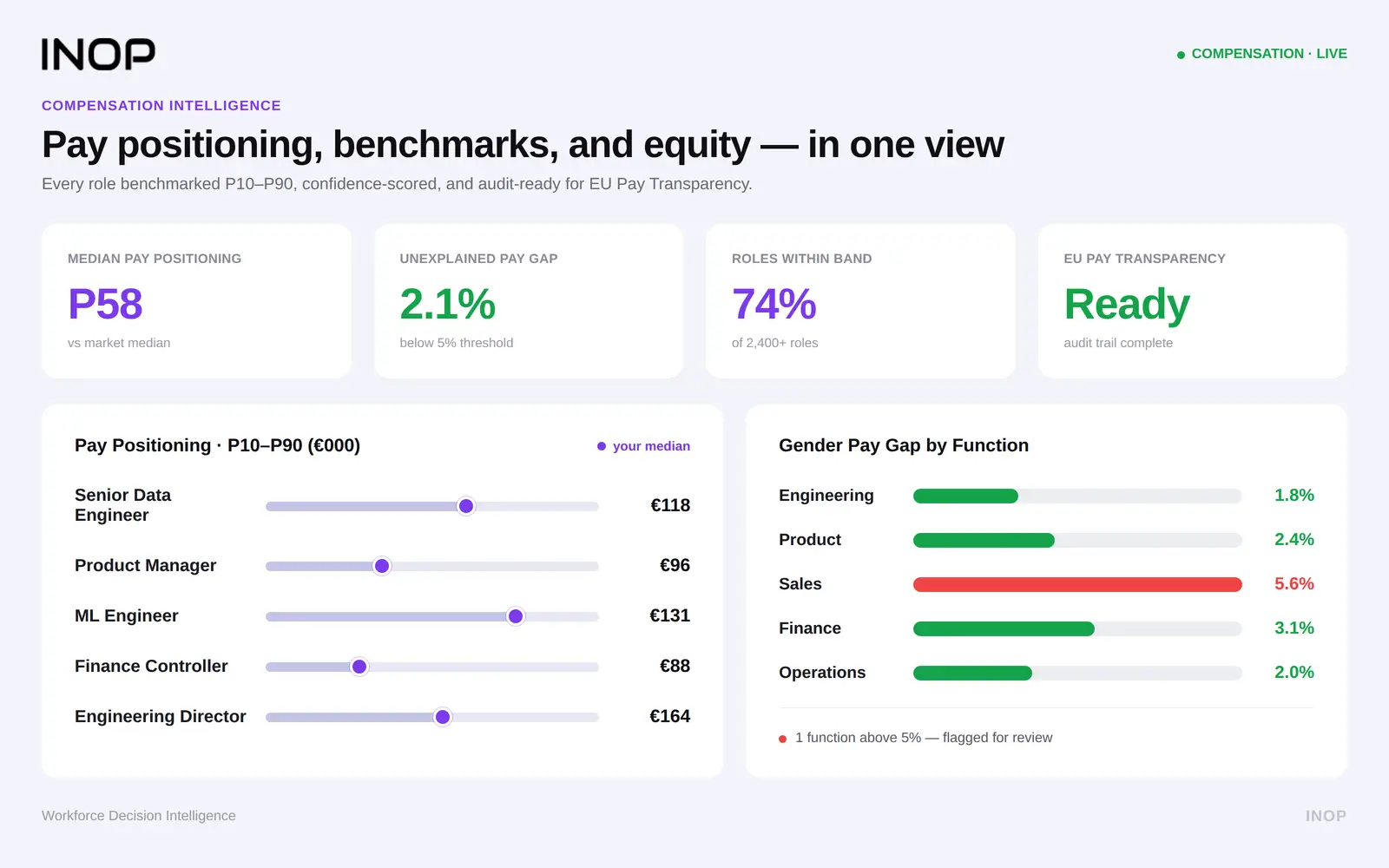
Because an internal move often comes with a compensation question attached, that evaluation also draws on INOP’s Compensation Analytics platform, so a redeployment recommendation reflects real, current market pay data rather than an outdated internal band that could make an internal move look less attractive than an external offer.
Conclusion
AI for internal mobility works because it replaces a visibility-dependent process with an evidence-based one, and the research consistently shows that evidence-based internal mobility produces both better retention and better financial outcomes than defaulting to external hiring. The organizations getting real value from it didn’t just buy a matching tool, they built the underlying skills data first, gave the program a genuine equity audit, and measured it against retention rather than activity.
Frequently Asked Questions
What is internal mobility, and how does it differ from succession planning?
Internal mobility refers to the deliberate movement of employees into new roles within the same organization — whether vertical promotions, lateral transfers, or cross-functional moves. Succession planning is a narrower practice focused specifically on identifying and preparing individuals for leadership or critical roles in the future. The key difference is scope: internal mobility applies across all levels and role types and is an ongoing, employee-driven process, while succession planning is typically top-down, leadership-focused, and tied to specific vacancies or risk scenarios. An organization can have active internal mobility without a formal succession plan, but high-performing enterprises use both together as complementary retention levers.
What is the internal mobility rate and how is it calculated?
The internal mobility rate measures the percentage of open roles filled by existing employees rather than external hires. The formula is: (number of internal hires in a period ÷ total hires in the same period) × 100. For example, if a company made 80 total hires in a quarter and 20 were filled internally, the internal mobility rate is 25%. Average organizations typically fall between 10% and 15%, while top-performing enterprises target 20% to 30%. Tracking this metric quarterly gives HR leaders a measurable signal of whether the organization is actually using its internal talent pool or defaulting to external recruitment by default.
What internal mobility rate should large enterprises aim for?
Industry benchmarks place the healthy target range for enterprise organizations at 20% to 30% of roles filled internally. At this level, organizations see meaningful reductions in external recruiting costs and measurable improvement in average employee tenure. Research indicates that employees at companies with high internal mobility stay an average of 5.4 years, compared to 2.9 years at companies with low mobility. Enterprises that fall below 10% are typically leaving a significant retention and cost-reduction opportunity untapped, since replacing a mid-level employee can cost between 50% and 150% of their annual salary.
How does AI support internal mobility programs in large organizations?
AI-powered internal mobility platforms do three things that manual or spreadsheet-driven processes cannot: they map the entire organization’s skills landscape continuously, they surface role-fit matches to employees before those employees begin looking externally, and they remove the manager-as-gatekeeper bottleneck that causes high-potential employees to stagnate in roles where they are visible to only one leader. Machine learning models can analyze an employee’s current skills, performance history, and stated career aspirations against all open roles, projects, and mentorship opportunities — and proactively recommend the best-fit next move. At enterprise scale, this shifts the HR function from reactive replacement to proactive retention.
How do enterprises use internal mobility software to reduce turnover specifically?
Enterprise internal mobility software reduces turnover by solving the visibility problem. In large organizations with siloed departments, employees often don’t know that relevant opportunities exist in other parts of the business. Software centralizes all open roles across every department and location into a single employee-facing interface, meaning someone in finance can discover and apply for a data analytics role in marketing without relying on informal networks or manager referrals. This directly addresses one of the most consistent reasons employees cite for leaving: lack of visible career advancement within the organization. Research shows that 81% of organizations offering structured internal mobility reduce turnover by 30% or more.
How do AI-powered internal mobility tools support pay equity and fairness?
A persistent limitation of informal internal mobility — where managers nominate candidates based on personal visibility — is that it disproportionately benefits employees who are already well-networked or whose managers are strong advocates. AI platforms that match employees to opportunities based on verified skills data rather than relationships create a more equitable process. This matters particularly for gender and ethnicity equity: when internal job boards are paired with skills-based matching and transparent eligibility criteria, organizations reduce the structural bias that causes high-performing employees from underrepresented groups to be systematically overlooked for advancement, which in turn drives regrettable attrition.
What metrics should HR teams track to measure the impact of an internal mobility program?
The core metrics are: internal mobility rate (percentage of roles filled internally), internal hire retention rate versus external hire retention rate, average time-to-productivity for internal versus external hires, internal application rate (how many employees are actively engaging with the internal job board), and manager release rate (how readily managers are letting talent move to other teams). Beyond those, leading indicators include engagement scores among employees who have not moved internally in 18+ months — this cohort is the highest-risk group for voluntary attrition and the primary target for proactive mobility outreach.
Book a Demo
Make confident workforce decisions that support strategy and value creation.