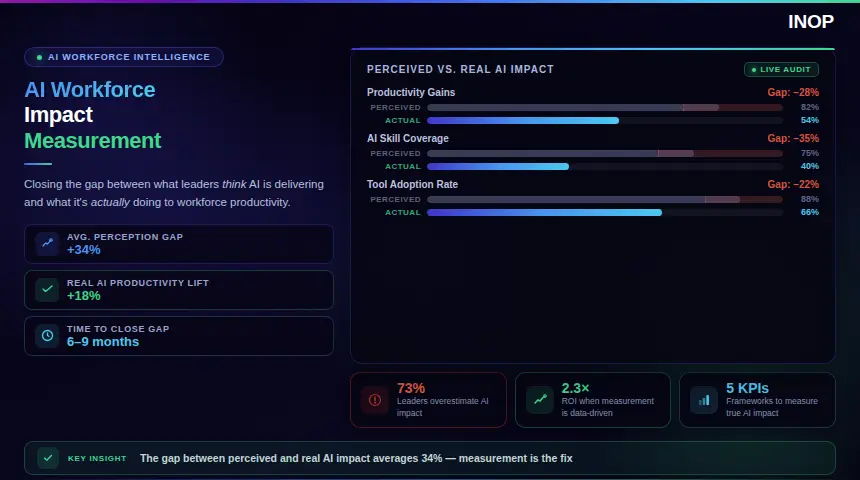
AI workforce impact measurement is the practice of tracking what AI adoption actually does to workforce output, capability, and risk, using verified data rather than confidence surveys. Most organizations can already tell you how their employees feel about AI. Far fewer can tell you, with evidence, what AI has actually changed about how those employees work, and that gap between perception and proof is where the real risk sits.
This guide covers the measurement gap current research keeps surfacing, what a credible measurement approach actually tracks, and how to connect measured impact to a real decision instead of a quarterly sentiment report.
What AI Workforce Impact Measurement Actually Means
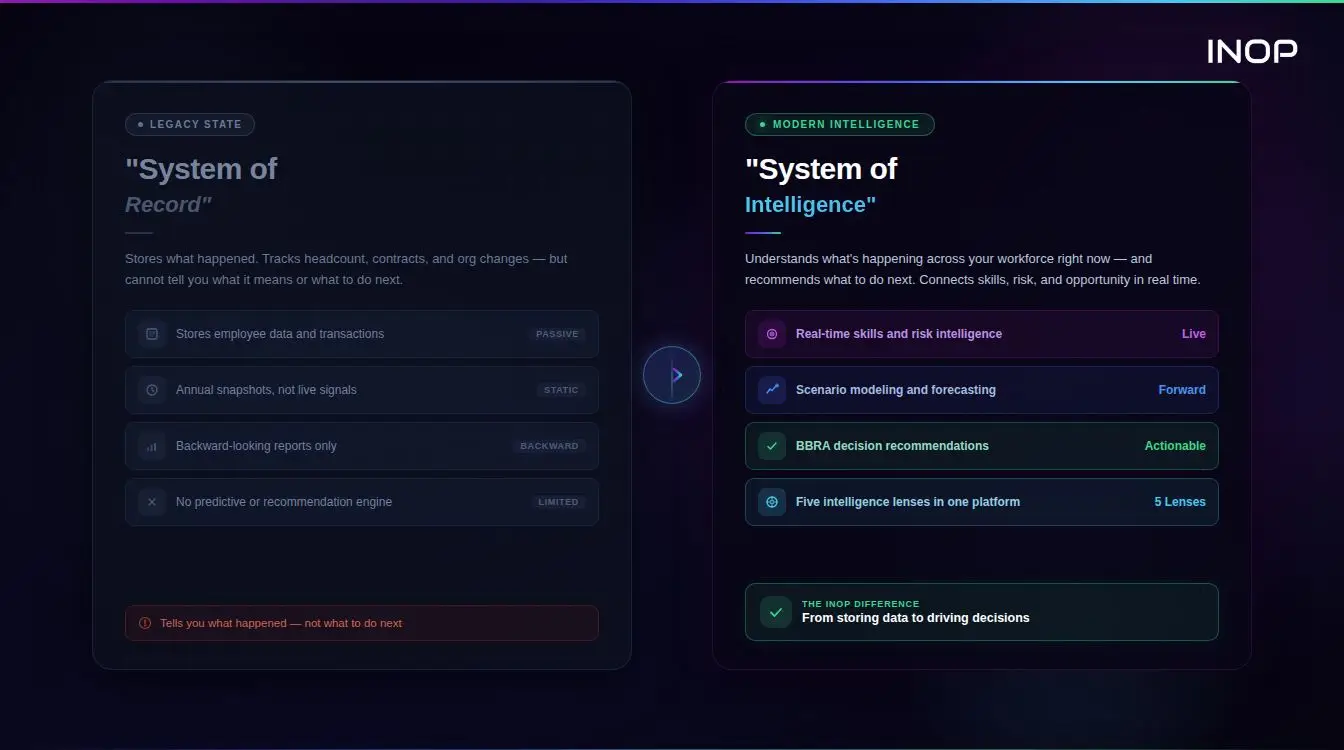
AI workforce impact measurement is not the same as tracking AI adoption. Adoption tells you how many employees are using a tool. Impact measurement tells you what changed as a result, in output, in capability, in risk exposure, and whether that change matches what the organization expected when it made the investment. Most organizations conflate the two, reporting adoption rates as though they were evidence of impact.
The Measurement Gap Nobody Talks About
Recent research has started to quantify just how wide the gap is between what employees believe AI is doing for their output and what shows up in verified, firm-level data.
Self-Reported Impact Runs Far Ahead of Measured Impact
A 2026 survey of technical workers found a median self-reported change in the value of their work of 1.3 times in March 2025, rising to roughly 2 times by March 2026, with respondents forecasting 2.5 times by March 2027, according to METR’s research on self-reported AI usage impact. The same research is candid about its own limitations, noting there are reasons to be skeptical of the magnitude of these self-reported figures. That skepticism is warranted once you compare it against harder measurement: firm-level labor productivity gains attributable to AI average just 0.29 percent, and macro-level total factor productivity growth attributable to AI sits at roughly 0.07 percentage points per year, according to recent analysis compiling AI productivity research. Workers feel a 2x change. The verified firm-level number is closer to a rounding error.
Firm-Level Productivity Gains Remain Small and Concentrated
The same research found that the top 20 percent of companies are capturing roughly 74 percent of the measured AI value being generated, which means most of the productivity story currently belongs to a small group of organizations that have built real measurement and deployment discipline, not to AI adoption broadly. Separately, 91 percent of businesses now report using AI in some capacity, yet 80 percent see no measurable bottom-line impact from it, and worker confidence in using the technology fell 18 percent even as regular usage climbed, according to recent AI productivity statistics research. Adoption without a way to measure impact is producing exactly this pattern: broad usage, concentrated results, and declining confidence in between.
See how INOP measures AI’s real impact on your workforce against verified data, not sentiment. Book a demo to walk through a live measurement view for your organization.
What to Actually Measure
Closing the gap between perceived and real impact means tracking a specific set of signals, not a single satisfaction score.
Task-Level Productivity, Not Just Adoption Rates
Productivity impact from AI varies significantly by task and job, with controlled studies showing gains in the range of 20 to 60 percent while most real-world experiments show gains closer to 15 to 30 percent, according to the International AI Safety Report’s review of productivity research. That gap between controlled and real-world results is itself a measurement finding worth tracking internally, since it means a pilot’s results rarely translate directly to deployment at scale. Measuring at the task level, rather than reporting a single company-wide productivity figure, is what surfaces where AI is actually delivering and where it is not.
Workforce Sentiment and Confidence Alongside Output
Output data alone misses half the picture. Regular AI usage has climbed to 45 percent of workers even as confidence in using the technology has fallen sharply, a combination researchers link to rising “job hugging,” where a majority of workers plan to stay with their current employer specifically to avoid the uncertainty of a job change, according to the same AI productivity research. Measuring sentiment alongside output catches a risk that a pure productivity dashboard would miss entirely: employees who are technically more productive on paper while becoming quietly less engaged and more retention-flighted underneath it.
Role-Level Exposure and Displacement Risk
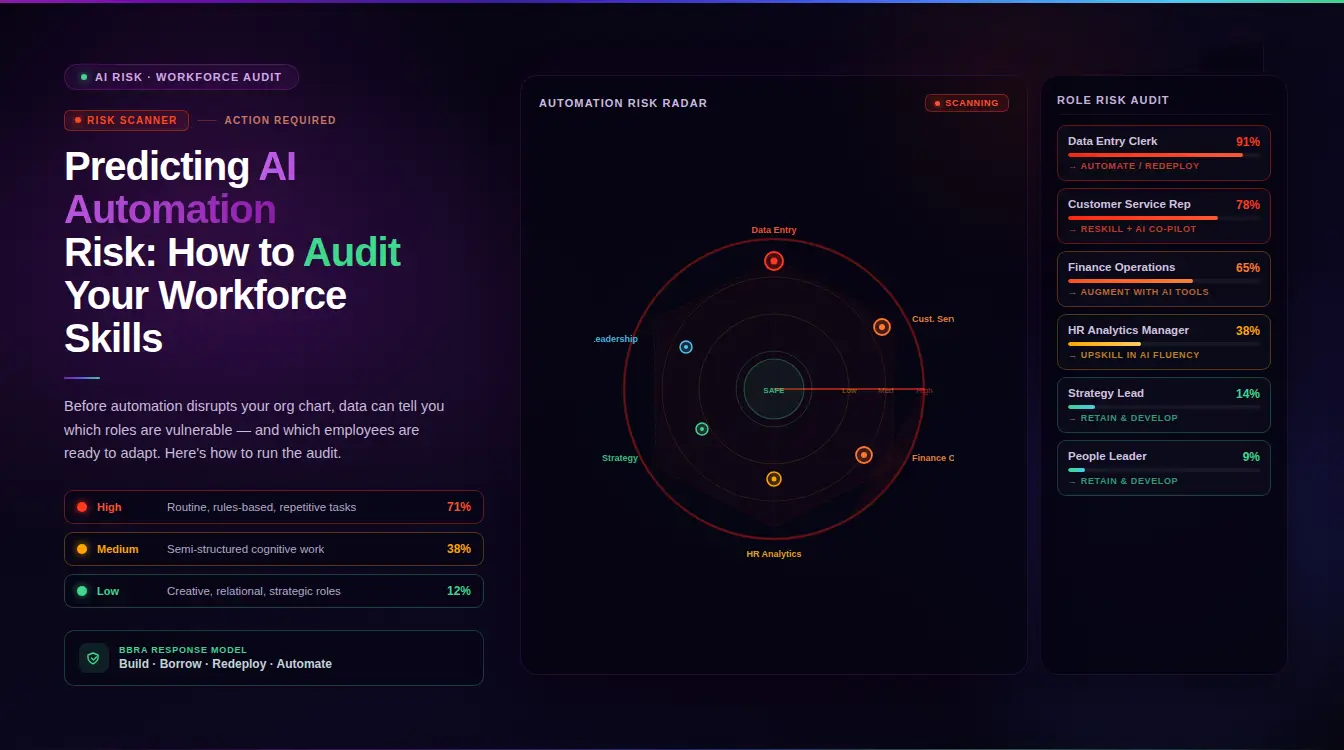
Impact measurement also needs to track which roles are structurally exposed to AI-driven change, separate from how those roles currently feel about it. Forrester’s research projects that 6.1 percent of United States jobs will be lost to AI by 2030, with roughly 20 percent of jobs significantly impacted in some form short of elimination, according to recent research compiling enterprise AI productivity reports. INOP’s skills intelligence platform supports this layer of measurement directly, mapping which roles carry the highest exposure based on external labor market signals rather than internal assumption, so displacement risk gets tracked before it shows up as unplanned attrition or a restructuring decision made under pressure.
Applying INOP’s Five Intelligence Lenses to AI Workforce Impact Measurement
A single productivity number, even a verified one, does not tell you whether an AI investment is actually working. INOP evaluates measured AI impact through five intelligence lenses before drawing a conclusion from it.
- Strategy: Is the measured impact showing up in the specific business priority the AI investment was meant to support, or somewhere else entirely?
- Finance: Does the measured productivity gain translate into an actual return, given what firm-level data shows about how concentrated real AI value currently is?
- People: Is measured output improving while sentiment and confidence quietly decline, a combination that predicts future attrition risk?
- Market: How does the organization’s measured impact compare to what verified external benchmarks show for similar roles and industries?
- AI and Automation: Does the measured impact reflect genuine capability uplift, or a task that was simply automated away, which calls for a different response?
Turning Measured Impact Into Action with BBRA
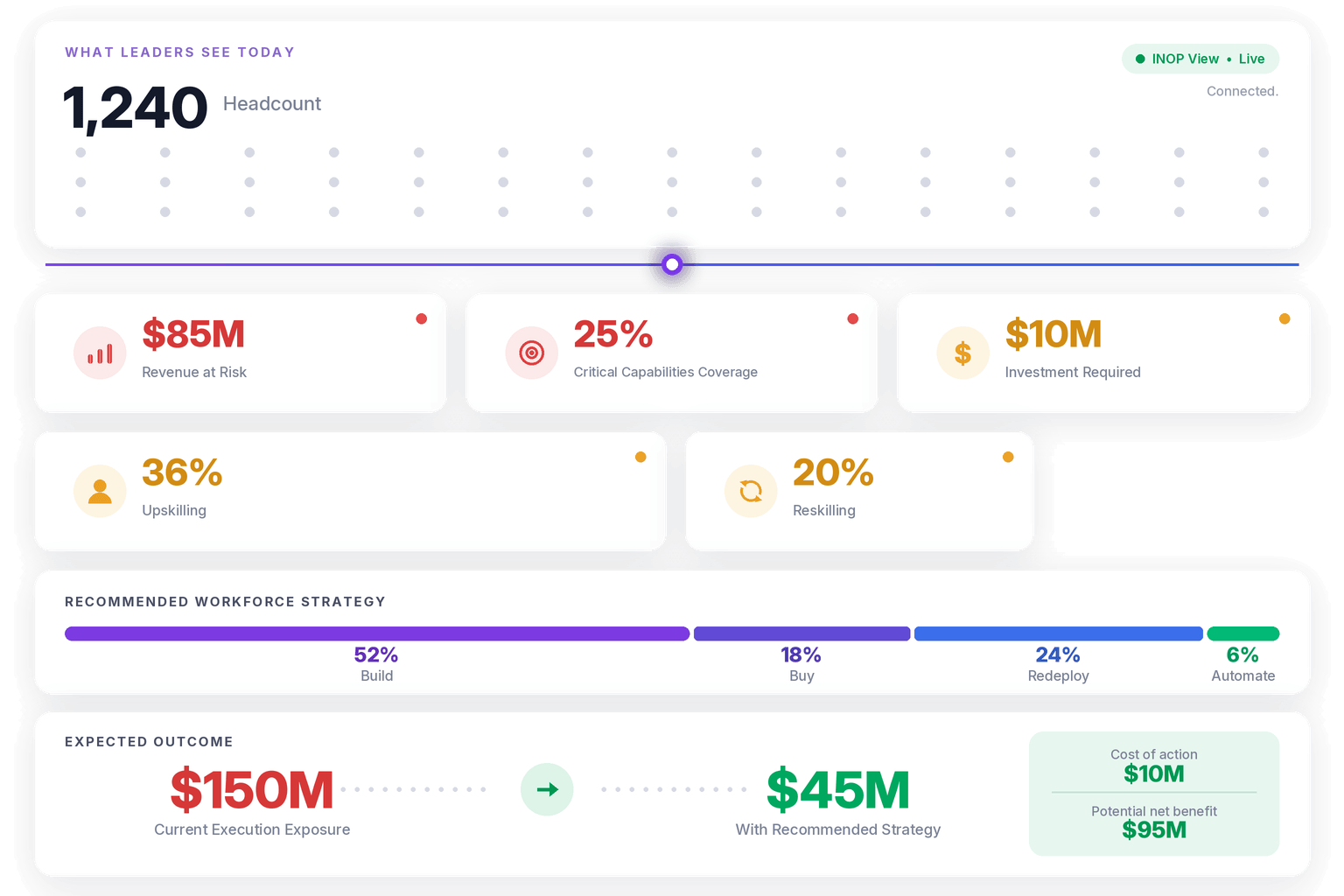
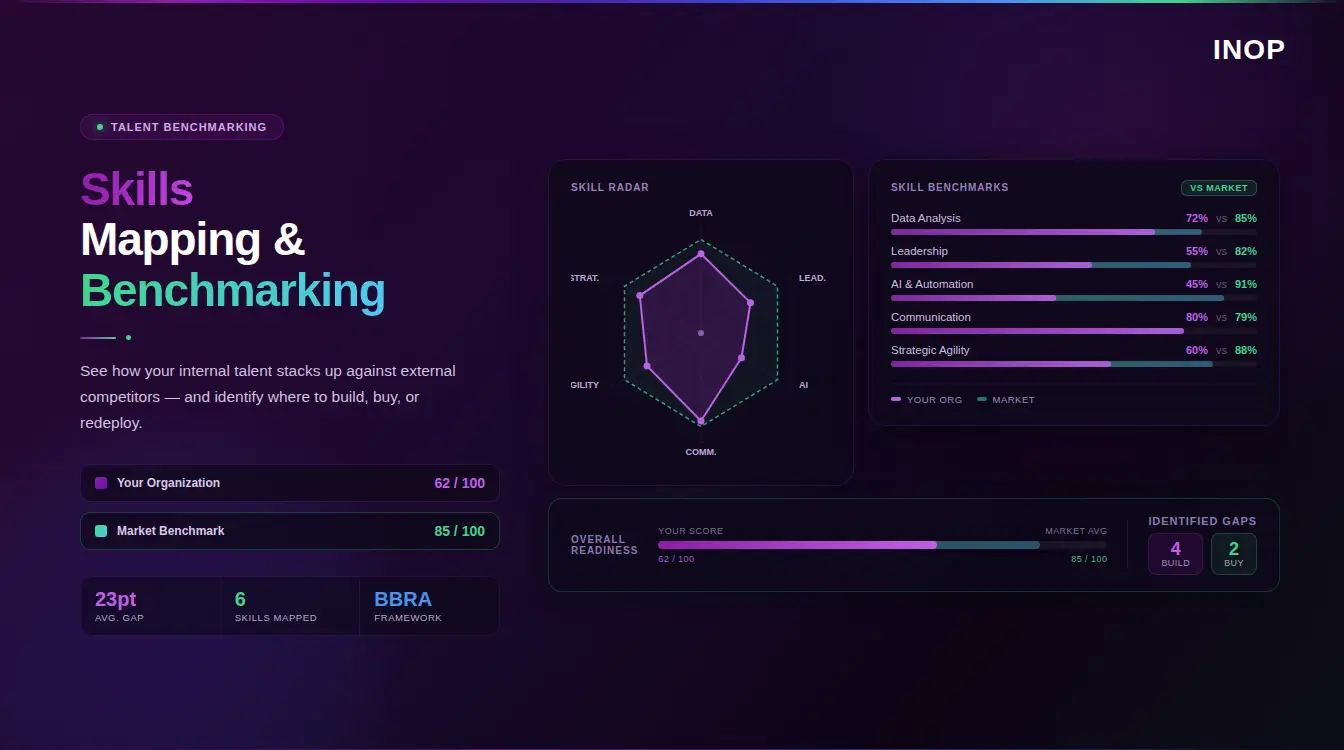
Measurement that stops at a dashboard produces awareness without a next step. INOP’s proprietary BBRA framework, Build, Buy, Redeploy, and Automate, connects a measured impact finding to a modeled response, comparing all four pathways against financial tradeoffs across four time horizons: thirty days, one hundred eighty days, one year, and three years.
Applied to a measurement finding, this means a role showing high AI exposure and low current AI proficiency does not sit in a report waiting for the next planning cycle. It gets compared immediately: would targeted upskilling close the capability gap fastest, would redeploying someone with adjacent skills be quicker, does external hiring make sense given current market scarcity, or does the task itself warrant automation given what the measured impact data actually shows. Novice-level employees see measurable AI productivity gains as high as 34 percent in some roles, while experts in the same roles often see zero or negative gains, according to recent research on AI productivity across skill levels, a bifurcation that only becomes actionable once it feeds into a decision process like BBRA rather than sitting as an interesting finding in a report nobody acts on.
AI Workforce Impact Measurement for Private Equity Operating Partners
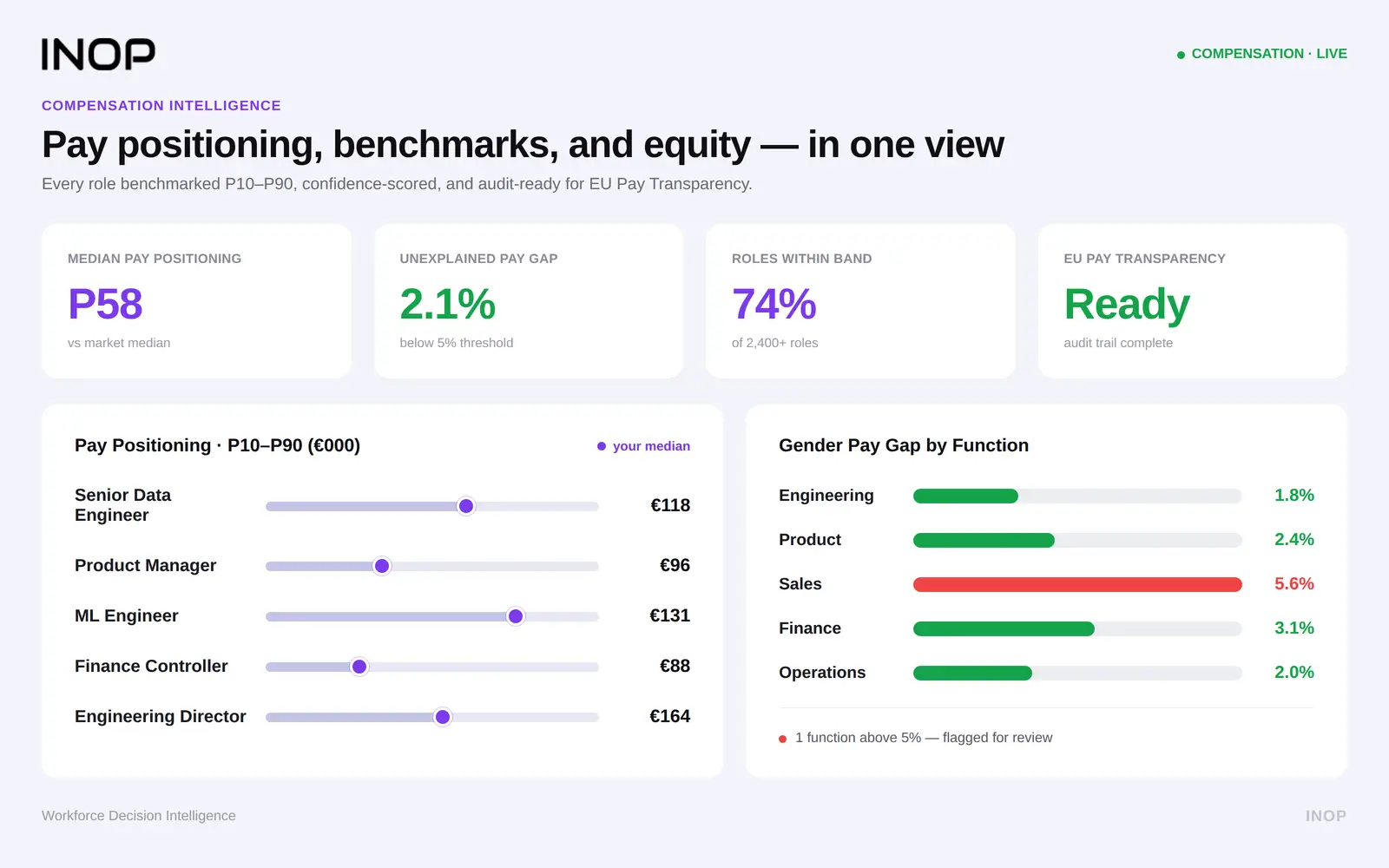
Inside a portfolio company, unverified AI impact claims are one of the easiest places for a hundred-day plan to go wrong. A portfolio company reporting strong AI-driven productivity gains based on employee self-report alone is reporting exactly the kind of figure current research shows runs well ahead of what verified firm-level data would confirm. Standardizing AI workforce impact measurement across a portfolio through INOP’s strategic workforce planning platform gives operating partners a consistent, verified way to compare AI-driven claims across assets rather than taking each portfolio company’s self-reported productivity story at face value. Where measured impact surfaces roles carrying disproportionate AI exposure and value, INOP’s compensation analytics platform connects that finding into pay benchmarking, since employees delivering verified AI-driven value are often underpriced relative to what the market would pay to retain that capability elsewhere.
Common Mistakes in AI Workforce Impact Measurement
Treating adoption rate as impact. A high percentage of employees using an AI tool says nothing about whether that use is translating into measurable output, and the gap between the two is currently wide across most industries.
Relying entirely on self-reported productivity. Self-report consistently runs ahead of verified firm-level data, sometimes by a wide margin, which makes it a poor sole input for a decision involving real budget.
Ignoring sentiment while output looks fine. A role that appears more productive on paper while quietly losing confidence and engagement is a retention risk hiding behind a good-looking metric.
Measuring once, at launch, and never again. AI-driven productivity impact shifts as tools mature and workers adjust, which is part of why INOP’s guidance on building measurement frameworks that track skills coverage, time to proficiency, and business impact on an ongoing basis treats measurement as continuous infrastructure rather than a one-time report.
Never connecting measurement to a decision. A verified impact number that does not feed into a build, buy, redeploy, or automate decision is a finding, not a plan. Organizations that use an AI skills engine to identify and reskill an existing employee see roughly 23 percent better cost efficiency than hiring externally, a gap detailed in INOP’s research on the business case for an AI skills engine, but that advantage only materializes when measured impact actually drives the redeployment or upskilling decision rather than sitting in a report.
Frequently Asked Questions
What is the difference between AI adoption tracking and AI workforce impact measurement?
Adoption tracking counts how many employees are using an AI tool. AI workforce impact measurement goes further, verifying what actually changed in output, capability, and risk as a result, since usage and measurable impact frequently diverge.
Why does self-reported AI productivity impact run ahead of measured impact?
Self-report reflects perceived value, which tends to be optimistic and grows over time as workers become more comfortable attributing gains to AI. Verified firm-level and macro productivity data currently shows a far smaller, more concentrated impact than employee self-report alone would suggest.
How often should AI workforce impact be measured?
Continuously rather than at a single launch checkpoint, since impact shifts as tools mature, workers adjust their usage, and the gap between novice and expert gains changes over time within the same role.
What should happen after AI workforce impact measurement identifies a gap?
The finding should be run through a decision model comparing build, buy, redeploy, and automate pathways before any budget or restructuring decision gets made. Measurement without a connected decision step produces a report, not a resolved gap.
How should private equity operating partners evaluate a portfolio company’s AI workforce impact measurement?
By checking whether reported productivity gains are backed by verified, firm-level data or rely primarily on employee self-report. The latter is currently running well ahead of what independent research shows AI is actually delivering at the firm level.
Ready to see what AI is actually doing to your workforce, beyond a confidence survey? Book a demo and INOP will walk through verified impact measurement for your organization, run every finding through BBRA, and show you exactly where to act first.