Organisations have never invested more in artificial intelligence (AI). Yet despite unprecedented advances in technical capabilities, transformation programmers continue to stall, productivity gains fall short, and many initiatives fail to scale.
The scale of this challenge is becoming impossible to ignore. Research cited in INOP’s Automation Accountability Gap report found that 46% of organisations abandoned most of their AI proof-of-concept initiatives before deployment. More broadly, failed digital transformation programmes cost organisations an estimated USD 2.3 trillion annually.
AI failure is often framed as a technology problem attributed to poor implementation, unreliable models, or limited technical expertise. While these factors matter, they explain only part of the story.
Organisations possess more operational data than ever, yet they lack visibility into how AI is changing work itself. They can explain what technology has been deployed, but not how tasks are evolving, where capability gaps are emerging, or why expected productivity gains fail to materialise.
This is the visibility gap behind AI failure.
This is not a call to abandon legacy workforce metrics, but recognition that governing AI transformation requires complementing them with measures that capture operational evolution in real time.
The Paradox of Data Abundance
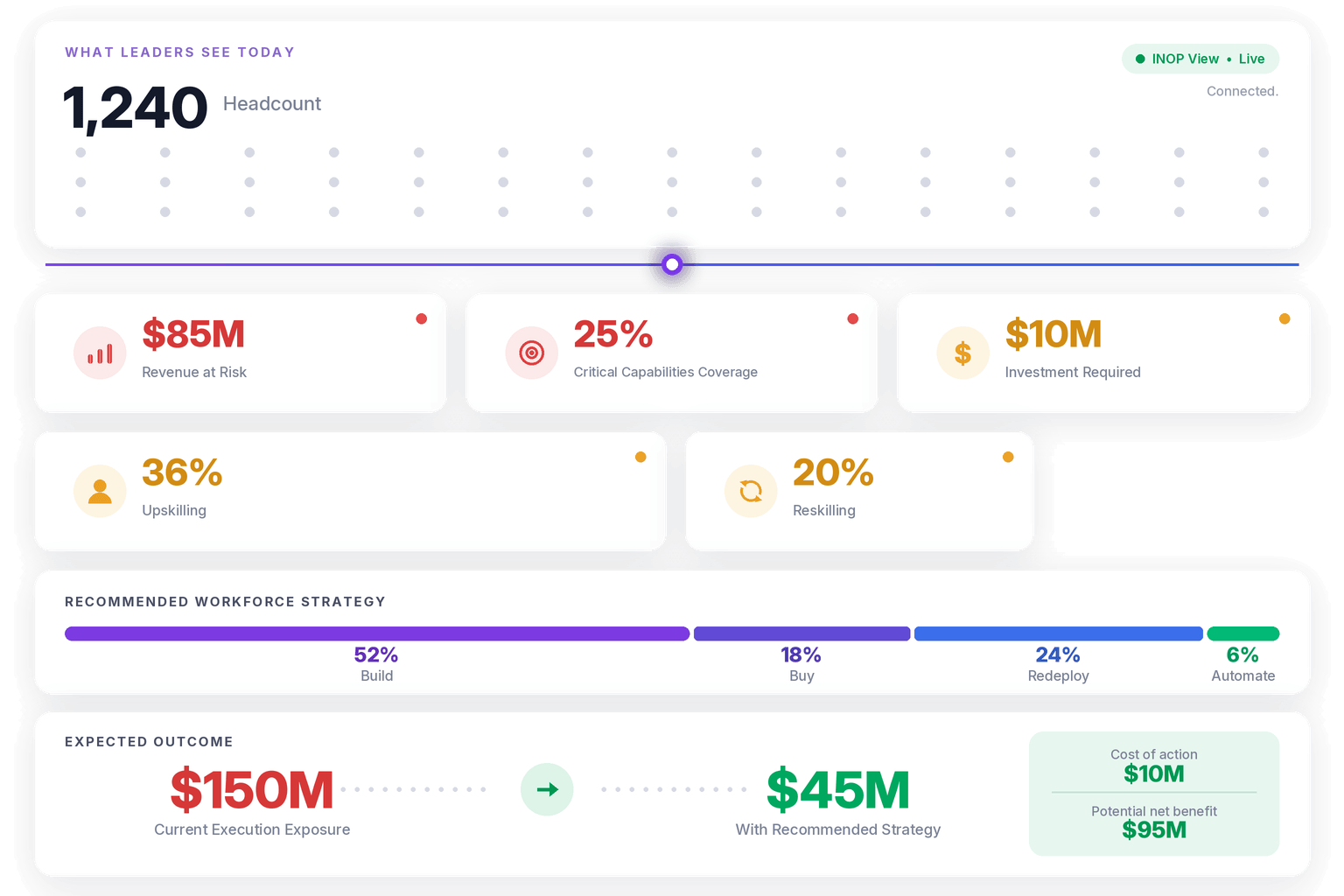
Modern organisations do not suffer from a data shortage. Enterprise systems generate an unprecedented volume of information, delivering executive dashboards that track software adoption, implementation milestones, hiring, turnover, and labour costs. Yet this abundance of data masks a deeper absence of visibility. Traditional enterprise metrics were designed to measure organisations as stable systems. They report who is employed, training completion rates, and resource allocation. They were never intended to explain how work evolves as automation becomes embedded across the enterprise. As a result, leaders monitor AI deployment in detail while remaining blind to day-to-day operational shifts. Which tasks are changing? Where is friction emerging? Which capabilities are becoming critical? This is the paradox of data abundance: organisations possess vast workforce data, yet remarkably little visibility into actual workforce change.The Anatomy of AI Failure: Three Operational Blind Spots
The visibility gap reflects a fundamental mismatch between how organisations measure work and how AI changes it. This creates three operational blind spots:The Role-to-Task Translation Gap
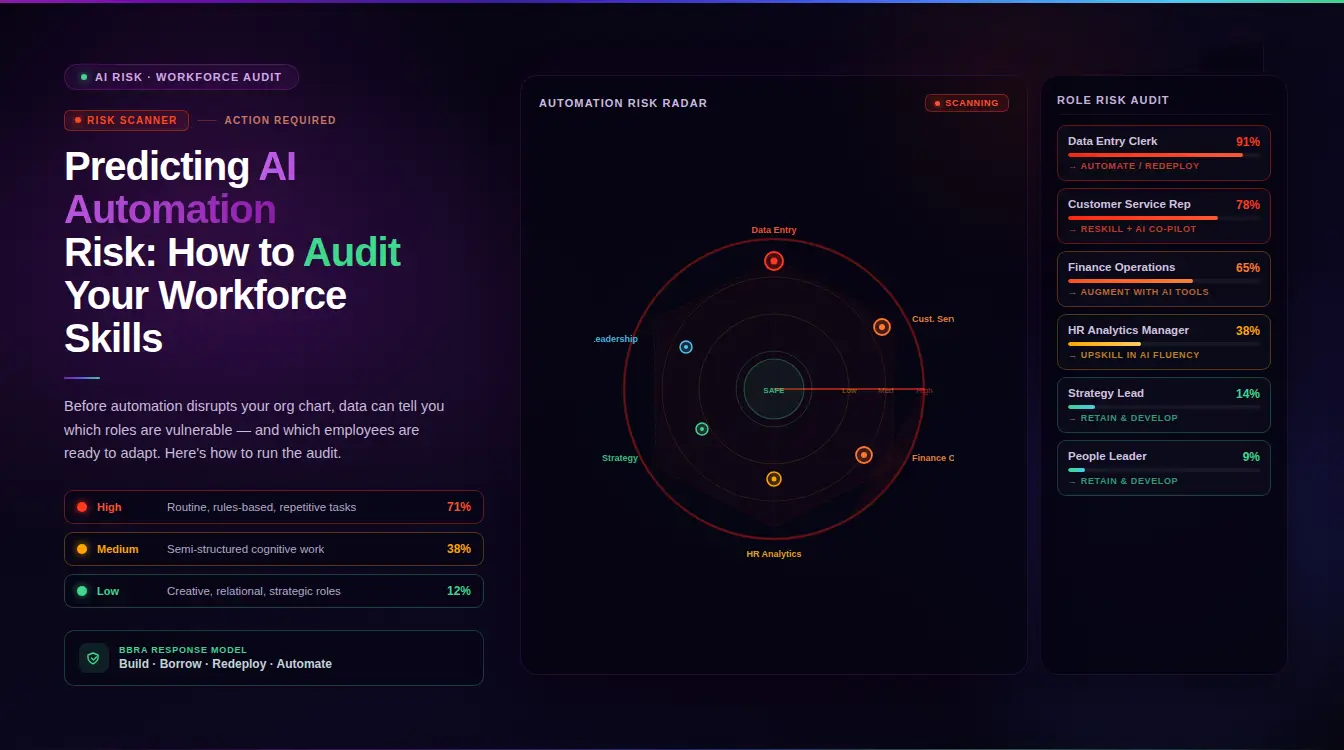
Organisations measure AI through roles. AI transforms work one task at a time. AI business cases are built around roles, assuming that task-level automation naturally translates into role-level headcount reductions or cost savings. In practice, AI rarely replaces entire jobs; it automates individual tasks within broader workflows. As routine tasks vanish, remaining work is redistributed and combined with new responsibilities requiring higher judgement or coordination. Evaluating transformation strictly through role-level metrics causes leaders to overestimate productivity gains while underestimating the effort required to realise them.The Invisible Friction of Adaptation
Even when technology performs as expected, implementation creates hidden friction. Middle managers must deliver productivity targets while managing operational uncertainty, while employees develop informal workarounds or revert to legacy processes when automated systems disrupt workflows. Because these adaptations are rarely captured by traditional reporting, leadership often assumes an initiative has succeeded while remaining unaware of the friction limiting its true value.The Hidden Cost of Transition
Deployment is not the end of change; it is the beginning of workforce adaptation. Processes require redesign, capabilities must be rebuilt, and productivity frequently fluctuates before stabilising. These transitional costs are seldom measured systematically, leaving organisations to recognise problems only after programmes fall behind schedule or financial returns require downward revision. Collectively, these blind spots illustrate why organisations possess abundant workforce data yet struggle to understand how AI is reshaping work.From Data to Visibility
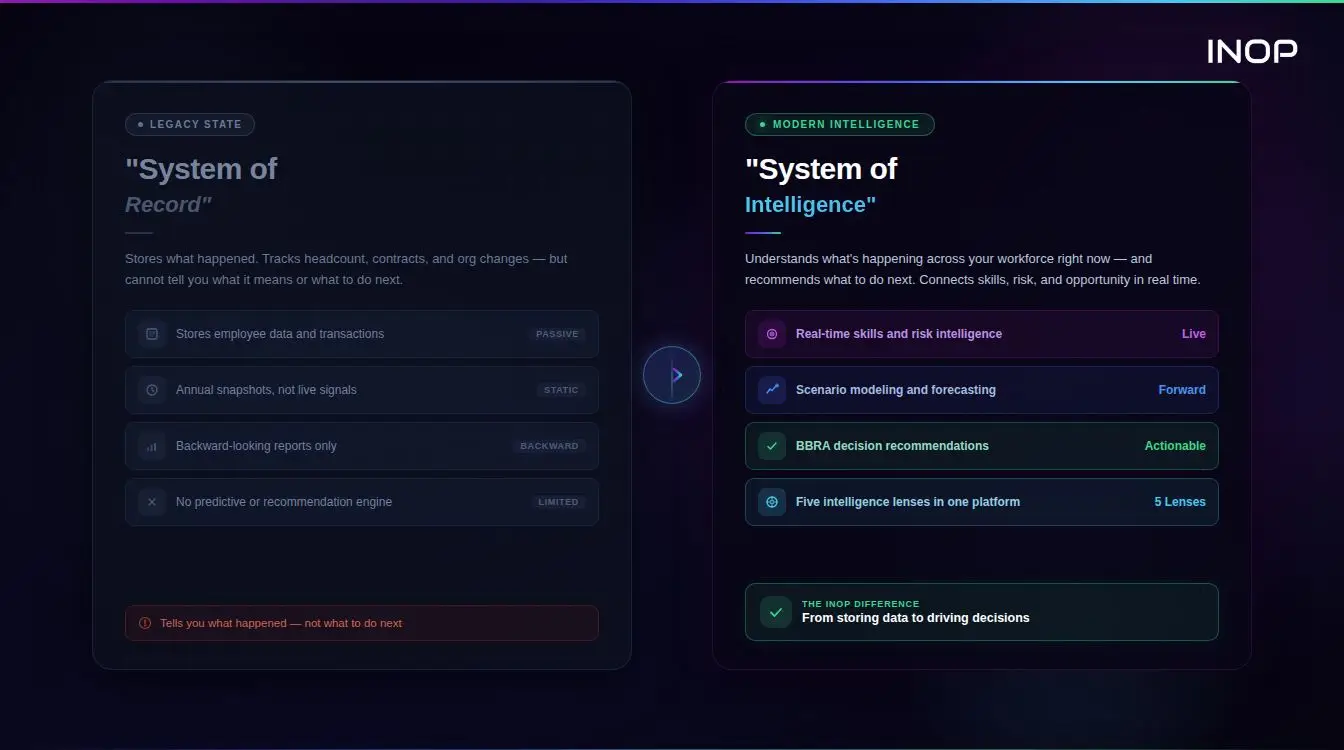
AI changes organisations one task at a time. Governance, however, continues to view organisations through static roles, functions, and departments. Closing this gap requires shifting from measuring static characteristics to observing dynamic organisational change. Data describes the organisation as it exists today; visibility explains how the organisation is changing and whether that change creates sustainable value.| Legacy Metrics (Lagging & Static) | Modern Visibility Indicators (Leading & Dynamic) |
|---|---|
| Headcount & FTE Counts | Task Automation vs. Capacity Realisation |
| Annual Turnover Rate | Workflow Friction & Handover Velocity |
| Training Hours Completed | Skills Gap Velocity & Workforce Adaptation |
| Software Licences Purchased | Active Task Integration & Capability Realignment |
Building a Governance Visibility Infrastructure
Closing the visibility gap is not about purchasing another HR platform or dashboard. It requires converting existing operational data into actionable governance intelligence. Workforce adaptation must be monitored with the same discipline applied to financial performance, operational risk, and cybersecurity. Just as boards expect timely reporting on financial exposure, they need continuous visibility into how automation is reshaping tasks, workflows, and capabilities. Ultimately, governance cannot depend solely on tracking technology deployment. It must explain how technology is reshaping the organisation and whether the workforce is adapting fast enough to sustain long-term value.Conclusion
Artificial intelligence is often presented as a technology challenge. Increasingly, it is a visibility challenge. Closing this gap requires organisations to rethink how they observe work, measure capability evolution, and govern adaptation. In the AI economy, competitive advantage will not belong simply to organisations that deploy AI. It will belong to organisations that can see how AI is transforming work while that transformation is taking place.Download the Complete Research Report
The Automation Accountability Gap
Explore the full research behind this article, including exclusive findings, executive frameworks, workforce impact analysis, and board-level recommendations for governing AI transformation.